Generalized nonsymmetric eigenproblem components: balancing, Hessenberg-triangular reduction, QZ iteration. More...
Functions/Subroutines | |
| pure subroutine, public | la_sggbak (job, side, n, ilo, ihi, lscale, rscale, m, v, ldv, info) |
| SGGBAK: forms the right or left eigenvectors of a real generalized eigenvalue problem A*x = lambda*B*x, by backward transformation on the computed eigenvectors of the balanced pair of matrices output by SGGBAL. | |
| pure subroutine, public | la_dggbak (job, side, n, ilo, ihi, lscale, rscale, m, v, ldv, info) |
| DGGBAK: forms the right or left eigenvectors of a real generalized eigenvalue problem A*x = lambda*B*x, by backward transformation on the computed eigenvectors of the balanced pair of matrices output by DGGBAL. | |
| pure subroutine, public | la_qggbak (job, side, n, ilo, ihi, lscale, rscale, m, v, ldv, info) |
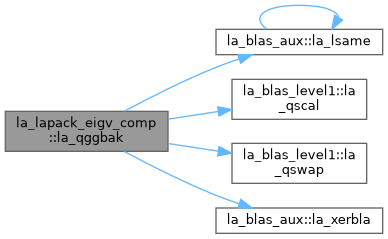
| QGGBAK: forms the right or left eigenvectors of a real generalized eigenvalue problem A*x = lambda*B*x, by backward transformation on the computed eigenvectors of the balanced pair of matrices output by QGGBAL. | |
| pure subroutine, public | la_sggbal (job, n, a, lda, b, ldb, ilo, ihi, lscale, rscale, work, info) |
| SGGBAL: balances a pair of general real matrices (A,B). This involves, first, permuting A and B by similarity transformations to isolate eigenvalues in the first 1 to ILO$-$1 and last IHI+1 to N elements on the diagonal; and second, applying a diagonal similarity transformation to rows and columns ILO to IHI to make the rows and columns as close in norm as possible. Both steps are optional. Balancing may reduce the 1-norm of the matrices, and improve the accuracy of the computed eigenvalues and/or eigenvectors in the generalized eigenvalue problem A*x = lambda*B*x. | |
| pure subroutine, public | la_dggbal (job, n, a, lda, b, ldb, ilo, ihi, lscale, rscale, work, info) |
| DGGBAL: balances a pair of general real matrices (A,B). This involves, first, permuting A and B by similarity transformations to isolate eigenvalues in the first 1 to ILO$-$1 and last IHI+1 to N elements on the diagonal; and second, applying a diagonal similarity transformation to rows and columns ILO to IHI to make the rows and columns as close in norm as possible. Both steps are optional. Balancing may reduce the 1-norm of the matrices, and improve the accuracy of the computed eigenvalues and/or eigenvectors in the generalized eigenvalue problem A*x = lambda*B*x. | |
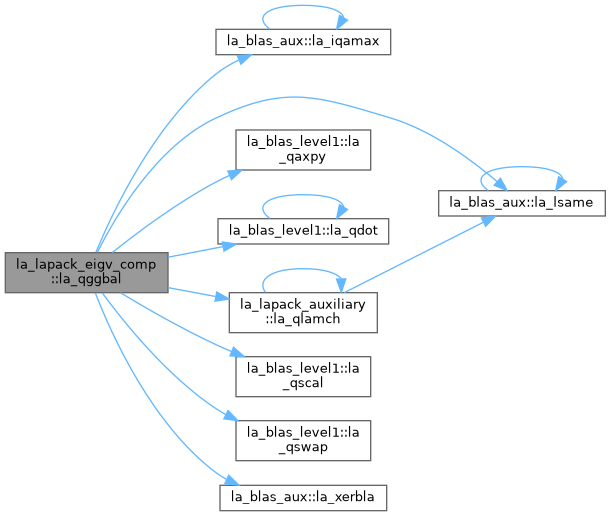
| pure subroutine, public | la_qggbal (job, n, a, lda, b, ldb, ilo, ihi, lscale, rscale, work, info) |
| QGGBAL: balances a pair of general real matrices (A,B). This involves, first, permuting A and B by similarity transformations to isolate eigenvalues in the first 1 to ILO$-$1 and last IHI+1 to N elements on the diagonal; and second, applying a diagonal similarity transformation to rows and columns ILO to IHI to make the rows and columns as close in norm as possible. Both steps are optional. Balancing may reduce the 1-norm of the matrices, and improve the accuracy of the computed eigenvalues and/or eigenvectors in the generalized eigenvalue problem A*x = lambda*B*x. | |
| pure subroutine, public | la_sgghrd (compq, compz, n, ilo, ihi, a, lda, b, ldb, q, ldq, z, ldz, info) |
| SGGHRD: reduces a pair of real matrices (A,B) to generalized upper Hessenberg form using orthogonal transformations, where A is a general matrix and B is upper triangular. The form of the generalized eigenvalue problem is A*x = lambda*B*x, and B is typically made upper triangular by computing its QR factorization and moving the orthogonal matrix Q to the left side of the equation. This subroutine simultaneously reduces A to a Hessenberg matrix H: Q**T*A*Z = H and transforms B to another upper triangular matrix T: Q**T*B*Z = T in order to reduce the problem to its standard form H*y = lambda*T*y where y = Z**T*x. The orthogonal matrices Q and Z are determined as products of Givens rotations. They may either be formed explicitly, or they may be postmultiplied into input matrices Q1 and Z1, so that Q1 * A * Z1**T = (Q1*Q) * H * (Z1*Z)**T Q1 * B * Z1**T = (Q1*Q) * T * (Z1*Z)**T If Q1 is the orthogonal matrix from the QR factorization of B in the original equation A*x = lambda*B*x, then SGGHRD reduces the original problem to generalized Hessenberg form. | |
| pure subroutine, public | la_dgghrd (compq, compz, n, ilo, ihi, a, lda, b, ldb, q, ldq, z, ldz, info) |
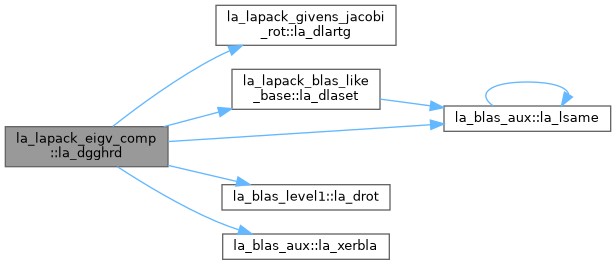
| DGGHRD: reduces a pair of real matrices (A,B) to generalized upper Hessenberg form using orthogonal transformations, where A is a general matrix and B is upper triangular. The form of the generalized eigenvalue problem is A*x = lambda*B*x, and B is typically made upper triangular by computing its QR factorization and moving the orthogonal matrix Q to the left side of the equation. This subroutine simultaneously reduces A to a Hessenberg matrix H: Q**T*A*Z = H and transforms B to another upper triangular matrix T: Q**T*B*Z = T in order to reduce the problem to its standard form H*y = lambda*T*y where y = Z**T*x. The orthogonal matrices Q and Z are determined as products of Givens rotations. They may either be formed explicitly, or they may be postmultiplied into input matrices Q1 and Z1, so that Q1 * A * Z1**T = (Q1*Q) * H * (Z1*Z)**T Q1 * B * Z1**T = (Q1*Q) * T * (Z1*Z)**T If Q1 is the orthogonal matrix from the QR factorization of B in the original equation A*x = lambda*B*x, then DGGHRD reduces the original problem to generalized Hessenberg form. | |
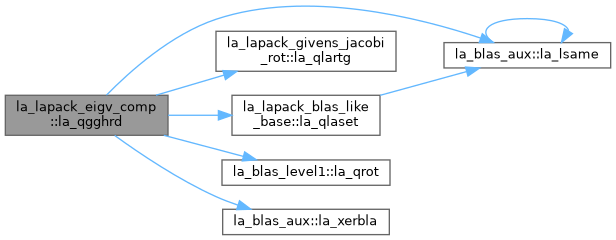
| pure subroutine, public | la_qgghrd (compq, compz, n, ilo, ihi, a, lda, b, ldb, q, ldq, z, ldz, info) |
| QGGHRD: reduces a pair of real matrices (A,B) to generalized upper Hessenberg form using orthogonal transformations, where A is a general matrix and B is upper triangular. The form of the generalized eigenvalue problem is A*x = lambda*B*x, and B is typically made upper triangular by computing its QR factorization and moving the orthogonal matrix Q to the left side of the equation. This subroutine simultaneously reduces A to a Hessenberg matrix H: Q**T*A*Z = H and transforms B to another upper triangular matrix T: Q**T*B*Z = T in order to reduce the problem to its standard form H*y = lambda*T*y where y = Z**T*x. The orthogonal matrices Q and Z are determined as products of Givens rotations. They may either be formed explicitly, or they may be postmultiplied into input matrices Q1 and Z1, so that Q1 * A * Z1**T = (Q1*Q) * H * (Z1*Z)**T Q1 * B * Z1**T = (Q1*Q) * T * (Z1*Z)**T If Q1 is the orthogonal matrix from the QR factorization of B in the original equation A*x = lambda*B*x, then QGGHRD reduces the original problem to generalized Hessenberg form. | |
| pure subroutine, public | la_sgghd3 (compq, compz, n, ilo, ihi, a, lda, b, ldb, q, ldq, z, ldz, work, lwork, info) |
| SGGHD3: reduces a pair of real matrices (A,B) to generalized upper Hessenberg form using orthogonal transformations, where A is a general matrix and B is upper triangular. The form of the generalized eigenvalue problem is A*x = lambda*B*x, and B is typically made upper triangular by computing its QR factorization and moving the orthogonal matrix Q to the left side of the equation. This subroutine simultaneously reduces A to a Hessenberg matrix H: Q**T*A*Z = H and transforms B to another upper triangular matrix T: Q**T*B*Z = T in order to reduce the problem to its standard form H*y = lambda*T*y where y = Z**T*x. The orthogonal matrices Q and Z are determined as products of Givens rotations. They may either be formed explicitly, or they may be postmultiplied into input matrices Q1 and Z1, so that Q1 * A * Z1**T = (Q1*Q) * H * (Z1*Z)**T Q1 * B * Z1**T = (Q1*Q) * T * (Z1*Z)**T If Q1 is the orthogonal matrix from the QR factorization of B in the original equation A*x = lambda*B*x, then SGGHD3 reduces the original problem to generalized Hessenberg form. This is a blocked variant of SGGHRD, using matrix-matrix multiplications for parts of the computation to enhance performance. | |
| pure subroutine, public | la_dgghd3 (compq, compz, n, ilo, ihi, a, lda, b, ldb, q, ldq, z, ldz, work, lwork, info) |
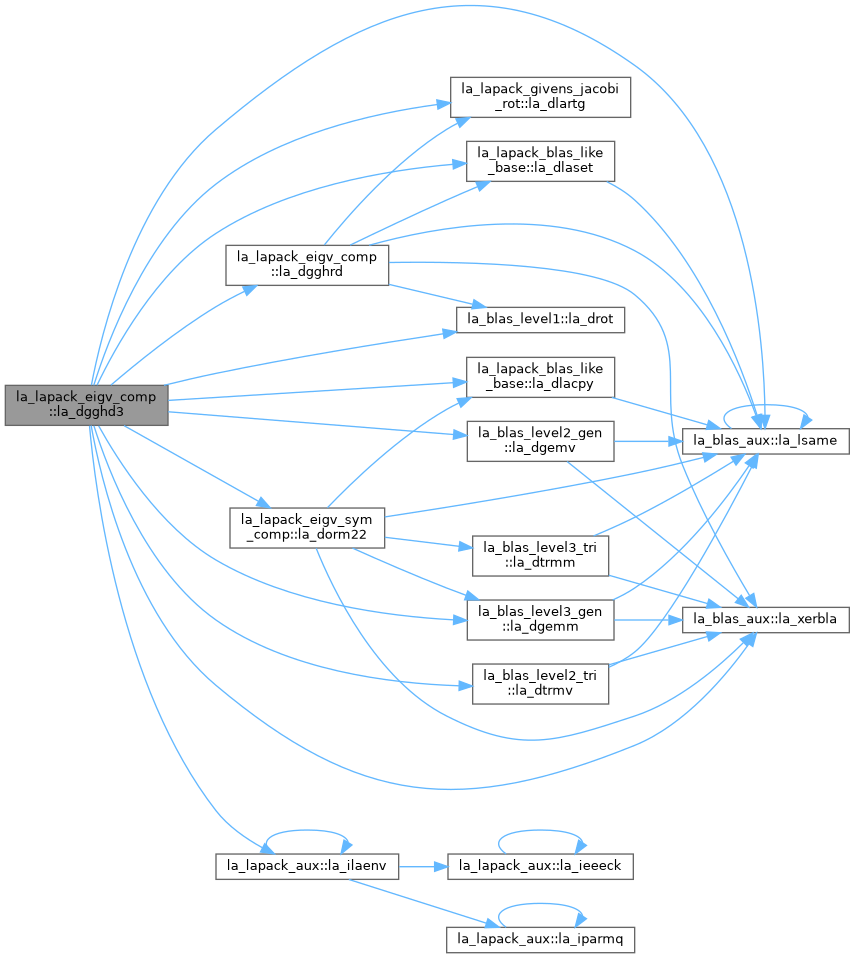
| DGGHD3: reduces a pair of real matrices (A,B) to generalized upper Hessenberg form using orthogonal transformations, where A is a general matrix and B is upper triangular. The form of the generalized eigenvalue problem is A*x = lambda*B*x, and B is typically made upper triangular by computing its QR factorization and moving the orthogonal matrix Q to the left side of the equation. This subroutine simultaneously reduces A to a Hessenberg matrix H: Q**T*A*Z = H and transforms B to another upper triangular matrix T: Q**T*B*Z = T in order to reduce the problem to its standard form H*y = lambda*T*y where y = Z**T*x. The orthogonal matrices Q and Z are determined as products of Givens rotations. They may either be formed explicitly, or they may be postmultiplied into input matrices Q1 and Z1, so that Q1 * A * Z1**T = (Q1*Q) * H * (Z1*Z)**T Q1 * B * Z1**T = (Q1*Q) * T * (Z1*Z)**T If Q1 is the orthogonal matrix from the QR factorization of B in the original equation A*x = lambda*B*x, then DGGHD3 reduces the original problem to generalized Hessenberg form. This is a blocked variant of DGGHRD, using matrix-matrix multiplications for parts of the computation to enhance performance. | |
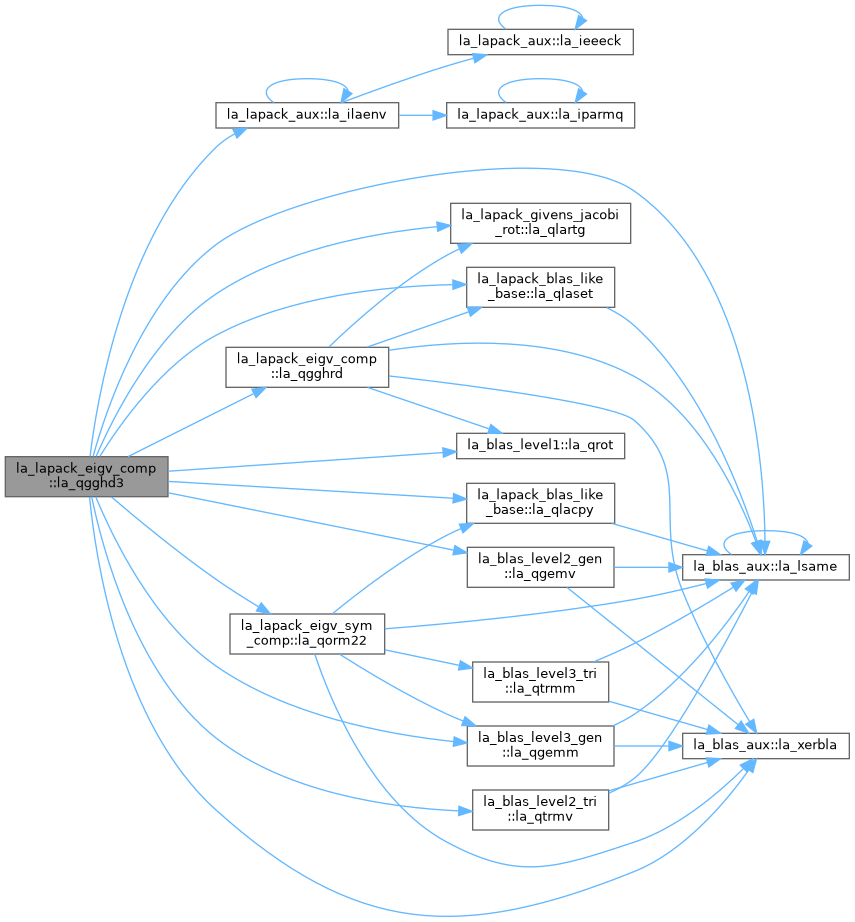
| pure subroutine, public | la_qgghd3 (compq, compz, n, ilo, ihi, a, lda, b, ldb, q, ldq, z, ldz, work, lwork, info) |
| QGGHD3: reduces a pair of real matrices (A,B) to generalized upper Hessenberg form using orthogonal transformations, where A is a general matrix and B is upper triangular. The form of the generalized eigenvalue problem is A*x = lambda*B*x, and B is typically made upper triangular by computing its QR factorization and moving the orthogonal matrix Q to the left side of the equation. This subroutine simultaneously reduces A to a Hessenberg matrix H: Q**T*A*Z = H and transforms B to another upper triangular matrix T: Q**T*B*Z = T in order to reduce the problem to its standard form H*y = lambda*T*y where y = Z**T*x. The orthogonal matrices Q and Z are determined as products of Givens rotations. They may either be formed explicitly, or they may be postmultiplied into input matrices Q1 and Z1, so that Q1 * A * Z1**T = (Q1*Q) * H * (Z1*Z)**T Q1 * B * Z1**T = (Q1*Q) * T * (Z1*Z)**T If Q1 is the orthogonal matrix from the QR factorization of B in the original equation A*x = lambda*B*x, then QGGHD3 reduces the original problem to generalized Hessenberg form. This is a blocked variant of QGGHRD, using matrix-matrix multiplications for parts of the computation to enhance performance. | |
| subroutine, public | la_shgeqz (job, compq, compz, n, ilo, ihi, h, ldh, t, ldt, alphar, alphai, beta, q, ldq, z, ldz, work, lwork, info) |
| SHGEQZ: computes the eigenvalues of a real matrix pair (H,T), where H is an upper Hessenberg matrix and T is upper triangular, using the double-shift QZ method. Matrix pairs of this type are produced by the reduction to generalized upper Hessenberg form of a real matrix pair (A,B): A = Q1*H*Z1**T, B = Q1*T*Z1**T, as computed by SGGHRD. If JOB='S', then the Hessenberg-triangular pair (H,T) is also reduced to generalized Schur form, H = Q*S*Z**T, T = Q*P*Z**T, where Q and Z are orthogonal matrices, P is an upper triangular matrix, and S is a quasi-triangular matrix with 1-by-1 and 2-by-2 diagonal blocks. The 1-by-1 blocks correspond to real eigenvalues of the matrix pair (H,T) and the 2-by-2 blocks correspond to complex conjugate pairs of eigenvalues. Additionally, the 2-by-2 upper triangular diagonal blocks of P corresponding to 2-by-2 blocks of S are reduced to positive diagonal form, i.e., if S(j+1,j) is non-zero, then P(j+1,j) = P(j,j+1) = 0, P(j,j) > 0, and P(j+1,j+1) > 0. Optionally, the orthogonal matrix Q from the generalized Schur factorization may be postmultiplied into an input matrix Q1, and the orthogonal matrix Z may be postmultiplied into an input matrix Z1. If Q1 and Z1 are the orthogonal matrices from SGGHRD that reduced the matrix pair (A,B) to generalized upper Hessenberg form, then the output matrices Q1*Q and Z1*Z are the orthogonal factors from the generalized Schur factorization of (A,B): A = (Q1*Q)*S*(Z1*Z)**T, B = (Q1*Q)*P*(Z1*Z)**T. To avoid overflow, eigenvalues of the matrix pair (H,T) (equivalently, of (A,B)) are computed as a pair of values (alpha,beta), where alpha is complex and beta real. If beta is nonzero, lambda = alpha / beta is an eigenvalue of the generalized nonsymmetric eigenvalue problem (GNEP) A*x = lambda*B*x and if alpha is nonzero, mu = beta / alpha is an eigenvalue of the alternate form of the GNEP mu*A*y = B*y. Real eigenvalues can be read directly from the generalized Schur form: alpha = S(i,i), beta = P(i,i). Ref: C.B. Moler Eigenvalue Problems", SIAM J. Numer. Anal., 10(1973), pp. 241–256. | |
| subroutine, public | la_dhgeqz (job, compq, compz, n, ilo, ihi, h, ldh, t, ldt, alphar, alphai, beta, q, ldq, z, ldz, work, lwork, info) |
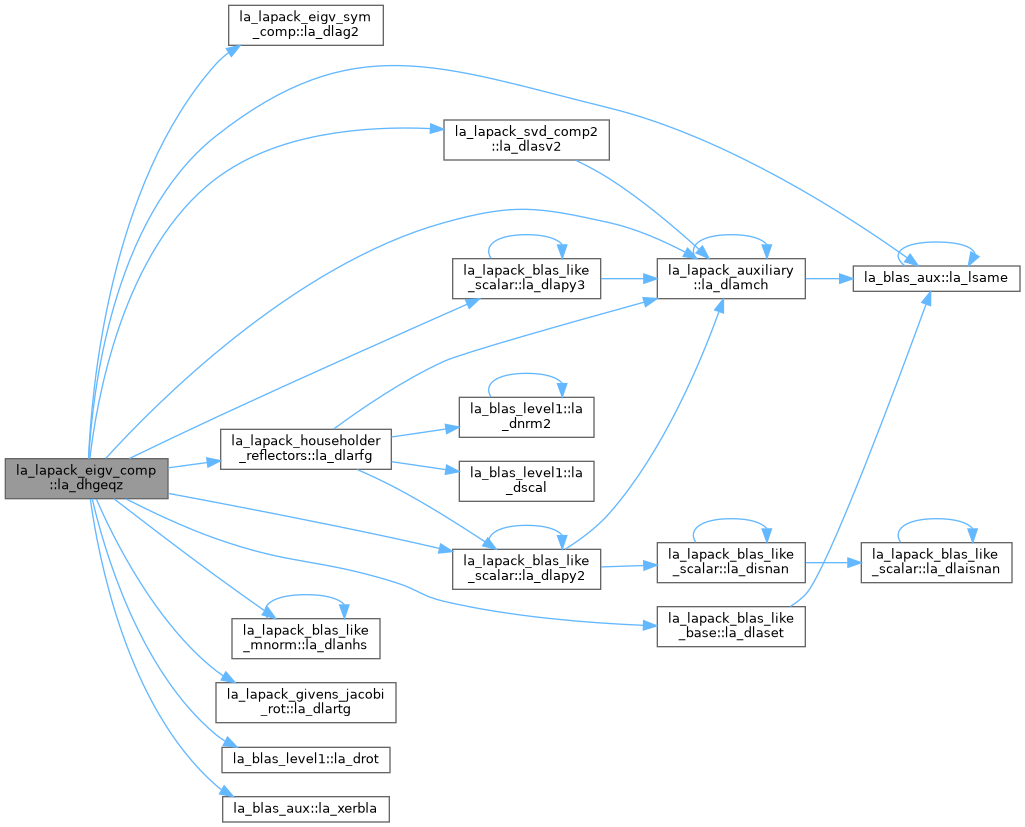
| DHGEQZ: computes the eigenvalues of a real matrix pair (H,T), where H is an upper Hessenberg matrix and T is upper triangular, using the double-shift QZ method. Matrix pairs of this type are produced by the reduction to generalized upper Hessenberg form of a real matrix pair (A,B): A = Q1*H*Z1**T, B = Q1*T*Z1**T, as computed by DGGHRD. If JOB='S', then the Hessenberg-triangular pair (H,T) is also reduced to generalized Schur form, H = Q*S*Z**T, T = Q*P*Z**T, where Q and Z are orthogonal matrices, P is an upper triangular matrix, and S is a quasi-triangular matrix with 1-by-1 and 2-by-2 diagonal blocks. The 1-by-1 blocks correspond to real eigenvalues of the matrix pair (H,T) and the 2-by-2 blocks correspond to complex conjugate pairs of eigenvalues. Additionally, the 2-by-2 upper triangular diagonal blocks of P corresponding to 2-by-2 blocks of S are reduced to positive diagonal form, i.e., if S(j+1,j) is non-zero, then P(j+1,j) = P(j,j+1) = 0, P(j,j) > 0, and P(j+1,j+1) > 0. Optionally, the orthogonal matrix Q from the generalized Schur factorization may be postmultiplied into an input matrix Q1, and the orthogonal matrix Z may be postmultiplied into an input matrix Z1. If Q1 and Z1 are the orthogonal matrices from DGGHRD that reduced the matrix pair (A,B) to generalized upper Hessenberg form, then the output matrices Q1*Q and Z1*Z are the orthogonal factors from the generalized Schur factorization of (A,B): A = (Q1*Q)*S*(Z1*Z)**T, B = (Q1*Q)*P*(Z1*Z)**T. To avoid overflow, eigenvalues of the matrix pair (H,T) (equivalently, of (A,B)) are computed as a pair of values (alpha,beta), where alpha is complex and beta real. If beta is nonzero, lambda = alpha / beta is an eigenvalue of the generalized nonsymmetric eigenvalue problem (GNEP) A*x = lambda*B*x and if alpha is nonzero, mu = beta / alpha is an eigenvalue of the alternate form of the GNEP mu*A*y = B*y. Real eigenvalues can be read directly from the generalized Schur form: alpha = S(i,i), beta = P(i,i). Ref: C.B. Moler Eigenvalue Problems", SIAM J. Numer. Anal., 10(1973), pp. 241–256. | |
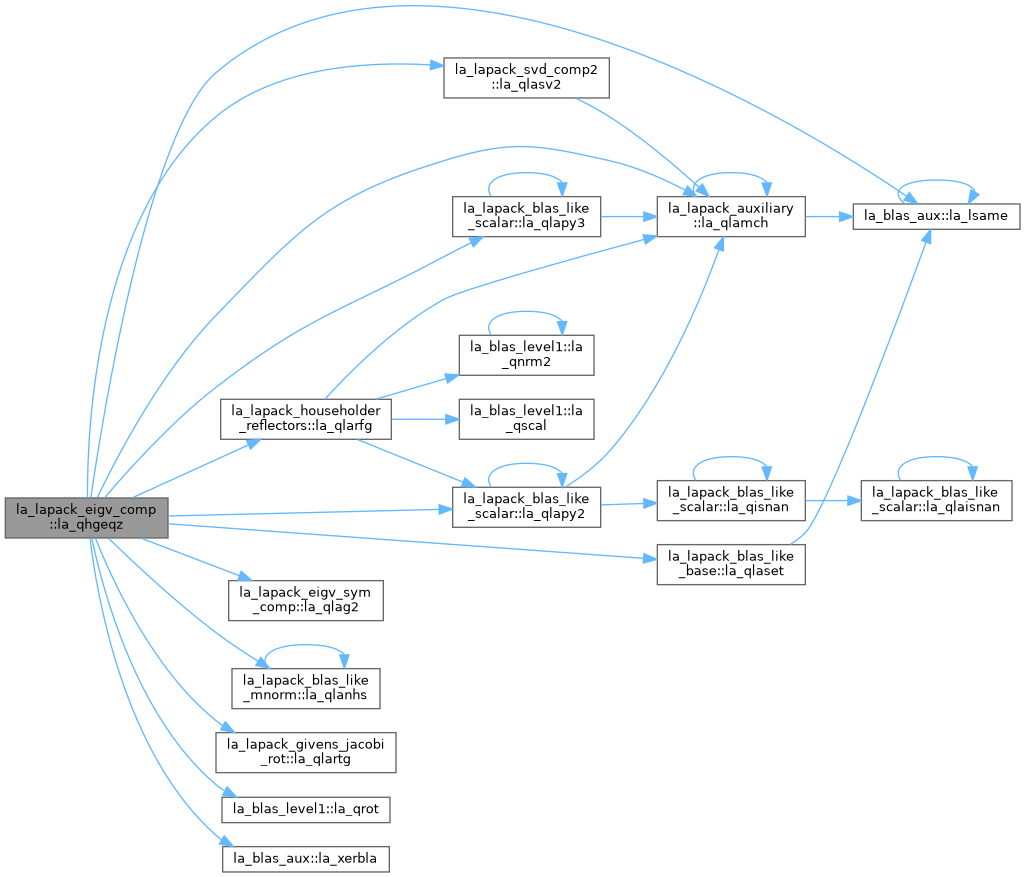
| subroutine, public | la_qhgeqz (job, compq, compz, n, ilo, ihi, h, ldh, t, ldt, alphar, alphai, beta, q, ldq, z, ldz, work, lwork, info) |
| QHGEQZ: computes the eigenvalues of a real matrix pair (H,T), where H is an upper Hessenberg matrix and T is upper triangular, using the double-shift QZ method. Matrix pairs of this type are produced by the reduction to generalized upper Hessenberg form of a real matrix pair (A,B): A = Q1*H*Z1**T, B = Q1*T*Z1**T, as computed by QGGHRD. If JOB='S', then the Hessenberg-triangular pair (H,T) is also reduced to generalized Schur form, H = Q*S*Z**T, T = Q*P*Z**T, where Q and Z are orthogonal matrices, P is an upper triangular matrix, and S is a quasi-triangular matrix with 1-by-1 and 2-by-2 diagonal blocks. The 1-by-1 blocks correspond to real eigenvalues of the matrix pair (H,T) and the 2-by-2 blocks correspond to complex conjugate pairs of eigenvalues. Additionally, the 2-by-2 upper triangular diagonal blocks of P corresponding to 2-by-2 blocks of S are reduced to positive diagonal form, i.e., if S(j+1,j) is non-zero, then P(j+1,j) = P(j,j+1) = 0, P(j,j) > 0, and P(j+1,j+1) > 0. Optionally, the orthogonal matrix Q from the generalized Schur factorization may be postmultiplied into an input matrix Q1, and the orthogonal matrix Z may be postmultiplied into an input matrix Z1. If Q1 and Z1 are the orthogonal matrices from QGGHRD that reduced the matrix pair (A,B) to generalized upper Hessenberg form, then the output matrices Q1*Q and Z1*Z are the orthogonal factors from the generalized Schur factorization of (A,B): A = (Q1*Q)*S*(Z1*Z)**T, B = (Q1*Q)*P*(Z1*Z)**T. To avoid overflow, eigenvalues of the matrix pair (H,T) (equivalently, of (A,B)) are computed as a pair of values (alpha,beta), where alpha is complex and beta real. If beta is nonzero, lambda = alpha / beta is an eigenvalue of the generalized nonsymmetric eigenvalue problem (GNEP) A*x = lambda*B*x and if alpha is nonzero, mu = beta / alpha is an eigenvalue of the alternate form of the GNEP mu*A*y = B*y. Real eigenvalues can be read directly from the generalized Schur form: alpha = S(i,i), beta = P(i,i). Ref: C.B. Moler Eigenvalue Problems", SIAM J. Numer. Anal., 10(1973), pp. 241–256. | |
| pure subroutine, public | la_cggbak (job, side, n, ilo, ihi, lscale, rscale, m, v, ldv, info) |
| CGGBAK: forms the right or left eigenvectors of a complex generalized eigenvalue problem A*x = lambda*B*x, by backward transformation on the computed eigenvectors of the balanced pair of matrices output by CGGBAL. | |
| pure subroutine, public | la_zggbak (job, side, n, ilo, ihi, lscale, rscale, m, v, ldv, info) |
| ZGGBAK: forms the right or left eigenvectors of a complex generalized eigenvalue problem A*x = lambda*B*x, by backward transformation on the computed eigenvectors of the balanced pair of matrices output by ZGGBAL. | |
| pure subroutine, public | la_wggbak (job, side, n, ilo, ihi, lscale, rscale, m, v, ldv, info) |
| WGGBAK: forms the right or left eigenvectors of a complex generalized eigenvalue problem A*x = lambda*B*x, by backward transformation on the computed eigenvectors of the balanced pair of matrices output by WGGBAL. | |
| pure subroutine, public | la_cggbal (job, n, a, lda, b, ldb, ilo, ihi, lscale, rscale, work, info) |
| CGGBAL: balances a pair of general complex matrices (A,B). This involves, first, permuting A and B by similarity transformations to isolate eigenvalues in the first 1 to ILO$-$1 and last IHI+1 to N elements on the diagonal; and second, applying a diagonal similarity transformation to rows and columns ILO to IHI to make the rows and columns as close in norm as possible. Both steps are optional. Balancing may reduce the 1-norm of the matrices, and improve the accuracy of the computed eigenvalues and/or eigenvectors in the generalized eigenvalue problem A*x = lambda*B*x. | |
| pure subroutine, public | la_zggbal (job, n, a, lda, b, ldb, ilo, ihi, lscale, rscale, work, info) |
| ZGGBAL: balances a pair of general complex matrices (A,B). This involves, first, permuting A and B by similarity transformations to isolate eigenvalues in the first 1 to ILO$-$1 and last IHI+1 to N elements on the diagonal; and second, applying a diagonal similarity transformation to rows and columns ILO to IHI to make the rows and columns as close in norm as possible. Both steps are optional. Balancing may reduce the 1-norm of the matrices, and improve the accuracy of the computed eigenvalues and/or eigenvectors in the generalized eigenvalue problem A*x = lambda*B*x. | |
| pure subroutine, public | la_wggbal (job, n, a, lda, b, ldb, ilo, ihi, lscale, rscale, work, info) |
| WGGBAL: balances a pair of general complex matrices (A,B). This involves, first, permuting A and B by similarity transformations to isolate eigenvalues in the first 1 to ILO$-$1 and last IHI+1 to N elements on the diagonal; and second, applying a diagonal similarity transformation to rows and columns ILO to IHI to make the rows and columns as close in norm as possible. Both steps are optional. Balancing may reduce the 1-norm of the matrices, and improve the accuracy of the computed eigenvalues and/or eigenvectors in the generalized eigenvalue problem A*x = lambda*B*x. | |
| pure subroutine, public | la_cgghrd (compq, compz, n, ilo, ihi, a, lda, b, ldb, q, ldq, z, ldz, info) |
| CGGHRD: reduces a pair of complex matrices (A,B) to generalized upper Hessenberg form using unitary transformations, where A is a general matrix and B is upper triangular. The form of the generalized eigenvalue problem is A*x = lambda*B*x, and B is typically made upper triangular by computing its QR factorization and moving the unitary matrix Q to the left side of the equation. This subroutine simultaneously reduces A to a Hessenberg matrix H: Q**H*A*Z = H and transforms B to another upper triangular matrix T: Q**H*B*Z = T in order to reduce the problem to its standard form H*y = lambda*T*y where y = Z**H*x. The unitary matrices Q and Z are determined as products of Givens rotations. They may either be formed explicitly, or they may be postmultiplied into input matrices Q1 and Z1, so that Q1 * A * Z1**H = (Q1*Q) * H * (Z1*Z)**H Q1 * B * Z1**H = (Q1*Q) * T * (Z1*Z)**H If Q1 is the unitary matrix from the QR factorization of B in the original equation A*x = lambda*B*x, then CGGHRD reduces the original problem to generalized Hessenberg form. | |
| pure subroutine, public | la_zgghrd (compq, compz, n, ilo, ihi, a, lda, b, ldb, q, ldq, z, ldz, info) |
| ZGGHRD: reduces a pair of complex matrices (A,B) to generalized upper Hessenberg form using unitary transformations, where A is a general matrix and B is upper triangular. The form of the generalized eigenvalue problem is A*x = lambda*B*x, and B is typically made upper triangular by computing its QR factorization and moving the unitary matrix Q to the left side of the equation. This subroutine simultaneously reduces A to a Hessenberg matrix H: Q**H*A*Z = H and transforms B to another upper triangular matrix T: Q**H*B*Z = T in order to reduce the problem to its standard form H*y = lambda*T*y where y = Z**H*x. The unitary matrices Q and Z are determined as products of Givens rotations. They may either be formed explicitly, or they may be postmultiplied into input matrices Q1 and Z1, so that Q1 * A * Z1**H = (Q1*Q) * H * (Z1*Z)**H Q1 * B * Z1**H = (Q1*Q) * T * (Z1*Z)**H If Q1 is the unitary matrix from the QR factorization of B in the original equation A*x = lambda*B*x, then ZGGHRD reduces the original problem to generalized Hessenberg form. | |
| pure subroutine, public | la_wgghrd (compq, compz, n, ilo, ihi, a, lda, b, ldb, q, ldq, z, ldz, info) |
| WGGHRD: reduces a pair of complex matrices (A,B) to generalized upper Hessenberg form using unitary transformations, where A is a general matrix and B is upper triangular. The form of the generalized eigenvalue problem is A*x = lambda*B*x, and B is typically made upper triangular by computing its QR factorization and moving the unitary matrix Q to the left side of the equation. This subroutine simultaneously reduces A to a Hessenberg matrix H: Q**H*A*Z = H and transforms B to another upper triangular matrix T: Q**H*B*Z = T in order to reduce the problem to its standard form H*y = lambda*T*y where y = Z**H*x. The unitary matrices Q and Z are determined as products of Givens rotations. They may either be formed explicitly, or they may be postmultiplied into input matrices Q1 and Z1, so that Q1 * A * Z1**H = (Q1*Q) * H * (Z1*Z)**H Q1 * B * Z1**H = (Q1*Q) * T * (Z1*Z)**H If Q1 is the unitary matrix from the QR factorization of B in the original equation A*x = lambda*B*x, then WGGHRD reduces the original problem to generalized Hessenberg form. | |
| pure subroutine, public | la_cgghd3 (compq, compz, n, ilo, ihi, a, lda, b, ldb, q, ldq, z, ldz, work, lwork, info) |
| CGGHD3: reduces a pair of complex matrices (A,B) to generalized upper Hessenberg form using unitary transformations, where A is a general matrix and B is upper triangular. The form of the generalized eigenvalue problem is A*x = lambda*B*x, and B is typically made upper triangular by computing its QR factorization and moving the unitary matrix Q to the left side of the equation. This subroutine simultaneously reduces A to a Hessenberg matrix H: Q**H*A*Z = H and transforms B to another upper triangular matrix T: Q**H*B*Z = T in order to reduce the problem to its standard form H*y = lambda*T*y where y = Z**H*x. The unitary matrices Q and Z are determined as products of Givens rotations. They may either be formed explicitly, or they may be postmultiplied into input matrices Q1 and Z1, so that Q1 * A * Z1**H = (Q1*Q) * H * (Z1*Z)**H Q1 * B * Z1**H = (Q1*Q) * T * (Z1*Z)**H If Q1 is the unitary matrix from the QR factorization of B in the original equation A*x = lambda*B*x, then CGGHD3 reduces the original problem to generalized Hessenberg form. This is a blocked variant of CGGHRD, using matrix-matrix multiplications for parts of the computation to enhance performance. | |
| pure subroutine, public | la_zgghd3 (compq, compz, n, ilo, ihi, a, lda, b, ldb, q, ldq, z, ldz, work, lwork, info) |
| ZGGHD3: reduces a pair of complex matrices (A,B) to generalized upper Hessenberg form using unitary transformations, where A is a general matrix and B is upper triangular. The form of the generalized eigenvalue problem is A*x = lambda*B*x, and B is typically made upper triangular by computing its QR factorization and moving the unitary matrix Q to the left side of the equation. This subroutine simultaneously reduces A to a Hessenberg matrix H: Q**H*A*Z = H and transforms B to another upper triangular matrix T: Q**H*B*Z = T in order to reduce the problem to its standard form H*y = lambda*T*y where y = Z**H*x. The unitary matrices Q and Z are determined as products of Givens rotations. They may either be formed explicitly, or they may be postmultiplied into input matrices Q1 and Z1, so that Q1 * A * Z1**H = (Q1*Q) * H * (Z1*Z)**H Q1 * B * Z1**H = (Q1*Q) * T * (Z1*Z)**H If Q1 is the unitary matrix from the QR factorization of B in the original equation A*x = lambda*B*x, then ZGGHD3 reduces the original problem to generalized Hessenberg form. This is a blocked variant of CGGHRD, using matrix-matrix multiplications for parts of the computation to enhance performance. | |
| pure subroutine, public | la_wgghd3 (compq, compz, n, ilo, ihi, a, lda, b, ldb, q, ldq, z, ldz, work, lwork, info) |
| WGGHD3: reduces a pair of complex matrices (A,B) to generalized upper Hessenberg form using unitary transformations, where A is a general matrix and B is upper triangular. The form of the generalized eigenvalue problem is A*x = lambda*B*x, and B is typically made upper triangular by computing its QR factorization and moving the unitary matrix Q to the left side of the equation. This subroutine simultaneously reduces A to a Hessenberg matrix H: Q**H*A*Z = H and transforms B to another upper triangular matrix T: Q**H*B*Z = T in order to reduce the problem to its standard form H*y = lambda*T*y where y = Z**H*x. The unitary matrices Q and Z are determined as products of Givens rotations. They may either be formed explicitly, or they may be postmultiplied into input matrices Q1 and Z1, so that Q1 * A * Z1**H = (Q1*Q) * H * (Z1*Z)**H Q1 * B * Z1**H = (Q1*Q) * T * (Z1*Z)**H If Q1 is the unitary matrix from the QR factorization of B in the original equation A*x = lambda*B*x, then WGGHD3 reduces the original problem to generalized Hessenberg form. This is a blocked variant of ZGGHRD, using matrix-matrix multiplications for parts of the computation to enhance performance. | |
| subroutine, public | la_chgeqz (job, compq, compz, n, ilo, ihi, h, ldh, t, ldt, alpha, beta, q, ldq, z, ldz, work, lwork, rwork, info) |
| CHGEQZ: computes the eigenvalues of a complex matrix pair (H,T), where H is an upper Hessenberg matrix and T is upper triangular, using the single-shift QZ method. Matrix pairs of this type are produced by the reduction to generalized upper Hessenberg form of a complex matrix pair (A,B): A = Q1*H*Z1**H, B = Q1*T*Z1**H, as computed by CGGHRD. If JOB='S', then the Hessenberg-triangular pair (H,T) is also reduced to generalized Schur form, H = Q*S*Z**H, T = Q*P*Z**H, where Q and Z are unitary matrices and S and P are upper triangular. Optionally, the unitary matrix Q from the generalized Schur factorization may be postmultiplied into an input matrix Q1, and the unitary matrix Z may be postmultiplied into an input matrix Z1. If Q1 and Z1 are the unitary matrices from CGGHRD that reduced the matrix pair (A,B) to generalized Hessenberg form, then the output matrices Q1*Q and Z1*Z are the unitary factors from the generalized Schur factorization of (A,B): A = (Q1*Q)*S*(Z1*Z)**H, B = (Q1*Q)*P*(Z1*Z)**H. To avoid overflow, eigenvalues of the matrix pair (H,T) (equivalently, of (A,B)) are computed as a pair of complex values (alpha,beta). If beta is nonzero, lambda = alpha / beta is an eigenvalue of the generalized nonsymmetric eigenvalue problem (GNEP) A*x = lambda*B*x and if alpha is nonzero, mu = beta / alpha is an eigenvalue of the alternate form of the GNEP mu*A*y = B*y. The values of alpha and beta for the i-th eigenvalue can be read directly from the generalized Schur form: alpha = S(i,i), beta = P(i,i). Ref: C.B. Moler Eigenvalue Problems", SIAM J. Numer. Anal., 10(1973), pp. 241–256. | |
| subroutine, public | la_zhgeqz (job, compq, compz, n, ilo, ihi, h, ldh, t, ldt, alpha, beta, q, ldq, z, ldz, work, lwork, rwork, info) |
| ZHGEQZ: computes the eigenvalues of a complex matrix pair (H,T), where H is an upper Hessenberg matrix and T is upper triangular, using the single-shift QZ method. Matrix pairs of this type are produced by the reduction to generalized upper Hessenberg form of a complex matrix pair (A,B): A = Q1*H*Z1**H, B = Q1*T*Z1**H, as computed by ZGGHRD. If JOB='S', then the Hessenberg-triangular pair (H,T) is also reduced to generalized Schur form, H = Q*S*Z**H, T = Q*P*Z**H, where Q and Z are unitary matrices and S and P are upper triangular. Optionally, the unitary matrix Q from the generalized Schur factorization may be postmultiplied into an input matrix Q1, and the unitary matrix Z may be postmultiplied into an input matrix Z1. If Q1 and Z1 are the unitary matrices from ZGGHRD that reduced the matrix pair (A,B) to generalized Hessenberg form, then the output matrices Q1*Q and Z1*Z are the unitary factors from the generalized Schur factorization of (A,B): A = (Q1*Q)*S*(Z1*Z)**H, B = (Q1*Q)*P*(Z1*Z)**H. To avoid overflow, eigenvalues of the matrix pair (H,T) (equivalently, of (A,B)) are computed as a pair of complex values (alpha,beta). If beta is nonzero, lambda = alpha / beta is an eigenvalue of the generalized nonsymmetric eigenvalue problem (GNEP) A*x = lambda*B*x and if alpha is nonzero, mu = beta / alpha is an eigenvalue of the alternate form of the GNEP mu*A*y = B*y. The values of alpha and beta for the i-th eigenvalue can be read directly from the generalized Schur form: alpha = S(i,i), beta = P(i,i). Ref: C.B. Moler Eigenvalue Problems", SIAM J. Numer. Anal., 10(1973), pp. 241–256. | |
| subroutine, public | la_whgeqz (job, compq, compz, n, ilo, ihi, h, ldh, t, ldt, alpha, beta, q, ldq, z, ldz, work, lwork, rwork, info) |
| WHGEQZ: computes the eigenvalues of a complex matrix pair (H,T), where H is an upper Hessenberg matrix and T is upper triangular, using the single-shift QZ method. Matrix pairs of this type are produced by the reduction to generalized upper Hessenberg form of a complex matrix pair (A,B): A = Q1*H*Z1**H, B = Q1*T*Z1**H, as computed by WGGHRD. If JOB='S', then the Hessenberg-triangular pair (H,T) is also reduced to generalized Schur form, H = Q*S*Z**H, T = Q*P*Z**H, where Q and Z are unitary matrices and S and P are upper triangular. Optionally, the unitary matrix Q from the generalized Schur factorization may be postmultiplied into an input matrix Q1, and the unitary matrix Z may be postmultiplied into an input matrix Z1. If Q1 and Z1 are the unitary matrices from WGGHRD that reduced the matrix pair (A,B) to generalized Hessenberg form, then the output matrices Q1*Q and Z1*Z are the unitary factors from the generalized Schur factorization of (A,B): A = (Q1*Q)*S*(Z1*Z)**H, B = (Q1*Q)*P*(Z1*Z)**H. To avoid overflow, eigenvalues of the matrix pair (H,T) (equivalently, of (A,B)) are computed as a pair of complex values (alpha,beta). If beta is nonzero, lambda = alpha / beta is an eigenvalue of the generalized nonsymmetric eigenvalue problem (GNEP) A*x = lambda*B*x and if alpha is nonzero, mu = beta / alpha is an eigenvalue of the alternate form of the GNEP mu*A*y = B*y. The values of alpha and beta for the i-th eigenvalue can be read directly from the generalized Schur form: alpha = S(i,i), beta = P(i,i). Ref: C.B. Moler Eigenvalue Problems", SIAM J. Numer. Anal., 10(1973), pp. 241–256. | |
Detailed Description
Generalized nonsymmetric eigenproblem components: balancing, Hessenberg-triangular reduction, QZ iteration.
Function/Subroutine Documentation
◆ la_cggbak()
| pure subroutine, public la_lapack_eigv_comp::la_cggbak | ( | character, intent(in) | job, |
| character, intent(in) | side, | ||
| integer(ilp), intent(in) | n, | ||
| integer(ilp), intent(in) | ilo, | ||
| integer(ilp), intent(in) | ihi, | ||
| real(sp), dimension(*), intent(in) | lscale, | ||
| real(sp), dimension(*), intent(in) | rscale, | ||
| integer(ilp), intent(in) | m, | ||
| complex(sp), dimension(ldv,*), intent(inout) | v, | ||
| integer(ilp), intent(in) | ldv, | ||
| integer(ilp), intent(out) | info ) |
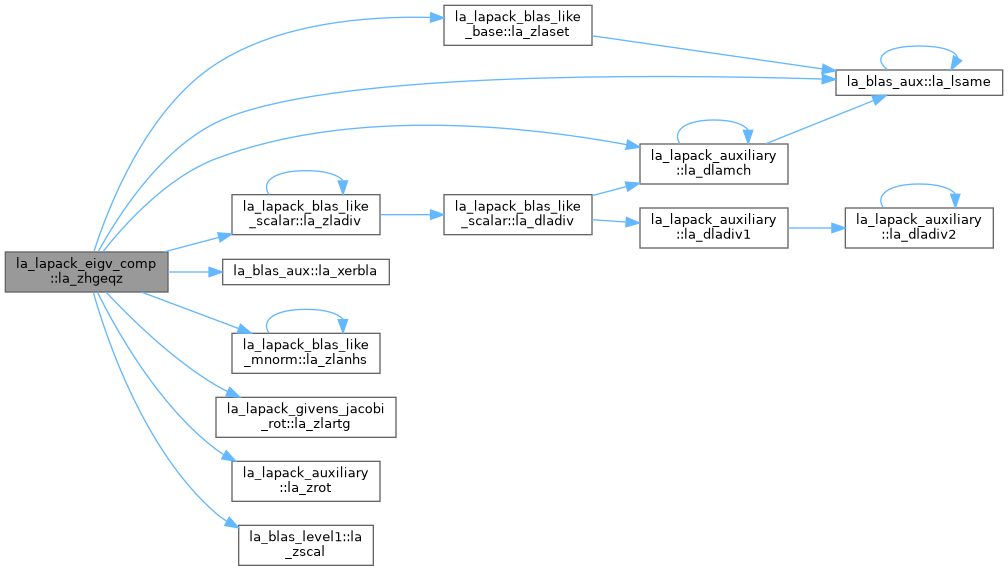
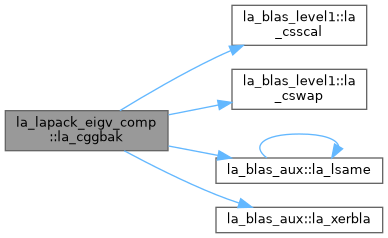
CGGBAK: forms the right or left eigenvectors of a complex generalized eigenvalue problem A*x = lambda*B*x, by backward transformation on the computed eigenvectors of the balanced pair of matrices output by CGGBAL.
◆ la_cggbal()
| pure subroutine, public la_lapack_eigv_comp::la_cggbal | ( | character, intent(in) | job, |
| integer(ilp), intent(in) | n, | ||
| complex(sp), dimension(lda,*), intent(inout) | a, | ||
| integer(ilp), intent(in) | lda, | ||
| complex(sp), dimension(ldb,*), intent(inout) | b, | ||
| integer(ilp), intent(in) | ldb, | ||
| integer(ilp), intent(out) | ilo, | ||
| integer(ilp), intent(out) | ihi, | ||
| real(sp), dimension(*), intent(out) | lscale, | ||
| real(sp), dimension(*), intent(out) | rscale, | ||
| real(sp), dimension(*), intent(out) | work, | ||
| integer(ilp), intent(out) | info ) |
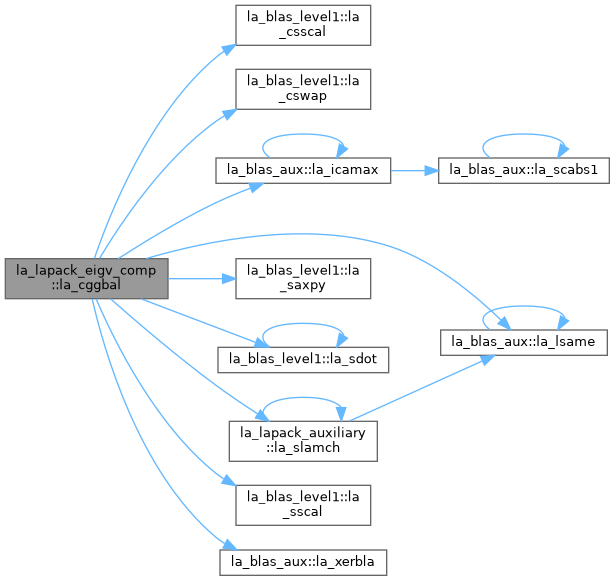
CGGBAL: balances a pair of general complex matrices (A,B). This involves, first, permuting A and B by similarity transformations to isolate eigenvalues in the first 1 to ILO$-$1 and last IHI+1 to N elements on the diagonal; and second, applying a diagonal similarity transformation to rows and columns ILO to IHI to make the rows and columns as close in norm as possible. Both steps are optional. Balancing may reduce the 1-norm of the matrices, and improve the accuracy of the computed eigenvalues and/or eigenvectors in the generalized eigenvalue problem A*x = lambda*B*x.
◆ la_cgghd3()
| pure subroutine, public la_lapack_eigv_comp::la_cgghd3 | ( | character, intent(in) | compq, |
| character, intent(in) | compz, | ||
| integer(ilp), intent(in) | n, | ||
| integer(ilp), intent(in) | ilo, | ||
| integer(ilp), intent(in) | ihi, | ||
| complex(sp), dimension(lda,*), intent(inout) | a, | ||
| integer(ilp), intent(in) | lda, | ||
| complex(sp), dimension(ldb,*), intent(inout) | b, | ||
| integer(ilp), intent(in) | ldb, | ||
| complex(sp), dimension(ldq,*), intent(inout) | q, | ||
| integer(ilp), intent(in) | ldq, | ||
| complex(sp), dimension(ldz,*), intent(inout) | z, | ||
| integer(ilp), intent(in) | ldz, | ||
| complex(sp), dimension(*), intent(out) | work, | ||
| integer(ilp), intent(in) | lwork, | ||
| integer(ilp), intent(out) | info ) |
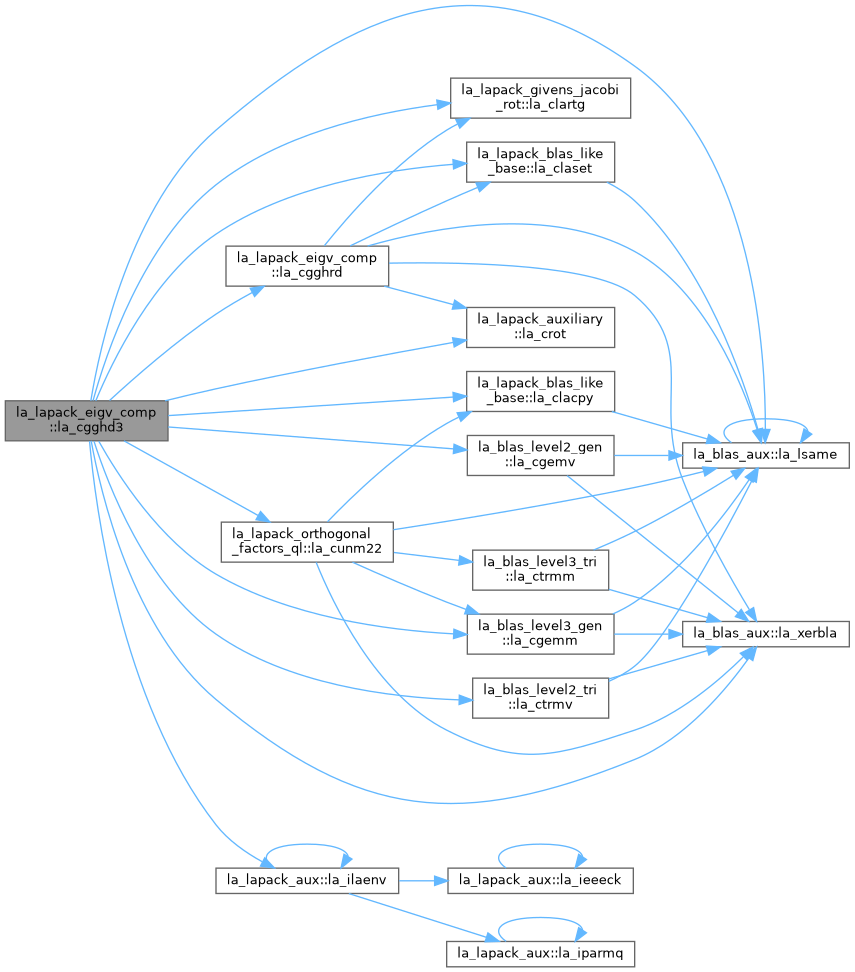
CGGHD3: reduces a pair of complex matrices (A,B) to generalized upper Hessenberg form using unitary transformations, where A is a general matrix and B is upper triangular. The form of the generalized eigenvalue problem is A*x = lambda*B*x, and B is typically made upper triangular by computing its QR factorization and moving the unitary matrix Q to the left side of the equation. This subroutine simultaneously reduces A to a Hessenberg matrix H: Q**H*A*Z = H and transforms B to another upper triangular matrix T: Q**H*B*Z = T in order to reduce the problem to its standard form H*y = lambda*T*y where y = Z**H*x. The unitary matrices Q and Z are determined as products of Givens rotations. They may either be formed explicitly, or they may be postmultiplied into input matrices Q1 and Z1, so that Q1 * A * Z1**H = (Q1*Q) * H * (Z1*Z)**H Q1 * B * Z1**H = (Q1*Q) * T * (Z1*Z)**H If Q1 is the unitary matrix from the QR factorization of B in the original equation A*x = lambda*B*x, then CGGHD3 reduces the original problem to generalized Hessenberg form. This is a blocked variant of CGGHRD, using matrix-matrix multiplications for parts of the computation to enhance performance.
◆ la_cgghrd()
| pure subroutine, public la_lapack_eigv_comp::la_cgghrd | ( | character, intent(in) | compq, |
| character, intent(in) | compz, | ||
| integer(ilp), intent(in) | n, | ||
| integer(ilp), intent(in) | ilo, | ||
| integer(ilp), intent(in) | ihi, | ||
| complex(sp), dimension(lda,*), intent(inout) | a, | ||
| integer(ilp), intent(in) | lda, | ||
| complex(sp), dimension(ldb,*), intent(inout) | b, | ||
| integer(ilp), intent(in) | ldb, | ||
| complex(sp), dimension(ldq,*), intent(inout) | q, | ||
| integer(ilp), intent(in) | ldq, | ||
| complex(sp), dimension(ldz,*), intent(inout) | z, | ||
| integer(ilp), intent(in) | ldz, | ||
| integer(ilp), intent(out) | info ) |
CGGHRD: reduces a pair of complex matrices (A,B) to generalized upper Hessenberg form using unitary transformations, where A is a general matrix and B is upper triangular. The form of the generalized eigenvalue problem is A*x = lambda*B*x, and B is typically made upper triangular by computing its QR factorization and moving the unitary matrix Q to the left side of the equation. This subroutine simultaneously reduces A to a Hessenberg matrix H: Q**H*A*Z = H and transforms B to another upper triangular matrix T: Q**H*B*Z = T in order to reduce the problem to its standard form H*y = lambda*T*y where y = Z**H*x. The unitary matrices Q and Z are determined as products of Givens rotations. They may either be formed explicitly, or they may be postmultiplied into input matrices Q1 and Z1, so that Q1 * A * Z1**H = (Q1*Q) * H * (Z1*Z)**H Q1 * B * Z1**H = (Q1*Q) * T * (Z1*Z)**H If Q1 is the unitary matrix from the QR factorization of B in the original equation A*x = lambda*B*x, then CGGHRD reduces the original problem to generalized Hessenberg form.
◆ la_chgeqz()
| subroutine, public la_lapack_eigv_comp::la_chgeqz | ( | character, intent(in) | job, |
| character, intent(in) | compq, | ||
| character, intent(in) | compz, | ||
| integer(ilp), intent(in) | n, | ||
| integer(ilp), intent(in) | ilo, | ||
| integer(ilp), intent(in) | ihi, | ||
| complex(sp), dimension(ldh,*), intent(inout) | h, | ||
| integer(ilp), intent(in) | ldh, | ||
| complex(sp), dimension(ldt,*), intent(inout) | t, | ||
| integer(ilp), intent(in) | ldt, | ||
| complex(sp), dimension(*), intent(out) | alpha, | ||
| complex(sp), dimension(*), intent(out) | beta, | ||
| complex(sp), dimension(ldq,*), intent(inout) | q, | ||
| integer(ilp), intent(in) | ldq, | ||
| complex(sp), dimension(ldz,*), intent(inout) | z, | ||
| integer(ilp), intent(in) | ldz, | ||
| complex(sp), dimension(*), intent(out) | work, | ||
| integer(ilp), intent(in) | lwork, | ||
| real(sp), dimension(*), intent(out) | rwork, | ||
| integer(ilp), intent(out) | info ) |
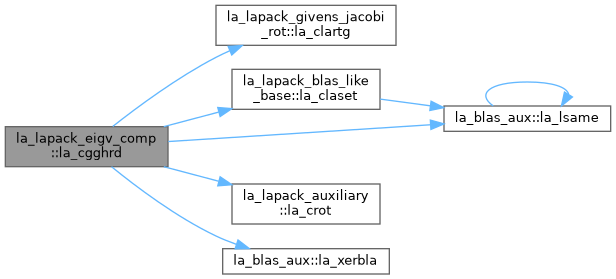
CHGEQZ: computes the eigenvalues of a complex matrix pair (H,T), where H is an upper Hessenberg matrix and T is upper triangular, using the single-shift QZ method. Matrix pairs of this type are produced by the reduction to generalized upper Hessenberg form of a complex matrix pair (A,B): A = Q1*H*Z1**H, B = Q1*T*Z1**H, as computed by CGGHRD. If JOB='S', then the Hessenberg-triangular pair (H,T) is also reduced to generalized Schur form, H = Q*S*Z**H, T = Q*P*Z**H, where Q and Z are unitary matrices and S and P are upper triangular. Optionally, the unitary matrix Q from the generalized Schur factorization may be postmultiplied into an input matrix Q1, and the unitary matrix Z may be postmultiplied into an input matrix Z1. If Q1 and Z1 are the unitary matrices from CGGHRD that reduced the matrix pair (A,B) to generalized Hessenberg form, then the output matrices Q1*Q and Z1*Z are the unitary factors from the generalized Schur factorization of (A,B): A = (Q1*Q)*S*(Z1*Z)**H, B = (Q1*Q)*P*(Z1*Z)**H. To avoid overflow, eigenvalues of the matrix pair (H,T) (equivalently, of (A,B)) are computed as a pair of complex values (alpha,beta). If beta is nonzero, lambda = alpha / beta is an eigenvalue of the generalized nonsymmetric eigenvalue problem (GNEP) A*x = lambda*B*x and if alpha is nonzero, mu = beta / alpha is an eigenvalue of the alternate form of the GNEP mu*A*y = B*y. The values of alpha and beta for the i-th eigenvalue can be read directly from the generalized Schur form: alpha = S(i,i), beta = P(i,i). Ref: C.B. Moler Eigenvalue Problems", SIAM J. Numer. Anal., 10(1973), pp. 241–256.
◆ la_dggbak()
| pure subroutine, public la_lapack_eigv_comp::la_dggbak | ( | character, intent(in) | job, |
| character, intent(in) | side, | ||
| integer(ilp), intent(in) | n, | ||
| integer(ilp), intent(in) | ilo, | ||
| integer(ilp), intent(in) | ihi, | ||
| real(dp), dimension(*), intent(in) | lscale, | ||
| real(dp), dimension(*), intent(in) | rscale, | ||
| integer(ilp), intent(in) | m, | ||
| real(dp), dimension(ldv,*), intent(inout) | v, | ||
| integer(ilp), intent(in) | ldv, | ||
| integer(ilp), intent(out) | info ) |
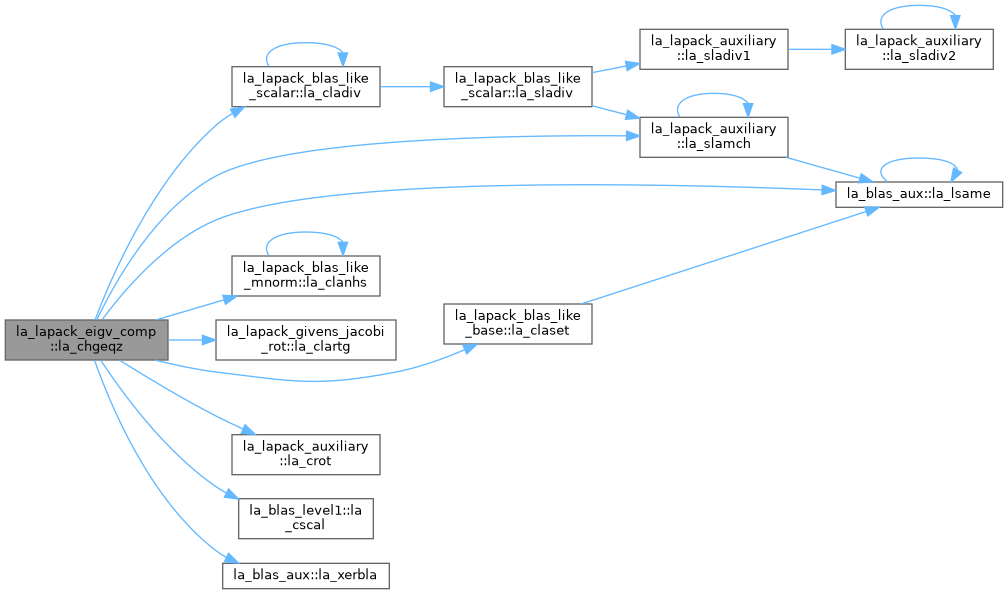
DGGBAK: forms the right or left eigenvectors of a real generalized eigenvalue problem A*x = lambda*B*x, by backward transformation on the computed eigenvectors of the balanced pair of matrices output by DGGBAL.
◆ la_dggbal()
| pure subroutine, public la_lapack_eigv_comp::la_dggbal | ( | character, intent(in) | job, |
| integer(ilp), intent(in) | n, | ||
| real(dp), dimension(lda,*), intent(inout) | a, | ||
| integer(ilp), intent(in) | lda, | ||
| real(dp), dimension(ldb,*), intent(inout) | b, | ||
| integer(ilp), intent(in) | ldb, | ||
| integer(ilp), intent(out) | ilo, | ||
| integer(ilp), intent(out) | ihi, | ||
| real(dp), dimension(*), intent(out) | lscale, | ||
| real(dp), dimension(*), intent(out) | rscale, | ||
| real(dp), dimension(*), intent(out) | work, | ||
| integer(ilp), intent(out) | info ) |
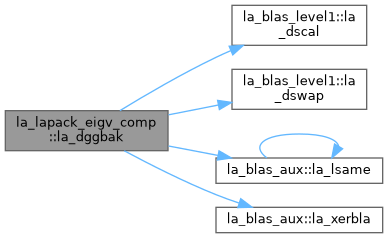
DGGBAL: balances a pair of general real matrices (A,B). This involves, first, permuting A and B by similarity transformations to isolate eigenvalues in the first 1 to ILO$-$1 and last IHI+1 to N elements on the diagonal; and second, applying a diagonal similarity transformation to rows and columns ILO to IHI to make the rows and columns as close in norm as possible. Both steps are optional. Balancing may reduce the 1-norm of the matrices, and improve the accuracy of the computed eigenvalues and/or eigenvectors in the generalized eigenvalue problem A*x = lambda*B*x.
◆ la_dgghd3()
| pure subroutine, public la_lapack_eigv_comp::la_dgghd3 | ( | character, intent(in) | compq, |
| character, intent(in) | compz, | ||
| integer(ilp), intent(in) | n, | ||
| integer(ilp), intent(in) | ilo, | ||
| integer(ilp), intent(in) | ihi, | ||
| real(dp), dimension(lda,*), intent(inout) | a, | ||
| integer(ilp), intent(in) | lda, | ||
| real(dp), dimension(ldb,*), intent(inout) | b, | ||
| integer(ilp), intent(in) | ldb, | ||
| real(dp), dimension(ldq,*), intent(inout) | q, | ||
| integer(ilp), intent(in) | ldq, | ||
| real(dp), dimension(ldz,*), intent(inout) | z, | ||
| integer(ilp), intent(in) | ldz, | ||
| real(dp), dimension(*), intent(out) | work, | ||
| integer(ilp), intent(in) | lwork, | ||
| integer(ilp), intent(out) | info ) |
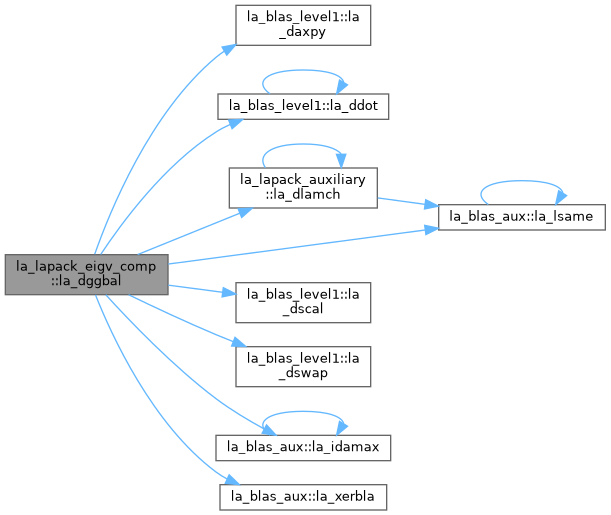
DGGHD3: reduces a pair of real matrices (A,B) to generalized upper Hessenberg form using orthogonal transformations, where A is a general matrix and B is upper triangular. The form of the generalized eigenvalue problem is A*x = lambda*B*x, and B is typically made upper triangular by computing its QR factorization and moving the orthogonal matrix Q to the left side of the equation. This subroutine simultaneously reduces A to a Hessenberg matrix H: Q**T*A*Z = H and transforms B to another upper triangular matrix T: Q**T*B*Z = T in order to reduce the problem to its standard form H*y = lambda*T*y where y = Z**T*x. The orthogonal matrices Q and Z are determined as products of Givens rotations. They may either be formed explicitly, or they may be postmultiplied into input matrices Q1 and Z1, so that Q1 * A * Z1**T = (Q1*Q) * H * (Z1*Z)**T Q1 * B * Z1**T = (Q1*Q) * T * (Z1*Z)**T If Q1 is the orthogonal matrix from the QR factorization of B in the original equation A*x = lambda*B*x, then DGGHD3 reduces the original problem to generalized Hessenberg form. This is a blocked variant of DGGHRD, using matrix-matrix multiplications for parts of the computation to enhance performance.
◆ la_dgghrd()
| pure subroutine, public la_lapack_eigv_comp::la_dgghrd | ( | character, intent(in) | compq, |
| character, intent(in) | compz, | ||
| integer(ilp), intent(in) | n, | ||
| integer(ilp), intent(in) | ilo, | ||
| integer(ilp), intent(in) | ihi, | ||
| real(dp), dimension(lda,*), intent(inout) | a, | ||
| integer(ilp), intent(in) | lda, | ||
| real(dp), dimension(ldb,*), intent(inout) | b, | ||
| integer(ilp), intent(in) | ldb, | ||
| real(dp), dimension(ldq,*), intent(inout) | q, | ||
| integer(ilp), intent(in) | ldq, | ||
| real(dp), dimension(ldz,*), intent(inout) | z, | ||
| integer(ilp), intent(in) | ldz, | ||
| integer(ilp), intent(out) | info ) |
DGGHRD: reduces a pair of real matrices (A,B) to generalized upper Hessenberg form using orthogonal transformations, where A is a general matrix and B is upper triangular. The form of the generalized eigenvalue problem is A*x = lambda*B*x, and B is typically made upper triangular by computing its QR factorization and moving the orthogonal matrix Q to the left side of the equation. This subroutine simultaneously reduces A to a Hessenberg matrix H: Q**T*A*Z = H and transforms B to another upper triangular matrix T: Q**T*B*Z = T in order to reduce the problem to its standard form H*y = lambda*T*y where y = Z**T*x. The orthogonal matrices Q and Z are determined as products of Givens rotations. They may either be formed explicitly, or they may be postmultiplied into input matrices Q1 and Z1, so that Q1 * A * Z1**T = (Q1*Q) * H * (Z1*Z)**T Q1 * B * Z1**T = (Q1*Q) * T * (Z1*Z)**T If Q1 is the orthogonal matrix from the QR factorization of B in the original equation A*x = lambda*B*x, then DGGHRD reduces the original problem to generalized Hessenberg form.
◆ la_dhgeqz()
| subroutine, public la_lapack_eigv_comp::la_dhgeqz | ( | character, intent(in) | job, |
| character, intent(in) | compq, | ||
| character, intent(in) | compz, | ||
| integer(ilp), intent(in) | n, | ||
| integer(ilp), intent(in) | ilo, | ||
| integer(ilp), intent(in) | ihi, | ||
| real(dp), dimension(ldh,*), intent(inout) | h, | ||
| integer(ilp), intent(in) | ldh, | ||
| real(dp), dimension(ldt,*), intent(inout) | t, | ||
| integer(ilp), intent(in) | ldt, | ||
| real(dp), dimension(*), intent(out) | alphar, | ||
| real(dp), dimension(*), intent(out) | alphai, | ||
| real(dp), dimension(*), intent(out) | beta, | ||
| real(dp), dimension(ldq,*), intent(inout) | q, | ||
| integer(ilp), intent(in) | ldq, | ||
| real(dp), dimension(ldz,*), intent(inout) | z, | ||
| integer(ilp), intent(in) | ldz, | ||
| real(dp), dimension(*), intent(out) | work, | ||
| integer(ilp), intent(in) | lwork, | ||
| integer(ilp), intent(out) | info ) |
DHGEQZ: computes the eigenvalues of a real matrix pair (H,T), where H is an upper Hessenberg matrix and T is upper triangular, using the double-shift QZ method. Matrix pairs of this type are produced by the reduction to generalized upper Hessenberg form of a real matrix pair (A,B): A = Q1*H*Z1**T, B = Q1*T*Z1**T, as computed by DGGHRD. If JOB='S', then the Hessenberg-triangular pair (H,T) is also reduced to generalized Schur form, H = Q*S*Z**T, T = Q*P*Z**T, where Q and Z are orthogonal matrices, P is an upper triangular matrix, and S is a quasi-triangular matrix with 1-by-1 and 2-by-2 diagonal blocks. The 1-by-1 blocks correspond to real eigenvalues of the matrix pair (H,T) and the 2-by-2 blocks correspond to complex conjugate pairs of eigenvalues. Additionally, the 2-by-2 upper triangular diagonal blocks of P corresponding to 2-by-2 blocks of S are reduced to positive diagonal form, i.e., if S(j+1,j) is non-zero, then P(j+1,j) = P(j,j+1) = 0, P(j,j) > 0, and P(j+1,j+1) > 0. Optionally, the orthogonal matrix Q from the generalized Schur factorization may be postmultiplied into an input matrix Q1, and the orthogonal matrix Z may be postmultiplied into an input matrix Z1. If Q1 and Z1 are the orthogonal matrices from DGGHRD that reduced the matrix pair (A,B) to generalized upper Hessenberg form, then the output matrices Q1*Q and Z1*Z are the orthogonal factors from the generalized Schur factorization of (A,B): A = (Q1*Q)*S*(Z1*Z)**T, B = (Q1*Q)*P*(Z1*Z)**T. To avoid overflow, eigenvalues of the matrix pair (H,T) (equivalently, of (A,B)) are computed as a pair of values (alpha,beta), where alpha is complex and beta real. If beta is nonzero, lambda = alpha / beta is an eigenvalue of the generalized nonsymmetric eigenvalue problem (GNEP) A*x = lambda*B*x and if alpha is nonzero, mu = beta / alpha is an eigenvalue of the alternate form of the GNEP mu*A*y = B*y. Real eigenvalues can be read directly from the generalized Schur form: alpha = S(i,i), beta = P(i,i). Ref: C.B. Moler Eigenvalue Problems", SIAM J. Numer. Anal., 10(1973), pp. 241–256.
◆ la_qggbak()
| pure subroutine, public la_lapack_eigv_comp::la_qggbak | ( | character, intent(in) | job, |
| character, intent(in) | side, | ||
| integer(ilp), intent(in) | n, | ||
| integer(ilp), intent(in) | ilo, | ||
| integer(ilp), intent(in) | ihi, | ||
| real(qp), dimension(*), intent(in) | lscale, | ||
| real(qp), dimension(*), intent(in) | rscale, | ||
| integer(ilp), intent(in) | m, | ||
| real(qp), dimension(ldv,*), intent(inout) | v, | ||
| integer(ilp), intent(in) | ldv, | ||
| integer(ilp), intent(out) | info ) |
QGGBAK: forms the right or left eigenvectors of a real generalized eigenvalue problem A*x = lambda*B*x, by backward transformation on the computed eigenvectors of the balanced pair of matrices output by QGGBAL.
◆ la_qggbal()
| pure subroutine, public la_lapack_eigv_comp::la_qggbal | ( | character, intent(in) | job, |
| integer(ilp), intent(in) | n, | ||
| real(qp), dimension(lda,*), intent(inout) | a, | ||
| integer(ilp), intent(in) | lda, | ||
| real(qp), dimension(ldb,*), intent(inout) | b, | ||
| integer(ilp), intent(in) | ldb, | ||
| integer(ilp), intent(out) | ilo, | ||
| integer(ilp), intent(out) | ihi, | ||
| real(qp), dimension(*), intent(out) | lscale, | ||
| real(qp), dimension(*), intent(out) | rscale, | ||
| real(qp), dimension(*), intent(out) | work, | ||
| integer(ilp), intent(out) | info ) |
QGGBAL: balances a pair of general real matrices (A,B). This involves, first, permuting A and B by similarity transformations to isolate eigenvalues in the first 1 to ILO$-$1 and last IHI+1 to N elements on the diagonal; and second, applying a diagonal similarity transformation to rows and columns ILO to IHI to make the rows and columns as close in norm as possible. Both steps are optional. Balancing may reduce the 1-norm of the matrices, and improve the accuracy of the computed eigenvalues and/or eigenvectors in the generalized eigenvalue problem A*x = lambda*B*x.
◆ la_qgghd3()
| pure subroutine, public la_lapack_eigv_comp::la_qgghd3 | ( | character, intent(in) | compq, |
| character, intent(in) | compz, | ||
| integer(ilp), intent(in) | n, | ||
| integer(ilp), intent(in) | ilo, | ||
| integer(ilp), intent(in) | ihi, | ||
| real(qp), dimension(lda,*), intent(inout) | a, | ||
| integer(ilp), intent(in) | lda, | ||
| real(qp), dimension(ldb,*), intent(inout) | b, | ||
| integer(ilp), intent(in) | ldb, | ||
| real(qp), dimension(ldq,*), intent(inout) | q, | ||
| integer(ilp), intent(in) | ldq, | ||
| real(qp), dimension(ldz,*), intent(inout) | z, | ||
| integer(ilp), intent(in) | ldz, | ||
| real(qp), dimension(*), intent(out) | work, | ||
| integer(ilp), intent(in) | lwork, | ||
| integer(ilp), intent(out) | info ) |
QGGHD3: reduces a pair of real matrices (A,B) to generalized upper Hessenberg form using orthogonal transformations, where A is a general matrix and B is upper triangular. The form of the generalized eigenvalue problem is A*x = lambda*B*x, and B is typically made upper triangular by computing its QR factorization and moving the orthogonal matrix Q to the left side of the equation. This subroutine simultaneously reduces A to a Hessenberg matrix H: Q**T*A*Z = H and transforms B to another upper triangular matrix T: Q**T*B*Z = T in order to reduce the problem to its standard form H*y = lambda*T*y where y = Z**T*x. The orthogonal matrices Q and Z are determined as products of Givens rotations. They may either be formed explicitly, or they may be postmultiplied into input matrices Q1 and Z1, so that Q1 * A * Z1**T = (Q1*Q) * H * (Z1*Z)**T Q1 * B * Z1**T = (Q1*Q) * T * (Z1*Z)**T If Q1 is the orthogonal matrix from the QR factorization of B in the original equation A*x = lambda*B*x, then QGGHD3 reduces the original problem to generalized Hessenberg form. This is a blocked variant of QGGHRD, using matrix-matrix multiplications for parts of the computation to enhance performance.
◆ la_qgghrd()
| pure subroutine, public la_lapack_eigv_comp::la_qgghrd | ( | character, intent(in) | compq, |
| character, intent(in) | compz, | ||
| integer(ilp), intent(in) | n, | ||
| integer(ilp), intent(in) | ilo, | ||
| integer(ilp), intent(in) | ihi, | ||
| real(qp), dimension(lda,*), intent(inout) | a, | ||
| integer(ilp), intent(in) | lda, | ||
| real(qp), dimension(ldb,*), intent(inout) | b, | ||
| integer(ilp), intent(in) | ldb, | ||
| real(qp), dimension(ldq,*), intent(inout) | q, | ||
| integer(ilp), intent(in) | ldq, | ||
| real(qp), dimension(ldz,*), intent(inout) | z, | ||
| integer(ilp), intent(in) | ldz, | ||
| integer(ilp), intent(out) | info ) |
QGGHRD: reduces a pair of real matrices (A,B) to generalized upper Hessenberg form using orthogonal transformations, where A is a general matrix and B is upper triangular. The form of the generalized eigenvalue problem is A*x = lambda*B*x, and B is typically made upper triangular by computing its QR factorization and moving the orthogonal matrix Q to the left side of the equation. This subroutine simultaneously reduces A to a Hessenberg matrix H: Q**T*A*Z = H and transforms B to another upper triangular matrix T: Q**T*B*Z = T in order to reduce the problem to its standard form H*y = lambda*T*y where y = Z**T*x. The orthogonal matrices Q and Z are determined as products of Givens rotations. They may either be formed explicitly, or they may be postmultiplied into input matrices Q1 and Z1, so that Q1 * A * Z1**T = (Q1*Q) * H * (Z1*Z)**T Q1 * B * Z1**T = (Q1*Q) * T * (Z1*Z)**T If Q1 is the orthogonal matrix from the QR factorization of B in the original equation A*x = lambda*B*x, then QGGHRD reduces the original problem to generalized Hessenberg form.
◆ la_qhgeqz()
| subroutine, public la_lapack_eigv_comp::la_qhgeqz | ( | character, intent(in) | job, |
| character, intent(in) | compq, | ||
| character, intent(in) | compz, | ||
| integer(ilp), intent(in) | n, | ||
| integer(ilp), intent(in) | ilo, | ||
| integer(ilp), intent(in) | ihi, | ||
| real(qp), dimension(ldh,*), intent(inout) | h, | ||
| integer(ilp), intent(in) | ldh, | ||
| real(qp), dimension(ldt,*), intent(inout) | t, | ||
| integer(ilp), intent(in) | ldt, | ||
| real(qp), dimension(*), intent(out) | alphar, | ||
| real(qp), dimension(*), intent(out) | alphai, | ||
| real(qp), dimension(*), intent(out) | beta, | ||
| real(qp), dimension(ldq,*), intent(inout) | q, | ||
| integer(ilp), intent(in) | ldq, | ||
| real(qp), dimension(ldz,*), intent(inout) | z, | ||
| integer(ilp), intent(in) | ldz, | ||
| real(qp), dimension(*), intent(out) | work, | ||
| integer(ilp), intent(in) | lwork, | ||
| integer(ilp), intent(out) | info ) |
QHGEQZ: computes the eigenvalues of a real matrix pair (H,T), where H is an upper Hessenberg matrix and T is upper triangular, using the double-shift QZ method. Matrix pairs of this type are produced by the reduction to generalized upper Hessenberg form of a real matrix pair (A,B): A = Q1*H*Z1**T, B = Q1*T*Z1**T, as computed by QGGHRD. If JOB='S', then the Hessenberg-triangular pair (H,T) is also reduced to generalized Schur form, H = Q*S*Z**T, T = Q*P*Z**T, where Q and Z are orthogonal matrices, P is an upper triangular matrix, and S is a quasi-triangular matrix with 1-by-1 and 2-by-2 diagonal blocks. The 1-by-1 blocks correspond to real eigenvalues of the matrix pair (H,T) and the 2-by-2 blocks correspond to complex conjugate pairs of eigenvalues. Additionally, the 2-by-2 upper triangular diagonal blocks of P corresponding to 2-by-2 blocks of S are reduced to positive diagonal form, i.e., if S(j+1,j) is non-zero, then P(j+1,j) = P(j,j+1) = 0, P(j,j) > 0, and P(j+1,j+1) > 0. Optionally, the orthogonal matrix Q from the generalized Schur factorization may be postmultiplied into an input matrix Q1, and the orthogonal matrix Z may be postmultiplied into an input matrix Z1. If Q1 and Z1 are the orthogonal matrices from QGGHRD that reduced the matrix pair (A,B) to generalized upper Hessenberg form, then the output matrices Q1*Q and Z1*Z are the orthogonal factors from the generalized Schur factorization of (A,B): A = (Q1*Q)*S*(Z1*Z)**T, B = (Q1*Q)*P*(Z1*Z)**T. To avoid overflow, eigenvalues of the matrix pair (H,T) (equivalently, of (A,B)) are computed as a pair of values (alpha,beta), where alpha is complex and beta real. If beta is nonzero, lambda = alpha / beta is an eigenvalue of the generalized nonsymmetric eigenvalue problem (GNEP) A*x = lambda*B*x and if alpha is nonzero, mu = beta / alpha is an eigenvalue of the alternate form of the GNEP mu*A*y = B*y. Real eigenvalues can be read directly from the generalized Schur form: alpha = S(i,i), beta = P(i,i). Ref: C.B. Moler Eigenvalue Problems", SIAM J. Numer. Anal., 10(1973), pp. 241–256.
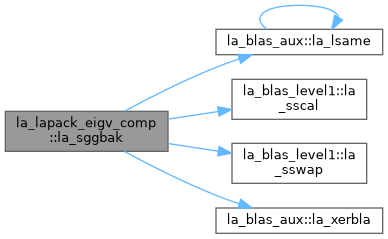
◆ la_sggbak()
| pure subroutine, public la_lapack_eigv_comp::la_sggbak | ( | character, intent(in) | job, |
| character, intent(in) | side, | ||
| integer(ilp), intent(in) | n, | ||
| integer(ilp), intent(in) | ilo, | ||
| integer(ilp), intent(in) | ihi, | ||
| real(sp), dimension(*), intent(in) | lscale, | ||
| real(sp), dimension(*), intent(in) | rscale, | ||
| integer(ilp), intent(in) | m, | ||
| real(sp), dimension(ldv,*), intent(inout) | v, | ||
| integer(ilp), intent(in) | ldv, | ||
| integer(ilp), intent(out) | info ) |
SGGBAK: forms the right or left eigenvectors of a real generalized eigenvalue problem A*x = lambda*B*x, by backward transformation on the computed eigenvectors of the balanced pair of matrices output by SGGBAL.
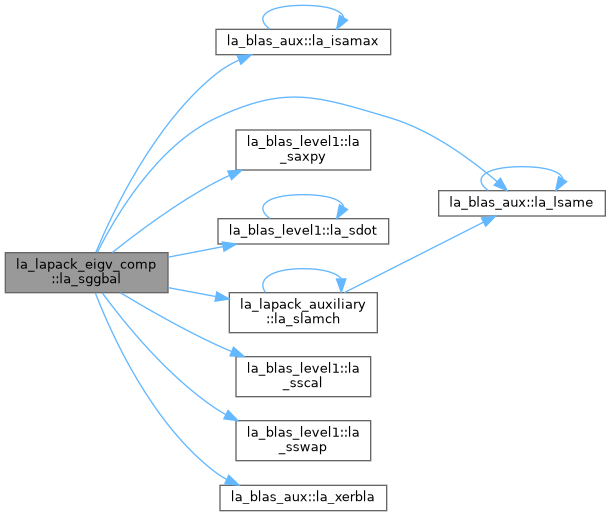
◆ la_sggbal()
| pure subroutine, public la_lapack_eigv_comp::la_sggbal | ( | character, intent(in) | job, |
| integer(ilp), intent(in) | n, | ||
| real(sp), dimension(lda,*), intent(inout) | a, | ||
| integer(ilp), intent(in) | lda, | ||
| real(sp), dimension(ldb,*), intent(inout) | b, | ||
| integer(ilp), intent(in) | ldb, | ||
| integer(ilp), intent(out) | ilo, | ||
| integer(ilp), intent(out) | ihi, | ||
| real(sp), dimension(*), intent(out) | lscale, | ||
| real(sp), dimension(*), intent(out) | rscale, | ||
| real(sp), dimension(*), intent(out) | work, | ||
| integer(ilp), intent(out) | info ) |
SGGBAL: balances a pair of general real matrices (A,B). This involves, first, permuting A and B by similarity transformations to isolate eigenvalues in the first 1 to ILO$-$1 and last IHI+1 to N elements on the diagonal; and second, applying a diagonal similarity transformation to rows and columns ILO to IHI to make the rows and columns as close in norm as possible. Both steps are optional. Balancing may reduce the 1-norm of the matrices, and improve the accuracy of the computed eigenvalues and/or eigenvectors in the generalized eigenvalue problem A*x = lambda*B*x.
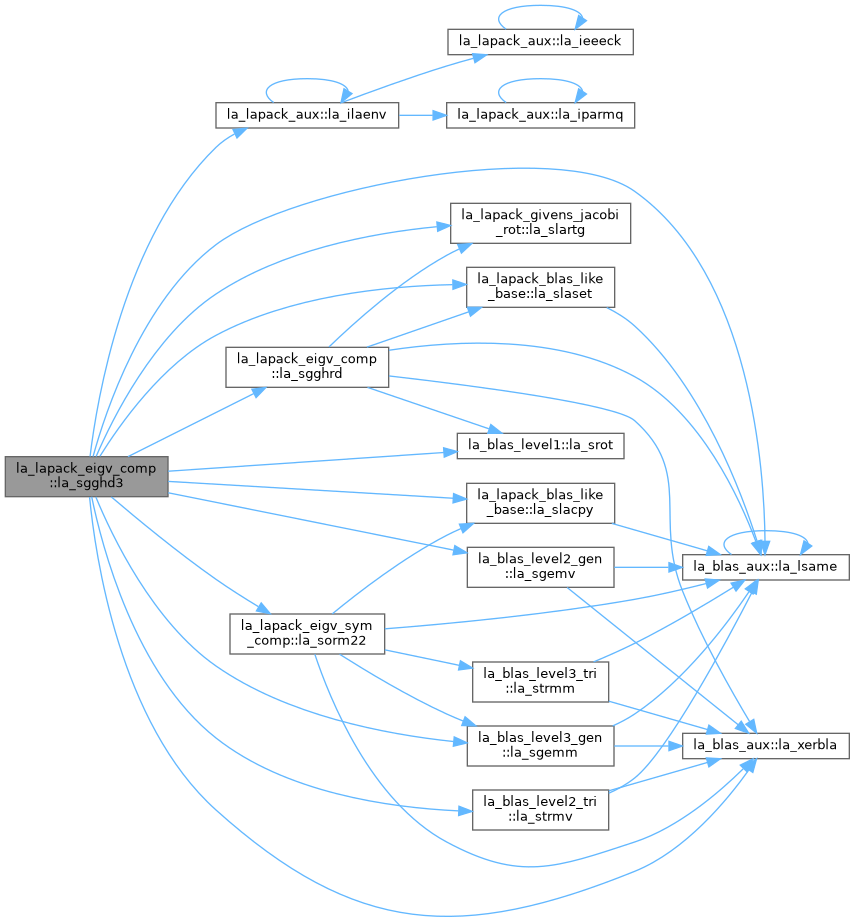
◆ la_sgghd3()
| pure subroutine, public la_lapack_eigv_comp::la_sgghd3 | ( | character, intent(in) | compq, |
| character, intent(in) | compz, | ||
| integer(ilp), intent(in) | n, | ||
| integer(ilp), intent(in) | ilo, | ||
| integer(ilp), intent(in) | ihi, | ||
| real(sp), dimension(lda,*), intent(inout) | a, | ||
| integer(ilp), intent(in) | lda, | ||
| real(sp), dimension(ldb,*), intent(inout) | b, | ||
| integer(ilp), intent(in) | ldb, | ||
| real(sp), dimension(ldq,*), intent(inout) | q, | ||
| integer(ilp), intent(in) | ldq, | ||
| real(sp), dimension(ldz,*), intent(inout) | z, | ||
| integer(ilp), intent(in) | ldz, | ||
| real(sp), dimension(*), intent(out) | work, | ||
| integer(ilp), intent(in) | lwork, | ||
| integer(ilp), intent(out) | info ) |
SGGHD3: reduces a pair of real matrices (A,B) to generalized upper Hessenberg form using orthogonal transformations, where A is a general matrix and B is upper triangular. The form of the generalized eigenvalue problem is A*x = lambda*B*x, and B is typically made upper triangular by computing its QR factorization and moving the orthogonal matrix Q to the left side of the equation. This subroutine simultaneously reduces A to a Hessenberg matrix H: Q**T*A*Z = H and transforms B to another upper triangular matrix T: Q**T*B*Z = T in order to reduce the problem to its standard form H*y = lambda*T*y where y = Z**T*x. The orthogonal matrices Q and Z are determined as products of Givens rotations. They may either be formed explicitly, or they may be postmultiplied into input matrices Q1 and Z1, so that Q1 * A * Z1**T = (Q1*Q) * H * (Z1*Z)**T Q1 * B * Z1**T = (Q1*Q) * T * (Z1*Z)**T If Q1 is the orthogonal matrix from the QR factorization of B in the original equation A*x = lambda*B*x, then SGGHD3 reduces the original problem to generalized Hessenberg form. This is a blocked variant of SGGHRD, using matrix-matrix multiplications for parts of the computation to enhance performance.
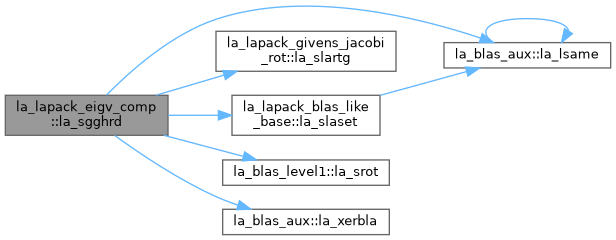
◆ la_sgghrd()
| pure subroutine, public la_lapack_eigv_comp::la_sgghrd | ( | character, intent(in) | compq, |
| character, intent(in) | compz, | ||
| integer(ilp), intent(in) | n, | ||
| integer(ilp), intent(in) | ilo, | ||
| integer(ilp), intent(in) | ihi, | ||
| real(sp), dimension(lda,*), intent(inout) | a, | ||
| integer(ilp), intent(in) | lda, | ||
| real(sp), dimension(ldb,*), intent(inout) | b, | ||
| integer(ilp), intent(in) | ldb, | ||
| real(sp), dimension(ldq,*), intent(inout) | q, | ||
| integer(ilp), intent(in) | ldq, | ||
| real(sp), dimension(ldz,*), intent(inout) | z, | ||
| integer(ilp), intent(in) | ldz, | ||
| integer(ilp), intent(out) | info ) |
SGGHRD: reduces a pair of real matrices (A,B) to generalized upper Hessenberg form using orthogonal transformations, where A is a general matrix and B is upper triangular. The form of the generalized eigenvalue problem is A*x = lambda*B*x, and B is typically made upper triangular by computing its QR factorization and moving the orthogonal matrix Q to the left side of the equation. This subroutine simultaneously reduces A to a Hessenberg matrix H: Q**T*A*Z = H and transforms B to another upper triangular matrix T: Q**T*B*Z = T in order to reduce the problem to its standard form H*y = lambda*T*y where y = Z**T*x. The orthogonal matrices Q and Z are determined as products of Givens rotations. They may either be formed explicitly, or they may be postmultiplied into input matrices Q1 and Z1, so that Q1 * A * Z1**T = (Q1*Q) * H * (Z1*Z)**T Q1 * B * Z1**T = (Q1*Q) * T * (Z1*Z)**T If Q1 is the orthogonal matrix from the QR factorization of B in the original equation A*x = lambda*B*x, then SGGHRD reduces the original problem to generalized Hessenberg form.
◆ la_shgeqz()
| subroutine, public la_lapack_eigv_comp::la_shgeqz | ( | character, intent(in) | job, |
| character, intent(in) | compq, | ||
| character, intent(in) | compz, | ||
| integer(ilp), intent(in) | n, | ||
| integer(ilp), intent(in) | ilo, | ||
| integer(ilp), intent(in) | ihi, | ||
| real(sp), dimension(ldh,*), intent(inout) | h, | ||
| integer(ilp), intent(in) | ldh, | ||
| real(sp), dimension(ldt,*), intent(inout) | t, | ||
| integer(ilp), intent(in) | ldt, | ||
| real(sp), dimension(*), intent(out) | alphar, | ||
| real(sp), dimension(*), intent(out) | alphai, | ||
| real(sp), dimension(*), intent(out) | beta, | ||
| real(sp), dimension(ldq,*), intent(inout) | q, | ||
| integer(ilp), intent(in) | ldq, | ||
| real(sp), dimension(ldz,*), intent(inout) | z, | ||
| integer(ilp), intent(in) | ldz, | ||
| real(sp), dimension(*), intent(out) | work, | ||
| integer(ilp), intent(in) | lwork, | ||
| integer(ilp), intent(out) | info ) |
SHGEQZ: computes the eigenvalues of a real matrix pair (H,T), where H is an upper Hessenberg matrix and T is upper triangular, using the double-shift QZ method. Matrix pairs of this type are produced by the reduction to generalized upper Hessenberg form of a real matrix pair (A,B): A = Q1*H*Z1**T, B = Q1*T*Z1**T, as computed by SGGHRD. If JOB='S', then the Hessenberg-triangular pair (H,T) is also reduced to generalized Schur form, H = Q*S*Z**T, T = Q*P*Z**T, where Q and Z are orthogonal matrices, P is an upper triangular matrix, and S is a quasi-triangular matrix with 1-by-1 and 2-by-2 diagonal blocks. The 1-by-1 blocks correspond to real eigenvalues of the matrix pair (H,T) and the 2-by-2 blocks correspond to complex conjugate pairs of eigenvalues. Additionally, the 2-by-2 upper triangular diagonal blocks of P corresponding to 2-by-2 blocks of S are reduced to positive diagonal form, i.e., if S(j+1,j) is non-zero, then P(j+1,j) = P(j,j+1) = 0, P(j,j) > 0, and P(j+1,j+1) > 0. Optionally, the orthogonal matrix Q from the generalized Schur factorization may be postmultiplied into an input matrix Q1, and the orthogonal matrix Z may be postmultiplied into an input matrix Z1. If Q1 and Z1 are the orthogonal matrices from SGGHRD that reduced the matrix pair (A,B) to generalized upper Hessenberg form, then the output matrices Q1*Q and Z1*Z are the orthogonal factors from the generalized Schur factorization of (A,B): A = (Q1*Q)*S*(Z1*Z)**T, B = (Q1*Q)*P*(Z1*Z)**T. To avoid overflow, eigenvalues of the matrix pair (H,T) (equivalently, of (A,B)) are computed as a pair of values (alpha,beta), where alpha is complex and beta real. If beta is nonzero, lambda = alpha / beta is an eigenvalue of the generalized nonsymmetric eigenvalue problem (GNEP) A*x = lambda*B*x and if alpha is nonzero, mu = beta / alpha is an eigenvalue of the alternate form of the GNEP mu*A*y = B*y. Real eigenvalues can be read directly from the generalized Schur form: alpha = S(i,i), beta = P(i,i). Ref: C.B. Moler Eigenvalue Problems", SIAM J. Numer. Anal., 10(1973), pp. 241–256.
◆ la_wggbak()
| pure subroutine, public la_lapack_eigv_comp::la_wggbak | ( | character, intent(in) | job, |
| character, intent(in) | side, | ||
| integer(ilp), intent(in) | n, | ||
| integer(ilp), intent(in) | ilo, | ||
| integer(ilp), intent(in) | ihi, | ||
| real(qp), dimension(*), intent(in) | lscale, | ||
| real(qp), dimension(*), intent(in) | rscale, | ||
| integer(ilp), intent(in) | m, | ||
| complex(qp), dimension(ldv,*), intent(inout) | v, | ||
| integer(ilp), intent(in) | ldv, | ||
| integer(ilp), intent(out) | info ) |
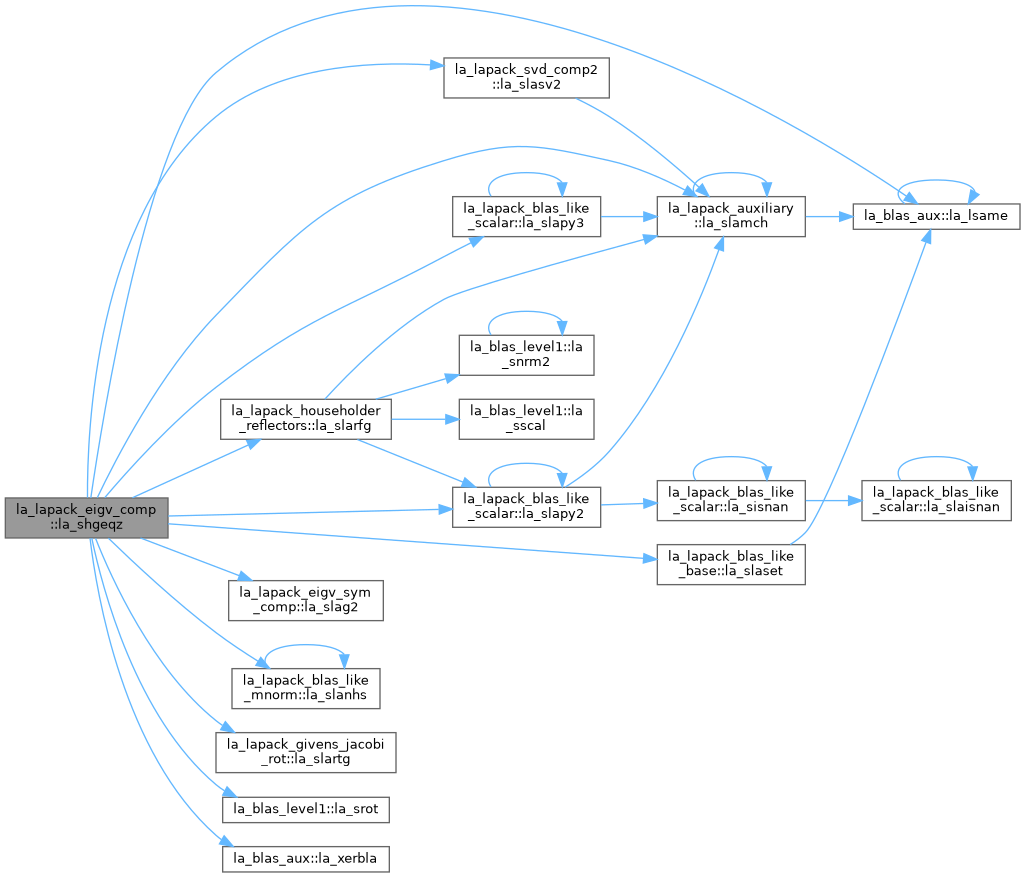
WGGBAK: forms the right or left eigenvectors of a complex generalized eigenvalue problem A*x = lambda*B*x, by backward transformation on the computed eigenvectors of the balanced pair of matrices output by WGGBAL.
◆ la_wggbal()
| pure subroutine, public la_lapack_eigv_comp::la_wggbal | ( | character, intent(in) | job, |
| integer(ilp), intent(in) | n, | ||
| complex(qp), dimension(lda,*), intent(inout) | a, | ||
| integer(ilp), intent(in) | lda, | ||
| complex(qp), dimension(ldb,*), intent(inout) | b, | ||
| integer(ilp), intent(in) | ldb, | ||
| integer(ilp), intent(out) | ilo, | ||
| integer(ilp), intent(out) | ihi, | ||
| real(qp), dimension(*), intent(out) | lscale, | ||
| real(qp), dimension(*), intent(out) | rscale, | ||
| real(qp), dimension(*), intent(out) | work, | ||
| integer(ilp), intent(out) | info ) |
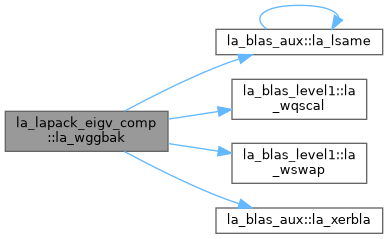
WGGBAL: balances a pair of general complex matrices (A,B). This involves, first, permuting A and B by similarity transformations to isolate eigenvalues in the first 1 to ILO$-$1 and last IHI+1 to N elements on the diagonal; and second, applying a diagonal similarity transformation to rows and columns ILO to IHI to make the rows and columns as close in norm as possible. Both steps are optional. Balancing may reduce the 1-norm of the matrices, and improve the accuracy of the computed eigenvalues and/or eigenvectors in the generalized eigenvalue problem A*x = lambda*B*x.
◆ la_wgghd3()
| pure subroutine, public la_lapack_eigv_comp::la_wgghd3 | ( | character, intent(in) | compq, |
| character, intent(in) | compz, | ||
| integer(ilp), intent(in) | n, | ||
| integer(ilp), intent(in) | ilo, | ||
| integer(ilp), intent(in) | ihi, | ||
| complex(qp), dimension(lda,*), intent(inout) | a, | ||
| integer(ilp), intent(in) | lda, | ||
| complex(qp), dimension(ldb,*), intent(inout) | b, | ||
| integer(ilp), intent(in) | ldb, | ||
| complex(qp), dimension(ldq,*), intent(inout) | q, | ||
| integer(ilp), intent(in) | ldq, | ||
| complex(qp), dimension(ldz,*), intent(inout) | z, | ||
| integer(ilp), intent(in) | ldz, | ||
| complex(qp), dimension(*), intent(out) | work, | ||
| integer(ilp), intent(in) | lwork, | ||
| integer(ilp), intent(out) | info ) |
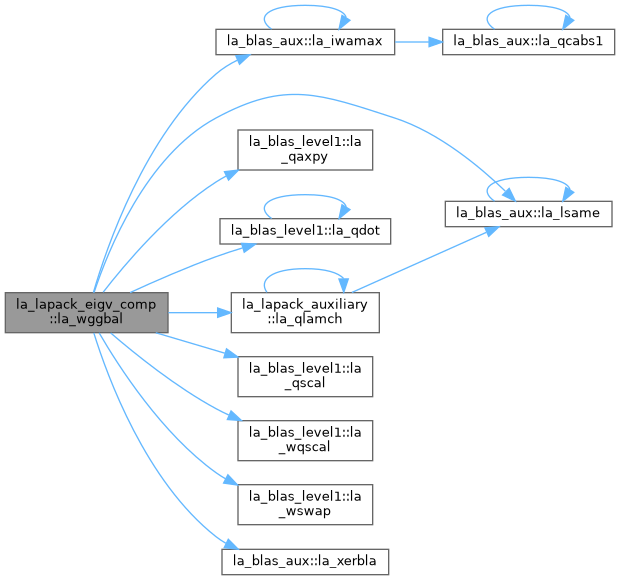
WGGHD3: reduces a pair of complex matrices (A,B) to generalized upper Hessenberg form using unitary transformations, where A is a general matrix and B is upper triangular. The form of the generalized eigenvalue problem is A*x = lambda*B*x, and B is typically made upper triangular by computing its QR factorization and moving the unitary matrix Q to the left side of the equation. This subroutine simultaneously reduces A to a Hessenberg matrix H: Q**H*A*Z = H and transforms B to another upper triangular matrix T: Q**H*B*Z = T in order to reduce the problem to its standard form H*y = lambda*T*y where y = Z**H*x. The unitary matrices Q and Z are determined as products of Givens rotations. They may either be formed explicitly, or they may be postmultiplied into input matrices Q1 and Z1, so that Q1 * A * Z1**H = (Q1*Q) * H * (Z1*Z)**H Q1 * B * Z1**H = (Q1*Q) * T * (Z1*Z)**H If Q1 is the unitary matrix from the QR factorization of B in the original equation A*x = lambda*B*x, then WGGHD3 reduces the original problem to generalized Hessenberg form. This is a blocked variant of ZGGHRD, using matrix-matrix multiplications for parts of the computation to enhance performance.
◆ la_wgghrd()
| pure subroutine, public la_lapack_eigv_comp::la_wgghrd | ( | character, intent(in) | compq, |
| character, intent(in) | compz, | ||
| integer(ilp), intent(in) | n, | ||
| integer(ilp), intent(in) | ilo, | ||
| integer(ilp), intent(in) | ihi, | ||
| complex(qp), dimension(lda,*), intent(inout) | a, | ||
| integer(ilp), intent(in) | lda, | ||
| complex(qp), dimension(ldb,*), intent(inout) | b, | ||
| integer(ilp), intent(in) | ldb, | ||
| complex(qp), dimension(ldq,*), intent(inout) | q, | ||
| integer(ilp), intent(in) | ldq, | ||
| complex(qp), dimension(ldz,*), intent(inout) | z, | ||
| integer(ilp), intent(in) | ldz, | ||
| integer(ilp), intent(out) | info ) |
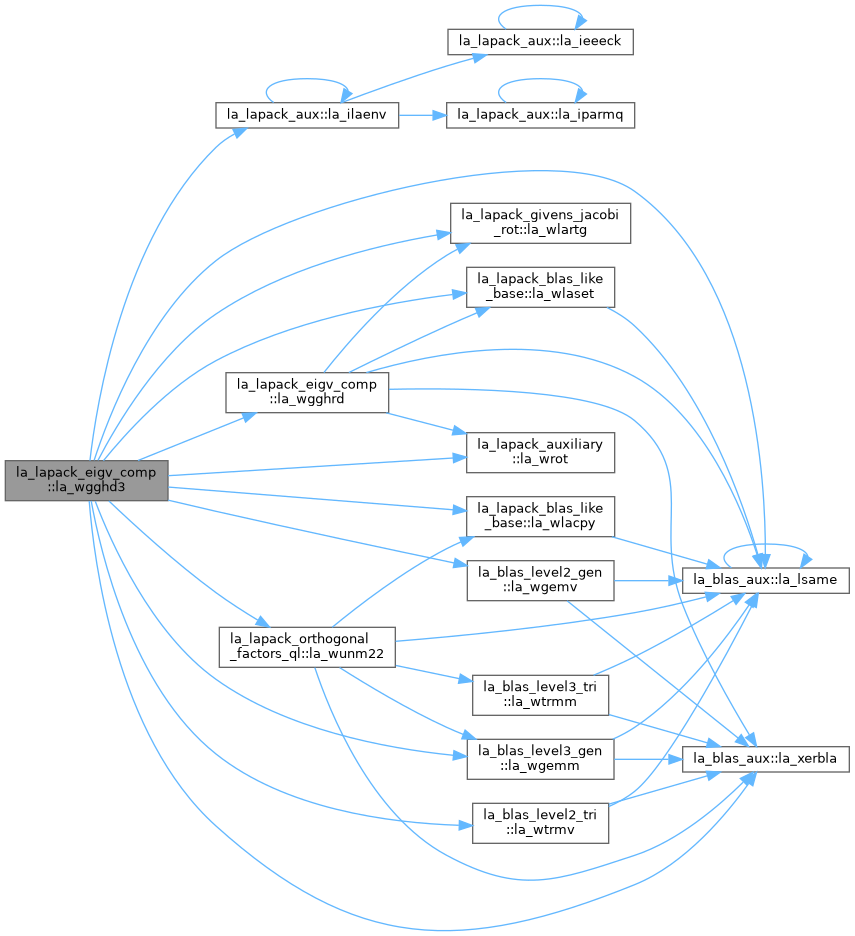
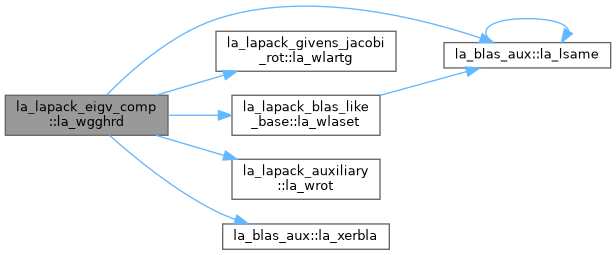
WGGHRD: reduces a pair of complex matrices (A,B) to generalized upper Hessenberg form using unitary transformations, where A is a general matrix and B is upper triangular. The form of the generalized eigenvalue problem is A*x = lambda*B*x, and B is typically made upper triangular by computing its QR factorization and moving the unitary matrix Q to the left side of the equation. This subroutine simultaneously reduces A to a Hessenberg matrix H: Q**H*A*Z = H and transforms B to another upper triangular matrix T: Q**H*B*Z = T in order to reduce the problem to its standard form H*y = lambda*T*y where y = Z**H*x. The unitary matrices Q and Z are determined as products of Givens rotations. They may either be formed explicitly, or they may be postmultiplied into input matrices Q1 and Z1, so that Q1 * A * Z1**H = (Q1*Q) * H * (Z1*Z)**H Q1 * B * Z1**H = (Q1*Q) * T * (Z1*Z)**H If Q1 is the unitary matrix from the QR factorization of B in the original equation A*x = lambda*B*x, then WGGHRD reduces the original problem to generalized Hessenberg form.
◆ la_whgeqz()
| subroutine, public la_lapack_eigv_comp::la_whgeqz | ( | character, intent(in) | job, |
| character, intent(in) | compq, | ||
| character, intent(in) | compz, | ||
| integer(ilp), intent(in) | n, | ||
| integer(ilp), intent(in) | ilo, | ||
| integer(ilp), intent(in) | ihi, | ||
| complex(qp), dimension(ldh,*), intent(inout) | h, | ||
| integer(ilp), intent(in) | ldh, | ||
| complex(qp), dimension(ldt,*), intent(inout) | t, | ||
| integer(ilp), intent(in) | ldt, | ||
| complex(qp), dimension(*), intent(out) | alpha, | ||
| complex(qp), dimension(*), intent(out) | beta, | ||
| complex(qp), dimension(ldq,*), intent(inout) | q, | ||
| integer(ilp), intent(in) | ldq, | ||
| complex(qp), dimension(ldz,*), intent(inout) | z, | ||
| integer(ilp), intent(in) | ldz, | ||
| complex(qp), dimension(*), intent(out) | work, | ||
| integer(ilp), intent(in) | lwork, | ||
| real(qp), dimension(*), intent(out) | rwork, | ||
| integer(ilp), intent(out) | info ) |
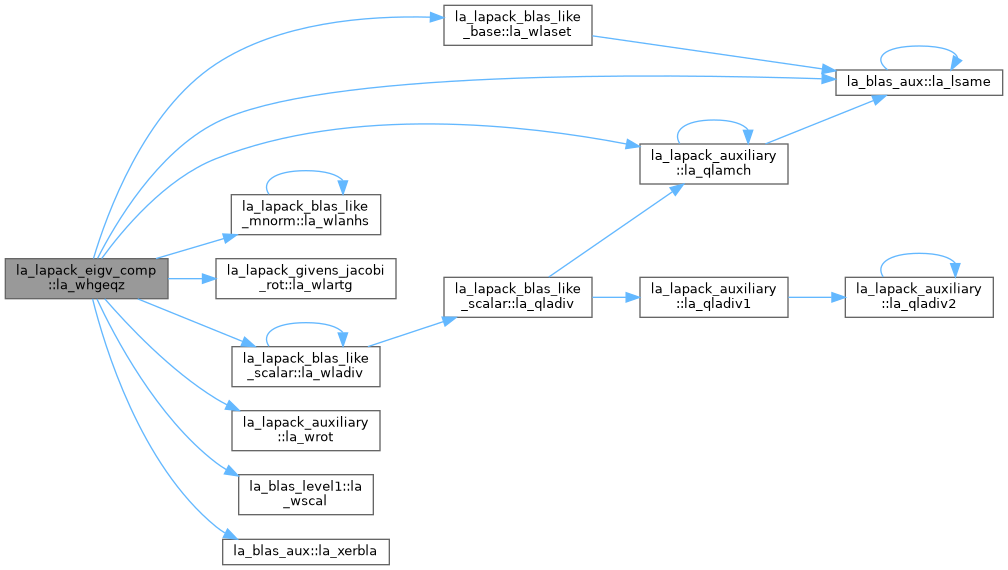
WHGEQZ: computes the eigenvalues of a complex matrix pair (H,T), where H is an upper Hessenberg matrix and T is upper triangular, using the single-shift QZ method. Matrix pairs of this type are produced by the reduction to generalized upper Hessenberg form of a complex matrix pair (A,B): A = Q1*H*Z1**H, B = Q1*T*Z1**H, as computed by WGGHRD. If JOB='S', then the Hessenberg-triangular pair (H,T) is also reduced to generalized Schur form, H = Q*S*Z**H, T = Q*P*Z**H, where Q and Z are unitary matrices and S and P are upper triangular. Optionally, the unitary matrix Q from the generalized Schur factorization may be postmultiplied into an input matrix Q1, and the unitary matrix Z may be postmultiplied into an input matrix Z1. If Q1 and Z1 are the unitary matrices from WGGHRD that reduced the matrix pair (A,B) to generalized Hessenberg form, then the output matrices Q1*Q and Z1*Z are the unitary factors from the generalized Schur factorization of (A,B): A = (Q1*Q)*S*(Z1*Z)**H, B = (Q1*Q)*P*(Z1*Z)**H. To avoid overflow, eigenvalues of the matrix pair (H,T) (equivalently, of (A,B)) are computed as a pair of complex values (alpha,beta). If beta is nonzero, lambda = alpha / beta is an eigenvalue of the generalized nonsymmetric eigenvalue problem (GNEP) A*x = lambda*B*x and if alpha is nonzero, mu = beta / alpha is an eigenvalue of the alternate form of the GNEP mu*A*y = B*y. The values of alpha and beta for the i-th eigenvalue can be read directly from the generalized Schur form: alpha = S(i,i), beta = P(i,i). Ref: C.B. Moler Eigenvalue Problems", SIAM J. Numer. Anal., 10(1973), pp. 241–256.
◆ la_zggbak()
| pure subroutine, public la_lapack_eigv_comp::la_zggbak | ( | character, intent(in) | job, |
| character, intent(in) | side, | ||
| integer(ilp), intent(in) | n, | ||
| integer(ilp), intent(in) | ilo, | ||
| integer(ilp), intent(in) | ihi, | ||
| real(dp), dimension(*), intent(in) | lscale, | ||
| real(dp), dimension(*), intent(in) | rscale, | ||
| integer(ilp), intent(in) | m, | ||
| complex(dp), dimension(ldv,*), intent(inout) | v, | ||
| integer(ilp), intent(in) | ldv, | ||
| integer(ilp), intent(out) | info ) |
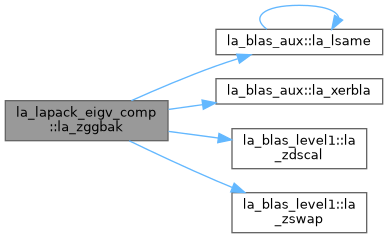
ZGGBAK: forms the right or left eigenvectors of a complex generalized eigenvalue problem A*x = lambda*B*x, by backward transformation on the computed eigenvectors of the balanced pair of matrices output by ZGGBAL.
◆ la_zggbal()
| pure subroutine, public la_lapack_eigv_comp::la_zggbal | ( | character, intent(in) | job, |
| integer(ilp), intent(in) | n, | ||
| complex(dp), dimension(lda,*), intent(inout) | a, | ||
| integer(ilp), intent(in) | lda, | ||
| complex(dp), dimension(ldb,*), intent(inout) | b, | ||
| integer(ilp), intent(in) | ldb, | ||
| integer(ilp), intent(out) | ilo, | ||
| integer(ilp), intent(out) | ihi, | ||
| real(dp), dimension(*), intent(out) | lscale, | ||
| real(dp), dimension(*), intent(out) | rscale, | ||
| real(dp), dimension(*), intent(out) | work, | ||
| integer(ilp), intent(out) | info ) |
ZGGBAL: balances a pair of general complex matrices (A,B). This involves, first, permuting A and B by similarity transformations to isolate eigenvalues in the first 1 to ILO$-$1 and last IHI+1 to N elements on the diagonal; and second, applying a diagonal similarity transformation to rows and columns ILO to IHI to make the rows and columns as close in norm as possible. Both steps are optional. Balancing may reduce the 1-norm of the matrices, and improve the accuracy of the computed eigenvalues and/or eigenvectors in the generalized eigenvalue problem A*x = lambda*B*x.
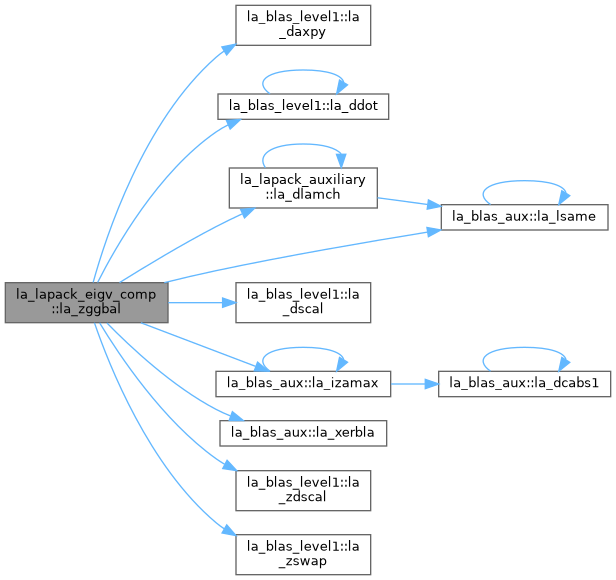
◆ la_zgghd3()
| pure subroutine, public la_lapack_eigv_comp::la_zgghd3 | ( | character, intent(in) | compq, |
| character, intent(in) | compz, | ||
| integer(ilp), intent(in) | n, | ||
| integer(ilp), intent(in) | ilo, | ||
| integer(ilp), intent(in) | ihi, | ||
| complex(dp), dimension(lda,*), intent(inout) | a, | ||
| integer(ilp), intent(in) | lda, | ||
| complex(dp), dimension(ldb,*), intent(inout) | b, | ||
| integer(ilp), intent(in) | ldb, | ||
| complex(dp), dimension(ldq,*), intent(inout) | q, | ||
| integer(ilp), intent(in) | ldq, | ||
| complex(dp), dimension(ldz,*), intent(inout) | z, | ||
| integer(ilp), intent(in) | ldz, | ||
| complex(dp), dimension(*), intent(out) | work, | ||
| integer(ilp), intent(in) | lwork, | ||
| integer(ilp), intent(out) | info ) |
ZGGHD3: reduces a pair of complex matrices (A,B) to generalized upper Hessenberg form using unitary transformations, where A is a general matrix and B is upper triangular. The form of the generalized eigenvalue problem is A*x = lambda*B*x, and B is typically made upper triangular by computing its QR factorization and moving the unitary matrix Q to the left side of the equation. This subroutine simultaneously reduces A to a Hessenberg matrix H: Q**H*A*Z = H and transforms B to another upper triangular matrix T: Q**H*B*Z = T in order to reduce the problem to its standard form H*y = lambda*T*y where y = Z**H*x. The unitary matrices Q and Z are determined as products of Givens rotations. They may either be formed explicitly, or they may be postmultiplied into input matrices Q1 and Z1, so that Q1 * A * Z1**H = (Q1*Q) * H * (Z1*Z)**H Q1 * B * Z1**H = (Q1*Q) * T * (Z1*Z)**H If Q1 is the unitary matrix from the QR factorization of B in the original equation A*x = lambda*B*x, then ZGGHD3 reduces the original problem to generalized Hessenberg form. This is a blocked variant of CGGHRD, using matrix-matrix multiplications for parts of the computation to enhance performance.
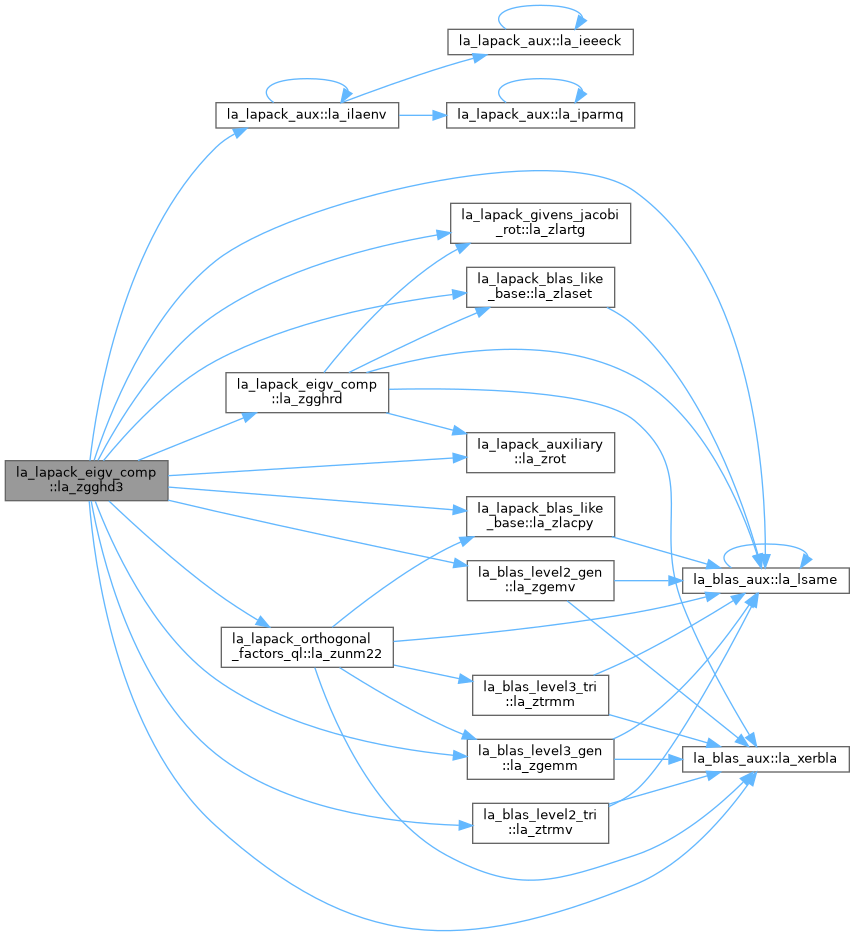
◆ la_zgghrd()
| pure subroutine, public la_lapack_eigv_comp::la_zgghrd | ( | character, intent(in) | compq, |
| character, intent(in) | compz, | ||
| integer(ilp), intent(in) | n, | ||
| integer(ilp), intent(in) | ilo, | ||
| integer(ilp), intent(in) | ihi, | ||
| complex(dp), dimension(lda,*), intent(inout) | a, | ||
| integer(ilp), intent(in) | lda, | ||
| complex(dp), dimension(ldb,*), intent(inout) | b, | ||
| integer(ilp), intent(in) | ldb, | ||
| complex(dp), dimension(ldq,*), intent(inout) | q, | ||
| integer(ilp), intent(in) | ldq, | ||
| complex(dp), dimension(ldz,*), intent(inout) | z, | ||
| integer(ilp), intent(in) | ldz, | ||
| integer(ilp), intent(out) | info ) |
ZGGHRD: reduces a pair of complex matrices (A,B) to generalized upper Hessenberg form using unitary transformations, where A is a general matrix and B is upper triangular. The form of the generalized eigenvalue problem is A*x = lambda*B*x, and B is typically made upper triangular by computing its QR factorization and moving the unitary matrix Q to the left side of the equation. This subroutine simultaneously reduces A to a Hessenberg matrix H: Q**H*A*Z = H and transforms B to another upper triangular matrix T: Q**H*B*Z = T in order to reduce the problem to its standard form H*y = lambda*T*y where y = Z**H*x. The unitary matrices Q and Z are determined as products of Givens rotations. They may either be formed explicitly, or they may be postmultiplied into input matrices Q1 and Z1, so that Q1 * A * Z1**H = (Q1*Q) * H * (Z1*Z)**H Q1 * B * Z1**H = (Q1*Q) * T * (Z1*Z)**H If Q1 is the unitary matrix from the QR factorization of B in the original equation A*x = lambda*B*x, then ZGGHRD reduces the original problem to generalized Hessenberg form.
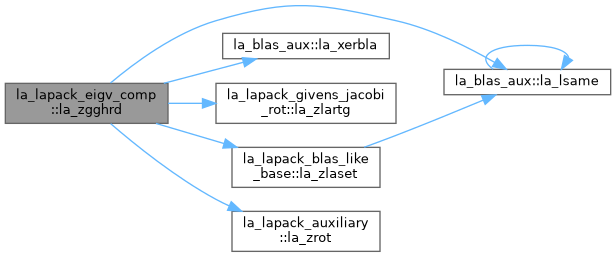
◆ la_zhgeqz()
| subroutine, public la_lapack_eigv_comp::la_zhgeqz | ( | character, intent(in) | job, |
| character, intent(in) | compq, | ||
| character, intent(in) | compz, | ||
| integer(ilp), intent(in) | n, | ||
| integer(ilp), intent(in) | ilo, | ||
| integer(ilp), intent(in) | ihi, | ||
| complex(dp), dimension(ldh,*), intent(inout) | h, | ||
| integer(ilp), intent(in) | ldh, | ||
| complex(dp), dimension(ldt,*), intent(inout) | t, | ||
| integer(ilp), intent(in) | ldt, | ||
| complex(dp), dimension(*), intent(out) | alpha, | ||
| complex(dp), dimension(*), intent(out) | beta, | ||
| complex(dp), dimension(ldq,*), intent(inout) | q, | ||
| integer(ilp), intent(in) | ldq, | ||
| complex(dp), dimension(ldz,*), intent(inout) | z, | ||
| integer(ilp), intent(in) | ldz, | ||
| complex(dp), dimension(*), intent(out) | work, | ||
| integer(ilp), intent(in) | lwork, | ||
| real(dp), dimension(*), intent(out) | rwork, | ||
| integer(ilp), intent(out) | info ) |
ZHGEQZ: computes the eigenvalues of a complex matrix pair (H,T), where H is an upper Hessenberg matrix and T is upper triangular, using the single-shift QZ method. Matrix pairs of this type are produced by the reduction to generalized upper Hessenberg form of a complex matrix pair (A,B): A = Q1*H*Z1**H, B = Q1*T*Z1**H, as computed by ZGGHRD. If JOB='S', then the Hessenberg-triangular pair (H,T) is also reduced to generalized Schur form, H = Q*S*Z**H, T = Q*P*Z**H, where Q and Z are unitary matrices and S and P are upper triangular. Optionally, the unitary matrix Q from the generalized Schur factorization may be postmultiplied into an input matrix Q1, and the unitary matrix Z may be postmultiplied into an input matrix Z1. If Q1 and Z1 are the unitary matrices from ZGGHRD that reduced the matrix pair (A,B) to generalized Hessenberg form, then the output matrices Q1*Q and Z1*Z are the unitary factors from the generalized Schur factorization of (A,B): A = (Q1*Q)*S*(Z1*Z)**H, B = (Q1*Q)*P*(Z1*Z)**H. To avoid overflow, eigenvalues of the matrix pair (H,T) (equivalently, of (A,B)) are computed as a pair of complex values (alpha,beta). If beta is nonzero, lambda = alpha / beta is an eigenvalue of the generalized nonsymmetric eigenvalue problem (GNEP) A*x = lambda*B*x and if alpha is nonzero, mu = beta / alpha is an eigenvalue of the alternate form of the GNEP mu*A*y = B*y. The values of alpha and beta for the i-th eigenvalue can be read directly from the generalized Schur form: alpha = S(i,i), beta = P(i,i). Ref: C.B. Moler Eigenvalue Problems", SIAM J. Numer. Anal., 10(1973), pp. 241–256.