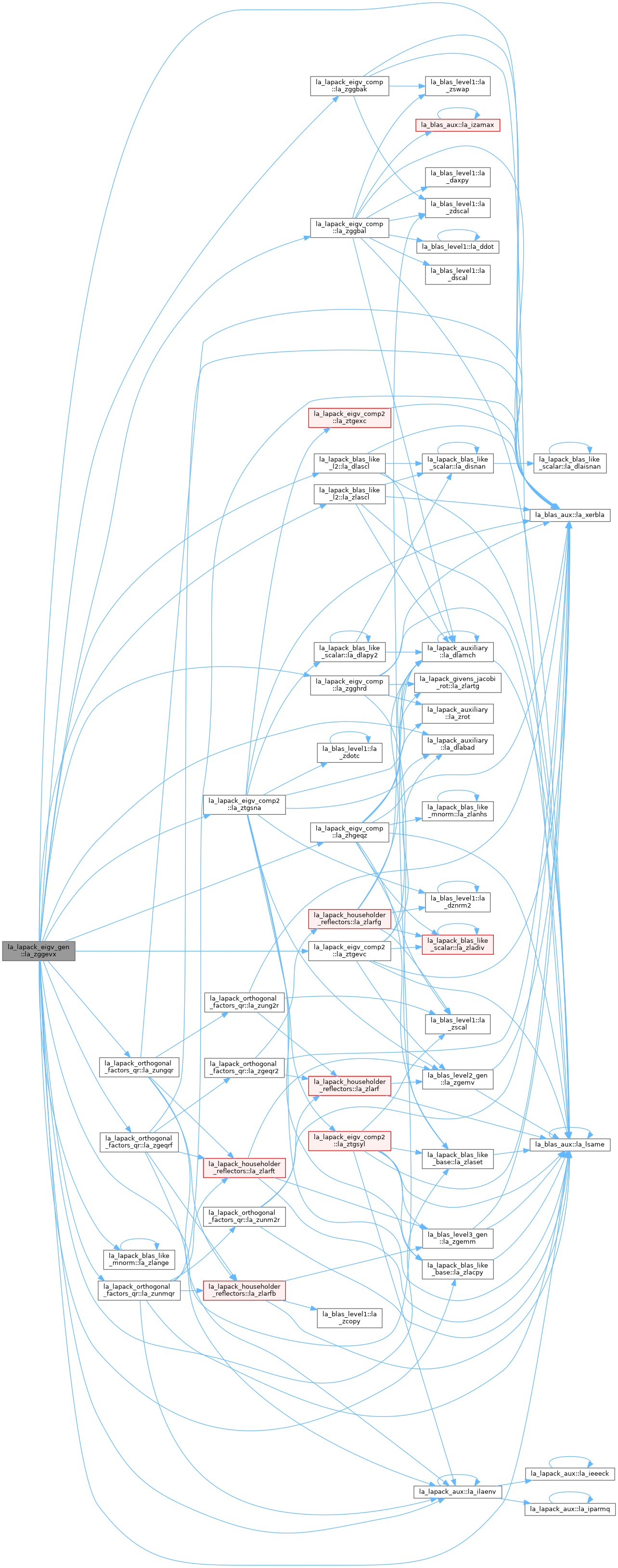
Nonsymmetric eigenvalue, Schur and generalized Schur drivers. More...
Functions/Subroutines | |
| subroutine, public | la_sgges (jobvsl, jobvsr, sort, selctg, n, a, lda, b, ldb, sdim, alphar, alphai, beta, vsl, ldvsl, vsr, ldvsr, work, lwork, bwork, info) |
| SGGES: computes for a pair of N-by-N real nonsymmetric matrices (A,B), the generalized eigenvalues, the generalized real Schur form (S,T), optionally, the left and/or right matrices of Schur vectors (VSL and VSR). This gives the generalized Schur factorization (A,B) = ( (VSL)*S*(VSR)**T, (VSL)*T*(VSR)**T ) Optionally, it also orders the eigenvalues so that a selected cluster of eigenvalues appears in the leading diagonal blocks of the upper quasi-triangular matrix S and the upper triangular matrix T.The leading columns of VSL and VSR then form an orthonormal basis for the corresponding left and right eigenspaces (deflating subspaces). (If only the generalized eigenvalues are needed, use the driver SGGEV instead, which is faster.) A generalized eigenvalue for a pair of matrices (A,B) is a scalar w or a ratio alpha/beta = w, such that A - w*B is singular. It is usually represented as the pair (alpha,beta), as there is a reasonable interpretation for beta=0 or both being zero. A pair of matrices (S,T) is in generalized real Schur form if T is upper triangular with non-negative diagonal and S is block upper triangular with 1-by-1 and 2-by-2 blocks. 1-by-1 blocks correspond to real generalized eigenvalues, while 2-by-2 blocks of S will be "standardized" by making the corresponding elements of T have the form: [ a 0 ] [ 0 b ] and the pair of corresponding 2-by-2 blocks in S and T will have a complex conjugate pair of generalized eigenvalues. | |
| subroutine, public | la_dgges (jobvsl, jobvsr, sort, selctg, n, a, lda, b, ldb, sdim, alphar, alphai, beta, vsl, ldvsl, vsr, ldvsr, work, lwork, bwork, info) |
| DGGES: computes for a pair of N-by-N real nonsymmetric matrices (A,B), the generalized eigenvalues, the generalized real Schur form (S,T), optionally, the left and/or right matrices of Schur vectors (VSL and VSR). This gives the generalized Schur factorization (A,B) = ( (VSL)*S*(VSR)**T, (VSL)*T*(VSR)**T ) Optionally, it also orders the eigenvalues so that a selected cluster of eigenvalues appears in the leading diagonal blocks of the upper quasi-triangular matrix S and the upper triangular matrix T.The leading columns of VSL and VSR then form an orthonormal basis for the corresponding left and right eigenspaces (deflating subspaces). (If only the generalized eigenvalues are needed, use the driver DGGEV instead, which is faster.) A generalized eigenvalue for a pair of matrices (A,B) is a scalar w or a ratio alpha/beta = w, such that A - w*B is singular. It is usually represented as the pair (alpha,beta), as there is a reasonable interpretation for beta=0 or both being zero. A pair of matrices (S,T) is in generalized real Schur form if T is upper triangular with non-negative diagonal and S is block upper triangular with 1-by-1 and 2-by-2 blocks. 1-by-1 blocks correspond to real generalized eigenvalues, while 2-by-2 blocks of S will be "standardized" by making the corresponding elements of T have the form: [ a 0 ] [ 0 b ] and the pair of corresponding 2-by-2 blocks in S and T will have a complex conjugate pair of generalized eigenvalues. | |
| subroutine, public | la_qgges (jobvsl, jobvsr, sort, selctg, n, a, lda, b, ldb, sdim, alphar, alphai, beta, vsl, ldvsl, vsr, ldvsr, work, lwork, bwork, info) |
| QGGES: computes for a pair of N-by-N real nonsymmetric matrices (A,B), the generalized eigenvalues, the generalized real Schur form (S,T), optionally, the left and/or right matrices of Schur vectors (VSL and VSR). This gives the generalized Schur factorization (A,B) = ( (VSL)*S*(VSR)**T, (VSL)*T*(VSR)**T ) Optionally, it also orders the eigenvalues so that a selected cluster of eigenvalues appears in the leading diagonal blocks of the upper quasi-triangular matrix S and the upper triangular matrix T.The leading columns of VSL and VSR then form an orthonormal basis for the corresponding left and right eigenspaces (deflating subspaces). (If only the generalized eigenvalues are needed, use the driver QGGEV instead, which is faster.) A generalized eigenvalue for a pair of matrices (A,B) is a scalar w or a ratio alpha/beta = w, such that A - w*B is singular. It is usually represented as the pair (alpha,beta), as there is a reasonable interpretation for beta=0 or both being zero. A pair of matrices (S,T) is in generalized real Schur form if T is upper triangular with non-negative diagonal and S is block upper triangular with 1-by-1 and 2-by-2 blocks. 1-by-1 blocks correspond to real generalized eigenvalues, while 2-by-2 blocks of S will be "standardized" by making the corresponding elements of T have the form: [ a 0 ] [ 0 b ] and the pair of corresponding 2-by-2 blocks in S and T will have a complex conjugate pair of generalized eigenvalues. | |
| subroutine, public | la_sggesx (jobvsl, jobvsr, sort, selctg, sense, n, a, lda, b, ldb, sdim, alphar, alphai, beta, vsl, ldvsl, vsr, ldvsr, rconde, rcondv, work, lwork, iwork, liwork, bwork, info) |
| SGGESX: computes for a pair of N-by-N real nonsymmetric matrices (A,B), the generalized eigenvalues, the real Schur form (S,T), and, optionally, the left and/or right matrices of Schur vectors (VSL and VSR). This gives the generalized Schur factorization (A,B) = ( (VSL) S (VSR)**T, (VSL) T (VSR)**T ) Optionally, it also orders the eigenvalues so that a selected cluster of eigenvalues appears in the leading diagonal blocks of the upper quasi-triangular matrix S and the upper triangular matrix T; computes a reciprocal condition number for the average of the selected eigenvalues (RCONDE); and computes a reciprocal condition number for the right and left deflating subspaces corresponding to the selected eigenvalues (RCONDV). The leading columns of VSL and VSR then form an orthonormal basis for the corresponding left and right eigenspaces (deflating subspaces). A generalized eigenvalue for a pair of matrices (A,B) is a scalar w or a ratio alpha/beta = w, such that A - w*B is singular. It is usually represented as the pair (alpha,beta), as there is a reasonable interpretation for beta=0 or for both being zero. A pair of matrices (S,T) is in generalized real Schur form if T is upper triangular with non-negative diagonal and S is block upper triangular with 1-by-1 and 2-by-2 blocks. 1-by-1 blocks correspond to real generalized eigenvalues, while 2-by-2 blocks of S will be "standardized" by making the corresponding elements of T have the form: [ a 0 ] [ 0 b ] and the pair of corresponding 2-by-2 blocks in S and T will have a complex conjugate pair of generalized eigenvalues. | |
| subroutine, public | la_dggesx (jobvsl, jobvsr, sort, selctg, sense, n, a, lda, b, ldb, sdim, alphar, alphai, beta, vsl, ldvsl, vsr, ldvsr, rconde, rcondv, work, lwork, iwork, liwork, bwork, info) |
| DGGESX: computes for a pair of N-by-N real nonsymmetric matrices (A,B), the generalized eigenvalues, the real Schur form (S,T), and, optionally, the left and/or right matrices of Schur vectors (VSL and VSR). This gives the generalized Schur factorization (A,B) = ( (VSL) S (VSR)**T, (VSL) T (VSR)**T ) Optionally, it also orders the eigenvalues so that a selected cluster of eigenvalues appears in the leading diagonal blocks of the upper quasi-triangular matrix S and the upper triangular matrix T; computes a reciprocal condition number for the average of the selected eigenvalues (RCONDE); and computes a reciprocal condition number for the right and left deflating subspaces corresponding to the selected eigenvalues (RCONDV). The leading columns of VSL and VSR then form an orthonormal basis for the corresponding left and right eigenspaces (deflating subspaces). A generalized eigenvalue for a pair of matrices (A,B) is a scalar w or a ratio alpha/beta = w, such that A - w*B is singular. It is usually represented as the pair (alpha,beta), as there is a reasonable interpretation for beta=0 or for both being zero. A pair of matrices (S,T) is in generalized real Schur form if T is upper triangular with non-negative diagonal and S is block upper triangular with 1-by-1 and 2-by-2 blocks. 1-by-1 blocks correspond to real generalized eigenvalues, while 2-by-2 blocks of S will be "standardized" by making the corresponding elements of T have the form: [ a 0 ] [ 0 b ] and the pair of corresponding 2-by-2 blocks in S and T will have a complex conjugate pair of generalized eigenvalues. | |
| subroutine, public | la_qggesx (jobvsl, jobvsr, sort, selctg, sense, n, a, lda, b, ldb, sdim, alphar, alphai, beta, vsl, ldvsl, vsr, ldvsr, rconde, rcondv, work, lwork, iwork, liwork, bwork, info) |
| QGGESX: computes for a pair of N-by-N real nonsymmetric matrices (A,B), the generalized eigenvalues, the real Schur form (S,T), and, optionally, the left and/or right matrices of Schur vectors (VSL and VSR). This gives the generalized Schur factorization (A,B) = ( (VSL) S (VSR)**T, (VSL) T (VSR)**T ) Optionally, it also orders the eigenvalues so that a selected cluster of eigenvalues appears in the leading diagonal blocks of the upper quasi-triangular matrix S and the upper triangular matrix T; computes a reciprocal condition number for the average of the selected eigenvalues (RCONDE); and computes a reciprocal condition number for the right and left deflating subspaces corresponding to the selected eigenvalues (RCONDV). The leading columns of VSL and VSR then form an orthonormal basis for the corresponding left and right eigenspaces (deflating subspaces). A generalized eigenvalue for a pair of matrices (A,B) is a scalar w or a ratio alpha/beta = w, such that A - w*B is singular. It is usually represented as the pair (alpha,beta), as there is a reasonable interpretation for beta=0 or for both being zero. A pair of matrices (S,T) is in generalized real Schur form if T is upper triangular with non-negative diagonal and S is block upper triangular with 1-by-1 and 2-by-2 blocks. 1-by-1 blocks correspond to real generalized eigenvalues, while 2-by-2 blocks of S will be "standardized" by making the corresponding elements of T have the form: [ a 0 ] [ 0 b ] and the pair of corresponding 2-by-2 blocks in S and T will have a complex conjugate pair of generalized eigenvalues. | |
| subroutine, public | la_sggev (jobvl, jobvr, n, a, lda, b, ldb, alphar, alphai, beta, vl, ldvl, vr, ldvr, work, lwork, info) |
| SGGEV: computes for a pair of N-by-N real nonsymmetric matrices (A,B) the generalized eigenvalues, and optionally, the left and/or right generalized eigenvectors. A generalized eigenvalue for a pair of matrices (A,B) is a scalar lambda or a ratio alpha/beta = lambda, such that A - lambda*B is singular. It is usually represented as the pair (alpha,beta), as there is a reasonable interpretation for beta=0, and even for both being zero. The right eigenvector v(j) corresponding to the eigenvalue lambda(j) of (A,B) satisfies A * v(j) = lambda(j) * B * v(j). The left eigenvector u(j) corresponding to the eigenvalue lambda(j) of (A,B) satisfies u(j)**H * A = lambda(j) * u(j)**H * B . where u(j)**H is the conjugate-transpose of u(j). | |
| subroutine, public | la_dggev (jobvl, jobvr, n, a, lda, b, ldb, alphar, alphai, beta, vl, ldvl, vr, ldvr, work, lwork, info) |
| DGGEV: computes for a pair of N-by-N real nonsymmetric matrices (A,B) the generalized eigenvalues, and optionally, the left and/or right generalized eigenvectors. A generalized eigenvalue for a pair of matrices (A,B) is a scalar lambda or a ratio alpha/beta = lambda, such that A - lambda*B is singular. It is usually represented as the pair (alpha,beta), as there is a reasonable interpretation for beta=0, and even for both being zero. The right eigenvector v(j) corresponding to the eigenvalue lambda(j) of (A,B) satisfies A * v(j) = lambda(j) * B * v(j). The left eigenvector u(j) corresponding to the eigenvalue lambda(j) of (A,B) satisfies u(j)**H * A = lambda(j) * u(j)**H * B . where u(j)**H is the conjugate-transpose of u(j). | |
| subroutine, public | la_qggev (jobvl, jobvr, n, a, lda, b, ldb, alphar, alphai, beta, vl, ldvl, vr, ldvr, work, lwork, info) |
| QGGEV: computes for a pair of N-by-N real nonsymmetric matrices (A,B) the generalized eigenvalues, and optionally, the left and/or right generalized eigenvectors. A generalized eigenvalue for a pair of matrices (A,B) is a scalar lambda or a ratio alpha/beta = lambda, such that A - lambda*B is singular. It is usually represented as the pair (alpha,beta), as there is a reasonable interpretation for beta=0, and even for both being zero. The right eigenvector v(j) corresponding to the eigenvalue lambda(j) of (A,B) satisfies A * v(j) = lambda(j) * B * v(j). The left eigenvector u(j) corresponding to the eigenvalue lambda(j) of (A,B) satisfies u(j)**H * A = lambda(j) * u(j)**H * B . where u(j)**H is the conjugate-transpose of u(j). | |
| subroutine, public | la_sggevx (balanc, jobvl, jobvr, sense, n, a, lda, b, ldb, alphar, alphai, beta, vl, ldvl, vr, ldvr, ilo, ihi, lscale, rscale, abnrm, bbnrm, rconde, rcondv, work, lwork, iwork, bwork, info) |
| SGGEVX: computes for a pair of N-by-N real nonsymmetric matrices (A,B) the generalized eigenvalues, and optionally, the left and/or right generalized eigenvectors. Optionally also, it computes a balancing transformation to improve the conditioning of the eigenvalues and eigenvectors (ILO, IHI, LSCALE, RSCALE, ABNRM, and BBNRM), reciprocal condition numbers for the eigenvalues (RCONDE), and reciprocal condition numbers for the right eigenvectors (RCONDV). A generalized eigenvalue for a pair of matrices (A,B) is a scalar lambda or a ratio alpha/beta = lambda, such that A - lambda*B is singular. It is usually represented as the pair (alpha,beta), as there is a reasonable interpretation for beta=0, and even for both being zero. The right eigenvector v(j) corresponding to the eigenvalue lambda(j) of (A,B) satisfies A * v(j) = lambda(j) * B * v(j) . The left eigenvector u(j) corresponding to the eigenvalue lambda(j) of (A,B) satisfies u(j)**H * A = lambda(j) * u(j)**H * B. where u(j)**H is the conjugate-transpose of u(j). | |
| subroutine, public | la_dggevx (balanc, jobvl, jobvr, sense, n, a, lda, b, ldb, alphar, alphai, beta, vl, ldvl, vr, ldvr, ilo, ihi, lscale, rscale, abnrm, bbnrm, rconde, rcondv, work, lwork, iwork, bwork, info) |
| DGGEVX: computes for a pair of N-by-N real nonsymmetric matrices (A,B) the generalized eigenvalues, and optionally, the left and/or right generalized eigenvectors. Optionally also, it computes a balancing transformation to improve the conditioning of the eigenvalues and eigenvectors (ILO, IHI, LSCALE, RSCALE, ABNRM, and BBNRM), reciprocal condition numbers for the eigenvalues (RCONDE), and reciprocal condition numbers for the right eigenvectors (RCONDV). A generalized eigenvalue for a pair of matrices (A,B) is a scalar lambda or a ratio alpha/beta = lambda, such that A - lambda*B is singular. It is usually represented as the pair (alpha,beta), as there is a reasonable interpretation for beta=0, and even for both being zero. The right eigenvector v(j) corresponding to the eigenvalue lambda(j) of (A,B) satisfies A * v(j) = lambda(j) * B * v(j) . The left eigenvector u(j) corresponding to the eigenvalue lambda(j) of (A,B) satisfies u(j)**H * A = lambda(j) * u(j)**H * B. where u(j)**H is the conjugate-transpose of u(j). | |
| subroutine, public | la_qggevx (balanc, jobvl, jobvr, sense, n, a, lda, b, ldb, alphar, alphai, beta, vl, ldvl, vr, ldvr, ilo, ihi, lscale, rscale, abnrm, bbnrm, rconde, rcondv, work, lwork, iwork, bwork, info) |
| QGGEVX: computes for a pair of N-by-N real nonsymmetric matrices (A,B) the generalized eigenvalues, and optionally, the left and/or right generalized eigenvectors. Optionally also, it computes a balancing transformation to improve the conditioning of the eigenvalues and eigenvectors (ILO, IHI, LSCALE, RSCALE, ABNRM, and BBNRM), reciprocal condition numbers for the eigenvalues (RCONDE), and reciprocal condition numbers for the right eigenvectors (RCONDV). A generalized eigenvalue for a pair of matrices (A,B) is a scalar lambda or a ratio alpha/beta = lambda, such that A - lambda*B is singular. It is usually represented as the pair (alpha,beta), as there is a reasonable interpretation for beta=0, and even for both being zero. The right eigenvector v(j) corresponding to the eigenvalue lambda(j) of (A,B) satisfies A * v(j) = lambda(j) * B * v(j) . The left eigenvector u(j) corresponding to the eigenvalue lambda(j) of (A,B) satisfies u(j)**H * A = lambda(j) * u(j)**H * B. where u(j)**H is the conjugate-transpose of u(j). | |
| subroutine, public | la_sgees (jobvs, sort, select, n, a, lda, sdim, wr, wi, vs, ldvs, work, lwork, bwork, info) |
| SGEES: computes for an N-by-N real nonsymmetric matrix A, the eigenvalues, the real Schur form T, and, optionally, the matrix of Schur vectors Z. This gives the Schur factorization A = Z*T*(Z**T). Optionally, it also orders the eigenvalues on the diagonal of the real Schur form so that selected eigenvalues are at the top left. The leading columns of Z then form an orthonormal basis for the invariant subspace corresponding to the selected eigenvalues. A matrix is in real Schur form if it is upper quasi-triangular with 1-by-1 and 2-by-2 blocks. 2-by-2 blocks will be standardized in the form [ a b ] [ c a ] where b*c < 0. The eigenvalues of such a block are a +- sqrt(bc). | |
| subroutine, public | la_dgees (jobvs, sort, select, n, a, lda, sdim, wr, wi, vs, ldvs, work, lwork, bwork, info) |
| DGEES: computes for an N-by-N real nonsymmetric matrix A, the eigenvalues, the real Schur form T, and, optionally, the matrix of Schur vectors Z. This gives the Schur factorization A = Z*T*(Z**T). Optionally, it also orders the eigenvalues on the diagonal of the real Schur form so that selected eigenvalues are at the top left. The leading columns of Z then form an orthonormal basis for the invariant subspace corresponding to the selected eigenvalues. A matrix is in real Schur form if it is upper quasi-triangular with 1-by-1 and 2-by-2 blocks. 2-by-2 blocks will be standardized in the form [ a b ] [ c a ] where b*c < 0. The eigenvalues of such a block are a +- sqrt(bc). | |
| subroutine, public | la_qgees (jobvs, sort, select, n, a, lda, sdim, wr, wi, vs, ldvs, work, lwork, bwork, info) |
| QGEES: computes for an N-by-N real nonsymmetric matrix A, the eigenvalues, the real Schur form T, and, optionally, the matrix of Schur vectors Z. This gives the Schur factorization A = Z*T*(Z**T). Optionally, it also orders the eigenvalues on the diagonal of the real Schur form so that selected eigenvalues are at the top left. The leading columns of Z then form an orthonormal basis for the invariant subspace corresponding to the selected eigenvalues. A matrix is in real Schur form if it is upper quasi-triangular with 1-by-1 and 2-by-2 blocks. 2-by-2 blocks will be standardized in the form [ a b ] [ c a ] where b*c < 0. The eigenvalues of such a block are a +- sqrt(bc). | |
| subroutine, public | la_sgeesx (jobvs, sort, select, sense, n, a, lda, sdim, wr, wi, vs, ldvs, rconde, rcondv, work, lwork, iwork, liwork, bwork, info) |
| SGEESX: computes for an N-by-N real nonsymmetric matrix A, the eigenvalues, the real Schur form T, and, optionally, the matrix of Schur vectors Z. This gives the Schur factorization A = Z*T*(Z**T). Optionally, it also orders the eigenvalues on the diagonal of the real Schur form so that selected eigenvalues are at the top left; computes a reciprocal condition number for the average of the selected eigenvalues (RCONDE); and computes a reciprocal condition number for the right invariant subspace corresponding to the selected eigenvalues (RCONDV). The leading columns of Z form an orthonormal basis for this invariant subspace. For further explanation of the reciprocal condition numbers RCONDE and RCONDV, see Section 4.10_sp of the LAPACK Users' Guide (where these quantities are called s and sep respectively). A real matrix is in real Schur form if it is upper quasi-triangular with 1-by-1 and 2-by-2 blocks. 2-by-2 blocks will be standardized in the form [ a b ] [ c a ] where b*c < 0. The eigenvalues of such a block are a +- sqrt(bc). | |
| subroutine, public | la_dgeesx (jobvs, sort, select, sense, n, a, lda, sdim, wr, wi, vs, ldvs, rconde, rcondv, work, lwork, iwork, liwork, bwork, info) |
| DGEESX: computes for an N-by-N real nonsymmetric matrix A, the eigenvalues, the real Schur form T, and, optionally, the matrix of Schur vectors Z. This gives the Schur factorization A = Z*T*(Z**T). Optionally, it also orders the eigenvalues on the diagonal of the real Schur form so that selected eigenvalues are at the top left; computes a reciprocal condition number for the average of the selected eigenvalues (RCONDE); and computes a reciprocal condition number for the right invariant subspace corresponding to the selected eigenvalues (RCONDV). The leading columns of Z form an orthonormal basis for this invariant subspace. For further explanation of the reciprocal condition numbers RCONDE and RCONDV, see Section 4.10_dp of the LAPACK Users' Guide (where these quantities are called s and sep respectively). A real matrix is in real Schur form if it is upper quasi-triangular with 1-by-1 and 2-by-2 blocks. 2-by-2 blocks will be standardized in the form [ a b ] [ c a ] where b*c < 0. The eigenvalues of such a block are a +- sqrt(bc). | |
| subroutine, public | la_qgeesx (jobvs, sort, select, sense, n, a, lda, sdim, wr, wi, vs, ldvs, rconde, rcondv, work, lwork, iwork, liwork, bwork, info) |
| QGEESX: computes for an N-by-N real nonsymmetric matrix A, the eigenvalues, the real Schur form T, and, optionally, the matrix of Schur vectors Z. This gives the Schur factorization A = Z*T*(Z**T). Optionally, it also orders the eigenvalues on the diagonal of the real Schur form so that selected eigenvalues are at the top left; computes a reciprocal condition number for the average of the selected eigenvalues (RCONDE); and computes a reciprocal condition number for the right invariant subspace corresponding to the selected eigenvalues (RCONDV). The leading columns of Z form an orthonormal basis for this invariant subspace. For further explanation of the reciprocal condition numbers RCONDE and RCONDV, see Section 4.10_qp of the LAPACK Users' Guide (where these quantities are called s and sep respectively). A real matrix is in real Schur form if it is upper quasi-triangular with 1-by-1 and 2-by-2 blocks. 2-by-2 blocks will be standardized in the form [ a b ] [ c a ] where b*c < 0. The eigenvalues of such a block are a +- sqrt(bc). | |
| subroutine, public | la_sgeev (jobvl, jobvr, n, a, lda, wr, wi, vl, ldvl, vr, ldvr, work, lwork, info) |
| SGEEV: computes for an N-by-N real nonsymmetric matrix A, the eigenvalues and, optionally, the left and/or right eigenvectors. The right eigenvector v(j) of A satisfies A * v(j) = lambda(j) * v(j) where lambda(j) is its eigenvalue. The left eigenvector u(j) of A satisfies u(j)**H * A = lambda(j) * u(j)**H where u(j)**H denotes the conjugate-transpose of u(j). The computed eigenvectors are normalized to have Euclidean norm equal to 1 and largest component real. | |
| subroutine, public | la_dgeev (jobvl, jobvr, n, a, lda, wr, wi, vl, ldvl, vr, ldvr, work, lwork, info) |
| DGEEV: computes for an N-by-N real nonsymmetric matrix A, the eigenvalues and, optionally, the left and/or right eigenvectors. The right eigenvector v(j) of A satisfies A * v(j) = lambda(j) * v(j) where lambda(j) is its eigenvalue. The left eigenvector u(j) of A satisfies u(j)**H * A = lambda(j) * u(j)**H where u(j)**H denotes the conjugate-transpose of u(j). The computed eigenvectors are normalized to have Euclidean norm equal to 1 and largest component real. | |
| subroutine, public | la_qgeev (jobvl, jobvr, n, a, lda, wr, wi, vl, ldvl, vr, ldvr, work, lwork, info) |
| QGEEV: computes for an N-by-N real nonsymmetric matrix A, the eigenvalues and, optionally, the left and/or right eigenvectors. The right eigenvector v(j) of A satisfies A * v(j) = lambda(j) * v(j) where lambda(j) is its eigenvalue. The left eigenvector u(j) of A satisfies u(j)**H * A = lambda(j) * u(j)**H where u(j)**H denotes the conjugate-transpose of u(j). The computed eigenvectors are normalized to have Euclidean norm equal to 1 and largest component real. | |
| subroutine, public | la_sgeevx (balanc, jobvl, jobvr, sense, n, a, lda, wr, wi, vl, ldvl, vr, ldvr, ilo, ihi, scale, abnrm, rconde, rcondv, work, lwork, iwork, info) |
| SGEEVX: computes for an N-by-N real nonsymmetric matrix A, the eigenvalues and, optionally, the left and/or right eigenvectors. Optionally also, it computes a balancing transformation to improve the conditioning of the eigenvalues and eigenvectors (ILO, IHI, SCALE, and ABNRM), reciprocal condition numbers for the eigenvalues (RCONDE), and reciprocal condition numbers for the right eigenvectors (RCONDV). The right eigenvector v(j) of A satisfies A * v(j) = lambda(j) * v(j) where lambda(j) is its eigenvalue. The left eigenvector u(j) of A satisfies u(j)**H * A = lambda(j) * u(j)**H where u(j)**H denotes the conjugate-transpose of u(j). The computed eigenvectors are normalized to have Euclidean norm equal to 1 and largest component real. Balancing a matrix means permuting the rows and columns to make it more nearly upper triangular, and applying a diagonal similarity transformation D * A * D**(-1), where D is a diagonal matrix, to make its rows and columns closer in norm and the condition numbers of its eigenvalues and eigenvectors smaller. The computed reciprocal condition numbers correspond to the balanced matrix. Permuting rows and columns will not change the condition numbers (in exact arithmetic) but diagonal scaling will. For further explanation of balancing, see section 4.10.2_sp of the LAPACK Users' Guide. | |
| subroutine, public | la_dgeevx (balanc, jobvl, jobvr, sense, n, a, lda, wr, wi, vl, ldvl, vr, ldvr, ilo, ihi, scale, abnrm, rconde, rcondv, work, lwork, iwork, info) |
| DGEEVX: computes for an N-by-N real nonsymmetric matrix A, the eigenvalues and, optionally, the left and/or right eigenvectors. Optionally also, it computes a balancing transformation to improve the conditioning of the eigenvalues and eigenvectors (ILO, IHI, SCALE, and ABNRM), reciprocal condition numbers for the eigenvalues (RCONDE), and reciprocal condition numbers for the right eigenvectors (RCONDV). The right eigenvector v(j) of A satisfies A * v(j) = lambda(j) * v(j) where lambda(j) is its eigenvalue. The left eigenvector u(j) of A satisfies u(j)**H * A = lambda(j) * u(j)**H where u(j)**H denotes the conjugate-transpose of u(j). The computed eigenvectors are normalized to have Euclidean norm equal to 1 and largest component real. Balancing a matrix means permuting the rows and columns to make it more nearly upper triangular, and applying a diagonal similarity transformation D * A * D**(-1), where D is a diagonal matrix, to make its rows and columns closer in norm and the condition numbers of its eigenvalues and eigenvectors smaller. The computed reciprocal condition numbers correspond to the balanced matrix. Permuting rows and columns will not change the condition numbers (in exact arithmetic) but diagonal scaling will. For further explanation of balancing, see section 4.10.2_dp of the LAPACK Users' Guide. | |
| subroutine, public | la_qgeevx (balanc, jobvl, jobvr, sense, n, a, lda, wr, wi, vl, ldvl, vr, ldvr, ilo, ihi, scale, abnrm, rconde, rcondv, work, lwork, iwork, info) |
| QGEEVX: computes for an N-by-N real nonsymmetric matrix A, the eigenvalues and, optionally, the left and/or right eigenvectors. Optionally also, it computes a balancing transformation to improve the conditioning of the eigenvalues and eigenvectors (ILO, IHI, SCALE, and ABNRM), reciprocal condition numbers for the eigenvalues (RCONDE), and reciprocal condition numbers for the right eigenvectors (RCONDV). The right eigenvector v(j) of A satisfies A * v(j) = lambda(j) * v(j) where lambda(j) is its eigenvalue. The left eigenvector u(j) of A satisfies u(j)**H * A = lambda(j) * u(j)**H where u(j)**H denotes the conjugate-transpose of u(j). The computed eigenvectors are normalized to have Euclidean norm equal to 1 and largest component real. Balancing a matrix means permuting the rows and columns to make it more nearly upper triangular, and applying a diagonal similarity transformation D * A * D**(-1), where D is a diagonal matrix, to make its rows and columns closer in norm and the condition numbers of its eigenvalues and eigenvectors smaller. The computed reciprocal condition numbers correspond to the balanced matrix. Permuting rows and columns will not change the condition numbers (in exact arithmetic) but diagonal scaling will. For further explanation of balancing, see section 4.10.2_qp of the LAPACK Users' Guide. | |
| subroutine, public | la_sgges3 (jobvsl, jobvsr, sort, selctg, n, a, lda, b, ldb, sdim, alphar, alphai, beta, vsl, ldvsl, vsr, ldvsr, work, lwork, bwork, info) |
| SGGES3: computes for a pair of N-by-N real nonsymmetric matrices (A,B), the generalized eigenvalues, the generalized real Schur form (S,T), optionally, the left and/or right matrices of Schur vectors (VSL and VSR). This gives the generalized Schur factorization (A,B) = ( (VSL)*S*(VSR)**T, (VSL)*T*(VSR)**T ) Optionally, it also orders the eigenvalues so that a selected cluster of eigenvalues appears in the leading diagonal blocks of the upper quasi-triangular matrix S and the upper triangular matrix T.The leading columns of VSL and VSR then form an orthonormal basis for the corresponding left and right eigenspaces (deflating subspaces). (If only the generalized eigenvalues are needed, use the driver SGGEV instead, which is faster.) A generalized eigenvalue for a pair of matrices (A,B) is a scalar w or a ratio alpha/beta = w, such that A - w*B is singular. It is usually represented as the pair (alpha,beta), as there is a reasonable interpretation for beta=0 or both being zero. A pair of matrices (S,T) is in generalized real Schur form if T is upper triangular with non-negative diagonal and S is block upper triangular with 1-by-1 and 2-by-2 blocks. 1-by-1 blocks correspond to real generalized eigenvalues, while 2-by-2 blocks of S will be "standardized" by making the corresponding elements of T have the form: [ a 0 ] [ 0 b ] and the pair of corresponding 2-by-2 blocks in S and T will have a complex conjugate pair of generalized eigenvalues. | |
| subroutine, public | la_dgges3 (jobvsl, jobvsr, sort, selctg, n, a, lda, b, ldb, sdim, alphar, alphai, beta, vsl, ldvsl, vsr, ldvsr, work, lwork, bwork, info) |
| DGGES3: computes for a pair of N-by-N real nonsymmetric matrices (A,B), the generalized eigenvalues, the generalized real Schur form (S,T), optionally, the left and/or right matrices of Schur vectors (VSL and VSR). This gives the generalized Schur factorization (A,B) = ( (VSL)*S*(VSR)**T, (VSL)*T*(VSR)**T ) Optionally, it also orders the eigenvalues so that a selected cluster of eigenvalues appears in the leading diagonal blocks of the upper quasi-triangular matrix S and the upper triangular matrix T.The leading columns of VSL and VSR then form an orthonormal basis for the corresponding left and right eigenspaces (deflating subspaces). (If only the generalized eigenvalues are needed, use the driver DGGEV instead, which is faster.) A generalized eigenvalue for a pair of matrices (A,B) is a scalar w or a ratio alpha/beta = w, such that A - w*B is singular. It is usually represented as the pair (alpha,beta), as there is a reasonable interpretation for beta=0 or both being zero. A pair of matrices (S,T) is in generalized real Schur form if T is upper triangular with non-negative diagonal and S is block upper triangular with 1-by-1 and 2-by-2 blocks. 1-by-1 blocks correspond to real generalized eigenvalues, while 2-by-2 blocks of S will be "standardized" by making the corresponding elements of T have the form: [ a 0 ] [ 0 b ] and the pair of corresponding 2-by-2 blocks in S and T will have a complex conjugate pair of generalized eigenvalues. | |
| subroutine, public | la_qgges3 (jobvsl, jobvsr, sort, selctg, n, a, lda, b, ldb, sdim, alphar, alphai, beta, vsl, ldvsl, vsr, ldvsr, work, lwork, bwork, info) |
| QGGES3: computes for a pair of N-by-N real nonsymmetric matrices (A,B), the generalized eigenvalues, the generalized real Schur form (S,T), optionally, the left and/or right matrices of Schur vectors (VSL and VSR). This gives the generalized Schur factorization (A,B) = ( (VSL)*S*(VSR)**T, (VSL)*T*(VSR)**T ) Optionally, it also orders the eigenvalues so that a selected cluster of eigenvalues appears in the leading diagonal blocks of the upper quasi-triangular matrix S and the upper triangular matrix T.The leading columns of VSL and VSR then form an orthonormal basis for the corresponding left and right eigenspaces (deflating subspaces). (If only the generalized eigenvalues are needed, use the driver QGGEV instead, which is faster.) A generalized eigenvalue for a pair of matrices (A,B) is a scalar w or a ratio alpha/beta = w, such that A - w*B is singular. It is usually represented as the pair (alpha,beta), as there is a reasonable interpretation for beta=0 or both being zero. A pair of matrices (S,T) is in generalized real Schur form if T is upper triangular with non-negative diagonal and S is block upper triangular with 1-by-1 and 2-by-2 blocks. 1-by-1 blocks correspond to real generalized eigenvalues, while 2-by-2 blocks of S will be "standardized" by making the corresponding elements of T have the form: [ a 0 ] [ 0 b ] and the pair of corresponding 2-by-2 blocks in S and T will have a complex conjugate pair of generalized eigenvalues. | |
| subroutine, public | la_sggev3 (jobvl, jobvr, n, a, lda, b, ldb, alphar, alphai, beta, vl, ldvl, vr, ldvr, work, lwork, info) |
| SGGEV3: computes for a pair of N-by-N real nonsymmetric matrices (A,B) the generalized eigenvalues, and optionally, the left and/or right generalized eigenvectors. A generalized eigenvalue for a pair of matrices (A,B) is a scalar lambda or a ratio alpha/beta = lambda, such that A - lambda*B is singular. It is usually represented as the pair (alpha,beta), as there is a reasonable interpretation for beta=0, and even for both being zero. The right eigenvector v(j) corresponding to the eigenvalue lambda(j) of (A,B) satisfies A * v(j) = lambda(j) * B * v(j). The left eigenvector u(j) corresponding to the eigenvalue lambda(j) of (A,B) satisfies u(j)**H * A = lambda(j) * u(j)**H * B . where u(j)**H is the conjugate-transpose of u(j). | |
| subroutine, public | la_dggev3 (jobvl, jobvr, n, a, lda, b, ldb, alphar, alphai, beta, vl, ldvl, vr, ldvr, work, lwork, info) |
| DGGEV3: computes for a pair of N-by-N real nonsymmetric matrices (A,B) the generalized eigenvalues, and optionally, the left and/or right generalized eigenvectors. A generalized eigenvalue for a pair of matrices (A,B) is a scalar lambda or a ratio alpha/beta = lambda, such that A - lambda*B is singular. It is usually represented as the pair (alpha,beta), as there is a reasonable interpretation for beta=0, and even for both being zero. The right eigenvector v(j) corresponding to the eigenvalue lambda(j) of (A,B) satisfies A * v(j) = lambda(j) * B * v(j). The left eigenvector u(j) corresponding to the eigenvalue lambda(j) of (A,B) satisfies u(j)**H * A = lambda(j) * u(j)**H * B . where u(j)**H is the conjugate-transpose of u(j). | |
| subroutine, public | la_qggev3 (jobvl, jobvr, n, a, lda, b, ldb, alphar, alphai, beta, vl, ldvl, vr, ldvr, work, lwork, info) |
| QGGEV3: computes for a pair of N-by-N real nonsymmetric matrices (A,B) the generalized eigenvalues, and optionally, the left and/or right generalized eigenvectors. A generalized eigenvalue for a pair of matrices (A,B) is a scalar lambda or a ratio alpha/beta = lambda, such that A - lambda*B is singular. It is usually represented as the pair (alpha,beta), as there is a reasonable interpretation for beta=0, and even for both being zero. The right eigenvector v(j) corresponding to the eigenvalue lambda(j) of (A,B) satisfies A * v(j) = lambda(j) * B * v(j). The left eigenvector u(j) corresponding to the eigenvalue lambda(j) of (A,B) satisfies u(j)**H * A = lambda(j) * u(j)**H * B . where u(j)**H is the conjugate-transpose of u(j). | |
| subroutine, public | la_cgges (jobvsl, jobvsr, sort, selctg, n, a, lda, b, ldb, sdim, alpha, beta, vsl, ldvsl, vsr, ldvsr, work, lwork, rwork, bwork, info) |
| CGGES: computes for a pair of N-by-N complex nonsymmetric matrices (A,B), the generalized eigenvalues, the generalized complex Schur form (S, T), and optionally left and/or right Schur vectors (VSL and VSR). This gives the generalized Schur factorization (A,B) = ( (VSL)*S*(VSR)**H, (VSL)*T*(VSR)**H ) where (VSR)**H is the conjugate-transpose of VSR. Optionally, it also orders the eigenvalues so that a selected cluster of eigenvalues appears in the leading diagonal blocks of the upper triangular matrix S and the upper triangular matrix T. The leading columns of VSL and VSR then form an unitary basis for the corresponding left and right eigenspaces (deflating subspaces). (If only the generalized eigenvalues are needed, use the driver CGGEV instead, which is faster.) A generalized eigenvalue for a pair of matrices (A,B) is a scalar w or a ratio alpha/beta = w, such that A - w*B is singular. It is usually represented as the pair (alpha,beta), as there is a reasonable interpretation for beta=0, and even for both being zero. A pair of matrices (S,T) is in generalized complex Schur form if S and T are upper triangular and, in addition, the diagonal elements of T are non-negative real numbers. | |
| subroutine, public | la_zgges (jobvsl, jobvsr, sort, selctg, n, a, lda, b, ldb, sdim, alpha, beta, vsl, ldvsl, vsr, ldvsr, work, lwork, rwork, bwork, info) |
| ZGGES: computes for a pair of N-by-N complex nonsymmetric matrices (A,B), the generalized eigenvalues, the generalized complex Schur form (S, T), and optionally left and/or right Schur vectors (VSL and VSR). This gives the generalized Schur factorization (A,B) = ( (VSL)*S*(VSR)**H, (VSL)*T*(VSR)**H ) where (VSR)**H is the conjugate-transpose of VSR. Optionally, it also orders the eigenvalues so that a selected cluster of eigenvalues appears in the leading diagonal blocks of the upper triangular matrix S and the upper triangular matrix T. The leading columns of VSL and VSR then form an unitary basis for the corresponding left and right eigenspaces (deflating subspaces). (If only the generalized eigenvalues are needed, use the driver ZGGEV instead, which is faster.) A generalized eigenvalue for a pair of matrices (A,B) is a scalar w or a ratio alpha/beta = w, such that A - w*B is singular. It is usually represented as the pair (alpha,beta), as there is a reasonable interpretation for beta=0, and even for both being zero. A pair of matrices (S,T) is in generalized complex Schur form if S and T are upper triangular and, in addition, the diagonal elements of T are non-negative real numbers. | |
| subroutine, public | la_wgges (jobvsl, jobvsr, sort, selctg, n, a, lda, b, ldb, sdim, alpha, beta, vsl, ldvsl, vsr, ldvsr, work, lwork, rwork, bwork, info) |
| WGGES: computes for a pair of N-by-N complex nonsymmetric matrices (A,B), the generalized eigenvalues, the generalized complex Schur form (S, T), and optionally left and/or right Schur vectors (VSL and VSR). This gives the generalized Schur factorization (A,B) = ( (VSL)*S*(VSR)**H, (VSL)*T*(VSR)**H ) where (VSR)**H is the conjugate-transpose of VSR. Optionally, it also orders the eigenvalues so that a selected cluster of eigenvalues appears in the leading diagonal blocks of the upper triangular matrix S and the upper triangular matrix T. The leading columns of VSL and VSR then form an unitary basis for the corresponding left and right eigenspaces (deflating subspaces). (If only the generalized eigenvalues are needed, use the driver WGGEV instead, which is faster.) A generalized eigenvalue for a pair of matrices (A,B) is a scalar w or a ratio alpha/beta = w, such that A - w*B is singular. It is usually represented as the pair (alpha,beta), as there is a reasonable interpretation for beta=0, and even for both being zero. A pair of matrices (S,T) is in generalized complex Schur form if S and T are upper triangular and, in addition, the diagonal elements of T are non-negative real numbers. | |
| subroutine, public | la_cggesx (jobvsl, jobvsr, sort, selctg, sense, n, a, lda, b, ldb, sdim, alpha, beta, vsl, ldvsl, vsr, ldvsr, rconde, rcondv, work, lwork, rwork, iwork, liwork, bwork, info) |
| CGGESX: computes for a pair of N-by-N complex nonsymmetric matrices (A,B), the generalized eigenvalues, the complex Schur form (S,T), and, optionally, the left and/or right matrices of Schur vectors (VSL and VSR). This gives the generalized Schur factorization (A,B) = ( (VSL) S (VSR)**H, (VSL) T (VSR)**H ) where (VSR)**H is the conjugate-transpose of VSR. Optionally, it also orders the eigenvalues so that a selected cluster of eigenvalues appears in the leading diagonal blocks of the upper triangular matrix S and the upper triangular matrix T; computes a reciprocal condition number for the average of the selected eigenvalues (RCONDE); and computes a reciprocal condition number for the right and left deflating subspaces corresponding to the selected eigenvalues (RCONDV). The leading columns of VSL and VSR then form an orthonormal basis for the corresponding left and right eigenspaces (deflating subspaces). A generalized eigenvalue for a pair of matrices (A,B) is a scalar w or a ratio alpha/beta = w, such that A - w*B is singular. It is usually represented as the pair (alpha,beta), as there is a reasonable interpretation for beta=0 or for both being zero. A pair of matrices (S,T) is in generalized complex Schur form if T is upper triangular with non-negative diagonal and S is upper triangular. | |
| subroutine, public | la_zggesx (jobvsl, jobvsr, sort, selctg, sense, n, a, lda, b, ldb, sdim, alpha, beta, vsl, ldvsl, vsr, ldvsr, rconde, rcondv, work, lwork, rwork, iwork, liwork, bwork, info) |
| ZGGESX: computes for a pair of N-by-N complex nonsymmetric matrices (A,B), the generalized eigenvalues, the complex Schur form (S,T), and, optionally, the left and/or right matrices of Schur vectors (VSL and VSR). This gives the generalized Schur factorization (A,B) = ( (VSL) S (VSR)**H, (VSL) T (VSR)**H ) where (VSR)**H is the conjugate-transpose of VSR. Optionally, it also orders the eigenvalues so that a selected cluster of eigenvalues appears in the leading diagonal blocks of the upper triangular matrix S and the upper triangular matrix T; computes a reciprocal condition number for the average of the selected eigenvalues (RCONDE); and computes a reciprocal condition number for the right and left deflating subspaces corresponding to the selected eigenvalues (RCONDV). The leading columns of VSL and VSR then form an orthonormal basis for the corresponding left and right eigenspaces (deflating subspaces). A generalized eigenvalue for a pair of matrices (A,B) is a scalar w or a ratio alpha/beta = w, such that A - w*B is singular. It is usually represented as the pair (alpha,beta), as there is a reasonable interpretation for beta=0 or for both being zero. A pair of matrices (S,T) is in generalized complex Schur form if T is upper triangular with non-negative diagonal and S is upper triangular. | |
| subroutine, public | la_wggesx (jobvsl, jobvsr, sort, selctg, sense, n, a, lda, b, ldb, sdim, alpha, beta, vsl, ldvsl, vsr, ldvsr, rconde, rcondv, work, lwork, rwork, iwork, liwork, bwork, info) |
| WGGESX: computes for a pair of N-by-N complex nonsymmetric matrices (A,B), the generalized eigenvalues, the complex Schur form (S,T), and, optionally, the left and/or right matrices of Schur vectors (VSL and VSR). This gives the generalized Schur factorization (A,B) = ( (VSL) S (VSR)**H, (VSL) T (VSR)**H ) where (VSR)**H is the conjugate-transpose of VSR. Optionally, it also orders the eigenvalues so that a selected cluster of eigenvalues appears in the leading diagonal blocks of the upper triangular matrix S and the upper triangular matrix T; computes a reciprocal condition number for the average of the selected eigenvalues (RCONDE); and computes a reciprocal condition number for the right and left deflating subspaces corresponding to the selected eigenvalues (RCONDV). The leading columns of VSL and VSR then form an orthonormal basis for the corresponding left and right eigenspaces (deflating subspaces). A generalized eigenvalue for a pair of matrices (A,B) is a scalar w or a ratio alpha/beta = w, such that A - w*B is singular. It is usually represented as the pair (alpha,beta), as there is a reasonable interpretation for beta=0 or for both being zero. A pair of matrices (S,T) is in generalized complex Schur form if T is upper triangular with non-negative diagonal and S is upper triangular. | |
| subroutine, public | la_cggev (jobvl, jobvr, n, a, lda, b, ldb, alpha, beta, vl, ldvl, vr, ldvr, work, lwork, rwork, info) |
| CGGEV: computes for a pair of N-by-N complex nonsymmetric matrices (A,B), the generalized eigenvalues, and optionally, the left and/or right generalized eigenvectors. A generalized eigenvalue for a pair of matrices (A,B) is a scalar lambda or a ratio alpha/beta = lambda, such that A - lambda*B is singular. It is usually represented as the pair (alpha,beta), as there is a reasonable interpretation for beta=0, and even for both being zero. The right generalized eigenvector v(j) corresponding to the generalized eigenvalue lambda(j) of (A,B) satisfies A * v(j) = lambda(j) * B * v(j). The left generalized eigenvector u(j) corresponding to the generalized eigenvalues lambda(j) of (A,B) satisfies u(j)**H * A = lambda(j) * u(j)**H * B where u(j)**H is the conjugate-transpose of u(j). | |
| subroutine, public | la_zggev (jobvl, jobvr, n, a, lda, b, ldb, alpha, beta, vl, ldvl, vr, ldvr, work, lwork, rwork, info) |
| ZGGEV: computes for a pair of N-by-N complex nonsymmetric matrices (A,B), the generalized eigenvalues, and optionally, the left and/or right generalized eigenvectors. A generalized eigenvalue for a pair of matrices (A,B) is a scalar lambda or a ratio alpha/beta = lambda, such that A - lambda*B is singular. It is usually represented as the pair (alpha,beta), as there is a reasonable interpretation for beta=0, and even for both being zero. The right generalized eigenvector v(j) corresponding to the generalized eigenvalue lambda(j) of (A,B) satisfies A * v(j) = lambda(j) * B * v(j). The left generalized eigenvector u(j) corresponding to the generalized eigenvalues lambda(j) of (A,B) satisfies u(j)**H * A = lambda(j) * u(j)**H * B where u(j)**H is the conjugate-transpose of u(j). | |
| subroutine, public | la_wggev (jobvl, jobvr, n, a, lda, b, ldb, alpha, beta, vl, ldvl, vr, ldvr, work, lwork, rwork, info) |
| WGGEV: computes for a pair of N-by-N complex nonsymmetric matrices (A,B), the generalized eigenvalues, and optionally, the left and/or right generalized eigenvectors. A generalized eigenvalue for a pair of matrices (A,B) is a scalar lambda or a ratio alpha/beta = lambda, such that A - lambda*B is singular. It is usually represented as the pair (alpha,beta), as there is a reasonable interpretation for beta=0, and even for both being zero. The right generalized eigenvector v(j) corresponding to the generalized eigenvalue lambda(j) of (A,B) satisfies A * v(j) = lambda(j) * B * v(j). The left generalized eigenvector u(j) corresponding to the generalized eigenvalues lambda(j) of (A,B) satisfies u(j)**H * A = lambda(j) * u(j)**H * B where u(j)**H is the conjugate-transpose of u(j). | |
| subroutine, public | la_cggevx (balanc, jobvl, jobvr, sense, n, a, lda, b, ldb, alpha, beta, vl, ldvl, vr, ldvr, ilo, ihi, lscale, rscale, abnrm, bbnrm, rconde, rcondv, work, lwork, rwork, iwork, bwork, info) |
| CGGEVX: computes for a pair of N-by-N complex nonsymmetric matrices (A,B) the generalized eigenvalues, and optionally, the left and/or right generalized eigenvectors. Optionally, it also computes a balancing transformation to improve the conditioning of the eigenvalues and eigenvectors (ILO, IHI, LSCALE, RSCALE, ABNRM, and BBNRM), reciprocal condition numbers for the eigenvalues (RCONDE), and reciprocal condition numbers for the right eigenvectors (RCONDV). A generalized eigenvalue for a pair of matrices (A,B) is a scalar lambda or a ratio alpha/beta = lambda, such that A - lambda*B is singular. It is usually represented as the pair (alpha,beta), as there is a reasonable interpretation for beta=0, and even for both being zero. The right eigenvector v(j) corresponding to the eigenvalue lambda(j) of (A,B) satisfies A * v(j) = lambda(j) * B * v(j) . The left eigenvector u(j) corresponding to the eigenvalue lambda(j) of (A,B) satisfies u(j)**H * A = lambda(j) * u(j)**H * B. where u(j)**H is the conjugate-transpose of u(j). | |
| subroutine, public | la_zggevx (balanc, jobvl, jobvr, sense, n, a, lda, b, ldb, alpha, beta, vl, ldvl, vr, ldvr, ilo, ihi, lscale, rscale, abnrm, bbnrm, rconde, rcondv, work, lwork, rwork, iwork, bwork, info) |
| ZGGEVX: computes for a pair of N-by-N complex nonsymmetric matrices (A,B) the generalized eigenvalues, and optionally, the left and/or right generalized eigenvectors. Optionally, it also computes a balancing transformation to improve the conditioning of the eigenvalues and eigenvectors (ILO, IHI, LSCALE, RSCALE, ABNRM, and BBNRM), reciprocal condition numbers for the eigenvalues (RCONDE), and reciprocal condition numbers for the right eigenvectors (RCONDV). A generalized eigenvalue for a pair of matrices (A,B) is a scalar lambda or a ratio alpha/beta = lambda, such that A - lambda*B is singular. It is usually represented as the pair (alpha,beta), as there is a reasonable interpretation for beta=0, and even for both being zero. The right eigenvector v(j) corresponding to the eigenvalue lambda(j) of (A,B) satisfies A * v(j) = lambda(j) * B * v(j) . The left eigenvector u(j) corresponding to the eigenvalue lambda(j) of (A,B) satisfies u(j)**H * A = lambda(j) * u(j)**H * B. where u(j)**H is the conjugate-transpose of u(j). | |
| subroutine, public | la_wggevx (balanc, jobvl, jobvr, sense, n, a, lda, b, ldb, alpha, beta, vl, ldvl, vr, ldvr, ilo, ihi, lscale, rscale, abnrm, bbnrm, rconde, rcondv, work, lwork, rwork, iwork, bwork, info) |
| WGGEVX: computes for a pair of N-by-N complex nonsymmetric matrices (A,B) the generalized eigenvalues, and optionally, the left and/or right generalized eigenvectors. Optionally, it also computes a balancing transformation to improve the conditioning of the eigenvalues and eigenvectors (ILO, IHI, LSCALE, RSCALE, ABNRM, and BBNRM), reciprocal condition numbers for the eigenvalues (RCONDE), and reciprocal condition numbers for the right eigenvectors (RCONDV). A generalized eigenvalue for a pair of matrices (A,B) is a scalar lambda or a ratio alpha/beta = lambda, such that A - lambda*B is singular. It is usually represented as the pair (alpha,beta), as there is a reasonable interpretation for beta=0, and even for both being zero. The right eigenvector v(j) corresponding to the eigenvalue lambda(j) of (A,B) satisfies A * v(j) = lambda(j) * B * v(j) . The left eigenvector u(j) corresponding to the eigenvalue lambda(j) of (A,B) satisfies u(j)**H * A = lambda(j) * u(j)**H * B. where u(j)**H is the conjugate-transpose of u(j). | |
| subroutine, public | la_cgees (jobvs, sort, select, n, a, lda, sdim, w, vs, ldvs, work, lwork, rwork, bwork, info) |
| CGEES: computes for an N-by-N complex nonsymmetric matrix A, the eigenvalues, the Schur form T, and, optionally, the matrix of Schur vectors Z. This gives the Schur factorization A = Z*T*(Z**H). Optionally, it also orders the eigenvalues on the diagonal of the Schur form so that selected eigenvalues are at the top left. The leading columns of Z then form an orthonormal basis for the invariant subspace corresponding to the selected eigenvalues. A complex matrix is in Schur form if it is upper triangular. | |
| subroutine, public | la_zgees (jobvs, sort, select, n, a, lda, sdim, w, vs, ldvs, work, lwork, rwork, bwork, info) |
| ZGEES: computes for an N-by-N complex nonsymmetric matrix A, the eigenvalues, the Schur form T, and, optionally, the matrix of Schur vectors Z. This gives the Schur factorization A = Z*T*(Z**H). Optionally, it also orders the eigenvalues on the diagonal of the Schur form so that selected eigenvalues are at the top left. The leading columns of Z then form an orthonormal basis for the invariant subspace corresponding to the selected eigenvalues. A complex matrix is in Schur form if it is upper triangular. | |
| subroutine, public | la_wgees (jobvs, sort, select, n, a, lda, sdim, w, vs, ldvs, work, lwork, rwork, bwork, info) |
| WGEES: computes for an N-by-N complex nonsymmetric matrix A, the eigenvalues, the Schur form T, and, optionally, the matrix of Schur vectors Z. This gives the Schur factorization A = Z*T*(Z**H). Optionally, it also orders the eigenvalues on the diagonal of the Schur form so that selected eigenvalues are at the top left. The leading columns of Z then form an orthonormal basis for the invariant subspace corresponding to the selected eigenvalues. A complex matrix is in Schur form if it is upper triangular. | |
| subroutine, public | la_cgeesx (jobvs, sort, select, sense, n, a, lda, sdim, w, vs, ldvs, rconde, rcondv, work, lwork, rwork, bwork, info) |
| CGEESX: computes for an N-by-N complex nonsymmetric matrix A, the eigenvalues, the Schur form T, and, optionally, the matrix of Schur vectors Z. This gives the Schur factorization A = Z*T*(Z**H). Optionally, it also orders the eigenvalues on the diagonal of the Schur form so that selected eigenvalues are at the top left; computes a reciprocal condition number for the average of the selected eigenvalues (RCONDE); and computes a reciprocal condition number for the right invariant subspace corresponding to the selected eigenvalues (RCONDV). The leading columns of Z form an orthonormal basis for this invariant subspace. For further explanation of the reciprocal condition numbers RCONDE and RCONDV, see Section 4.10_sp of the LAPACK Users' Guide (where these quantities are called s and sep respectively). A complex matrix is in Schur form if it is upper triangular. | |
| subroutine, public | la_zgeesx (jobvs, sort, select, sense, n, a, lda, sdim, w, vs, ldvs, rconde, rcondv, work, lwork, rwork, bwork, info) |
| ZGEESX: computes for an N-by-N complex nonsymmetric matrix A, the eigenvalues, the Schur form T, and, optionally, the matrix of Schur vectors Z. This gives the Schur factorization A = Z*T*(Z**H). Optionally, it also orders the eigenvalues on the diagonal of the Schur form so that selected eigenvalues are at the top left; computes a reciprocal condition number for the average of the selected eigenvalues (RCONDE); and computes a reciprocal condition number for the right invariant subspace corresponding to the selected eigenvalues (RCONDV). The leading columns of Z form an orthonormal basis for this invariant subspace. For further explanation of the reciprocal condition numbers RCONDE and RCONDV, see Section 4.10_dp of the LAPACK Users' Guide (where these quantities are called s and sep respectively). A complex matrix is in Schur form if it is upper triangular. | |
| subroutine, public | la_wgeesx (jobvs, sort, select, sense, n, a, lda, sdim, w, vs, ldvs, rconde, rcondv, work, lwork, rwork, bwork, info) |
| WGEESX: computes for an N-by-N complex nonsymmetric matrix A, the eigenvalues, the Schur form T, and, optionally, the matrix of Schur vectors Z. This gives the Schur factorization A = Z*T*(Z**H). Optionally, it also orders the eigenvalues on the diagonal of the Schur form so that selected eigenvalues are at the top left; computes a reciprocal condition number for the average of the selected eigenvalues (RCONDE); and computes a reciprocal condition number for the right invariant subspace corresponding to the selected eigenvalues (RCONDV). The leading columns of Z form an orthonormal basis for this invariant subspace. For further explanation of the reciprocal condition numbers RCONDE and RCONDV, see Section 4.10_qp of the LAPACK Users' Guide (where these quantities are called s and sep respectively). A complex matrix is in Schur form if it is upper triangular. | |
| subroutine, public | la_cgeev (jobvl, jobvr, n, a, lda, w, vl, ldvl, vr, ldvr, work, lwork, rwork, info) |
| CGEEV: computes for an N-by-N complex nonsymmetric matrix A, the eigenvalues and, optionally, the left and/or right eigenvectors. The right eigenvector v(j) of A satisfies A * v(j) = lambda(j) * v(j) where lambda(j) is its eigenvalue. The left eigenvector u(j) of A satisfies u(j)**H * A = lambda(j) * u(j)**H where u(j)**H denotes the conjugate transpose of u(j). The computed eigenvectors are normalized to have Euclidean norm equal to 1 and largest component real. | |
| subroutine, public | la_zgeev (jobvl, jobvr, n, a, lda, w, vl, ldvl, vr, ldvr, work, lwork, rwork, info) |
| ZGEEV: computes for an N-by-N complex nonsymmetric matrix A, the eigenvalues and, optionally, the left and/or right eigenvectors. The right eigenvector v(j) of A satisfies A * v(j) = lambda(j) * v(j) where lambda(j) is its eigenvalue. The left eigenvector u(j) of A satisfies u(j)**H * A = lambda(j) * u(j)**H where u(j)**H denotes the conjugate transpose of u(j). The computed eigenvectors are normalized to have Euclidean norm equal to 1 and largest component real. | |
| subroutine, public | la_wgeev (jobvl, jobvr, n, a, lda, w, vl, ldvl, vr, ldvr, work, lwork, rwork, info) |
| WGEEV: computes for an N-by-N complex nonsymmetric matrix A, the eigenvalues and, optionally, the left and/or right eigenvectors. The right eigenvector v(j) of A satisfies A * v(j) = lambda(j) * v(j) where lambda(j) is its eigenvalue. The left eigenvector u(j) of A satisfies u(j)**H * A = lambda(j) * u(j)**H where u(j)**H denotes the conjugate transpose of u(j). The computed eigenvectors are normalized to have Euclidean norm equal to 1 and largest component real. | |
| subroutine, public | la_cgeevx (balanc, jobvl, jobvr, sense, n, a, lda, w, vl, ldvl, vr, ldvr, ilo, ihi, scale, abnrm, rconde, rcondv, work, lwork, rwork, info) |
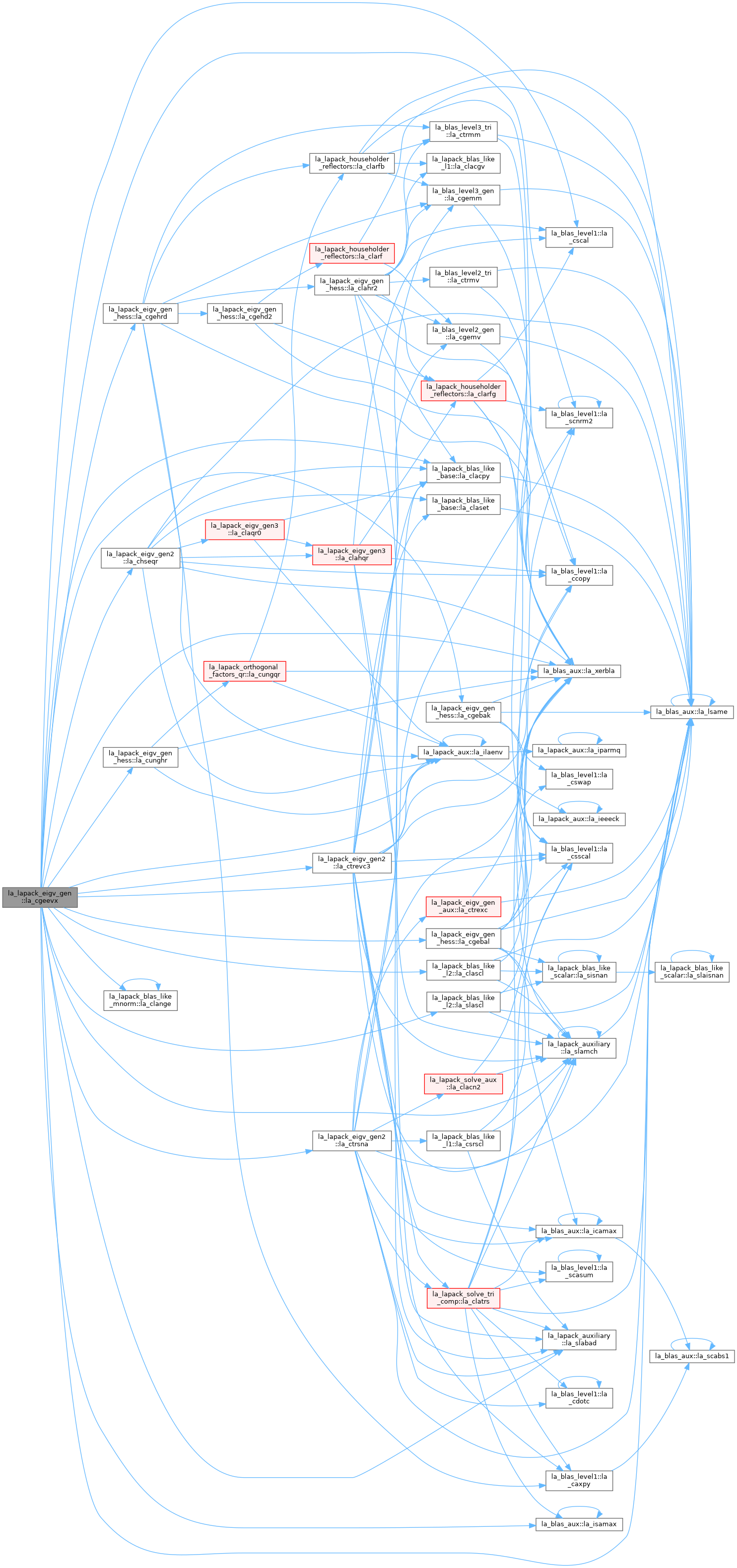
| CGEEVX: computes for an N-by-N complex nonsymmetric matrix A, the eigenvalues and, optionally, the left and/or right eigenvectors. Optionally also, it computes a balancing transformation to improve the conditioning of the eigenvalues and eigenvectors (ILO, IHI, SCALE, and ABNRM), reciprocal condition numbers for the eigenvalues (RCONDE), and reciprocal condition numbers for the right eigenvectors (RCONDV). The right eigenvector v(j) of A satisfies A * v(j) = lambda(j) * v(j) where lambda(j) is its eigenvalue. The left eigenvector u(j) of A satisfies u(j)**H * A = lambda(j) * u(j)**H where u(j)**H denotes the conjugate transpose of u(j). The computed eigenvectors are normalized to have Euclidean norm equal to 1 and largest component real. Balancing a matrix means permuting the rows and columns to make it more nearly upper triangular, and applying a diagonal similarity transformation D * A * D**(-1), where D is a diagonal matrix, to make its rows and columns closer in norm and the condition numbers of its eigenvalues and eigenvectors smaller. The computed reciprocal condition numbers correspond to the balanced matrix. Permuting rows and columns will not change the condition numbers (in exact arithmetic) but diagonal scaling will. For further explanation of balancing, see section 4.10.2_sp of the LAPACK Users' Guide. | |
| subroutine, public | la_zgeevx (balanc, jobvl, jobvr, sense, n, a, lda, w, vl, ldvl, vr, ldvr, ilo, ihi, scale, abnrm, rconde, rcondv, work, lwork, rwork, info) |
| ZGEEVX: computes for an N-by-N complex nonsymmetric matrix A, the eigenvalues and, optionally, the left and/or right eigenvectors. Optionally also, it computes a balancing transformation to improve the conditioning of the eigenvalues and eigenvectors (ILO, IHI, SCALE, and ABNRM), reciprocal condition numbers for the eigenvalues (RCONDE), and reciprocal condition numbers for the right eigenvectors (RCONDV). The right eigenvector v(j) of A satisfies A * v(j) = lambda(j) * v(j) where lambda(j) is its eigenvalue. The left eigenvector u(j) of A satisfies u(j)**H * A = lambda(j) * u(j)**H where u(j)**H denotes the conjugate transpose of u(j). The computed eigenvectors are normalized to have Euclidean norm equal to 1 and largest component real. Balancing a matrix means permuting the rows and columns to make it more nearly upper triangular, and applying a diagonal similarity transformation D * A * D**(-1), where D is a diagonal matrix, to make its rows and columns closer in norm and the condition numbers of its eigenvalues and eigenvectors smaller. The computed reciprocal condition numbers correspond to the balanced matrix. Permuting rows and columns will not change the condition numbers (in exact arithmetic) but diagonal scaling will. For further explanation of balancing, see section 4.10.2_dp of the LAPACK Users' Guide. | |
| subroutine, public | la_wgeevx (balanc, jobvl, jobvr, sense, n, a, lda, w, vl, ldvl, vr, ldvr, ilo, ihi, scale, abnrm, rconde, rcondv, work, lwork, rwork, info) |
| WGEEVX: computes for an N-by-N complex nonsymmetric matrix A, the eigenvalues and, optionally, the left and/or right eigenvectors. Optionally also, it computes a balancing transformation to improve the conditioning of the eigenvalues and eigenvectors (ILO, IHI, SCALE, and ABNRM), reciprocal condition numbers for the eigenvalues (RCONDE), and reciprocal condition numbers for the right eigenvectors (RCONDV). The right eigenvector v(j) of A satisfies A * v(j) = lambda(j) * v(j) where lambda(j) is its eigenvalue. The left eigenvector u(j) of A satisfies u(j)**H * A = lambda(j) * u(j)**H where u(j)**H denotes the conjugate transpose of u(j). The computed eigenvectors are normalized to have Euclidean norm equal to 1 and largest component real. Balancing a matrix means permuting the rows and columns to make it more nearly upper triangular, and applying a diagonal similarity transformation D * A * D**(-1), where D is a diagonal matrix, to make its rows and columns closer in norm and the condition numbers of its eigenvalues and eigenvectors smaller. The computed reciprocal condition numbers correspond to the balanced matrix. Permuting rows and columns will not change the condition numbers (in exact arithmetic) but diagonal scaling will. For further explanation of balancing, see section 4.10.2_qp of the LAPACK Users' Guide. | |
| subroutine, public | la_cgges3 (jobvsl, jobvsr, sort, selctg, n, a, lda, b, ldb, sdim, alpha, beta, vsl, ldvsl, vsr, ldvsr, work, lwork, rwork, bwork, info) |
| CGGES3: computes for a pair of N-by-N complex nonsymmetric matrices (A,B), the generalized eigenvalues, the generalized complex Schur form (S, T), and optionally left and/or right Schur vectors (VSL and VSR). This gives the generalized Schur factorization (A,B) = ( (VSL)*S*(VSR)**H, (VSL)*T*(VSR)**H ) where (VSR)**H is the conjugate-transpose of VSR. Optionally, it also orders the eigenvalues so that a selected cluster of eigenvalues appears in the leading diagonal blocks of the upper triangular matrix S and the upper triangular matrix T. The leading columns of VSL and VSR then form an unitary basis for the corresponding left and right eigenspaces (deflating subspaces). (If only the generalized eigenvalues are needed, use the driver CGGEV instead, which is faster.) A generalized eigenvalue for a pair of matrices (A,B) is a scalar w or a ratio alpha/beta = w, such that A - w*B is singular. It is usually represented as the pair (alpha,beta), as there is a reasonable interpretation for beta=0, and even for both being zero. A pair of matrices (S,T) is in generalized complex Schur form if S and T are upper triangular and, in addition, the diagonal elements of T are non-negative real numbers. | |
| subroutine, public | la_zgges3 (jobvsl, jobvsr, sort, selctg, n, a, lda, b, ldb, sdim, alpha, beta, vsl, ldvsl, vsr, ldvsr, work, lwork, rwork, bwork, info) |
| ZGGES3: computes for a pair of N-by-N complex nonsymmetric matrices (A,B), the generalized eigenvalues, the generalized complex Schur form (S, T), and optionally left and/or right Schur vectors (VSL and VSR). This gives the generalized Schur factorization (A,B) = ( (VSL)*S*(VSR)**H, (VSL)*T*(VSR)**H ) where (VSR)**H is the conjugate-transpose of VSR. Optionally, it also orders the eigenvalues so that a selected cluster of eigenvalues appears in the leading diagonal blocks of the upper triangular matrix S and the upper triangular matrix T. The leading columns of VSL and VSR then form an unitary basis for the corresponding left and right eigenspaces (deflating subspaces). (If only the generalized eigenvalues are needed, use the driver ZGGEV instead, which is faster.) A generalized eigenvalue for a pair of matrices (A,B) is a scalar w or a ratio alpha/beta = w, such that A - w*B is singular. It is usually represented as the pair (alpha,beta), as there is a reasonable interpretation for beta=0, and even for both being zero. A pair of matrices (S,T) is in generalized complex Schur form if S and T are upper triangular and, in addition, the diagonal elements of T are non-negative real numbers. | |
| subroutine, public | la_wgges3 (jobvsl, jobvsr, sort, selctg, n, a, lda, b, ldb, sdim, alpha, beta, vsl, ldvsl, vsr, ldvsr, work, lwork, rwork, bwork, info) |
| WGGES3: computes for a pair of N-by-N complex nonsymmetric matrices (A,B), the generalized eigenvalues, the generalized complex Schur form (S, T), and optionally left and/or right Schur vectors (VSL and VSR). This gives the generalized Schur factorization (A,B) = ( (VSL)*S*(VSR)**H, (VSL)*T*(VSR)**H ) where (VSR)**H is the conjugate-transpose of VSR. Optionally, it also orders the eigenvalues so that a selected cluster of eigenvalues appears in the leading diagonal blocks of the upper triangular matrix S and the upper triangular matrix T. The leading columns of VSL and VSR then form an unitary basis for the corresponding left and right eigenspaces (deflating subspaces). (If only the generalized eigenvalues are needed, use the driver WGGEV instead, which is faster.) A generalized eigenvalue for a pair of matrices (A,B) is a scalar w or a ratio alpha/beta = w, such that A - w*B is singular. It is usually represented as the pair (alpha,beta), as there is a reasonable interpretation for beta=0, and even for both being zero. A pair of matrices (S,T) is in generalized complex Schur form if S and T are upper triangular and, in addition, the diagonal elements of T are non-negative real numbers. | |
| subroutine, public | la_cggev3 (jobvl, jobvr, n, a, lda, b, ldb, alpha, beta, vl, ldvl, vr, ldvr, work, lwork, rwork, info) |
| CGGEV3: computes for a pair of N-by-N complex nonsymmetric matrices (A,B), the generalized eigenvalues, and optionally, the left and/or right generalized eigenvectors. A generalized eigenvalue for a pair of matrices (A,B) is a scalar lambda or a ratio alpha/beta = lambda, such that A - lambda*B is singular. It is usually represented as the pair (alpha,beta), as there is a reasonable interpretation for beta=0, and even for both being zero. The right generalized eigenvector v(j) corresponding to the generalized eigenvalue lambda(j) of (A,B) satisfies A * v(j) = lambda(j) * B * v(j). The left generalized eigenvector u(j) corresponding to the generalized eigenvalues lambda(j) of (A,B) satisfies u(j)**H * A = lambda(j) * u(j)**H * B where u(j)**H is the conjugate-transpose of u(j). | |
| subroutine, public | la_zggev3 (jobvl, jobvr, n, a, lda, b, ldb, alpha, beta, vl, ldvl, vr, ldvr, work, lwork, rwork, info) |
| ZGGEV3: computes for a pair of N-by-N complex nonsymmetric matrices (A,B), the generalized eigenvalues, and optionally, the left and/or right generalized eigenvectors. A generalized eigenvalue for a pair of matrices (A,B) is a scalar lambda or a ratio alpha/beta = lambda, such that A - lambda*B is singular. It is usually represented as the pair (alpha,beta), as there is a reasonable interpretation for beta=0, and even for both being zero. The right generalized eigenvector v(j) corresponding to the generalized eigenvalue lambda(j) of (A,B) satisfies A * v(j) = lambda(j) * B * v(j). The left generalized eigenvector u(j) corresponding to the generalized eigenvalues lambda(j) of (A,B) satisfies u(j)**H * A = lambda(j) * u(j)**H * B where u(j)**H is the conjugate-transpose of u(j). | |
| subroutine, public | la_wggev3 (jobvl, jobvr, n, a, lda, b, ldb, alpha, beta, vl, ldvl, vr, ldvr, work, lwork, rwork, info) |
| WGGEV3: computes for a pair of N-by-N complex nonsymmetric matrices (A,B), the generalized eigenvalues, and optionally, the left and/or right generalized eigenvectors. A generalized eigenvalue for a pair of matrices (A,B) is a scalar lambda or a ratio alpha/beta = lambda, such that A - lambda*B is singular. It is usually represented as the pair (alpha,beta), as there is a reasonable interpretation for beta=0, and even for both being zero. The right generalized eigenvector v(j) corresponding to the generalized eigenvalue lambda(j) of (A,B) satisfies A * v(j) = lambda(j) * B * v(j). The left generalized eigenvector u(j) corresponding to the generalized eigenvalues lambda(j) of (A,B) satisfies u(j)**H * A = lambda(j) * u(j)**H * B where u(j)**H is the conjugate-transpose of u(j). | |
Detailed Description
Nonsymmetric eigenvalue, Schur and generalized Schur drivers.
Function/Subroutine Documentation
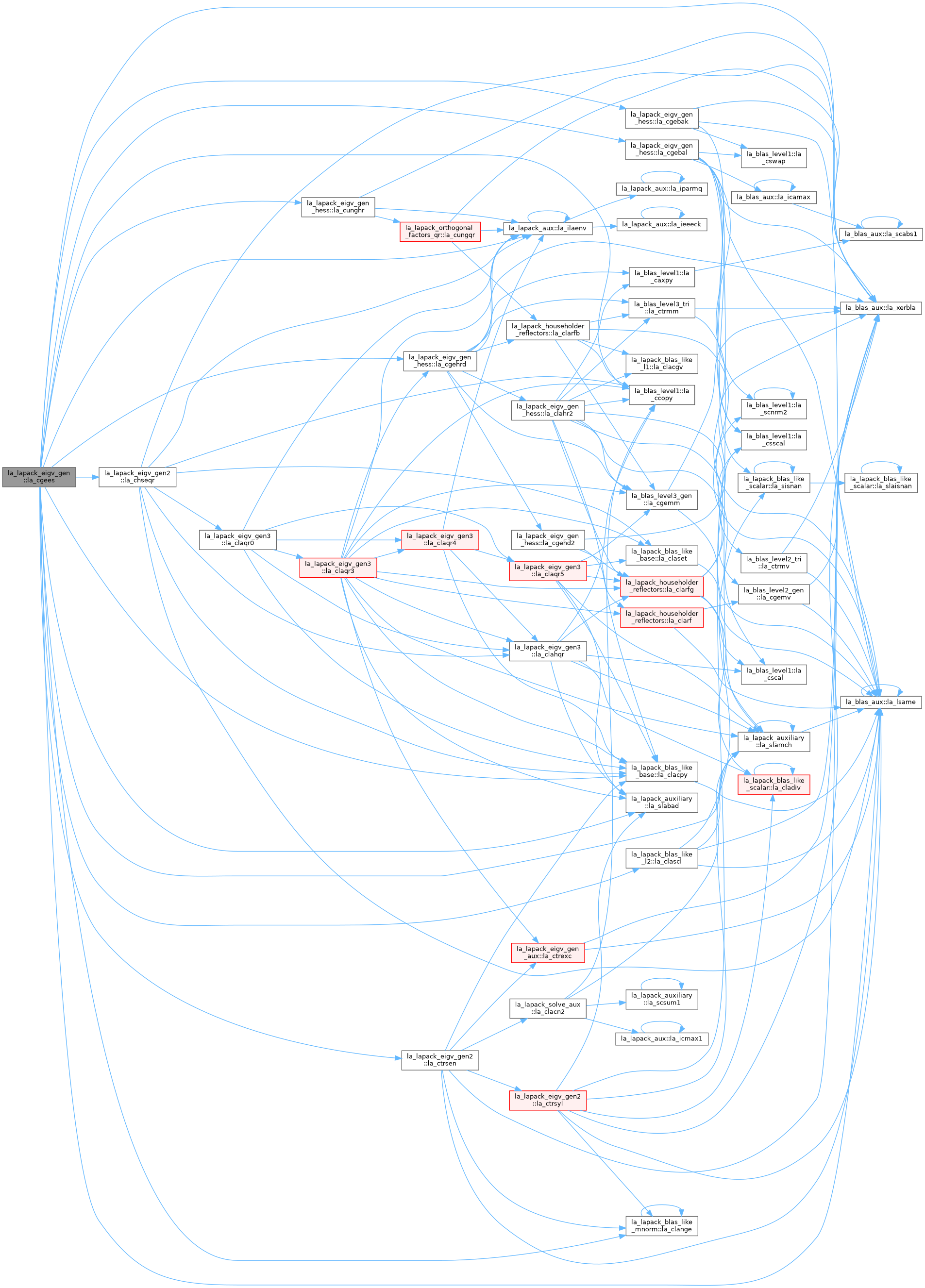
◆ la_cgees()
| subroutine, public la_lapack_eigv_gen::la_cgees | ( | character, intent(in) | jobvs, |
| character, intent(in) | sort, | ||
| procedure(la_select_c) | select, | ||
| integer(ilp), intent(in) | n, | ||
| complex(sp), dimension(lda,*), intent(inout) | a, | ||
| integer(ilp), intent(in) | lda, | ||
| integer(ilp), intent(out) | sdim, | ||
| complex(sp), dimension(*), intent(out) | w, | ||
| complex(sp), dimension(ldvs,*), intent(out) | vs, | ||
| integer(ilp), intent(in) | ldvs, | ||
| complex(sp), dimension(*), intent(out) | work, | ||
| integer(ilp), intent(in) | lwork, | ||
| real(sp), dimension(*), intent(out) | rwork, | ||
| logical(lk), dimension(*), intent(out) | bwork, | ||
| integer(ilp), intent(out) | info ) |
CGEES: computes for an N-by-N complex nonsymmetric matrix A, the eigenvalues, the Schur form T, and, optionally, the matrix of Schur vectors Z. This gives the Schur factorization A = Z*T*(Z**H). Optionally, it also orders the eigenvalues on the diagonal of the Schur form so that selected eigenvalues are at the top left. The leading columns of Z then form an orthonormal basis for the invariant subspace corresponding to the selected eigenvalues. A complex matrix is in Schur form if it is upper triangular.
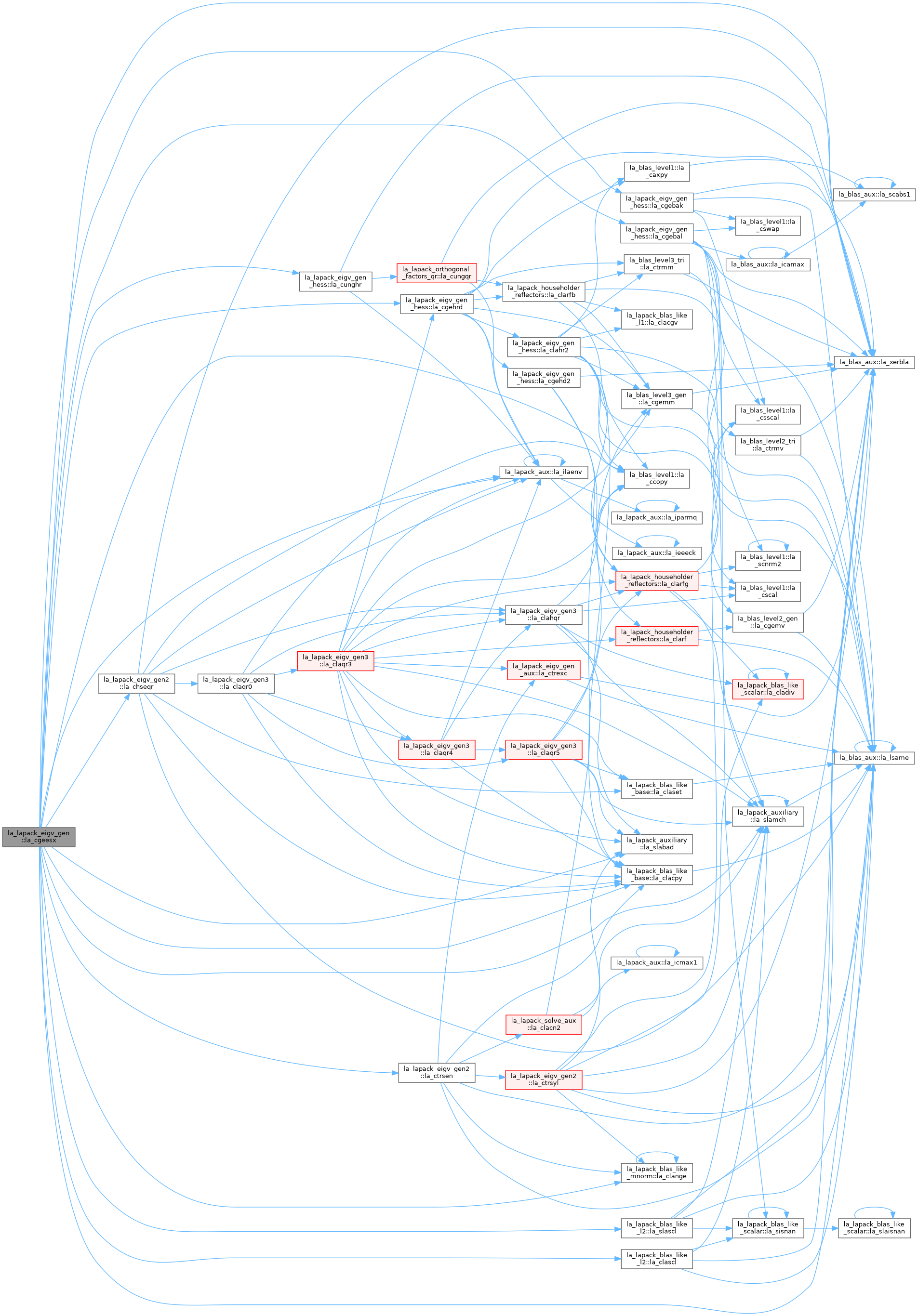
◆ la_cgeesx()
| subroutine, public la_lapack_eigv_gen::la_cgeesx | ( | character, intent(in) | jobvs, |
| character, intent(in) | sort, | ||
| procedure(la_select_c) | select, | ||
| character, intent(in) | sense, | ||
| integer(ilp), intent(in) | n, | ||
| complex(sp), dimension(lda,*), intent(inout) | a, | ||
| integer(ilp), intent(in) | lda, | ||
| integer(ilp), intent(out) | sdim, | ||
| complex(sp), dimension(*), intent(out) | w, | ||
| complex(sp), dimension(ldvs,*), intent(out) | vs, | ||
| integer(ilp), intent(in) | ldvs, | ||
| real(sp), intent(out) | rconde, | ||
| real(sp), intent(out) | rcondv, | ||
| complex(sp), dimension(*), intent(out) | work, | ||
| integer(ilp), intent(in) | lwork, | ||
| real(sp), dimension(*), intent(out) | rwork, | ||
| logical(lk), dimension(*), intent(out) | bwork, | ||
| integer(ilp), intent(out) | info ) |
CGEESX: computes for an N-by-N complex nonsymmetric matrix A, the eigenvalues, the Schur form T, and, optionally, the matrix of Schur vectors Z. This gives the Schur factorization A = Z*T*(Z**H). Optionally, it also orders the eigenvalues on the diagonal of the Schur form so that selected eigenvalues are at the top left; computes a reciprocal condition number for the average of the selected eigenvalues (RCONDE); and computes a reciprocal condition number for the right invariant subspace corresponding to the selected eigenvalues (RCONDV). The leading columns of Z form an orthonormal basis for this invariant subspace. For further explanation of the reciprocal condition numbers RCONDE and RCONDV, see Section 4.10_sp of the LAPACK Users' Guide (where these quantities are called s and sep respectively). A complex matrix is in Schur form if it is upper triangular.
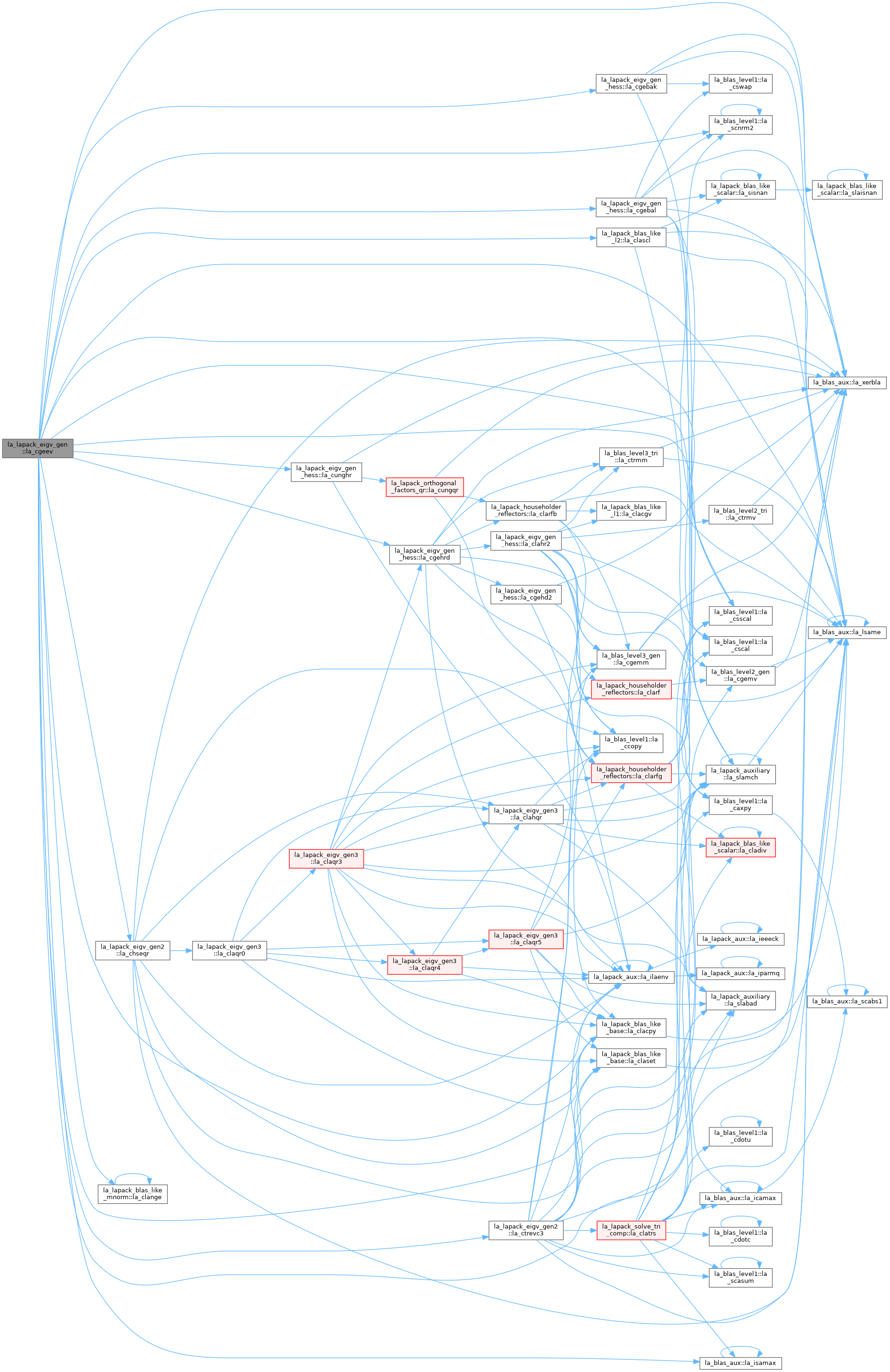
◆ la_cgeev()
| subroutine, public la_lapack_eigv_gen::la_cgeev | ( | character, intent(in) | jobvl, |
| character, intent(in) | jobvr, | ||
| integer(ilp), intent(in) | n, | ||
| complex(sp), dimension(lda,*), intent(inout) | a, | ||
| integer(ilp), intent(in) | lda, | ||
| complex(sp), dimension(*), intent(out) | w, | ||
| complex(sp), dimension(ldvl,*), intent(out) | vl, | ||
| integer(ilp), intent(in) | ldvl, | ||
| complex(sp), dimension(ldvr,*), intent(out) | vr, | ||
| integer(ilp), intent(in) | ldvr, | ||
| complex(sp), dimension(*), intent(out) | work, | ||
| integer(ilp), intent(in) | lwork, | ||
| real(sp), dimension(*), intent(out) | rwork, | ||
| integer(ilp), intent(out) | info ) |
CGEEV: computes for an N-by-N complex nonsymmetric matrix A, the eigenvalues and, optionally, the left and/or right eigenvectors. The right eigenvector v(j) of A satisfies A * v(j) = lambda(j) * v(j) where lambda(j) is its eigenvalue. The left eigenvector u(j) of A satisfies u(j)**H * A = lambda(j) * u(j)**H where u(j)**H denotes the conjugate transpose of u(j). The computed eigenvectors are normalized to have Euclidean norm equal to 1 and largest component real.
◆ la_cgeevx()
| subroutine, public la_lapack_eigv_gen::la_cgeevx | ( | character, intent(in) | balanc, |
| character, intent(in) | jobvl, | ||
| character, intent(in) | jobvr, | ||
| character, intent(in) | sense, | ||
| integer(ilp), intent(in) | n, | ||
| complex(sp), dimension(lda,*), intent(inout) | a, | ||
| integer(ilp), intent(in) | lda, | ||
| complex(sp), dimension(*), intent(out) | w, | ||
| complex(sp), dimension(ldvl,*), intent(out) | vl, | ||
| integer(ilp), intent(in) | ldvl, | ||
| complex(sp), dimension(ldvr,*), intent(out) | vr, | ||
| integer(ilp), intent(in) | ldvr, | ||
| integer(ilp), intent(out) | ilo, | ||
| integer(ilp), intent(out) | ihi, | ||
| real(sp), dimension(*), intent(out) | scale, | ||
| real(sp), intent(out) | abnrm, | ||
| real(sp), dimension(*), intent(out) | rconde, | ||
| real(sp), dimension(*), intent(out) | rcondv, | ||
| complex(sp), dimension(*), intent(out) | work, | ||
| integer(ilp), intent(in) | lwork, | ||
| real(sp), dimension(*), intent(out) | rwork, | ||
| integer(ilp), intent(out) | info ) |
CGEEVX: computes for an N-by-N complex nonsymmetric matrix A, the eigenvalues and, optionally, the left and/or right eigenvectors. Optionally also, it computes a balancing transformation to improve the conditioning of the eigenvalues and eigenvectors (ILO, IHI, SCALE, and ABNRM), reciprocal condition numbers for the eigenvalues (RCONDE), and reciprocal condition numbers for the right eigenvectors (RCONDV). The right eigenvector v(j) of A satisfies A * v(j) = lambda(j) * v(j) where lambda(j) is its eigenvalue. The left eigenvector u(j) of A satisfies u(j)**H * A = lambda(j) * u(j)**H where u(j)**H denotes the conjugate transpose of u(j). The computed eigenvectors are normalized to have Euclidean norm equal to 1 and largest component real. Balancing a matrix means permuting the rows and columns to make it more nearly upper triangular, and applying a diagonal similarity transformation D * A * D**(-1), where D is a diagonal matrix, to make its rows and columns closer in norm and the condition numbers of its eigenvalues and eigenvectors smaller. The computed reciprocal condition numbers correspond to the balanced matrix. Permuting rows and columns will not change the condition numbers (in exact arithmetic) but diagonal scaling will. For further explanation of balancing, see section 4.10.2_sp of the LAPACK Users' Guide.
◆ la_cgges()
| subroutine, public la_lapack_eigv_gen::la_cgges | ( | character, intent(in) | jobvsl, |
| character, intent(in) | jobvsr, | ||
| character, intent(in) | sort, | ||
| procedure(la_selctg_c) | selctg, | ||
| integer(ilp), intent(in) | n, | ||
| complex(sp), dimension(lda,*), intent(inout) | a, | ||
| integer(ilp), intent(in) | lda, | ||
| complex(sp), dimension(ldb,*), intent(inout) | b, | ||
| integer(ilp), intent(in) | ldb, | ||
| integer(ilp), intent(out) | sdim, | ||
| complex(sp), dimension(*), intent(out) | alpha, | ||
| complex(sp), dimension(*), intent(out) | beta, | ||
| complex(sp), dimension(ldvsl,*), intent(out) | vsl, | ||
| integer(ilp), intent(in) | ldvsl, | ||
| complex(sp), dimension(ldvsr,*), intent(out) | vsr, | ||
| integer(ilp), intent(in) | ldvsr, | ||
| complex(sp), dimension(*), intent(out) | work, | ||
| integer(ilp), intent(in) | lwork, | ||
| real(sp), dimension(*), intent(out) | rwork, | ||
| logical(lk), dimension(*), intent(out) | bwork, | ||
| integer(ilp), intent(out) | info ) |
CGGES: computes for a pair of N-by-N complex nonsymmetric matrices (A,B), the generalized eigenvalues, the generalized complex Schur form (S, T), and optionally left and/or right Schur vectors (VSL and VSR). This gives the generalized Schur factorization (A,B) = ( (VSL)*S*(VSR)**H, (VSL)*T*(VSR)**H ) where (VSR)**H is the conjugate-transpose of VSR. Optionally, it also orders the eigenvalues so that a selected cluster of eigenvalues appears in the leading diagonal blocks of the upper triangular matrix S and the upper triangular matrix T. The leading columns of VSL and VSR then form an unitary basis for the corresponding left and right eigenspaces (deflating subspaces). (If only the generalized eigenvalues are needed, use the driver CGGEV instead, which is faster.) A generalized eigenvalue for a pair of matrices (A,B) is a scalar w or a ratio alpha/beta = w, such that A - w*B is singular. It is usually represented as the pair (alpha,beta), as there is a reasonable interpretation for beta=0, and even for both being zero. A pair of matrices (S,T) is in generalized complex Schur form if S and T are upper triangular and, in addition, the diagonal elements of T are non-negative real numbers.
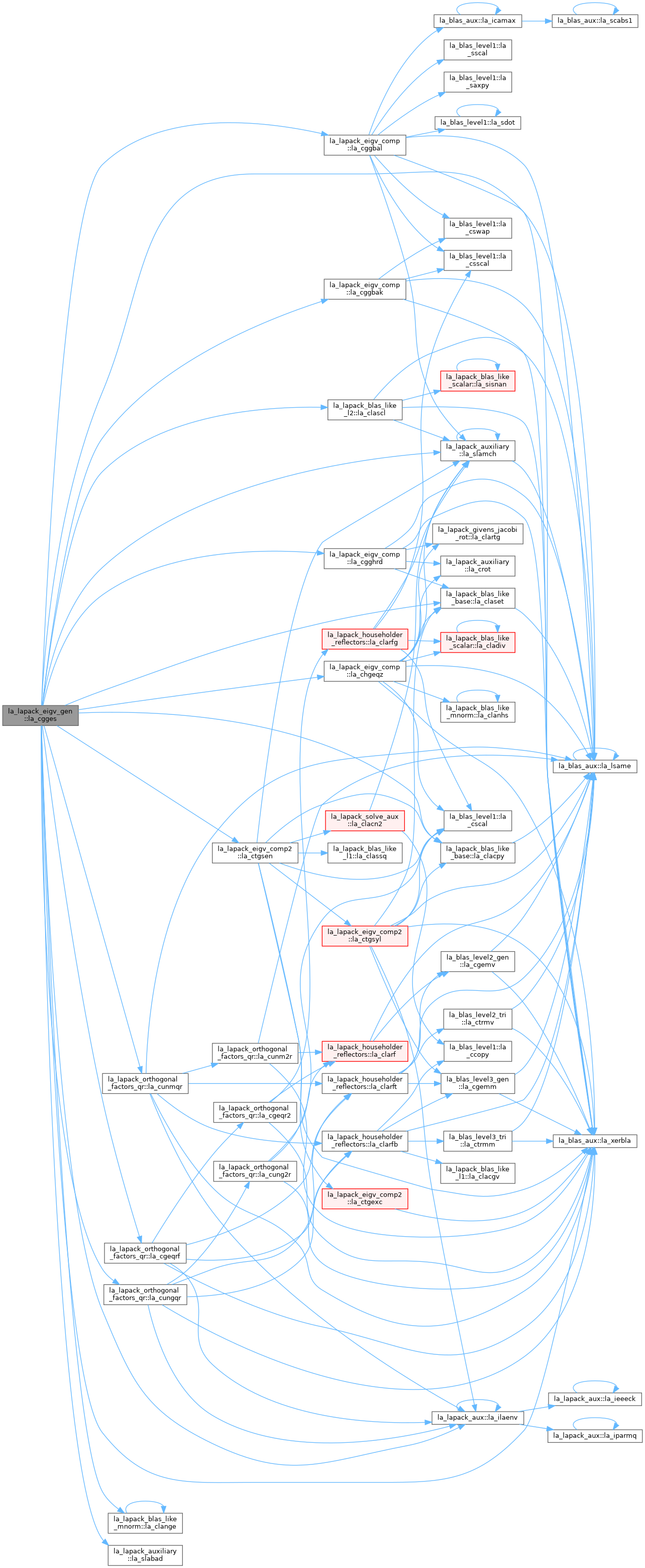
◆ la_cgges3()
| subroutine, public la_lapack_eigv_gen::la_cgges3 | ( | character, intent(in) | jobvsl, |
| character, intent(in) | jobvsr, | ||
| character, intent(in) | sort, | ||
| procedure(la_selctg_c) | selctg, | ||
| integer(ilp), intent(in) | n, | ||
| complex(sp), dimension(lda,*), intent(inout) | a, | ||
| integer(ilp), intent(in) | lda, | ||
| complex(sp), dimension(ldb,*), intent(inout) | b, | ||
| integer(ilp), intent(in) | ldb, | ||
| integer(ilp), intent(out) | sdim, | ||
| complex(sp), dimension(*), intent(out) | alpha, | ||
| complex(sp), dimension(*), intent(out) | beta, | ||
| complex(sp), dimension(ldvsl,*), intent(out) | vsl, | ||
| integer(ilp), intent(in) | ldvsl, | ||
| complex(sp), dimension(ldvsr,*), intent(out) | vsr, | ||
| integer(ilp), intent(in) | ldvsr, | ||
| complex(sp), dimension(*), intent(out) | work, | ||
| integer(ilp), intent(in) | lwork, | ||
| real(sp), dimension(*), intent(out) | rwork, | ||
| logical(lk), dimension(*), intent(out) | bwork, | ||
| integer(ilp), intent(out) | info ) |
CGGES3: computes for a pair of N-by-N complex nonsymmetric matrices (A,B), the generalized eigenvalues, the generalized complex Schur form (S, T), and optionally left and/or right Schur vectors (VSL and VSR). This gives the generalized Schur factorization (A,B) = ( (VSL)*S*(VSR)**H, (VSL)*T*(VSR)**H ) where (VSR)**H is the conjugate-transpose of VSR. Optionally, it also orders the eigenvalues so that a selected cluster of eigenvalues appears in the leading diagonal blocks of the upper triangular matrix S and the upper triangular matrix T. The leading columns of VSL and VSR then form an unitary basis for the corresponding left and right eigenspaces (deflating subspaces). (If only the generalized eigenvalues are needed, use the driver CGGEV instead, which is faster.) A generalized eigenvalue for a pair of matrices (A,B) is a scalar w or a ratio alpha/beta = w, such that A - w*B is singular. It is usually represented as the pair (alpha,beta), as there is a reasonable interpretation for beta=0, and even for both being zero. A pair of matrices (S,T) is in generalized complex Schur form if S and T are upper triangular and, in addition, the diagonal elements of T are non-negative real numbers.
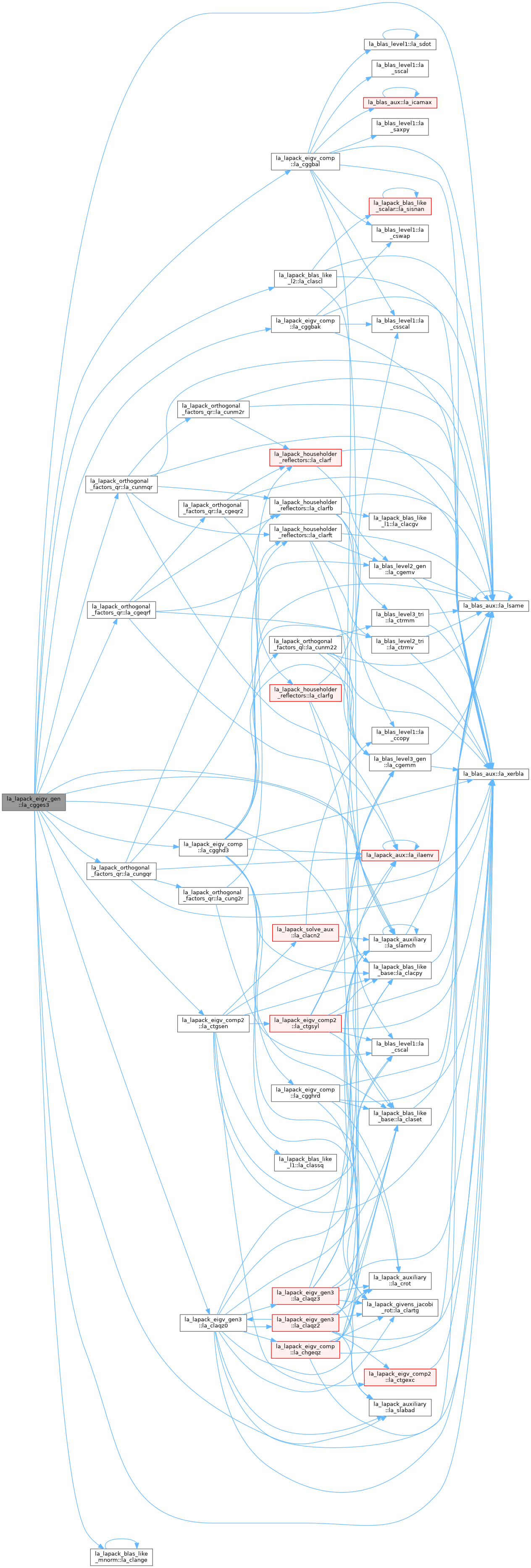
◆ la_cggesx()
| subroutine, public la_lapack_eigv_gen::la_cggesx | ( | character, intent(in) | jobvsl, |
| character, intent(in) | jobvsr, | ||
| character, intent(in) | sort, | ||
| procedure(la_selctg_c) | selctg, | ||
| character, intent(in) | sense, | ||
| integer(ilp), intent(in) | n, | ||
| complex(sp), dimension(lda,*), intent(inout) | a, | ||
| integer(ilp), intent(in) | lda, | ||
| complex(sp), dimension(ldb,*), intent(inout) | b, | ||
| integer(ilp), intent(in) | ldb, | ||
| integer(ilp), intent(out) | sdim, | ||
| complex(sp), dimension(*), intent(out) | alpha, | ||
| complex(sp), dimension(*), intent(out) | beta, | ||
| complex(sp), dimension(ldvsl,*), intent(out) | vsl, | ||
| integer(ilp), intent(in) | ldvsl, | ||
| complex(sp), dimension(ldvsr,*), intent(out) | vsr, | ||
| integer(ilp), intent(in) | ldvsr, | ||
| real(sp), dimension(2), intent(out) | rconde, | ||
| real(sp), dimension(2), intent(out) | rcondv, | ||
| complex(sp), dimension(*), intent(out) | work, | ||
| integer(ilp), intent(in) | lwork, | ||
| real(sp), dimension(*), intent(out) | rwork, | ||
| integer(ilp), dimension(*), intent(out) | iwork, | ||
| integer(ilp), intent(in) | liwork, | ||
| logical(lk), dimension(*), intent(out) | bwork, | ||
| integer(ilp), intent(out) | info ) |
CGGESX: computes for a pair of N-by-N complex nonsymmetric matrices (A,B), the generalized eigenvalues, the complex Schur form (S,T), and, optionally, the left and/or right matrices of Schur vectors (VSL and VSR). This gives the generalized Schur factorization (A,B) = ( (VSL) S (VSR)**H, (VSL) T (VSR)**H ) where (VSR)**H is the conjugate-transpose of VSR. Optionally, it also orders the eigenvalues so that a selected cluster of eigenvalues appears in the leading diagonal blocks of the upper triangular matrix S and the upper triangular matrix T; computes a reciprocal condition number for the average of the selected eigenvalues (RCONDE); and computes a reciprocal condition number for the right and left deflating subspaces corresponding to the selected eigenvalues (RCONDV). The leading columns of VSL and VSR then form an orthonormal basis for the corresponding left and right eigenspaces (deflating subspaces). A generalized eigenvalue for a pair of matrices (A,B) is a scalar w or a ratio alpha/beta = w, such that A - w*B is singular. It is usually represented as the pair (alpha,beta), as there is a reasonable interpretation for beta=0 or for both being zero. A pair of matrices (S,T) is in generalized complex Schur form if T is upper triangular with non-negative diagonal and S is upper triangular.
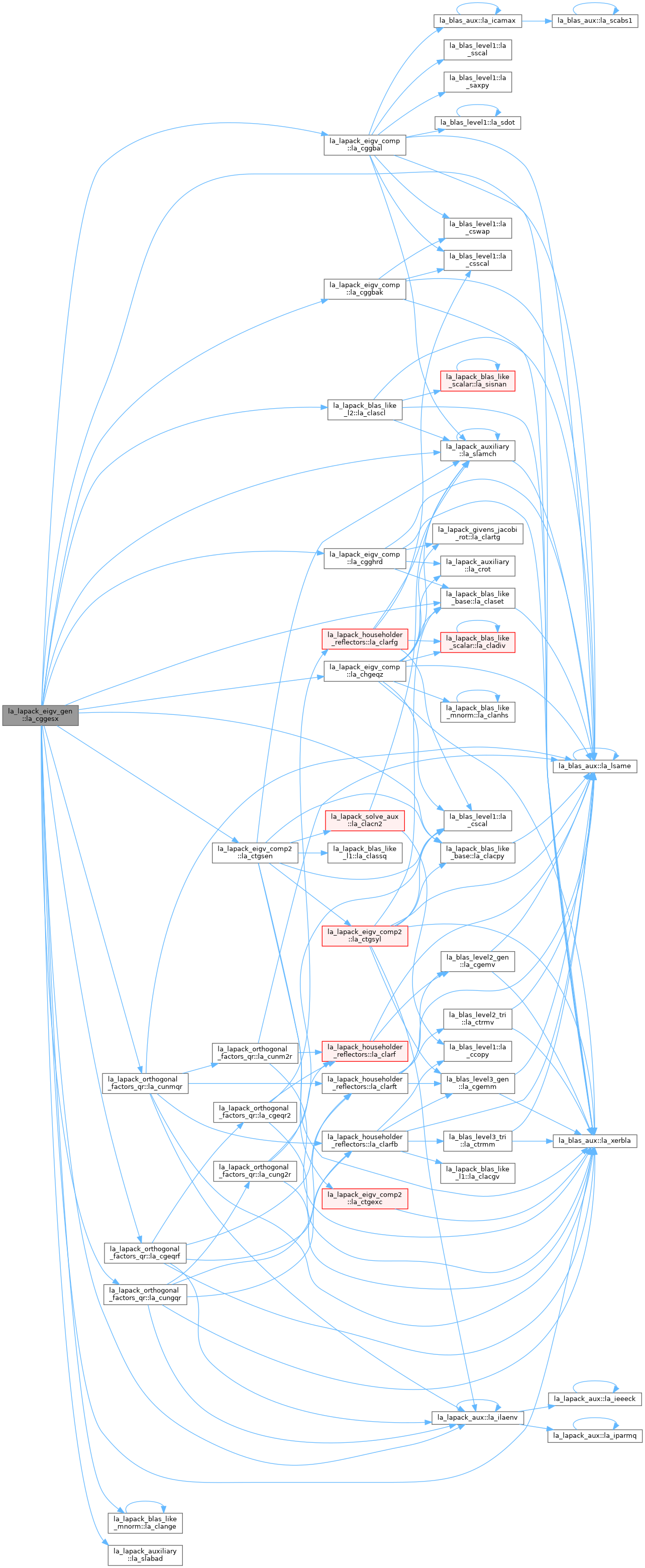
◆ la_cggev()
| subroutine, public la_lapack_eigv_gen::la_cggev | ( | character, intent(in) | jobvl, |
| character, intent(in) | jobvr, | ||
| integer(ilp), intent(in) | n, | ||
| complex(sp), dimension(lda,*), intent(inout) | a, | ||
| integer(ilp), intent(in) | lda, | ||
| complex(sp), dimension(ldb,*), intent(inout) | b, | ||
| integer(ilp), intent(in) | ldb, | ||
| complex(sp), dimension(*), intent(out) | alpha, | ||
| complex(sp), dimension(*), intent(out) | beta, | ||
| complex(sp), dimension(ldvl,*), intent(out) | vl, | ||
| integer(ilp), intent(in) | ldvl, | ||
| complex(sp), dimension(ldvr,*), intent(out) | vr, | ||
| integer(ilp), intent(in) | ldvr, | ||
| complex(sp), dimension(*), intent(out) | work, | ||
| integer(ilp), intent(in) | lwork, | ||
| real(sp), dimension(*), intent(out) | rwork, | ||
| integer(ilp), intent(out) | info ) |
CGGEV: computes for a pair of N-by-N complex nonsymmetric matrices (A,B), the generalized eigenvalues, and optionally, the left and/or right generalized eigenvectors. A generalized eigenvalue for a pair of matrices (A,B) is a scalar lambda or a ratio alpha/beta = lambda, such that A - lambda*B is singular. It is usually represented as the pair (alpha,beta), as there is a reasonable interpretation for beta=0, and even for both being zero. The right generalized eigenvector v(j) corresponding to the generalized eigenvalue lambda(j) of (A,B) satisfies A * v(j) = lambda(j) * B * v(j). The left generalized eigenvector u(j) corresponding to the generalized eigenvalues lambda(j) of (A,B) satisfies u(j)**H * A = lambda(j) * u(j)**H * B where u(j)**H is the conjugate-transpose of u(j).
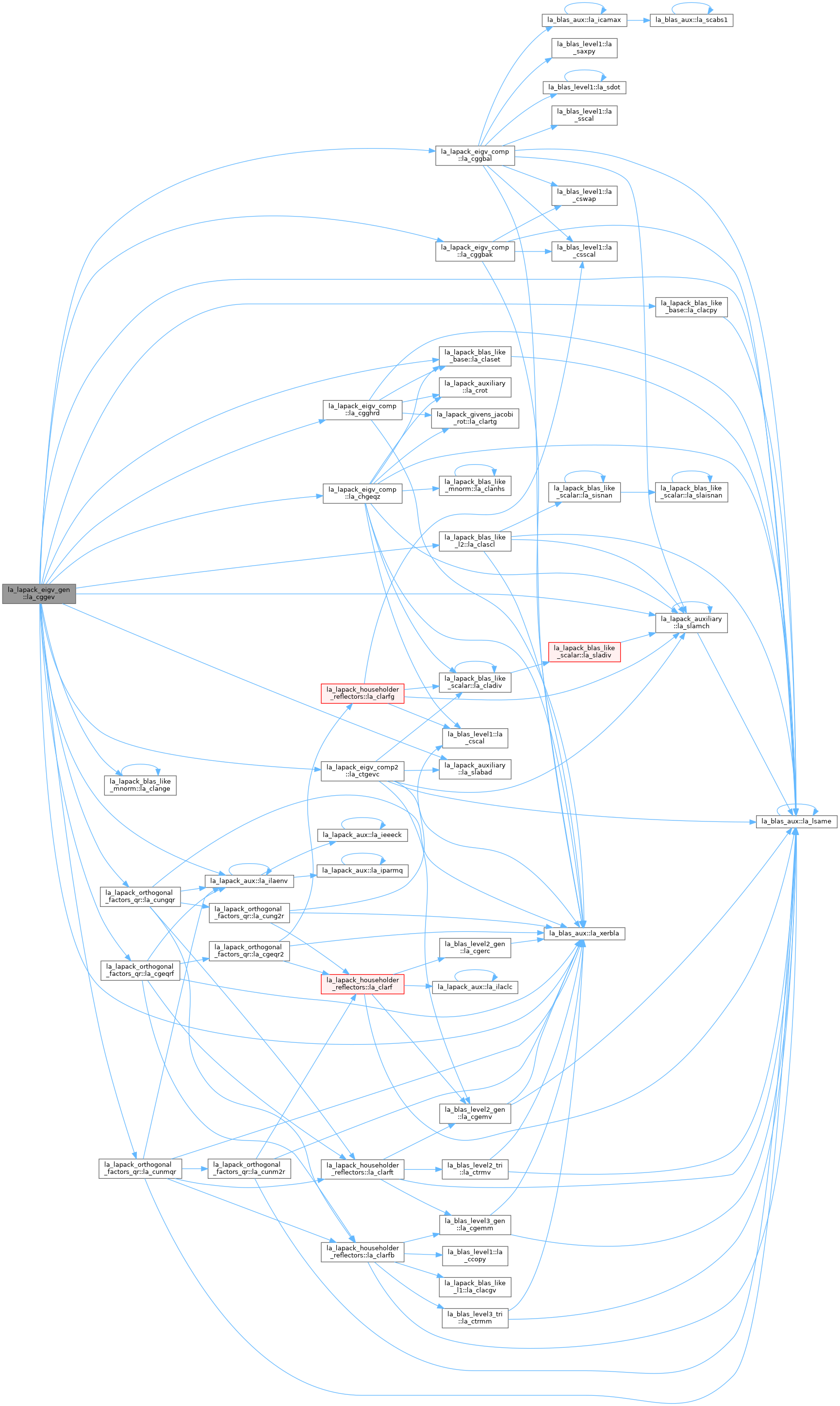
◆ la_cggev3()
| subroutine, public la_lapack_eigv_gen::la_cggev3 | ( | character, intent(in) | jobvl, |
| character, intent(in) | jobvr, | ||
| integer(ilp), intent(in) | n, | ||
| complex(sp), dimension(lda,*), intent(inout) | a, | ||
| integer(ilp), intent(in) | lda, | ||
| complex(sp), dimension(ldb,*), intent(inout) | b, | ||
| integer(ilp), intent(in) | ldb, | ||
| complex(sp), dimension(*), intent(out) | alpha, | ||
| complex(sp), dimension(*), intent(out) | beta, | ||
| complex(sp), dimension(ldvl,*), intent(out) | vl, | ||
| integer(ilp), intent(in) | ldvl, | ||
| complex(sp), dimension(ldvr,*), intent(out) | vr, | ||
| integer(ilp), intent(in) | ldvr, | ||
| complex(sp), dimension(*), intent(out) | work, | ||
| integer(ilp), intent(in) | lwork, | ||
| real(sp), dimension(*), intent(out) | rwork, | ||
| integer(ilp), intent(out) | info ) |
CGGEV3: computes for a pair of N-by-N complex nonsymmetric matrices (A,B), the generalized eigenvalues, and optionally, the left and/or right generalized eigenvectors. A generalized eigenvalue for a pair of matrices (A,B) is a scalar lambda or a ratio alpha/beta = lambda, such that A - lambda*B is singular. It is usually represented as the pair (alpha,beta), as there is a reasonable interpretation for beta=0, and even for both being zero. The right generalized eigenvector v(j) corresponding to the generalized eigenvalue lambda(j) of (A,B) satisfies A * v(j) = lambda(j) * B * v(j). The left generalized eigenvector u(j) corresponding to the generalized eigenvalues lambda(j) of (A,B) satisfies u(j)**H * A = lambda(j) * u(j)**H * B where u(j)**H is the conjugate-transpose of u(j).
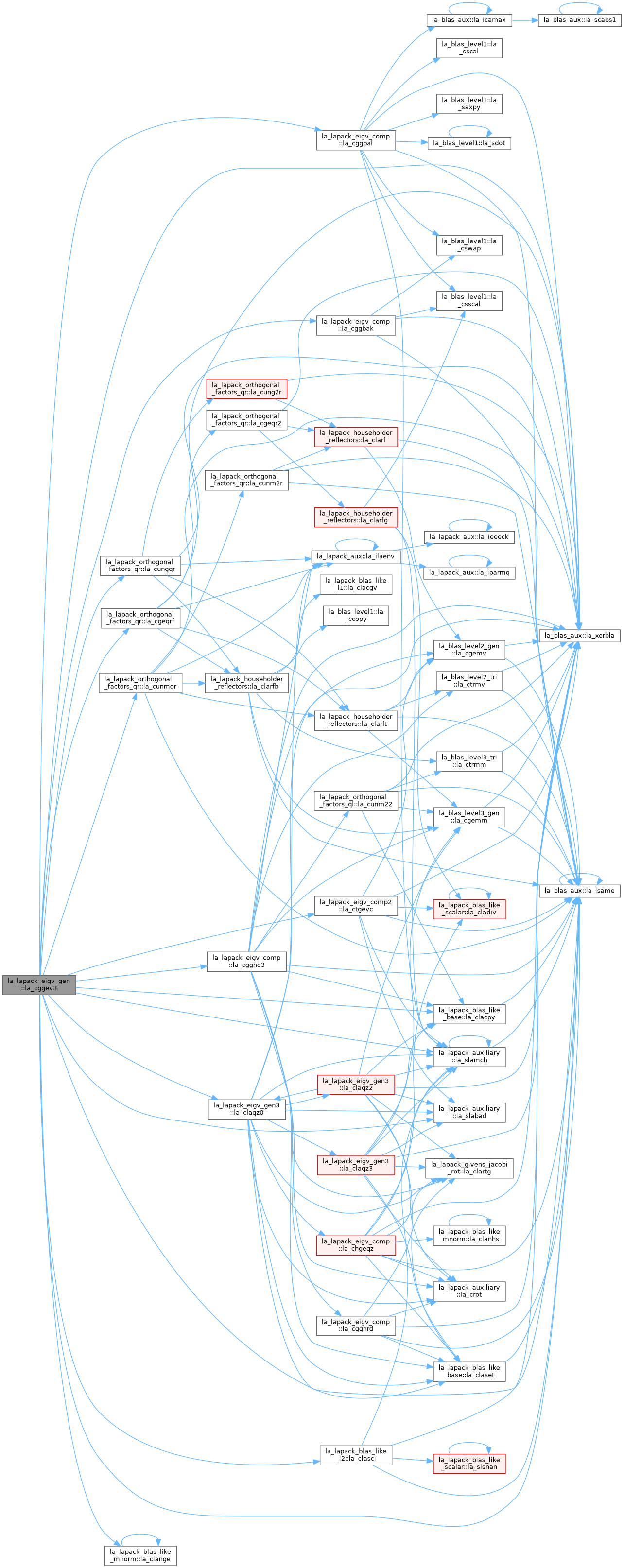
◆ la_cggevx()
| subroutine, public la_lapack_eigv_gen::la_cggevx | ( | character, intent(in) | balanc, |
| character, intent(in) | jobvl, | ||
| character, intent(in) | jobvr, | ||
| character, intent(in) | sense, | ||
| integer(ilp), intent(in) | n, | ||
| complex(sp), dimension(lda,*), intent(inout) | a, | ||
| integer(ilp), intent(in) | lda, | ||
| complex(sp), dimension(ldb,*), intent(inout) | b, | ||
| integer(ilp), intent(in) | ldb, | ||
| complex(sp), dimension(*), intent(out) | alpha, | ||
| complex(sp), dimension(*), intent(out) | beta, | ||
| complex(sp), dimension(ldvl,*), intent(out) | vl, | ||
| integer(ilp), intent(in) | ldvl, | ||
| complex(sp), dimension(ldvr,*), intent(out) | vr, | ||
| integer(ilp), intent(in) | ldvr, | ||
| integer(ilp), intent(out) | ilo, | ||
| integer(ilp), intent(out) | ihi, | ||
| real(sp), dimension(*), intent(out) | lscale, | ||
| real(sp), dimension(*), intent(out) | rscale, | ||
| real(sp), intent(out) | abnrm, | ||
| real(sp), intent(out) | bbnrm, | ||
| real(sp), dimension(*), intent(out) | rconde, | ||
| real(sp), dimension(*), intent(out) | rcondv, | ||
| complex(sp), dimension(*), intent(out) | work, | ||
| integer(ilp), intent(in) | lwork, | ||
| real(sp), dimension(*), intent(out) | rwork, | ||
| integer(ilp), dimension(*), intent(out) | iwork, | ||
| logical(lk), dimension(*), intent(out) | bwork, | ||
| integer(ilp), intent(out) | info ) |
CGGEVX: computes for a pair of N-by-N complex nonsymmetric matrices (A,B) the generalized eigenvalues, and optionally, the left and/or right generalized eigenvectors. Optionally, it also computes a balancing transformation to improve the conditioning of the eigenvalues and eigenvectors (ILO, IHI, LSCALE, RSCALE, ABNRM, and BBNRM), reciprocal condition numbers for the eigenvalues (RCONDE), and reciprocal condition numbers for the right eigenvectors (RCONDV). A generalized eigenvalue for a pair of matrices (A,B) is a scalar lambda or a ratio alpha/beta = lambda, such that A - lambda*B is singular. It is usually represented as the pair (alpha,beta), as there is a reasonable interpretation for beta=0, and even for both being zero. The right eigenvector v(j) corresponding to the eigenvalue lambda(j) of (A,B) satisfies A * v(j) = lambda(j) * B * v(j) . The left eigenvector u(j) corresponding to the eigenvalue lambda(j) of (A,B) satisfies u(j)**H * A = lambda(j) * u(j)**H * B. where u(j)**H is the conjugate-transpose of u(j).
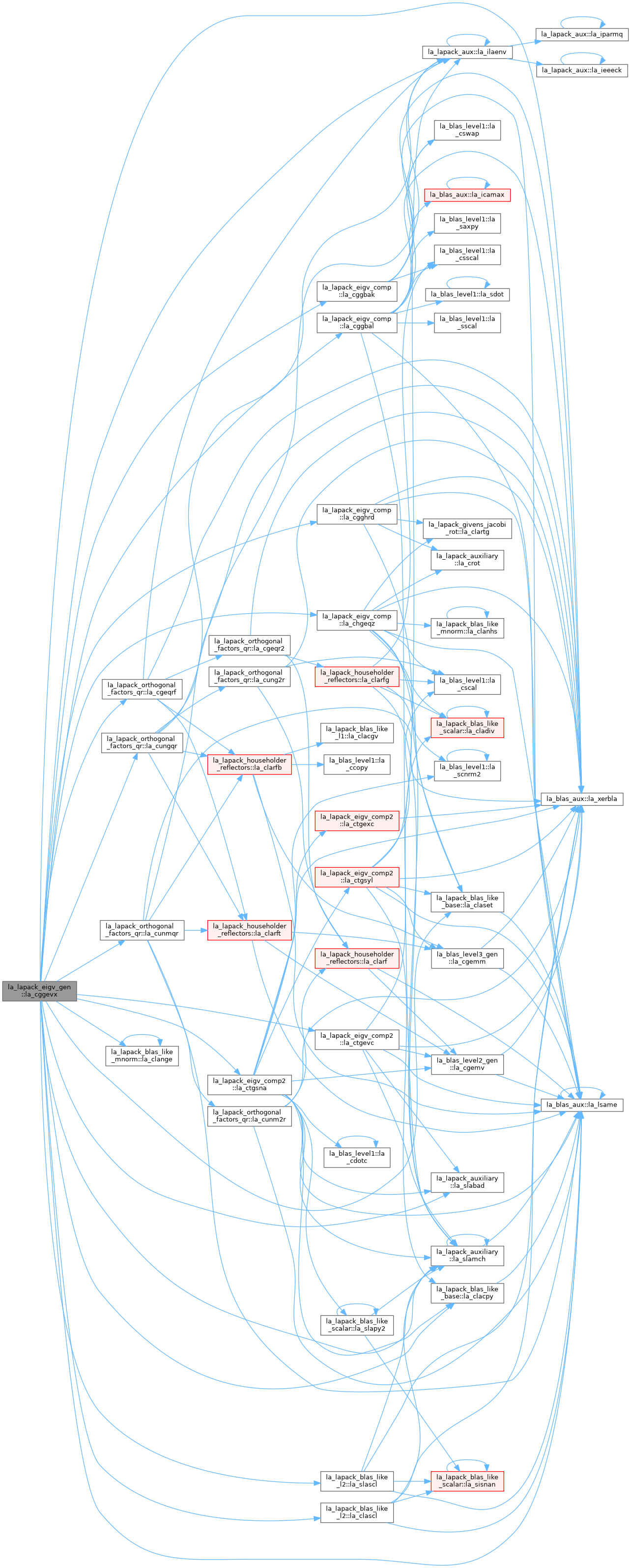
◆ la_dgees()
| subroutine, public la_lapack_eigv_gen::la_dgees | ( | character, intent(in) | jobvs, |
| character, intent(in) | sort, | ||
| procedure(la_select_d) | select, | ||
| integer(ilp), intent(in) | n, | ||
| real(dp), dimension(lda,*), intent(inout) | a, | ||
| integer(ilp), intent(in) | lda, | ||
| integer(ilp), intent(out) | sdim, | ||
| real(dp), dimension(*), intent(out) | wr, | ||
| real(dp), dimension(*), intent(out) | wi, | ||
| real(dp), dimension(ldvs,*), intent(out) | vs, | ||
| integer(ilp), intent(in) | ldvs, | ||
| real(dp), dimension(*), intent(out) | work, | ||
| integer(ilp), intent(in) | lwork, | ||
| logical(lk), dimension(*), intent(out) | bwork, | ||
| integer(ilp), intent(out) | info ) |
DGEES: computes for an N-by-N real nonsymmetric matrix A, the eigenvalues, the real Schur form T, and, optionally, the matrix of Schur vectors Z. This gives the Schur factorization A = Z*T*(Z**T). Optionally, it also orders the eigenvalues on the diagonal of the real Schur form so that selected eigenvalues are at the top left. The leading columns of Z then form an orthonormal basis for the invariant subspace corresponding to the selected eigenvalues. A matrix is in real Schur form if it is upper quasi-triangular with 1-by-1 and 2-by-2 blocks. 2-by-2 blocks will be standardized in the form [ a b ] [ c a ] where b*c < 0. The eigenvalues of such a block are a +- sqrt(bc).
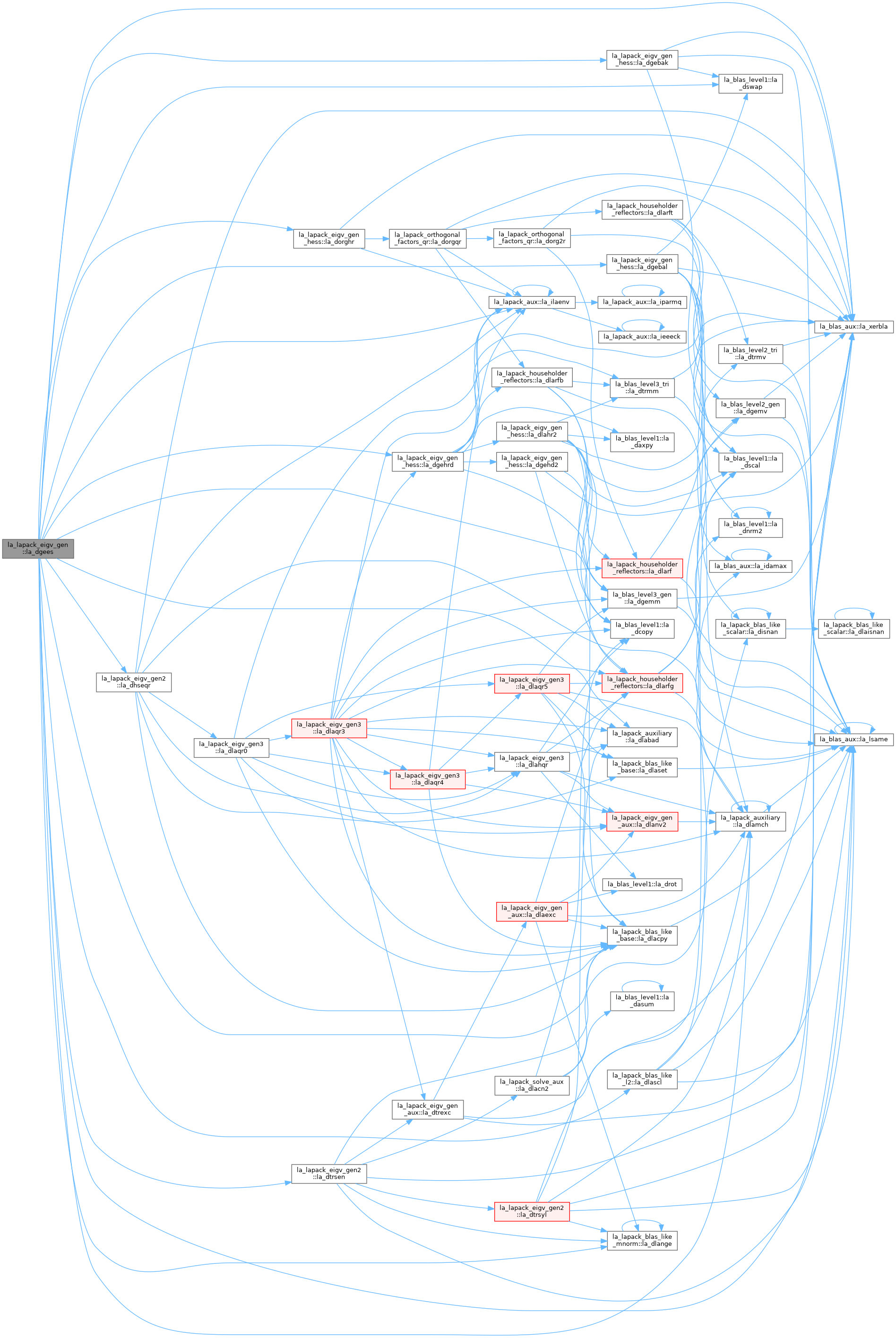
◆ la_dgeesx()
| subroutine, public la_lapack_eigv_gen::la_dgeesx | ( | character, intent(in) | jobvs, |
| character, intent(in) | sort, | ||
| procedure(la_select_d) | select, | ||
| character, intent(in) | sense, | ||
| integer(ilp), intent(in) | n, | ||
| real(dp), dimension(lda,*), intent(inout) | a, | ||
| integer(ilp), intent(in) | lda, | ||
| integer(ilp), intent(out) | sdim, | ||
| real(dp), dimension(*), intent(out) | wr, | ||
| real(dp), dimension(*), intent(out) | wi, | ||
| real(dp), dimension(ldvs,*), intent(out) | vs, | ||
| integer(ilp), intent(in) | ldvs, | ||
| real(dp), intent(out) | rconde, | ||
| real(dp), intent(out) | rcondv, | ||
| real(dp), dimension(*), intent(out) | work, | ||
| integer(ilp), intent(in) | lwork, | ||
| integer(ilp), dimension(*), intent(out) | iwork, | ||
| integer(ilp), intent(in) | liwork, | ||
| logical(lk), dimension(*), intent(out) | bwork, | ||
| integer(ilp), intent(out) | info ) |
DGEESX: computes for an N-by-N real nonsymmetric matrix A, the eigenvalues, the real Schur form T, and, optionally, the matrix of Schur vectors Z. This gives the Schur factorization A = Z*T*(Z**T). Optionally, it also orders the eigenvalues on the diagonal of the real Schur form so that selected eigenvalues are at the top left; computes a reciprocal condition number for the average of the selected eigenvalues (RCONDE); and computes a reciprocal condition number for the right invariant subspace corresponding to the selected eigenvalues (RCONDV). The leading columns of Z form an orthonormal basis for this invariant subspace. For further explanation of the reciprocal condition numbers RCONDE and RCONDV, see Section 4.10_dp of the LAPACK Users' Guide (where these quantities are called s and sep respectively). A real matrix is in real Schur form if it is upper quasi-triangular with 1-by-1 and 2-by-2 blocks. 2-by-2 blocks will be standardized in the form [ a b ] [ c a ] where b*c < 0. The eigenvalues of such a block are a +- sqrt(bc).
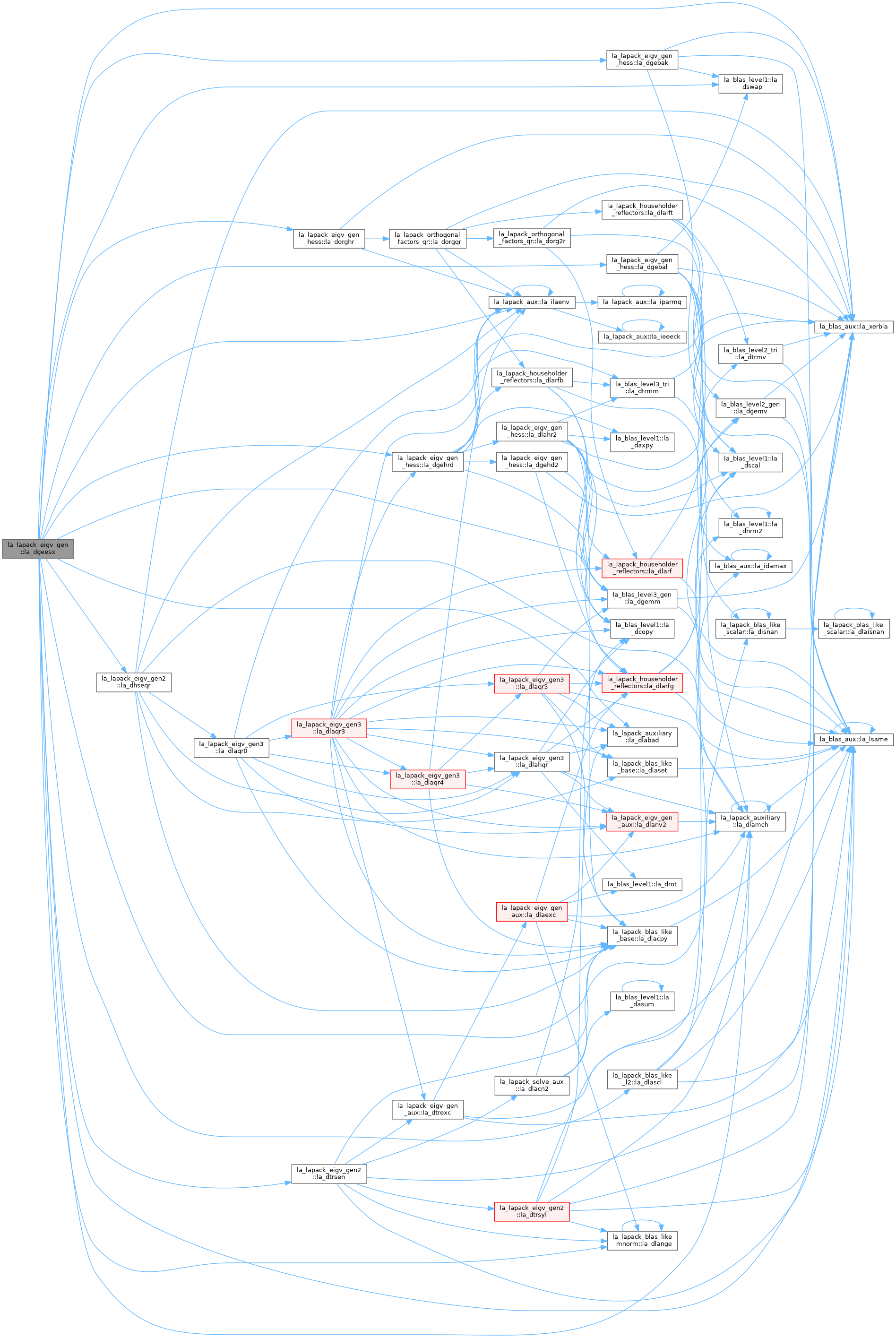
◆ la_dgeev()
| subroutine, public la_lapack_eigv_gen::la_dgeev | ( | character, intent(in) | jobvl, |
| character, intent(in) | jobvr, | ||
| integer(ilp), intent(in) | n, | ||
| real(dp), dimension(lda,*), intent(inout) | a, | ||
| integer(ilp), intent(in) | lda, | ||
| real(dp), dimension(*), intent(out) | wr, | ||
| real(dp), dimension(*), intent(out) | wi, | ||
| real(dp), dimension(ldvl,*), intent(out) | vl, | ||
| integer(ilp), intent(in) | ldvl, | ||
| real(dp), dimension(ldvr,*), intent(out) | vr, | ||
| integer(ilp), intent(in) | ldvr, | ||
| real(dp), dimension(*), intent(out) | work, | ||
| integer(ilp), intent(in) | lwork, | ||
| integer(ilp), intent(out) | info ) |
DGEEV: computes for an N-by-N real nonsymmetric matrix A, the eigenvalues and, optionally, the left and/or right eigenvectors. The right eigenvector v(j) of A satisfies A * v(j) = lambda(j) * v(j) where lambda(j) is its eigenvalue. The left eigenvector u(j) of A satisfies u(j)**H * A = lambda(j) * u(j)**H where u(j)**H denotes the conjugate-transpose of u(j). The computed eigenvectors are normalized to have Euclidean norm equal to 1 and largest component real.
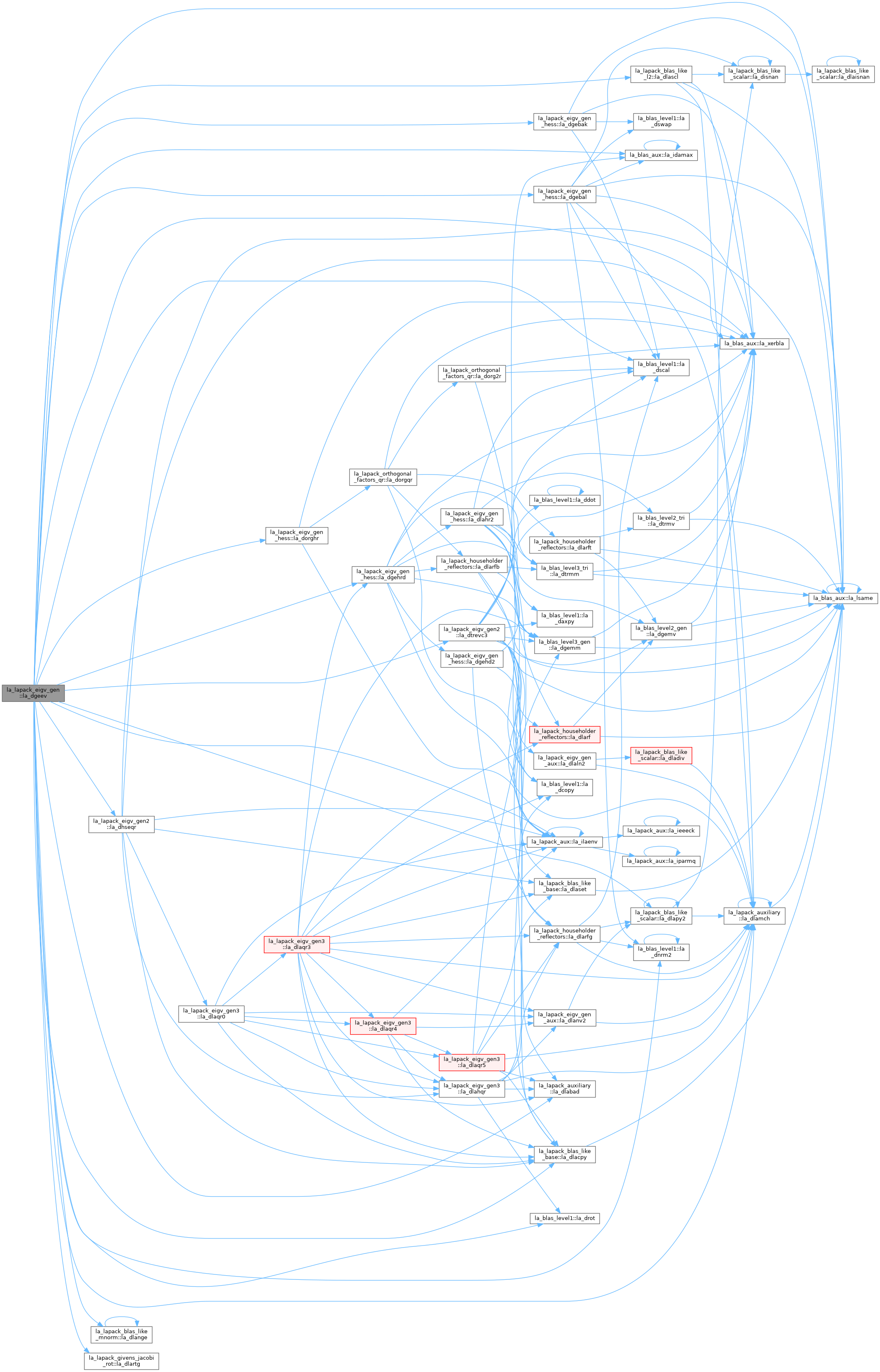
◆ la_dgeevx()
| subroutine, public la_lapack_eigv_gen::la_dgeevx | ( | character, intent(in) | balanc, |
| character, intent(in) | jobvl, | ||
| character, intent(in) | jobvr, | ||
| character, intent(in) | sense, | ||
| integer(ilp), intent(in) | n, | ||
| real(dp), dimension(lda,*), intent(inout) | a, | ||
| integer(ilp), intent(in) | lda, | ||
| real(dp), dimension(*), intent(out) | wr, | ||
| real(dp), dimension(*), intent(out) | wi, | ||
| real(dp), dimension(ldvl,*), intent(out) | vl, | ||
| integer(ilp), intent(in) | ldvl, | ||
| real(dp), dimension(ldvr,*), intent(out) | vr, | ||
| integer(ilp), intent(in) | ldvr, | ||
| integer(ilp), intent(out) | ilo, | ||
| integer(ilp), intent(out) | ihi, | ||
| real(dp), dimension(*), intent(out) | scale, | ||
| real(dp), intent(out) | abnrm, | ||
| real(dp), dimension(*), intent(out) | rconde, | ||
| real(dp), dimension(*), intent(out) | rcondv, | ||
| real(dp), dimension(*), intent(out) | work, | ||
| integer(ilp), intent(in) | lwork, | ||
| integer(ilp), dimension(*), intent(out) | iwork, | ||
| integer(ilp), intent(out) | info ) |
DGEEVX: computes for an N-by-N real nonsymmetric matrix A, the eigenvalues and, optionally, the left and/or right eigenvectors. Optionally also, it computes a balancing transformation to improve the conditioning of the eigenvalues and eigenvectors (ILO, IHI, SCALE, and ABNRM), reciprocal condition numbers for the eigenvalues (RCONDE), and reciprocal condition numbers for the right eigenvectors (RCONDV). The right eigenvector v(j) of A satisfies A * v(j) = lambda(j) * v(j) where lambda(j) is its eigenvalue. The left eigenvector u(j) of A satisfies u(j)**H * A = lambda(j) * u(j)**H where u(j)**H denotes the conjugate-transpose of u(j). The computed eigenvectors are normalized to have Euclidean norm equal to 1 and largest component real. Balancing a matrix means permuting the rows and columns to make it more nearly upper triangular, and applying a diagonal similarity transformation D * A * D**(-1), where D is a diagonal matrix, to make its rows and columns closer in norm and the condition numbers of its eigenvalues and eigenvectors smaller. The computed reciprocal condition numbers correspond to the balanced matrix. Permuting rows and columns will not change the condition numbers (in exact arithmetic) but diagonal scaling will. For further explanation of balancing, see section 4.10.2_dp of the LAPACK Users' Guide.
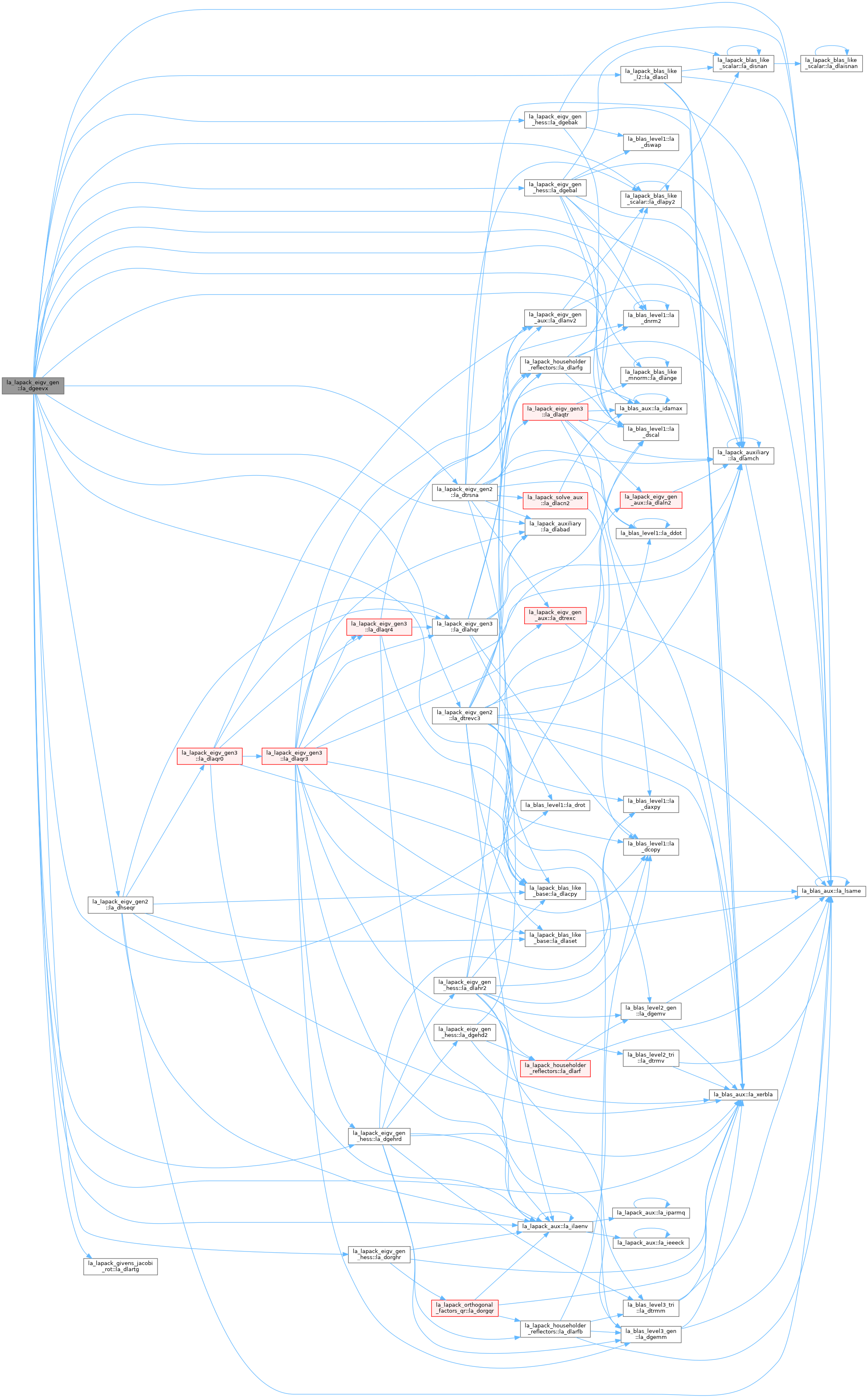
◆ la_dgges()
| subroutine, public la_lapack_eigv_gen::la_dgges | ( | character, intent(in) | jobvsl, |
| character, intent(in) | jobvsr, | ||
| character, intent(in) | sort, | ||
| procedure(la_selctg_d) | selctg, | ||
| integer(ilp), intent(in) | n, | ||
| real(dp), dimension(lda,*), intent(inout) | a, | ||
| integer(ilp), intent(in) | lda, | ||
| real(dp), dimension(ldb,*), intent(inout) | b, | ||
| integer(ilp), intent(in) | ldb, | ||
| integer(ilp), intent(out) | sdim, | ||
| real(dp), dimension(*), intent(out) | alphar, | ||
| real(dp), dimension(*), intent(out) | alphai, | ||
| real(dp), dimension(*), intent(out) | beta, | ||
| real(dp), dimension(ldvsl,*), intent(out) | vsl, | ||
| integer(ilp), intent(in) | ldvsl, | ||
| real(dp), dimension(ldvsr,*), intent(out) | vsr, | ||
| integer(ilp), intent(in) | ldvsr, | ||
| real(dp), dimension(*), intent(out) | work, | ||
| integer(ilp), intent(in) | lwork, | ||
| logical(lk), dimension(*), intent(out) | bwork, | ||
| integer(ilp), intent(out) | info ) |
DGGES: computes for a pair of N-by-N real nonsymmetric matrices (A,B), the generalized eigenvalues, the generalized real Schur form (S,T), optionally, the left and/or right matrices of Schur vectors (VSL and VSR). This gives the generalized Schur factorization (A,B) = ( (VSL)*S*(VSR)**T, (VSL)*T*(VSR)**T ) Optionally, it also orders the eigenvalues so that a selected cluster of eigenvalues appears in the leading diagonal blocks of the upper quasi-triangular matrix S and the upper triangular matrix T.The leading columns of VSL and VSR then form an orthonormal basis for the corresponding left and right eigenspaces (deflating subspaces). (If only the generalized eigenvalues are needed, use the driver DGGEV instead, which is faster.) A generalized eigenvalue for a pair of matrices (A,B) is a scalar w or a ratio alpha/beta = w, such that A - w*B is singular. It is usually represented as the pair (alpha,beta), as there is a reasonable interpretation for beta=0 or both being zero. A pair of matrices (S,T) is in generalized real Schur form if T is upper triangular with non-negative diagonal and S is block upper triangular with 1-by-1 and 2-by-2 blocks. 1-by-1 blocks correspond to real generalized eigenvalues, while 2-by-2 blocks of S will be "standardized" by making the corresponding elements of T have the form: [ a 0 ] [ 0 b ] and the pair of corresponding 2-by-2 blocks in S and T will have a complex conjugate pair of generalized eigenvalues.
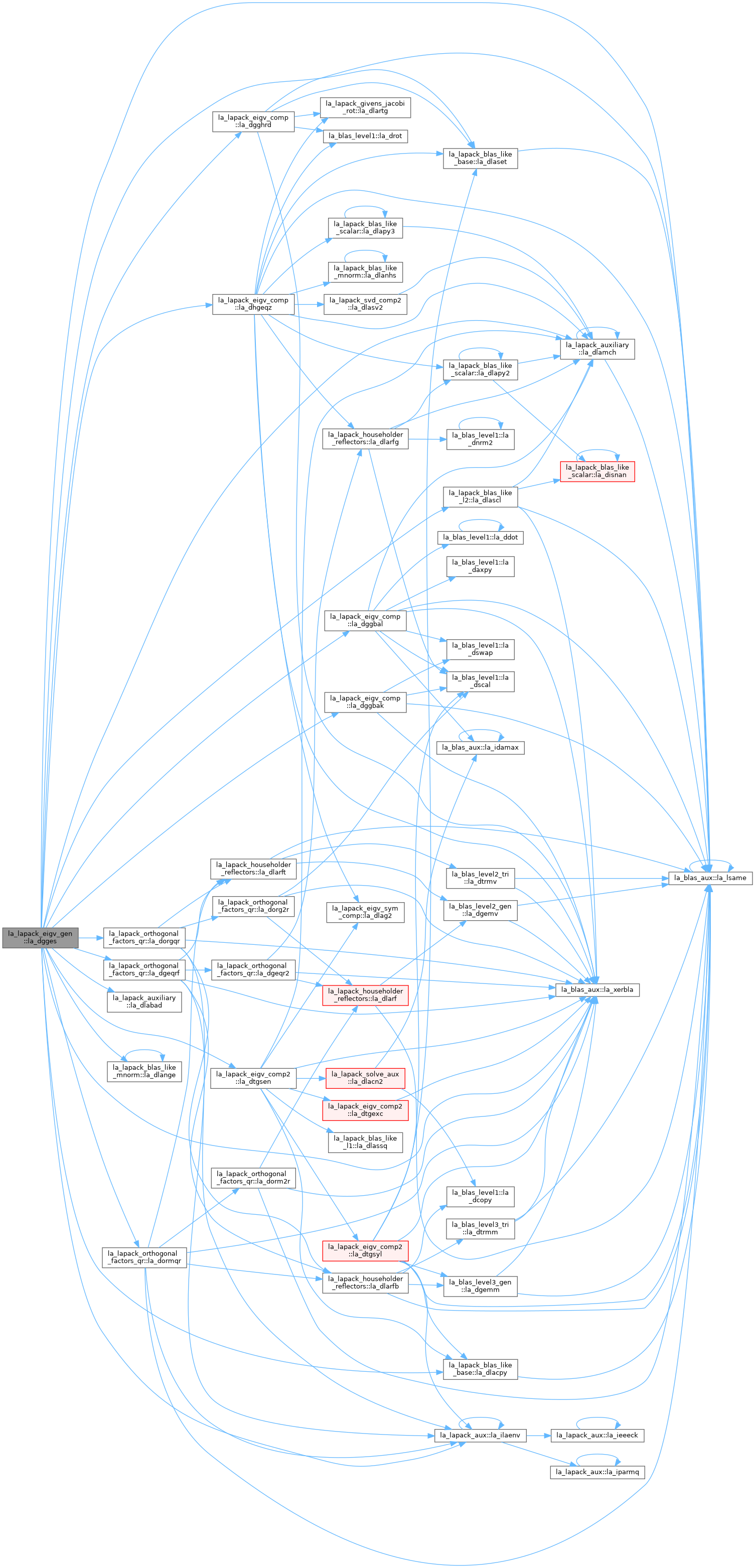
◆ la_dgges3()
| subroutine, public la_lapack_eigv_gen::la_dgges3 | ( | character, intent(in) | jobvsl, |
| character, intent(in) | jobvsr, | ||
| character, intent(in) | sort, | ||
| procedure(la_selctg_d) | selctg, | ||
| integer(ilp), intent(in) | n, | ||
| real(dp), dimension(lda,*), intent(inout) | a, | ||
| integer(ilp), intent(in) | lda, | ||
| real(dp), dimension(ldb,*), intent(inout) | b, | ||
| integer(ilp), intent(in) | ldb, | ||
| integer(ilp), intent(out) | sdim, | ||
| real(dp), dimension(*), intent(out) | alphar, | ||
| real(dp), dimension(*), intent(out) | alphai, | ||
| real(dp), dimension(*), intent(out) | beta, | ||
| real(dp), dimension(ldvsl,*), intent(out) | vsl, | ||
| integer(ilp), intent(in) | ldvsl, | ||
| real(dp), dimension(ldvsr,*), intent(out) | vsr, | ||
| integer(ilp), intent(in) | ldvsr, | ||
| real(dp), dimension(*), intent(out) | work, | ||
| integer(ilp), intent(in) | lwork, | ||
| logical(lk), dimension(*), intent(out) | bwork, | ||
| integer(ilp), intent(out) | info ) |
DGGES3: computes for a pair of N-by-N real nonsymmetric matrices (A,B), the generalized eigenvalues, the generalized real Schur form (S,T), optionally, the left and/or right matrices of Schur vectors (VSL and VSR). This gives the generalized Schur factorization (A,B) = ( (VSL)*S*(VSR)**T, (VSL)*T*(VSR)**T ) Optionally, it also orders the eigenvalues so that a selected cluster of eigenvalues appears in the leading diagonal blocks of the upper quasi-triangular matrix S and the upper triangular matrix T.The leading columns of VSL and VSR then form an orthonormal basis for the corresponding left and right eigenspaces (deflating subspaces). (If only the generalized eigenvalues are needed, use the driver DGGEV instead, which is faster.) A generalized eigenvalue for a pair of matrices (A,B) is a scalar w or a ratio alpha/beta = w, such that A - w*B is singular. It is usually represented as the pair (alpha,beta), as there is a reasonable interpretation for beta=0 or both being zero. A pair of matrices (S,T) is in generalized real Schur form if T is upper triangular with non-negative diagonal and S is block upper triangular with 1-by-1 and 2-by-2 blocks. 1-by-1 blocks correspond to real generalized eigenvalues, while 2-by-2 blocks of S will be "standardized" by making the corresponding elements of T have the form: [ a 0 ] [ 0 b ] and the pair of corresponding 2-by-2 blocks in S and T will have a complex conjugate pair of generalized eigenvalues.
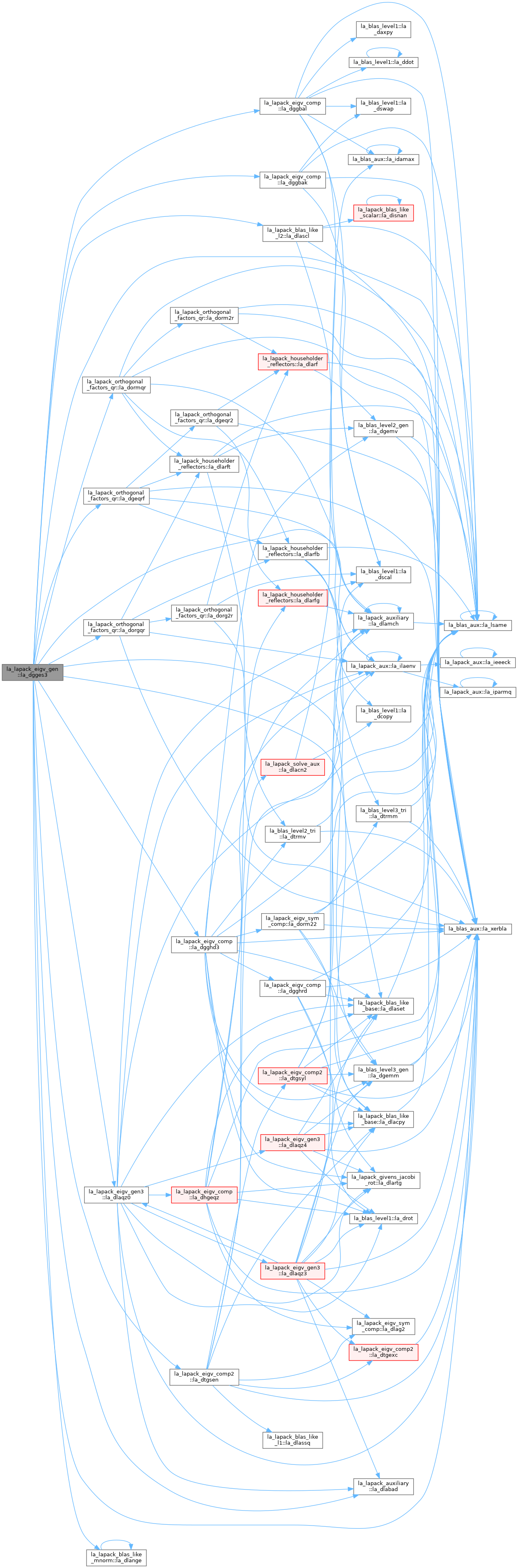
◆ la_dggesx()
| subroutine, public la_lapack_eigv_gen::la_dggesx | ( | character, intent(in) | jobvsl, |
| character, intent(in) | jobvsr, | ||
| character, intent(in) | sort, | ||
| procedure(la_selctg_d) | selctg, | ||
| character, intent(in) | sense, | ||
| integer(ilp), intent(in) | n, | ||
| real(dp), dimension(lda,*), intent(inout) | a, | ||
| integer(ilp), intent(in) | lda, | ||
| real(dp), dimension(ldb,*), intent(inout) | b, | ||
| integer(ilp), intent(in) | ldb, | ||
| integer(ilp), intent(out) | sdim, | ||
| real(dp), dimension(*), intent(out) | alphar, | ||
| real(dp), dimension(*), intent(out) | alphai, | ||
| real(dp), dimension(*), intent(out) | beta, | ||
| real(dp), dimension( ldvsl,*), intent(out) | vsl, | ||
| integer(ilp), intent(in) | ldvsl, | ||
| real(dp), dimension(ldvsr,*), intent(out) | vsr, | ||
| integer(ilp), intent(in) | ldvsr, | ||
| real(dp), dimension(2), intent(out) | rconde, | ||
| real(dp), dimension(2), intent(out) | rcondv, | ||
| real(dp), dimension(*), intent(out) | work, | ||
| integer(ilp), intent(in) | lwork, | ||
| integer(ilp), dimension(*), intent(out) | iwork, | ||
| integer(ilp), intent(in) | liwork, | ||
| logical(lk), dimension(*), intent(out) | bwork, | ||
| integer(ilp), intent(out) | info ) |
DGGESX: computes for a pair of N-by-N real nonsymmetric matrices (A,B), the generalized eigenvalues, the real Schur form (S,T), and, optionally, the left and/or right matrices of Schur vectors (VSL and VSR). This gives the generalized Schur factorization (A,B) = ( (VSL) S (VSR)**T, (VSL) T (VSR)**T ) Optionally, it also orders the eigenvalues so that a selected cluster of eigenvalues appears in the leading diagonal blocks of the upper quasi-triangular matrix S and the upper triangular matrix T; computes a reciprocal condition number for the average of the selected eigenvalues (RCONDE); and computes a reciprocal condition number for the right and left deflating subspaces corresponding to the selected eigenvalues (RCONDV). The leading columns of VSL and VSR then form an orthonormal basis for the corresponding left and right eigenspaces (deflating subspaces). A generalized eigenvalue for a pair of matrices (A,B) is a scalar w or a ratio alpha/beta = w, such that A - w*B is singular. It is usually represented as the pair (alpha,beta), as there is a reasonable interpretation for beta=0 or for both being zero. A pair of matrices (S,T) is in generalized real Schur form if T is upper triangular with non-negative diagonal and S is block upper triangular with 1-by-1 and 2-by-2 blocks. 1-by-1 blocks correspond to real generalized eigenvalues, while 2-by-2 blocks of S will be "standardized" by making the corresponding elements of T have the form: [ a 0 ] [ 0 b ] and the pair of corresponding 2-by-2 blocks in S and T will have a complex conjugate pair of generalized eigenvalues.
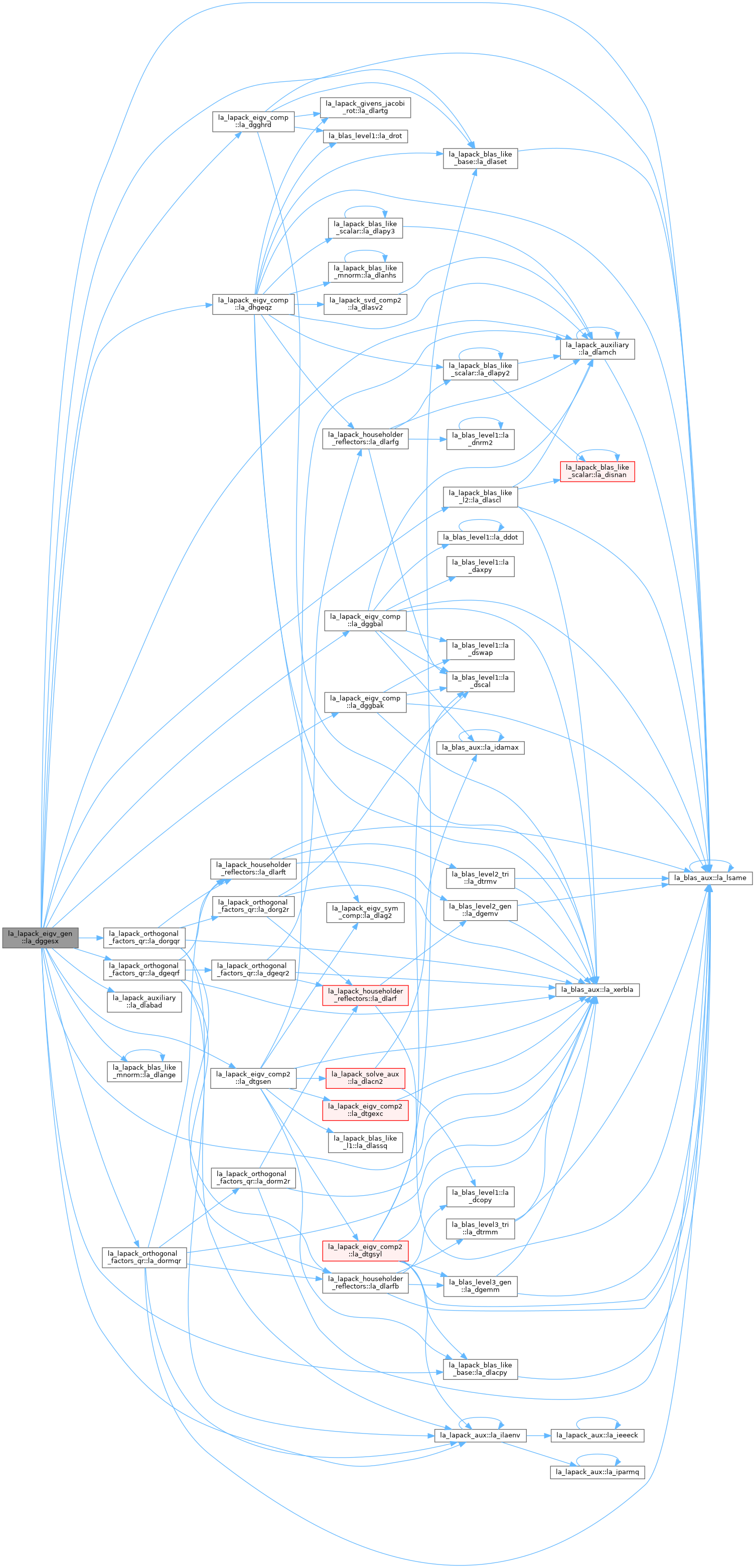
◆ la_dggev()
| subroutine, public la_lapack_eigv_gen::la_dggev | ( | character, intent(in) | jobvl, |
| character, intent(in) | jobvr, | ||
| integer(ilp), intent(in) | n, | ||
| real(dp), dimension(lda,*), intent(inout) | a, | ||
| integer(ilp), intent(in) | lda, | ||
| real(dp), dimension(ldb,*), intent(inout) | b, | ||
| integer(ilp), intent(in) | ldb, | ||
| real(dp), dimension(*), intent(out) | alphar, | ||
| real(dp), dimension(*), intent(out) | alphai, | ||
| real(dp), dimension(*), intent(out) | beta, | ||
| real(dp), dimension(ldvl,*), intent(out) | vl, | ||
| integer(ilp), intent(in) | ldvl, | ||
| real(dp), dimension(ldvr,*), intent(out) | vr, | ||
| integer(ilp), intent(in) | ldvr, | ||
| real(dp), dimension(*), intent(out) | work, | ||
| integer(ilp), intent(in) | lwork, | ||
| integer(ilp), intent(out) | info ) |
DGGEV: computes for a pair of N-by-N real nonsymmetric matrices (A,B) the generalized eigenvalues, and optionally, the left and/or right generalized eigenvectors. A generalized eigenvalue for a pair of matrices (A,B) is a scalar lambda or a ratio alpha/beta = lambda, such that A - lambda*B is singular. It is usually represented as the pair (alpha,beta), as there is a reasonable interpretation for beta=0, and even for both being zero. The right eigenvector v(j) corresponding to the eigenvalue lambda(j) of (A,B) satisfies A * v(j) = lambda(j) * B * v(j). The left eigenvector u(j) corresponding to the eigenvalue lambda(j) of (A,B) satisfies u(j)**H * A = lambda(j) * u(j)**H * B . where u(j)**H is the conjugate-transpose of u(j).
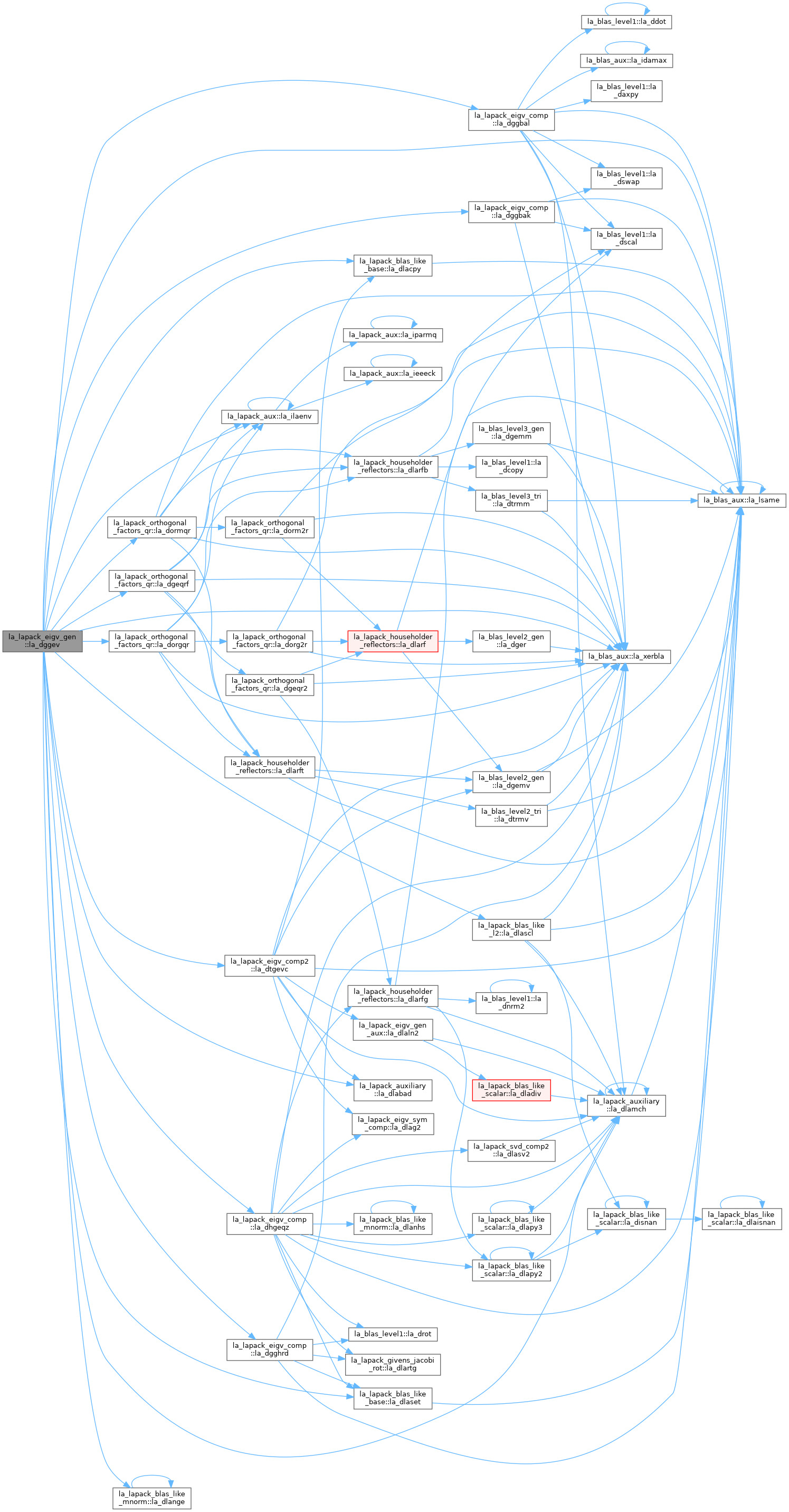
◆ la_dggev3()
| subroutine, public la_lapack_eigv_gen::la_dggev3 | ( | character, intent(in) | jobvl, |
| character, intent(in) | jobvr, | ||
| integer(ilp), intent(in) | n, | ||
| real(dp), dimension(lda,*), intent(inout) | a, | ||
| integer(ilp), intent(in) | lda, | ||
| real(dp), dimension(ldb,*), intent(inout) | b, | ||
| integer(ilp), intent(in) | ldb, | ||
| real(dp), dimension(*), intent(out) | alphar, | ||
| real(dp), dimension(*), intent(out) | alphai, | ||
| real(dp), dimension(*), intent(out) | beta, | ||
| real(dp), dimension(ldvl,*), intent(out) | vl, | ||
| integer(ilp), intent(in) | ldvl, | ||
| real(dp), dimension(ldvr,*), intent(out) | vr, | ||
| integer(ilp), intent(in) | ldvr, | ||
| real(dp), dimension(*), intent(out) | work, | ||
| integer(ilp), intent(in) | lwork, | ||
| integer(ilp), intent(out) | info ) |
DGGEV3: computes for a pair of N-by-N real nonsymmetric matrices (A,B) the generalized eigenvalues, and optionally, the left and/or right generalized eigenvectors. A generalized eigenvalue for a pair of matrices (A,B) is a scalar lambda or a ratio alpha/beta = lambda, such that A - lambda*B is singular. It is usually represented as the pair (alpha,beta), as there is a reasonable interpretation for beta=0, and even for both being zero. The right eigenvector v(j) corresponding to the eigenvalue lambda(j) of (A,B) satisfies A * v(j) = lambda(j) * B * v(j). The left eigenvector u(j) corresponding to the eigenvalue lambda(j) of (A,B) satisfies u(j)**H * A = lambda(j) * u(j)**H * B . where u(j)**H is the conjugate-transpose of u(j).
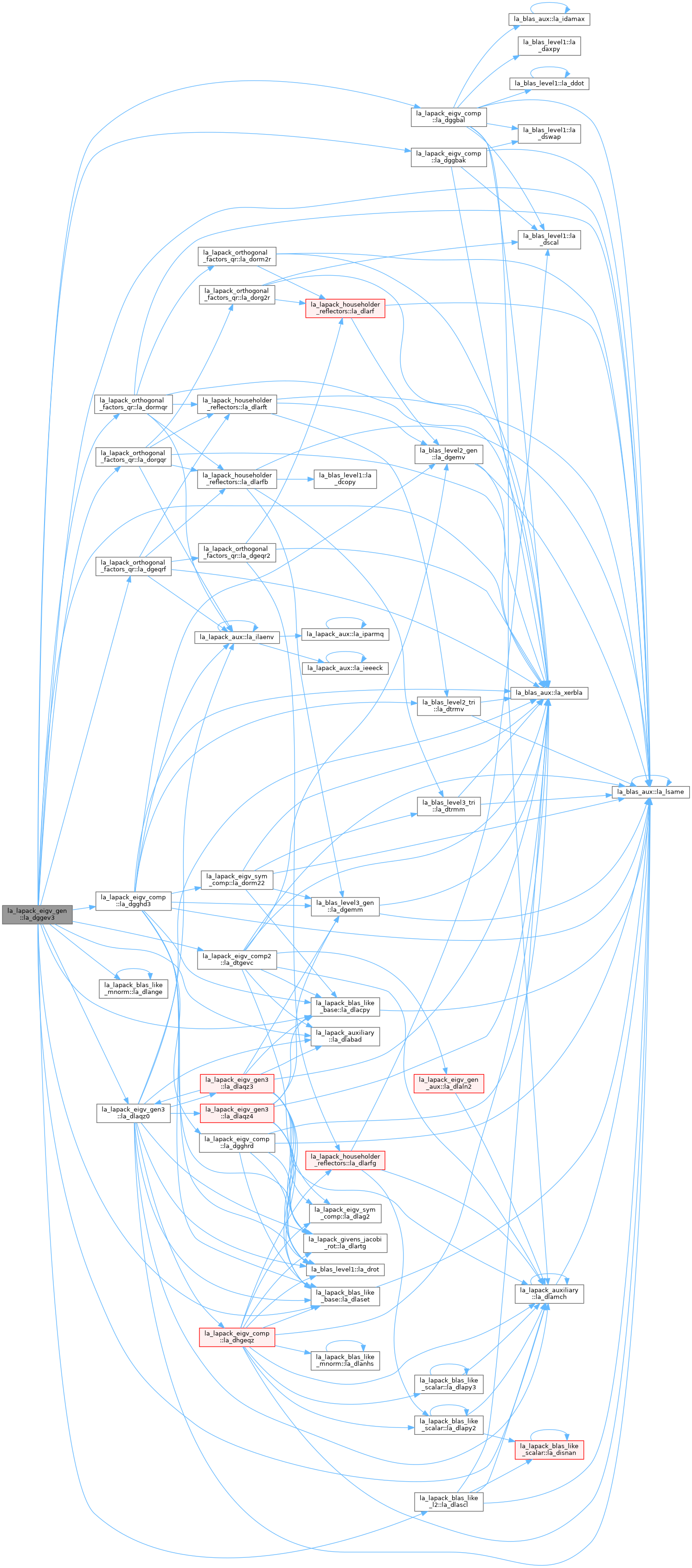
◆ la_dggevx()
| subroutine, public la_lapack_eigv_gen::la_dggevx | ( | character, intent(in) | balanc, |
| character, intent(in) | jobvl, | ||
| character, intent(in) | jobvr, | ||
| character, intent(in) | sense, | ||
| integer(ilp), intent(in) | n, | ||
| real(dp), dimension(lda,*), intent(inout) | a, | ||
| integer(ilp), intent(in) | lda, | ||
| real(dp), dimension(ldb,*), intent(inout) | b, | ||
| integer(ilp), intent(in) | ldb, | ||
| real(dp), dimension(*), intent(out) | alphar, | ||
| real(dp), dimension(*), intent(out) | alphai, | ||
| real(dp), dimension(*), intent(out) | beta, | ||
| real(dp), dimension(ldvl,*), intent(out) | vl, | ||
| integer(ilp), intent(in) | ldvl, | ||
| real(dp), dimension(ldvr,*), intent(out) | vr, | ||
| integer(ilp), intent(in) | ldvr, | ||
| integer(ilp), intent(out) | ilo, | ||
| integer(ilp), intent(out) | ihi, | ||
| real(dp), dimension(*), intent(out) | lscale, | ||
| real(dp), dimension(*), intent(out) | rscale, | ||
| real(dp), intent(out) | abnrm, | ||
| real(dp), intent(out) | bbnrm, | ||
| real(dp), dimension(*), intent(out) | rconde, | ||
| real(dp), dimension(*), intent(out) | rcondv, | ||
| real(dp), dimension(*), intent(out) | work, | ||
| integer(ilp), intent(in) | lwork, | ||
| integer(ilp), dimension(*), intent(out) | iwork, | ||
| logical(lk), dimension(*), intent(out) | bwork, | ||
| integer(ilp), intent(out) | info ) |
DGGEVX: computes for a pair of N-by-N real nonsymmetric matrices (A,B) the generalized eigenvalues, and optionally, the left and/or right generalized eigenvectors. Optionally also, it computes a balancing transformation to improve the conditioning of the eigenvalues and eigenvectors (ILO, IHI, LSCALE, RSCALE, ABNRM, and BBNRM), reciprocal condition numbers for the eigenvalues (RCONDE), and reciprocal condition numbers for the right eigenvectors (RCONDV). A generalized eigenvalue for a pair of matrices (A,B) is a scalar lambda or a ratio alpha/beta = lambda, such that A - lambda*B is singular. It is usually represented as the pair (alpha,beta), as there is a reasonable interpretation for beta=0, and even for both being zero. The right eigenvector v(j) corresponding to the eigenvalue lambda(j) of (A,B) satisfies A * v(j) = lambda(j) * B * v(j) . The left eigenvector u(j) corresponding to the eigenvalue lambda(j) of (A,B) satisfies u(j)**H * A = lambda(j) * u(j)**H * B. where u(j)**H is the conjugate-transpose of u(j).
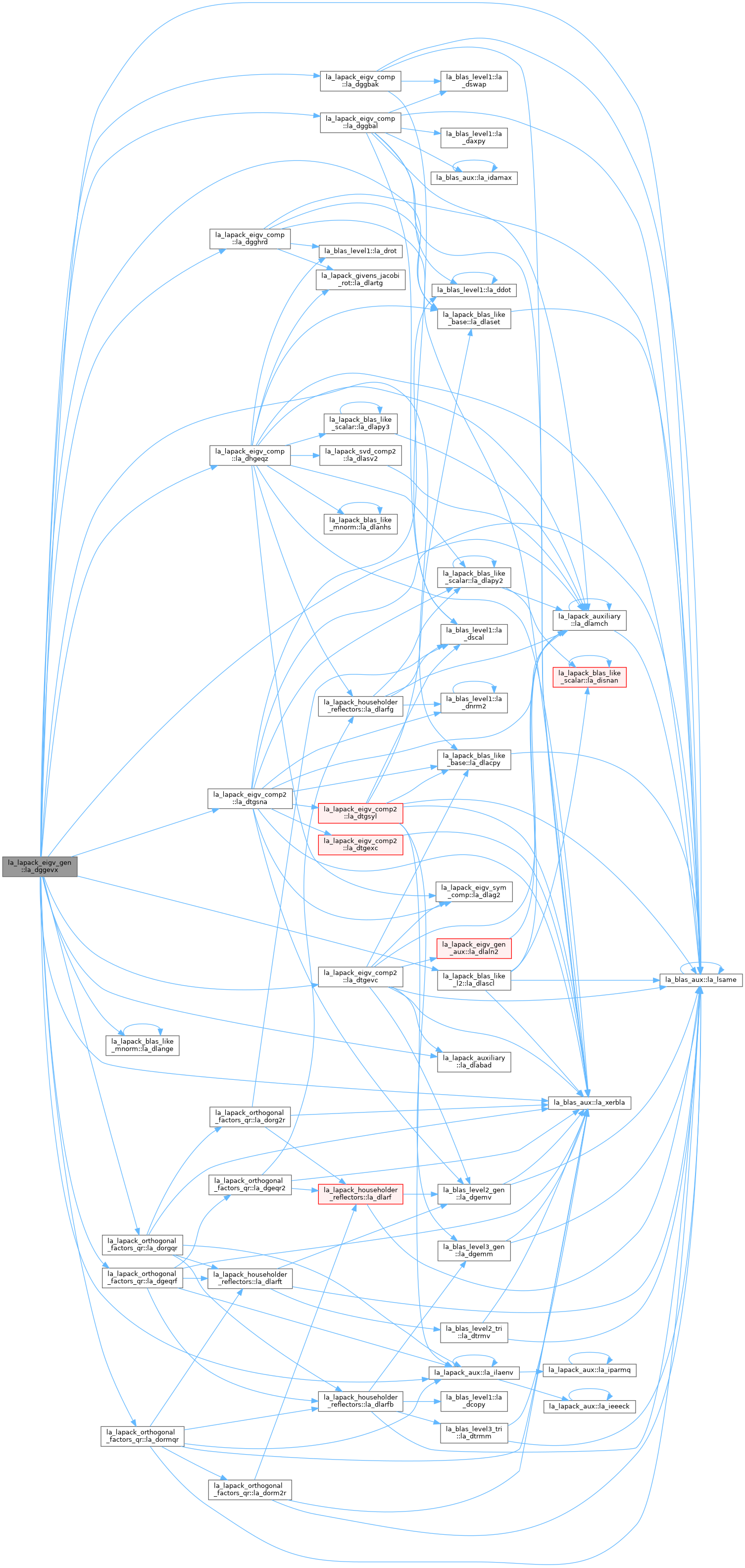
◆ la_qgees()
| subroutine, public la_lapack_eigv_gen::la_qgees | ( | character, intent(in) | jobvs, |
| character, intent(in) | sort, | ||
| procedure(la_select_q) | select, | ||
| integer(ilp), intent(in) | n, | ||
| real(qp), dimension(lda,*), intent(inout) | a, | ||
| integer(ilp), intent(in) | lda, | ||
| integer(ilp), intent(out) | sdim, | ||
| real(qp), dimension(*), intent(out) | wr, | ||
| real(qp), dimension(*), intent(out) | wi, | ||
| real(qp), dimension(ldvs,*), intent(out) | vs, | ||
| integer(ilp), intent(in) | ldvs, | ||
| real(qp), dimension(*), intent(out) | work, | ||
| integer(ilp), intent(in) | lwork, | ||
| logical(lk), dimension(*), intent(out) | bwork, | ||
| integer(ilp), intent(out) | info ) |
QGEES: computes for an N-by-N real nonsymmetric matrix A, the eigenvalues, the real Schur form T, and, optionally, the matrix of Schur vectors Z. This gives the Schur factorization A = Z*T*(Z**T). Optionally, it also orders the eigenvalues on the diagonal of the real Schur form so that selected eigenvalues are at the top left. The leading columns of Z then form an orthonormal basis for the invariant subspace corresponding to the selected eigenvalues. A matrix is in real Schur form if it is upper quasi-triangular with 1-by-1 and 2-by-2 blocks. 2-by-2 blocks will be standardized in the form [ a b ] [ c a ] where b*c < 0. The eigenvalues of such a block are a +- sqrt(bc).
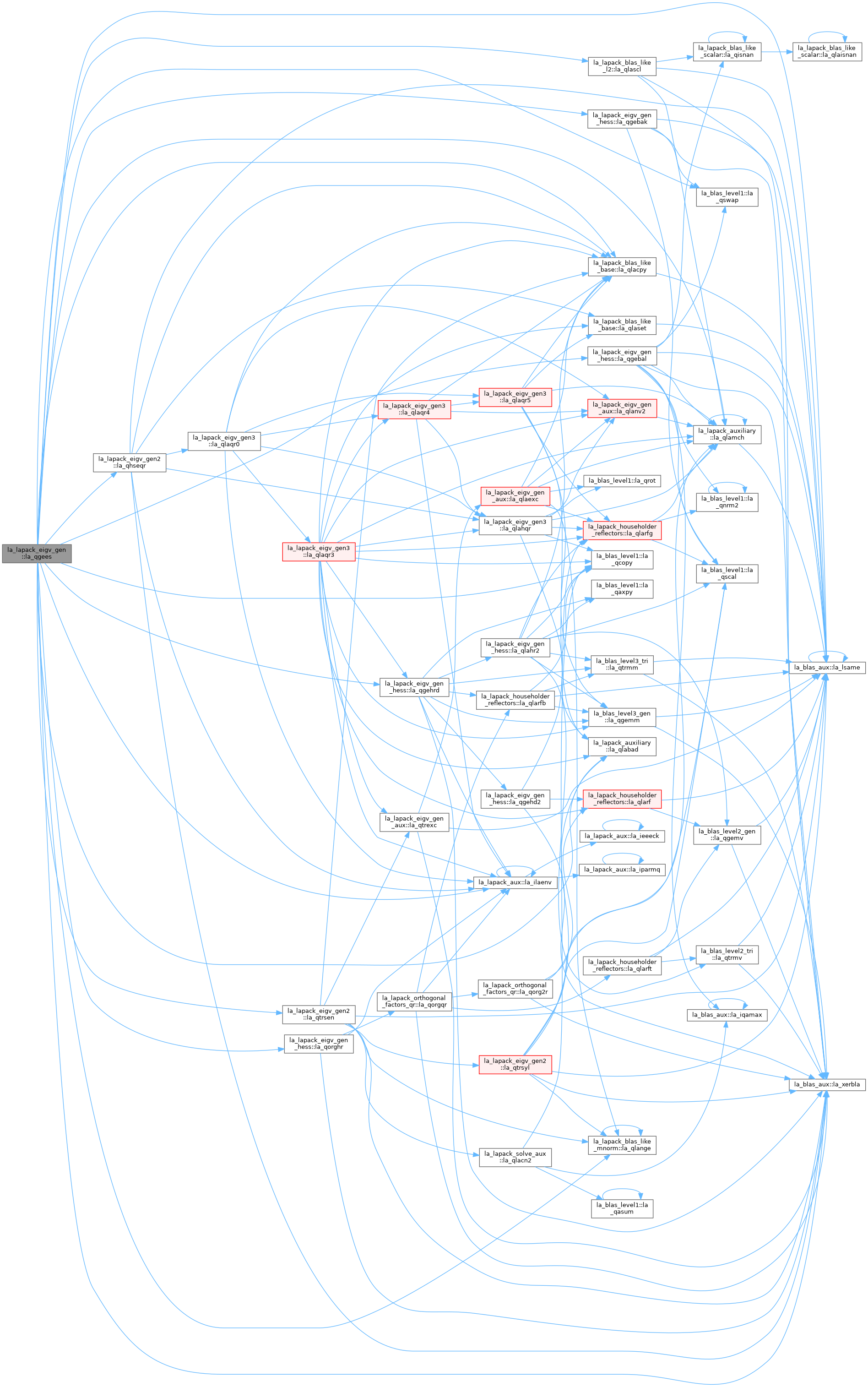
◆ la_qgeesx()
| subroutine, public la_lapack_eigv_gen::la_qgeesx | ( | character, intent(in) | jobvs, |
| character, intent(in) | sort, | ||
| procedure(la_select_q) | select, | ||
| character, intent(in) | sense, | ||
| integer(ilp), intent(in) | n, | ||
| real(qp), dimension(lda,*), intent(inout) | a, | ||
| integer(ilp), intent(in) | lda, | ||
| integer(ilp), intent(out) | sdim, | ||
| real(qp), dimension(*), intent(out) | wr, | ||
| real(qp), dimension(*), intent(out) | wi, | ||
| real(qp), dimension(ldvs,*), intent(out) | vs, | ||
| integer(ilp), intent(in) | ldvs, | ||
| real(qp), intent(out) | rconde, | ||
| real(qp), intent(out) | rcondv, | ||
| real(qp), dimension(*), intent(out) | work, | ||
| integer(ilp), intent(in) | lwork, | ||
| integer(ilp), dimension(*), intent(out) | iwork, | ||
| integer(ilp), intent(in) | liwork, | ||
| logical(lk), dimension(*), intent(out) | bwork, | ||
| integer(ilp), intent(out) | info ) |
QGEESX: computes for an N-by-N real nonsymmetric matrix A, the eigenvalues, the real Schur form T, and, optionally, the matrix of Schur vectors Z. This gives the Schur factorization A = Z*T*(Z**T). Optionally, it also orders the eigenvalues on the diagonal of the real Schur form so that selected eigenvalues are at the top left; computes a reciprocal condition number for the average of the selected eigenvalues (RCONDE); and computes a reciprocal condition number for the right invariant subspace corresponding to the selected eigenvalues (RCONDV). The leading columns of Z form an orthonormal basis for this invariant subspace. For further explanation of the reciprocal condition numbers RCONDE and RCONDV, see Section 4.10_qp of the LAPACK Users' Guide (where these quantities are called s and sep respectively). A real matrix is in real Schur form if it is upper quasi-triangular with 1-by-1 and 2-by-2 blocks. 2-by-2 blocks will be standardized in the form [ a b ] [ c a ] where b*c < 0. The eigenvalues of such a block are a +- sqrt(bc).
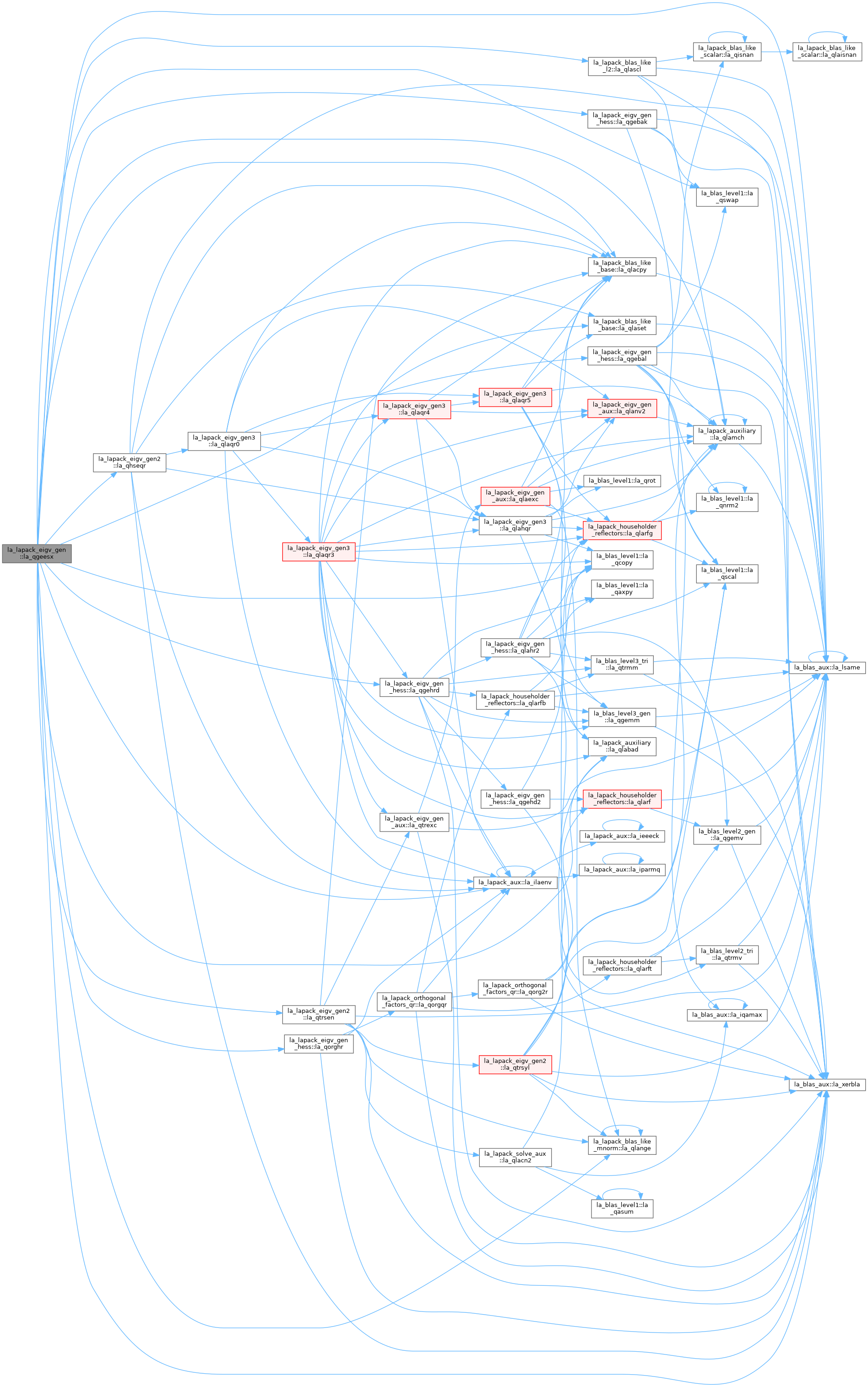
◆ la_qgeev()
| subroutine, public la_lapack_eigv_gen::la_qgeev | ( | character, intent(in) | jobvl, |
| character, intent(in) | jobvr, | ||
| integer(ilp), intent(in) | n, | ||
| real(qp), dimension(lda,*), intent(inout) | a, | ||
| integer(ilp), intent(in) | lda, | ||
| real(qp), dimension(*), intent(out) | wr, | ||
| real(qp), dimension(*), intent(out) | wi, | ||
| real(qp), dimension(ldvl,*), intent(out) | vl, | ||
| integer(ilp), intent(in) | ldvl, | ||
| real(qp), dimension(ldvr,*), intent(out) | vr, | ||
| integer(ilp), intent(in) | ldvr, | ||
| real(qp), dimension(*), intent(out) | work, | ||
| integer(ilp), intent(in) | lwork, | ||
| integer(ilp), intent(out) | info ) |
QGEEV: computes for an N-by-N real nonsymmetric matrix A, the eigenvalues and, optionally, the left and/or right eigenvectors. The right eigenvector v(j) of A satisfies A * v(j) = lambda(j) * v(j) where lambda(j) is its eigenvalue. The left eigenvector u(j) of A satisfies u(j)**H * A = lambda(j) * u(j)**H where u(j)**H denotes the conjugate-transpose of u(j). The computed eigenvectors are normalized to have Euclidean norm equal to 1 and largest component real.
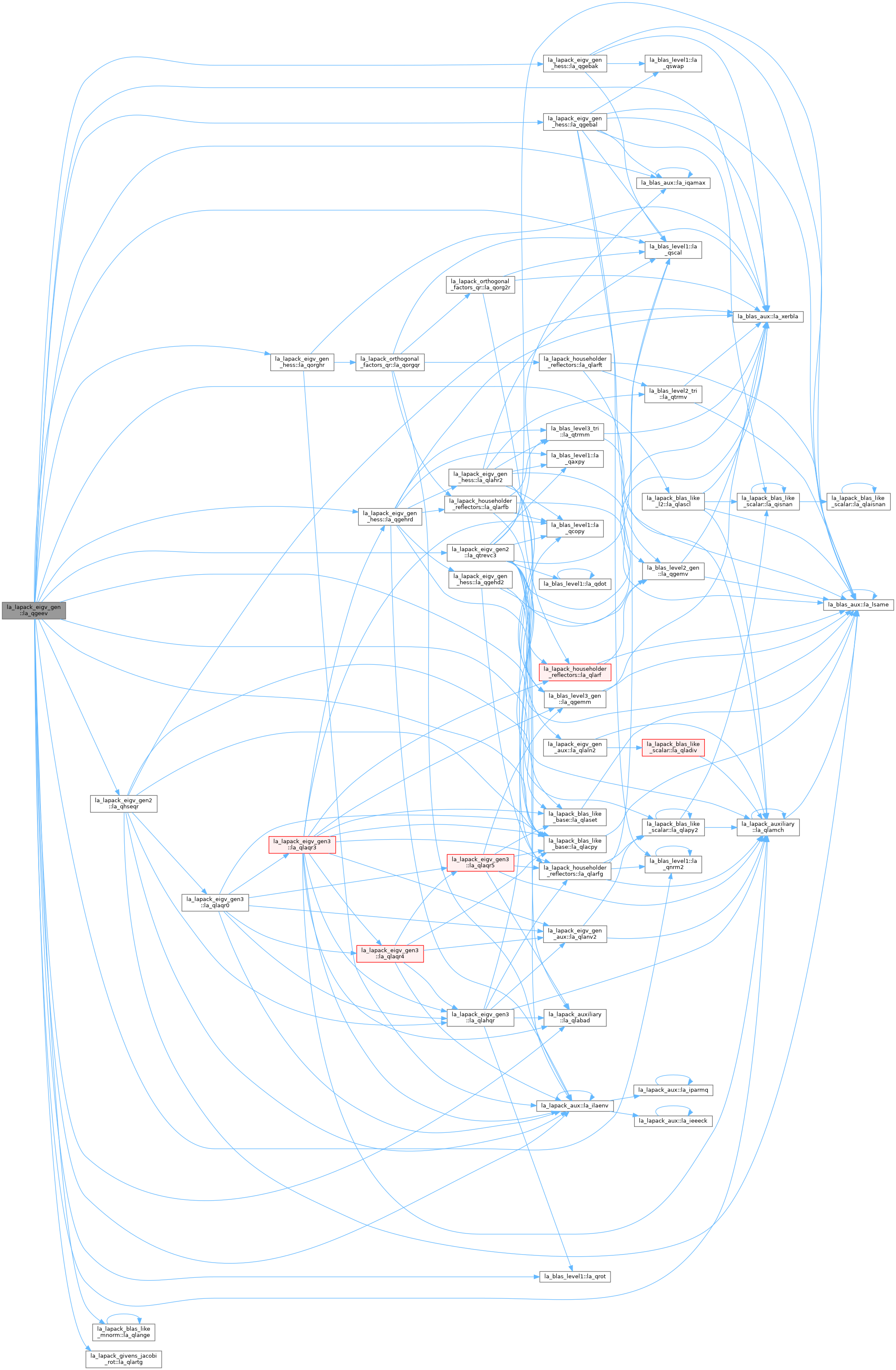
◆ la_qgeevx()
| subroutine, public la_lapack_eigv_gen::la_qgeevx | ( | character, intent(in) | balanc, |
| character, intent(in) | jobvl, | ||
| character, intent(in) | jobvr, | ||
| character, intent(in) | sense, | ||
| integer(ilp), intent(in) | n, | ||
| real(qp), dimension(lda,*), intent(inout) | a, | ||
| integer(ilp), intent(in) | lda, | ||
| real(qp), dimension(*), intent(out) | wr, | ||
| real(qp), dimension(*), intent(out) | wi, | ||
| real(qp), dimension(ldvl,*), intent(out) | vl, | ||
| integer(ilp), intent(in) | ldvl, | ||
| real(qp), dimension(ldvr,*), intent(out) | vr, | ||
| integer(ilp), intent(in) | ldvr, | ||
| integer(ilp), intent(out) | ilo, | ||
| integer(ilp), intent(out) | ihi, | ||
| real(qp), dimension(*), intent(out) | scale, | ||
| real(qp), intent(out) | abnrm, | ||
| real(qp), dimension(*), intent(out) | rconde, | ||
| real(qp), dimension(*), intent(out) | rcondv, | ||
| real(qp), dimension(*), intent(out) | work, | ||
| integer(ilp), intent(in) | lwork, | ||
| integer(ilp), dimension(*), intent(out) | iwork, | ||
| integer(ilp), intent(out) | info ) |
QGEEVX: computes for an N-by-N real nonsymmetric matrix A, the eigenvalues and, optionally, the left and/or right eigenvectors. Optionally also, it computes a balancing transformation to improve the conditioning of the eigenvalues and eigenvectors (ILO, IHI, SCALE, and ABNRM), reciprocal condition numbers for the eigenvalues (RCONDE), and reciprocal condition numbers for the right eigenvectors (RCONDV). The right eigenvector v(j) of A satisfies A * v(j) = lambda(j) * v(j) where lambda(j) is its eigenvalue. The left eigenvector u(j) of A satisfies u(j)**H * A = lambda(j) * u(j)**H where u(j)**H denotes the conjugate-transpose of u(j). The computed eigenvectors are normalized to have Euclidean norm equal to 1 and largest component real. Balancing a matrix means permuting the rows and columns to make it more nearly upper triangular, and applying a diagonal similarity transformation D * A * D**(-1), where D is a diagonal matrix, to make its rows and columns closer in norm and the condition numbers of its eigenvalues and eigenvectors smaller. The computed reciprocal condition numbers correspond to the balanced matrix. Permuting rows and columns will not change the condition numbers (in exact arithmetic) but diagonal scaling will. For further explanation of balancing, see section 4.10.2_qp of the LAPACK Users' Guide.
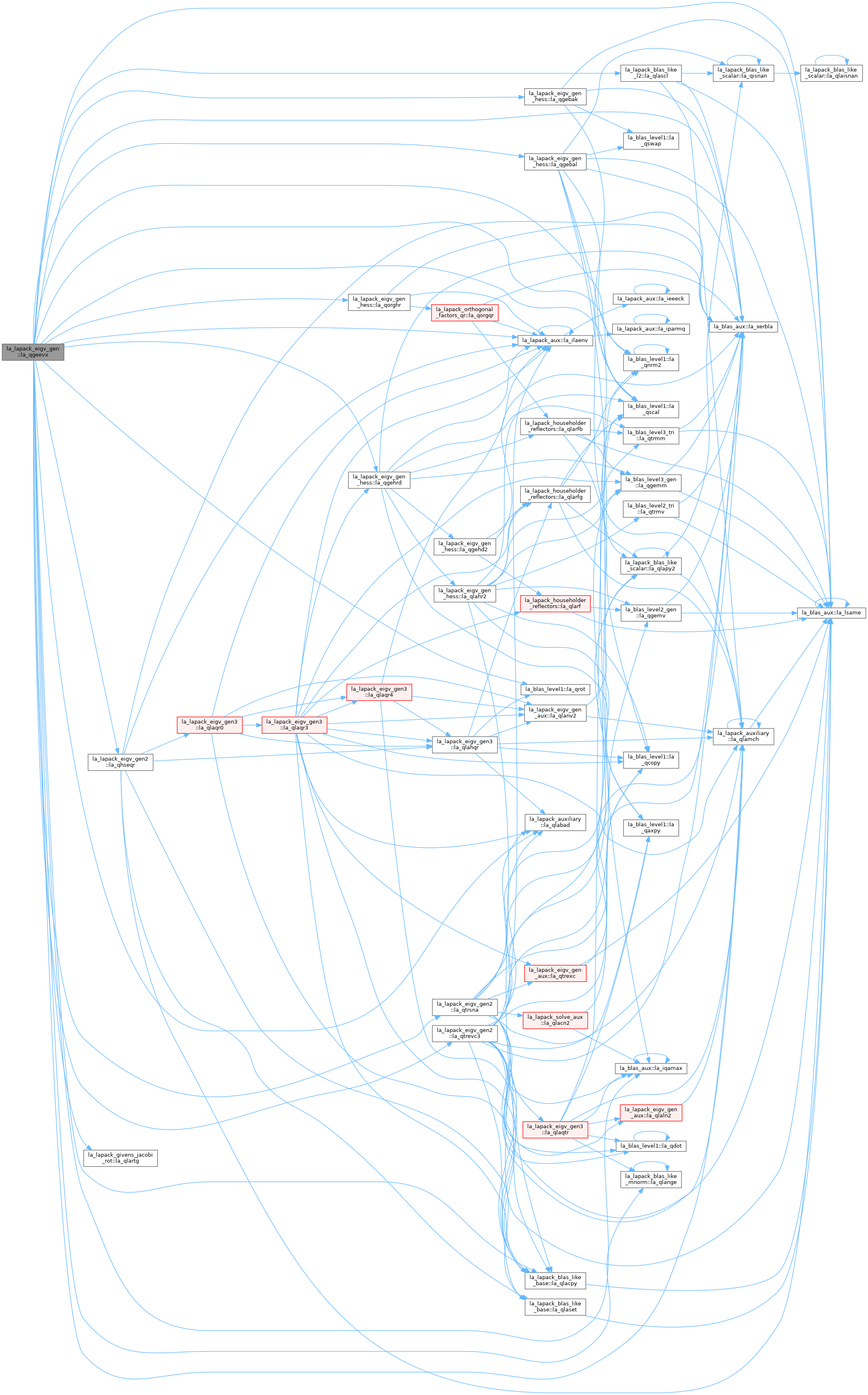
◆ la_qgges()
| subroutine, public la_lapack_eigv_gen::la_qgges | ( | character, intent(in) | jobvsl, |
| character, intent(in) | jobvsr, | ||
| character, intent(in) | sort, | ||
| procedure(la_selctg_q) | selctg, | ||
| integer(ilp), intent(in) | n, | ||
| real(qp), dimension(lda,*), intent(inout) | a, | ||
| integer(ilp), intent(in) | lda, | ||
| real(qp), dimension(ldb,*), intent(inout) | b, | ||
| integer(ilp), intent(in) | ldb, | ||
| integer(ilp), intent(out) | sdim, | ||
| real(qp), dimension(*), intent(out) | alphar, | ||
| real(qp), dimension(*), intent(out) | alphai, | ||
| real(qp), dimension(*), intent(out) | beta, | ||
| real(qp), dimension(ldvsl,*), intent(out) | vsl, | ||
| integer(ilp), intent(in) | ldvsl, | ||
| real(qp), dimension(ldvsr,*), intent(out) | vsr, | ||
| integer(ilp), intent(in) | ldvsr, | ||
| real(qp), dimension(*), intent(out) | work, | ||
| integer(ilp), intent(in) | lwork, | ||
| logical(lk), dimension(*), intent(out) | bwork, | ||
| integer(ilp), intent(out) | info ) |
QGGES: computes for a pair of N-by-N real nonsymmetric matrices (A,B), the generalized eigenvalues, the generalized real Schur form (S,T), optionally, the left and/or right matrices of Schur vectors (VSL and VSR). This gives the generalized Schur factorization (A,B) = ( (VSL)*S*(VSR)**T, (VSL)*T*(VSR)**T ) Optionally, it also orders the eigenvalues so that a selected cluster of eigenvalues appears in the leading diagonal blocks of the upper quasi-triangular matrix S and the upper triangular matrix T.The leading columns of VSL and VSR then form an orthonormal basis for the corresponding left and right eigenspaces (deflating subspaces). (If only the generalized eigenvalues are needed, use the driver QGGEV instead, which is faster.) A generalized eigenvalue for a pair of matrices (A,B) is a scalar w or a ratio alpha/beta = w, such that A - w*B is singular. It is usually represented as the pair (alpha,beta), as there is a reasonable interpretation for beta=0 or both being zero. A pair of matrices (S,T) is in generalized real Schur form if T is upper triangular with non-negative diagonal and S is block upper triangular with 1-by-1 and 2-by-2 blocks. 1-by-1 blocks correspond to real generalized eigenvalues, while 2-by-2 blocks of S will be "standardized" by making the corresponding elements of T have the form: [ a 0 ] [ 0 b ] and the pair of corresponding 2-by-2 blocks in S and T will have a complex conjugate pair of generalized eigenvalues.
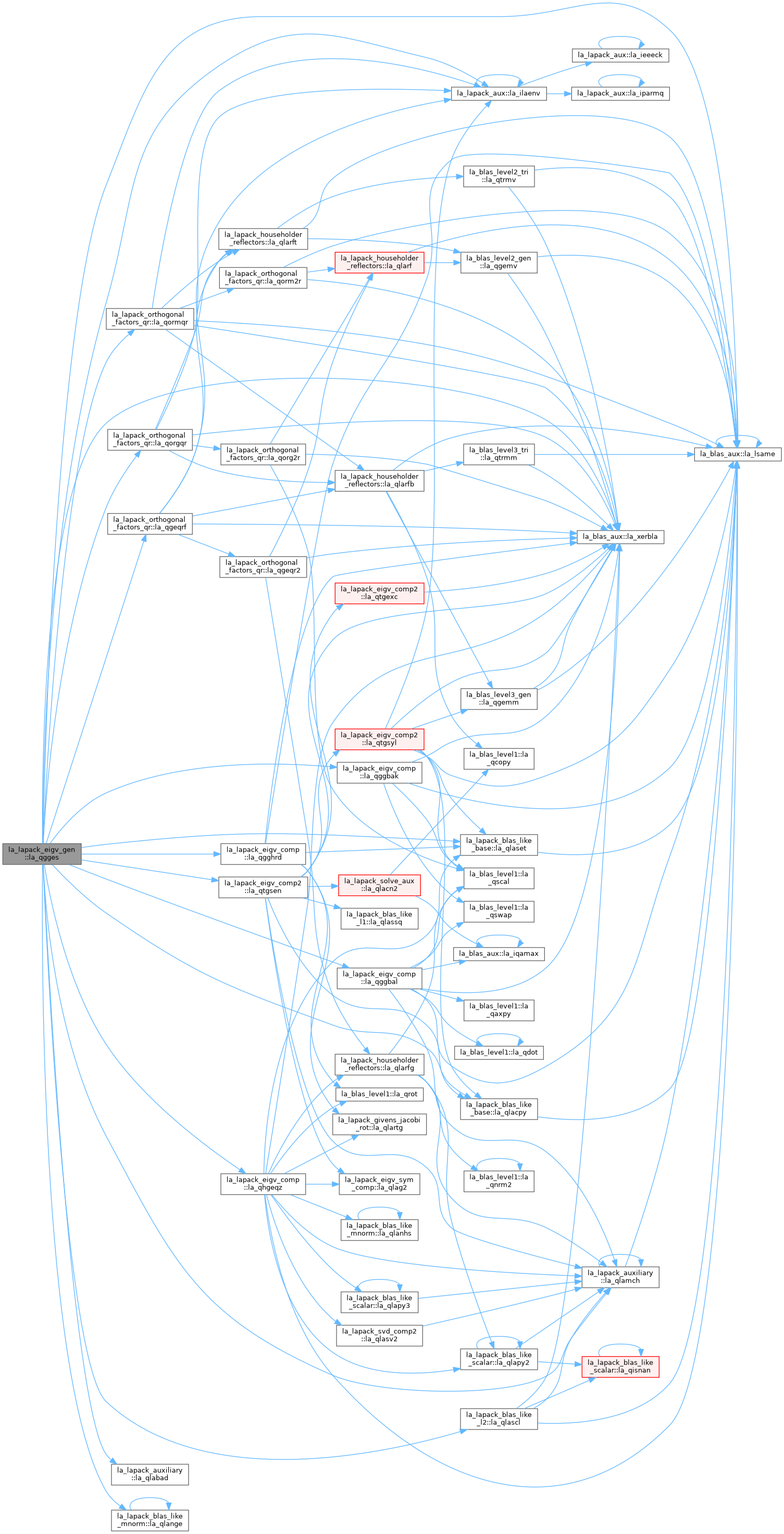
◆ la_qgges3()
| subroutine, public la_lapack_eigv_gen::la_qgges3 | ( | character, intent(in) | jobvsl, |
| character, intent(in) | jobvsr, | ||
| character, intent(in) | sort, | ||
| procedure(la_selctg_q) | selctg, | ||
| integer(ilp), intent(in) | n, | ||
| real(qp), dimension(lda,*), intent(inout) | a, | ||
| integer(ilp), intent(in) | lda, | ||
| real(qp), dimension(ldb,*), intent(inout) | b, | ||
| integer(ilp), intent(in) | ldb, | ||
| integer(ilp), intent(out) | sdim, | ||
| real(qp), dimension(*), intent(out) | alphar, | ||
| real(qp), dimension(*), intent(out) | alphai, | ||
| real(qp), dimension(*), intent(out) | beta, | ||
| real(qp), dimension(ldvsl,*), intent(out) | vsl, | ||
| integer(ilp), intent(in) | ldvsl, | ||
| real(qp), dimension(ldvsr,*), intent(out) | vsr, | ||
| integer(ilp), intent(in) | ldvsr, | ||
| real(qp), dimension(*), intent(out) | work, | ||
| integer(ilp), intent(in) | lwork, | ||
| logical(lk), dimension(*), intent(out) | bwork, | ||
| integer(ilp), intent(out) | info ) |
QGGES3: computes for a pair of N-by-N real nonsymmetric matrices (A,B), the generalized eigenvalues, the generalized real Schur form (S,T), optionally, the left and/or right matrices of Schur vectors (VSL and VSR). This gives the generalized Schur factorization (A,B) = ( (VSL)*S*(VSR)**T, (VSL)*T*(VSR)**T ) Optionally, it also orders the eigenvalues so that a selected cluster of eigenvalues appears in the leading diagonal blocks of the upper quasi-triangular matrix S and the upper triangular matrix T.The leading columns of VSL and VSR then form an orthonormal basis for the corresponding left and right eigenspaces (deflating subspaces). (If only the generalized eigenvalues are needed, use the driver QGGEV instead, which is faster.) A generalized eigenvalue for a pair of matrices (A,B) is a scalar w or a ratio alpha/beta = w, such that A - w*B is singular. It is usually represented as the pair (alpha,beta), as there is a reasonable interpretation for beta=0 or both being zero. A pair of matrices (S,T) is in generalized real Schur form if T is upper triangular with non-negative diagonal and S is block upper triangular with 1-by-1 and 2-by-2 blocks. 1-by-1 blocks correspond to real generalized eigenvalues, while 2-by-2 blocks of S will be "standardized" by making the corresponding elements of T have the form: [ a 0 ] [ 0 b ] and the pair of corresponding 2-by-2 blocks in S and T will have a complex conjugate pair of generalized eigenvalues.
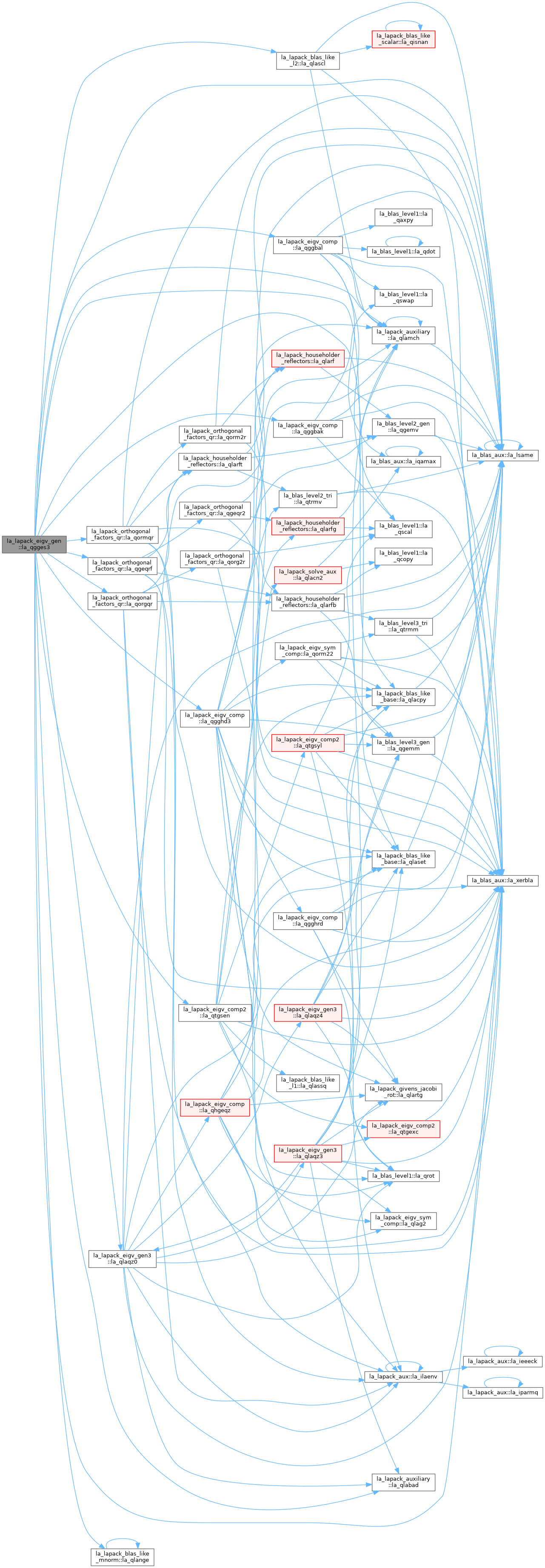
◆ la_qggesx()
| subroutine, public la_lapack_eigv_gen::la_qggesx | ( | character, intent(in) | jobvsl, |
| character, intent(in) | jobvsr, | ||
| character, intent(in) | sort, | ||
| procedure(la_selctg_q) | selctg, | ||
| character, intent(in) | sense, | ||
| integer(ilp), intent(in) | n, | ||
| real(qp), dimension(lda,*), intent(inout) | a, | ||
| integer(ilp), intent(in) | lda, | ||
| real(qp), dimension(ldb,*), intent(inout) | b, | ||
| integer(ilp), intent(in) | ldb, | ||
| integer(ilp), intent(out) | sdim, | ||
| real(qp), dimension(*), intent(out) | alphar, | ||
| real(qp), dimension(*), intent(out) | alphai, | ||
| real(qp), dimension(*), intent(out) | beta, | ||
| real(qp), dimension( ldvsl,*), intent(out) | vsl, | ||
| integer(ilp), intent(in) | ldvsl, | ||
| real(qp), dimension(ldvsr,*), intent(out) | vsr, | ||
| integer(ilp), intent(in) | ldvsr, | ||
| real(qp), dimension(2), intent(out) | rconde, | ||
| real(qp), dimension(2), intent(out) | rcondv, | ||
| real(qp), dimension(*), intent(out) | work, | ||
| integer(ilp), intent(in) | lwork, | ||
| integer(ilp), dimension(*), intent(out) | iwork, | ||
| integer(ilp), intent(in) | liwork, | ||
| logical(lk), dimension(*), intent(out) | bwork, | ||
| integer(ilp), intent(out) | info ) |
QGGESX: computes for a pair of N-by-N real nonsymmetric matrices (A,B), the generalized eigenvalues, the real Schur form (S,T), and, optionally, the left and/or right matrices of Schur vectors (VSL and VSR). This gives the generalized Schur factorization (A,B) = ( (VSL) S (VSR)**T, (VSL) T (VSR)**T ) Optionally, it also orders the eigenvalues so that a selected cluster of eigenvalues appears in the leading diagonal blocks of the upper quasi-triangular matrix S and the upper triangular matrix T; computes a reciprocal condition number for the average of the selected eigenvalues (RCONDE); and computes a reciprocal condition number for the right and left deflating subspaces corresponding to the selected eigenvalues (RCONDV). The leading columns of VSL and VSR then form an orthonormal basis for the corresponding left and right eigenspaces (deflating subspaces). A generalized eigenvalue for a pair of matrices (A,B) is a scalar w or a ratio alpha/beta = w, such that A - w*B is singular. It is usually represented as the pair (alpha,beta), as there is a reasonable interpretation for beta=0 or for both being zero. A pair of matrices (S,T) is in generalized real Schur form if T is upper triangular with non-negative diagonal and S is block upper triangular with 1-by-1 and 2-by-2 blocks. 1-by-1 blocks correspond to real generalized eigenvalues, while 2-by-2 blocks of S will be "standardized" by making the corresponding elements of T have the form: [ a 0 ] [ 0 b ] and the pair of corresponding 2-by-2 blocks in S and T will have a complex conjugate pair of generalized eigenvalues.
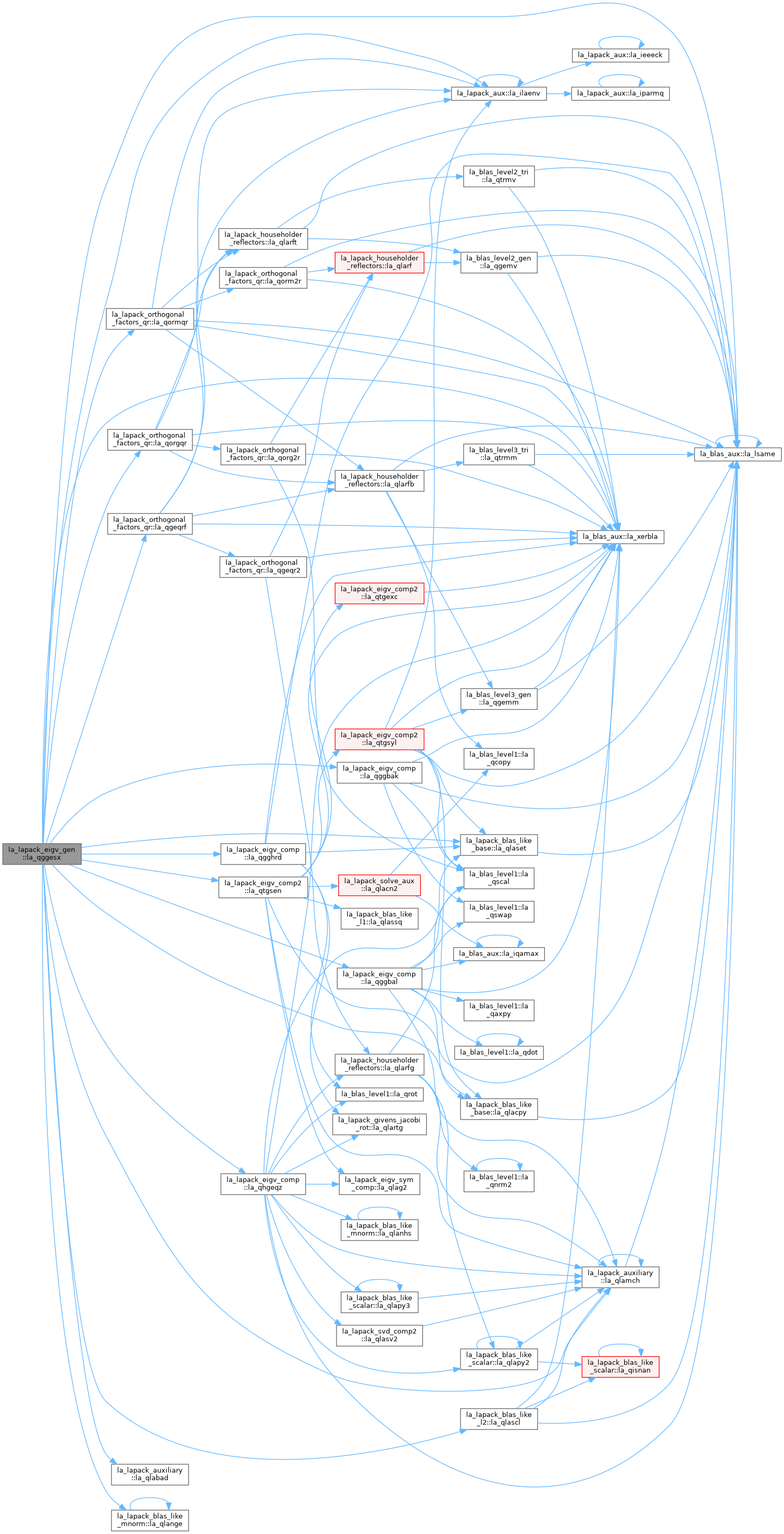
◆ la_qggev()
| subroutine, public la_lapack_eigv_gen::la_qggev | ( | character, intent(in) | jobvl, |
| character, intent(in) | jobvr, | ||
| integer(ilp), intent(in) | n, | ||
| real(qp), dimension(lda,*), intent(inout) | a, | ||
| integer(ilp), intent(in) | lda, | ||
| real(qp), dimension(ldb,*), intent(inout) | b, | ||
| integer(ilp), intent(in) | ldb, | ||
| real(qp), dimension(*), intent(out) | alphar, | ||
| real(qp), dimension(*), intent(out) | alphai, | ||
| real(qp), dimension(*), intent(out) | beta, | ||
| real(qp), dimension(ldvl,*), intent(out) | vl, | ||
| integer(ilp), intent(in) | ldvl, | ||
| real(qp), dimension(ldvr,*), intent(out) | vr, | ||
| integer(ilp), intent(in) | ldvr, | ||
| real(qp), dimension(*), intent(out) | work, | ||
| integer(ilp), intent(in) | lwork, | ||
| integer(ilp), intent(out) | info ) |
QGGEV: computes for a pair of N-by-N real nonsymmetric matrices (A,B) the generalized eigenvalues, and optionally, the left and/or right generalized eigenvectors. A generalized eigenvalue for a pair of matrices (A,B) is a scalar lambda or a ratio alpha/beta = lambda, such that A - lambda*B is singular. It is usually represented as the pair (alpha,beta), as there is a reasonable interpretation for beta=0, and even for both being zero. The right eigenvector v(j) corresponding to the eigenvalue lambda(j) of (A,B) satisfies A * v(j) = lambda(j) * B * v(j). The left eigenvector u(j) corresponding to the eigenvalue lambda(j) of (A,B) satisfies u(j)**H * A = lambda(j) * u(j)**H * B . where u(j)**H is the conjugate-transpose of u(j).
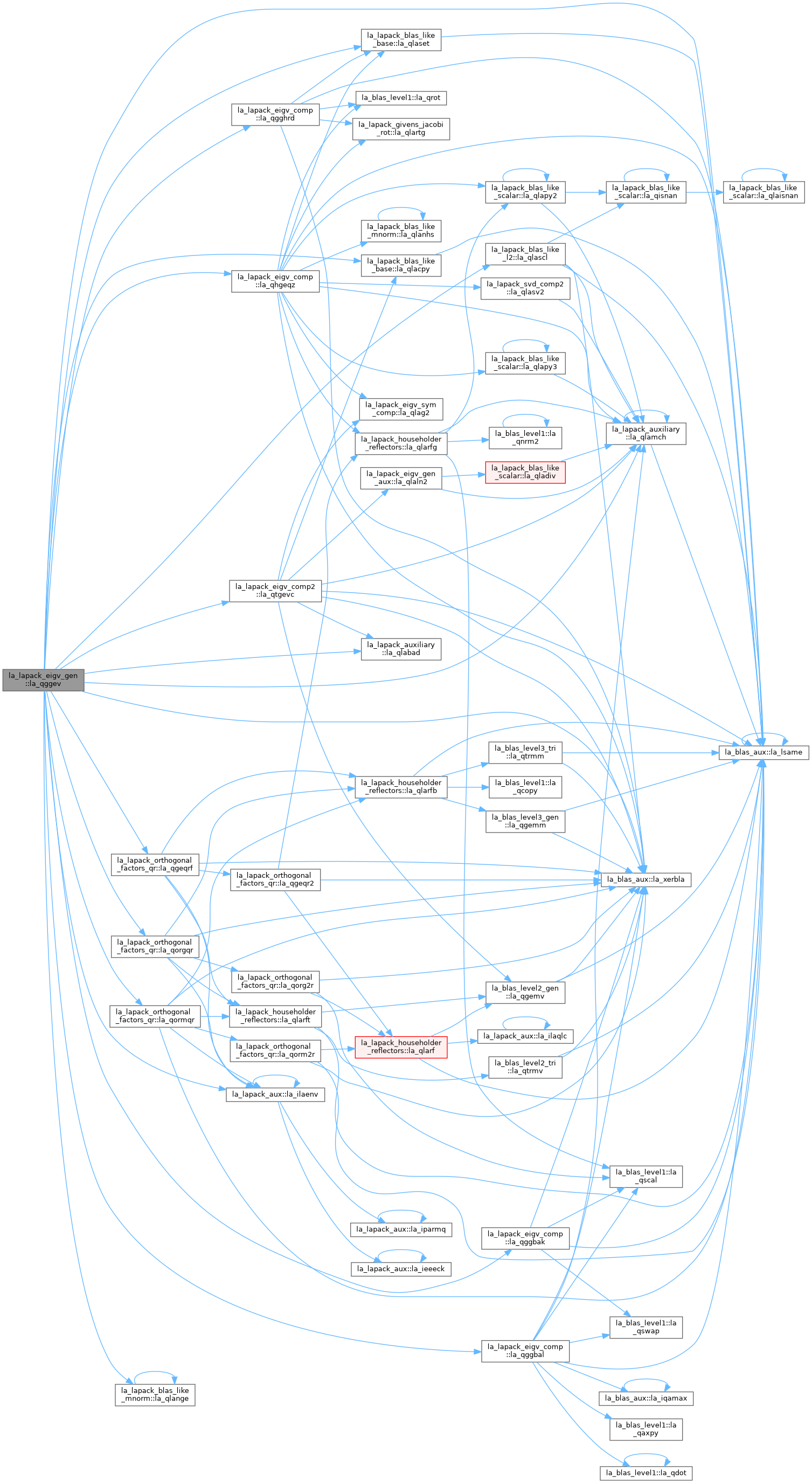
◆ la_qggev3()
| subroutine, public la_lapack_eigv_gen::la_qggev3 | ( | character, intent(in) | jobvl, |
| character, intent(in) | jobvr, | ||
| integer(ilp), intent(in) | n, | ||
| real(qp), dimension(lda,*), intent(inout) | a, | ||
| integer(ilp), intent(in) | lda, | ||
| real(qp), dimension(ldb,*), intent(inout) | b, | ||
| integer(ilp), intent(in) | ldb, | ||
| real(qp), dimension(*), intent(out) | alphar, | ||
| real(qp), dimension(*), intent(out) | alphai, | ||
| real(qp), dimension(*), intent(out) | beta, | ||
| real(qp), dimension(ldvl,*), intent(out) | vl, | ||
| integer(ilp), intent(in) | ldvl, | ||
| real(qp), dimension(ldvr,*), intent(out) | vr, | ||
| integer(ilp), intent(in) | ldvr, | ||
| real(qp), dimension(*), intent(out) | work, | ||
| integer(ilp), intent(in) | lwork, | ||
| integer(ilp), intent(out) | info ) |
QGGEV3: computes for a pair of N-by-N real nonsymmetric matrices (A,B) the generalized eigenvalues, and optionally, the left and/or right generalized eigenvectors. A generalized eigenvalue for a pair of matrices (A,B) is a scalar lambda or a ratio alpha/beta = lambda, such that A - lambda*B is singular. It is usually represented as the pair (alpha,beta), as there is a reasonable interpretation for beta=0, and even for both being zero. The right eigenvector v(j) corresponding to the eigenvalue lambda(j) of (A,B) satisfies A * v(j) = lambda(j) * B * v(j). The left eigenvector u(j) corresponding to the eigenvalue lambda(j) of (A,B) satisfies u(j)**H * A = lambda(j) * u(j)**H * B . where u(j)**H is the conjugate-transpose of u(j).
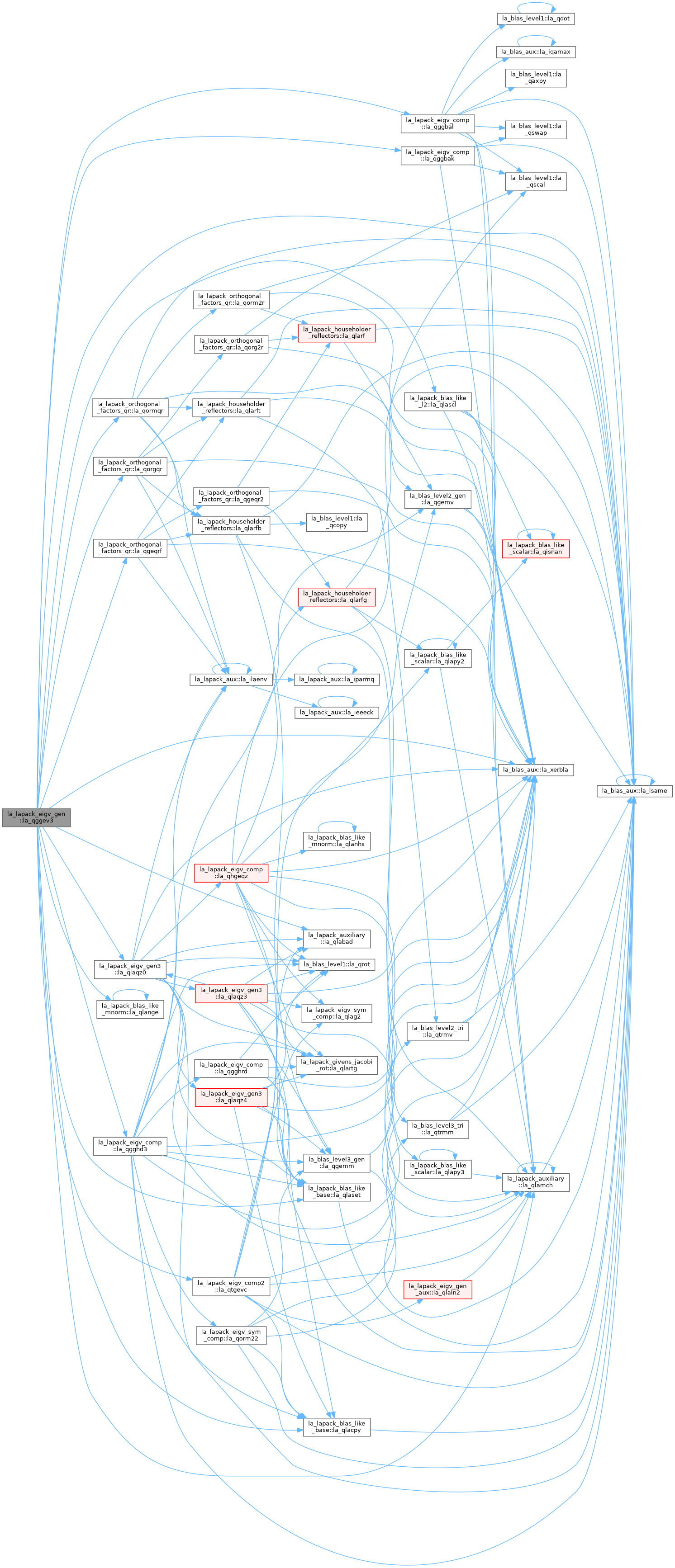
◆ la_qggevx()
| subroutine, public la_lapack_eigv_gen::la_qggevx | ( | character, intent(in) | balanc, |
| character, intent(in) | jobvl, | ||
| character, intent(in) | jobvr, | ||
| character, intent(in) | sense, | ||
| integer(ilp), intent(in) | n, | ||
| real(qp), dimension(lda,*), intent(inout) | a, | ||
| integer(ilp), intent(in) | lda, | ||
| real(qp), dimension(ldb,*), intent(inout) | b, | ||
| integer(ilp), intent(in) | ldb, | ||
| real(qp), dimension(*), intent(out) | alphar, | ||
| real(qp), dimension(*), intent(out) | alphai, | ||
| real(qp), dimension(*), intent(out) | beta, | ||
| real(qp), dimension(ldvl,*), intent(out) | vl, | ||
| integer(ilp), intent(in) | ldvl, | ||
| real(qp), dimension(ldvr,*), intent(out) | vr, | ||
| integer(ilp), intent(in) | ldvr, | ||
| integer(ilp), intent(out) | ilo, | ||
| integer(ilp), intent(out) | ihi, | ||
| real(qp), dimension(*), intent(out) | lscale, | ||
| real(qp), dimension(*), intent(out) | rscale, | ||
| real(qp), intent(out) | abnrm, | ||
| real(qp), intent(out) | bbnrm, | ||
| real(qp), dimension(*), intent(out) | rconde, | ||
| real(qp), dimension(*), intent(out) | rcondv, | ||
| real(qp), dimension(*), intent(out) | work, | ||
| integer(ilp), intent(in) | lwork, | ||
| integer(ilp), dimension(*), intent(out) | iwork, | ||
| logical(lk), dimension(*), intent(out) | bwork, | ||
| integer(ilp), intent(out) | info ) |
QGGEVX: computes for a pair of N-by-N real nonsymmetric matrices (A,B) the generalized eigenvalues, and optionally, the left and/or right generalized eigenvectors. Optionally also, it computes a balancing transformation to improve the conditioning of the eigenvalues and eigenvectors (ILO, IHI, LSCALE, RSCALE, ABNRM, and BBNRM), reciprocal condition numbers for the eigenvalues (RCONDE), and reciprocal condition numbers for the right eigenvectors (RCONDV). A generalized eigenvalue for a pair of matrices (A,B) is a scalar lambda or a ratio alpha/beta = lambda, such that A - lambda*B is singular. It is usually represented as the pair (alpha,beta), as there is a reasonable interpretation for beta=0, and even for both being zero. The right eigenvector v(j) corresponding to the eigenvalue lambda(j) of (A,B) satisfies A * v(j) = lambda(j) * B * v(j) . The left eigenvector u(j) corresponding to the eigenvalue lambda(j) of (A,B) satisfies u(j)**H * A = lambda(j) * u(j)**H * B. where u(j)**H is the conjugate-transpose of u(j).
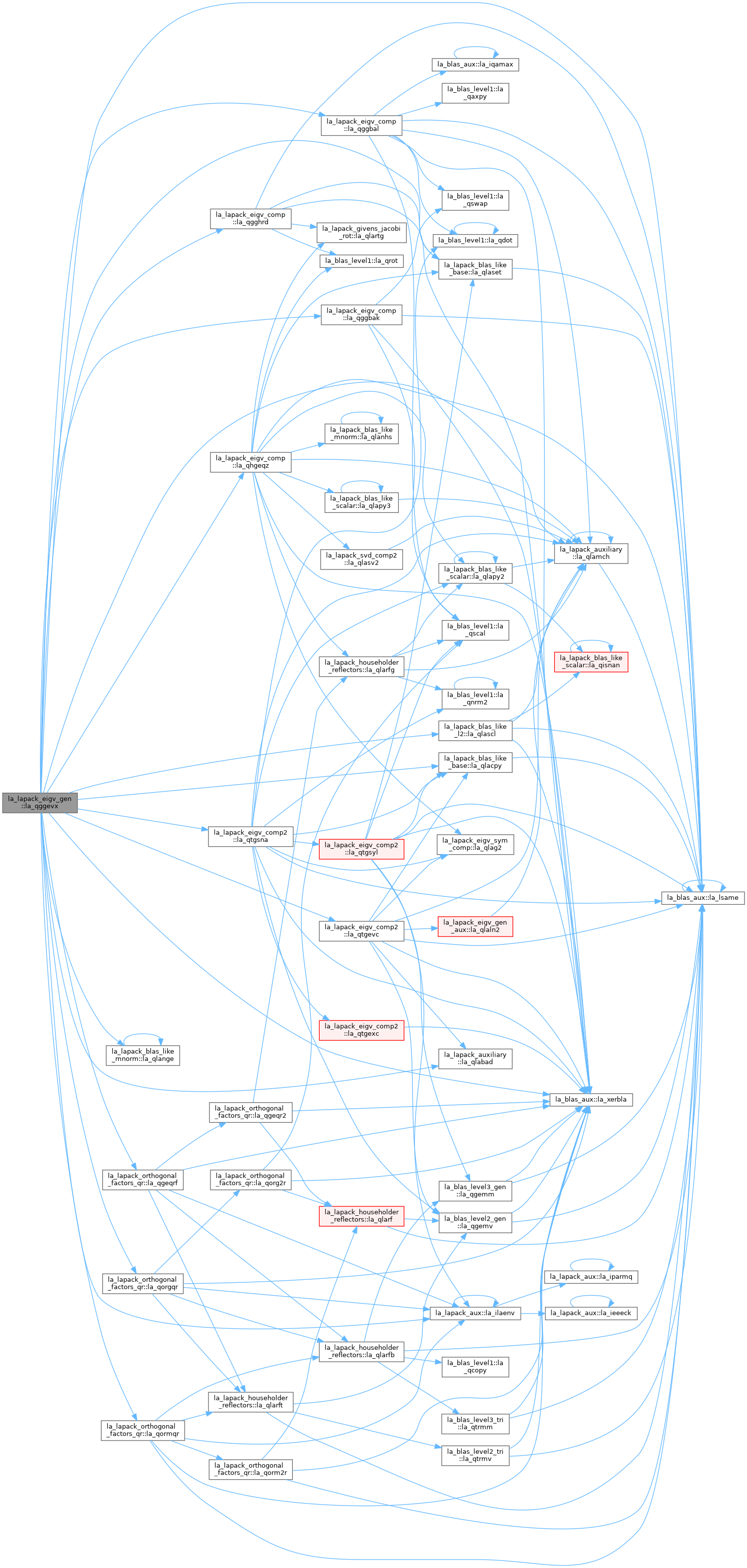
◆ la_sgees()
| subroutine, public la_lapack_eigv_gen::la_sgees | ( | character, intent(in) | jobvs, |
| character, intent(in) | sort, | ||
| procedure(la_select_s) | select, | ||
| integer(ilp), intent(in) | n, | ||
| real(sp), dimension(lda,*), intent(inout) | a, | ||
| integer(ilp), intent(in) | lda, | ||
| integer(ilp), intent(out) | sdim, | ||
| real(sp), dimension(*), intent(out) | wr, | ||
| real(sp), dimension(*), intent(out) | wi, | ||
| real(sp), dimension(ldvs,*), intent(out) | vs, | ||
| integer(ilp), intent(in) | ldvs, | ||
| real(sp), dimension(*), intent(out) | work, | ||
| integer(ilp), intent(in) | lwork, | ||
| logical(lk), dimension(*), intent(out) | bwork, | ||
| integer(ilp), intent(out) | info ) |
SGEES: computes for an N-by-N real nonsymmetric matrix A, the eigenvalues, the real Schur form T, and, optionally, the matrix of Schur vectors Z. This gives the Schur factorization A = Z*T*(Z**T). Optionally, it also orders the eigenvalues on the diagonal of the real Schur form so that selected eigenvalues are at the top left. The leading columns of Z then form an orthonormal basis for the invariant subspace corresponding to the selected eigenvalues. A matrix is in real Schur form if it is upper quasi-triangular with 1-by-1 and 2-by-2 blocks. 2-by-2 blocks will be standardized in the form [ a b ] [ c a ] where b*c < 0. The eigenvalues of such a block are a +- sqrt(bc).
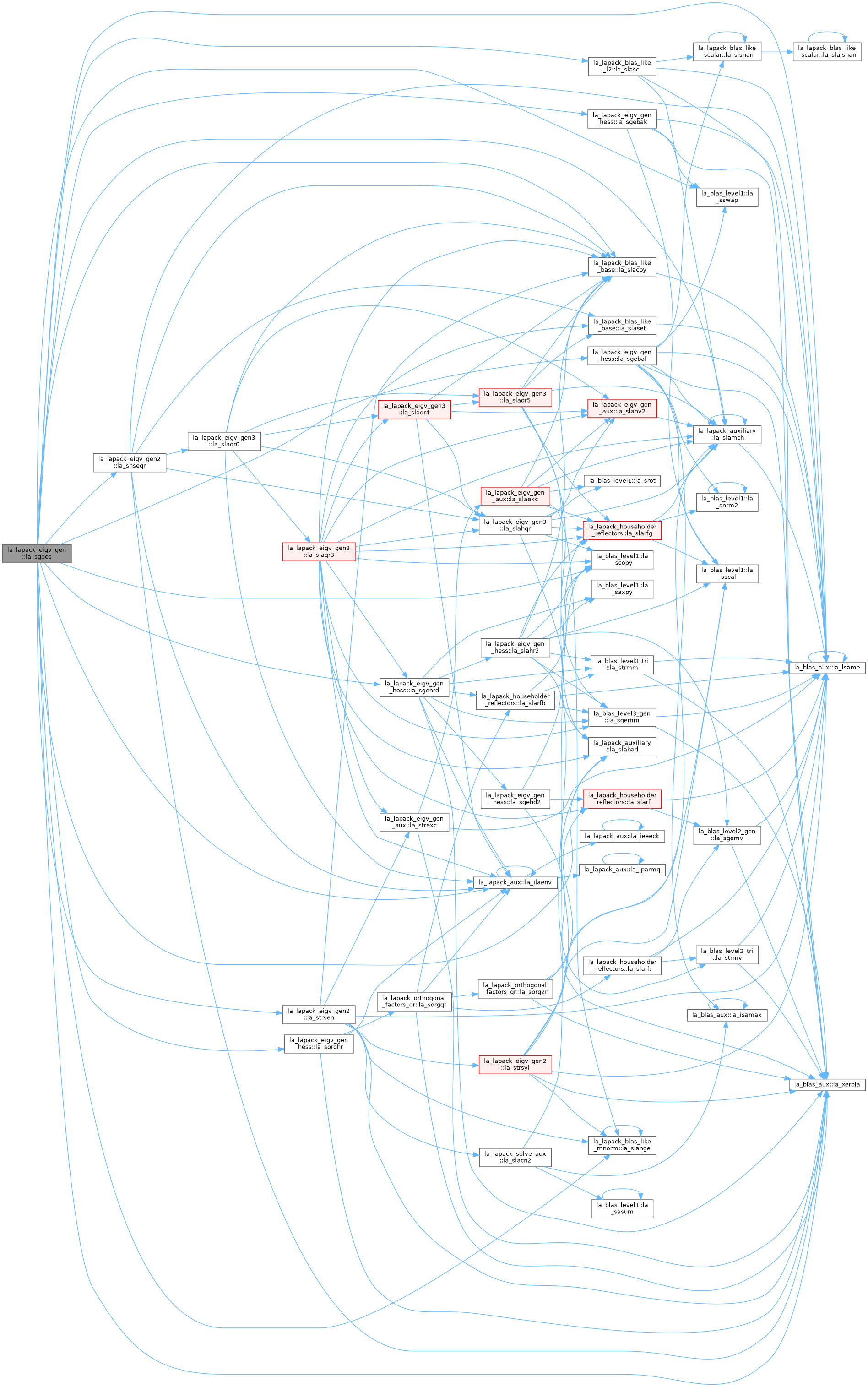
◆ la_sgeesx()
| subroutine, public la_lapack_eigv_gen::la_sgeesx | ( | character, intent(in) | jobvs, |
| character, intent(in) | sort, | ||
| procedure(la_select_s) | select, | ||
| character, intent(in) | sense, | ||
| integer(ilp), intent(in) | n, | ||
| real(sp), dimension(lda,*), intent(inout) | a, | ||
| integer(ilp), intent(in) | lda, | ||
| integer(ilp), intent(out) | sdim, | ||
| real(sp), dimension(*), intent(out) | wr, | ||
| real(sp), dimension(*), intent(out) | wi, | ||
| real(sp), dimension(ldvs,*), intent(out) | vs, | ||
| integer(ilp), intent(in) | ldvs, | ||
| real(sp), intent(out) | rconde, | ||
| real(sp), intent(out) | rcondv, | ||
| real(sp), dimension(*), intent(out) | work, | ||
| integer(ilp), intent(in) | lwork, | ||
| integer(ilp), dimension(*), intent(out) | iwork, | ||
| integer(ilp), intent(in) | liwork, | ||
| logical(lk), dimension(*), intent(out) | bwork, | ||
| integer(ilp), intent(out) | info ) |
SGEESX: computes for an N-by-N real nonsymmetric matrix A, the eigenvalues, the real Schur form T, and, optionally, the matrix of Schur vectors Z. This gives the Schur factorization A = Z*T*(Z**T). Optionally, it also orders the eigenvalues on the diagonal of the real Schur form so that selected eigenvalues are at the top left; computes a reciprocal condition number for the average of the selected eigenvalues (RCONDE); and computes a reciprocal condition number for the right invariant subspace corresponding to the selected eigenvalues (RCONDV). The leading columns of Z form an orthonormal basis for this invariant subspace. For further explanation of the reciprocal condition numbers RCONDE and RCONDV, see Section 4.10_sp of the LAPACK Users' Guide (where these quantities are called s and sep respectively). A real matrix is in real Schur form if it is upper quasi-triangular with 1-by-1 and 2-by-2 blocks. 2-by-2 blocks will be standardized in the form [ a b ] [ c a ] where b*c < 0. The eigenvalues of such a block are a +- sqrt(bc).
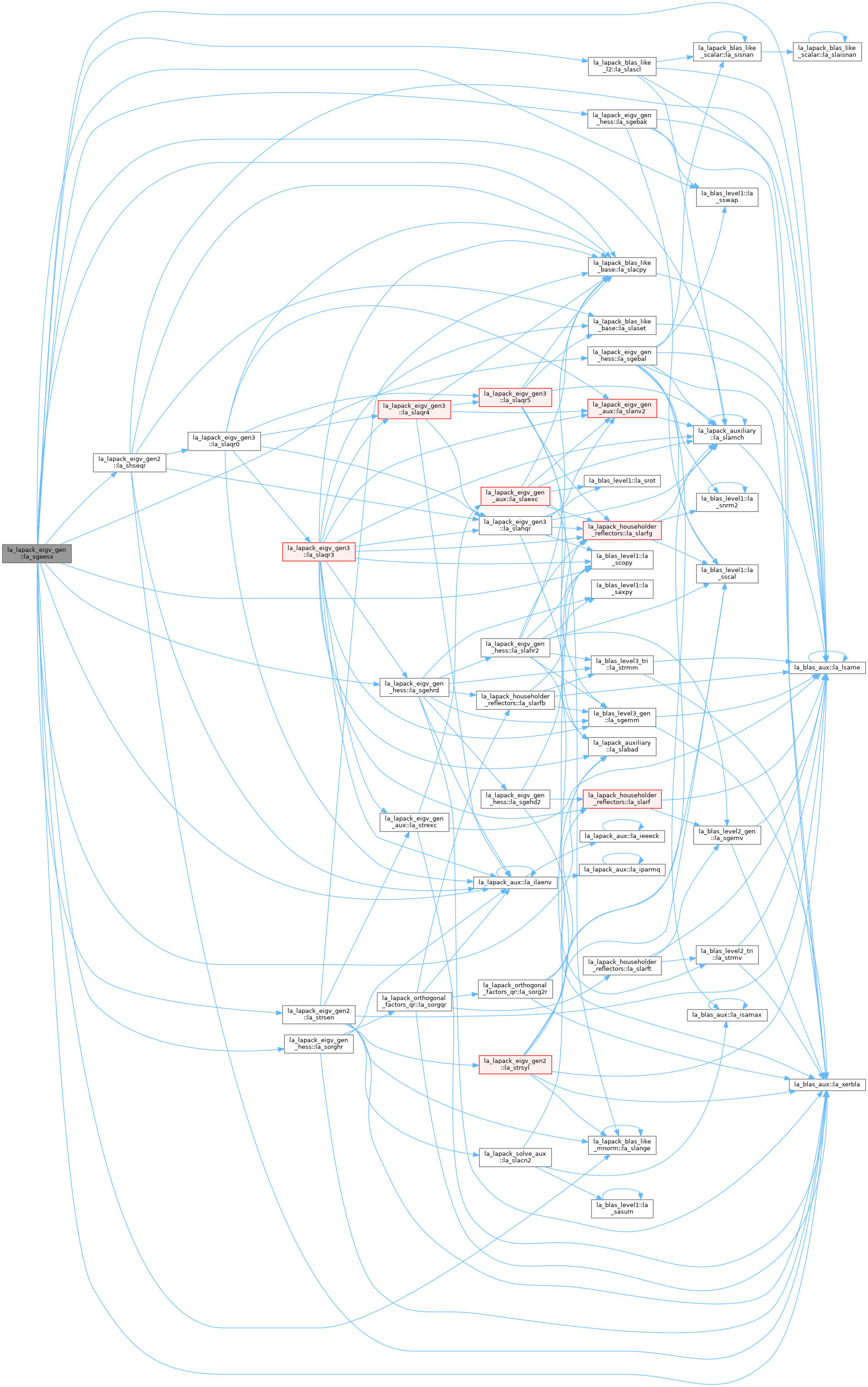
◆ la_sgeev()
| subroutine, public la_lapack_eigv_gen::la_sgeev | ( | character, intent(in) | jobvl, |
| character, intent(in) | jobvr, | ||
| integer(ilp), intent(in) | n, | ||
| real(sp), dimension(lda,*), intent(inout) | a, | ||
| integer(ilp), intent(in) | lda, | ||
| real(sp), dimension(*), intent(out) | wr, | ||
| real(sp), dimension(*), intent(out) | wi, | ||
| real(sp), dimension(ldvl,*), intent(out) | vl, | ||
| integer(ilp), intent(in) | ldvl, | ||
| real(sp), dimension(ldvr,*), intent(out) | vr, | ||
| integer(ilp), intent(in) | ldvr, | ||
| real(sp), dimension(*), intent(out) | work, | ||
| integer(ilp), intent(in) | lwork, | ||
| integer(ilp), intent(out) | info ) |
SGEEV: computes for an N-by-N real nonsymmetric matrix A, the eigenvalues and, optionally, the left and/or right eigenvectors. The right eigenvector v(j) of A satisfies A * v(j) = lambda(j) * v(j) where lambda(j) is its eigenvalue. The left eigenvector u(j) of A satisfies u(j)**H * A = lambda(j) * u(j)**H where u(j)**H denotes the conjugate-transpose of u(j). The computed eigenvectors are normalized to have Euclidean norm equal to 1 and largest component real.
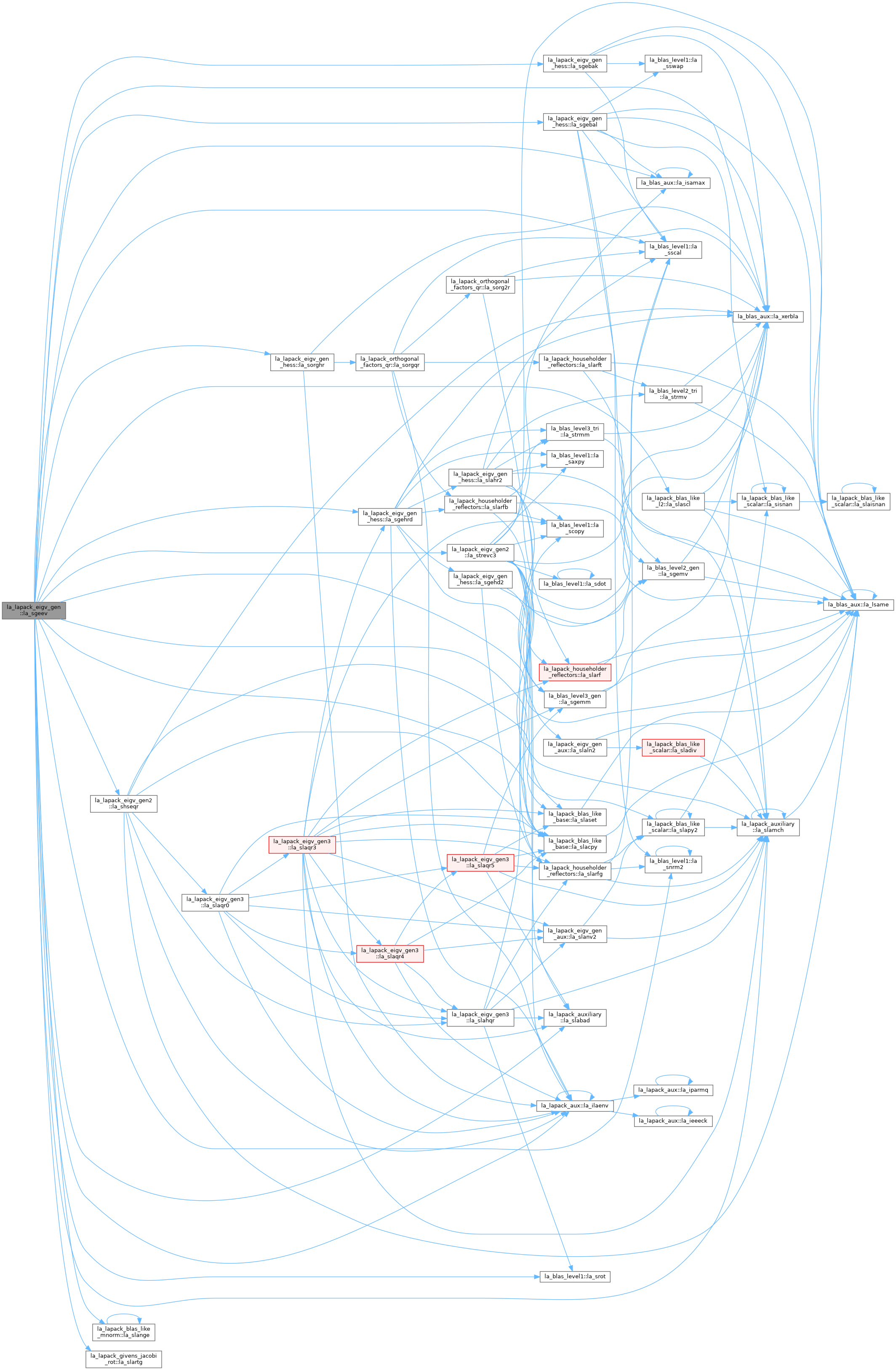
◆ la_sgeevx()
| subroutine, public la_lapack_eigv_gen::la_sgeevx | ( | character, intent(in) | balanc, |
| character, intent(in) | jobvl, | ||
| character, intent(in) | jobvr, | ||
| character, intent(in) | sense, | ||
| integer(ilp), intent(in) | n, | ||
| real(sp), dimension(lda,*), intent(inout) | a, | ||
| integer(ilp), intent(in) | lda, | ||
| real(sp), dimension(*), intent(out) | wr, | ||
| real(sp), dimension(*), intent(out) | wi, | ||
| real(sp), dimension(ldvl,*), intent(out) | vl, | ||
| integer(ilp), intent(in) | ldvl, | ||
| real(sp), dimension(ldvr,*), intent(out) | vr, | ||
| integer(ilp), intent(in) | ldvr, | ||
| integer(ilp), intent(out) | ilo, | ||
| integer(ilp), intent(out) | ihi, | ||
| real(sp), dimension(*), intent(out) | scale, | ||
| real(sp), intent(out) | abnrm, | ||
| real(sp), dimension(*), intent(out) | rconde, | ||
| real(sp), dimension(*), intent(out) | rcondv, | ||
| real(sp), dimension(*), intent(out) | work, | ||
| integer(ilp), intent(in) | lwork, | ||
| integer(ilp), dimension(*), intent(out) | iwork, | ||
| integer(ilp), intent(out) | info ) |
SGEEVX: computes for an N-by-N real nonsymmetric matrix A, the eigenvalues and, optionally, the left and/or right eigenvectors. Optionally also, it computes a balancing transformation to improve the conditioning of the eigenvalues and eigenvectors (ILO, IHI, SCALE, and ABNRM), reciprocal condition numbers for the eigenvalues (RCONDE), and reciprocal condition numbers for the right eigenvectors (RCONDV). The right eigenvector v(j) of A satisfies A * v(j) = lambda(j) * v(j) where lambda(j) is its eigenvalue. The left eigenvector u(j) of A satisfies u(j)**H * A = lambda(j) * u(j)**H where u(j)**H denotes the conjugate-transpose of u(j). The computed eigenvectors are normalized to have Euclidean norm equal to 1 and largest component real. Balancing a matrix means permuting the rows and columns to make it more nearly upper triangular, and applying a diagonal similarity transformation D * A * D**(-1), where D is a diagonal matrix, to make its rows and columns closer in norm and the condition numbers of its eigenvalues and eigenvectors smaller. The computed reciprocal condition numbers correspond to the balanced matrix. Permuting rows and columns will not change the condition numbers (in exact arithmetic) but diagonal scaling will. For further explanation of balancing, see section 4.10.2_sp of the LAPACK Users' Guide.
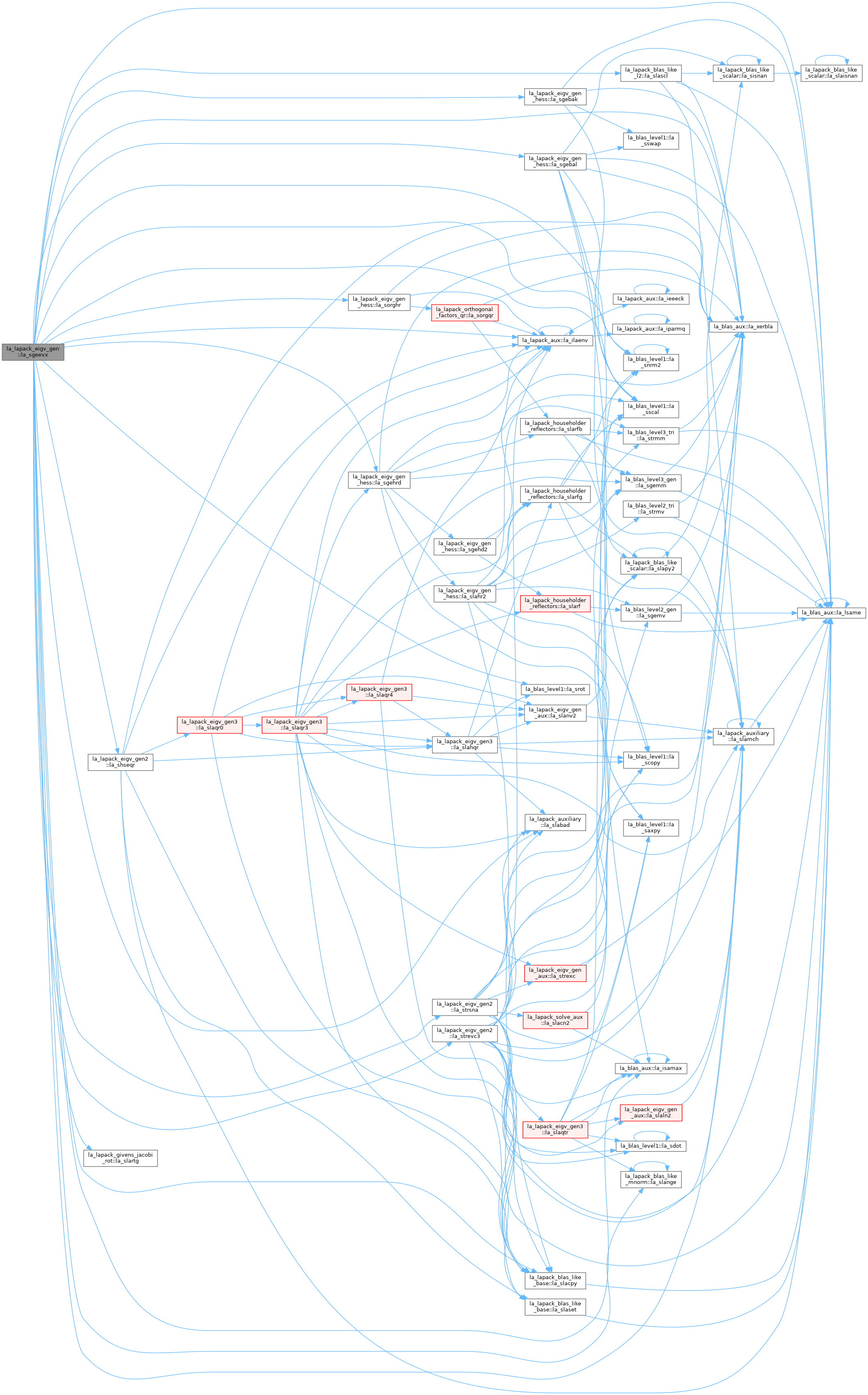
◆ la_sgges()
| subroutine, public la_lapack_eigv_gen::la_sgges | ( | character, intent(in) | jobvsl, |
| character, intent(in) | jobvsr, | ||
| character, intent(in) | sort, | ||
| procedure(la_selctg_s) | selctg, | ||
| integer(ilp), intent(in) | n, | ||
| real(sp), dimension(lda,*), intent(inout) | a, | ||
| integer(ilp), intent(in) | lda, | ||
| real(sp), dimension(ldb,*), intent(inout) | b, | ||
| integer(ilp), intent(in) | ldb, | ||
| integer(ilp), intent(out) | sdim, | ||
| real(sp), dimension(*), intent(out) | alphar, | ||
| real(sp), dimension(*), intent(out) | alphai, | ||
| real(sp), dimension(*), intent(out) | beta, | ||
| real(sp), dimension(ldvsl,*), intent(out) | vsl, | ||
| integer(ilp), intent(in) | ldvsl, | ||
| real(sp), dimension(ldvsr,*), intent(out) | vsr, | ||
| integer(ilp), intent(in) | ldvsr, | ||
| real(sp), dimension(*), intent(out) | work, | ||
| integer(ilp), intent(in) | lwork, | ||
| logical(lk), dimension(*), intent(out) | bwork, | ||
| integer(ilp), intent(out) | info ) |
SGGES: computes for a pair of N-by-N real nonsymmetric matrices (A,B), the generalized eigenvalues, the generalized real Schur form (S,T), optionally, the left and/or right matrices of Schur vectors (VSL and VSR). This gives the generalized Schur factorization (A,B) = ( (VSL)*S*(VSR)**T, (VSL)*T*(VSR)**T ) Optionally, it also orders the eigenvalues so that a selected cluster of eigenvalues appears in the leading diagonal blocks of the upper quasi-triangular matrix S and the upper triangular matrix T.The leading columns of VSL and VSR then form an orthonormal basis for the corresponding left and right eigenspaces (deflating subspaces). (If only the generalized eigenvalues are needed, use the driver SGGEV instead, which is faster.) A generalized eigenvalue for a pair of matrices (A,B) is a scalar w or a ratio alpha/beta = w, such that A - w*B is singular. It is usually represented as the pair (alpha,beta), as there is a reasonable interpretation for beta=0 or both being zero. A pair of matrices (S,T) is in generalized real Schur form if T is upper triangular with non-negative diagonal and S is block upper triangular with 1-by-1 and 2-by-2 blocks. 1-by-1 blocks correspond to real generalized eigenvalues, while 2-by-2 blocks of S will be "standardized" by making the corresponding elements of T have the form: [ a 0 ] [ 0 b ] and the pair of corresponding 2-by-2 blocks in S and T will have a complex conjugate pair of generalized eigenvalues.
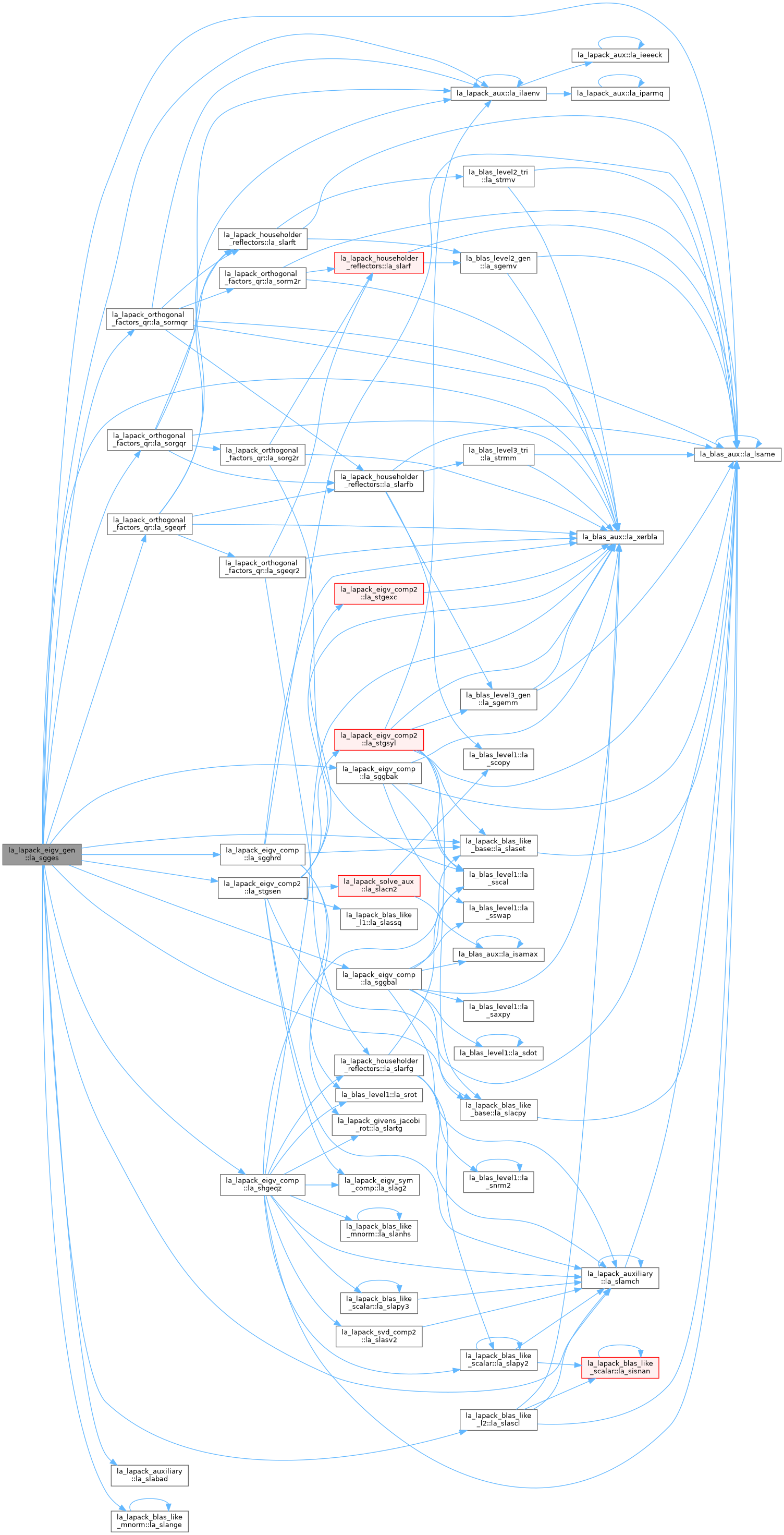
◆ la_sgges3()
| subroutine, public la_lapack_eigv_gen::la_sgges3 | ( | character, intent(in) | jobvsl, |
| character, intent(in) | jobvsr, | ||
| character, intent(in) | sort, | ||
| procedure(la_selctg_s) | selctg, | ||
| integer(ilp), intent(in) | n, | ||
| real(sp), dimension(lda,*), intent(inout) | a, | ||
| integer(ilp), intent(in) | lda, | ||
| real(sp), dimension(ldb,*), intent(inout) | b, | ||
| integer(ilp), intent(in) | ldb, | ||
| integer(ilp), intent(out) | sdim, | ||
| real(sp), dimension(*), intent(out) | alphar, | ||
| real(sp), dimension(*), intent(out) | alphai, | ||
| real(sp), dimension(*), intent(out) | beta, | ||
| real(sp), dimension(ldvsl,*), intent(out) | vsl, | ||
| integer(ilp), intent(in) | ldvsl, | ||
| real(sp), dimension(ldvsr,*), intent(out) | vsr, | ||
| integer(ilp), intent(in) | ldvsr, | ||
| real(sp), dimension(*), intent(out) | work, | ||
| integer(ilp), intent(in) | lwork, | ||
| logical(lk), dimension(*), intent(out) | bwork, | ||
| integer(ilp), intent(out) | info ) |
SGGES3: computes for a pair of N-by-N real nonsymmetric matrices (A,B), the generalized eigenvalues, the generalized real Schur form (S,T), optionally, the left and/or right matrices of Schur vectors (VSL and VSR). This gives the generalized Schur factorization (A,B) = ( (VSL)*S*(VSR)**T, (VSL)*T*(VSR)**T ) Optionally, it also orders the eigenvalues so that a selected cluster of eigenvalues appears in the leading diagonal blocks of the upper quasi-triangular matrix S and the upper triangular matrix T.The leading columns of VSL and VSR then form an orthonormal basis for the corresponding left and right eigenspaces (deflating subspaces). (If only the generalized eigenvalues are needed, use the driver SGGEV instead, which is faster.) A generalized eigenvalue for a pair of matrices (A,B) is a scalar w or a ratio alpha/beta = w, such that A - w*B is singular. It is usually represented as the pair (alpha,beta), as there is a reasonable interpretation for beta=0 or both being zero. A pair of matrices (S,T) is in generalized real Schur form if T is upper triangular with non-negative diagonal and S is block upper triangular with 1-by-1 and 2-by-2 blocks. 1-by-1 blocks correspond to real generalized eigenvalues, while 2-by-2 blocks of S will be "standardized" by making the corresponding elements of T have the form: [ a 0 ] [ 0 b ] and the pair of corresponding 2-by-2 blocks in S and T will have a complex conjugate pair of generalized eigenvalues.
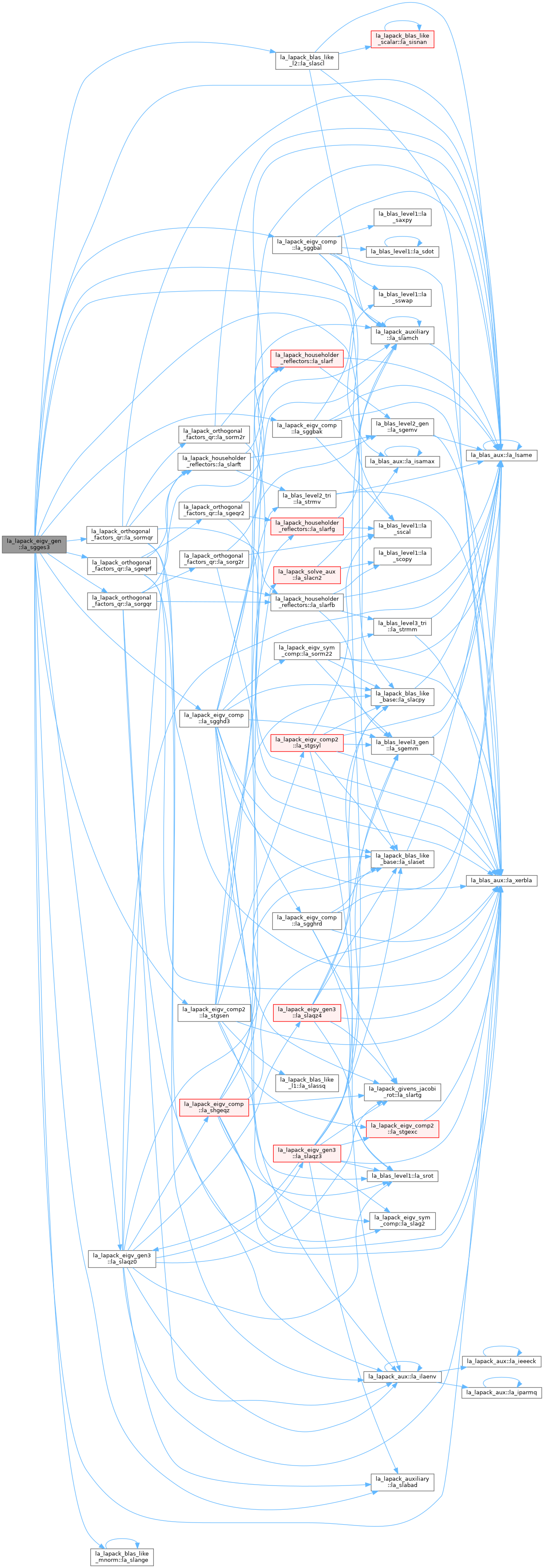
◆ la_sggesx()
| subroutine, public la_lapack_eigv_gen::la_sggesx | ( | character, intent(in) | jobvsl, |
| character, intent(in) | jobvsr, | ||
| character, intent(in) | sort, | ||
| procedure(la_selctg_s) | selctg, | ||
| character, intent(in) | sense, | ||
| integer(ilp), intent(in) | n, | ||
| real(sp), dimension(lda,*), intent(inout) | a, | ||
| integer(ilp), intent(in) | lda, | ||
| real(sp), dimension(ldb,*), intent(inout) | b, | ||
| integer(ilp), intent(in) | ldb, | ||
| integer(ilp), intent(out) | sdim, | ||
| real(sp), dimension(*), intent(out) | alphar, | ||
| real(sp), dimension(*), intent(out) | alphai, | ||
| real(sp), dimension(*), intent(out) | beta, | ||
| real(sp), dimension( ldvsl,*), intent(out) | vsl, | ||
| integer(ilp), intent(in) | ldvsl, | ||
| real(sp), dimension(ldvsr,*), intent(out) | vsr, | ||
| integer(ilp), intent(in) | ldvsr, | ||
| real(sp), dimension(2), intent(out) | rconde, | ||
| real(sp), dimension(2), intent(out) | rcondv, | ||
| real(sp), dimension(*), intent(out) | work, | ||
| integer(ilp), intent(in) | lwork, | ||
| integer(ilp), dimension(*), intent(out) | iwork, | ||
| integer(ilp), intent(in) | liwork, | ||
| logical(lk), dimension(*), intent(out) | bwork, | ||
| integer(ilp), intent(out) | info ) |
SGGESX: computes for a pair of N-by-N real nonsymmetric matrices (A,B), the generalized eigenvalues, the real Schur form (S,T), and, optionally, the left and/or right matrices of Schur vectors (VSL and VSR). This gives the generalized Schur factorization (A,B) = ( (VSL) S (VSR)**T, (VSL) T (VSR)**T ) Optionally, it also orders the eigenvalues so that a selected cluster of eigenvalues appears in the leading diagonal blocks of the upper quasi-triangular matrix S and the upper triangular matrix T; computes a reciprocal condition number for the average of the selected eigenvalues (RCONDE); and computes a reciprocal condition number for the right and left deflating subspaces corresponding to the selected eigenvalues (RCONDV). The leading columns of VSL and VSR then form an orthonormal basis for the corresponding left and right eigenspaces (deflating subspaces). A generalized eigenvalue for a pair of matrices (A,B) is a scalar w or a ratio alpha/beta = w, such that A - w*B is singular. It is usually represented as the pair (alpha,beta), as there is a reasonable interpretation for beta=0 or for both being zero. A pair of matrices (S,T) is in generalized real Schur form if T is upper triangular with non-negative diagonal and S is block upper triangular with 1-by-1 and 2-by-2 blocks. 1-by-1 blocks correspond to real generalized eigenvalues, while 2-by-2 blocks of S will be "standardized" by making the corresponding elements of T have the form: [ a 0 ] [ 0 b ] and the pair of corresponding 2-by-2 blocks in S and T will have a complex conjugate pair of generalized eigenvalues.
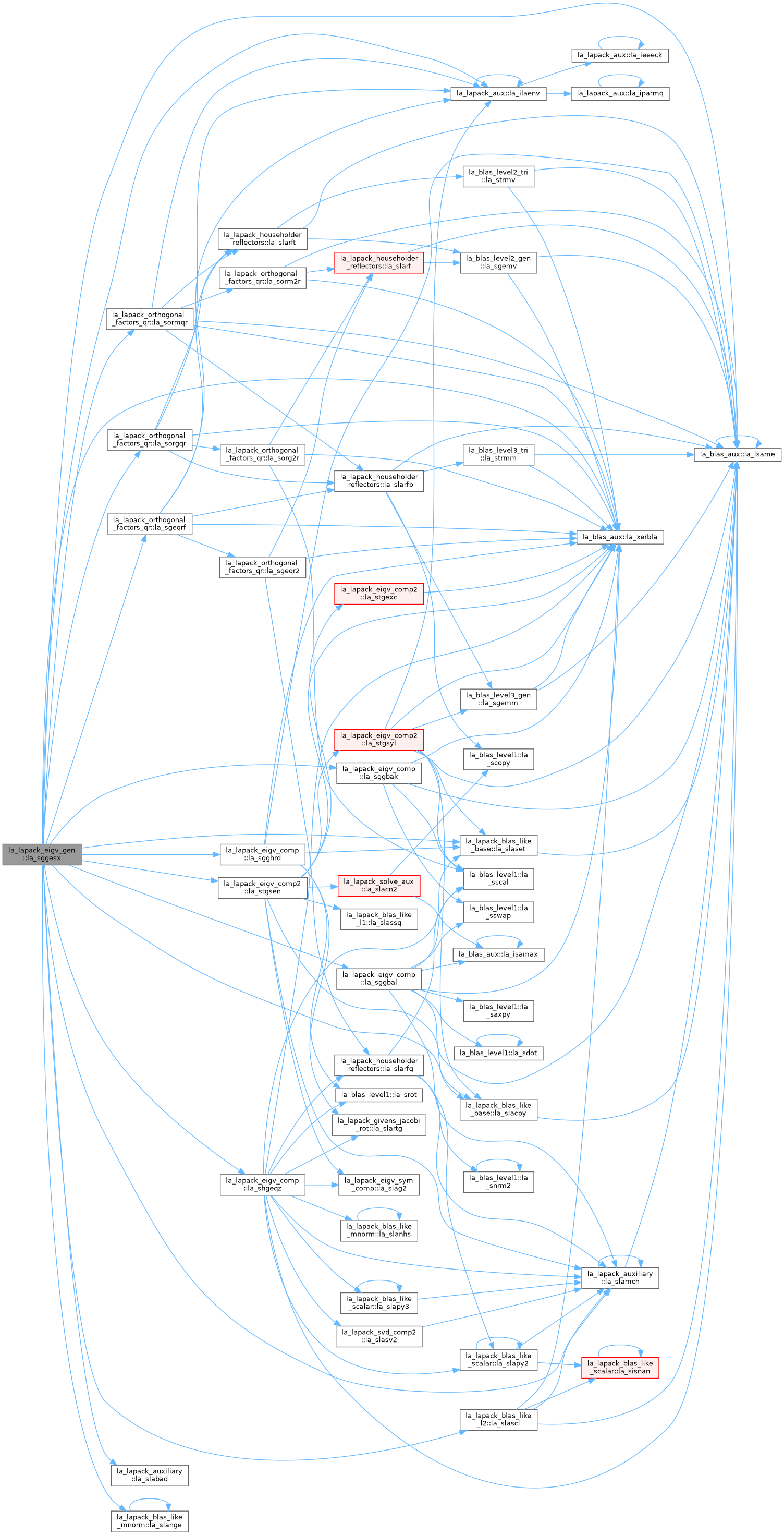
◆ la_sggev()
| subroutine, public la_lapack_eigv_gen::la_sggev | ( | character, intent(in) | jobvl, |
| character, intent(in) | jobvr, | ||
| integer(ilp), intent(in) | n, | ||
| real(sp), dimension(lda,*), intent(inout) | a, | ||
| integer(ilp), intent(in) | lda, | ||
| real(sp), dimension(ldb,*), intent(inout) | b, | ||
| integer(ilp), intent(in) | ldb, | ||
| real(sp), dimension(*), intent(out) | alphar, | ||
| real(sp), dimension(*), intent(out) | alphai, | ||
| real(sp), dimension(*), intent(out) | beta, | ||
| real(sp), dimension(ldvl,*), intent(out) | vl, | ||
| integer(ilp), intent(in) | ldvl, | ||
| real(sp), dimension(ldvr,*), intent(out) | vr, | ||
| integer(ilp), intent(in) | ldvr, | ||
| real(sp), dimension(*), intent(out) | work, | ||
| integer(ilp), intent(in) | lwork, | ||
| integer(ilp), intent(out) | info ) |
SGGEV: computes for a pair of N-by-N real nonsymmetric matrices (A,B) the generalized eigenvalues, and optionally, the left and/or right generalized eigenvectors. A generalized eigenvalue for a pair of matrices (A,B) is a scalar lambda or a ratio alpha/beta = lambda, such that A - lambda*B is singular. It is usually represented as the pair (alpha,beta), as there is a reasonable interpretation for beta=0, and even for both being zero. The right eigenvector v(j) corresponding to the eigenvalue lambda(j) of (A,B) satisfies A * v(j) = lambda(j) * B * v(j). The left eigenvector u(j) corresponding to the eigenvalue lambda(j) of (A,B) satisfies u(j)**H * A = lambda(j) * u(j)**H * B . where u(j)**H is the conjugate-transpose of u(j).
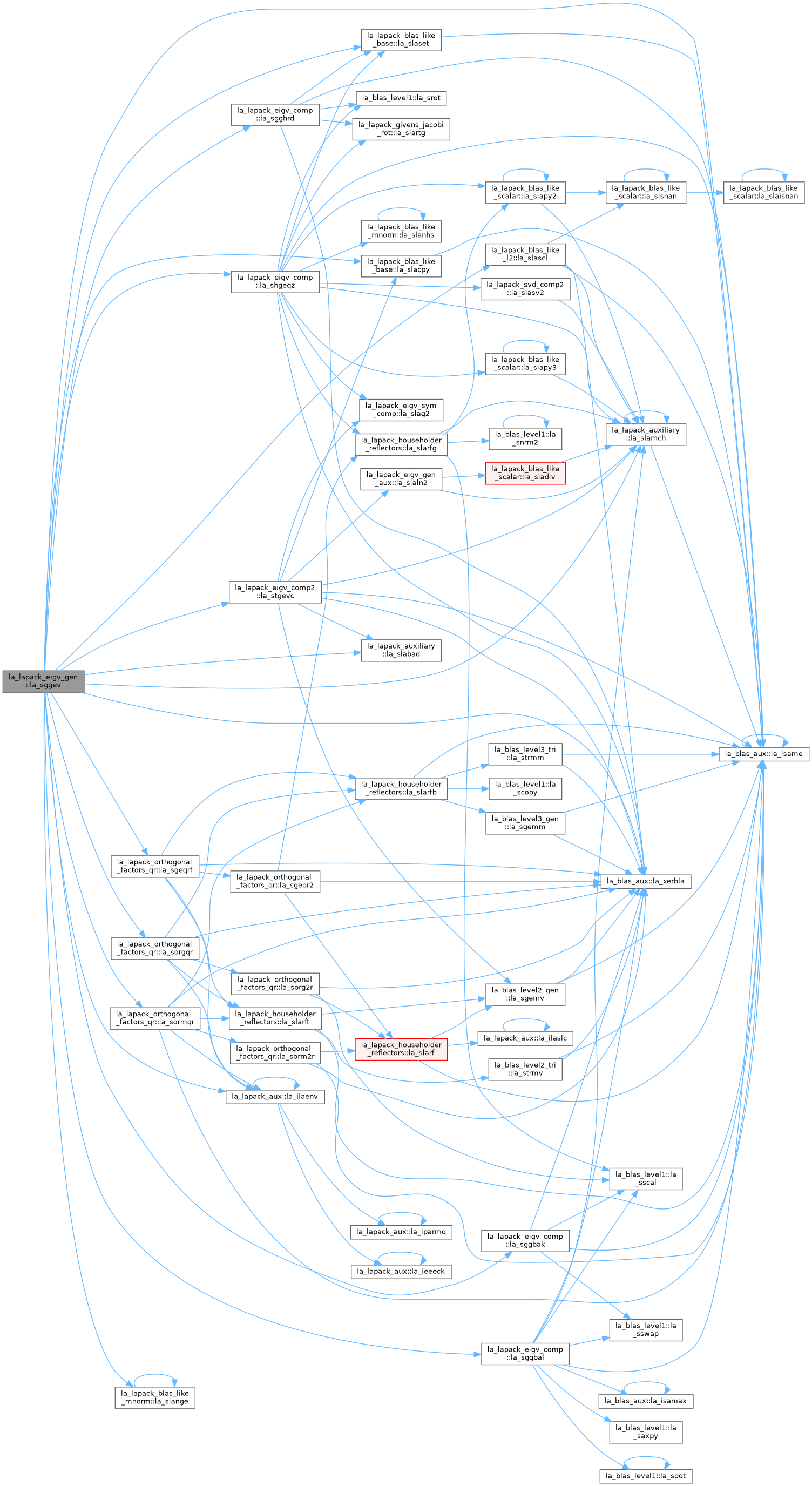
◆ la_sggev3()
| subroutine, public la_lapack_eigv_gen::la_sggev3 | ( | character, intent(in) | jobvl, |
| character, intent(in) | jobvr, | ||
| integer(ilp), intent(in) | n, | ||
| real(sp), dimension(lda,*), intent(inout) | a, | ||
| integer(ilp), intent(in) | lda, | ||
| real(sp), dimension(ldb,*), intent(inout) | b, | ||
| integer(ilp), intent(in) | ldb, | ||
| real(sp), dimension(*), intent(out) | alphar, | ||
| real(sp), dimension(*), intent(out) | alphai, | ||
| real(sp), dimension(*), intent(out) | beta, | ||
| real(sp), dimension(ldvl,*), intent(out) | vl, | ||
| integer(ilp), intent(in) | ldvl, | ||
| real(sp), dimension(ldvr,*), intent(out) | vr, | ||
| integer(ilp), intent(in) | ldvr, | ||
| real(sp), dimension(*), intent(out) | work, | ||
| integer(ilp), intent(in) | lwork, | ||
| integer(ilp), intent(out) | info ) |
SGGEV3: computes for a pair of N-by-N real nonsymmetric matrices (A,B) the generalized eigenvalues, and optionally, the left and/or right generalized eigenvectors. A generalized eigenvalue for a pair of matrices (A,B) is a scalar lambda or a ratio alpha/beta = lambda, such that A - lambda*B is singular. It is usually represented as the pair (alpha,beta), as there is a reasonable interpretation for beta=0, and even for both being zero. The right eigenvector v(j) corresponding to the eigenvalue lambda(j) of (A,B) satisfies A * v(j) = lambda(j) * B * v(j). The left eigenvector u(j) corresponding to the eigenvalue lambda(j) of (A,B) satisfies u(j)**H * A = lambda(j) * u(j)**H * B . where u(j)**H is the conjugate-transpose of u(j).
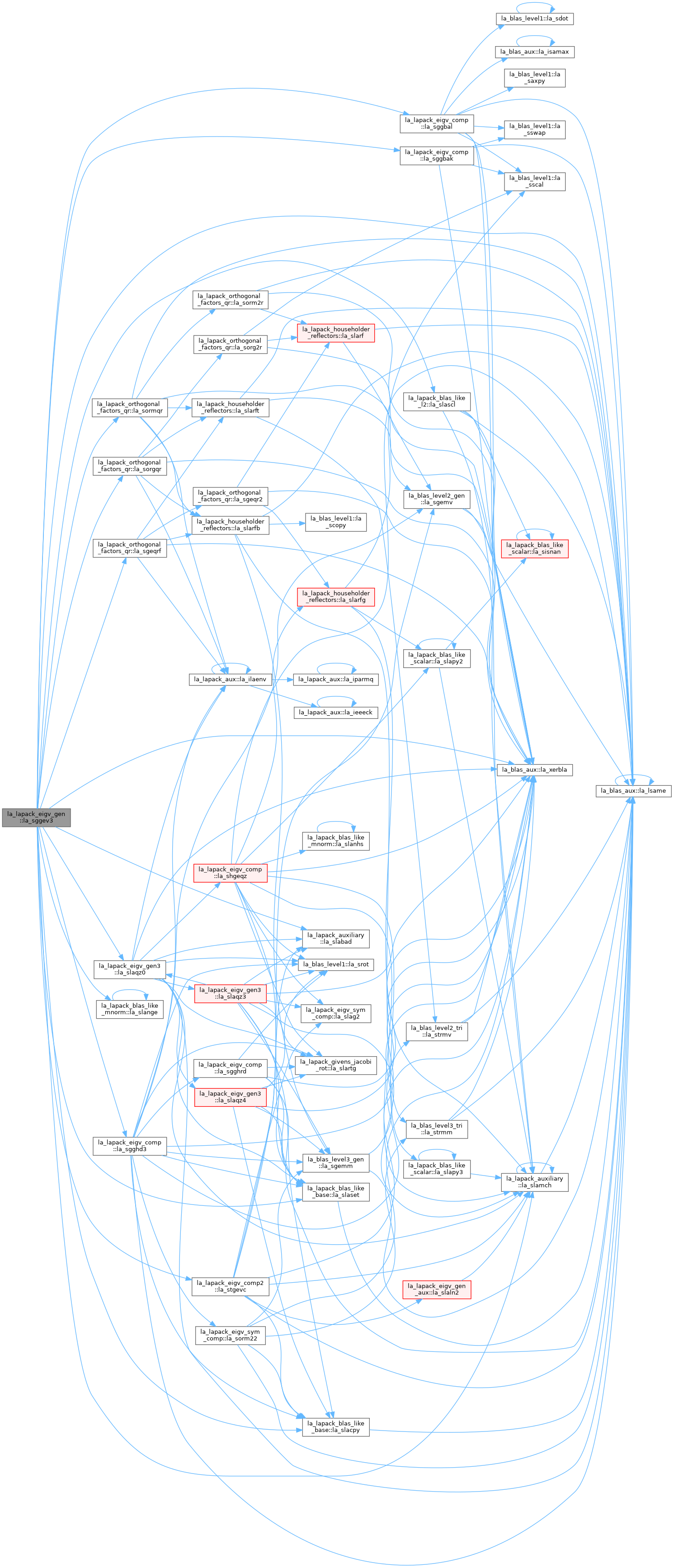
◆ la_sggevx()
| subroutine, public la_lapack_eigv_gen::la_sggevx | ( | character, intent(in) | balanc, |
| character, intent(in) | jobvl, | ||
| character, intent(in) | jobvr, | ||
| character, intent(in) | sense, | ||
| integer(ilp), intent(in) | n, | ||
| real(sp), dimension(lda,*), intent(inout) | a, | ||
| integer(ilp), intent(in) | lda, | ||
| real(sp), dimension(ldb,*), intent(inout) | b, | ||
| integer(ilp), intent(in) | ldb, | ||
| real(sp), dimension(*), intent(out) | alphar, | ||
| real(sp), dimension(*), intent(out) | alphai, | ||
| real(sp), dimension(*), intent(out) | beta, | ||
| real(sp), dimension(ldvl,*), intent(out) | vl, | ||
| integer(ilp), intent(in) | ldvl, | ||
| real(sp), dimension(ldvr,*), intent(out) | vr, | ||
| integer(ilp), intent(in) | ldvr, | ||
| integer(ilp), intent(out) | ilo, | ||
| integer(ilp), intent(out) | ihi, | ||
| real(sp), dimension(*), intent(out) | lscale, | ||
| real(sp), dimension(*), intent(out) | rscale, | ||
| real(sp), intent(out) | abnrm, | ||
| real(sp), intent(out) | bbnrm, | ||
| real(sp), dimension(*), intent(out) | rconde, | ||
| real(sp), dimension(*), intent(out) | rcondv, | ||
| real(sp), dimension(*), intent(out) | work, | ||
| integer(ilp), intent(in) | lwork, | ||
| integer(ilp), dimension(*), intent(out) | iwork, | ||
| logical(lk), dimension(*), intent(out) | bwork, | ||
| integer(ilp), intent(out) | info ) |
SGGEVX: computes for a pair of N-by-N real nonsymmetric matrices (A,B) the generalized eigenvalues, and optionally, the left and/or right generalized eigenvectors. Optionally also, it computes a balancing transformation to improve the conditioning of the eigenvalues and eigenvectors (ILO, IHI, LSCALE, RSCALE, ABNRM, and BBNRM), reciprocal condition numbers for the eigenvalues (RCONDE), and reciprocal condition numbers for the right eigenvectors (RCONDV). A generalized eigenvalue for a pair of matrices (A,B) is a scalar lambda or a ratio alpha/beta = lambda, such that A - lambda*B is singular. It is usually represented as the pair (alpha,beta), as there is a reasonable interpretation for beta=0, and even for both being zero. The right eigenvector v(j) corresponding to the eigenvalue lambda(j) of (A,B) satisfies A * v(j) = lambda(j) * B * v(j) . The left eigenvector u(j) corresponding to the eigenvalue lambda(j) of (A,B) satisfies u(j)**H * A = lambda(j) * u(j)**H * B. where u(j)**H is the conjugate-transpose of u(j).
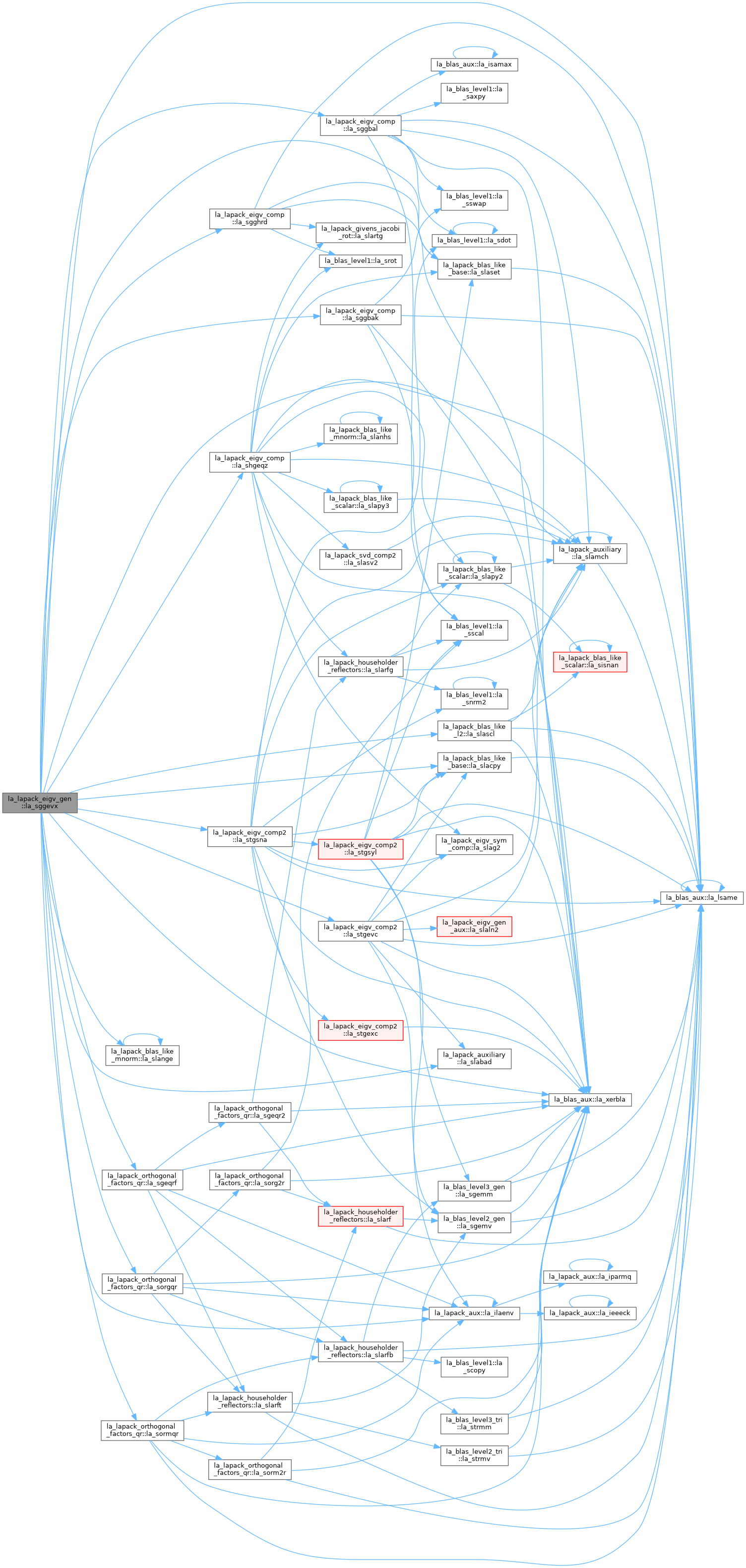
◆ la_wgees()
| subroutine, public la_lapack_eigv_gen::la_wgees | ( | character, intent(in) | jobvs, |
| character, intent(in) | sort, | ||
| procedure(la_select_w) | select, | ||
| integer(ilp), intent(in) | n, | ||
| complex(qp), dimension(lda,*), intent(inout) | a, | ||
| integer(ilp), intent(in) | lda, | ||
| integer(ilp), intent(out) | sdim, | ||
| complex(qp), dimension(*), intent(out) | w, | ||
| complex(qp), dimension(ldvs,*), intent(out) | vs, | ||
| integer(ilp), intent(in) | ldvs, | ||
| complex(qp), dimension(*), intent(out) | work, | ||
| integer(ilp), intent(in) | lwork, | ||
| real(qp), dimension(*), intent(out) | rwork, | ||
| logical(lk), dimension(*), intent(out) | bwork, | ||
| integer(ilp), intent(out) | info ) |
WGEES: computes for an N-by-N complex nonsymmetric matrix A, the eigenvalues, the Schur form T, and, optionally, the matrix of Schur vectors Z. This gives the Schur factorization A = Z*T*(Z**H). Optionally, it also orders the eigenvalues on the diagonal of the Schur form so that selected eigenvalues are at the top left. The leading columns of Z then form an orthonormal basis for the invariant subspace corresponding to the selected eigenvalues. A complex matrix is in Schur form if it is upper triangular.
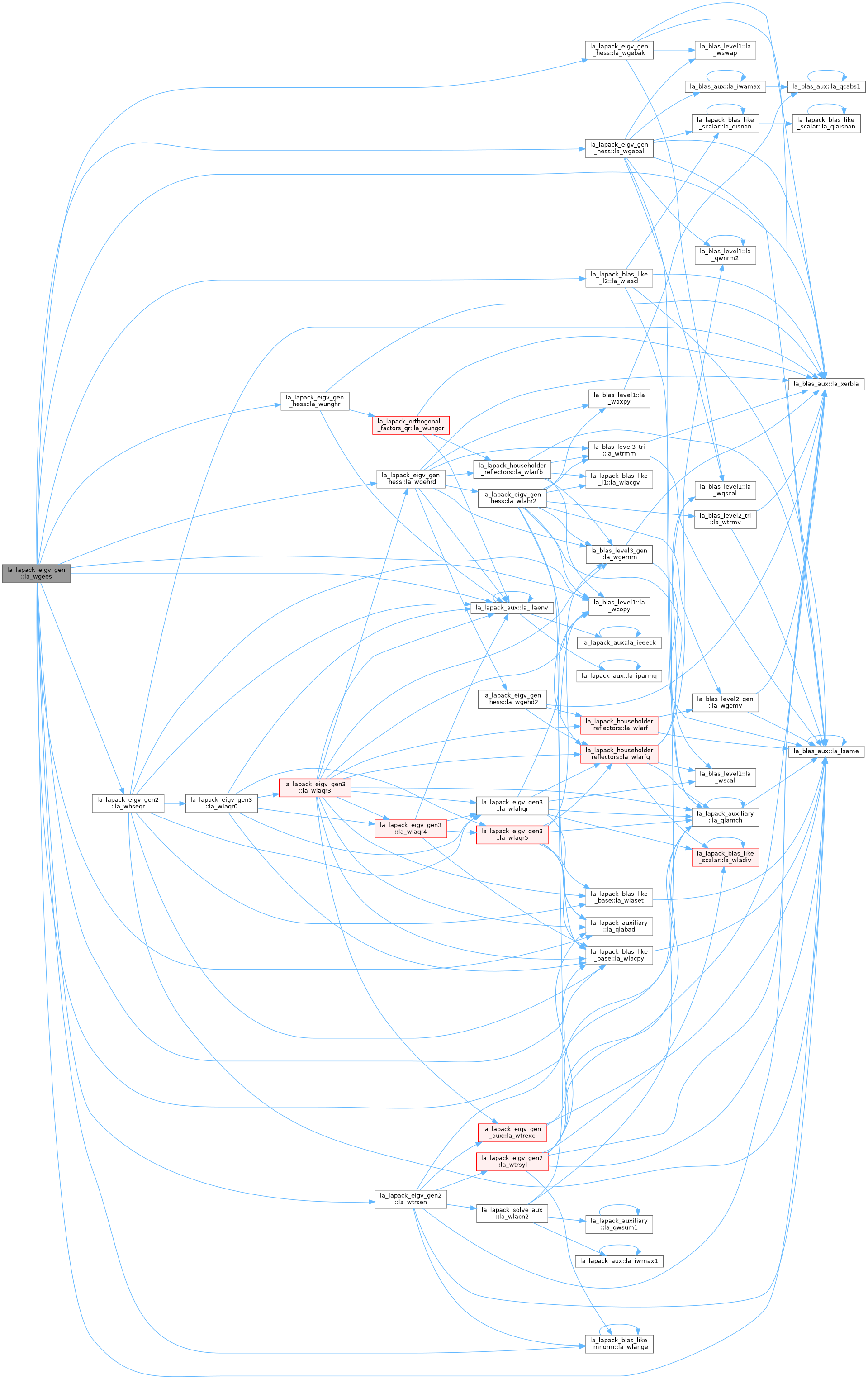
◆ la_wgeesx()
| subroutine, public la_lapack_eigv_gen::la_wgeesx | ( | character, intent(in) | jobvs, |
| character, intent(in) | sort, | ||
| procedure(la_select_w) | select, | ||
| character, intent(in) | sense, | ||
| integer(ilp), intent(in) | n, | ||
| complex(qp), dimension(lda,*), intent(inout) | a, | ||
| integer(ilp), intent(in) | lda, | ||
| integer(ilp), intent(out) | sdim, | ||
| complex(qp), dimension(*), intent(out) | w, | ||
| complex(qp), dimension(ldvs,*), intent(out) | vs, | ||
| integer(ilp), intent(in) | ldvs, | ||
| real(qp), intent(out) | rconde, | ||
| real(qp), intent(out) | rcondv, | ||
| complex(qp), dimension(*), intent(out) | work, | ||
| integer(ilp), intent(in) | lwork, | ||
| real(qp), dimension(*), intent(out) | rwork, | ||
| logical(lk), dimension(*), intent(out) | bwork, | ||
| integer(ilp), intent(out) | info ) |
WGEESX: computes for an N-by-N complex nonsymmetric matrix A, the eigenvalues, the Schur form T, and, optionally, the matrix of Schur vectors Z. This gives the Schur factorization A = Z*T*(Z**H). Optionally, it also orders the eigenvalues on the diagonal of the Schur form so that selected eigenvalues are at the top left; computes a reciprocal condition number for the average of the selected eigenvalues (RCONDE); and computes a reciprocal condition number for the right invariant subspace corresponding to the selected eigenvalues (RCONDV). The leading columns of Z form an orthonormal basis for this invariant subspace. For further explanation of the reciprocal condition numbers RCONDE and RCONDV, see Section 4.10_qp of the LAPACK Users' Guide (where these quantities are called s and sep respectively). A complex matrix is in Schur form if it is upper triangular.
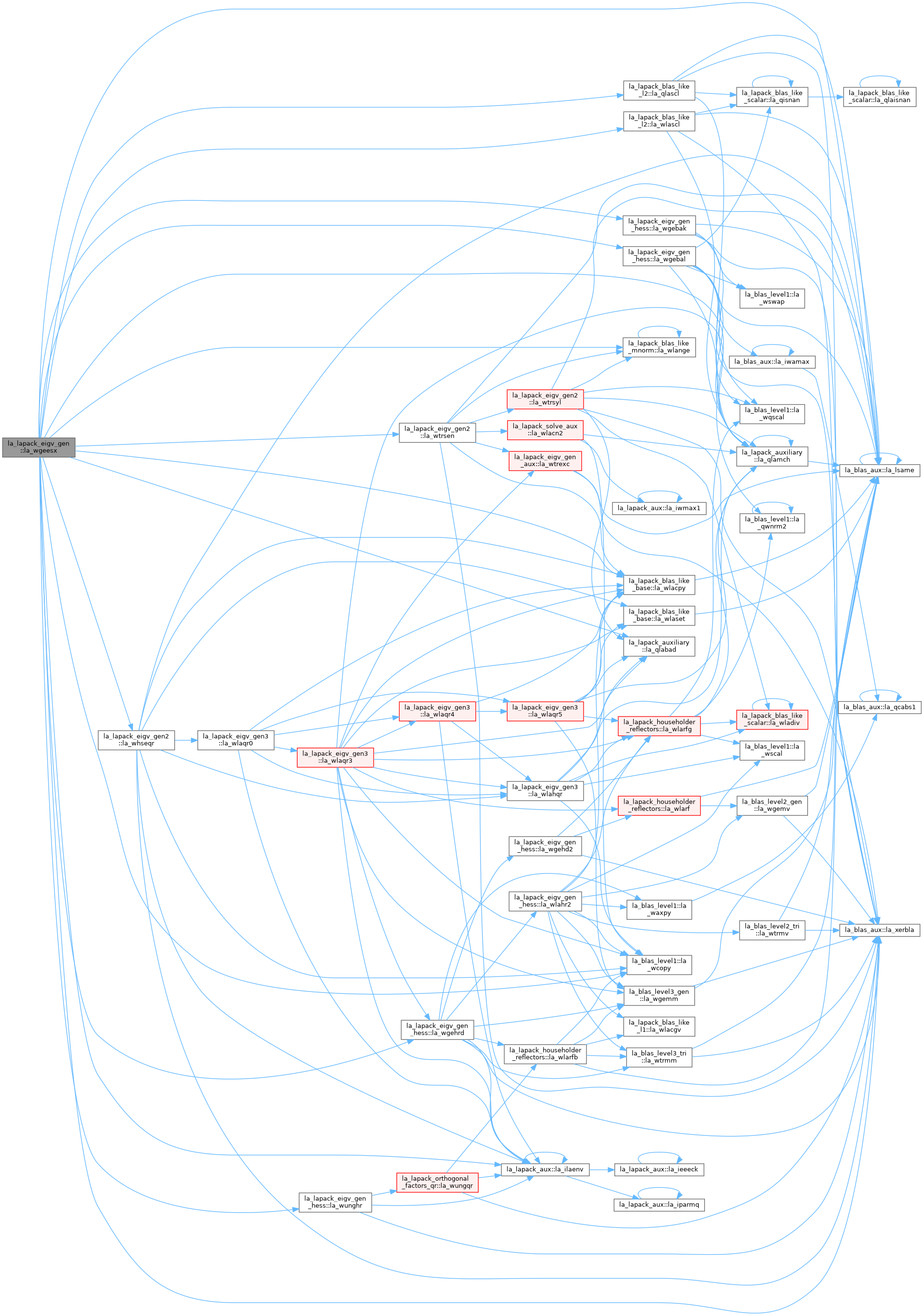
◆ la_wgeev()
| subroutine, public la_lapack_eigv_gen::la_wgeev | ( | character, intent(in) | jobvl, |
| character, intent(in) | jobvr, | ||
| integer(ilp), intent(in) | n, | ||
| complex(qp), dimension(lda,*), intent(inout) | a, | ||
| integer(ilp), intent(in) | lda, | ||
| complex(qp), dimension(*), intent(out) | w, | ||
| complex(qp), dimension(ldvl,*), intent(out) | vl, | ||
| integer(ilp), intent(in) | ldvl, | ||
| complex(qp), dimension(ldvr,*), intent(out) | vr, | ||
| integer(ilp), intent(in) | ldvr, | ||
| complex(qp), dimension(*), intent(out) | work, | ||
| integer(ilp), intent(in) | lwork, | ||
| real(qp), dimension(*), intent(out) | rwork, | ||
| integer(ilp), intent(out) | info ) |
WGEEV: computes for an N-by-N complex nonsymmetric matrix A, the eigenvalues and, optionally, the left and/or right eigenvectors. The right eigenvector v(j) of A satisfies A * v(j) = lambda(j) * v(j) where lambda(j) is its eigenvalue. The left eigenvector u(j) of A satisfies u(j)**H * A = lambda(j) * u(j)**H where u(j)**H denotes the conjugate transpose of u(j). The computed eigenvectors are normalized to have Euclidean norm equal to 1 and largest component real.
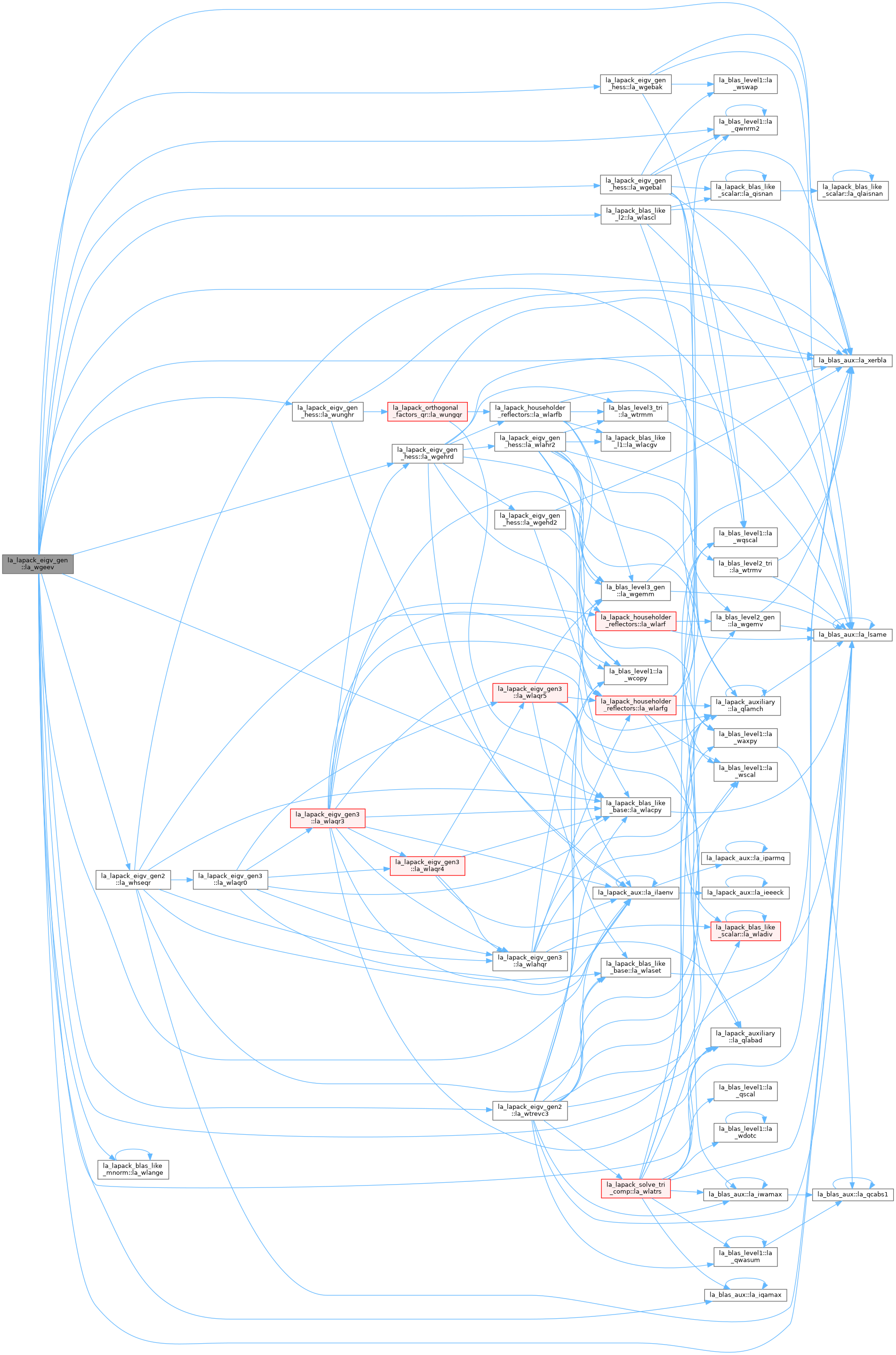
◆ la_wgeevx()
| subroutine, public la_lapack_eigv_gen::la_wgeevx | ( | character, intent(in) | balanc, |
| character, intent(in) | jobvl, | ||
| character, intent(in) | jobvr, | ||
| character, intent(in) | sense, | ||
| integer(ilp), intent(in) | n, | ||
| complex(qp), dimension(lda,*), intent(inout) | a, | ||
| integer(ilp), intent(in) | lda, | ||
| complex(qp), dimension(*), intent(out) | w, | ||
| complex(qp), dimension(ldvl,*), intent(out) | vl, | ||
| integer(ilp), intent(in) | ldvl, | ||
| complex(qp), dimension(ldvr,*), intent(out) | vr, | ||
| integer(ilp), intent(in) | ldvr, | ||
| integer(ilp), intent(out) | ilo, | ||
| integer(ilp), intent(out) | ihi, | ||
| real(qp), dimension(*), intent(out) | scale, | ||
| real(qp), intent(out) | abnrm, | ||
| real(qp), dimension(*), intent(out) | rconde, | ||
| real(qp), dimension(*), intent(out) | rcondv, | ||
| complex(qp), dimension(*), intent(out) | work, | ||
| integer(ilp), intent(in) | lwork, | ||
| real(qp), dimension(*), intent(out) | rwork, | ||
| integer(ilp), intent(out) | info ) |
WGEEVX: computes for an N-by-N complex nonsymmetric matrix A, the eigenvalues and, optionally, the left and/or right eigenvectors. Optionally also, it computes a balancing transformation to improve the conditioning of the eigenvalues and eigenvectors (ILO, IHI, SCALE, and ABNRM), reciprocal condition numbers for the eigenvalues (RCONDE), and reciprocal condition numbers for the right eigenvectors (RCONDV). The right eigenvector v(j) of A satisfies A * v(j) = lambda(j) * v(j) where lambda(j) is its eigenvalue. The left eigenvector u(j) of A satisfies u(j)**H * A = lambda(j) * u(j)**H where u(j)**H denotes the conjugate transpose of u(j). The computed eigenvectors are normalized to have Euclidean norm equal to 1 and largest component real. Balancing a matrix means permuting the rows and columns to make it more nearly upper triangular, and applying a diagonal similarity transformation D * A * D**(-1), where D is a diagonal matrix, to make its rows and columns closer in norm and the condition numbers of its eigenvalues and eigenvectors smaller. The computed reciprocal condition numbers correspond to the balanced matrix. Permuting rows and columns will not change the condition numbers (in exact arithmetic) but diagonal scaling will. For further explanation of balancing, see section 4.10.2_qp of the LAPACK Users' Guide.
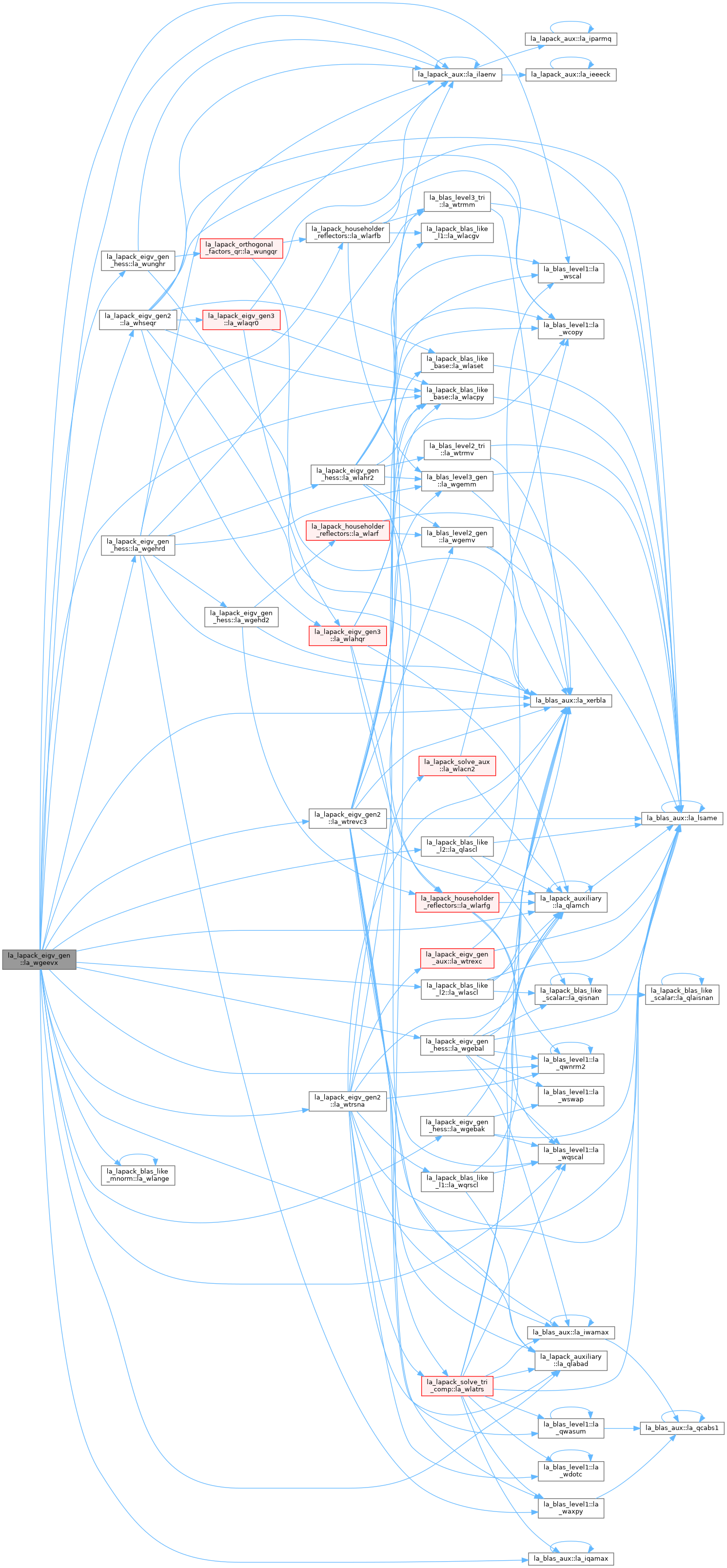
◆ la_wgges()
| subroutine, public la_lapack_eigv_gen::la_wgges | ( | character, intent(in) | jobvsl, |
| character, intent(in) | jobvsr, | ||
| character, intent(in) | sort, | ||
| procedure(la_selctg_w) | selctg, | ||
| integer(ilp), intent(in) | n, | ||
| complex(qp), dimension(lda,*), intent(inout) | a, | ||
| integer(ilp), intent(in) | lda, | ||
| complex(qp), dimension(ldb,*), intent(inout) | b, | ||
| integer(ilp), intent(in) | ldb, | ||
| integer(ilp), intent(out) | sdim, | ||
| complex(qp), dimension(*), intent(out) | alpha, | ||
| complex(qp), dimension(*), intent(out) | beta, | ||
| complex(qp), dimension(ldvsl,*), intent(out) | vsl, | ||
| integer(ilp), intent(in) | ldvsl, | ||
| complex(qp), dimension(ldvsr,*), intent(out) | vsr, | ||
| integer(ilp), intent(in) | ldvsr, | ||
| complex(qp), dimension(*), intent(out) | work, | ||
| integer(ilp), intent(in) | lwork, | ||
| real(qp), dimension(*), intent(out) | rwork, | ||
| logical(lk), dimension(*), intent(out) | bwork, | ||
| integer(ilp), intent(out) | info ) |
WGGES: computes for a pair of N-by-N complex nonsymmetric matrices (A,B), the generalized eigenvalues, the generalized complex Schur form (S, T), and optionally left and/or right Schur vectors (VSL and VSR). This gives the generalized Schur factorization (A,B) = ( (VSL)*S*(VSR)**H, (VSL)*T*(VSR)**H ) where (VSR)**H is the conjugate-transpose of VSR. Optionally, it also orders the eigenvalues so that a selected cluster of eigenvalues appears in the leading diagonal blocks of the upper triangular matrix S and the upper triangular matrix T. The leading columns of VSL and VSR then form an unitary basis for the corresponding left and right eigenspaces (deflating subspaces). (If only the generalized eigenvalues are needed, use the driver WGGEV instead, which is faster.) A generalized eigenvalue for a pair of matrices (A,B) is a scalar w or a ratio alpha/beta = w, such that A - w*B is singular. It is usually represented as the pair (alpha,beta), as there is a reasonable interpretation for beta=0, and even for both being zero. A pair of matrices (S,T) is in generalized complex Schur form if S and T are upper triangular and, in addition, the diagonal elements of T are non-negative real numbers.
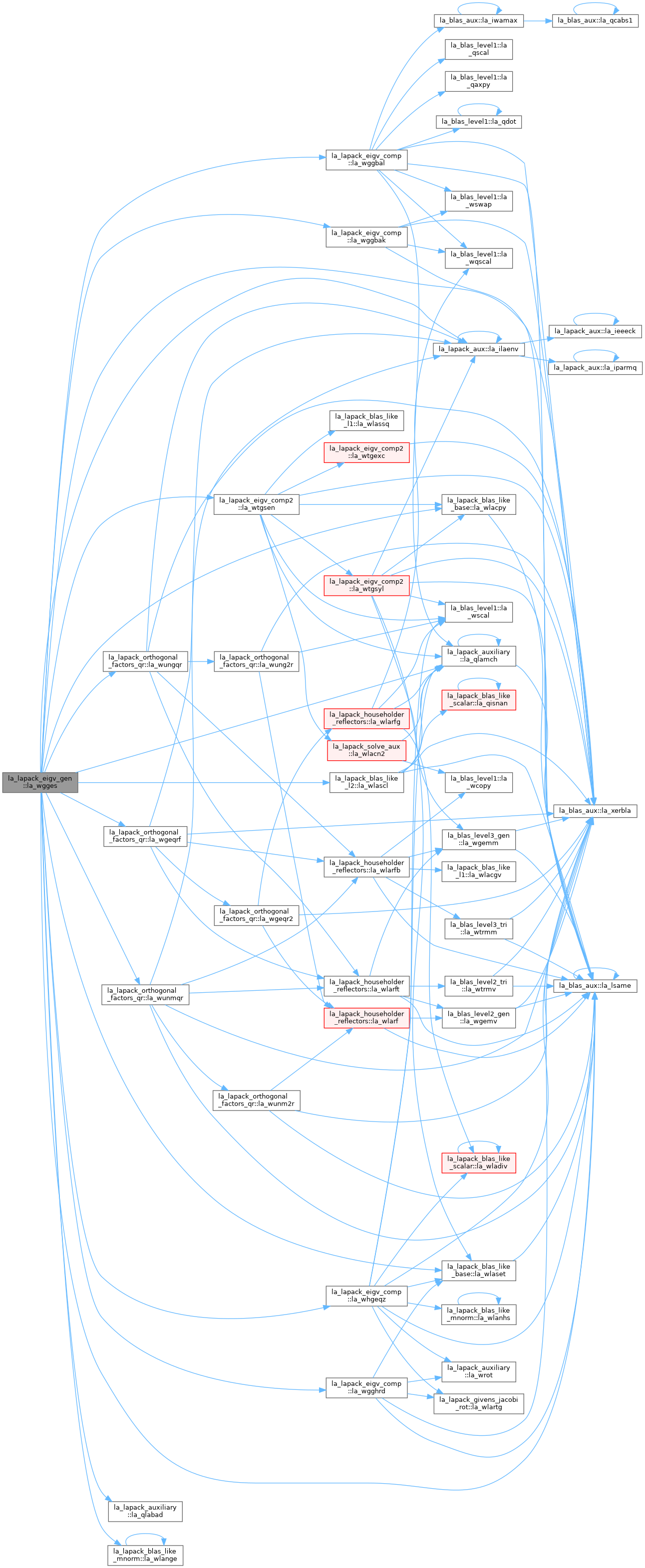
◆ la_wgges3()
| subroutine, public la_lapack_eigv_gen::la_wgges3 | ( | character, intent(in) | jobvsl, |
| character, intent(in) | jobvsr, | ||
| character, intent(in) | sort, | ||
| procedure(la_selctg_w) | selctg, | ||
| integer(ilp), intent(in) | n, | ||
| complex(qp), dimension(lda,*), intent(inout) | a, | ||
| integer(ilp), intent(in) | lda, | ||
| complex(qp), dimension(ldb,*), intent(inout) | b, | ||
| integer(ilp), intent(in) | ldb, | ||
| integer(ilp), intent(out) | sdim, | ||
| complex(qp), dimension(*), intent(out) | alpha, | ||
| complex(qp), dimension(*), intent(out) | beta, | ||
| complex(qp), dimension(ldvsl,*), intent(out) | vsl, | ||
| integer(ilp), intent(in) | ldvsl, | ||
| complex(qp), dimension(ldvsr,*), intent(out) | vsr, | ||
| integer(ilp), intent(in) | ldvsr, | ||
| complex(qp), dimension(*), intent(out) | work, | ||
| integer(ilp), intent(in) | lwork, | ||
| real(qp), dimension(*), intent(out) | rwork, | ||
| logical(lk), dimension(*), intent(out) | bwork, | ||
| integer(ilp), intent(out) | info ) |
WGGES3: computes for a pair of N-by-N complex nonsymmetric matrices (A,B), the generalized eigenvalues, the generalized complex Schur form (S, T), and optionally left and/or right Schur vectors (VSL and VSR). This gives the generalized Schur factorization (A,B) = ( (VSL)*S*(VSR)**H, (VSL)*T*(VSR)**H ) where (VSR)**H is the conjugate-transpose of VSR. Optionally, it also orders the eigenvalues so that a selected cluster of eigenvalues appears in the leading diagonal blocks of the upper triangular matrix S and the upper triangular matrix T. The leading columns of VSL and VSR then form an unitary basis for the corresponding left and right eigenspaces (deflating subspaces). (If only the generalized eigenvalues are needed, use the driver WGGEV instead, which is faster.) A generalized eigenvalue for a pair of matrices (A,B) is a scalar w or a ratio alpha/beta = w, such that A - w*B is singular. It is usually represented as the pair (alpha,beta), as there is a reasonable interpretation for beta=0, and even for both being zero. A pair of matrices (S,T) is in generalized complex Schur form if S and T are upper triangular and, in addition, the diagonal elements of T are non-negative real numbers.
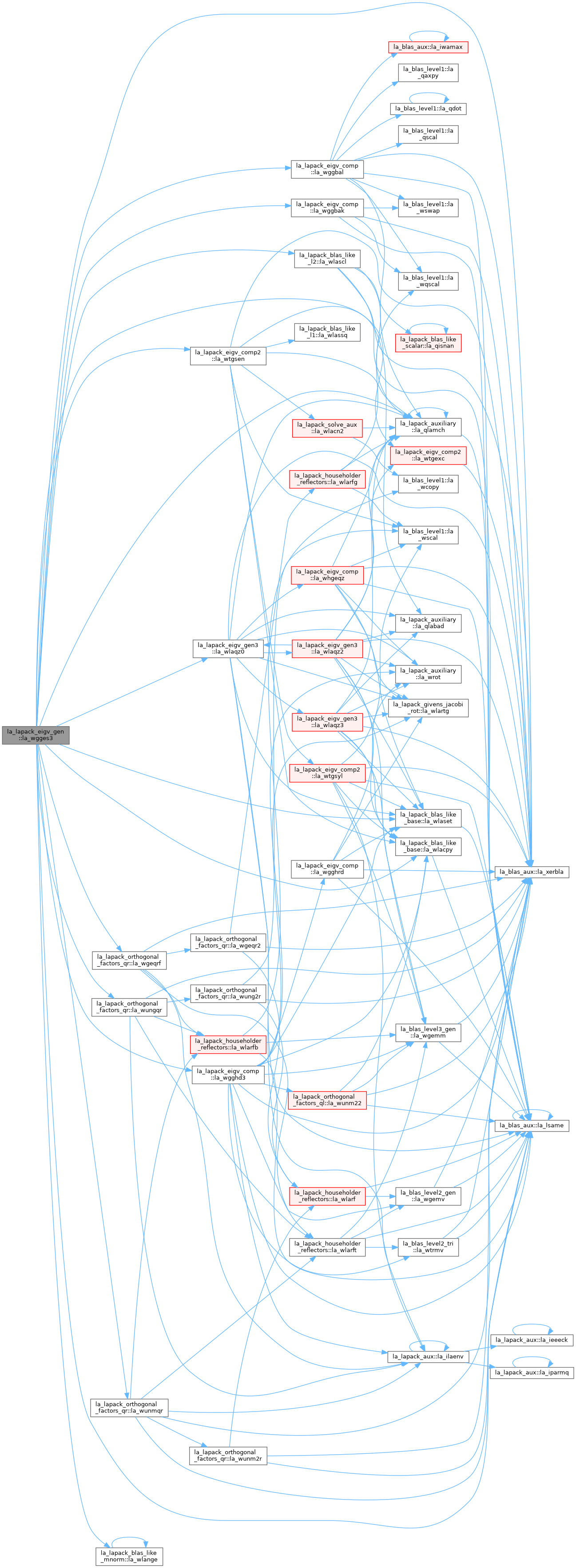
◆ la_wggesx()
| subroutine, public la_lapack_eigv_gen::la_wggesx | ( | character, intent(in) | jobvsl, |
| character, intent(in) | jobvsr, | ||
| character, intent(in) | sort, | ||
| procedure(la_selctg_w) | selctg, | ||
| character, intent(in) | sense, | ||
| integer(ilp), intent(in) | n, | ||
| complex(qp), dimension(lda,*), intent(inout) | a, | ||
| integer(ilp), intent(in) | lda, | ||
| complex(qp), dimension(ldb,*), intent(inout) | b, | ||
| integer(ilp), intent(in) | ldb, | ||
| integer(ilp), intent(out) | sdim, | ||
| complex(qp), dimension(*), intent(out) | alpha, | ||
| complex(qp), dimension(*), intent(out) | beta, | ||
| complex(qp), dimension(ldvsl,*), intent(out) | vsl, | ||
| integer(ilp), intent(in) | ldvsl, | ||
| complex(qp), dimension(ldvsr,*), intent(out) | vsr, | ||
| integer(ilp), intent(in) | ldvsr, | ||
| real(qp), dimension(2), intent(out) | rconde, | ||
| real(qp), dimension(2), intent(out) | rcondv, | ||
| complex(qp), dimension(*), intent(out) | work, | ||
| integer(ilp), intent(in) | lwork, | ||
| real(qp), dimension(*), intent(out) | rwork, | ||
| integer(ilp), dimension(*), intent(out) | iwork, | ||
| integer(ilp), intent(in) | liwork, | ||
| logical(lk), dimension(*), intent(out) | bwork, | ||
| integer(ilp), intent(out) | info ) |
WGGESX: computes for a pair of N-by-N complex nonsymmetric matrices (A,B), the generalized eigenvalues, the complex Schur form (S,T), and, optionally, the left and/or right matrices of Schur vectors (VSL and VSR). This gives the generalized Schur factorization (A,B) = ( (VSL) S (VSR)**H, (VSL) T (VSR)**H ) where (VSR)**H is the conjugate-transpose of VSR. Optionally, it also orders the eigenvalues so that a selected cluster of eigenvalues appears in the leading diagonal blocks of the upper triangular matrix S and the upper triangular matrix T; computes a reciprocal condition number for the average of the selected eigenvalues (RCONDE); and computes a reciprocal condition number for the right and left deflating subspaces corresponding to the selected eigenvalues (RCONDV). The leading columns of VSL and VSR then form an orthonormal basis for the corresponding left and right eigenspaces (deflating subspaces). A generalized eigenvalue for a pair of matrices (A,B) is a scalar w or a ratio alpha/beta = w, such that A - w*B is singular. It is usually represented as the pair (alpha,beta), as there is a reasonable interpretation for beta=0 or for both being zero. A pair of matrices (S,T) is in generalized complex Schur form if T is upper triangular with non-negative diagonal and S is upper triangular.
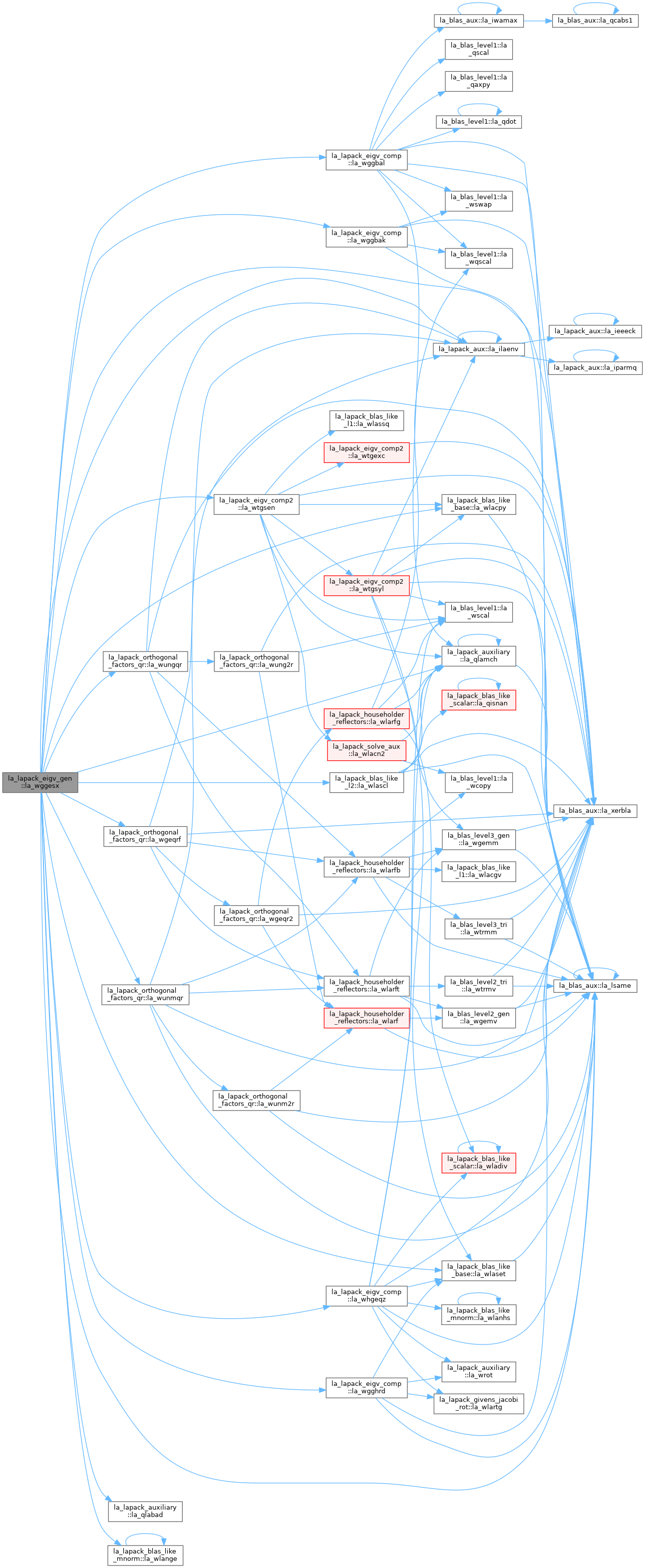
◆ la_wggev()
| subroutine, public la_lapack_eigv_gen::la_wggev | ( | character, intent(in) | jobvl, |
| character, intent(in) | jobvr, | ||
| integer(ilp), intent(in) | n, | ||
| complex(qp), dimension(lda,*), intent(inout) | a, | ||
| integer(ilp), intent(in) | lda, | ||
| complex(qp), dimension(ldb,*), intent(inout) | b, | ||
| integer(ilp), intent(in) | ldb, | ||
| complex(qp), dimension(*), intent(out) | alpha, | ||
| complex(qp), dimension(*), intent(out) | beta, | ||
| complex(qp), dimension(ldvl,*), intent(out) | vl, | ||
| integer(ilp), intent(in) | ldvl, | ||
| complex(qp), dimension(ldvr,*), intent(out) | vr, | ||
| integer(ilp), intent(in) | ldvr, | ||
| complex(qp), dimension(*), intent(out) | work, | ||
| integer(ilp), intent(in) | lwork, | ||
| real(qp), dimension(*), intent(out) | rwork, | ||
| integer(ilp), intent(out) | info ) |
WGGEV: computes for a pair of N-by-N complex nonsymmetric matrices (A,B), the generalized eigenvalues, and optionally, the left and/or right generalized eigenvectors. A generalized eigenvalue for a pair of matrices (A,B) is a scalar lambda or a ratio alpha/beta = lambda, such that A - lambda*B is singular. It is usually represented as the pair (alpha,beta), as there is a reasonable interpretation for beta=0, and even for both being zero. The right generalized eigenvector v(j) corresponding to the generalized eigenvalue lambda(j) of (A,B) satisfies A * v(j) = lambda(j) * B * v(j). The left generalized eigenvector u(j) corresponding to the generalized eigenvalues lambda(j) of (A,B) satisfies u(j)**H * A = lambda(j) * u(j)**H * B where u(j)**H is the conjugate-transpose of u(j).
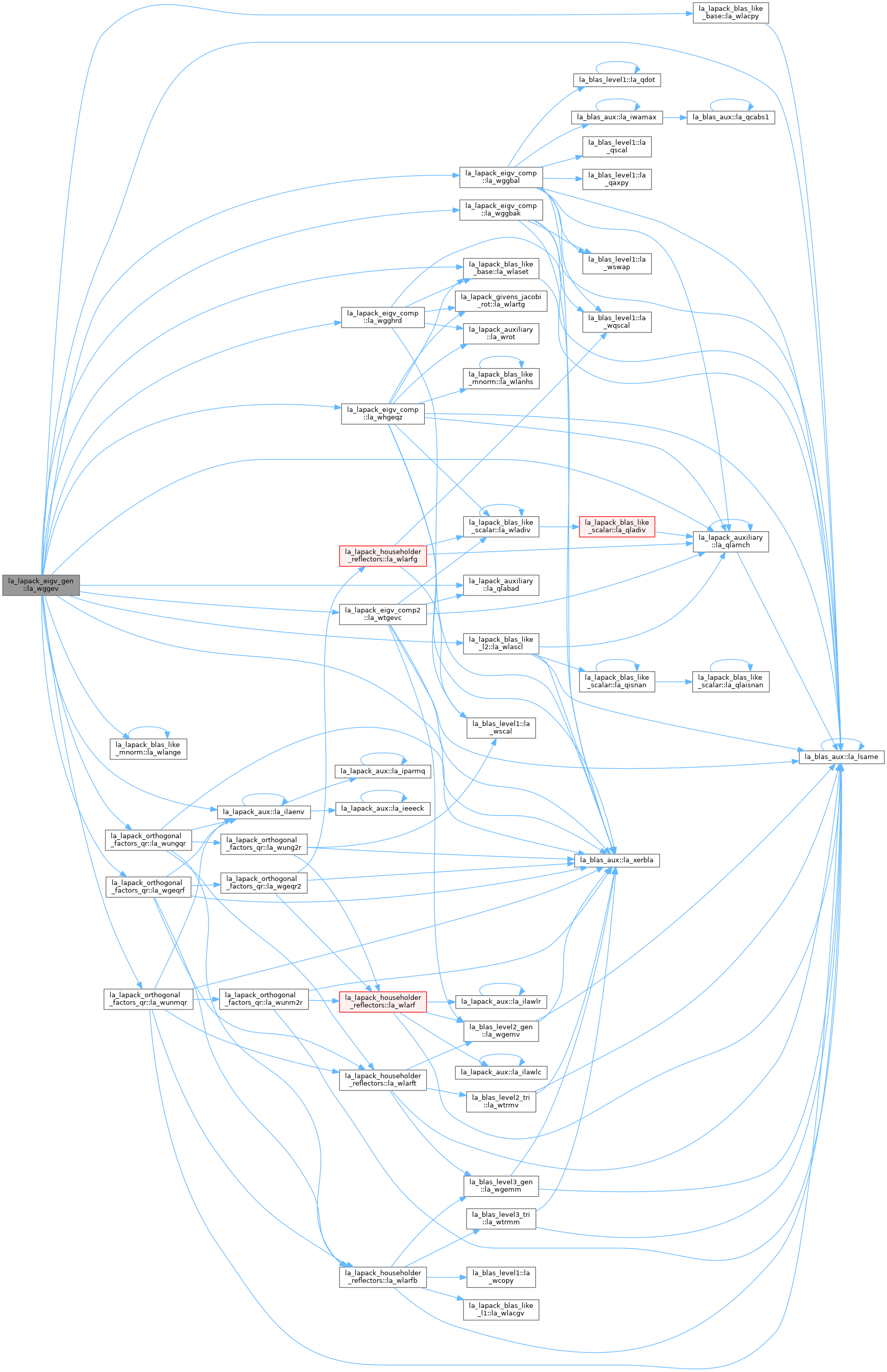
◆ la_wggev3()
| subroutine, public la_lapack_eigv_gen::la_wggev3 | ( | character, intent(in) | jobvl, |
| character, intent(in) | jobvr, | ||
| integer(ilp), intent(in) | n, | ||
| complex(qp), dimension(lda,*), intent(inout) | a, | ||
| integer(ilp), intent(in) | lda, | ||
| complex(qp), dimension(ldb,*), intent(inout) | b, | ||
| integer(ilp), intent(in) | ldb, | ||
| complex(qp), dimension(*), intent(out) | alpha, | ||
| complex(qp), dimension(*), intent(out) | beta, | ||
| complex(qp), dimension(ldvl,*), intent(out) | vl, | ||
| integer(ilp), intent(in) | ldvl, | ||
| complex(qp), dimension(ldvr,*), intent(out) | vr, | ||
| integer(ilp), intent(in) | ldvr, | ||
| complex(qp), dimension(*), intent(out) | work, | ||
| integer(ilp), intent(in) | lwork, | ||
| real(qp), dimension(*), intent(out) | rwork, | ||
| integer(ilp), intent(out) | info ) |
WGGEV3: computes for a pair of N-by-N complex nonsymmetric matrices (A,B), the generalized eigenvalues, and optionally, the left and/or right generalized eigenvectors. A generalized eigenvalue for a pair of matrices (A,B) is a scalar lambda or a ratio alpha/beta = lambda, such that A - lambda*B is singular. It is usually represented as the pair (alpha,beta), as there is a reasonable interpretation for beta=0, and even for both being zero. The right generalized eigenvector v(j) corresponding to the generalized eigenvalue lambda(j) of (A,B) satisfies A * v(j) = lambda(j) * B * v(j). The left generalized eigenvector u(j) corresponding to the generalized eigenvalues lambda(j) of (A,B) satisfies u(j)**H * A = lambda(j) * u(j)**H * B where u(j)**H is the conjugate-transpose of u(j).
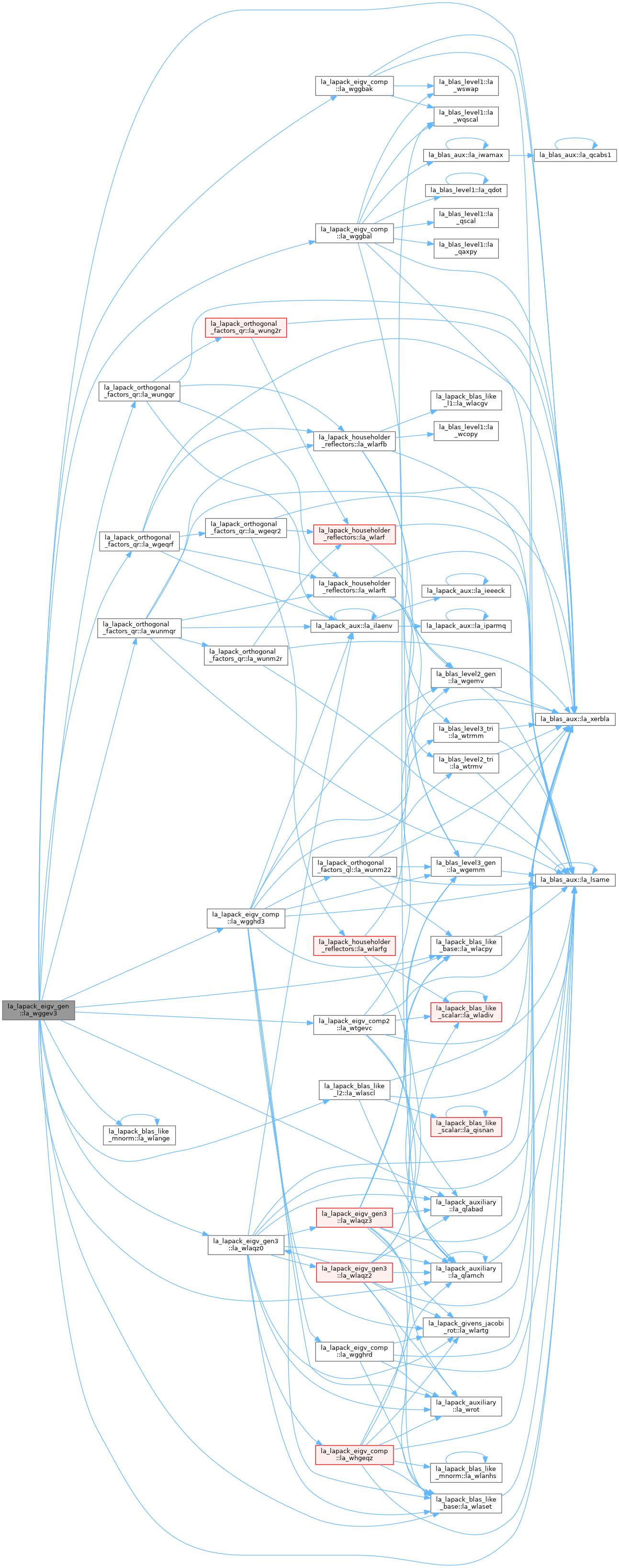
◆ la_wggevx()
| subroutine, public la_lapack_eigv_gen::la_wggevx | ( | character, intent(in) | balanc, |
| character, intent(in) | jobvl, | ||
| character, intent(in) | jobvr, | ||
| character, intent(in) | sense, | ||
| integer(ilp), intent(in) | n, | ||
| complex(qp), dimension(lda,*), intent(inout) | a, | ||
| integer(ilp), intent(in) | lda, | ||
| complex(qp), dimension(ldb,*), intent(inout) | b, | ||
| integer(ilp), intent(in) | ldb, | ||
| complex(qp), dimension(*), intent(out) | alpha, | ||
| complex(qp), dimension(*), intent(out) | beta, | ||
| complex(qp), dimension(ldvl,*), intent(out) | vl, | ||
| integer(ilp), intent(in) | ldvl, | ||
| complex(qp), dimension(ldvr,*), intent(out) | vr, | ||
| integer(ilp), intent(in) | ldvr, | ||
| integer(ilp), intent(out) | ilo, | ||
| integer(ilp), intent(out) | ihi, | ||
| real(qp), dimension(*), intent(out) | lscale, | ||
| real(qp), dimension(*), intent(out) | rscale, | ||
| real(qp), intent(out) | abnrm, | ||
| real(qp), intent(out) | bbnrm, | ||
| real(qp), dimension(*), intent(out) | rconde, | ||
| real(qp), dimension(*), intent(out) | rcondv, | ||
| complex(qp), dimension(*), intent(out) | work, | ||
| integer(ilp), intent(in) | lwork, | ||
| real(qp), dimension(*), intent(out) | rwork, | ||
| integer(ilp), dimension(*), intent(out) | iwork, | ||
| logical(lk), dimension(*), intent(out) | bwork, | ||
| integer(ilp), intent(out) | info ) |
WGGEVX: computes for a pair of N-by-N complex nonsymmetric matrices (A,B) the generalized eigenvalues, and optionally, the left and/or right generalized eigenvectors. Optionally, it also computes a balancing transformation to improve the conditioning of the eigenvalues and eigenvectors (ILO, IHI, LSCALE, RSCALE, ABNRM, and BBNRM), reciprocal condition numbers for the eigenvalues (RCONDE), and reciprocal condition numbers for the right eigenvectors (RCONDV). A generalized eigenvalue for a pair of matrices (A,B) is a scalar lambda or a ratio alpha/beta = lambda, such that A - lambda*B is singular. It is usually represented as the pair (alpha,beta), as there is a reasonable interpretation for beta=0, and even for both being zero. The right eigenvector v(j) corresponding to the eigenvalue lambda(j) of (A,B) satisfies A * v(j) = lambda(j) * B * v(j) . The left eigenvector u(j) corresponding to the eigenvalue lambda(j) of (A,B) satisfies u(j)**H * A = lambda(j) * u(j)**H * B. where u(j)**H is the conjugate-transpose of u(j).
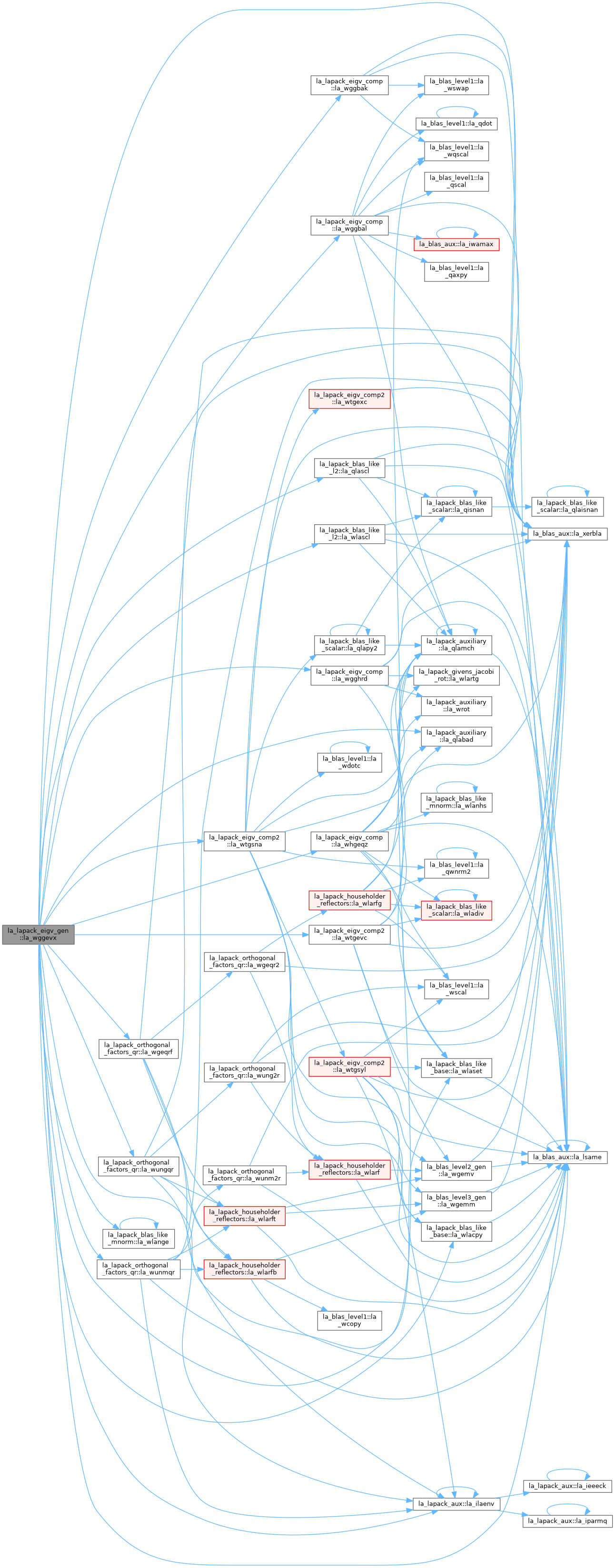
◆ la_zgees()
| subroutine, public la_lapack_eigv_gen::la_zgees | ( | character, intent(in) | jobvs, |
| character, intent(in) | sort, | ||
| procedure(la_select_z) | select, | ||
| integer(ilp), intent(in) | n, | ||
| complex(dp), dimension(lda,*), intent(inout) | a, | ||
| integer(ilp), intent(in) | lda, | ||
| integer(ilp), intent(out) | sdim, | ||
| complex(dp), dimension(*), intent(out) | w, | ||
| complex(dp), dimension(ldvs,*), intent(out) | vs, | ||
| integer(ilp), intent(in) | ldvs, | ||
| complex(dp), dimension(*), intent(out) | work, | ||
| integer(ilp), intent(in) | lwork, | ||
| real(dp), dimension(*), intent(out) | rwork, | ||
| logical(lk), dimension(*), intent(out) | bwork, | ||
| integer(ilp), intent(out) | info ) |
ZGEES: computes for an N-by-N complex nonsymmetric matrix A, the eigenvalues, the Schur form T, and, optionally, the matrix of Schur vectors Z. This gives the Schur factorization A = Z*T*(Z**H). Optionally, it also orders the eigenvalues on the diagonal of the Schur form so that selected eigenvalues are at the top left. The leading columns of Z then form an orthonormal basis for the invariant subspace corresponding to the selected eigenvalues. A complex matrix is in Schur form if it is upper triangular.
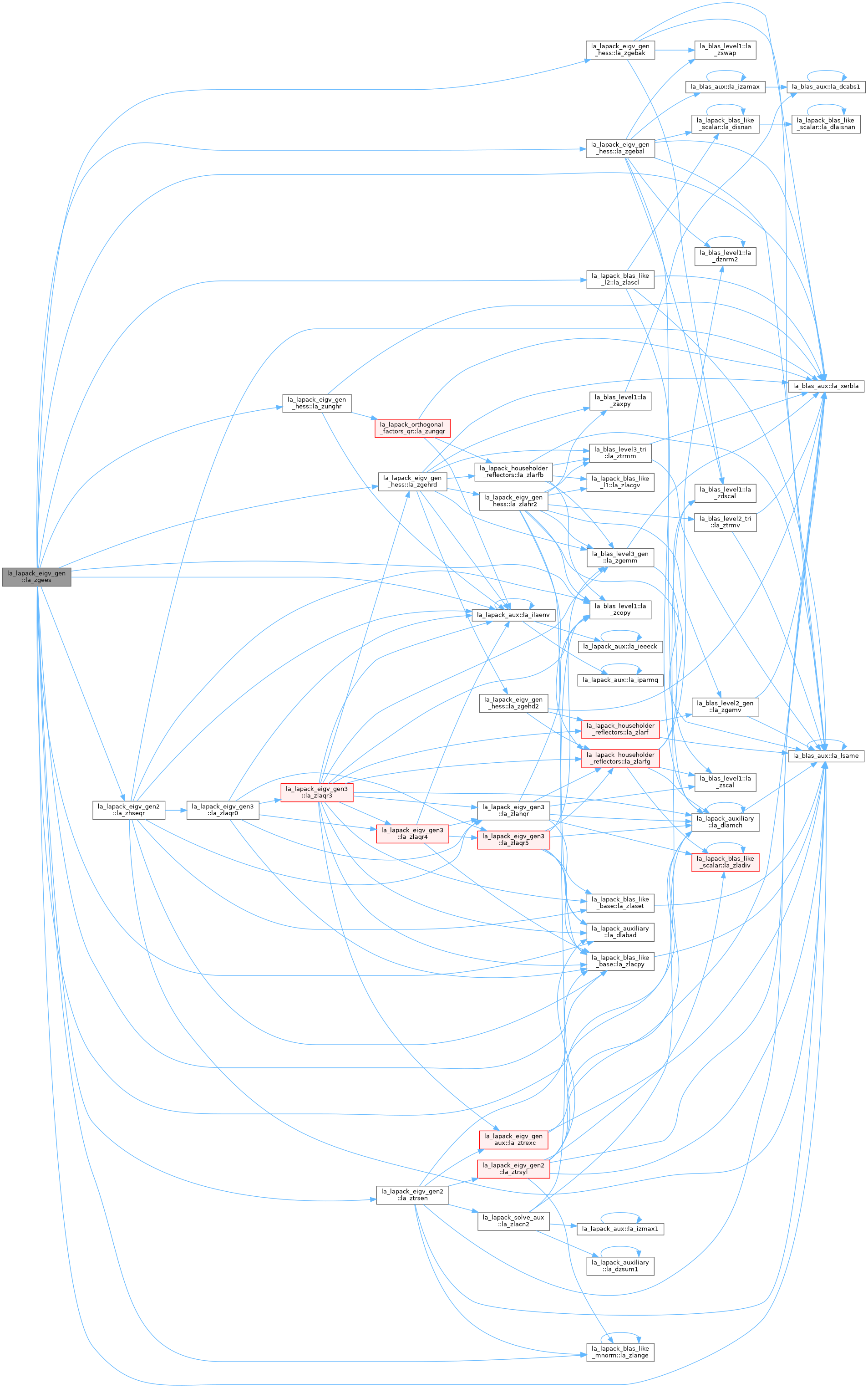
◆ la_zgeesx()
| subroutine, public la_lapack_eigv_gen::la_zgeesx | ( | character, intent(in) | jobvs, |
| character, intent(in) | sort, | ||
| procedure(la_select_z) | select, | ||
| character, intent(in) | sense, | ||
| integer(ilp), intent(in) | n, | ||
| complex(dp), dimension(lda,*), intent(inout) | a, | ||
| integer(ilp), intent(in) | lda, | ||
| integer(ilp), intent(out) | sdim, | ||
| complex(dp), dimension(*), intent(out) | w, | ||
| complex(dp), dimension(ldvs,*), intent(out) | vs, | ||
| integer(ilp), intent(in) | ldvs, | ||
| real(dp), intent(out) | rconde, | ||
| real(dp), intent(out) | rcondv, | ||
| complex(dp), dimension(*), intent(out) | work, | ||
| integer(ilp), intent(in) | lwork, | ||
| real(dp), dimension(*), intent(out) | rwork, | ||
| logical(lk), dimension(*), intent(out) | bwork, | ||
| integer(ilp), intent(out) | info ) |
ZGEESX: computes for an N-by-N complex nonsymmetric matrix A, the eigenvalues, the Schur form T, and, optionally, the matrix of Schur vectors Z. This gives the Schur factorization A = Z*T*(Z**H). Optionally, it also orders the eigenvalues on the diagonal of the Schur form so that selected eigenvalues are at the top left; computes a reciprocal condition number for the average of the selected eigenvalues (RCONDE); and computes a reciprocal condition number for the right invariant subspace corresponding to the selected eigenvalues (RCONDV). The leading columns of Z form an orthonormal basis for this invariant subspace. For further explanation of the reciprocal condition numbers RCONDE and RCONDV, see Section 4.10_dp of the LAPACK Users' Guide (where these quantities are called s and sep respectively). A complex matrix is in Schur form if it is upper triangular.
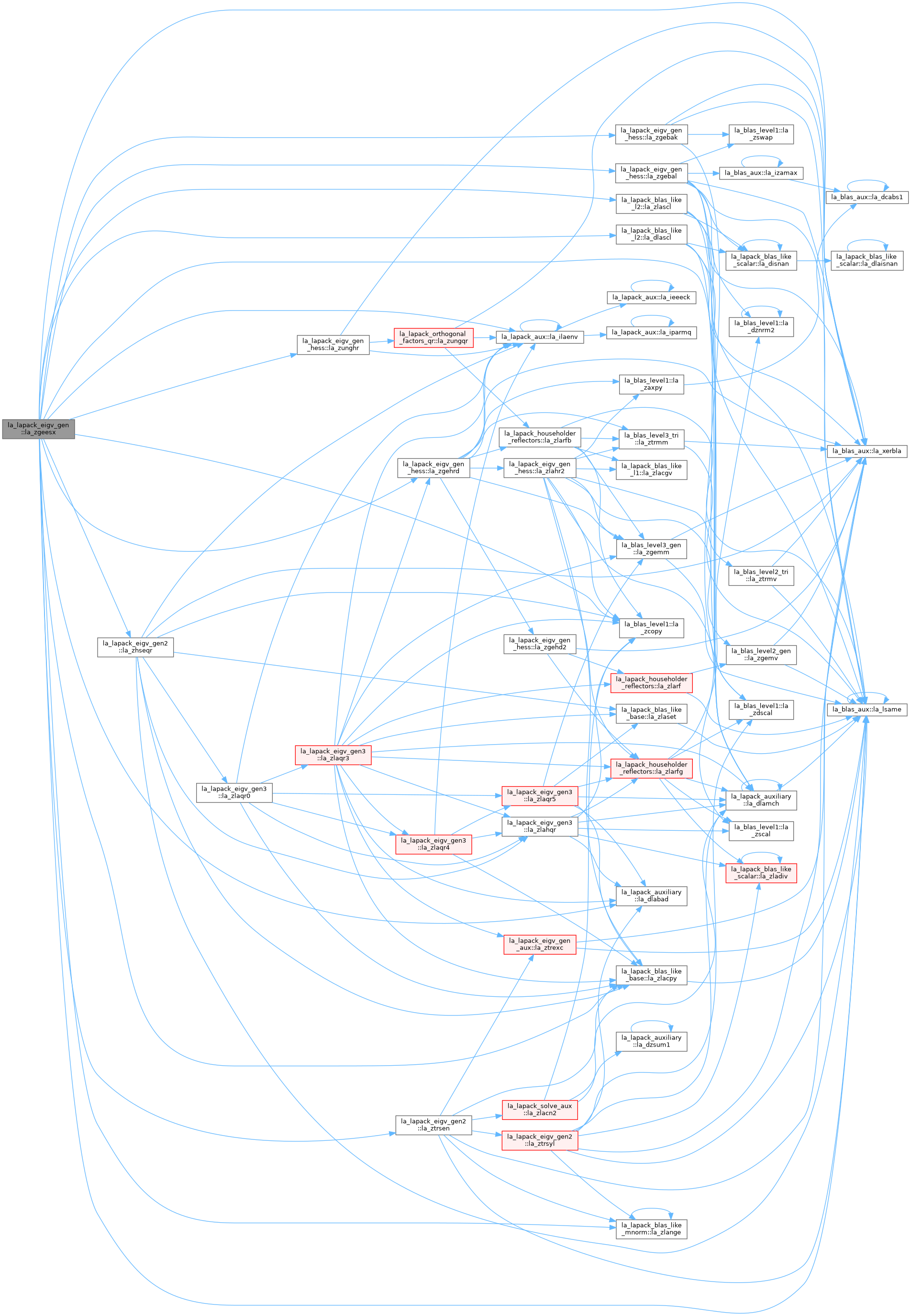
◆ la_zgeev()
| subroutine, public la_lapack_eigv_gen::la_zgeev | ( | character, intent(in) | jobvl, |
| character, intent(in) | jobvr, | ||
| integer(ilp), intent(in) | n, | ||
| complex(dp), dimension(lda,*), intent(inout) | a, | ||
| integer(ilp), intent(in) | lda, | ||
| complex(dp), dimension(*), intent(out) | w, | ||
| complex(dp), dimension(ldvl,*), intent(out) | vl, | ||
| integer(ilp), intent(in) | ldvl, | ||
| complex(dp), dimension(ldvr,*), intent(out) | vr, | ||
| integer(ilp), intent(in) | ldvr, | ||
| complex(dp), dimension(*), intent(out) | work, | ||
| integer(ilp), intent(in) | lwork, | ||
| real(dp), dimension(*), intent(out) | rwork, | ||
| integer(ilp), intent(out) | info ) |
ZGEEV: computes for an N-by-N complex nonsymmetric matrix A, the eigenvalues and, optionally, the left and/or right eigenvectors. The right eigenvector v(j) of A satisfies A * v(j) = lambda(j) * v(j) where lambda(j) is its eigenvalue. The left eigenvector u(j) of A satisfies u(j)**H * A = lambda(j) * u(j)**H where u(j)**H denotes the conjugate transpose of u(j). The computed eigenvectors are normalized to have Euclidean norm equal to 1 and largest component real.
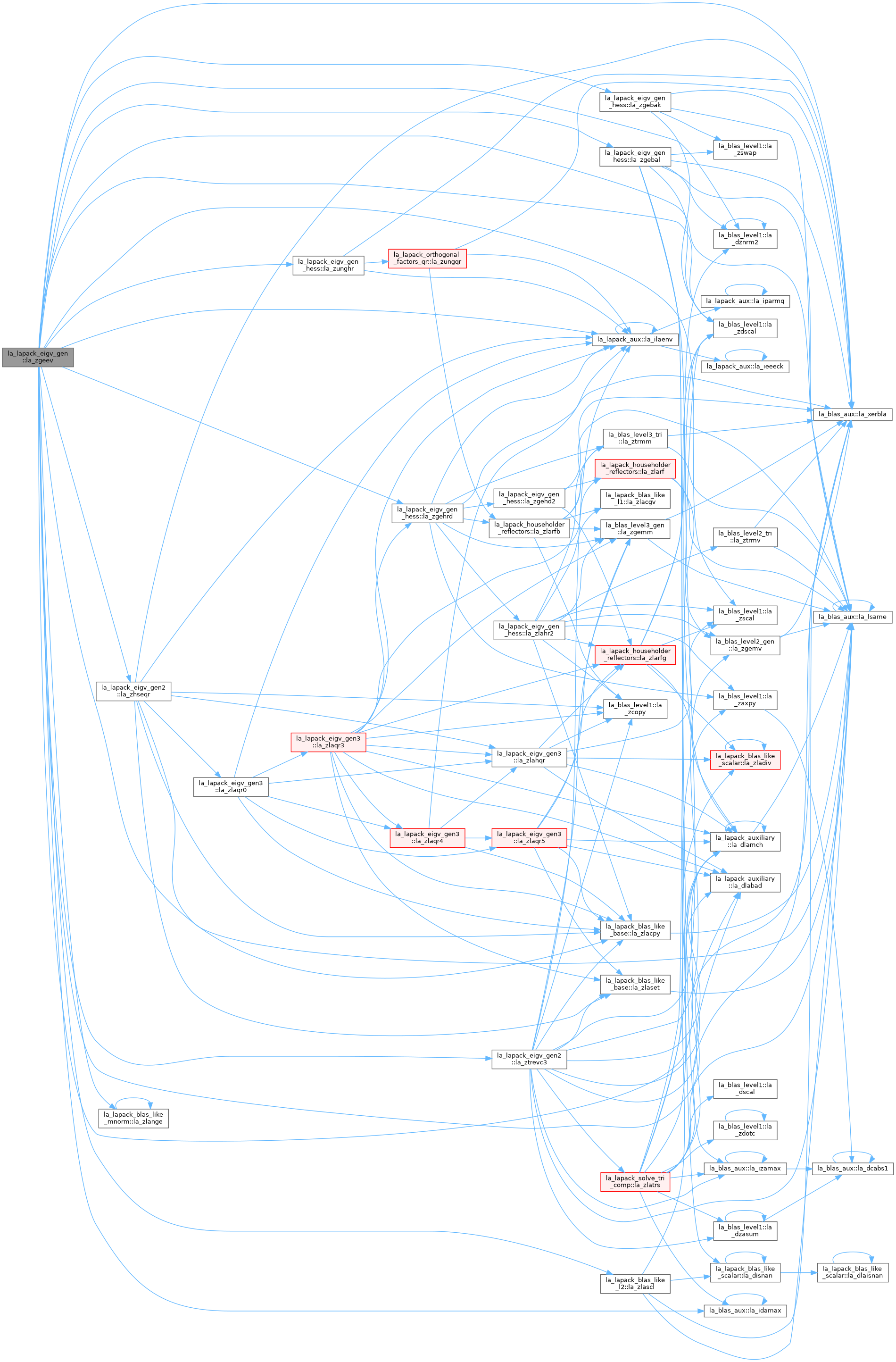
◆ la_zgeevx()
| subroutine, public la_lapack_eigv_gen::la_zgeevx | ( | character, intent(in) | balanc, |
| character, intent(in) | jobvl, | ||
| character, intent(in) | jobvr, | ||
| character, intent(in) | sense, | ||
| integer(ilp), intent(in) | n, | ||
| complex(dp), dimension(lda,*), intent(inout) | a, | ||
| integer(ilp), intent(in) | lda, | ||
| complex(dp), dimension(*), intent(out) | w, | ||
| complex(dp), dimension(ldvl,*), intent(out) | vl, | ||
| integer(ilp), intent(in) | ldvl, | ||
| complex(dp), dimension(ldvr,*), intent(out) | vr, | ||
| integer(ilp), intent(in) | ldvr, | ||
| integer(ilp), intent(out) | ilo, | ||
| integer(ilp), intent(out) | ihi, | ||
| real(dp), dimension(*), intent(out) | scale, | ||
| real(dp), intent(out) | abnrm, | ||
| real(dp), dimension(*), intent(out) | rconde, | ||
| real(dp), dimension(*), intent(out) | rcondv, | ||
| complex(dp), dimension(*), intent(out) | work, | ||
| integer(ilp), intent(in) | lwork, | ||
| real(dp), dimension(*), intent(out) | rwork, | ||
| integer(ilp), intent(out) | info ) |
ZGEEVX: computes for an N-by-N complex nonsymmetric matrix A, the eigenvalues and, optionally, the left and/or right eigenvectors. Optionally also, it computes a balancing transformation to improve the conditioning of the eigenvalues and eigenvectors (ILO, IHI, SCALE, and ABNRM), reciprocal condition numbers for the eigenvalues (RCONDE), and reciprocal condition numbers for the right eigenvectors (RCONDV). The right eigenvector v(j) of A satisfies A * v(j) = lambda(j) * v(j) where lambda(j) is its eigenvalue. The left eigenvector u(j) of A satisfies u(j)**H * A = lambda(j) * u(j)**H where u(j)**H denotes the conjugate transpose of u(j). The computed eigenvectors are normalized to have Euclidean norm equal to 1 and largest component real. Balancing a matrix means permuting the rows and columns to make it more nearly upper triangular, and applying a diagonal similarity transformation D * A * D**(-1), where D is a diagonal matrix, to make its rows and columns closer in norm and the condition numbers of its eigenvalues and eigenvectors smaller. The computed reciprocal condition numbers correspond to the balanced matrix. Permuting rows and columns will not change the condition numbers (in exact arithmetic) but diagonal scaling will. For further explanation of balancing, see section 4.10.2_dp of the LAPACK Users' Guide.
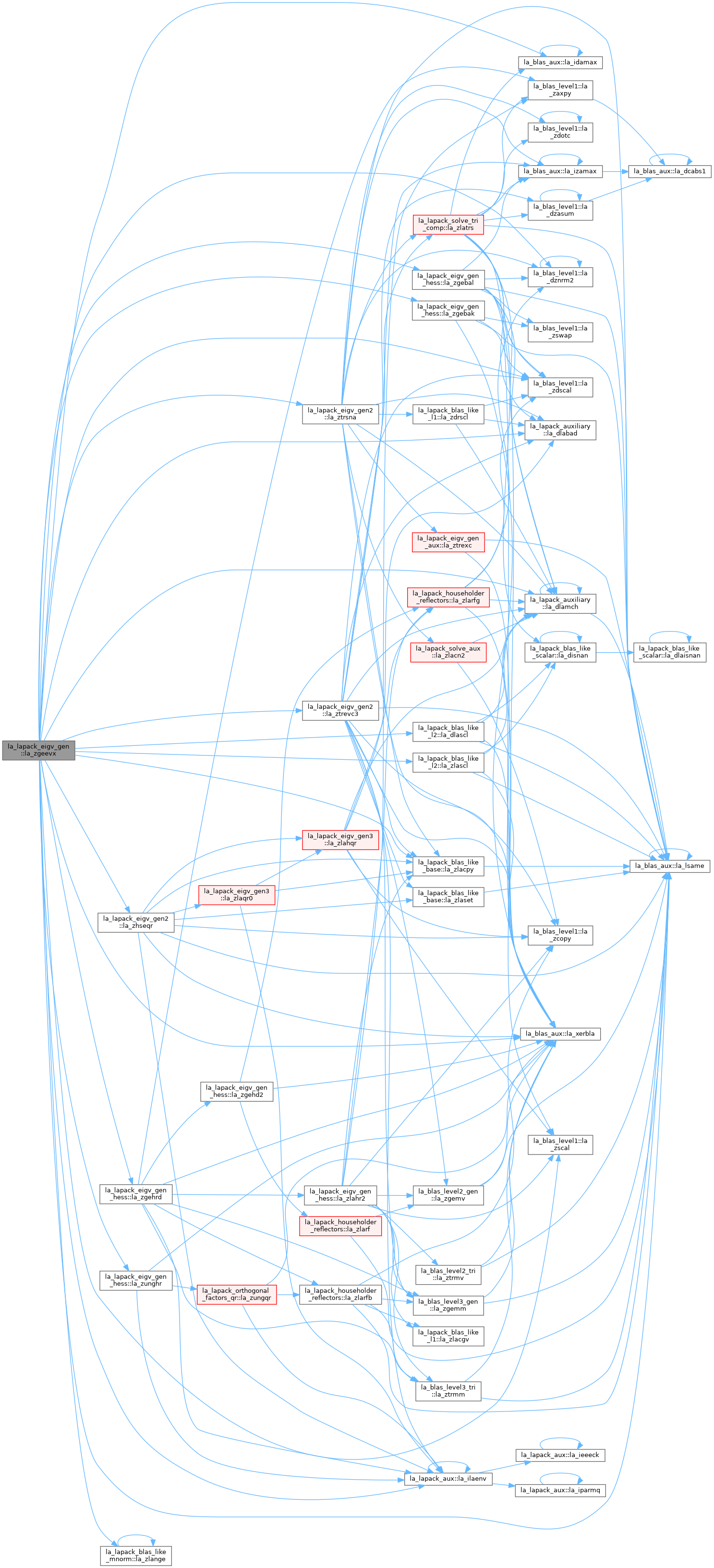
◆ la_zgges()
| subroutine, public la_lapack_eigv_gen::la_zgges | ( | character, intent(in) | jobvsl, |
| character, intent(in) | jobvsr, | ||
| character, intent(in) | sort, | ||
| procedure(la_selctg_z) | selctg, | ||
| integer(ilp), intent(in) | n, | ||
| complex(dp), dimension(lda,*), intent(inout) | a, | ||
| integer(ilp), intent(in) | lda, | ||
| complex(dp), dimension(ldb,*), intent(inout) | b, | ||
| integer(ilp), intent(in) | ldb, | ||
| integer(ilp), intent(out) | sdim, | ||
| complex(dp), dimension(*), intent(out) | alpha, | ||
| complex(dp), dimension(*), intent(out) | beta, | ||
| complex(dp), dimension(ldvsl,*), intent(out) | vsl, | ||
| integer(ilp), intent(in) | ldvsl, | ||
| complex(dp), dimension(ldvsr,*), intent(out) | vsr, | ||
| integer(ilp), intent(in) | ldvsr, | ||
| complex(dp), dimension(*), intent(out) | work, | ||
| integer(ilp), intent(in) | lwork, | ||
| real(dp), dimension(*), intent(out) | rwork, | ||
| logical(lk), dimension(*), intent(out) | bwork, | ||
| integer(ilp), intent(out) | info ) |
ZGGES: computes for a pair of N-by-N complex nonsymmetric matrices (A,B), the generalized eigenvalues, the generalized complex Schur form (S, T), and optionally left and/or right Schur vectors (VSL and VSR). This gives the generalized Schur factorization (A,B) = ( (VSL)*S*(VSR)**H, (VSL)*T*(VSR)**H ) where (VSR)**H is the conjugate-transpose of VSR. Optionally, it also orders the eigenvalues so that a selected cluster of eigenvalues appears in the leading diagonal blocks of the upper triangular matrix S and the upper triangular matrix T. The leading columns of VSL and VSR then form an unitary basis for the corresponding left and right eigenspaces (deflating subspaces). (If only the generalized eigenvalues are needed, use the driver ZGGEV instead, which is faster.) A generalized eigenvalue for a pair of matrices (A,B) is a scalar w or a ratio alpha/beta = w, such that A - w*B is singular. It is usually represented as the pair (alpha,beta), as there is a reasonable interpretation for beta=0, and even for both being zero. A pair of matrices (S,T) is in generalized complex Schur form if S and T are upper triangular and, in addition, the diagonal elements of T are non-negative real numbers.
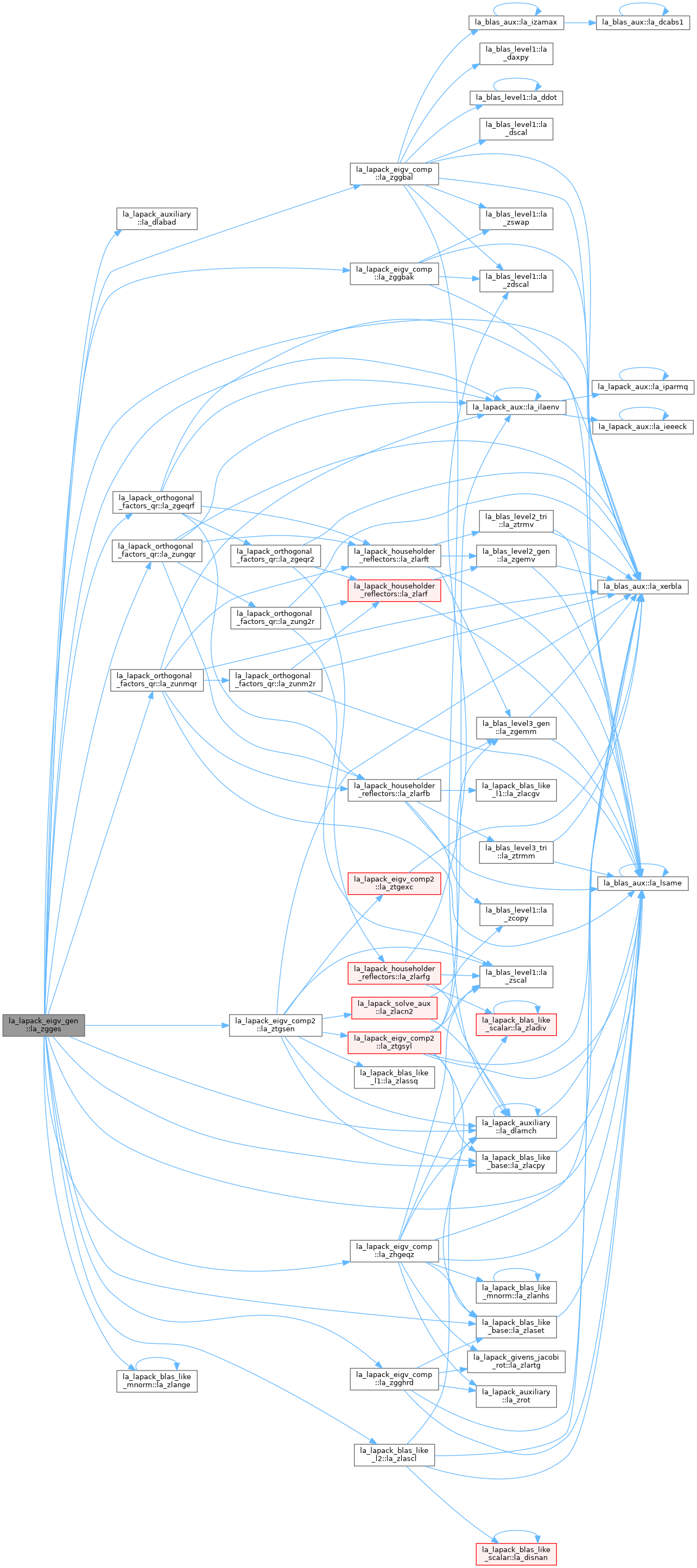
◆ la_zgges3()
| subroutine, public la_lapack_eigv_gen::la_zgges3 | ( | character, intent(in) | jobvsl, |
| character, intent(in) | jobvsr, | ||
| character, intent(in) | sort, | ||
| procedure(la_selctg_z) | selctg, | ||
| integer(ilp), intent(in) | n, | ||
| complex(dp), dimension(lda,*), intent(inout) | a, | ||
| integer(ilp), intent(in) | lda, | ||
| complex(dp), dimension(ldb,*), intent(inout) | b, | ||
| integer(ilp), intent(in) | ldb, | ||
| integer(ilp), intent(out) | sdim, | ||
| complex(dp), dimension(*), intent(out) | alpha, | ||
| complex(dp), dimension(*), intent(out) | beta, | ||
| complex(dp), dimension(ldvsl,*), intent(out) | vsl, | ||
| integer(ilp), intent(in) | ldvsl, | ||
| complex(dp), dimension(ldvsr,*), intent(out) | vsr, | ||
| integer(ilp), intent(in) | ldvsr, | ||
| complex(dp), dimension(*), intent(out) | work, | ||
| integer(ilp), intent(in) | lwork, | ||
| real(dp), dimension(*), intent(out) | rwork, | ||
| logical(lk), dimension(*), intent(out) | bwork, | ||
| integer(ilp), intent(out) | info ) |
ZGGES3: computes for a pair of N-by-N complex nonsymmetric matrices (A,B), the generalized eigenvalues, the generalized complex Schur form (S, T), and optionally left and/or right Schur vectors (VSL and VSR). This gives the generalized Schur factorization (A,B) = ( (VSL)*S*(VSR)**H, (VSL)*T*(VSR)**H ) where (VSR)**H is the conjugate-transpose of VSR. Optionally, it also orders the eigenvalues so that a selected cluster of eigenvalues appears in the leading diagonal blocks of the upper triangular matrix S and the upper triangular matrix T. The leading columns of VSL and VSR then form an unitary basis for the corresponding left and right eigenspaces (deflating subspaces). (If only the generalized eigenvalues are needed, use the driver ZGGEV instead, which is faster.) A generalized eigenvalue for a pair of matrices (A,B) is a scalar w or a ratio alpha/beta = w, such that A - w*B is singular. It is usually represented as the pair (alpha,beta), as there is a reasonable interpretation for beta=0, and even for both being zero. A pair of matrices (S,T) is in generalized complex Schur form if S and T are upper triangular and, in addition, the diagonal elements of T are non-negative real numbers.
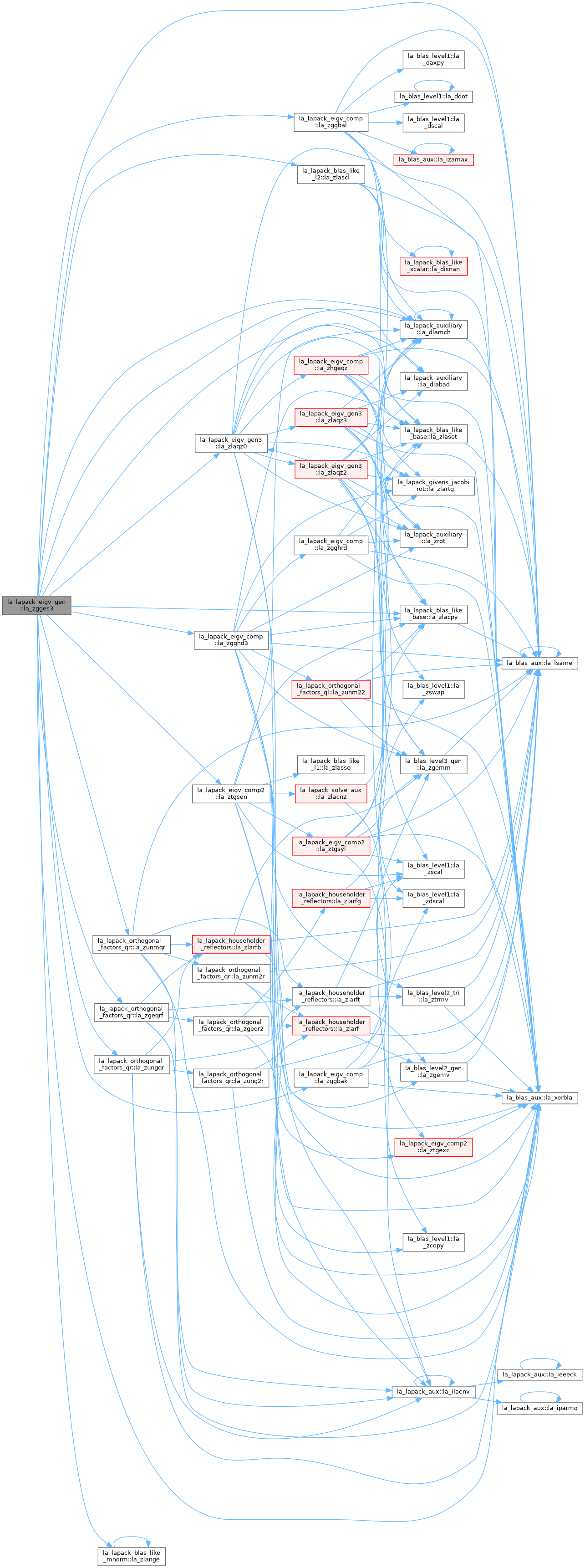
◆ la_zggesx()
| subroutine, public la_lapack_eigv_gen::la_zggesx | ( | character, intent(in) | jobvsl, |
| character, intent(in) | jobvsr, | ||
| character, intent(in) | sort, | ||
| procedure(la_selctg_z) | selctg, | ||
| character, intent(in) | sense, | ||
| integer(ilp), intent(in) | n, | ||
| complex(dp), dimension(lda,*), intent(inout) | a, | ||
| integer(ilp), intent(in) | lda, | ||
| complex(dp), dimension(ldb,*), intent(inout) | b, | ||
| integer(ilp), intent(in) | ldb, | ||
| integer(ilp), intent(out) | sdim, | ||
| complex(dp), dimension(*), intent(out) | alpha, | ||
| complex(dp), dimension(*), intent(out) | beta, | ||
| complex(dp), dimension(ldvsl,*), intent(out) | vsl, | ||
| integer(ilp), intent(in) | ldvsl, | ||
| complex(dp), dimension(ldvsr,*), intent(out) | vsr, | ||
| integer(ilp), intent(in) | ldvsr, | ||
| real(dp), dimension(2), intent(out) | rconde, | ||
| real(dp), dimension(2), intent(out) | rcondv, | ||
| complex(dp), dimension(*), intent(out) | work, | ||
| integer(ilp), intent(in) | lwork, | ||
| real(dp), dimension(*), intent(out) | rwork, | ||
| integer(ilp), dimension(*), intent(out) | iwork, | ||
| integer(ilp), intent(in) | liwork, | ||
| logical(lk), dimension(*), intent(out) | bwork, | ||
| integer(ilp), intent(out) | info ) |
ZGGESX: computes for a pair of N-by-N complex nonsymmetric matrices (A,B), the generalized eigenvalues, the complex Schur form (S,T), and, optionally, the left and/or right matrices of Schur vectors (VSL and VSR). This gives the generalized Schur factorization (A,B) = ( (VSL) S (VSR)**H, (VSL) T (VSR)**H ) where (VSR)**H is the conjugate-transpose of VSR. Optionally, it also orders the eigenvalues so that a selected cluster of eigenvalues appears in the leading diagonal blocks of the upper triangular matrix S and the upper triangular matrix T; computes a reciprocal condition number for the average of the selected eigenvalues (RCONDE); and computes a reciprocal condition number for the right and left deflating subspaces corresponding to the selected eigenvalues (RCONDV). The leading columns of VSL and VSR then form an orthonormal basis for the corresponding left and right eigenspaces (deflating subspaces). A generalized eigenvalue for a pair of matrices (A,B) is a scalar w or a ratio alpha/beta = w, such that A - w*B is singular. It is usually represented as the pair (alpha,beta), as there is a reasonable interpretation for beta=0 or for both being zero. A pair of matrices (S,T) is in generalized complex Schur form if T is upper triangular with non-negative diagonal and S is upper triangular.
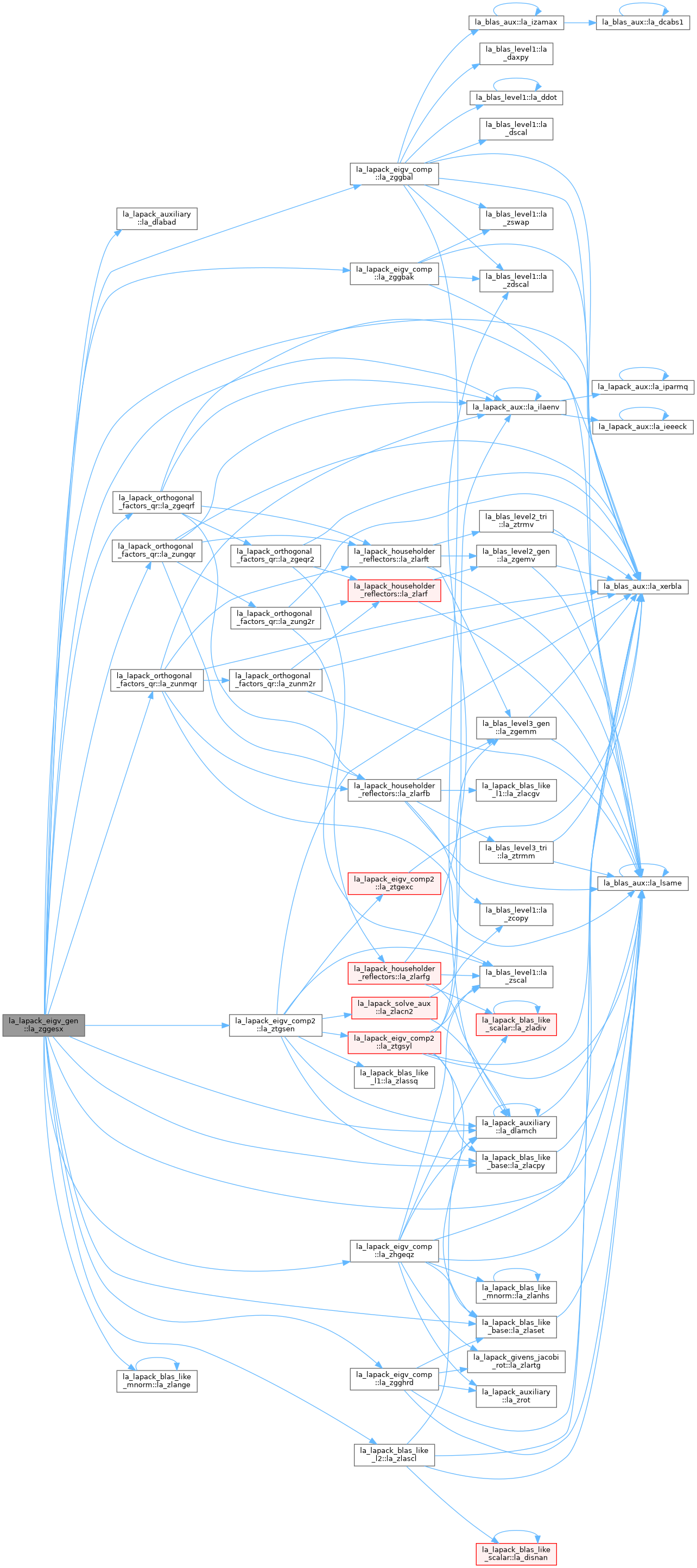
◆ la_zggev()
| subroutine, public la_lapack_eigv_gen::la_zggev | ( | character, intent(in) | jobvl, |
| character, intent(in) | jobvr, | ||
| integer(ilp), intent(in) | n, | ||
| complex(dp), dimension(lda,*), intent(inout) | a, | ||
| integer(ilp), intent(in) | lda, | ||
| complex(dp), dimension(ldb,*), intent(inout) | b, | ||
| integer(ilp), intent(in) | ldb, | ||
| complex(dp), dimension(*), intent(out) | alpha, | ||
| complex(dp), dimension(*), intent(out) | beta, | ||
| complex(dp), dimension(ldvl,*), intent(out) | vl, | ||
| integer(ilp), intent(in) | ldvl, | ||
| complex(dp), dimension(ldvr,*), intent(out) | vr, | ||
| integer(ilp), intent(in) | ldvr, | ||
| complex(dp), dimension(*), intent(out) | work, | ||
| integer(ilp), intent(in) | lwork, | ||
| real(dp), dimension(*), intent(out) | rwork, | ||
| integer(ilp), intent(out) | info ) |
ZGGEV: computes for a pair of N-by-N complex nonsymmetric matrices (A,B), the generalized eigenvalues, and optionally, the left and/or right generalized eigenvectors. A generalized eigenvalue for a pair of matrices (A,B) is a scalar lambda or a ratio alpha/beta = lambda, such that A - lambda*B is singular. It is usually represented as the pair (alpha,beta), as there is a reasonable interpretation for beta=0, and even for both being zero. The right generalized eigenvector v(j) corresponding to the generalized eigenvalue lambda(j) of (A,B) satisfies A * v(j) = lambda(j) * B * v(j). The left generalized eigenvector u(j) corresponding to the generalized eigenvalues lambda(j) of (A,B) satisfies u(j)**H * A = lambda(j) * u(j)**H * B where u(j)**H is the conjugate-transpose of u(j).
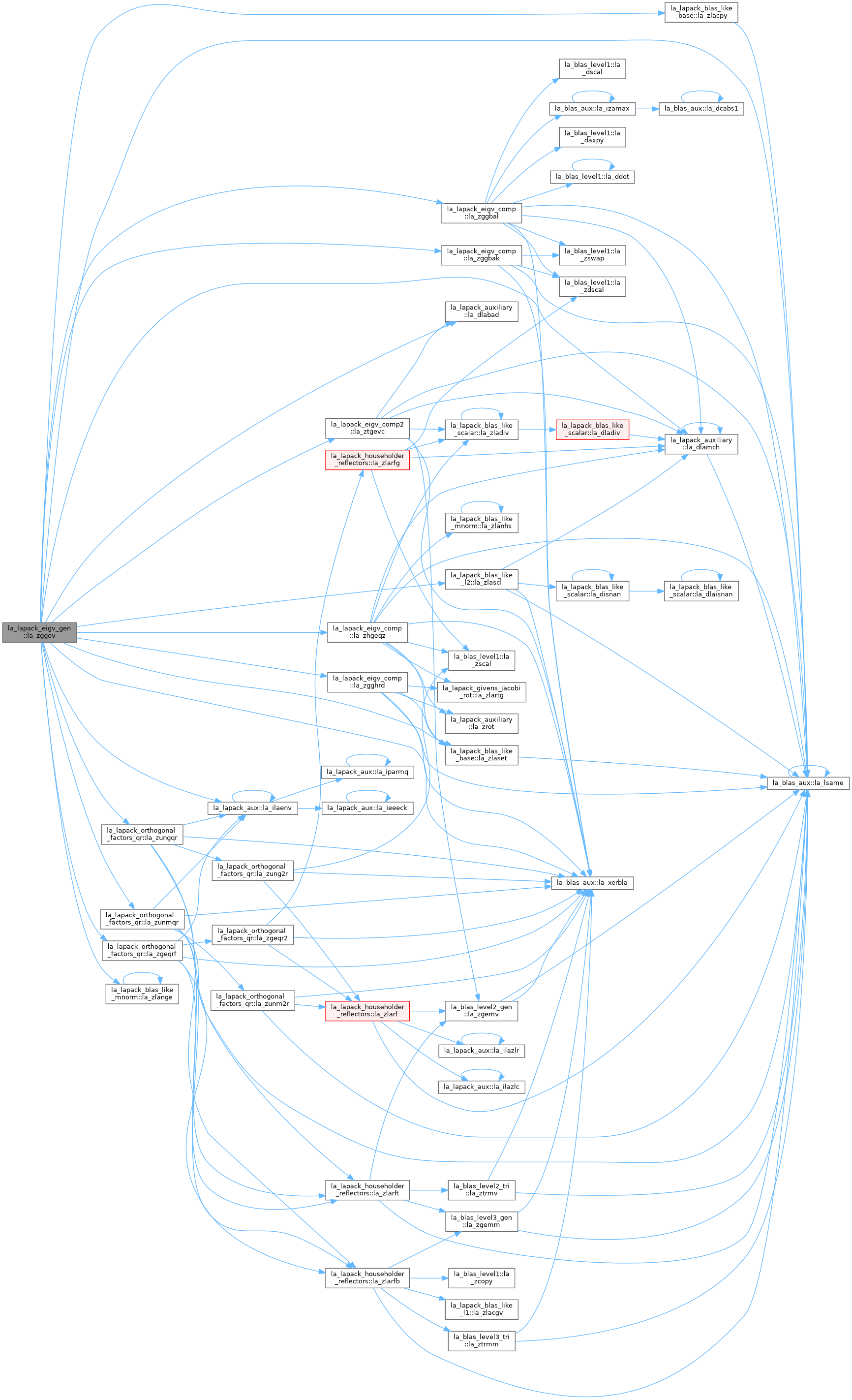
◆ la_zggev3()
| subroutine, public la_lapack_eigv_gen::la_zggev3 | ( | character, intent(in) | jobvl, |
| character, intent(in) | jobvr, | ||
| integer(ilp), intent(in) | n, | ||
| complex(dp), dimension(lda,*), intent(inout) | a, | ||
| integer(ilp), intent(in) | lda, | ||
| complex(dp), dimension(ldb,*), intent(inout) | b, | ||
| integer(ilp), intent(in) | ldb, | ||
| complex(dp), dimension(*), intent(out) | alpha, | ||
| complex(dp), dimension(*), intent(out) | beta, | ||
| complex(dp), dimension(ldvl,*), intent(out) | vl, | ||
| integer(ilp), intent(in) | ldvl, | ||
| complex(dp), dimension(ldvr,*), intent(out) | vr, | ||
| integer(ilp), intent(in) | ldvr, | ||
| complex(dp), dimension(*), intent(out) | work, | ||
| integer(ilp), intent(in) | lwork, | ||
| real(dp), dimension(*), intent(out) | rwork, | ||
| integer(ilp), intent(out) | info ) |
ZGGEV3: computes for a pair of N-by-N complex nonsymmetric matrices (A,B), the generalized eigenvalues, and optionally, the left and/or right generalized eigenvectors. A generalized eigenvalue for a pair of matrices (A,B) is a scalar lambda or a ratio alpha/beta = lambda, such that A - lambda*B is singular. It is usually represented as the pair (alpha,beta), as there is a reasonable interpretation for beta=0, and even for both being zero. The right generalized eigenvector v(j) corresponding to the generalized eigenvalue lambda(j) of (A,B) satisfies A * v(j) = lambda(j) * B * v(j). The left generalized eigenvector u(j) corresponding to the generalized eigenvalues lambda(j) of (A,B) satisfies u(j)**H * A = lambda(j) * u(j)**H * B where u(j)**H is the conjugate-transpose of u(j).
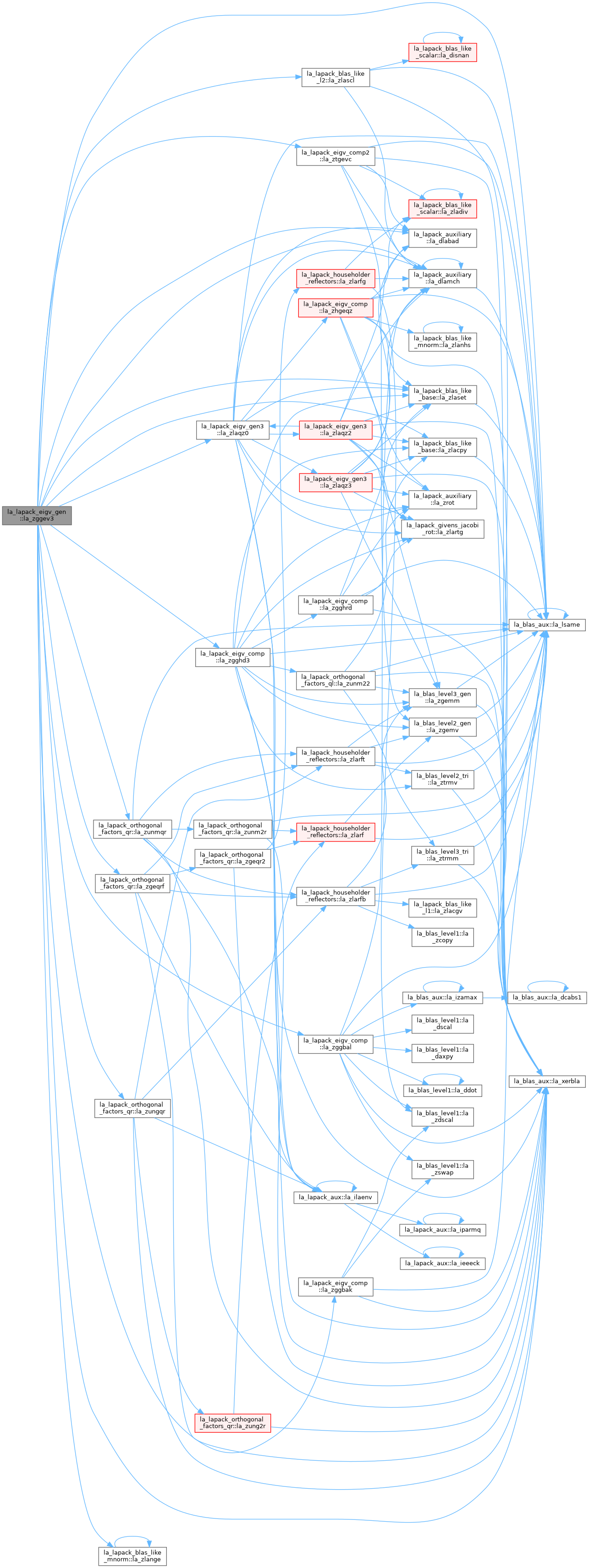
◆ la_zggevx()
| subroutine, public la_lapack_eigv_gen::la_zggevx | ( | character, intent(in) | balanc, |
| character, intent(in) | jobvl, | ||
| character, intent(in) | jobvr, | ||
| character, intent(in) | sense, | ||
| integer(ilp), intent(in) | n, | ||
| complex(dp), dimension(lda,*), intent(inout) | a, | ||
| integer(ilp), intent(in) | lda, | ||
| complex(dp), dimension(ldb,*), intent(inout) | b, | ||
| integer(ilp), intent(in) | ldb, | ||
| complex(dp), dimension(*), intent(out) | alpha, | ||
| complex(dp), dimension(*), intent(out) | beta, | ||
| complex(dp), dimension(ldvl,*), intent(out) | vl, | ||
| integer(ilp), intent(in) | ldvl, | ||
| complex(dp), dimension(ldvr,*), intent(out) | vr, | ||
| integer(ilp), intent(in) | ldvr, | ||
| integer(ilp), intent(out) | ilo, | ||
| integer(ilp), intent(out) | ihi, | ||
| real(dp), dimension(*), intent(out) | lscale, | ||
| real(dp), dimension(*), intent(out) | rscale, | ||
| real(dp), intent(out) | abnrm, | ||
| real(dp), intent(out) | bbnrm, | ||
| real(dp), dimension(*), intent(out) | rconde, | ||
| real(dp), dimension(*), intent(out) | rcondv, | ||
| complex(dp), dimension(*), intent(out) | work, | ||
| integer(ilp), intent(in) | lwork, | ||
| real(dp), dimension(*), intent(out) | rwork, | ||
| integer(ilp), dimension(*), intent(out) | iwork, | ||
| logical(lk), dimension(*), intent(out) | bwork, | ||
| integer(ilp), intent(out) | info ) |
ZGGEVX: computes for a pair of N-by-N complex nonsymmetric matrices (A,B) the generalized eigenvalues, and optionally, the left and/or right generalized eigenvectors. Optionally, it also computes a balancing transformation to improve the conditioning of the eigenvalues and eigenvectors (ILO, IHI, LSCALE, RSCALE, ABNRM, and BBNRM), reciprocal condition numbers for the eigenvalues (RCONDE), and reciprocal condition numbers for the right eigenvectors (RCONDV). A generalized eigenvalue for a pair of matrices (A,B) is a scalar lambda or a ratio alpha/beta = lambda, such that A - lambda*B is singular. It is usually represented as the pair (alpha,beta), as there is a reasonable interpretation for beta=0, and even for both being zero. The right eigenvector v(j) corresponding to the eigenvalue lambda(j) of (A,B) satisfies A * v(j) = lambda(j) * B * v(j) . The left eigenvector u(j) corresponding to the eigenvalue lambda(j) of (A,B) satisfies u(j)**H * A = lambda(j) * u(j)**H * B. where u(j)**H is the conjugate-transpose of u(j).