Least-squares drivers: QR, complete orthogonal, SVD and divide-and-conquer solutions. More...
Functions/Subroutines | |
| subroutine, public | la_sgels (trans, m, n, nrhs, a, lda, b, ldb, work, lwork, info) |
| SGELS: solves overdetermined or underdetermined real linear systems involving an M-by-N matrix A, or its transpose, using a QR or LQ factorization of A. It is assumed that A has full rank. The following options are provided: | |
| subroutine, public | la_dgels (trans, m, n, nrhs, a, lda, b, ldb, work, lwork, info) |
| DGELS: solves overdetermined or underdetermined real linear systems involving an M-by-N matrix A, or its transpose, using a QR or LQ factorization of A. It is assumed that A has full rank. The following options are provided: | |
| subroutine, public | la_qgels (trans, m, n, nrhs, a, lda, b, ldb, work, lwork, info) |
| QGELS: solves overdetermined or underdetermined real linear systems involving an M-by-N matrix A, or its transpose, using a QR or LQ factorization of A. It is assumed that A has full rank. The following options are provided: | |
| subroutine, public | la_sgelsy (m, n, nrhs, a, lda, b, ldb, jpvt, rcond, rank, work, lwork, info) |
| SGELSY: computes the minimum-norm solution to a real linear least squares problem: minimize || A * X - B || using a complete orthogonal factorization of A. A is an M-by-N matrix which may be rank-deficient. Several right hand side vectors b and solution vectors x can be handled in a single call; they are stored as the columns of the M-by-NRHS right hand side matrix B and the N-by-NRHS solution matrix X. The routine first computes a QR factorization with column pivoting: A * P = Q * [ R11 R12 ] [ 0 R22 ] with R11 defined as the largest leading submatrix whose estimated condition number is less than 1/RCOND. The order of R11, RANK, is the effective rank of A. Then, R22 is considered to be negligible, and R12 is annihilated by orthogonal transformations from the right, arriving at the complete orthogonal factorization: A * P = Q * [ T11 0 ] * Z [ 0 0 ] The minimum-norm solution is then X = P * Z**T [ inv(T11)*Q1**T*B ] [ 0 ] where Q1 consists of the first RANK columns of Q. This routine is basically identical to the original xGELSX except three differences: o The call to the subroutine xGEQPF has been substituted by the the call to the subroutine xGEQP3. This subroutine is a Blas-3 version of the QR factorization with column pivoting. o Matrix B (the right hand side) is updated with Blas-3. o The permutation of matrix B (the right hand side) is faster and more simple. | |
| subroutine, public | la_dgelsy (m, n, nrhs, a, lda, b, ldb, jpvt, rcond, rank, work, lwork, info) |
| DGELSY: computes the minimum-norm solution to a real linear least squares problem: minimize || A * X - B || using a complete orthogonal factorization of A. A is an M-by-N matrix which may be rank-deficient. Several right hand side vectors b and solution vectors x can be handled in a single call; they are stored as the columns of the M-by-NRHS right hand side matrix B and the N-by-NRHS solution matrix X. The routine first computes a QR factorization with column pivoting: A * P = Q * [ R11 R12 ] [ 0 R22 ] with R11 defined as the largest leading submatrix whose estimated condition number is less than 1/RCOND. The order of R11, RANK, is the effective rank of A. Then, R22 is considered to be negligible, and R12 is annihilated by orthogonal transformations from the right, arriving at the complete orthogonal factorization: A * P = Q * [ T11 0 ] * Z [ 0 0 ] The minimum-norm solution is then X = P * Z**T [ inv(T11)*Q1**T*B ] [ 0 ] where Q1 consists of the first RANK columns of Q. This routine is basically identical to the original xGELSX except three differences: o The call to the subroutine xGEQPF has been substituted by the the call to the subroutine xGEQP3. This subroutine is a Blas-3 version of the QR factorization with column pivoting. o Matrix B (the right hand side) is updated with Blas-3. o The permutation of matrix B (the right hand side) is faster and more simple. | |
| subroutine, public | la_qgelsy (m, n, nrhs, a, lda, b, ldb, jpvt, rcond, rank, work, lwork, info) |
| QGELSY: computes the minimum-norm solution to a real linear least squares problem: minimize || A * X - B || using a complete orthogonal factorization of A. A is an M-by-N matrix which may be rank-deficient. Several right hand side vectors b and solution vectors x can be handled in a single call; they are stored as the columns of the M-by-NRHS right hand side matrix B and the N-by-NRHS solution matrix X. The routine first computes a QR factorization with column pivoting: A * P = Q * [ R11 R12 ] [ 0 R22 ] with R11 defined as the largest leading submatrix whose estimated condition number is less than 1/RCOND. The order of R11, RANK, is the effective rank of A. Then, R22 is considered to be negligible, and R12 is annihilated by orthogonal transformations from the right, arriving at the complete orthogonal factorization: A * P = Q * [ T11 0 ] * Z [ 0 0 ] The minimum-norm solution is then X = P * Z**T [ inv(T11)*Q1**T*B ] [ 0 ] where Q1 consists of the first RANK columns of Q. This routine is basically identical to the original xGELSX except three differences: o The call to the subroutine xGEQPF has been substituted by the the call to the subroutine xGEQP3. This subroutine is a Blas-3 version of the QR factorization with column pivoting. o Matrix B (the right hand side) is updated with Blas-3. o The permutation of matrix B (the right hand side) is faster and more simple. | |
| subroutine, public | la_sgetsls (trans, m, n, nrhs, a, lda, b, ldb, work, lwork, info) |
| SGETSLS: solves overdetermined or underdetermined real linear systems involving an M-by-N matrix A, using a tall skinny QR or short wide LQ factorization of A. It is assumed that A has full rank. The following options are provided: | |
| subroutine, public | la_dgetsls (trans, m, n, nrhs, a, lda, b, ldb, work, lwork, info) |
| DGETSLS: solves overdetermined or underdetermined real linear systems involving an M-by-N matrix A, using a tall skinny QR or short wide LQ factorization of A. It is assumed that A has full rank. The following options are provided: | |
| subroutine, public | la_qgetsls (trans, m, n, nrhs, a, lda, b, ldb, work, lwork, info) |
| QGETSLS: solves overdetermined or underdetermined real linear systems involving an M-by-N matrix A, using a tall skinny QR or short wide LQ factorization of A. It is assumed that A has full rank. The following options are provided: | |
| subroutine, public | la_sgelsd (m, n, nrhs, a, lda, b, ldb, s, rcond, rank, work, lwork, iwork, info) |
| SGELSD: computes the minimum-norm solution to a real linear least squares problem: minimize 2-norm(| b - A*x |) using the singular value decomposition (SVD) of A. A is an M-by-N matrix which may be rank-deficient. Several right hand side vectors b and solution vectors x can be handled in a single call; they are stored as the columns of the M-by-NRHS right hand side matrix B and the N-by-NRHS solution matrix X. The problem is solved in three steps: (1) Reduce the coefficient matrix A to bidiagonal form with Householder transformations, reducing the original problem into a "bidiagonal least squares problem" (BLS) (2) Solve the BLS using a divide and conquer approach. (3) Apply back all the Householder transformations to solve the original least squares problem. The effective rank of A is determined by treating as zero those singular values which are less than RCOND times the largest singular value. The divide and conquer algorithm makes very mild assumptions about floating point arithmetic. It will work on machines with a guard digit in add/subtract, or on those binary machines without guard digits which subtract like the Cray X-MP, Cray Y-MP, Cray C-90, or Cray-2. It could conceivably fail on hexadecimal or decimal machines without guard digits, but we know of none. | |
| subroutine, public | la_dgelsd (m, n, nrhs, a, lda, b, ldb, s, rcond, rank, work, lwork, iwork, info) |
| DGELSD: computes the minimum-norm solution to a real linear least squares problem: minimize 2-norm(| b - A*x |) using the singular value decomposition (SVD) of A. A is an M-by-N matrix which may be rank-deficient. Several right hand side vectors b and solution vectors x can be handled in a single call; they are stored as the columns of the M-by-NRHS right hand side matrix B and the N-by-NRHS solution matrix X. The problem is solved in three steps: (1) Reduce the coefficient matrix A to bidiagonal form with Householder transformations, reducing the original problem into a "bidiagonal least squares problem" (BLS) (2) Solve the BLS using a divide and conquer approach. (3) Apply back all the Householder transformations to solve the original least squares problem. The effective rank of A is determined by treating as zero those singular values which are less than RCOND times the largest singular value. The divide and conquer algorithm makes very mild assumptions about floating point arithmetic. It will work on machines with a guard digit in add/subtract, or on those binary machines without guard digits which subtract like the Cray X-MP, Cray Y-MP, Cray C-90, or Cray-2. It could conceivably fail on hexadecimal or decimal machines without guard digits, but we know of none. | |
| subroutine, public | la_qgelsd (m, n, nrhs, a, lda, b, ldb, s, rcond, rank, work, lwork, iwork, info) |
| QGELSD: computes the minimum-norm solution to a real linear least squares problem: minimize 2-norm(| b - A*x |) using the singular value decomposition (SVD) of A. A is an M-by-N matrix which may be rank-deficient. Several right hand side vectors b and solution vectors x can be handled in a single call; they are stored as the columns of the M-by-NRHS right hand side matrix B and the N-by-NRHS solution matrix X. The problem is solved in three steps: (1) Reduce the coefficient matrix A to bidiagonal form with Householder transformations, reducing the original problem into a "bidiagonal least squares problem" (BLS) (2) Solve the BLS using a divide and conquer approach. (3) Apply back all the Householder transformations to solve the original least squares problem. The effective rank of A is determined by treating as zero those singular values which are less than RCOND times the largest singular value. The divide and conquer algorithm makes very mild assumptions about floating point arithmetic. It will work on machines with a guard digit in add/subtract, or on those binary machines without guard digits which subtract like the Cray X-MP, Cray Y-MP, Cray C-90, or Cray-2. It could conceivably fail on hexadecimal or decimal machines without guard digits, but we know of none. | |
| subroutine, public | la_sgelss (m, n, nrhs, a, lda, b, ldb, s, rcond, rank, work, lwork, info) |
| SGELSS: computes the minimum norm solution to a real linear least squares problem: Minimize 2-norm(| b - A*x |). using the singular value decomposition (SVD) of A. A is an M-by-N matrix which may be rank-deficient. Several right hand side vectors b and solution vectors x can be handled in a single call; they are stored as the columns of the M-by-NRHS right hand side matrix B and the N-by-NRHS solution matrix X. The effective rank of A is determined by treating as zero those singular values which are less than RCOND times the largest singular value. | |
| subroutine, public | la_dgelss (m, n, nrhs, a, lda, b, ldb, s, rcond, rank, work, lwork, info) |
| DGELSS: computes the minimum norm solution to a real linear least squares problem: Minimize 2-norm(| b - A*x |). using the singular value decomposition (SVD) of A. A is an M-by-N matrix which may be rank-deficient. Several right hand side vectors b and solution vectors x can be handled in a single call; they are stored as the columns of the M-by-NRHS right hand side matrix B and the N-by-NRHS solution matrix X. The effective rank of A is determined by treating as zero those singular values which are less than RCOND times the largest singular value. | |
| subroutine, public | la_qgelss (m, n, nrhs, a, lda, b, ldb, s, rcond, rank, work, lwork, info) |
| QGELSS: computes the minimum norm solution to a real linear least squares problem: Minimize 2-norm(| b - A*x |). using the singular value decomposition (SVD) of A. A is an M-by-N matrix which may be rank-deficient. Several right hand side vectors b and solution vectors x can be handled in a single call; they are stored as the columns of the M-by-NRHS right hand side matrix B and the N-by-NRHS solution matrix X. The effective rank of A is determined by treating as zero those singular values which are less than RCOND times the largest singular value. | |
| subroutine, public | la_cgels (trans, m, n, nrhs, a, lda, b, ldb, work, lwork, info) |
| CGELS: solves overdetermined or underdetermined complex linear systems involving an M-by-N matrix A, or its conjugate-transpose, using a QR or LQ factorization of A. It is assumed that A has full rank. The following options are provided: | |
| subroutine, public | la_zgels (trans, m, n, nrhs, a, lda, b, ldb, work, lwork, info) |
| ZGELS: solves overdetermined or underdetermined complex linear systems involving an M-by-N matrix A, or its conjugate-transpose, using a QR or LQ factorization of A. It is assumed that A has full rank. The following options are provided: | |
| subroutine, public | la_wgels (trans, m, n, nrhs, a, lda, b, ldb, work, lwork, info) |
| WGELS: solves overdetermined or underdetermined complex linear systems involving an M-by-N matrix A, or its conjugate-transpose, using a QR or LQ factorization of A. It is assumed that A has full rank. The following options are provided: | |
| subroutine, public | la_cgelsd (m, n, nrhs, a, lda, b, ldb, s, rcond, rank, work, lwork, rwork, iwork, info) |
| CGELSD: computes the minimum-norm solution to a real linear least squares problem: minimize 2-norm(| b - A*x |) using the singular value decomposition (SVD) of A. A is an M-by-N matrix which may be rank-deficient. Several right hand side vectors b and solution vectors x can be handled in a single call; they are stored as the columns of the M-by-NRHS right hand side matrix B and the N-by-NRHS solution matrix X. The problem is solved in three steps: (1) Reduce the coefficient matrix A to bidiagonal form with Householder transformations, reducing the original problem into a "bidiagonal least squares problem" (BLS) (2) Solve the BLS using a divide and conquer approach. (3) Apply back all the Householder transformations to solve the original least squares problem. The effective rank of A is determined by treating as zero those singular values which are less than RCOND times the largest singular value. The divide and conquer algorithm makes very mild assumptions about floating point arithmetic. It will work on machines with a guard digit in add/subtract, or on those binary machines without guard digits which subtract like the Cray X-MP, Cray Y-MP, Cray C-90, or Cray-2. It could conceivably fail on hexadecimal or decimal machines without guard digits, but we know of none. | |
| subroutine, public | la_zgelsd (m, n, nrhs, a, lda, b, ldb, s, rcond, rank, work, lwork, rwork, iwork, info) |
| ZGELSD: computes the minimum-norm solution to a real linear least squares problem: minimize 2-norm(| b - A*x |) using the singular value decomposition (SVD) of A. A is an M-by-N matrix which may be rank-deficient. Several right hand side vectors b and solution vectors x can be handled in a single call; they are stored as the columns of the M-by-NRHS right hand side matrix B and the N-by-NRHS solution matrix X. The problem is solved in three steps: (1) Reduce the coefficient matrix A to bidiagonal form with Householder transformations, reducing the original problem into a "bidiagonal least squares problem" (BLS) (2) Solve the BLS using a divide and conquer approach. (3) Apply back all the Householder transformations to solve the original least squares problem. The effective rank of A is determined by treating as zero those singular values which are less than RCOND times the largest singular value. The divide and conquer algorithm makes very mild assumptions about floating point arithmetic. It will work on machines with a guard digit in add/subtract, or on those binary machines without guard digits which subtract like the Cray X-MP, Cray Y-MP, Cray C-90, or Cray-2. It could conceivably fail on hexadecimal or decimal machines without guard digits, but we know of none. | |
| subroutine, public | la_wgelsd (m, n, nrhs, a, lda, b, ldb, s, rcond, rank, work, lwork, rwork, iwork, info) |
| WGELSD: computes the minimum-norm solution to a real linear least squares problem: minimize 2-norm(| b - A*x |) using the singular value decomposition (SVD) of A. A is an M-by-N matrix which may be rank-deficient. Several right hand side vectors b and solution vectors x can be handled in a single call; they are stored as the columns of the M-by-NRHS right hand side matrix B and the N-by-NRHS solution matrix X. The problem is solved in three steps: (1) Reduce the coefficient matrix A to bidiagonal form with Householder transformations, reducing the original problem into a "bidiagonal least squares problem" (BLS) (2) Solve the BLS using a divide and conquer approach. (3) Apply back all the Householder transformations to solve the original least squares problem. The effective rank of A is determined by treating as zero those singular values which are less than RCOND times the largest singular value. The divide and conquer algorithm makes very mild assumptions about floating point arithmetic. It will work on machines with a guard digit in add/subtract, or on those binary machines without guard digits which subtract like the Cray X-MP, Cray Y-MP, Cray C-90, or Cray-2. It could conceivably fail on hexadecimal or decimal machines without guard digits, but we know of none. | |
| subroutine, public | la_cgelss (m, n, nrhs, a, lda, b, ldb, s, rcond, rank, work, lwork, rwork, info) |
| CGELSS: computes the minimum norm solution to a complex linear least squares problem: Minimize 2-norm(| b - A*x |). using the singular value decomposition (SVD) of A. A is an M-by-N matrix which may be rank-deficient. Several right hand side vectors b and solution vectors x can be handled in a single call; they are stored as the columns of the M-by-NRHS right hand side matrix B and the N-by-NRHS solution matrix X. The effective rank of A is determined by treating as zero those singular values which are less than RCOND times the largest singular value. | |
| subroutine, public | la_zgelss (m, n, nrhs, a, lda, b, ldb, s, rcond, rank, work, lwork, rwork, info) |
| ZGELSS: computes the minimum norm solution to a complex linear least squares problem: Minimize 2-norm(| b - A*x |). using the singular value decomposition (SVD) of A. A is an M-by-N matrix which may be rank-deficient. Several right hand side vectors b and solution vectors x can be handled in a single call; they are stored as the columns of the M-by-NRHS right hand side matrix B and the N-by-NRHS solution matrix X. The effective rank of A is determined by treating as zero those singular values which are less than RCOND times the largest singular value. | |
| subroutine, public | la_wgelss (m, n, nrhs, a, lda, b, ldb, s, rcond, rank, work, lwork, rwork, info) |
| WGELSS: computes the minimum norm solution to a complex linear least squares problem: Minimize 2-norm(| b - A*x |). using the singular value decomposition (SVD) of A. A is an M-by-N matrix which may be rank-deficient. Several right hand side vectors b and solution vectors x can be handled in a single call; they are stored as the columns of the M-by-NRHS right hand side matrix B and the N-by-NRHS solution matrix X. The effective rank of A is determined by treating as zero those singular values which are less than RCOND times the largest singular value. | |
| subroutine, public | la_cgelsy (m, n, nrhs, a, lda, b, ldb, jpvt, rcond, rank, work, lwork, rwork, info) |
| CGELSY: computes the minimum-norm solution to a complex linear least squares problem: minimize || A * X - B || using a complete orthogonal factorization of A. A is an M-by-N matrix which may be rank-deficient. Several right hand side vectors b and solution vectors x can be handled in a single call; they are stored as the columns of the M-by-NRHS right hand side matrix B and the N-by-NRHS solution matrix X. The routine first computes a QR factorization with column pivoting: A * P = Q * [ R11 R12 ] [ 0 R22 ] with R11 defined as the largest leading submatrix whose estimated condition number is less than 1/RCOND. The order of R11, RANK, is the effective rank of A. Then, R22 is considered to be negligible, and R12 is annihilated by unitary transformations from the right, arriving at the complete orthogonal factorization: A * P = Q * [ T11 0 ] * Z [ 0 0 ] The minimum-norm solution is then X = P * Z**H [ inv(T11)*Q1**H*B ] [ 0 ] where Q1 consists of the first RANK columns of Q. This routine is basically identical to the original xGELSX except three differences: o The permutation of matrix B (the right hand side) is faster and more simple. o The call to the subroutine xGEQPF has been substituted by the the call to the subroutine xGEQP3. This subroutine is a Blas-3 version of the QR factorization with column pivoting. o Matrix B (the right hand side) is updated with Blas-3. | |
| subroutine, public | la_zgelsy (m, n, nrhs, a, lda, b, ldb, jpvt, rcond, rank, work, lwork, rwork, info) |
| ZGELSY: computes the minimum-norm solution to a complex linear least squares problem: minimize || A * X - B || using a complete orthogonal factorization of A. A is an M-by-N matrix which may be rank-deficient. Several right hand side vectors b and solution vectors x can be handled in a single call; they are stored as the columns of the M-by-NRHS right hand side matrix B and the N-by-NRHS solution matrix X. The routine first computes a QR factorization with column pivoting: A * P = Q * [ R11 R12 ] [ 0 R22 ] with R11 defined as the largest leading submatrix whose estimated condition number is less than 1/RCOND. The order of R11, RANK, is the effective rank of A. Then, R22 is considered to be negligible, and R12 is annihilated by unitary transformations from the right, arriving at the complete orthogonal factorization: A * P = Q * [ T11 0 ] * Z [ 0 0 ] The minimum-norm solution is then X = P * Z**H [ inv(T11)*Q1**H*B ] [ 0 ] where Q1 consists of the first RANK columns of Q. This routine is basically identical to the original xGELSX except three differences: o The permutation of matrix B (the right hand side) is faster and more simple. o The call to the subroutine xGEQPF has been substituted by the the call to the subroutine xGEQP3. This subroutine is a Blas-3 version of the QR factorization with column pivoting. o Matrix B (the right hand side) is updated with Blas-3. | |
| subroutine, public | la_wgelsy (m, n, nrhs, a, lda, b, ldb, jpvt, rcond, rank, work, lwork, rwork, info) |
| WGELSY: computes the minimum-norm solution to a complex linear least squares problem: minimize || A * X - B || using a complete orthogonal factorization of A. A is an M-by-N matrix which may be rank-deficient. Several right hand side vectors b and solution vectors x can be handled in a single call; they are stored as the columns of the M-by-NRHS right hand side matrix B and the N-by-NRHS solution matrix X. The routine first computes a QR factorization with column pivoting: A * P = Q * [ R11 R12 ] [ 0 R22 ] with R11 defined as the largest leading submatrix whose estimated condition number is less than 1/RCOND. The order of R11, RANK, is the effective rank of A. Then, R22 is considered to be negligible, and R12 is annihilated by unitary transformations from the right, arriving at the complete orthogonal factorization: A * P = Q * [ T11 0 ] * Z [ 0 0 ] The minimum-norm solution is then X = P * Z**H [ inv(T11)*Q1**H*B ] [ 0 ] where Q1 consists of the first RANK columns of Q. This routine is basically identical to the original xGELSX except three differences: o The permutation of matrix B (the right hand side) is faster and more simple. o The call to the subroutine xGEQPF has been substituted by the the call to the subroutine xGEQP3. This subroutine is a Blas-3 version of the QR factorization with column pivoting. o Matrix B (the right hand side) is updated with Blas-3. | |
| subroutine, public | la_cgetsls (trans, m, n, nrhs, a, lda, b, ldb, work, lwork, info) |
| CGETSLS: solves overdetermined or underdetermined complex linear systems involving an M-by-N matrix A, using a tall skinny QR or short wide LQ factorization of A. It is assumed that A has full rank. The following options are provided: | |
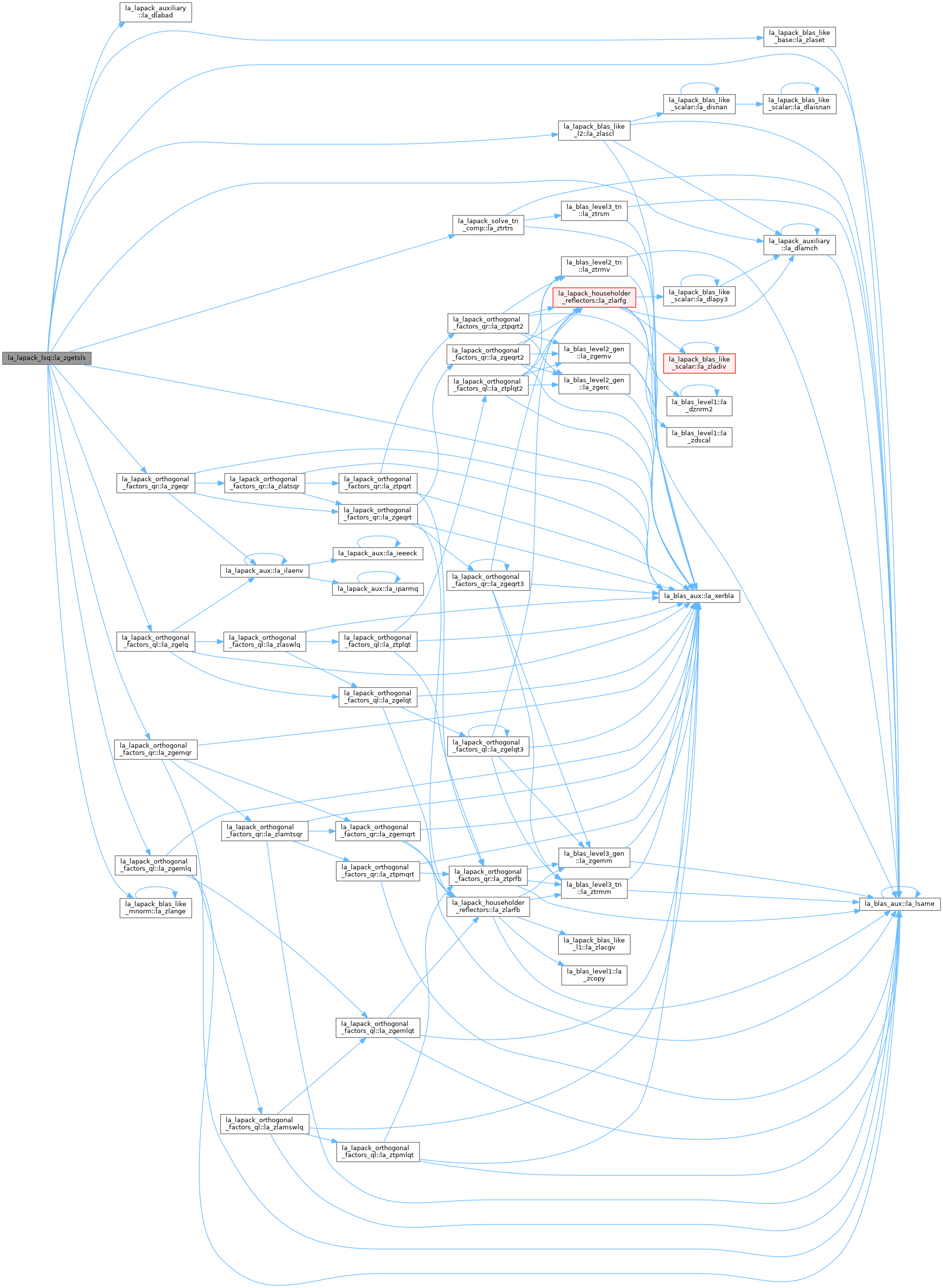
| subroutine, public | la_zgetsls (trans, m, n, nrhs, a, lda, b, ldb, work, lwork, info) |
| ZGETSLS: solves overdetermined or underdetermined complex linear systems involving an M-by-N matrix A, using a tall skinny QR or short wide LQ factorization of A. It is assumed that A has full rank. The following options are provided: | |
| subroutine, public | la_wgetsls (trans, m, n, nrhs, a, lda, b, ldb, work, lwork, info) |
| WGETSLS: solves overdetermined or underdetermined complex linear systems involving an M-by-N matrix A, using a tall skinny QR or short wide LQ factorization of A. It is assumed that A has full rank. The following options are provided: | |
Detailed Description
Least-squares drivers: QR, complete orthogonal, SVD and divide-and-conquer solutions.
Function/Subroutine Documentation
◆ la_cgels()
| subroutine, public la_lapack_lsq::la_cgels | ( | character, intent(in) | trans, |
| integer(ilp), intent(in) | m, | ||
| integer(ilp), intent(in) | n, | ||
| integer(ilp), intent(in) | nrhs, | ||
| complex(sp), dimension(lda,*), intent(inout) | a, | ||
| integer(ilp), intent(in) | lda, | ||
| complex(sp), dimension(ldb,*), intent(inout) | b, | ||
| integer(ilp), intent(in) | ldb, | ||
| complex(sp), dimension(*), intent(out) | work, | ||
| integer(ilp), intent(in) | lwork, | ||
| integer(ilp), intent(out) | info ) |
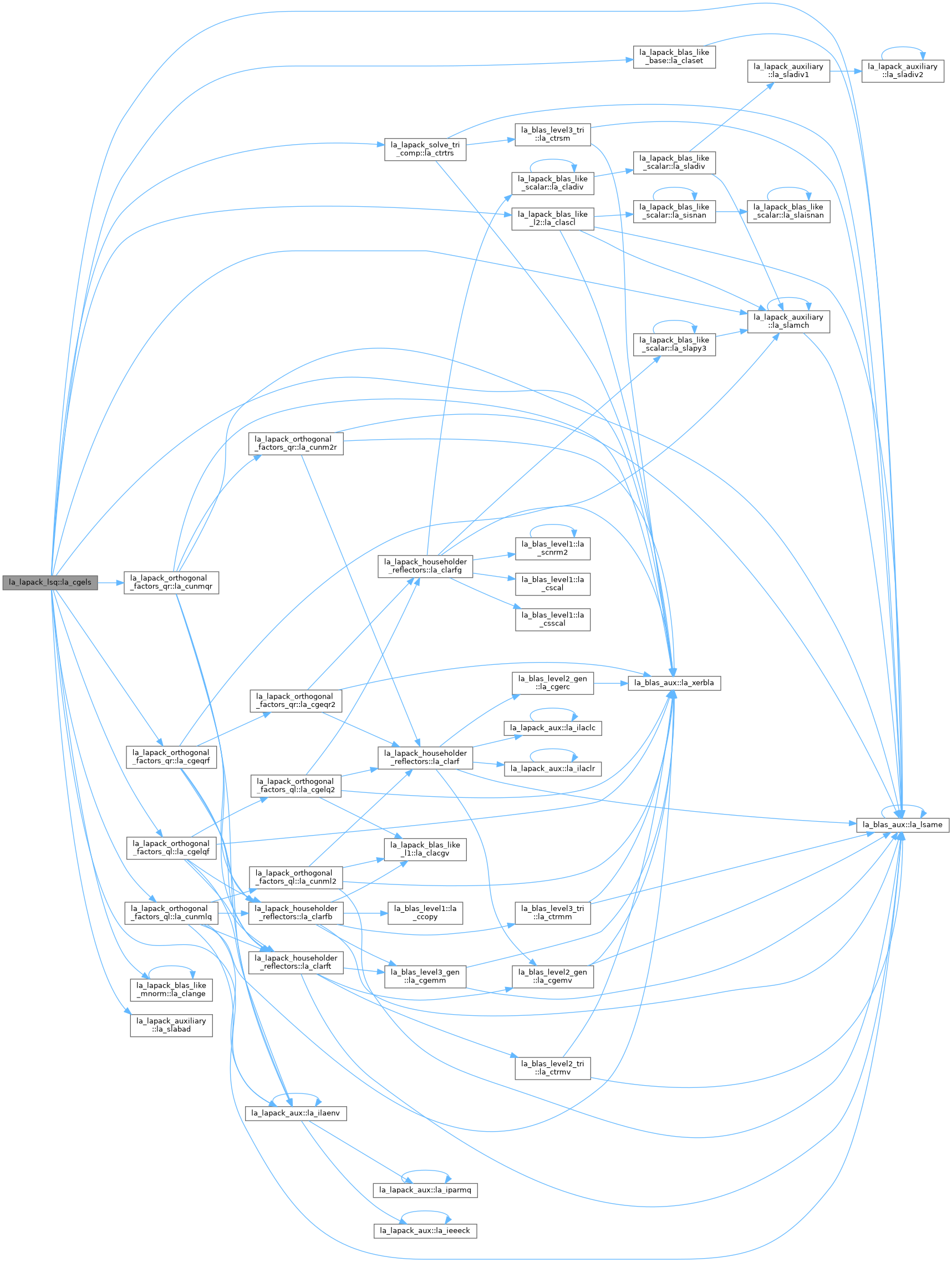
CGELS: solves overdetermined or underdetermined complex linear systems involving an M-by-N matrix A, or its conjugate-transpose, using a QR or LQ factorization of A. It is assumed that A has full rank. The following options are provided:
- If TRANS = 'N' and m >= n: find the least squares solution of an overdetermined system, i.e., solve the least squares problem minimize || B - A*X ||.
- If TRANS = 'N' and m < n: find the minimum norm solution of an underdetermined system A * X = B.
- If TRANS = 'C' and m >= n: find the minimum norm solution of an underdetermined system A**H * X = B.
- If TRANS = 'C' and m < n: find the least squares solution of an overdetermined system, i.e., solve the least squares problem minimize || B - A**H * X ||. Several right hand side vectors b and solution vectors x can be handled in a single call; they are stored as the columns of the M-by-NRHS right hand side matrix B and the N-by-NRHS solution matrix X.
◆ la_cgelsd()
| subroutine, public la_lapack_lsq::la_cgelsd | ( | integer(ilp), intent(in) | m, |
| integer(ilp), intent(in) | n, | ||
| integer(ilp), intent(in) | nrhs, | ||
| complex(sp), dimension(lda,*), intent(inout) | a, | ||
| integer(ilp), intent(in) | lda, | ||
| complex(sp), dimension(ldb,*), intent(inout) | b, | ||
| integer(ilp), intent(in) | ldb, | ||
| real(sp), dimension(*), intent(out) | s, | ||
| real(sp), intent(in) | rcond, | ||
| integer(ilp), intent(out) | rank, | ||
| complex(sp), dimension(*), intent(out) | work, | ||
| integer(ilp), intent(in) | lwork, | ||
| real(sp), dimension(*), intent(out) | rwork, | ||
| integer(ilp), dimension(*), intent(out) | iwork, | ||
| integer(ilp), intent(out) | info ) |
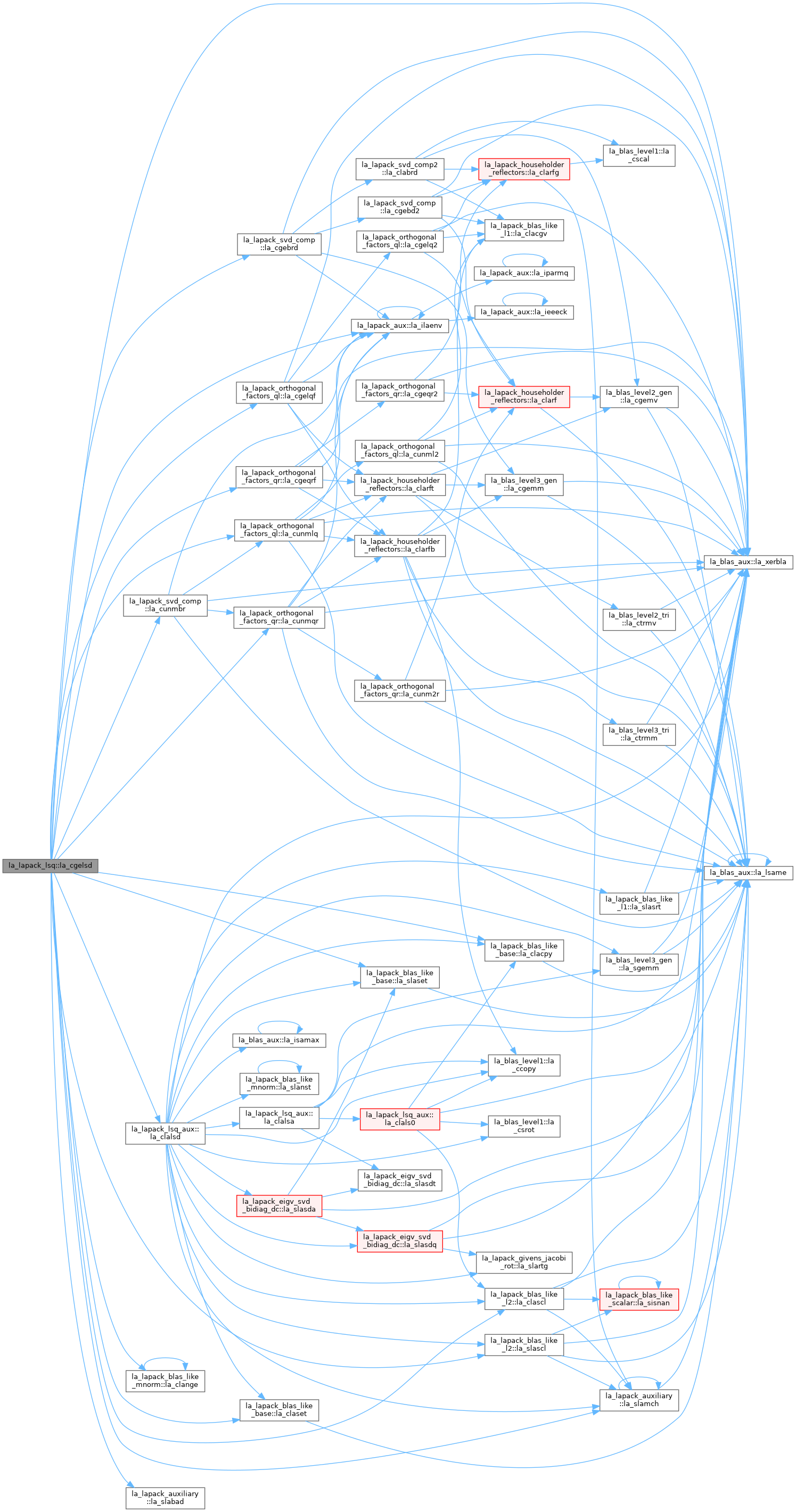
CGELSD: computes the minimum-norm solution to a real linear least squares problem: minimize 2-norm(| b - A*x |) using the singular value decomposition (SVD) of A. A is an M-by-N matrix which may be rank-deficient. Several right hand side vectors b and solution vectors x can be handled in a single call; they are stored as the columns of the M-by-NRHS right hand side matrix B and the N-by-NRHS solution matrix X. The problem is solved in three steps: (1) Reduce the coefficient matrix A to bidiagonal form with Householder transformations, reducing the original problem into a "bidiagonal least squares problem" (BLS) (2) Solve the BLS using a divide and conquer approach. (3) Apply back all the Householder transformations to solve the original least squares problem. The effective rank of A is determined by treating as zero those singular values which are less than RCOND times the largest singular value. The divide and conquer algorithm makes very mild assumptions about floating point arithmetic. It will work on machines with a guard digit in add/subtract, or on those binary machines without guard digits which subtract like the Cray X-MP, Cray Y-MP, Cray C-90, or Cray-2. It could conceivably fail on hexadecimal or decimal machines without guard digits, but we know of none.
◆ la_cgelss()
| subroutine, public la_lapack_lsq::la_cgelss | ( | integer(ilp), intent(in) | m, |
| integer(ilp), intent(in) | n, | ||
| integer(ilp), intent(in) | nrhs, | ||
| complex(sp), dimension(lda,*), intent(inout) | a, | ||
| integer(ilp), intent(in) | lda, | ||
| complex(sp), dimension(ldb,*), intent(inout) | b, | ||
| integer(ilp), intent(in) | ldb, | ||
| real(sp), dimension(*), intent(out) | s, | ||
| real(sp), intent(in) | rcond, | ||
| integer(ilp), intent(out) | rank, | ||
| complex(sp), dimension(*), intent(out) | work, | ||
| integer(ilp), intent(in) | lwork, | ||
| real(sp), dimension(*), intent(out) | rwork, | ||
| integer(ilp), intent(out) | info ) |
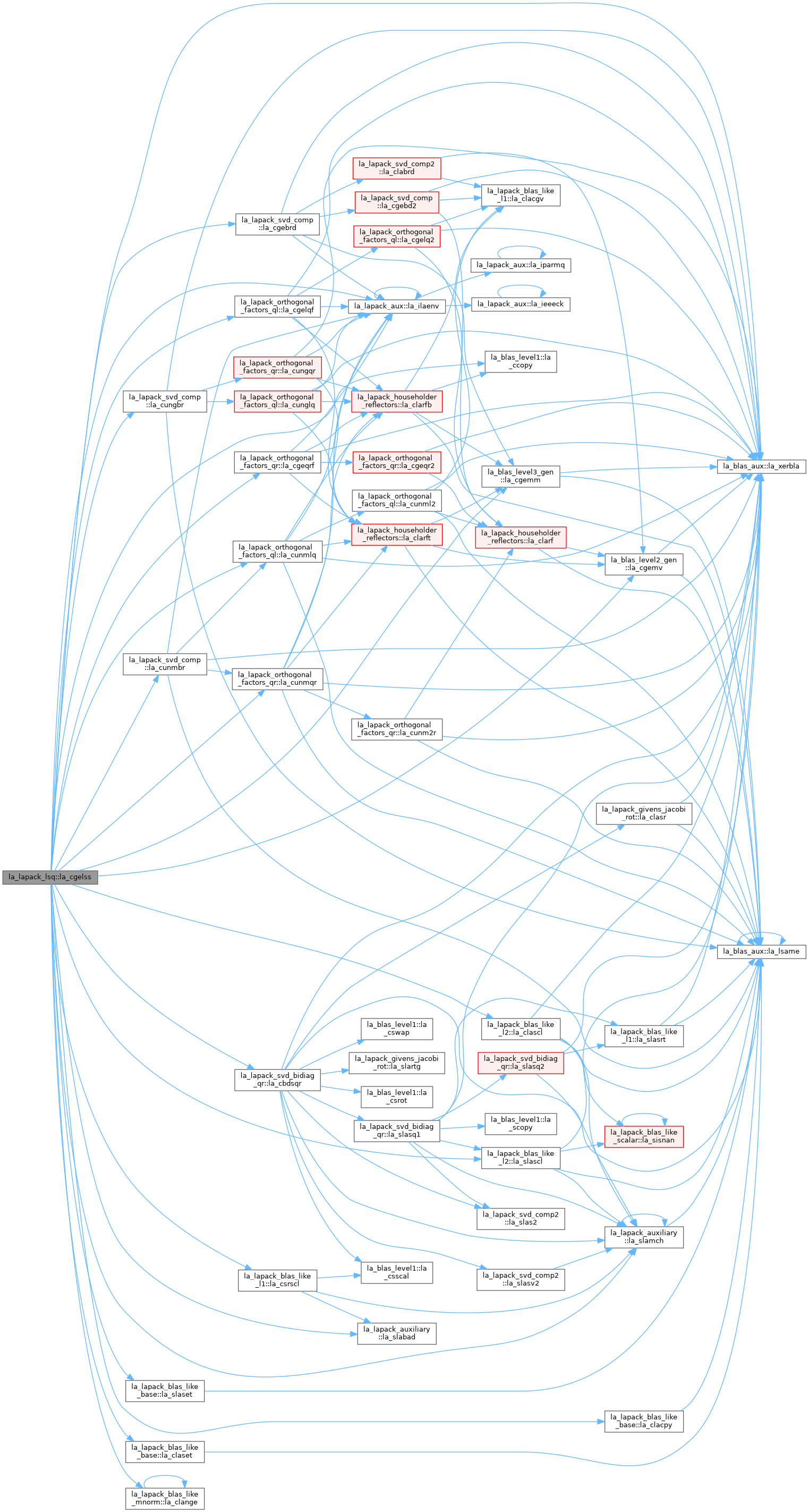
CGELSS: computes the minimum norm solution to a complex linear least squares problem: Minimize 2-norm(| b - A*x |). using the singular value decomposition (SVD) of A. A is an M-by-N matrix which may be rank-deficient. Several right hand side vectors b and solution vectors x can be handled in a single call; they are stored as the columns of the M-by-NRHS right hand side matrix B and the N-by-NRHS solution matrix X. The effective rank of A is determined by treating as zero those singular values which are less than RCOND times the largest singular value.
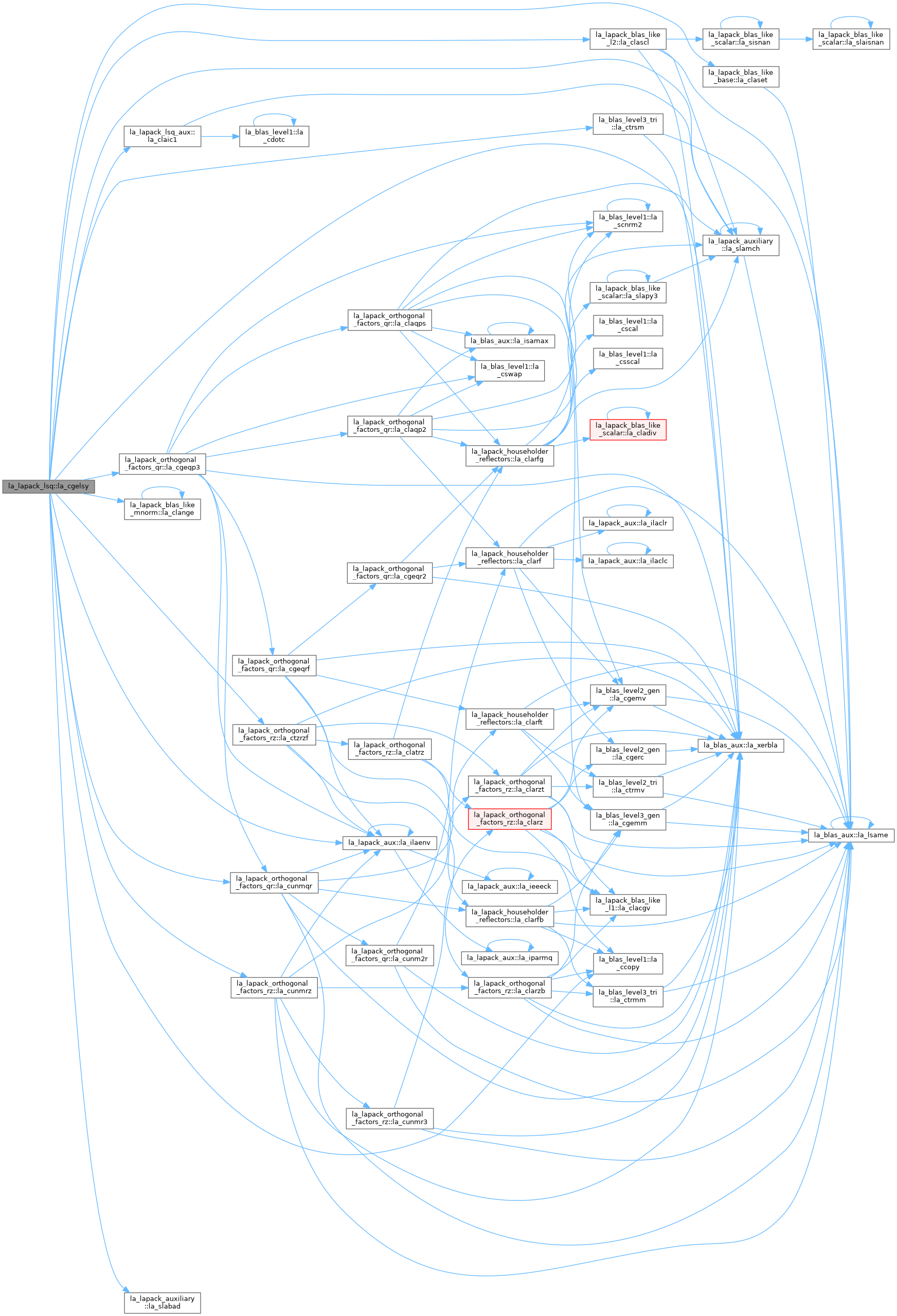
◆ la_cgelsy()
| subroutine, public la_lapack_lsq::la_cgelsy | ( | integer(ilp), intent(in) | m, |
| integer(ilp), intent(in) | n, | ||
| integer(ilp), intent(in) | nrhs, | ||
| complex(sp), dimension(lda,*), intent(inout) | a, | ||
| integer(ilp), intent(in) | lda, | ||
| complex(sp), dimension(ldb,*), intent(inout) | b, | ||
| integer(ilp), intent(in) | ldb, | ||
| integer(ilp), dimension(*), intent(inout) | jpvt, | ||
| real(sp), intent(in) | rcond, | ||
| integer(ilp), intent(out) | rank, | ||
| complex(sp), dimension(*), intent(out) | work, | ||
| integer(ilp), intent(in) | lwork, | ||
| real(sp), dimension(*), intent(out) | rwork, | ||
| integer(ilp), intent(out) | info ) |
CGELSY: computes the minimum-norm solution to a complex linear least squares problem: minimize || A * X - B || using a complete orthogonal factorization of A. A is an M-by-N matrix which may be rank-deficient. Several right hand side vectors b and solution vectors x can be handled in a single call; they are stored as the columns of the M-by-NRHS right hand side matrix B and the N-by-NRHS solution matrix X. The routine first computes a QR factorization with column pivoting: A * P = Q * [ R11 R12 ] [ 0 R22 ] with R11 defined as the largest leading submatrix whose estimated condition number is less than 1/RCOND. The order of R11, RANK, is the effective rank of A. Then, R22 is considered to be negligible, and R12 is annihilated by unitary transformations from the right, arriving at the complete orthogonal factorization: A * P = Q * [ T11 0 ] * Z [ 0 0 ] The minimum-norm solution is then X = P * Z**H [ inv(T11)*Q1**H*B ] [ 0 ] where Q1 consists of the first RANK columns of Q. This routine is basically identical to the original xGELSX except three differences: o The permutation of matrix B (the right hand side) is faster and more simple. o The call to the subroutine xGEQPF has been substituted by the the call to the subroutine xGEQP3. This subroutine is a Blas-3 version of the QR factorization with column pivoting. o Matrix B (the right hand side) is updated with Blas-3.
◆ la_cgetsls()
| subroutine, public la_lapack_lsq::la_cgetsls | ( | character, intent(in) | trans, |
| integer(ilp), intent(in) | m, | ||
| integer(ilp), intent(in) | n, | ||
| integer(ilp), intent(in) | nrhs, | ||
| complex(sp), dimension(lda,*), intent(inout) | a, | ||
| integer(ilp), intent(in) | lda, | ||
| complex(sp), dimension(ldb,*), intent(inout) | b, | ||
| integer(ilp), intent(in) | ldb, | ||
| complex(sp), dimension(*), intent(out) | work, | ||
| integer(ilp), intent(in) | lwork, | ||
| integer(ilp), intent(out) | info ) |
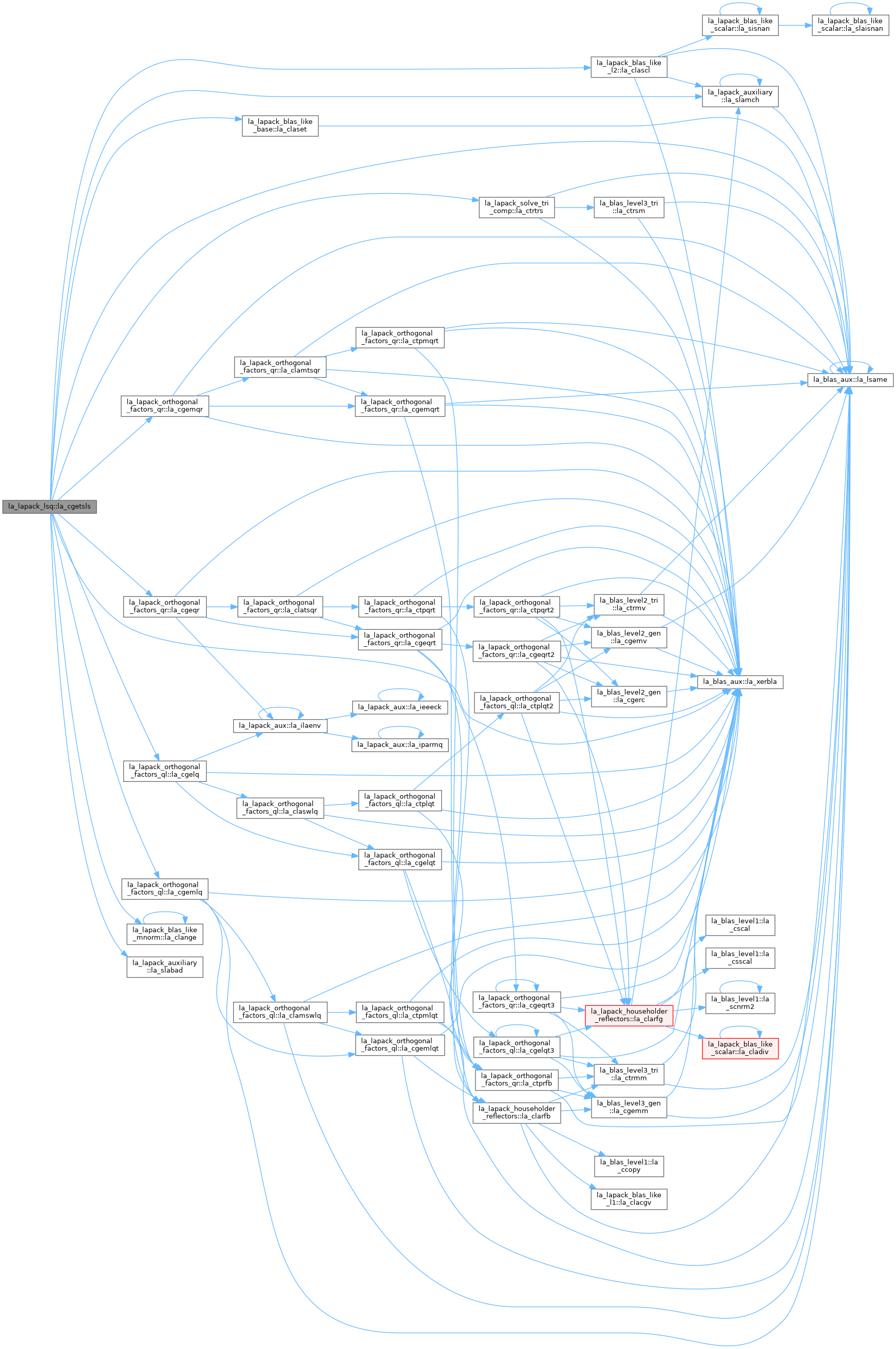
CGETSLS: solves overdetermined or underdetermined complex linear systems involving an M-by-N matrix A, using a tall skinny QR or short wide LQ factorization of A. It is assumed that A has full rank. The following options are provided:
- If TRANS = 'N' and m >= n: find the least squares solution of an overdetermined system, i.e., solve the least squares problem minimize || B - A*X ||.
- If TRANS = 'N' and m < n: find the minimum norm solution of an underdetermined system A * X = B.
- If TRANS = 'C' and m >= n: find the minimum norm solution of an undetermined system A**T * X = B.
- If TRANS = 'C' and m < n: find the least squares solution of an overdetermined system, i.e., solve the least squares problem minimize || B - A**T * X ||. Several right hand side vectors b and solution vectors x can be handled in a single call; they are stored as the columns of the M-by-NRHS right hand side matrix B and the N-by-NRHS solution matrix X.
◆ la_dgels()
| subroutine, public la_lapack_lsq::la_dgels | ( | character, intent(in) | trans, |
| integer(ilp), intent(in) | m, | ||
| integer(ilp), intent(in) | n, | ||
| integer(ilp), intent(in) | nrhs, | ||
| real(dp), dimension(lda,*), intent(inout) | a, | ||
| integer(ilp), intent(in) | lda, | ||
| real(dp), dimension(ldb,*), intent(inout) | b, | ||
| integer(ilp), intent(in) | ldb, | ||
| real(dp), dimension(*), intent(out) | work, | ||
| integer(ilp), intent(in) | lwork, | ||
| integer(ilp), intent(out) | info ) |
DGELS: solves overdetermined or underdetermined real linear systems involving an M-by-N matrix A, or its transpose, using a QR or LQ factorization of A. It is assumed that A has full rank. The following options are provided:
- If TRANS = 'N' and m >= n: find the least squares solution of an overdetermined system, i.e., solve the least squares problem minimize || B - A*X ||.
- If TRANS = 'N' and m < n: find the minimum norm solution of an underdetermined system A * X = B.
- If TRANS = 'T' and m >= n: find the minimum norm solution of an underdetermined system A**T * X = B.
- If TRANS = 'T' and m < n: find the least squares solution of an overdetermined system, i.e., solve the least squares problem minimize || B - A**T * X ||. Several right hand side vectors b and solution vectors x can be handled in a single call; they are stored as the columns of the M-by-NRHS right hand side matrix B and the N-by-NRHS solution matrix X.
◆ la_dgelsd()
| subroutine, public la_lapack_lsq::la_dgelsd | ( | integer(ilp), intent(in) | m, |
| integer(ilp), intent(in) | n, | ||
| integer(ilp), intent(in) | nrhs, | ||
| real(dp), dimension(lda,*), intent(inout) | a, | ||
| integer(ilp), intent(in) | lda, | ||
| real(dp), dimension(ldb,*), intent(inout) | b, | ||
| integer(ilp), intent(in) | ldb, | ||
| real(dp), dimension(*), intent(out) | s, | ||
| real(dp), intent(in) | rcond, | ||
| integer(ilp), intent(out) | rank, | ||
| real(dp), dimension(*), intent(out) | work, | ||
| integer(ilp), intent(in) | lwork, | ||
| integer(ilp), dimension(*), intent(out) | iwork, | ||
| integer(ilp), intent(out) | info ) |
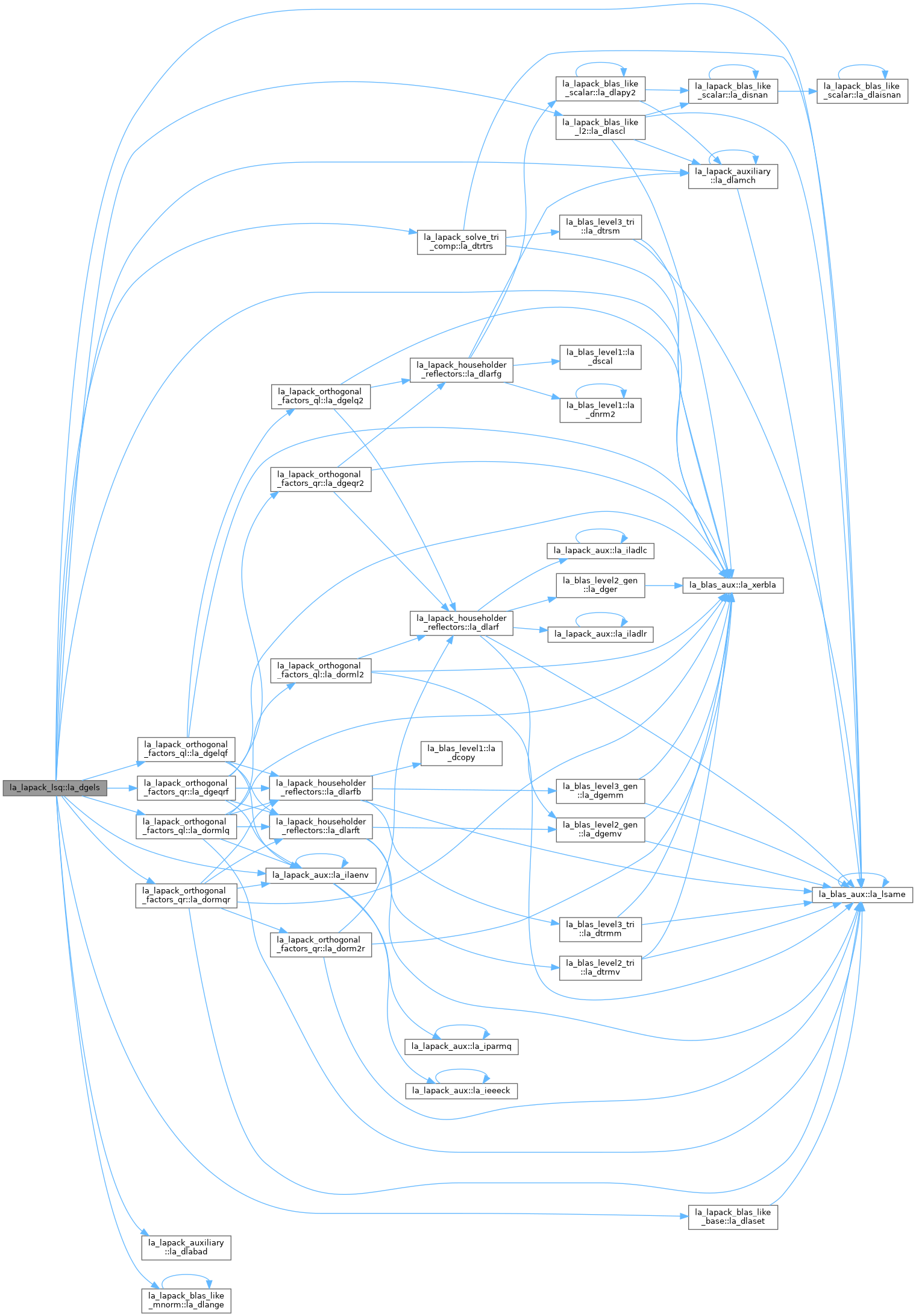
DGELSD: computes the minimum-norm solution to a real linear least squares problem: minimize 2-norm(| b - A*x |) using the singular value decomposition (SVD) of A. A is an M-by-N matrix which may be rank-deficient. Several right hand side vectors b and solution vectors x can be handled in a single call; they are stored as the columns of the M-by-NRHS right hand side matrix B and the N-by-NRHS solution matrix X. The problem is solved in three steps: (1) Reduce the coefficient matrix A to bidiagonal form with Householder transformations, reducing the original problem into a "bidiagonal least squares problem" (BLS) (2) Solve the BLS using a divide and conquer approach. (3) Apply back all the Householder transformations to solve the original least squares problem. The effective rank of A is determined by treating as zero those singular values which are less than RCOND times the largest singular value. The divide and conquer algorithm makes very mild assumptions about floating point arithmetic. It will work on machines with a guard digit in add/subtract, or on those binary machines without guard digits which subtract like the Cray X-MP, Cray Y-MP, Cray C-90, or Cray-2. It could conceivably fail on hexadecimal or decimal machines without guard digits, but we know of none.
◆ la_dgelss()
| subroutine, public la_lapack_lsq::la_dgelss | ( | integer(ilp), intent(in) | m, |
| integer(ilp), intent(in) | n, | ||
| integer(ilp), intent(in) | nrhs, | ||
| real(dp), dimension(lda,*), intent(inout) | a, | ||
| integer(ilp), intent(in) | lda, | ||
| real(dp), dimension(ldb,*), intent(inout) | b, | ||
| integer(ilp), intent(in) | ldb, | ||
| real(dp), dimension(*), intent(out) | s, | ||
| real(dp), intent(in) | rcond, | ||
| integer(ilp), intent(out) | rank, | ||
| real(dp), dimension(*), intent(out) | work, | ||
| integer(ilp), intent(in) | lwork, | ||
| integer(ilp), intent(out) | info ) |
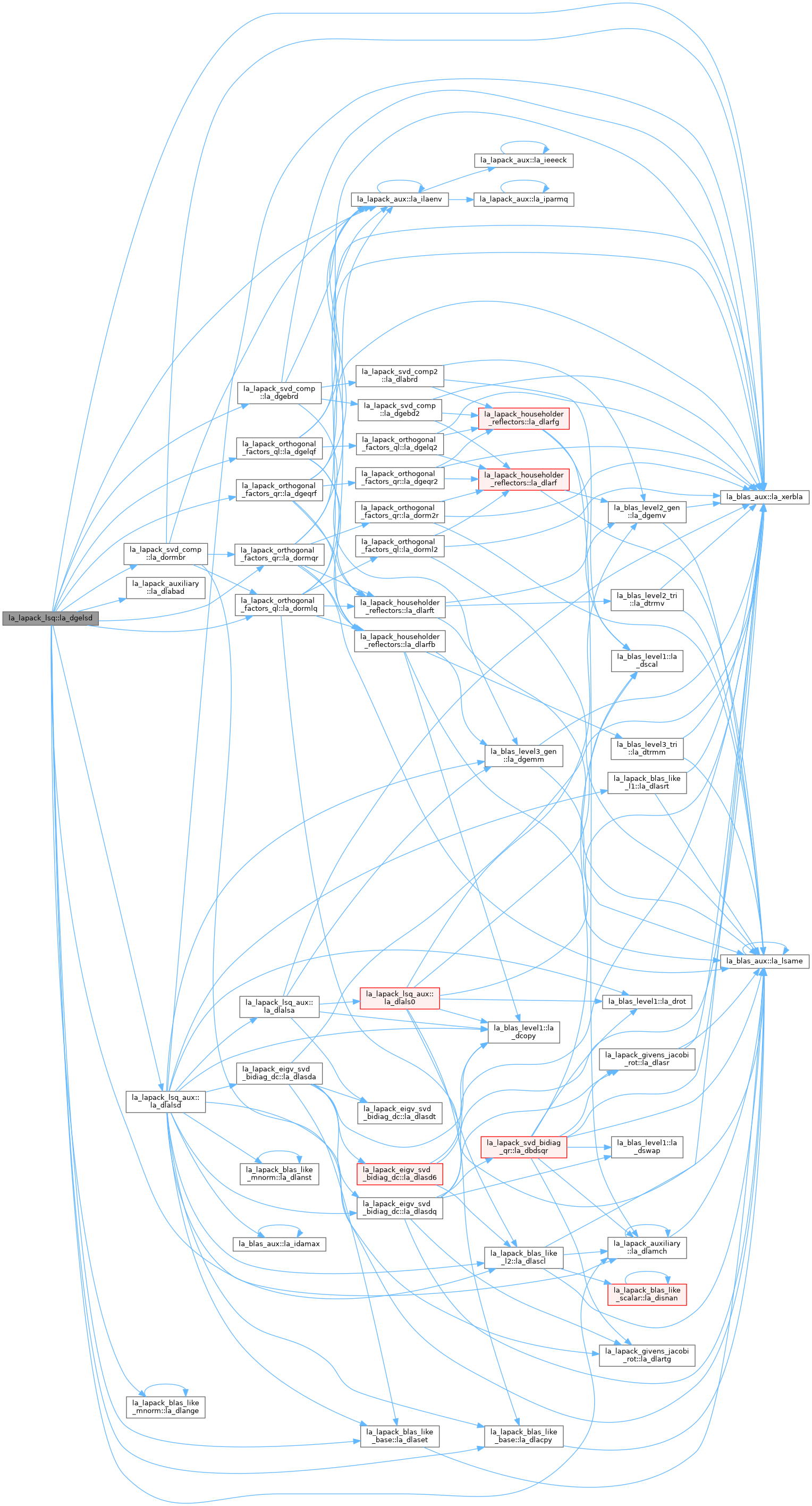
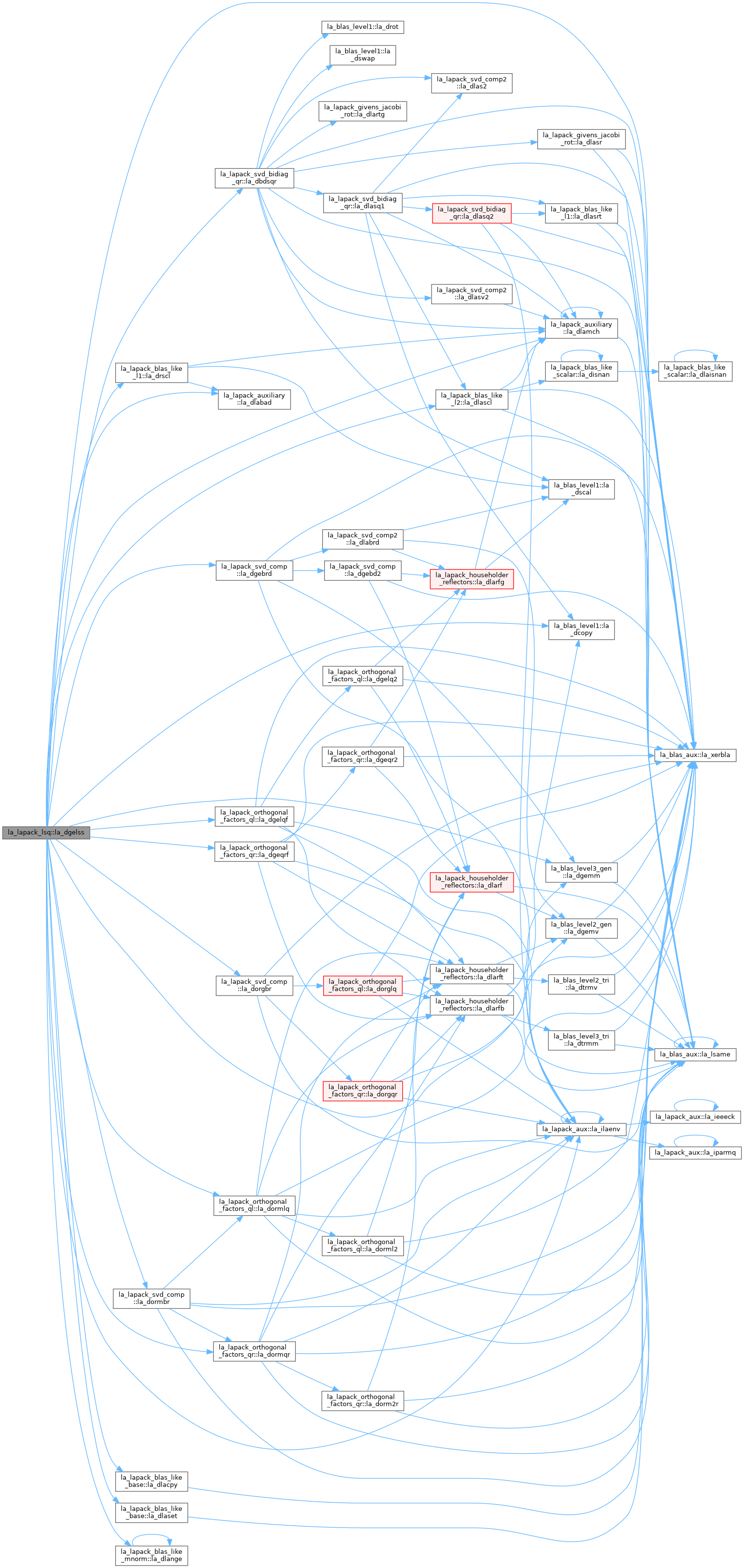
DGELSS: computes the minimum norm solution to a real linear least squares problem: Minimize 2-norm(| b - A*x |). using the singular value decomposition (SVD) of A. A is an M-by-N matrix which may be rank-deficient. Several right hand side vectors b and solution vectors x can be handled in a single call; they are stored as the columns of the M-by-NRHS right hand side matrix B and the N-by-NRHS solution matrix X. The effective rank of A is determined by treating as zero those singular values which are less than RCOND times the largest singular value.
◆ la_dgelsy()
| subroutine, public la_lapack_lsq::la_dgelsy | ( | integer(ilp), intent(in) | m, |
| integer(ilp), intent(in) | n, | ||
| integer(ilp), intent(in) | nrhs, | ||
| real(dp), dimension(lda,*), intent(inout) | a, | ||
| integer(ilp), intent(in) | lda, | ||
| real(dp), dimension(ldb,*), intent(inout) | b, | ||
| integer(ilp), intent(in) | ldb, | ||
| integer(ilp), dimension(*), intent(inout) | jpvt, | ||
| real(dp), intent(in) | rcond, | ||
| integer(ilp), intent(out) | rank, | ||
| real(dp), dimension(*), intent(out) | work, | ||
| integer(ilp), intent(in) | lwork, | ||
| integer(ilp), intent(out) | info ) |
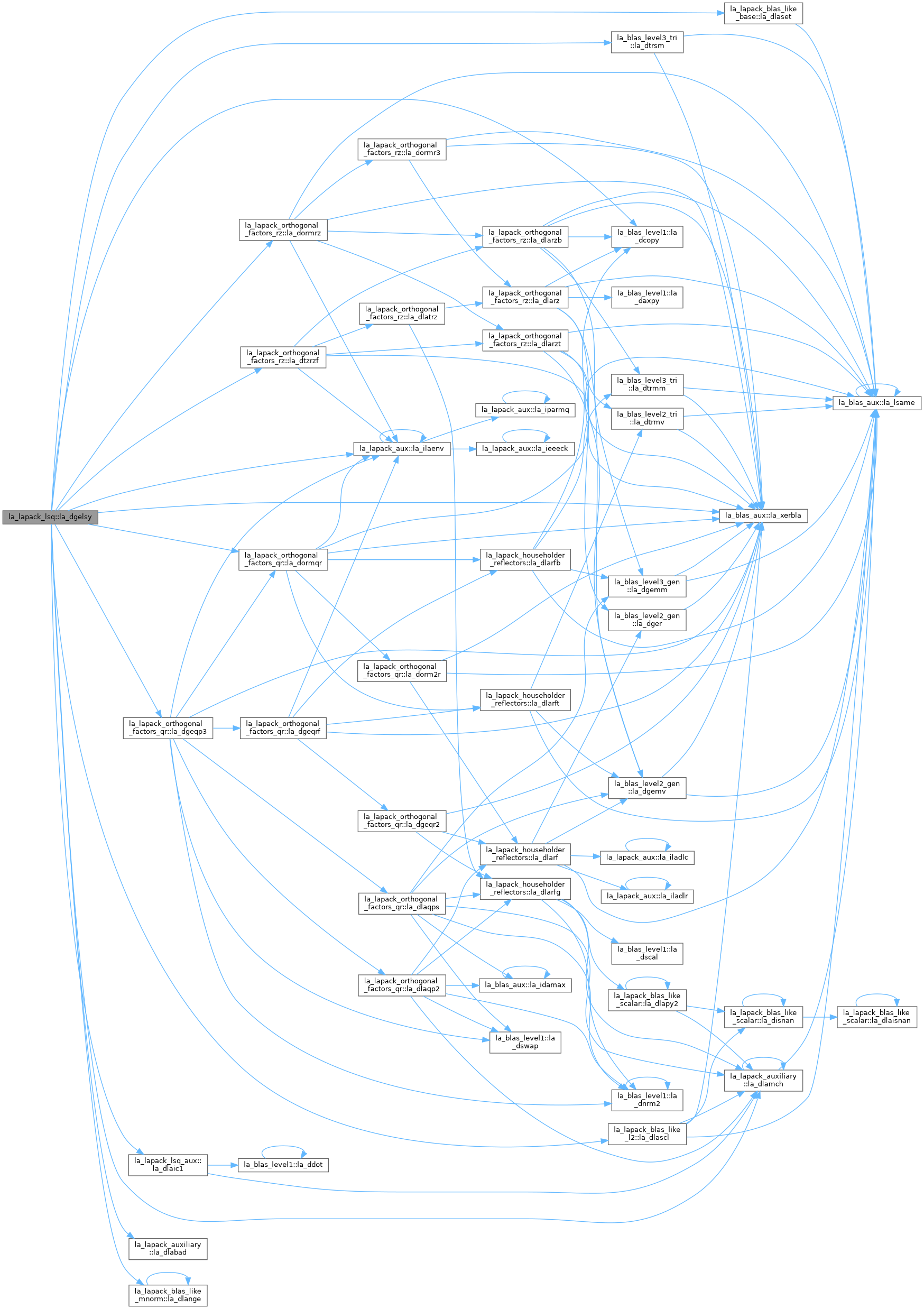
DGELSY: computes the minimum-norm solution to a real linear least squares problem: minimize || A * X - B || using a complete orthogonal factorization of A. A is an M-by-N matrix which may be rank-deficient. Several right hand side vectors b and solution vectors x can be handled in a single call; they are stored as the columns of the M-by-NRHS right hand side matrix B and the N-by-NRHS solution matrix X. The routine first computes a QR factorization with column pivoting: A * P = Q * [ R11 R12 ] [ 0 R22 ] with R11 defined as the largest leading submatrix whose estimated condition number is less than 1/RCOND. The order of R11, RANK, is the effective rank of A. Then, R22 is considered to be negligible, and R12 is annihilated by orthogonal transformations from the right, arriving at the complete orthogonal factorization: A * P = Q * [ T11 0 ] * Z [ 0 0 ] The minimum-norm solution is then X = P * Z**T [ inv(T11)*Q1**T*B ] [ 0 ] where Q1 consists of the first RANK columns of Q. This routine is basically identical to the original xGELSX except three differences: o The call to the subroutine xGEQPF has been substituted by the the call to the subroutine xGEQP3. This subroutine is a Blas-3 version of the QR factorization with column pivoting. o Matrix B (the right hand side) is updated with Blas-3. o The permutation of matrix B (the right hand side) is faster and more simple.
◆ la_dgetsls()
| subroutine, public la_lapack_lsq::la_dgetsls | ( | character, intent(in) | trans, |
| integer(ilp), intent(in) | m, | ||
| integer(ilp), intent(in) | n, | ||
| integer(ilp), intent(in) | nrhs, | ||
| real(dp), dimension(lda,*), intent(inout) | a, | ||
| integer(ilp), intent(in) | lda, | ||
| real(dp), dimension(ldb,*), intent(inout) | b, | ||
| integer(ilp), intent(in) | ldb, | ||
| real(dp), dimension(*), intent(out) | work, | ||
| integer(ilp), intent(in) | lwork, | ||
| integer(ilp), intent(out) | info ) |
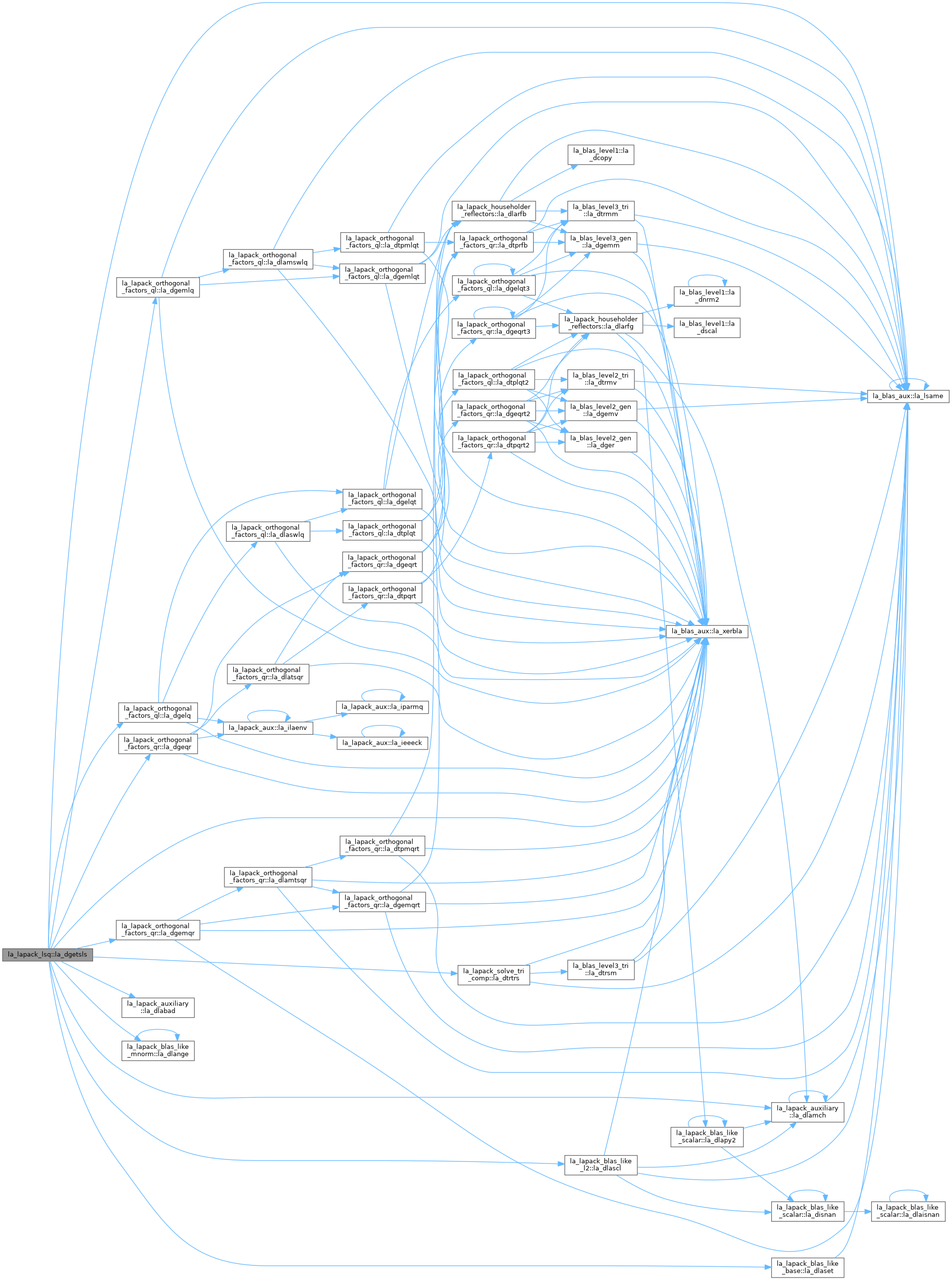
DGETSLS: solves overdetermined or underdetermined real linear systems involving an M-by-N matrix A, using a tall skinny QR or short wide LQ factorization of A. It is assumed that A has full rank. The following options are provided:
- If TRANS = 'N' and m >= n: find the least squares solution of an overdetermined system, i.e., solve the least squares problem minimize || B - A*X ||.
- If TRANS = 'N' and m < n: find the minimum norm solution of an underdetermined system A * X = B.
- If TRANS = 'T' and m >= n: find the minimum norm solution of an undetermined system A**T * X = B.
- If TRANS = 'T' and m < n: find the least squares solution of an overdetermined system, i.e., solve the least squares problem minimize || B - A**T * X ||. Several right hand side vectors b and solution vectors x can be handled in a single call; they are stored as the columns of the M-by-NRHS right hand side matrix B and the N-by-NRHS solution matrix X.
◆ la_qgels()
| subroutine, public la_lapack_lsq::la_qgels | ( | character, intent(in) | trans, |
| integer(ilp), intent(in) | m, | ||
| integer(ilp), intent(in) | n, | ||
| integer(ilp), intent(in) | nrhs, | ||
| real(qp), dimension(lda,*), intent(inout) | a, | ||
| integer(ilp), intent(in) | lda, | ||
| real(qp), dimension(ldb,*), intent(inout) | b, | ||
| integer(ilp), intent(in) | ldb, | ||
| real(qp), dimension(*), intent(out) | work, | ||
| integer(ilp), intent(in) | lwork, | ||
| integer(ilp), intent(out) | info ) |
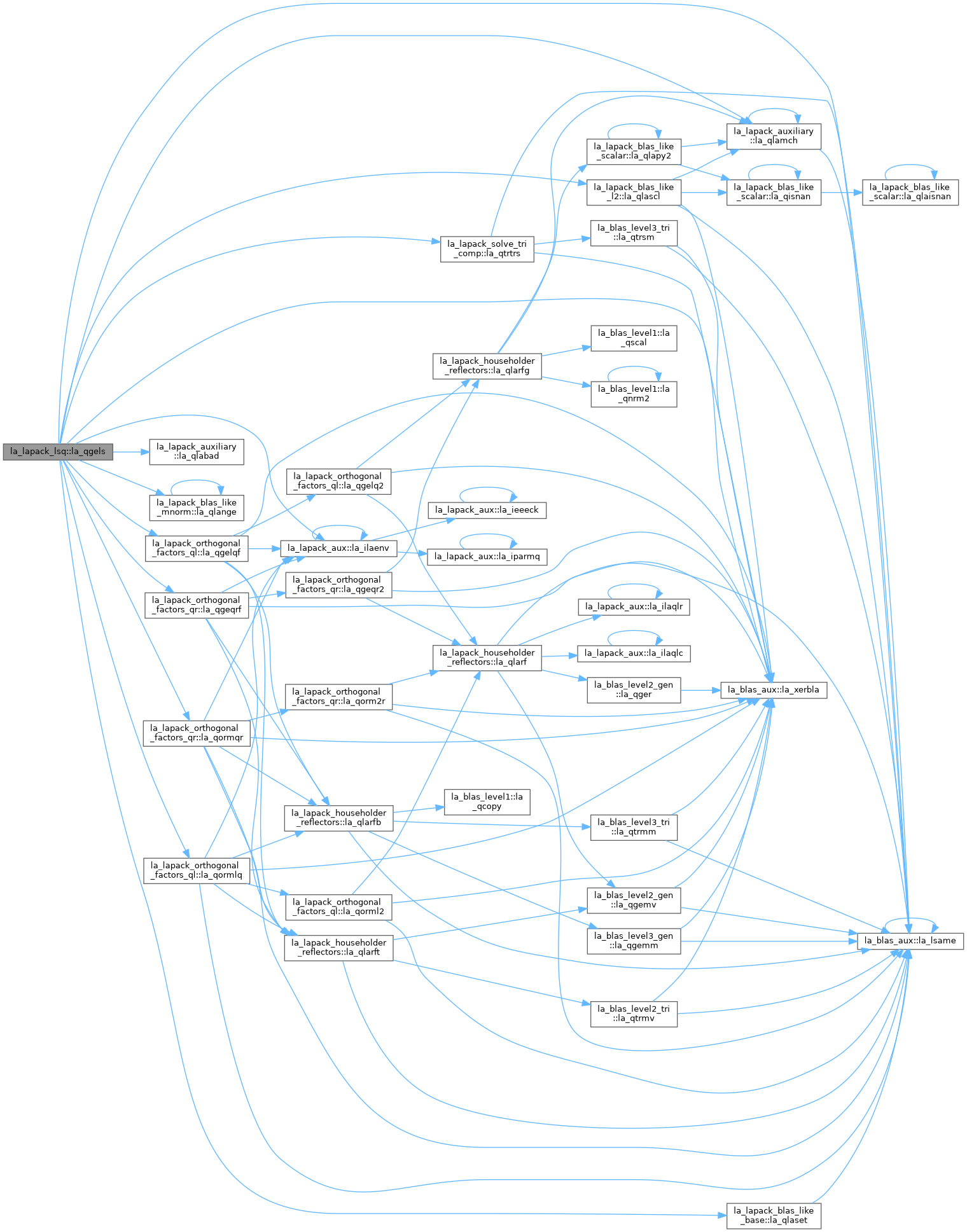
QGELS: solves overdetermined or underdetermined real linear systems involving an M-by-N matrix A, or its transpose, using a QR or LQ factorization of A. It is assumed that A has full rank. The following options are provided:
- If TRANS = 'N' and m >= n: find the least squares solution of an overdetermined system, i.e., solve the least squares problem minimize || B - A*X ||.
- If TRANS = 'N' and m < n: find the minimum norm solution of an underdetermined system A * X = B.
- If TRANS = 'T' and m >= n: find the minimum norm solution of an underdetermined system A**T * X = B.
- If TRANS = 'T' and m < n: find the least squares solution of an overdetermined system, i.e., solve the least squares problem minimize || B - A**T * X ||. Several right hand side vectors b and solution vectors x can be handled in a single call; they are stored as the columns of the M-by-NRHS right hand side matrix B and the N-by-NRHS solution matrix X.
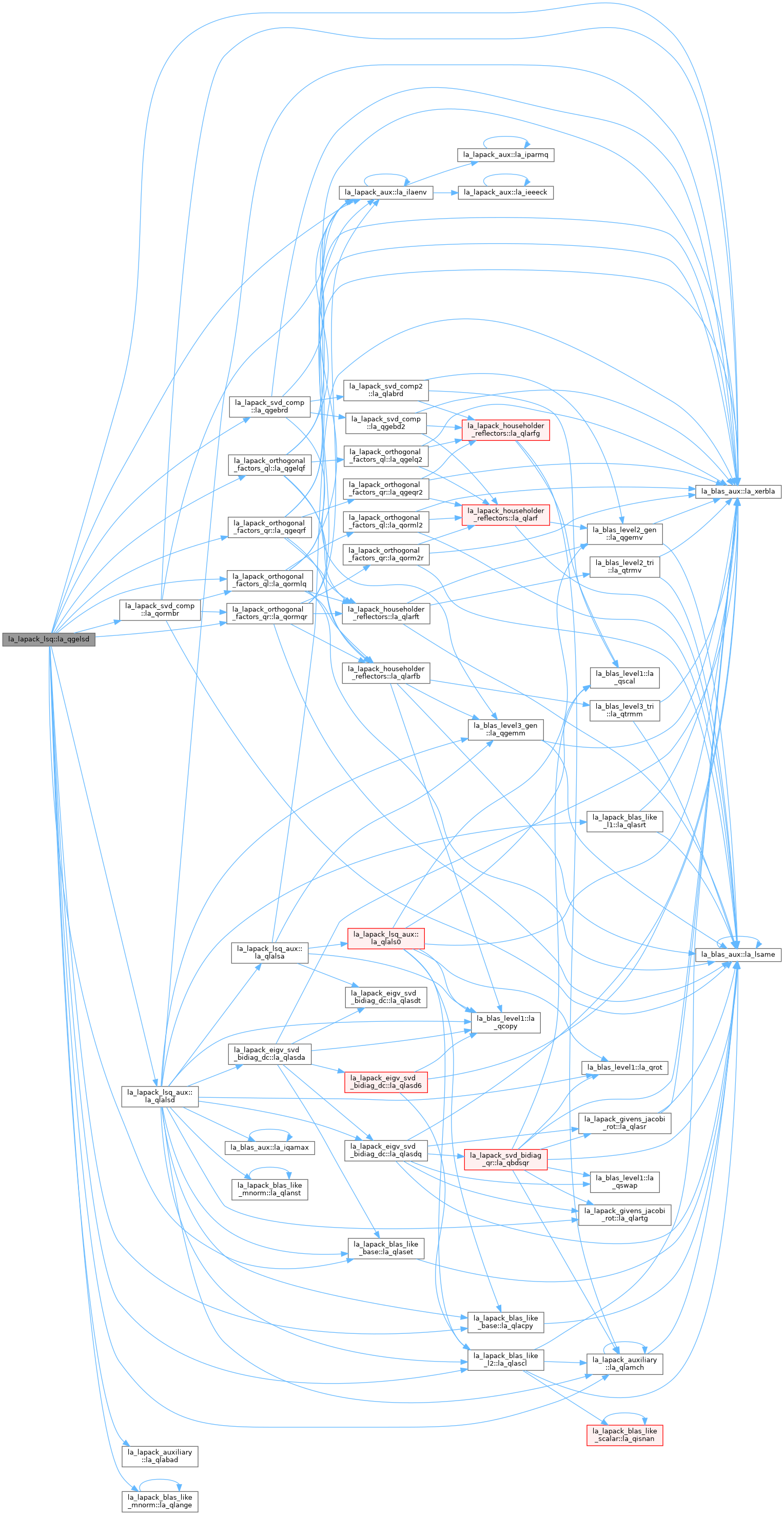
◆ la_qgelsd()
| subroutine, public la_lapack_lsq::la_qgelsd | ( | integer(ilp), intent(in) | m, |
| integer(ilp), intent(in) | n, | ||
| integer(ilp), intent(in) | nrhs, | ||
| real(qp), dimension(lda,*), intent(inout) | a, | ||
| integer(ilp), intent(in) | lda, | ||
| real(qp), dimension(ldb,*), intent(inout) | b, | ||
| integer(ilp), intent(in) | ldb, | ||
| real(qp), dimension(*), intent(out) | s, | ||
| real(qp), intent(in) | rcond, | ||
| integer(ilp), intent(out) | rank, | ||
| real(qp), dimension(*), intent(out) | work, | ||
| integer(ilp), intent(in) | lwork, | ||
| integer(ilp), dimension(*), intent(out) | iwork, | ||
| integer(ilp), intent(out) | info ) |
QGELSD: computes the minimum-norm solution to a real linear least squares problem: minimize 2-norm(| b - A*x |) using the singular value decomposition (SVD) of A. A is an M-by-N matrix which may be rank-deficient. Several right hand side vectors b and solution vectors x can be handled in a single call; they are stored as the columns of the M-by-NRHS right hand side matrix B and the N-by-NRHS solution matrix X. The problem is solved in three steps: (1) Reduce the coefficient matrix A to bidiagonal form with Householder transformations, reducing the original problem into a "bidiagonal least squares problem" (BLS) (2) Solve the BLS using a divide and conquer approach. (3) Apply back all the Householder transformations to solve the original least squares problem. The effective rank of A is determined by treating as zero those singular values which are less than RCOND times the largest singular value. The divide and conquer algorithm makes very mild assumptions about floating point arithmetic. It will work on machines with a guard digit in add/subtract, or on those binary machines without guard digits which subtract like the Cray X-MP, Cray Y-MP, Cray C-90, or Cray-2. It could conceivably fail on hexadecimal or decimal machines without guard digits, but we know of none.
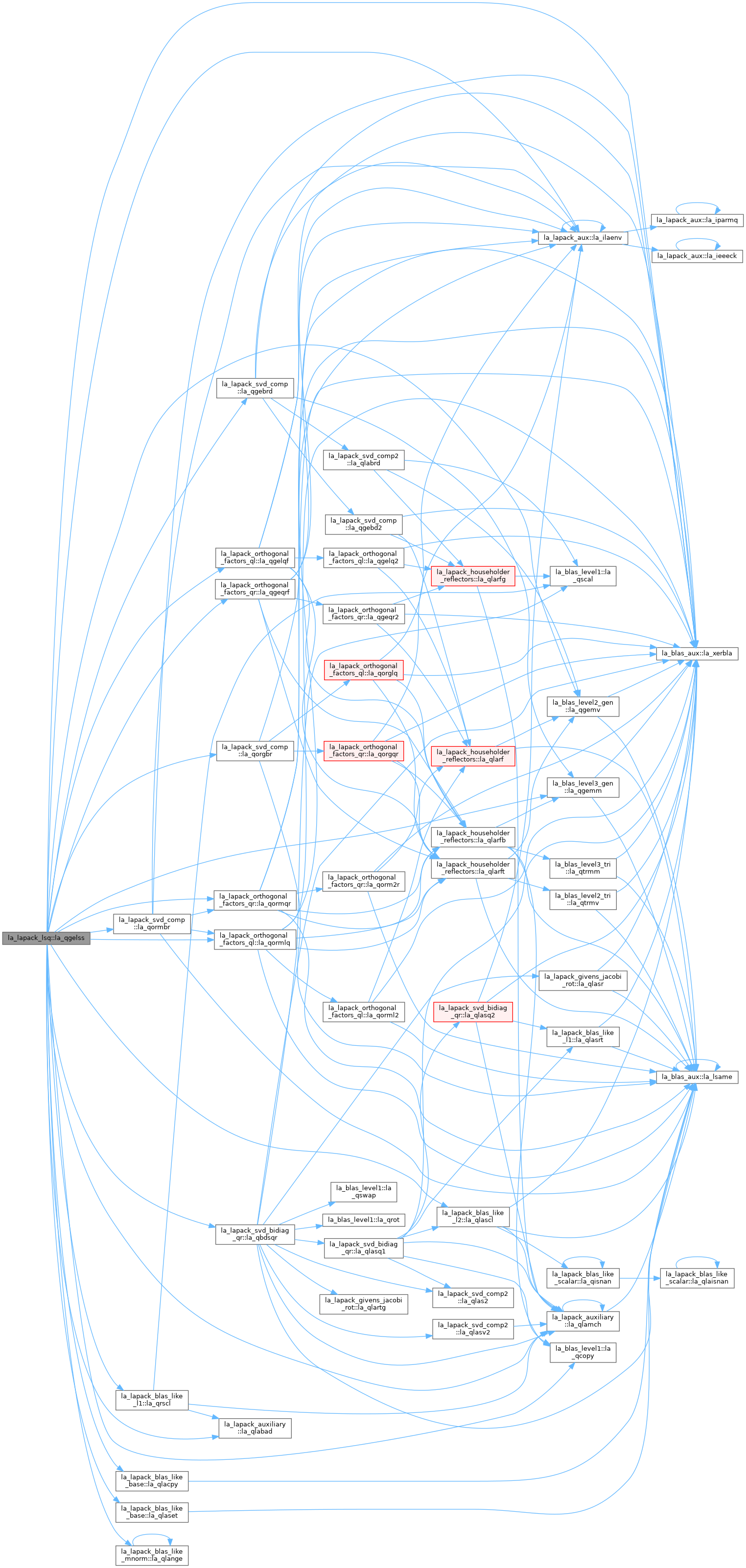
◆ la_qgelss()
| subroutine, public la_lapack_lsq::la_qgelss | ( | integer(ilp), intent(in) | m, |
| integer(ilp), intent(in) | n, | ||
| integer(ilp), intent(in) | nrhs, | ||
| real(qp), dimension(lda,*), intent(inout) | a, | ||
| integer(ilp), intent(in) | lda, | ||
| real(qp), dimension(ldb,*), intent(inout) | b, | ||
| integer(ilp), intent(in) | ldb, | ||
| real(qp), dimension(*), intent(out) | s, | ||
| real(qp), intent(in) | rcond, | ||
| integer(ilp), intent(out) | rank, | ||
| real(qp), dimension(*), intent(out) | work, | ||
| integer(ilp), intent(in) | lwork, | ||
| integer(ilp), intent(out) | info ) |
QGELSS: computes the minimum norm solution to a real linear least squares problem: Minimize 2-norm(| b - A*x |). using the singular value decomposition (SVD) of A. A is an M-by-N matrix which may be rank-deficient. Several right hand side vectors b and solution vectors x can be handled in a single call; they are stored as the columns of the M-by-NRHS right hand side matrix B and the N-by-NRHS solution matrix X. The effective rank of A is determined by treating as zero those singular values which are less than RCOND times the largest singular value.
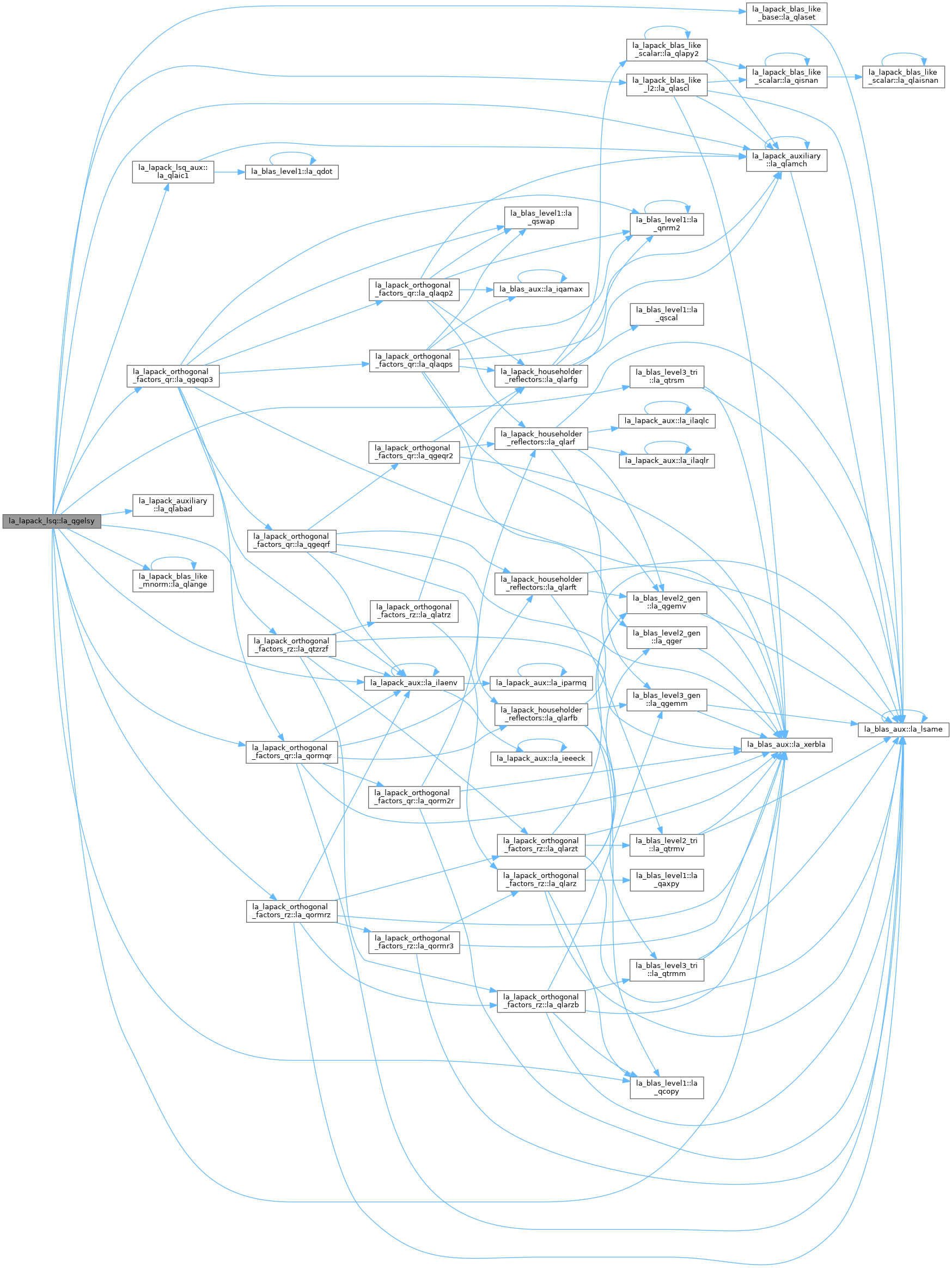
◆ la_qgelsy()
| subroutine, public la_lapack_lsq::la_qgelsy | ( | integer(ilp), intent(in) | m, |
| integer(ilp), intent(in) | n, | ||
| integer(ilp), intent(in) | nrhs, | ||
| real(qp), dimension(lda,*), intent(inout) | a, | ||
| integer(ilp), intent(in) | lda, | ||
| real(qp), dimension(ldb,*), intent(inout) | b, | ||
| integer(ilp), intent(in) | ldb, | ||
| integer(ilp), dimension(*), intent(inout) | jpvt, | ||
| real(qp), intent(in) | rcond, | ||
| integer(ilp), intent(out) | rank, | ||
| real(qp), dimension(*), intent(out) | work, | ||
| integer(ilp), intent(in) | lwork, | ||
| integer(ilp), intent(out) | info ) |
QGELSY: computes the minimum-norm solution to a real linear least squares problem: minimize || A * X - B || using a complete orthogonal factorization of A. A is an M-by-N matrix which may be rank-deficient. Several right hand side vectors b and solution vectors x can be handled in a single call; they are stored as the columns of the M-by-NRHS right hand side matrix B and the N-by-NRHS solution matrix X. The routine first computes a QR factorization with column pivoting: A * P = Q * [ R11 R12 ] [ 0 R22 ] with R11 defined as the largest leading submatrix whose estimated condition number is less than 1/RCOND. The order of R11, RANK, is the effective rank of A. Then, R22 is considered to be negligible, and R12 is annihilated by orthogonal transformations from the right, arriving at the complete orthogonal factorization: A * P = Q * [ T11 0 ] * Z [ 0 0 ] The minimum-norm solution is then X = P * Z**T [ inv(T11)*Q1**T*B ] [ 0 ] where Q1 consists of the first RANK columns of Q. This routine is basically identical to the original xGELSX except three differences: o The call to the subroutine xGEQPF has been substituted by the the call to the subroutine xGEQP3. This subroutine is a Blas-3 version of the QR factorization with column pivoting. o Matrix B (the right hand side) is updated with Blas-3. o The permutation of matrix B (the right hand side) is faster and more simple.
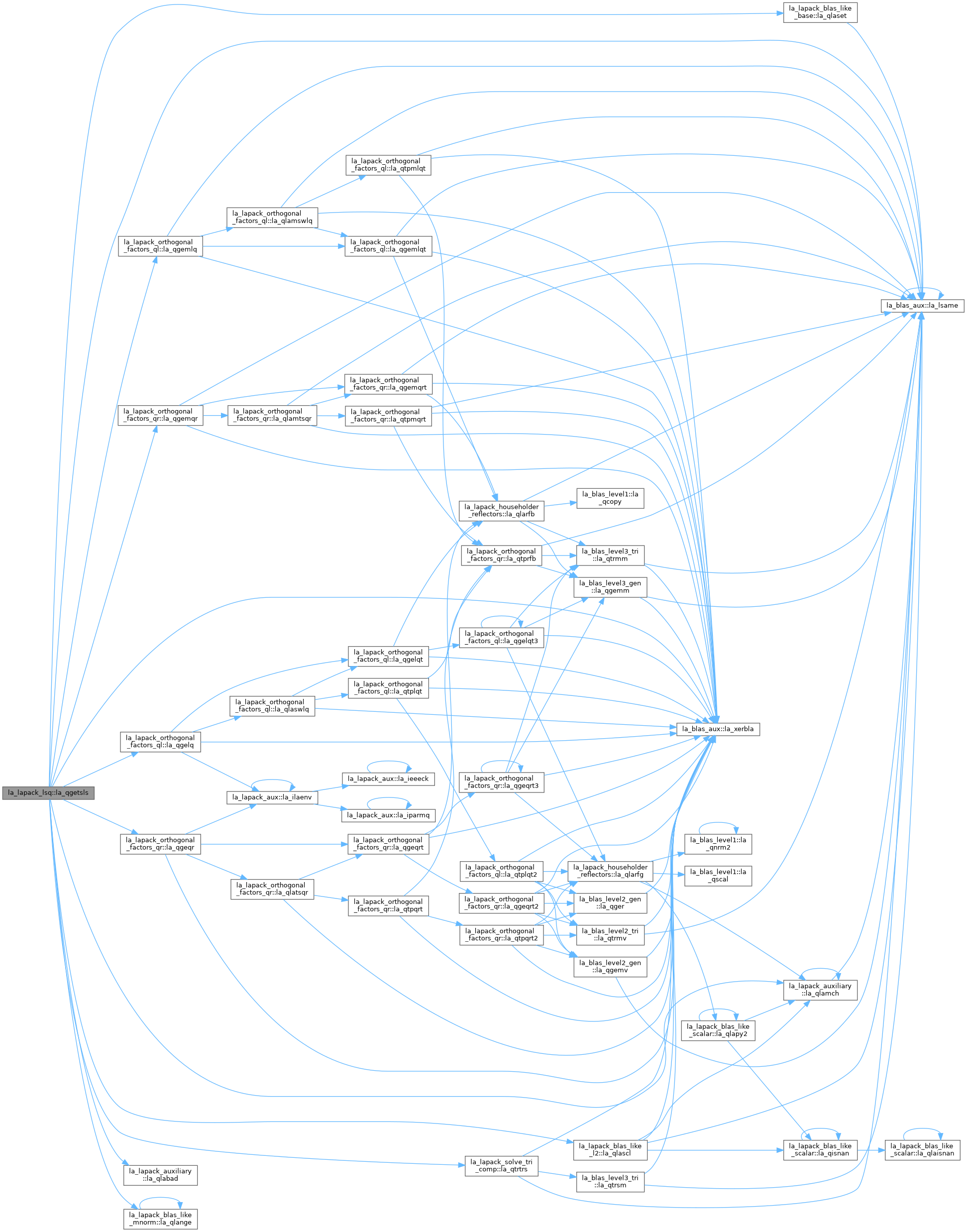
◆ la_qgetsls()
| subroutine, public la_lapack_lsq::la_qgetsls | ( | character, intent(in) | trans, |
| integer(ilp), intent(in) | m, | ||
| integer(ilp), intent(in) | n, | ||
| integer(ilp), intent(in) | nrhs, | ||
| real(qp), dimension(lda,*), intent(inout) | a, | ||
| integer(ilp), intent(in) | lda, | ||
| real(qp), dimension(ldb,*), intent(inout) | b, | ||
| integer(ilp), intent(in) | ldb, | ||
| real(qp), dimension(*), intent(out) | work, | ||
| integer(ilp), intent(in) | lwork, | ||
| integer(ilp), intent(out) | info ) |
QGETSLS: solves overdetermined or underdetermined real linear systems involving an M-by-N matrix A, using a tall skinny QR or short wide LQ factorization of A. It is assumed that A has full rank. The following options are provided:
- If TRANS = 'N' and m >= n: find the least squares solution of an overdetermined system, i.e., solve the least squares problem minimize || B - A*X ||.
- If TRANS = 'N' and m < n: find the minimum norm solution of an underdetermined system A * X = B.
- If TRANS = 'T' and m >= n: find the minimum norm solution of an undetermined system A**T * X = B.
- If TRANS = 'T' and m < n: find the least squares solution of an overdetermined system, i.e., solve the least squares problem minimize || B - A**T * X ||. Several right hand side vectors b and solution vectors x can be handled in a single call; they are stored as the columns of the M-by-NRHS right hand side matrix B and the N-by-NRHS solution matrix X.
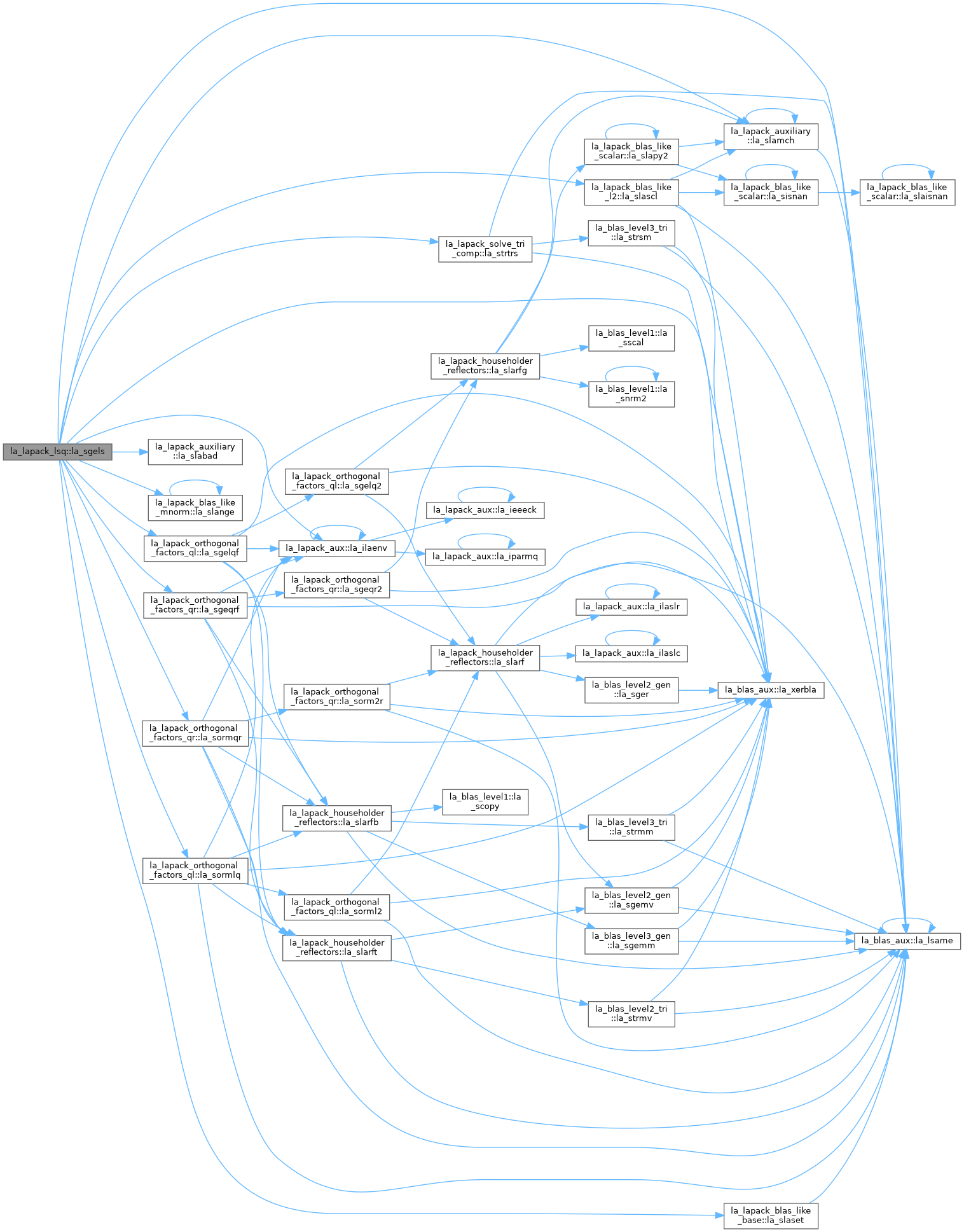
◆ la_sgels()
| subroutine, public la_lapack_lsq::la_sgels | ( | character, intent(in) | trans, |
| integer(ilp), intent(in) | m, | ||
| integer(ilp), intent(in) | n, | ||
| integer(ilp), intent(in) | nrhs, | ||
| real(sp), dimension(lda,*), intent(inout) | a, | ||
| integer(ilp), intent(in) | lda, | ||
| real(sp), dimension(ldb,*), intent(inout) | b, | ||
| integer(ilp), intent(in) | ldb, | ||
| real(sp), dimension(*), intent(out) | work, | ||
| integer(ilp), intent(in) | lwork, | ||
| integer(ilp), intent(out) | info ) |
SGELS: solves overdetermined or underdetermined real linear systems involving an M-by-N matrix A, or its transpose, using a QR or LQ factorization of A. It is assumed that A has full rank. The following options are provided:
- If TRANS = 'N' and m >= n: find the least squares solution of an overdetermined system, i.e., solve the least squares problem minimize || B - A*X ||.
- If TRANS = 'N' and m < n: find the minimum norm solution of an underdetermined system A * X = B.
- If TRANS = 'T' and m >= n: find the minimum norm solution of an underdetermined system A**T * X = B.
- If TRANS = 'T' and m < n: find the least squares solution of an overdetermined system, i.e., solve the least squares problem minimize || B - A**T * X ||. Several right hand side vectors b and solution vectors x can be handled in a single call; they are stored as the columns of the M-by-NRHS right hand side matrix B and the N-by-NRHS solution matrix X.
◆ la_sgelsd()
| subroutine, public la_lapack_lsq::la_sgelsd | ( | integer(ilp), intent(in) | m, |
| integer(ilp), intent(in) | n, | ||
| integer(ilp), intent(in) | nrhs, | ||
| real(sp), dimension(lda,*), intent(inout) | a, | ||
| integer(ilp), intent(in) | lda, | ||
| real(sp), dimension(ldb,*), intent(inout) | b, | ||
| integer(ilp), intent(in) | ldb, | ||
| real(sp), dimension(*), intent(out) | s, | ||
| real(sp), intent(in) | rcond, | ||
| integer(ilp), intent(out) | rank, | ||
| real(sp), dimension(*), intent(out) | work, | ||
| integer(ilp), intent(in) | lwork, | ||
| integer(ilp), dimension(*), intent(out) | iwork, | ||
| integer(ilp), intent(out) | info ) |
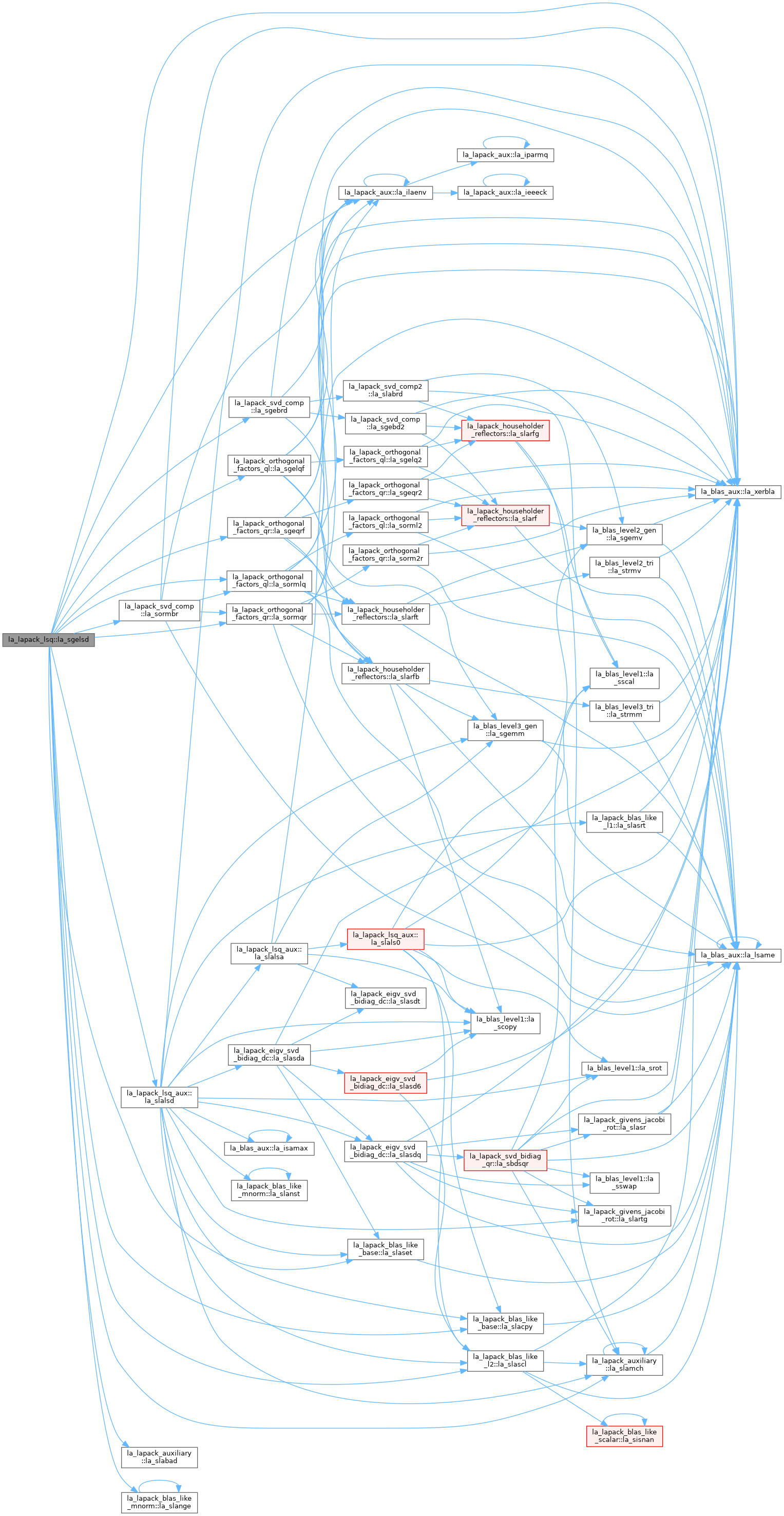
SGELSD: computes the minimum-norm solution to a real linear least squares problem: minimize 2-norm(| b - A*x |) using the singular value decomposition (SVD) of A. A is an M-by-N matrix which may be rank-deficient. Several right hand side vectors b and solution vectors x can be handled in a single call; they are stored as the columns of the M-by-NRHS right hand side matrix B and the N-by-NRHS solution matrix X. The problem is solved in three steps: (1) Reduce the coefficient matrix A to bidiagonal form with Householder transformations, reducing the original problem into a "bidiagonal least squares problem" (BLS) (2) Solve the BLS using a divide and conquer approach. (3) Apply back all the Householder transformations to solve the original least squares problem. The effective rank of A is determined by treating as zero those singular values which are less than RCOND times the largest singular value. The divide and conquer algorithm makes very mild assumptions about floating point arithmetic. It will work on machines with a guard digit in add/subtract, or on those binary machines without guard digits which subtract like the Cray X-MP, Cray Y-MP, Cray C-90, or Cray-2. It could conceivably fail on hexadecimal or decimal machines without guard digits, but we know of none.
◆ la_sgelss()
| subroutine, public la_lapack_lsq::la_sgelss | ( | integer(ilp), intent(in) | m, |
| integer(ilp), intent(in) | n, | ||
| integer(ilp), intent(in) | nrhs, | ||
| real(sp), dimension(lda,*), intent(inout) | a, | ||
| integer(ilp), intent(in) | lda, | ||
| real(sp), dimension(ldb,*), intent(inout) | b, | ||
| integer(ilp), intent(in) | ldb, | ||
| real(sp), dimension(*), intent(out) | s, | ||
| real(sp), intent(in) | rcond, | ||
| integer(ilp), intent(out) | rank, | ||
| real(sp), dimension(*), intent(out) | work, | ||
| integer(ilp), intent(in) | lwork, | ||
| integer(ilp), intent(out) | info ) |
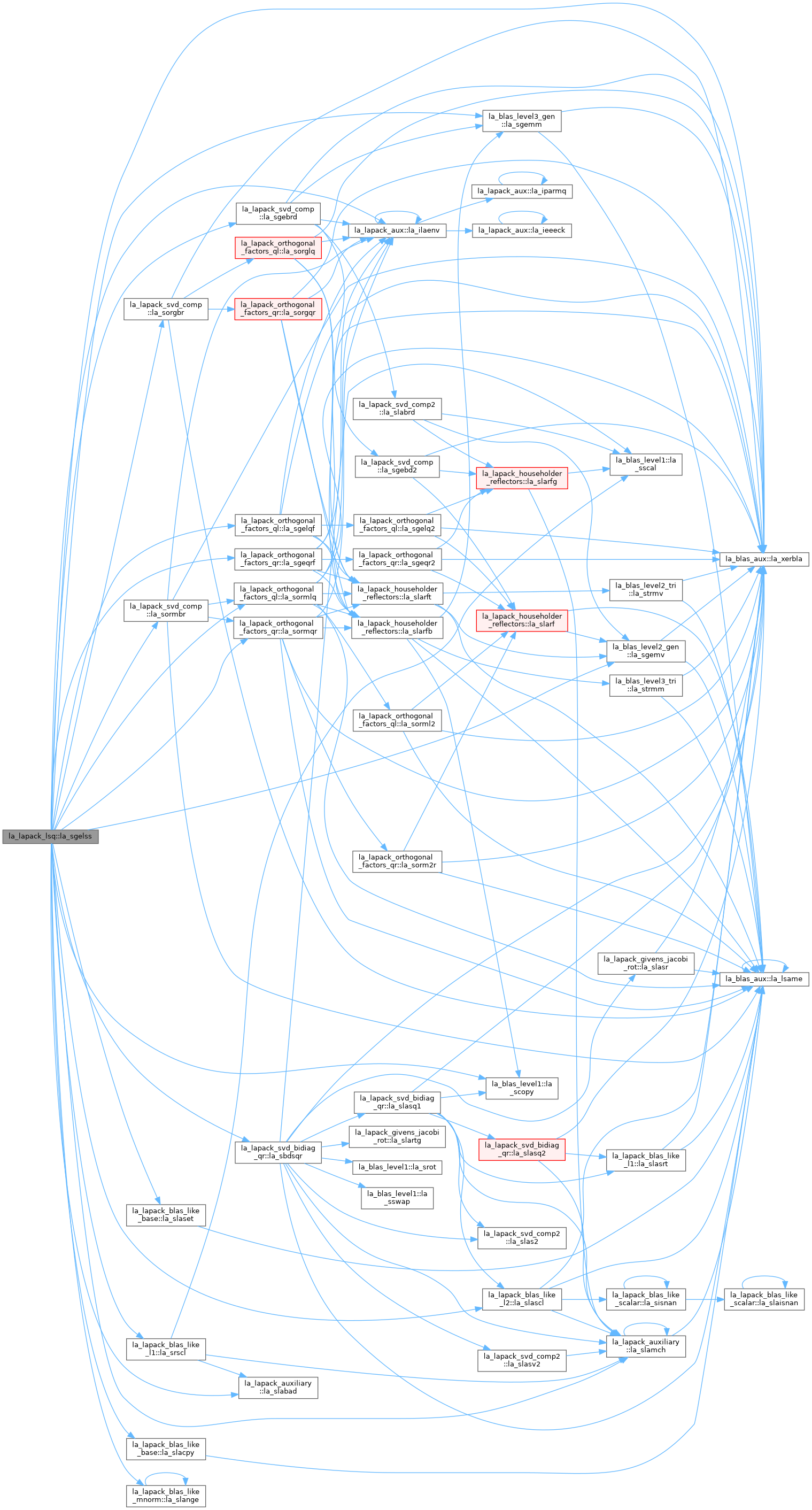
SGELSS: computes the minimum norm solution to a real linear least squares problem: Minimize 2-norm(| b - A*x |). using the singular value decomposition (SVD) of A. A is an M-by-N matrix which may be rank-deficient. Several right hand side vectors b and solution vectors x can be handled in a single call; they are stored as the columns of the M-by-NRHS right hand side matrix B and the N-by-NRHS solution matrix X. The effective rank of A is determined by treating as zero those singular values which are less than RCOND times the largest singular value.
◆ la_sgelsy()
| subroutine, public la_lapack_lsq::la_sgelsy | ( | integer(ilp), intent(in) | m, |
| integer(ilp), intent(in) | n, | ||
| integer(ilp), intent(in) | nrhs, | ||
| real(sp), dimension(lda,*), intent(inout) | a, | ||
| integer(ilp), intent(in) | lda, | ||
| real(sp), dimension(ldb,*), intent(inout) | b, | ||
| integer(ilp), intent(in) | ldb, | ||
| integer(ilp), dimension(*), intent(inout) | jpvt, | ||
| real(sp), intent(in) | rcond, | ||
| integer(ilp), intent(out) | rank, | ||
| real(sp), dimension(*), intent(out) | work, | ||
| integer(ilp), intent(in) | lwork, | ||
| integer(ilp), intent(out) | info ) |
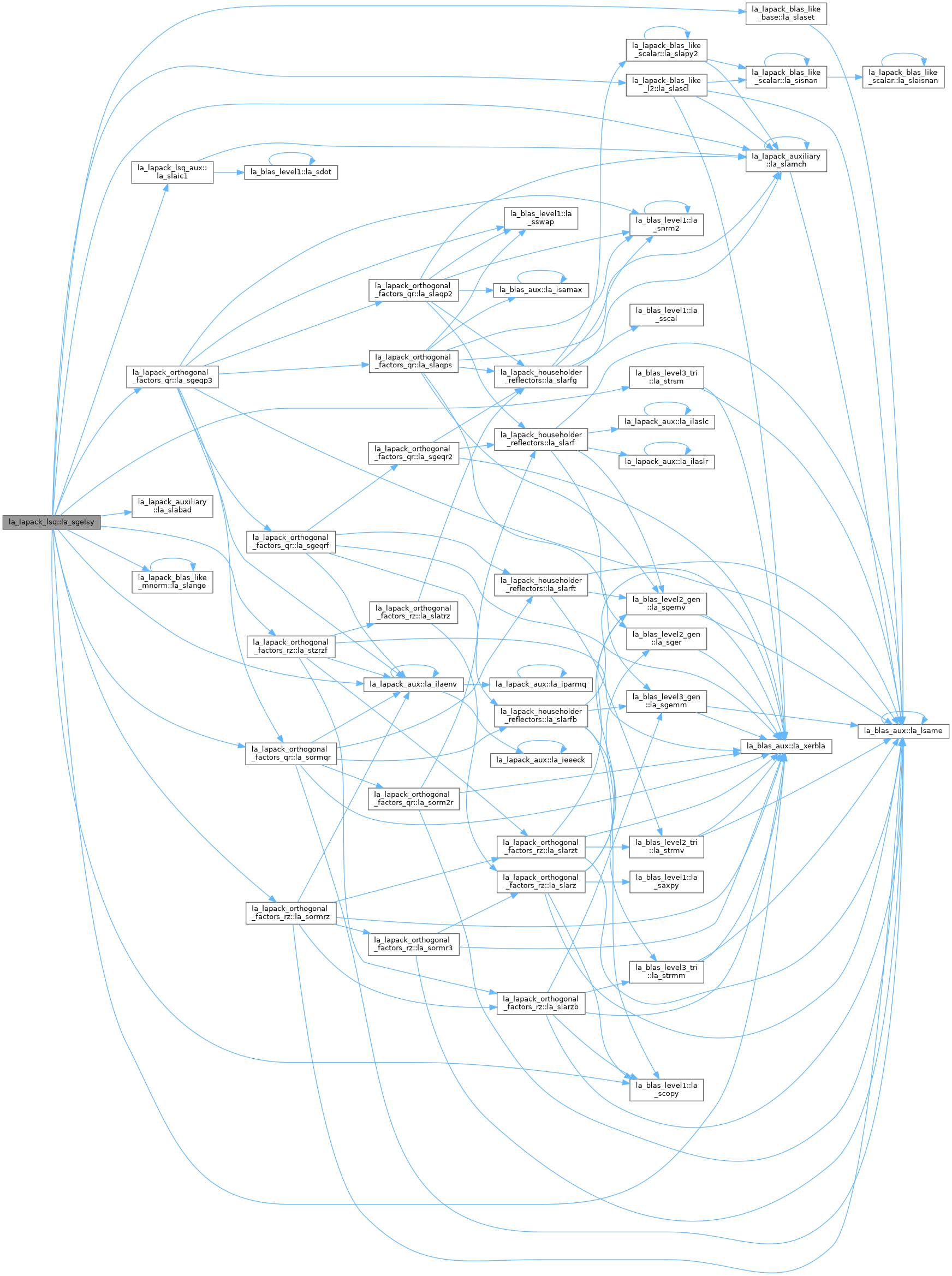
SGELSY: computes the minimum-norm solution to a real linear least squares problem: minimize || A * X - B || using a complete orthogonal factorization of A. A is an M-by-N matrix which may be rank-deficient. Several right hand side vectors b and solution vectors x can be handled in a single call; they are stored as the columns of the M-by-NRHS right hand side matrix B and the N-by-NRHS solution matrix X. The routine first computes a QR factorization with column pivoting: A * P = Q * [ R11 R12 ] [ 0 R22 ] with R11 defined as the largest leading submatrix whose estimated condition number is less than 1/RCOND. The order of R11, RANK, is the effective rank of A. Then, R22 is considered to be negligible, and R12 is annihilated by orthogonal transformations from the right, arriving at the complete orthogonal factorization: A * P = Q * [ T11 0 ] * Z [ 0 0 ] The minimum-norm solution is then X = P * Z**T [ inv(T11)*Q1**T*B ] [ 0 ] where Q1 consists of the first RANK columns of Q. This routine is basically identical to the original xGELSX except three differences: o The call to the subroutine xGEQPF has been substituted by the the call to the subroutine xGEQP3. This subroutine is a Blas-3 version of the QR factorization with column pivoting. o Matrix B (the right hand side) is updated with Blas-3. o The permutation of matrix B (the right hand side) is faster and more simple.
◆ la_sgetsls()
| subroutine, public la_lapack_lsq::la_sgetsls | ( | character, intent(in) | trans, |
| integer(ilp), intent(in) | m, | ||
| integer(ilp), intent(in) | n, | ||
| integer(ilp), intent(in) | nrhs, | ||
| real(sp), dimension(lda,*), intent(inout) | a, | ||
| integer(ilp), intent(in) | lda, | ||
| real(sp), dimension(ldb,*), intent(inout) | b, | ||
| integer(ilp), intent(in) | ldb, | ||
| real(sp), dimension(*), intent(out) | work, | ||
| integer(ilp), intent(in) | lwork, | ||
| integer(ilp), intent(out) | info ) |
SGETSLS: solves overdetermined or underdetermined real linear systems involving an M-by-N matrix A, using a tall skinny QR or short wide LQ factorization of A. It is assumed that A has full rank. The following options are provided:
- If TRANS = 'N' and m >= n: find the least squares solution of an overdetermined system, i.e., solve the least squares problem minimize || B - A*X ||.
- If TRANS = 'N' and m < n: find the minimum norm solution of an underdetermined system A * X = B.
- If TRANS = 'T' and m >= n: find the minimum norm solution of an undetermined system A**T * X = B.
- If TRANS = 'T' and m < n: find the least squares solution of an overdetermined system, i.e., solve the least squares problem minimize || B - A**T * X ||. Several right hand side vectors b and solution vectors x can be handled in a single call; they are stored as the columns of the M-by-NRHS right hand side matrix B and the N-by-NRHS solution matrix X.
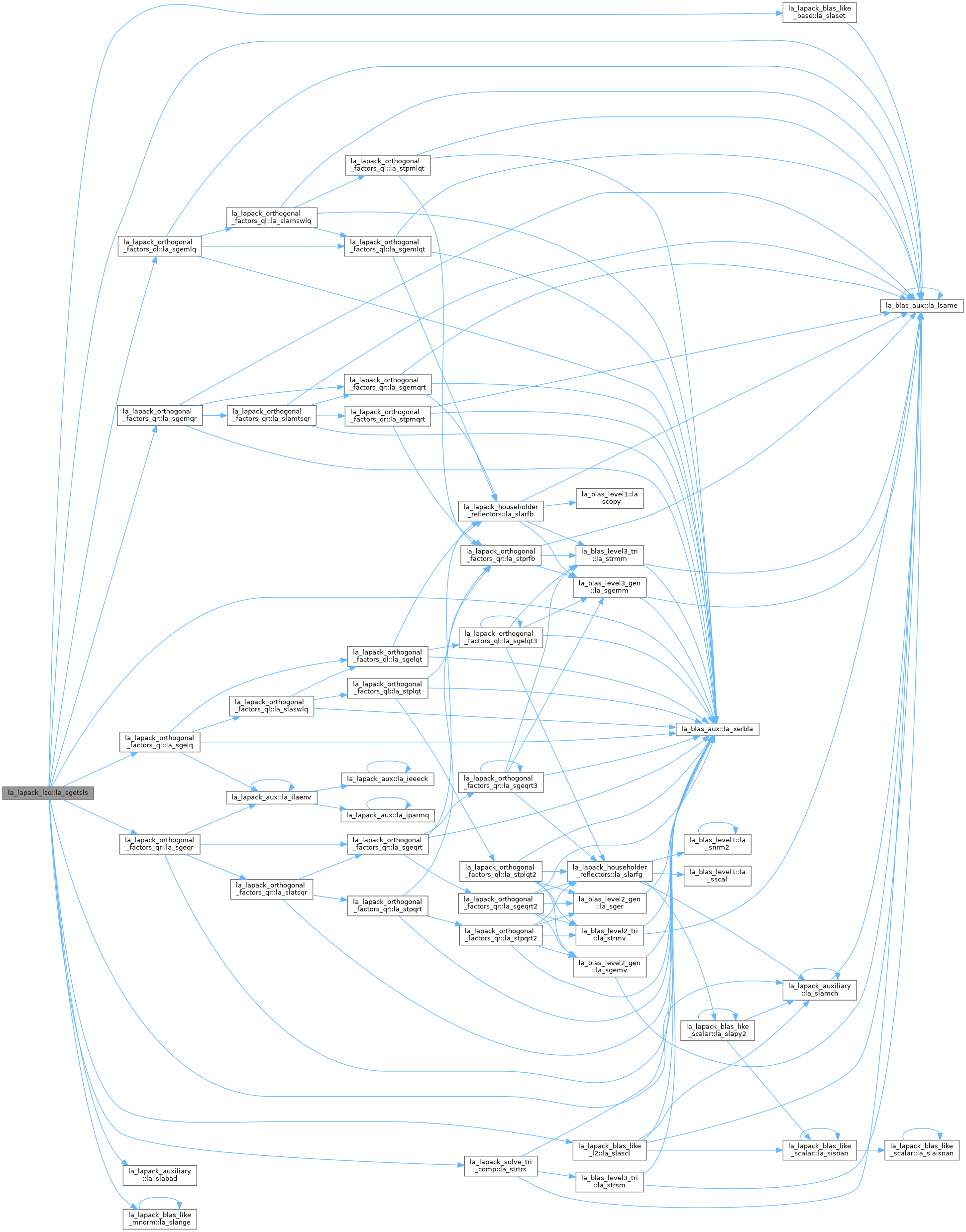
◆ la_wgels()
| subroutine, public la_lapack_lsq::la_wgels | ( | character, intent(in) | trans, |
| integer(ilp), intent(in) | m, | ||
| integer(ilp), intent(in) | n, | ||
| integer(ilp), intent(in) | nrhs, | ||
| complex(qp), dimension(lda,*), intent(inout) | a, | ||
| integer(ilp), intent(in) | lda, | ||
| complex(qp), dimension(ldb,*), intent(inout) | b, | ||
| integer(ilp), intent(in) | ldb, | ||
| complex(qp), dimension(*), intent(out) | work, | ||
| integer(ilp), intent(in) | lwork, | ||
| integer(ilp), intent(out) | info ) |
WGELS: solves overdetermined or underdetermined complex linear systems involving an M-by-N matrix A, or its conjugate-transpose, using a QR or LQ factorization of A. It is assumed that A has full rank. The following options are provided:
- If TRANS = 'N' and m >= n: find the least squares solution of an overdetermined system, i.e., solve the least squares problem minimize || B - A*X ||.
- If TRANS = 'N' and m < n: find the minimum norm solution of an underdetermined system A * X = B.
- If TRANS = 'C' and m >= n: find the minimum norm solution of an underdetermined system A**H * X = B.
- If TRANS = 'C' and m < n: find the least squares solution of an overdetermined system, i.e., solve the least squares problem minimize || B - A**H * X ||. Several right hand side vectors b and solution vectors x can be handled in a single call; they are stored as the columns of the M-by-NRHS right hand side matrix B and the N-by-NRHS solution matrix X.
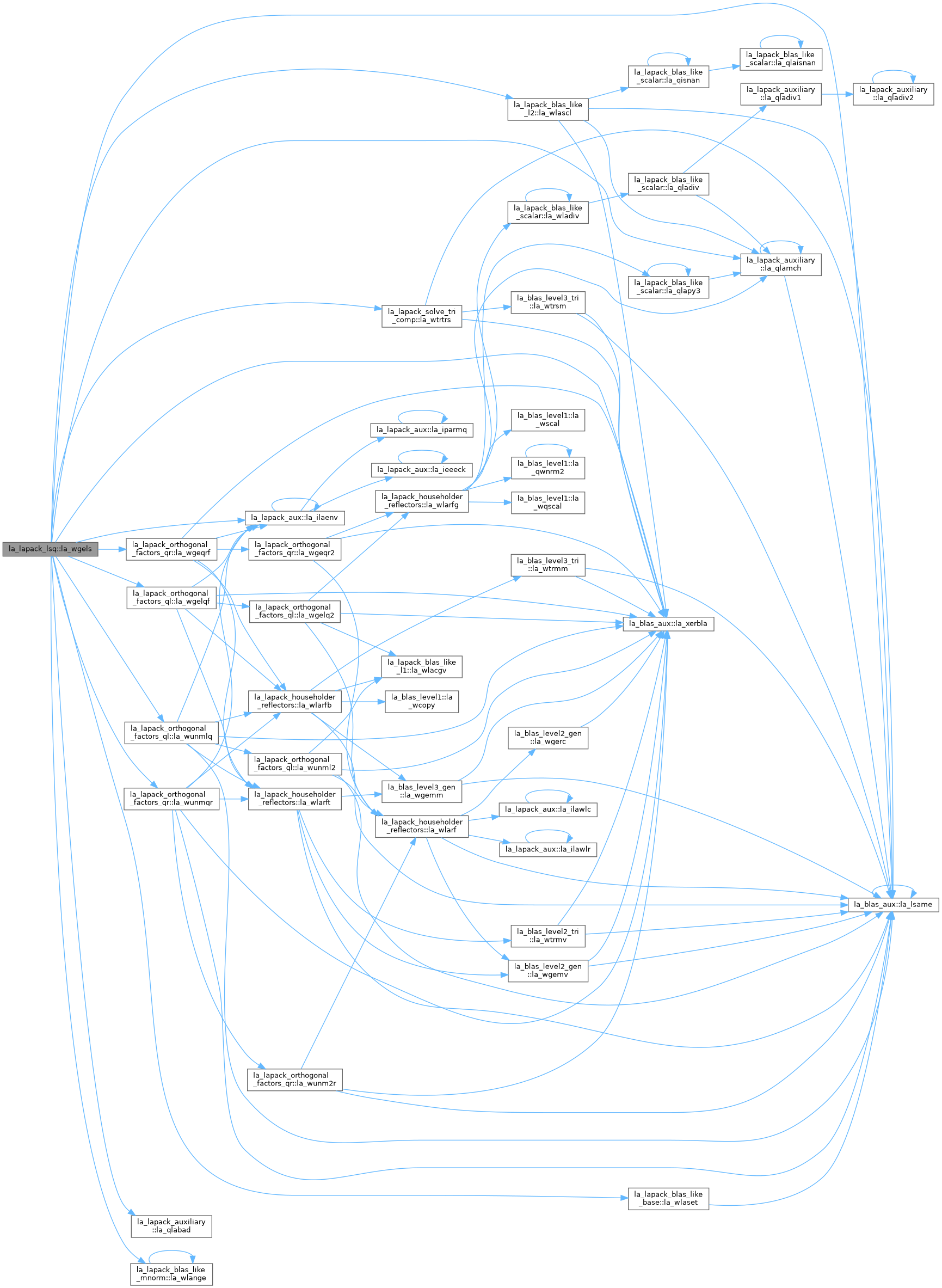
◆ la_wgelsd()
| subroutine, public la_lapack_lsq::la_wgelsd | ( | integer(ilp), intent(in) | m, |
| integer(ilp), intent(in) | n, | ||
| integer(ilp), intent(in) | nrhs, | ||
| complex(qp), dimension(lda,*), intent(inout) | a, | ||
| integer(ilp), intent(in) | lda, | ||
| complex(qp), dimension(ldb,*), intent(inout) | b, | ||
| integer(ilp), intent(in) | ldb, | ||
| real(qp), dimension(*), intent(out) | s, | ||
| real(qp), intent(in) | rcond, | ||
| integer(ilp), intent(out) | rank, | ||
| complex(qp), dimension(*), intent(out) | work, | ||
| integer(ilp), intent(in) | lwork, | ||
| real(qp), dimension(*), intent(out) | rwork, | ||
| integer(ilp), dimension(*), intent(out) | iwork, | ||
| integer(ilp), intent(out) | info ) |
WGELSD: computes the minimum-norm solution to a real linear least squares problem: minimize 2-norm(| b - A*x |) using the singular value decomposition (SVD) of A. A is an M-by-N matrix which may be rank-deficient. Several right hand side vectors b and solution vectors x can be handled in a single call; they are stored as the columns of the M-by-NRHS right hand side matrix B and the N-by-NRHS solution matrix X. The problem is solved in three steps: (1) Reduce the coefficient matrix A to bidiagonal form with Householder transformations, reducing the original problem into a "bidiagonal least squares problem" (BLS) (2) Solve the BLS using a divide and conquer approach. (3) Apply back all the Householder transformations to solve the original least squares problem. The effective rank of A is determined by treating as zero those singular values which are less than RCOND times the largest singular value. The divide and conquer algorithm makes very mild assumptions about floating point arithmetic. It will work on machines with a guard digit in add/subtract, or on those binary machines without guard digits which subtract like the Cray X-MP, Cray Y-MP, Cray C-90, or Cray-2. It could conceivably fail on hexadecimal or decimal machines without guard digits, but we know of none.
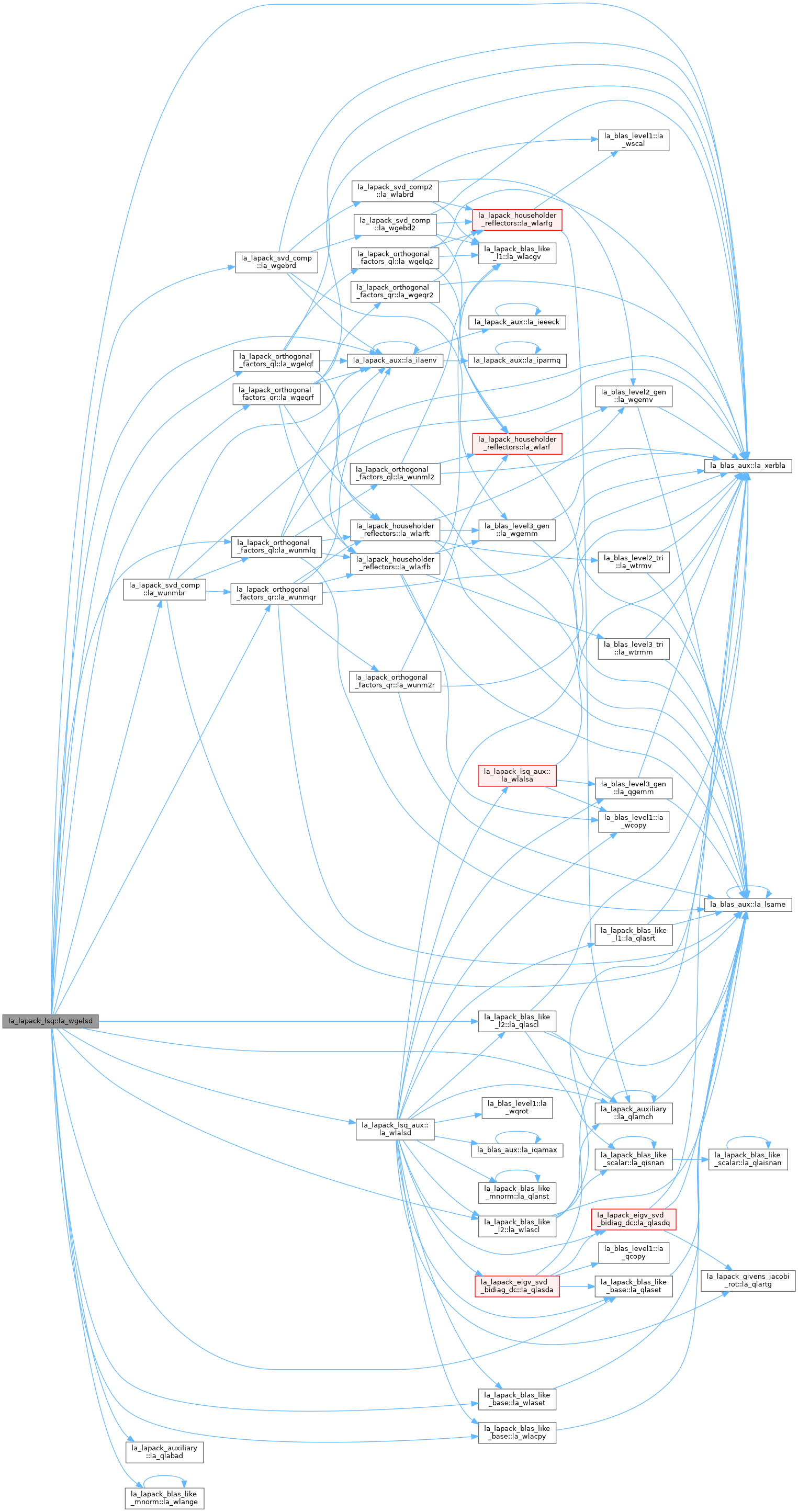
◆ la_wgelss()
| subroutine, public la_lapack_lsq::la_wgelss | ( | integer(ilp), intent(in) | m, |
| integer(ilp), intent(in) | n, | ||
| integer(ilp), intent(in) | nrhs, | ||
| complex(qp), dimension(lda,*), intent(inout) | a, | ||
| integer(ilp), intent(in) | lda, | ||
| complex(qp), dimension(ldb,*), intent(inout) | b, | ||
| integer(ilp), intent(in) | ldb, | ||
| real(qp), dimension(*), intent(out) | s, | ||
| real(qp), intent(in) | rcond, | ||
| integer(ilp), intent(out) | rank, | ||
| complex(qp), dimension(*), intent(out) | work, | ||
| integer(ilp), intent(in) | lwork, | ||
| real(qp), dimension(*), intent(out) | rwork, | ||
| integer(ilp), intent(out) | info ) |
WGELSS: computes the minimum norm solution to a complex linear least squares problem: Minimize 2-norm(| b - A*x |). using the singular value decomposition (SVD) of A. A is an M-by-N matrix which may be rank-deficient. Several right hand side vectors b and solution vectors x can be handled in a single call; they are stored as the columns of the M-by-NRHS right hand side matrix B and the N-by-NRHS solution matrix X. The effective rank of A is determined by treating as zero those singular values which are less than RCOND times the largest singular value.
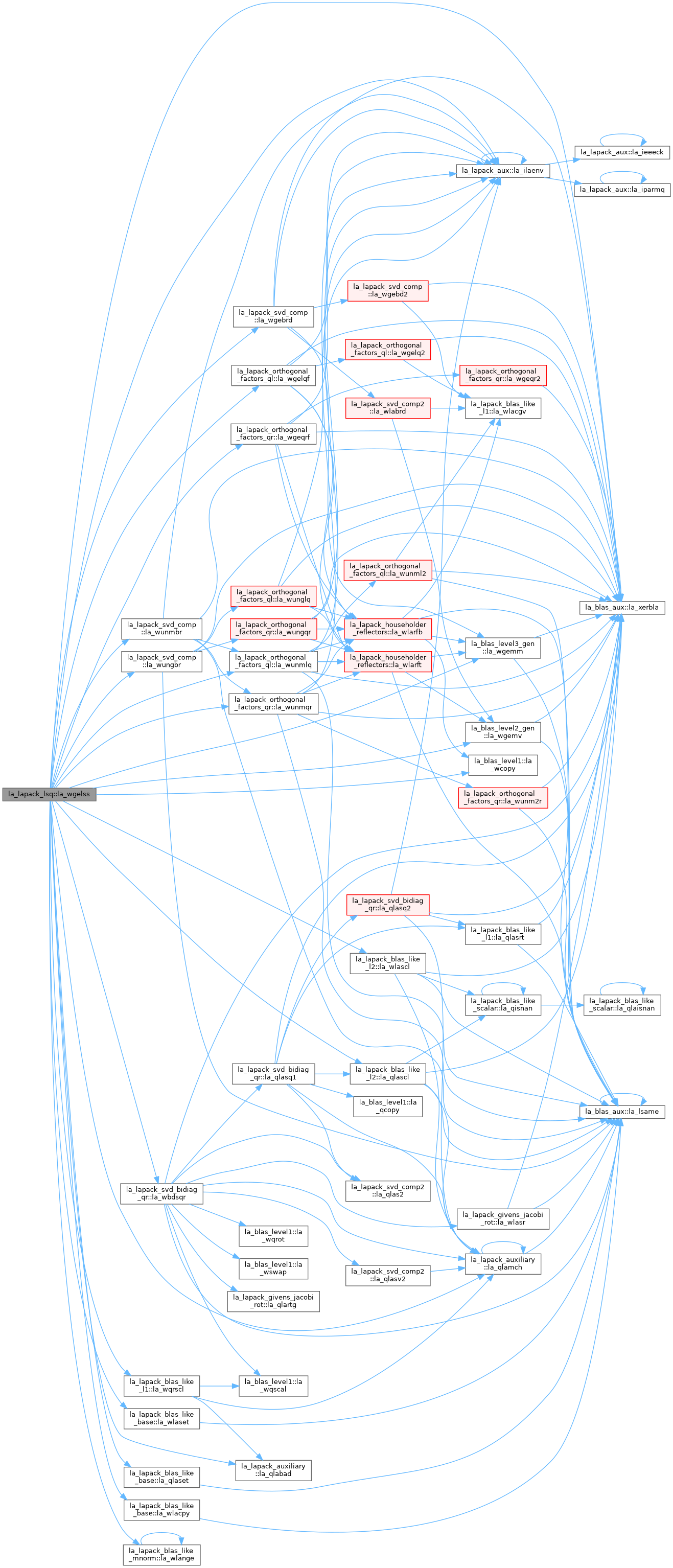
◆ la_wgelsy()
| subroutine, public la_lapack_lsq::la_wgelsy | ( | integer(ilp), intent(in) | m, |
| integer(ilp), intent(in) | n, | ||
| integer(ilp), intent(in) | nrhs, | ||
| complex(qp), dimension(lda,*), intent(inout) | a, | ||
| integer(ilp), intent(in) | lda, | ||
| complex(qp), dimension(ldb,*), intent(inout) | b, | ||
| integer(ilp), intent(in) | ldb, | ||
| integer(ilp), dimension(*), intent(inout) | jpvt, | ||
| real(qp), intent(in) | rcond, | ||
| integer(ilp), intent(out) | rank, | ||
| complex(qp), dimension(*), intent(out) | work, | ||
| integer(ilp), intent(in) | lwork, | ||
| real(qp), dimension(*), intent(out) | rwork, | ||
| integer(ilp), intent(out) | info ) |
WGELSY: computes the minimum-norm solution to a complex linear least squares problem: minimize || A * X - B || using a complete orthogonal factorization of A. A is an M-by-N matrix which may be rank-deficient. Several right hand side vectors b and solution vectors x can be handled in a single call; they are stored as the columns of the M-by-NRHS right hand side matrix B and the N-by-NRHS solution matrix X. The routine first computes a QR factorization with column pivoting: A * P = Q * [ R11 R12 ] [ 0 R22 ] with R11 defined as the largest leading submatrix whose estimated condition number is less than 1/RCOND. The order of R11, RANK, is the effective rank of A. Then, R22 is considered to be negligible, and R12 is annihilated by unitary transformations from the right, arriving at the complete orthogonal factorization: A * P = Q * [ T11 0 ] * Z [ 0 0 ] The minimum-norm solution is then X = P * Z**H [ inv(T11)*Q1**H*B ] [ 0 ] where Q1 consists of the first RANK columns of Q. This routine is basically identical to the original xGELSX except three differences: o The permutation of matrix B (the right hand side) is faster and more simple. o The call to the subroutine xGEQPF has been substituted by the the call to the subroutine xGEQP3. This subroutine is a Blas-3 version of the QR factorization with column pivoting. o Matrix B (the right hand side) is updated with Blas-3.
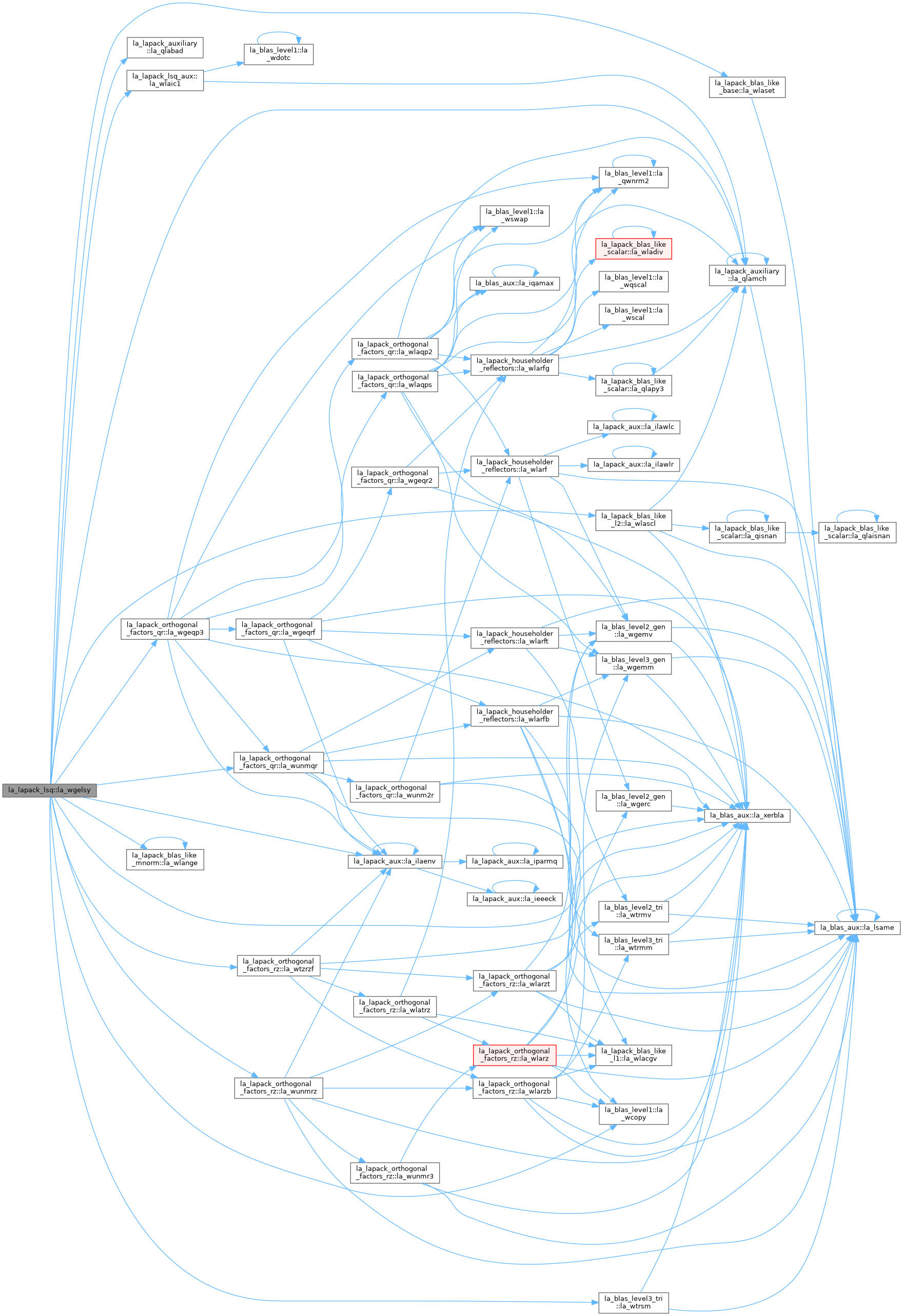
◆ la_wgetsls()
| subroutine, public la_lapack_lsq::la_wgetsls | ( | character, intent(in) | trans, |
| integer(ilp), intent(in) | m, | ||
| integer(ilp), intent(in) | n, | ||
| integer(ilp), intent(in) | nrhs, | ||
| complex(qp), dimension(lda,*), intent(inout) | a, | ||
| integer(ilp), intent(in) | lda, | ||
| complex(qp), dimension(ldb,*), intent(inout) | b, | ||
| integer(ilp), intent(in) | ldb, | ||
| complex(qp), dimension(*), intent(out) | work, | ||
| integer(ilp), intent(in) | lwork, | ||
| integer(ilp), intent(out) | info ) |
WGETSLS: solves overdetermined or underdetermined complex linear systems involving an M-by-N matrix A, using a tall skinny QR or short wide LQ factorization of A. It is assumed that A has full rank. The following options are provided:
- If TRANS = 'N' and m >= n: find the least squares solution of an overdetermined system, i.e., solve the least squares problem minimize || B - A*X ||.
- If TRANS = 'N' and m < n: find the minimum norm solution of an underdetermined system A * X = B.
- If TRANS = 'C' and m >= n: find the minimum norm solution of an undetermined system A**T * X = B.
- If TRANS = 'C' and m < n: find the least squares solution of an overdetermined system, i.e., solve the least squares problem minimize || B - A**T * X ||. Several right hand side vectors b and solution vectors x can be handled in a single call; they are stored as the columns of the M-by-NRHS right hand side matrix B and the N-by-NRHS solution matrix X.
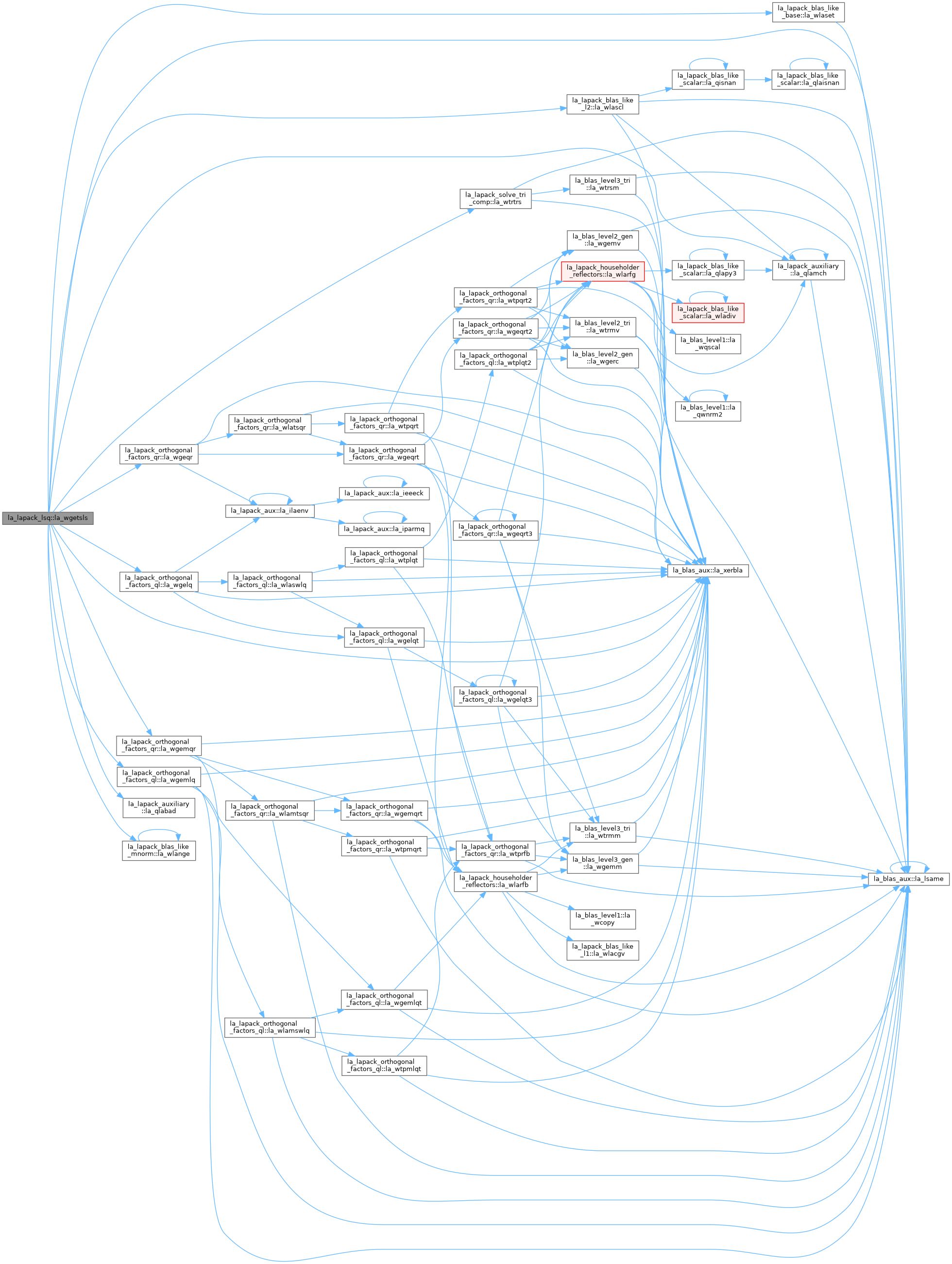
◆ la_zgels()
| subroutine, public la_lapack_lsq::la_zgels | ( | character, intent(in) | trans, |
| integer(ilp), intent(in) | m, | ||
| integer(ilp), intent(in) | n, | ||
| integer(ilp), intent(in) | nrhs, | ||
| complex(dp), dimension(lda,*), intent(inout) | a, | ||
| integer(ilp), intent(in) | lda, | ||
| complex(dp), dimension(ldb,*), intent(inout) | b, | ||
| integer(ilp), intent(in) | ldb, | ||
| complex(dp), dimension(*), intent(out) | work, | ||
| integer(ilp), intent(in) | lwork, | ||
| integer(ilp), intent(out) | info ) |
ZGELS: solves overdetermined or underdetermined complex linear systems involving an M-by-N matrix A, or its conjugate-transpose, using a QR or LQ factorization of A. It is assumed that A has full rank. The following options are provided:
- If TRANS = 'N' and m >= n: find the least squares solution of an overdetermined system, i.e., solve the least squares problem minimize || B - A*X ||.
- If TRANS = 'N' and m < n: find the minimum norm solution of an underdetermined system A * X = B.
- If TRANS = 'C' and m >= n: find the minimum norm solution of an underdetermined system A**H * X = B.
- If TRANS = 'C' and m < n: find the least squares solution of an overdetermined system, i.e., solve the least squares problem minimize || B - A**H * X ||. Several right hand side vectors b and solution vectors x can be handled in a single call; they are stored as the columns of the M-by-NRHS right hand side matrix B and the N-by-NRHS solution matrix X.
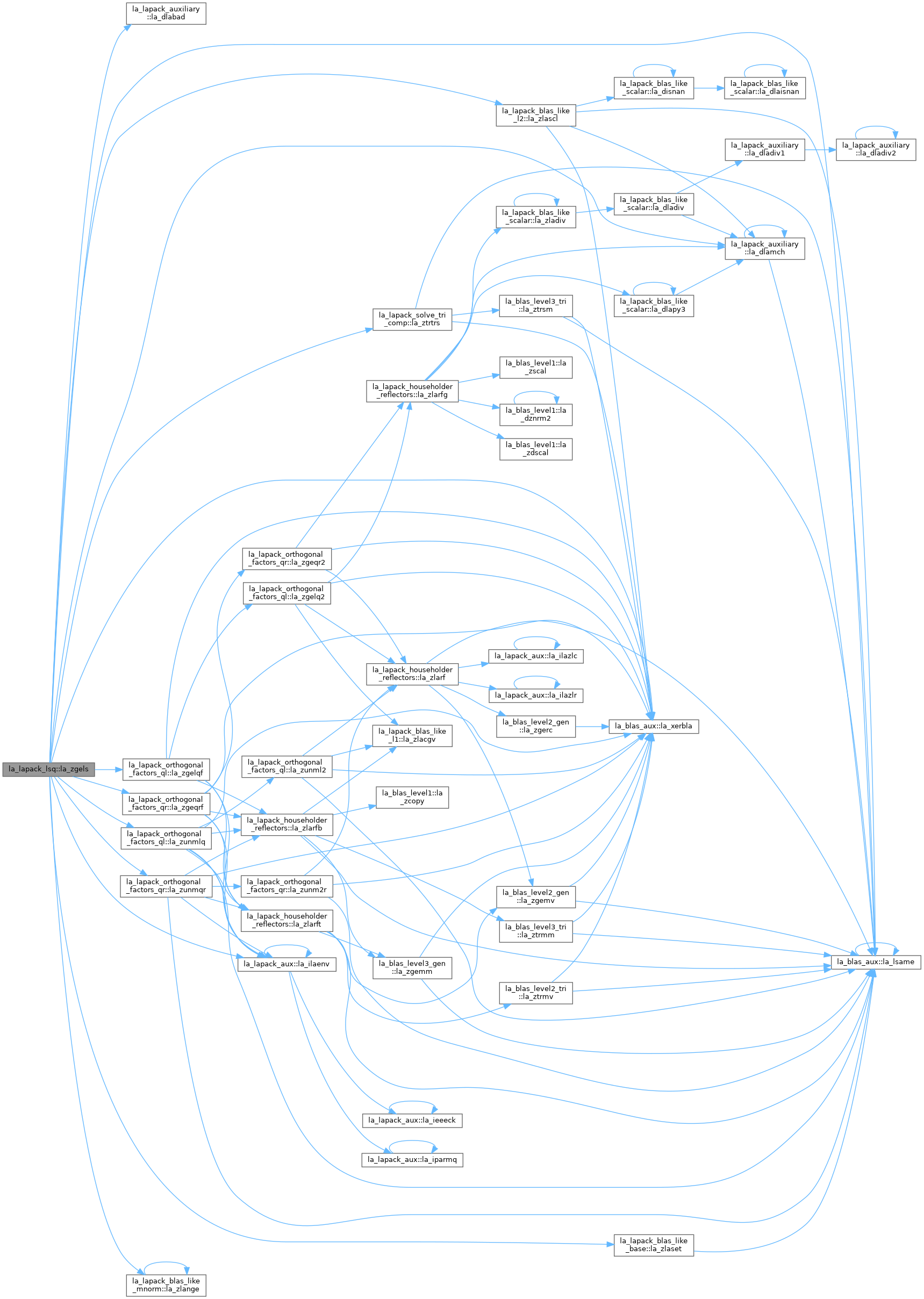
◆ la_zgelsd()
| subroutine, public la_lapack_lsq::la_zgelsd | ( | integer(ilp), intent(in) | m, |
| integer(ilp), intent(in) | n, | ||
| integer(ilp), intent(in) | nrhs, | ||
| complex(dp), dimension(lda,*), intent(inout) | a, | ||
| integer(ilp), intent(in) | lda, | ||
| complex(dp), dimension(ldb,*), intent(inout) | b, | ||
| integer(ilp), intent(in) | ldb, | ||
| real(dp), dimension(*), intent(out) | s, | ||
| real(dp), intent(in) | rcond, | ||
| integer(ilp), intent(out) | rank, | ||
| complex(dp), dimension(*), intent(out) | work, | ||
| integer(ilp), intent(in) | lwork, | ||
| real(dp), dimension(*), intent(out) | rwork, | ||
| integer(ilp), dimension(*), intent(out) | iwork, | ||
| integer(ilp), intent(out) | info ) |
ZGELSD: computes the minimum-norm solution to a real linear least squares problem: minimize 2-norm(| b - A*x |) using the singular value decomposition (SVD) of A. A is an M-by-N matrix which may be rank-deficient. Several right hand side vectors b and solution vectors x can be handled in a single call; they are stored as the columns of the M-by-NRHS right hand side matrix B and the N-by-NRHS solution matrix X. The problem is solved in three steps: (1) Reduce the coefficient matrix A to bidiagonal form with Householder transformations, reducing the original problem into a "bidiagonal least squares problem" (BLS) (2) Solve the BLS using a divide and conquer approach. (3) Apply back all the Householder transformations to solve the original least squares problem. The effective rank of A is determined by treating as zero those singular values which are less than RCOND times the largest singular value. The divide and conquer algorithm makes very mild assumptions about floating point arithmetic. It will work on machines with a guard digit in add/subtract, or on those binary machines without guard digits which subtract like the Cray X-MP, Cray Y-MP, Cray C-90, or Cray-2. It could conceivably fail on hexadecimal or decimal machines without guard digits, but we know of none.
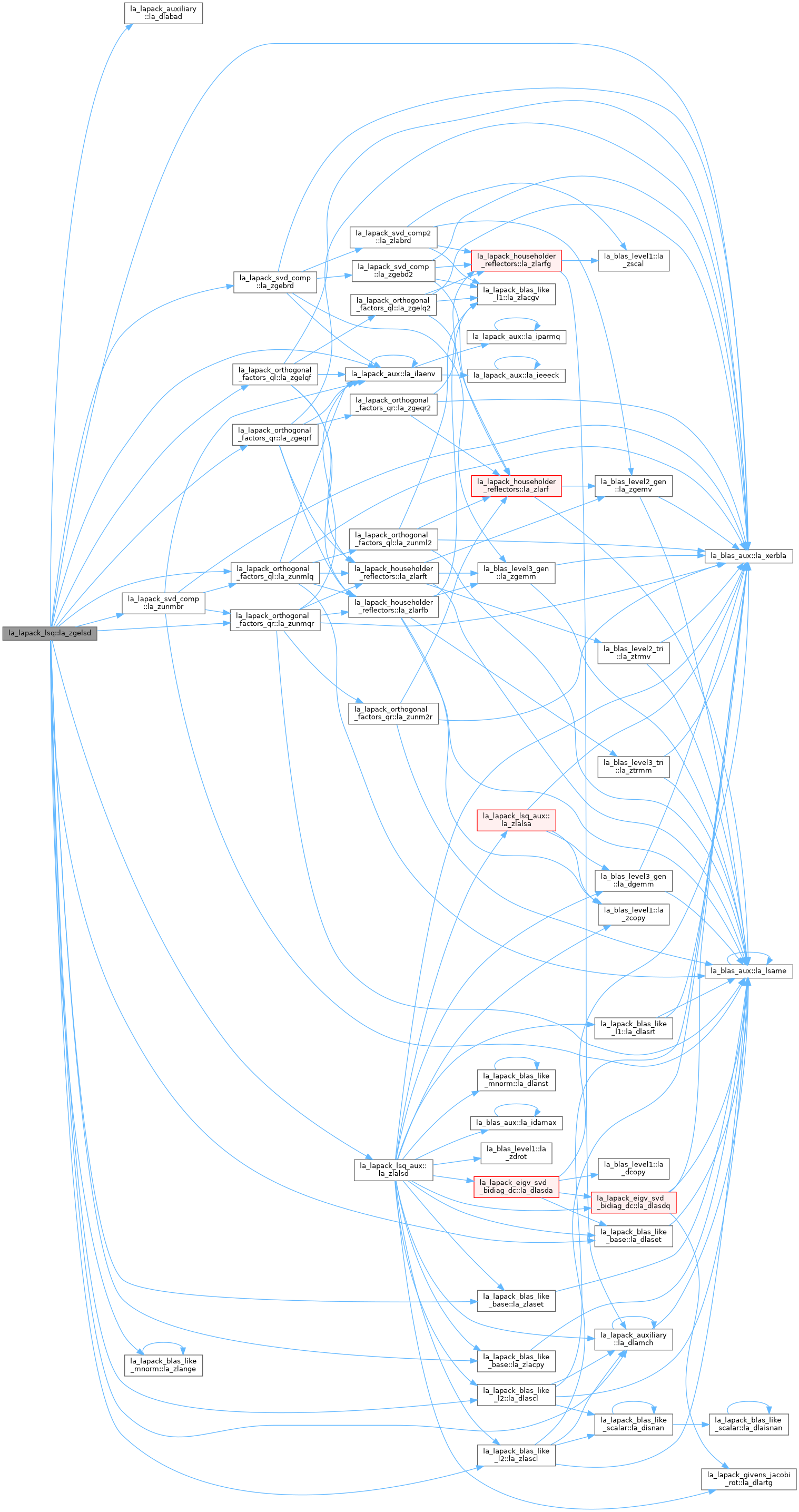
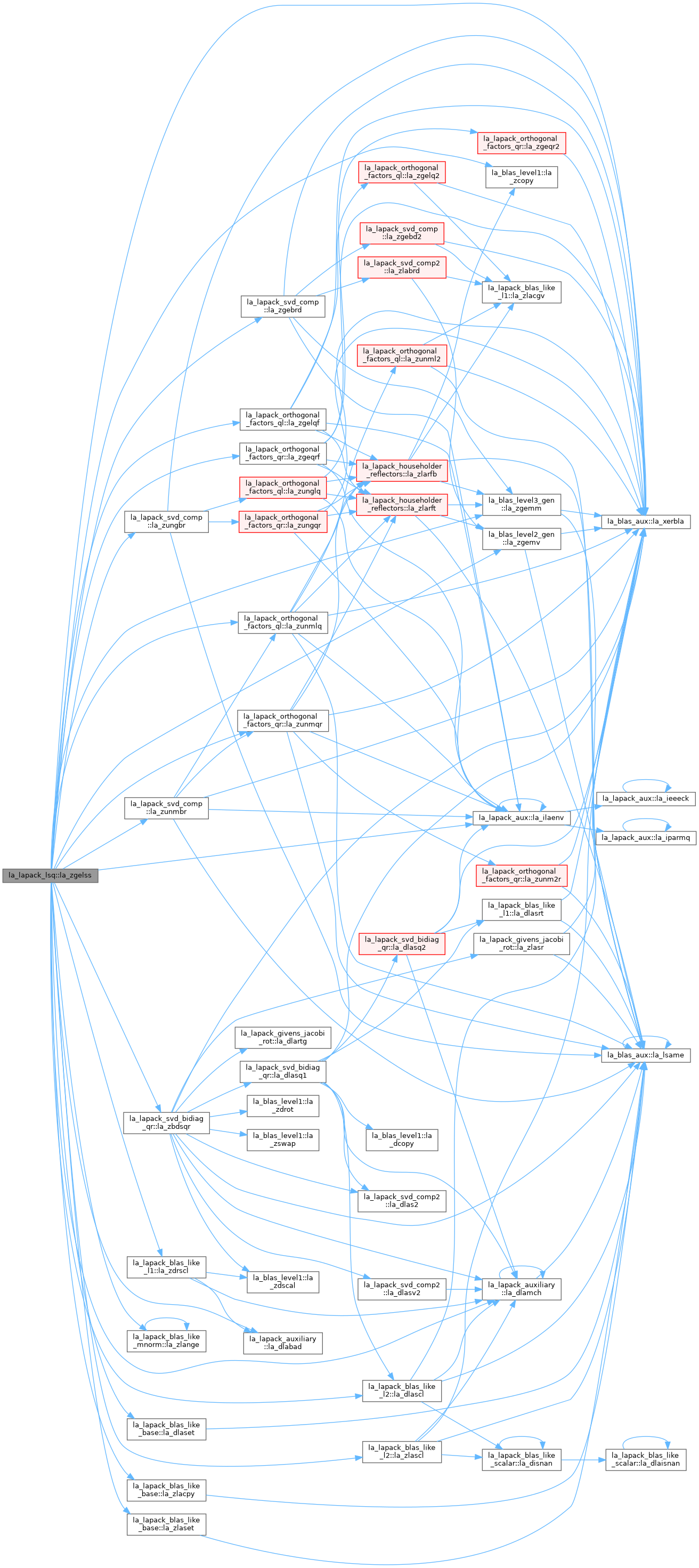
◆ la_zgelss()
| subroutine, public la_lapack_lsq::la_zgelss | ( | integer(ilp), intent(in) | m, |
| integer(ilp), intent(in) | n, | ||
| integer(ilp), intent(in) | nrhs, | ||
| complex(dp), dimension(lda,*), intent(inout) | a, | ||
| integer(ilp), intent(in) | lda, | ||
| complex(dp), dimension(ldb,*), intent(inout) | b, | ||
| integer(ilp), intent(in) | ldb, | ||
| real(dp), dimension(*), intent(out) | s, | ||
| real(dp), intent(in) | rcond, | ||
| integer(ilp), intent(out) | rank, | ||
| complex(dp), dimension(*), intent(out) | work, | ||
| integer(ilp), intent(in) | lwork, | ||
| real(dp), dimension(*), intent(out) | rwork, | ||
| integer(ilp), intent(out) | info ) |
ZGELSS: computes the minimum norm solution to a complex linear least squares problem: Minimize 2-norm(| b - A*x |). using the singular value decomposition (SVD) of A. A is an M-by-N matrix which may be rank-deficient. Several right hand side vectors b and solution vectors x can be handled in a single call; they are stored as the columns of the M-by-NRHS right hand side matrix B and the N-by-NRHS solution matrix X. The effective rank of A is determined by treating as zero those singular values which are less than RCOND times the largest singular value.
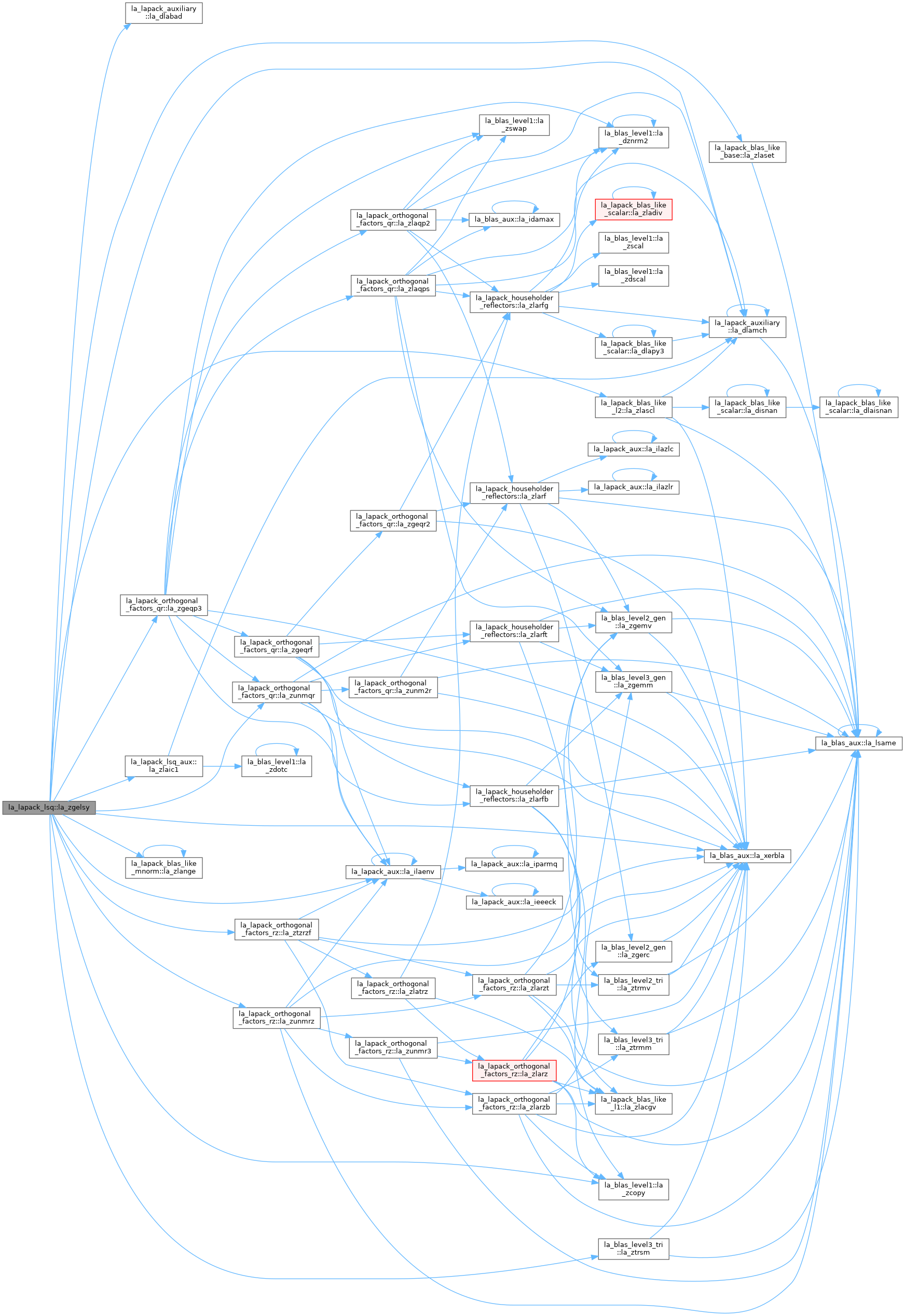
◆ la_zgelsy()
| subroutine, public la_lapack_lsq::la_zgelsy | ( | integer(ilp), intent(in) | m, |
| integer(ilp), intent(in) | n, | ||
| integer(ilp), intent(in) | nrhs, | ||
| complex(dp), dimension(lda,*), intent(inout) | a, | ||
| integer(ilp), intent(in) | lda, | ||
| complex(dp), dimension(ldb,*), intent(inout) | b, | ||
| integer(ilp), intent(in) | ldb, | ||
| integer(ilp), dimension(*), intent(inout) | jpvt, | ||
| real(dp), intent(in) | rcond, | ||
| integer(ilp), intent(out) | rank, | ||
| complex(dp), dimension(*), intent(out) | work, | ||
| integer(ilp), intent(in) | lwork, | ||
| real(dp), dimension(*), intent(out) | rwork, | ||
| integer(ilp), intent(out) | info ) |
ZGELSY: computes the minimum-norm solution to a complex linear least squares problem: minimize || A * X - B || using a complete orthogonal factorization of A. A is an M-by-N matrix which may be rank-deficient. Several right hand side vectors b and solution vectors x can be handled in a single call; they are stored as the columns of the M-by-NRHS right hand side matrix B and the N-by-NRHS solution matrix X. The routine first computes a QR factorization with column pivoting: A * P = Q * [ R11 R12 ] [ 0 R22 ] with R11 defined as the largest leading submatrix whose estimated condition number is less than 1/RCOND. The order of R11, RANK, is the effective rank of A. Then, R22 is considered to be negligible, and R12 is annihilated by unitary transformations from the right, arriving at the complete orthogonal factorization: A * P = Q * [ T11 0 ] * Z [ 0 0 ] The minimum-norm solution is then X = P * Z**H [ inv(T11)*Q1**H*B ] [ 0 ] where Q1 consists of the first RANK columns of Q. This routine is basically identical to the original xGELSX except three differences: o The permutation of matrix B (the right hand side) is faster and more simple. o The call to the subroutine xGEQPF has been substituted by the the call to the subroutine xGEQP3. This subroutine is a Blas-3 version of the QR factorization with column pivoting. o Matrix B (the right hand side) is updated with Blas-3.
◆ la_zgetsls()
| subroutine, public la_lapack_lsq::la_zgetsls | ( | character, intent(in) | trans, |
| integer(ilp), intent(in) | m, | ||
| integer(ilp), intent(in) | n, | ||
| integer(ilp), intent(in) | nrhs, | ||
| complex(dp), dimension(lda,*), intent(inout) | a, | ||
| integer(ilp), intent(in) | lda, | ||
| complex(dp), dimension(ldb,*), intent(inout) | b, | ||
| integer(ilp), intent(in) | ldb, | ||
| complex(dp), dimension(*), intent(out) | work, | ||
| integer(ilp), intent(in) | lwork, | ||
| integer(ilp), intent(out) | info ) |
ZGETSLS: solves overdetermined or underdetermined complex linear systems involving an M-by-N matrix A, using a tall skinny QR or short wide LQ factorization of A. It is assumed that A has full rank. The following options are provided:
- If TRANS = 'N' and m >= n: find the least squares solution of an overdetermined system, i.e., solve the least squares problem minimize || B - A*X ||.
- If TRANS = 'N' and m < n: find the minimum norm solution of an underdetermined system A * X = B.
- If TRANS = 'C' and m >= n: find the minimum norm solution of an undetermined system A**T * X = B.
- If TRANS = 'C' and m < n: find the least squares solution of an overdetermined system, i.e., solve the least squares problem minimize || B - A**T * X ||. Several right hand side vectors b and solution vectors x can be handled in a single call; they are stored as the columns of the M-by-NRHS right hand side matrix B and the N-by-NRHS solution matrix X.