Constrained least squares: equality constraints and the general Gauss-Markov model. More...
Functions/Subroutines | |
| pure subroutine, public | la_sggglm (n, m, p, a, lda, b, ldb, d, x, y, work, lwork, info) |
| SGGGLM: solves a general Gauss-Markov linear model (GLM) problem: minimize || y ||_2 subject to d = A*x + B*y x where A is an N-by-M matrix, B is an N-by-P matrix, and d is a given N-vector. It is assumed that M <= N <= M+P, and rank(A) = M and rank( A B ) = N. Under these assumptions, the constrained equation is always consistent, and there is a unique solution x and a minimal 2-norm solution y, which is obtained using a generalized QR factorization of the matrices (A, B) given by A = Q*(R), B = Q*T*Z. (0) In particular, if matrix B is square nonsingular, then the problem GLM is equivalent to the following weighted linear least squares problem minimize || inv(B)*(d-A*x) ||_2 x where inv(B) denotes the inverse of B. | |
| pure subroutine, public | la_dggglm (n, m, p, a, lda, b, ldb, d, x, y, work, lwork, info) |
| DGGGLM: solves a general Gauss-Markov linear model (GLM) problem: minimize || y ||_2 subject to d = A*x + B*y x where A is an N-by-M matrix, B is an N-by-P matrix, and d is a given N-vector. It is assumed that M <= N <= M+P, and rank(A) = M and rank( A B ) = N. Under these assumptions, the constrained equation is always consistent, and there is a unique solution x and a minimal 2-norm solution y, which is obtained using a generalized QR factorization of the matrices (A, B) given by A = Q*(R), B = Q*T*Z. (0) In particular, if matrix B is square nonsingular, then the problem GLM is equivalent to the following weighted linear least squares problem minimize || inv(B)*(d-A*x) ||_2 x where inv(B) denotes the inverse of B. | |
| pure subroutine, public | la_qggglm (n, m, p, a, lda, b, ldb, d, x, y, work, lwork, info) |
| QGGGLM: solves a general Gauss-Markov linear model (GLM) problem: minimize || y ||_2 subject to d = A*x + B*y x where A is an N-by-M matrix, B is an N-by-P matrix, and d is a given N-vector. It is assumed that M <= N <= M+P, and rank(A) = M and rank( A B ) = N. Under these assumptions, the constrained equation is always consistent, and there is a unique solution x and a minimal 2-norm solution y, which is obtained using a generalized QR factorization of the matrices (A, B) given by A = Q*(R), B = Q*T*Z. (0) In particular, if matrix B is square nonsingular, then the problem GLM is equivalent to the following weighted linear least squares problem minimize || inv(B)*(d-A*x) ||_2 x where inv(B) denotes the inverse of B. | |
| pure subroutine, public | la_sgglse (m, n, p, a, lda, b, ldb, c, d, x, work, lwork, info) |
| SGGLSE: solves the linear equality-constrained least squares (LSE) problem: minimize || c - A*x ||_2 subject to B*x = d where A is an M-by-N matrix, B is a P-by-N matrix, c is a given M-vector, and d is a given P-vector. It is assumed that P <= N <= M+P, and rank(B) = P and rank( (A) ) = N. ( (B) ) These conditions ensure that the LSE problem has a unique solution, which is obtained using a generalized RQ factorization of the matrices (B, A) given by B = (0 R)*Q, A = Z*T*Q. | |
| pure subroutine, public | la_dgglse (m, n, p, a, lda, b, ldb, c, d, x, work, lwork, info) |
| DGGLSE: solves the linear equality-constrained least squares (LSE) problem: minimize || c - A*x ||_2 subject to B*x = d where A is an M-by-N matrix, B is a P-by-N matrix, c is a given M-vector, and d is a given P-vector. It is assumed that P <= N <= M+P, and rank(B) = P and rank( (A) ) = N. ( (B) ) These conditions ensure that the LSE problem has a unique solution, which is obtained using a generalized RQ factorization of the matrices (B, A) given by B = (0 R)*Q, A = Z*T*Q. | |
| pure subroutine, public | la_qgglse (m, n, p, a, lda, b, ldb, c, d, x, work, lwork, info) |
| QGGLSE: solves the linear equality-constrained least squares (LSE) problem: minimize || c - A*x ||_2 subject to B*x = d where A is an M-by-N matrix, B is a P-by-N matrix, c is a given M-vector, and d is a given P-vector. It is assumed that P <= N <= M+P, and rank(B) = P and rank( (A) ) = N. ( (B) ) These conditions ensure that the LSE problem has a unique solution, which is obtained using a generalized RQ factorization of the matrices (B, A) given by B = (0 R)*Q, A = Z*T*Q. | |
| pure subroutine, public | la_cggglm (n, m, p, a, lda, b, ldb, d, x, y, work, lwork, info) |
| CGGGLM: solves a general Gauss-Markov linear model (GLM) problem: minimize || y ||_2 subject to d = A*x + B*y x where A is an N-by-M matrix, B is an N-by-P matrix, and d is a given N-vector. It is assumed that M <= N <= M+P, and rank(A) = M and rank( A B ) = N. Under these assumptions, the constrained equation is always consistent, and there is a unique solution x and a minimal 2-norm solution y, which is obtained using a generalized QR factorization of the matrices (A, B) given by A = Q*(R), B = Q*T*Z. (0) In particular, if matrix B is square nonsingular, then the problem GLM is equivalent to the following weighted linear least squares problem minimize || inv(B)*(d-A*x) ||_2 x where inv(B) denotes the inverse of B. | |
| pure subroutine, public | la_zggglm (n, m, p, a, lda, b, ldb, d, x, y, work, lwork, info) |
| ZGGGLM: solves a general Gauss-Markov linear model (GLM) problem: minimize || y ||_2 subject to d = A*x + B*y x where A is an N-by-M matrix, B is an N-by-P matrix, and d is a given N-vector. It is assumed that M <= N <= M+P, and rank(A) = M and rank( A B ) = N. Under these assumptions, the constrained equation is always consistent, and there is a unique solution x and a minimal 2-norm solution y, which is obtained using a generalized QR factorization of the matrices (A, B) given by A = Q*(R), B = Q*T*Z. (0) In particular, if matrix B is square nonsingular, then the problem GLM is equivalent to the following weighted linear least squares problem minimize || inv(B)*(d-A*x) ||_2 x where inv(B) denotes the inverse of B. | |
| pure subroutine, public | la_wggglm (n, m, p, a, lda, b, ldb, d, x, y, work, lwork, info) |
| WGGGLM: solves a general Gauss-Markov linear model (GLM) problem: minimize || y ||_2 subject to d = A*x + B*y x where A is an N-by-M matrix, B is an N-by-P matrix, and d is a given N-vector. It is assumed that M <= N <= M+P, and rank(A) = M and rank( A B ) = N. Under these assumptions, the constrained equation is always consistent, and there is a unique solution x and a minimal 2-norm solution y, which is obtained using a generalized QR factorization of the matrices (A, B) given by A = Q*(R), B = Q*T*Z. (0) In particular, if matrix B is square nonsingular, then the problem GLM is equivalent to the following weighted linear least squares problem minimize || inv(B)*(d-A*x) ||_2 x where inv(B) denotes the inverse of B. | |
| pure subroutine, public | la_cgglse (m, n, p, a, lda, b, ldb, c, d, x, work, lwork, info) |
| CGGLSE: solves the linear equality-constrained least squares (LSE) problem: minimize || c - A*x ||_2 subject to B*x = d where A is an M-by-N matrix, B is a P-by-N matrix, c is a given M-vector, and d is a given P-vector. It is assumed that P <= N <= M+P, and rank(B) = P and rank( (A) ) = N. ( (B) ) These conditions ensure that the LSE problem has a unique solution, which is obtained using a generalized RQ factorization of the matrices (B, A) given by B = (0 R)*Q, A = Z*T*Q. | |
| pure subroutine, public | la_zgglse (m, n, p, a, lda, b, ldb, c, d, x, work, lwork, info) |
| ZGGLSE: solves the linear equality-constrained least squares (LSE) problem: minimize || c - A*x ||_2 subject to B*x = d where A is an M-by-N matrix, B is a P-by-N matrix, c is a given M-vector, and d is a given P-vector. It is assumed that P <= N <= M+P, and rank(B) = P and rank( (A) ) = N. ( (B) ) These conditions ensure that the LSE problem has a unique solution, which is obtained using a generalized RQ factorization of the matrices (B, A) given by B = (0 R)*Q, A = Z*T*Q. | |
| pure subroutine, public | la_wgglse (m, n, p, a, lda, b, ldb, c, d, x, work, lwork, info) |
| WGGLSE: solves the linear equality-constrained least squares (LSE) problem: minimize || c - A*x ||_2 subject to B*x = d where A is an M-by-N matrix, B is a P-by-N matrix, c is a given M-vector, and d is a given P-vector. It is assumed that P <= N <= M+P, and rank(B) = P and rank( (A) ) = N. ( (B) ) These conditions ensure that the LSE problem has a unique solution, which is obtained using a generalized RQ factorization of the matrices (B, A) given by B = (0 R)*Q, A = Z*T*Q. | |
Detailed Description
Constrained least squares: equality constraints and the general Gauss-Markov model.
Function/Subroutine Documentation
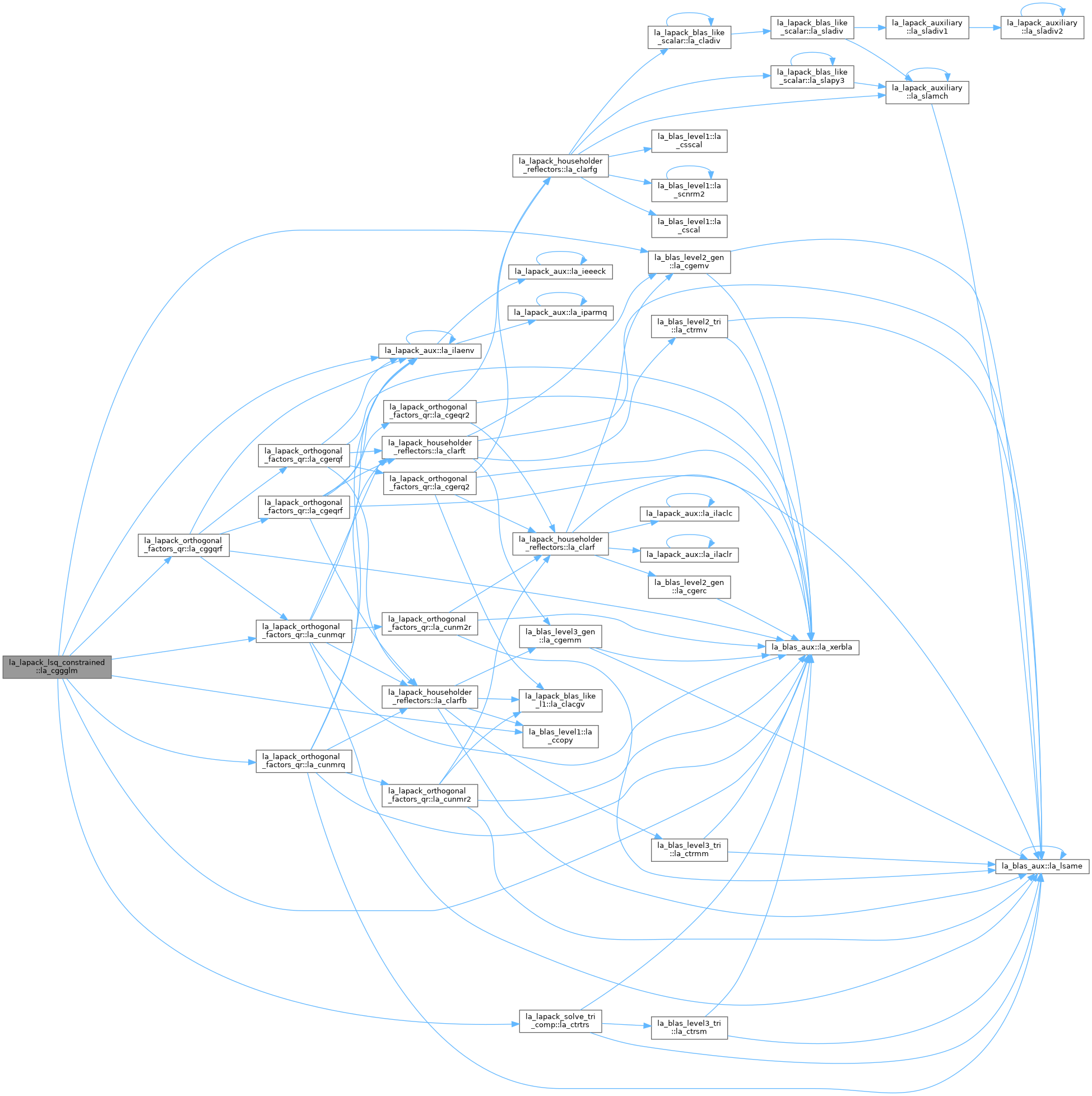
◆ la_cggglm()
| pure subroutine, public la_lapack_lsq_constrained::la_cggglm | ( | integer(ilp), intent(in) | n, |
| integer(ilp), intent(in) | m, | ||
| integer(ilp), intent(in) | p, | ||
| complex(sp), dimension(lda,*), intent(inout) | a, | ||
| integer(ilp), intent(in) | lda, | ||
| complex(sp), dimension(ldb,*), intent(inout) | b, | ||
| integer(ilp), intent(in) | ldb, | ||
| complex(sp), dimension(*), intent(inout) | d, | ||
| complex(sp), dimension(*), intent(out) | x, | ||
| complex(sp), dimension(*), intent(out) | y, | ||
| complex(sp), dimension(*), intent(out) | work, | ||
| integer(ilp), intent(in) | lwork, | ||
| integer(ilp), intent(out) | info ) |
CGGGLM: solves a general Gauss-Markov linear model (GLM) problem: minimize || y ||_2 subject to d = A*x + B*y x where A is an N-by-M matrix, B is an N-by-P matrix, and d is a given N-vector. It is assumed that M <= N <= M+P, and rank(A) = M and rank( A B ) = N. Under these assumptions, the constrained equation is always consistent, and there is a unique solution x and a minimal 2-norm solution y, which is obtained using a generalized QR factorization of the matrices (A, B) given by A = Q*(R), B = Q*T*Z. (0) In particular, if matrix B is square nonsingular, then the problem GLM is equivalent to the following weighted linear least squares problem minimize || inv(B)*(d-A*x) ||_2 x where inv(B) denotes the inverse of B.
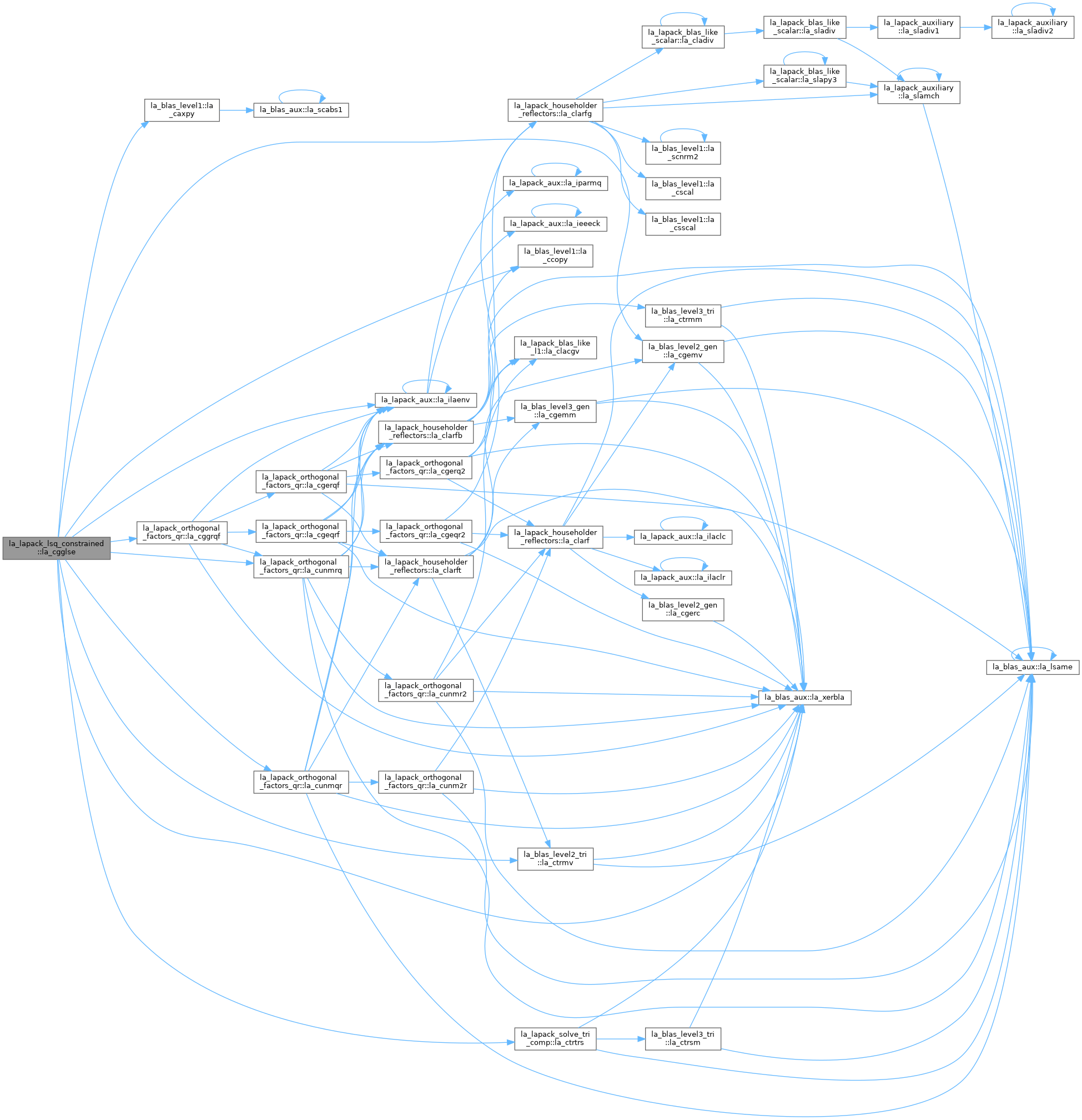
◆ la_cgglse()
| pure subroutine, public la_lapack_lsq_constrained::la_cgglse | ( | integer(ilp), intent(in) | m, |
| integer(ilp), intent(in) | n, | ||
| integer(ilp), intent(in) | p, | ||
| complex(sp), dimension(lda,*), intent(inout) | a, | ||
| integer(ilp), intent(in) | lda, | ||
| complex(sp), dimension(ldb,*), intent(inout) | b, | ||
| integer(ilp), intent(in) | ldb, | ||
| complex(sp), dimension(*), intent(inout) | c, | ||
| complex(sp), dimension(*), intent(inout) | d, | ||
| complex(sp), dimension(*), intent(out) | x, | ||
| complex(sp), dimension(*), intent(out) | work, | ||
| integer(ilp), intent(in) | lwork, | ||
| integer(ilp), intent(out) | info ) |
CGGLSE: solves the linear equality-constrained least squares (LSE) problem: minimize || c - A*x ||_2 subject to B*x = d where A is an M-by-N matrix, B is a P-by-N matrix, c is a given M-vector, and d is a given P-vector. It is assumed that P <= N <= M+P, and rank(B) = P and rank( (A) ) = N. ( (B) ) These conditions ensure that the LSE problem has a unique solution, which is obtained using a generalized RQ factorization of the matrices (B, A) given by B = (0 R)*Q, A = Z*T*Q.
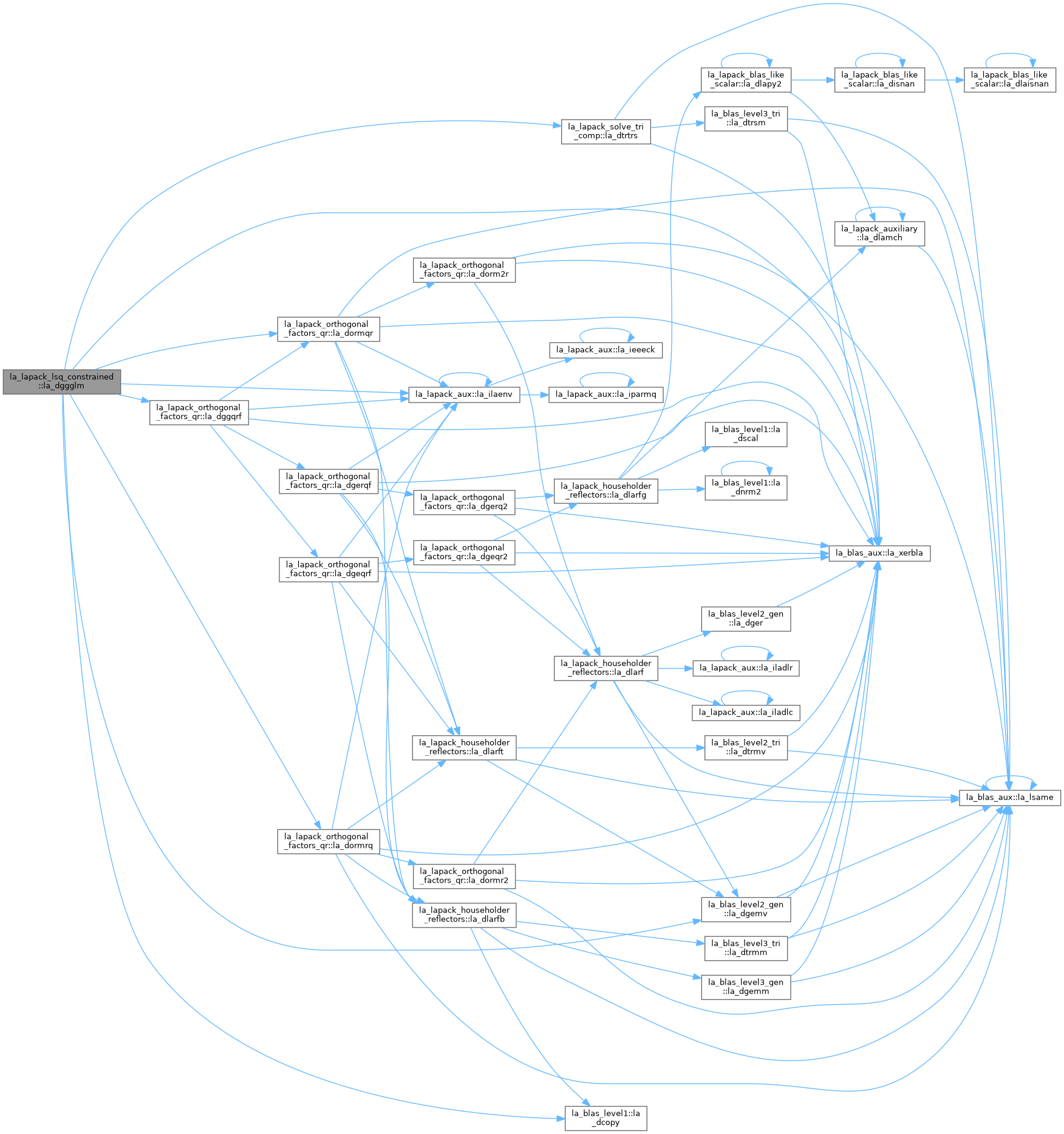
◆ la_dggglm()
| pure subroutine, public la_lapack_lsq_constrained::la_dggglm | ( | integer(ilp), intent(in) | n, |
| integer(ilp), intent(in) | m, | ||
| integer(ilp), intent(in) | p, | ||
| real(dp), dimension(lda,*), intent(inout) | a, | ||
| integer(ilp), intent(in) | lda, | ||
| real(dp), dimension(ldb,*), intent(inout) | b, | ||
| integer(ilp), intent(in) | ldb, | ||
| real(dp), dimension(*), intent(inout) | d, | ||
| real(dp), dimension(*), intent(out) | x, | ||
| real(dp), dimension(*), intent(out) | y, | ||
| real(dp), dimension(*), intent(out) | work, | ||
| integer(ilp), intent(in) | lwork, | ||
| integer(ilp), intent(out) | info ) |
DGGGLM: solves a general Gauss-Markov linear model (GLM) problem: minimize || y ||_2 subject to d = A*x + B*y x where A is an N-by-M matrix, B is an N-by-P matrix, and d is a given N-vector. It is assumed that M <= N <= M+P, and rank(A) = M and rank( A B ) = N. Under these assumptions, the constrained equation is always consistent, and there is a unique solution x and a minimal 2-norm solution y, which is obtained using a generalized QR factorization of the matrices (A, B) given by A = Q*(R), B = Q*T*Z. (0) In particular, if matrix B is square nonsingular, then the problem GLM is equivalent to the following weighted linear least squares problem minimize || inv(B)*(d-A*x) ||_2 x where inv(B) denotes the inverse of B.
◆ la_dgglse()
| pure subroutine, public la_lapack_lsq_constrained::la_dgglse | ( | integer(ilp), intent(in) | m, |
| integer(ilp), intent(in) | n, | ||
| integer(ilp), intent(in) | p, | ||
| real(dp), dimension(lda,*), intent(inout) | a, | ||
| integer(ilp), intent(in) | lda, | ||
| real(dp), dimension(ldb,*), intent(inout) | b, | ||
| integer(ilp), intent(in) | ldb, | ||
| real(dp), dimension(*), intent(inout) | c, | ||
| real(dp), dimension(*), intent(inout) | d, | ||
| real(dp), dimension(*), intent(out) | x, | ||
| real(dp), dimension(*), intent(out) | work, | ||
| integer(ilp), intent(in) | lwork, | ||
| integer(ilp), intent(out) | info ) |
DGGLSE: solves the linear equality-constrained least squares (LSE) problem: minimize || c - A*x ||_2 subject to B*x = d where A is an M-by-N matrix, B is a P-by-N matrix, c is a given M-vector, and d is a given P-vector. It is assumed that P <= N <= M+P, and rank(B) = P and rank( (A) ) = N. ( (B) ) These conditions ensure that the LSE problem has a unique solution, which is obtained using a generalized RQ factorization of the matrices (B, A) given by B = (0 R)*Q, A = Z*T*Q.
◆ la_qggglm()
| pure subroutine, public la_lapack_lsq_constrained::la_qggglm | ( | integer(ilp), intent(in) | n, |
| integer(ilp), intent(in) | m, | ||
| integer(ilp), intent(in) | p, | ||
| real(qp), dimension(lda,*), intent(inout) | a, | ||
| integer(ilp), intent(in) | lda, | ||
| real(qp), dimension(ldb,*), intent(inout) | b, | ||
| integer(ilp), intent(in) | ldb, | ||
| real(qp), dimension(*), intent(inout) | d, | ||
| real(qp), dimension(*), intent(out) | x, | ||
| real(qp), dimension(*), intent(out) | y, | ||
| real(qp), dimension(*), intent(out) | work, | ||
| integer(ilp), intent(in) | lwork, | ||
| integer(ilp), intent(out) | info ) |
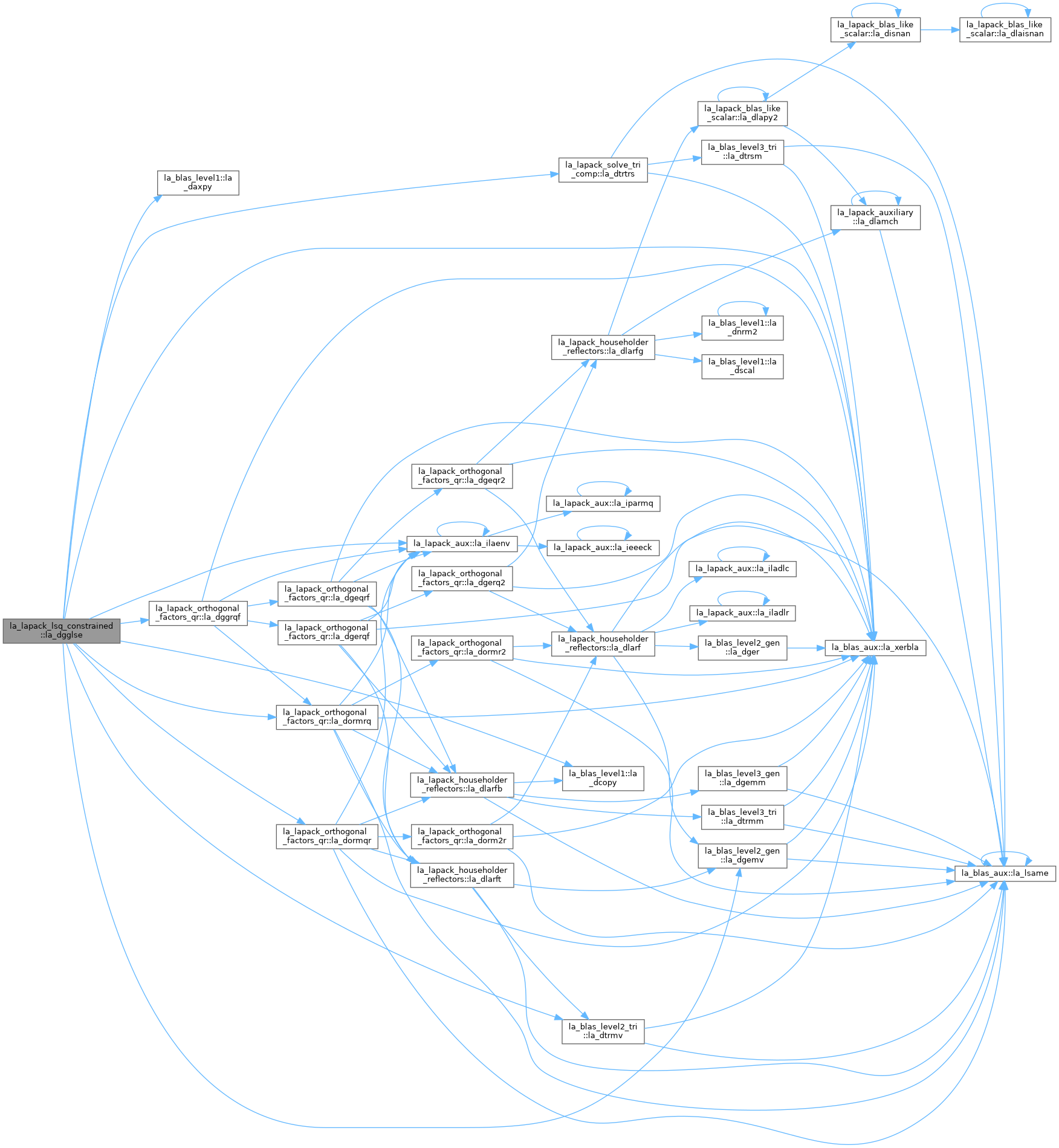
QGGGLM: solves a general Gauss-Markov linear model (GLM) problem: minimize || y ||_2 subject to d = A*x + B*y x where A is an N-by-M matrix, B is an N-by-P matrix, and d is a given N-vector. It is assumed that M <= N <= M+P, and rank(A) = M and rank( A B ) = N. Under these assumptions, the constrained equation is always consistent, and there is a unique solution x and a minimal 2-norm solution y, which is obtained using a generalized QR factorization of the matrices (A, B) given by A = Q*(R), B = Q*T*Z. (0) In particular, if matrix B is square nonsingular, then the problem GLM is equivalent to the following weighted linear least squares problem minimize || inv(B)*(d-A*x) ||_2 x where inv(B) denotes the inverse of B.
◆ la_qgglse()
| pure subroutine, public la_lapack_lsq_constrained::la_qgglse | ( | integer(ilp), intent(in) | m, |
| integer(ilp), intent(in) | n, | ||
| integer(ilp), intent(in) | p, | ||
| real(qp), dimension(lda,*), intent(inout) | a, | ||
| integer(ilp), intent(in) | lda, | ||
| real(qp), dimension(ldb,*), intent(inout) | b, | ||
| integer(ilp), intent(in) | ldb, | ||
| real(qp), dimension(*), intent(inout) | c, | ||
| real(qp), dimension(*), intent(inout) | d, | ||
| real(qp), dimension(*), intent(out) | x, | ||
| real(qp), dimension(*), intent(out) | work, | ||
| integer(ilp), intent(in) | lwork, | ||
| integer(ilp), intent(out) | info ) |
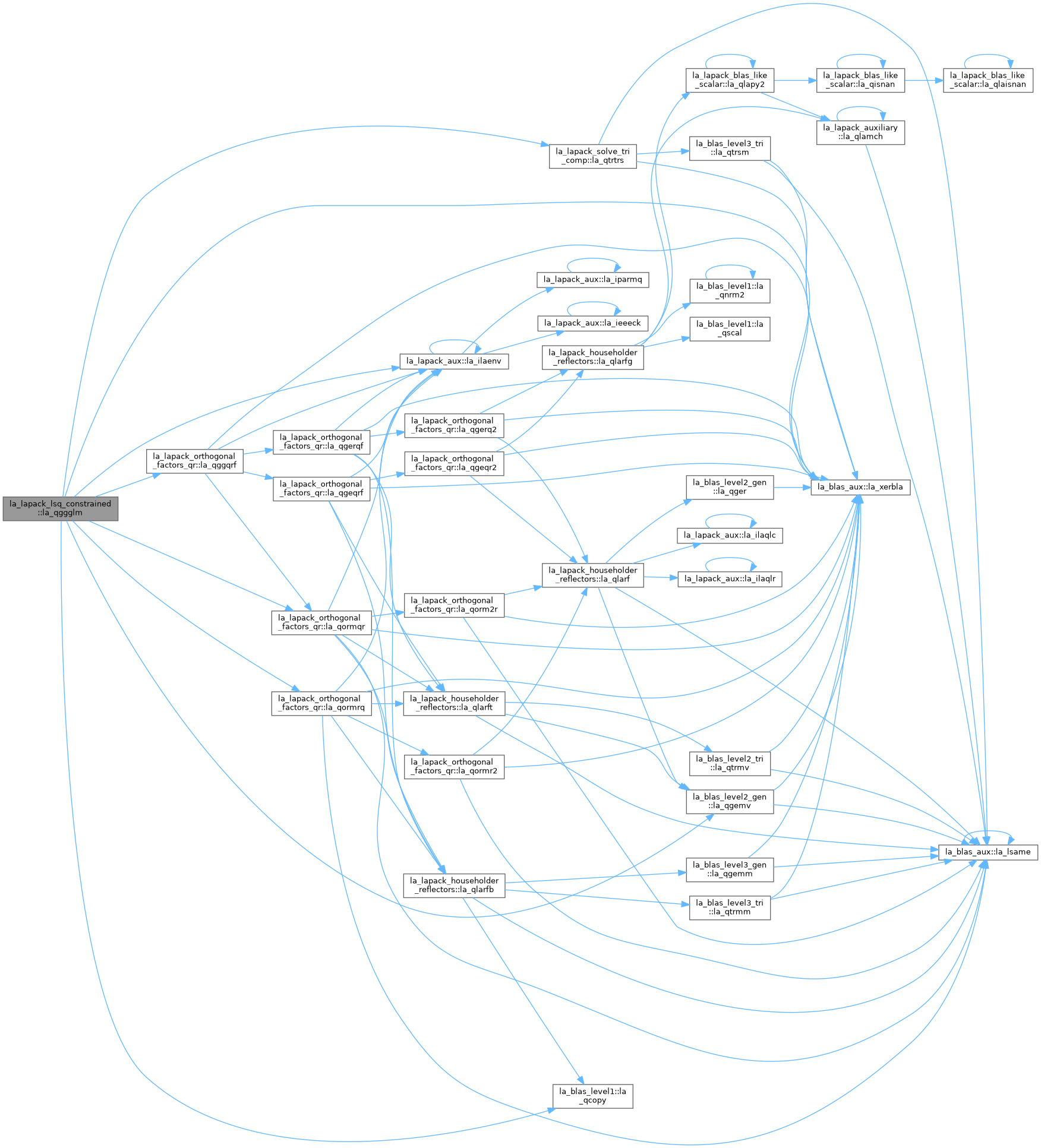
QGGLSE: solves the linear equality-constrained least squares (LSE) problem: minimize || c - A*x ||_2 subject to B*x = d where A is an M-by-N matrix, B is a P-by-N matrix, c is a given M-vector, and d is a given P-vector. It is assumed that P <= N <= M+P, and rank(B) = P and rank( (A) ) = N. ( (B) ) These conditions ensure that the LSE problem has a unique solution, which is obtained using a generalized RQ factorization of the matrices (B, A) given by B = (0 R)*Q, A = Z*T*Q.
◆ la_sggglm()
| pure subroutine, public la_lapack_lsq_constrained::la_sggglm | ( | integer(ilp), intent(in) | n, |
| integer(ilp), intent(in) | m, | ||
| integer(ilp), intent(in) | p, | ||
| real(sp), dimension(lda,*), intent(inout) | a, | ||
| integer(ilp), intent(in) | lda, | ||
| real(sp), dimension(ldb,*), intent(inout) | b, | ||
| integer(ilp), intent(in) | ldb, | ||
| real(sp), dimension(*), intent(inout) | d, | ||
| real(sp), dimension(*), intent(out) | x, | ||
| real(sp), dimension(*), intent(out) | y, | ||
| real(sp), dimension(*), intent(out) | work, | ||
| integer(ilp), intent(in) | lwork, | ||
| integer(ilp), intent(out) | info ) |
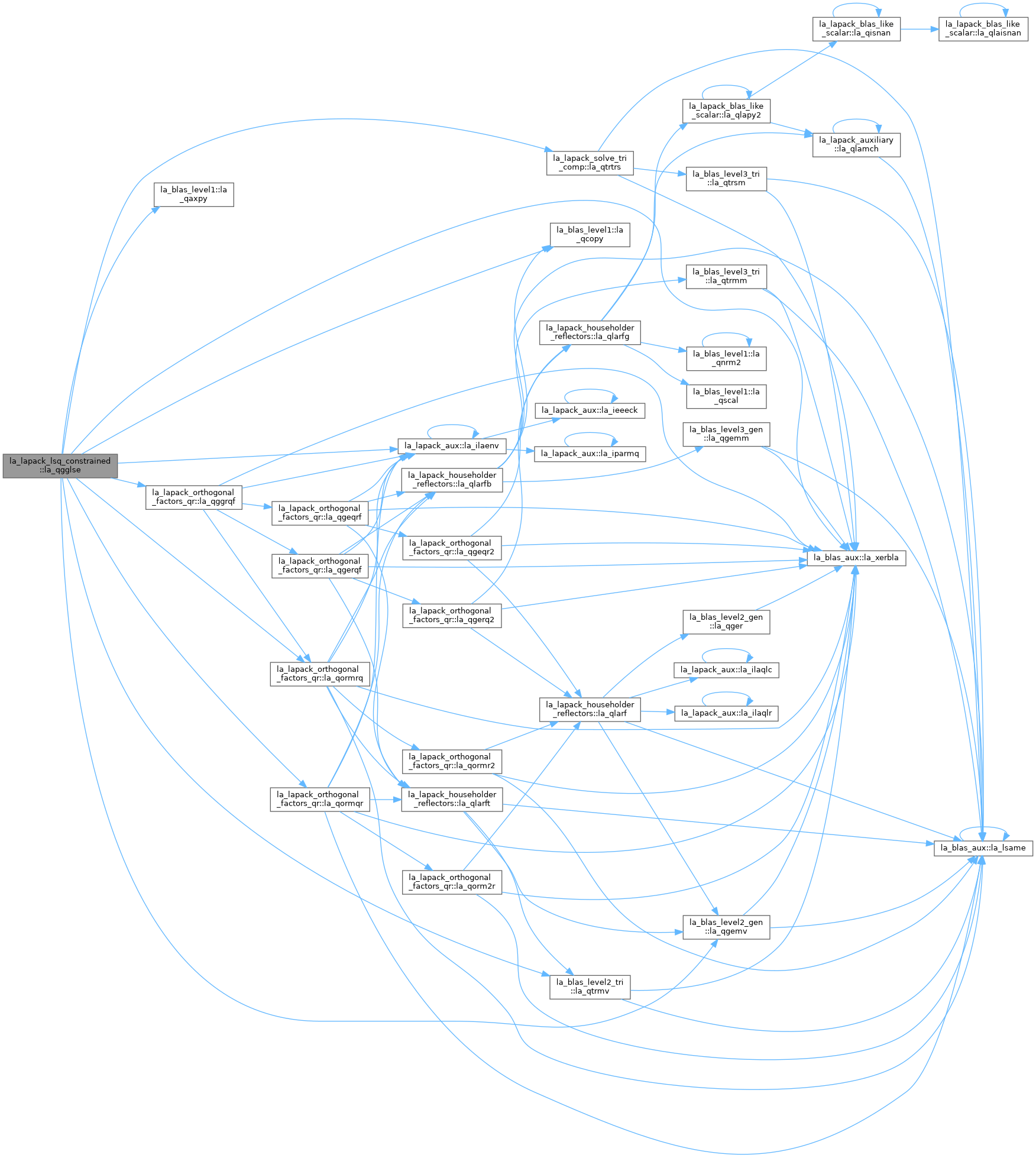
SGGGLM: solves a general Gauss-Markov linear model (GLM) problem: minimize || y ||_2 subject to d = A*x + B*y x where A is an N-by-M matrix, B is an N-by-P matrix, and d is a given N-vector. It is assumed that M <= N <= M+P, and rank(A) = M and rank( A B ) = N. Under these assumptions, the constrained equation is always consistent, and there is a unique solution x and a minimal 2-norm solution y, which is obtained using a generalized QR factorization of the matrices (A, B) given by A = Q*(R), B = Q*T*Z. (0) In particular, if matrix B is square nonsingular, then the problem GLM is equivalent to the following weighted linear least squares problem minimize || inv(B)*(d-A*x) ||_2 x where inv(B) denotes the inverse of B.
◆ la_sgglse()
| pure subroutine, public la_lapack_lsq_constrained::la_sgglse | ( | integer(ilp), intent(in) | m, |
| integer(ilp), intent(in) | n, | ||
| integer(ilp), intent(in) | p, | ||
| real(sp), dimension(lda,*), intent(inout) | a, | ||
| integer(ilp), intent(in) | lda, | ||
| real(sp), dimension(ldb,*), intent(inout) | b, | ||
| integer(ilp), intent(in) | ldb, | ||
| real(sp), dimension(*), intent(inout) | c, | ||
| real(sp), dimension(*), intent(inout) | d, | ||
| real(sp), dimension(*), intent(out) | x, | ||
| real(sp), dimension(*), intent(out) | work, | ||
| integer(ilp), intent(in) | lwork, | ||
| integer(ilp), intent(out) | info ) |
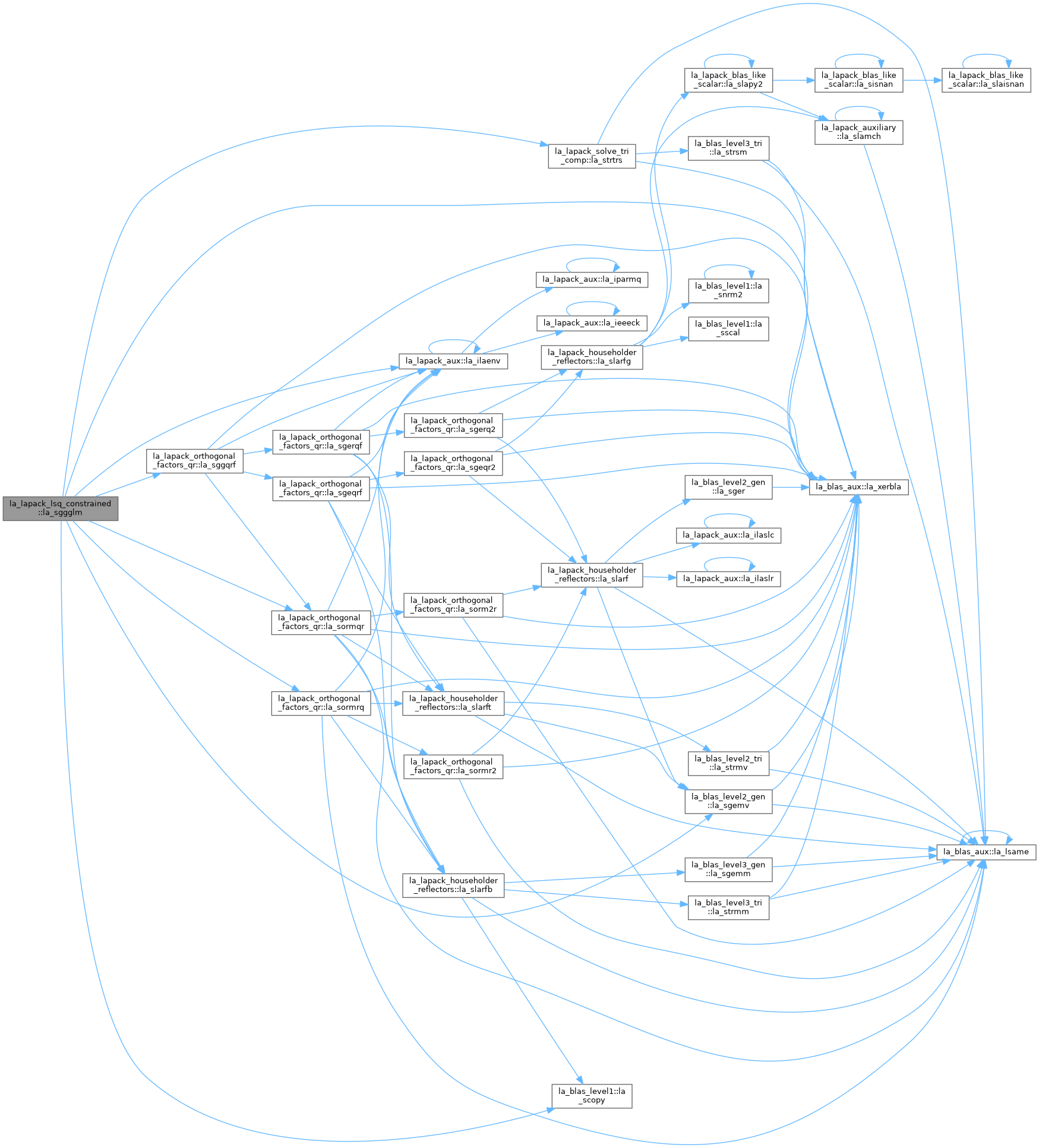
SGGLSE: solves the linear equality-constrained least squares (LSE) problem: minimize || c - A*x ||_2 subject to B*x = d where A is an M-by-N matrix, B is a P-by-N matrix, c is a given M-vector, and d is a given P-vector. It is assumed that P <= N <= M+P, and rank(B) = P and rank( (A) ) = N. ( (B) ) These conditions ensure that the LSE problem has a unique solution, which is obtained using a generalized RQ factorization of the matrices (B, A) given by B = (0 R)*Q, A = Z*T*Q.
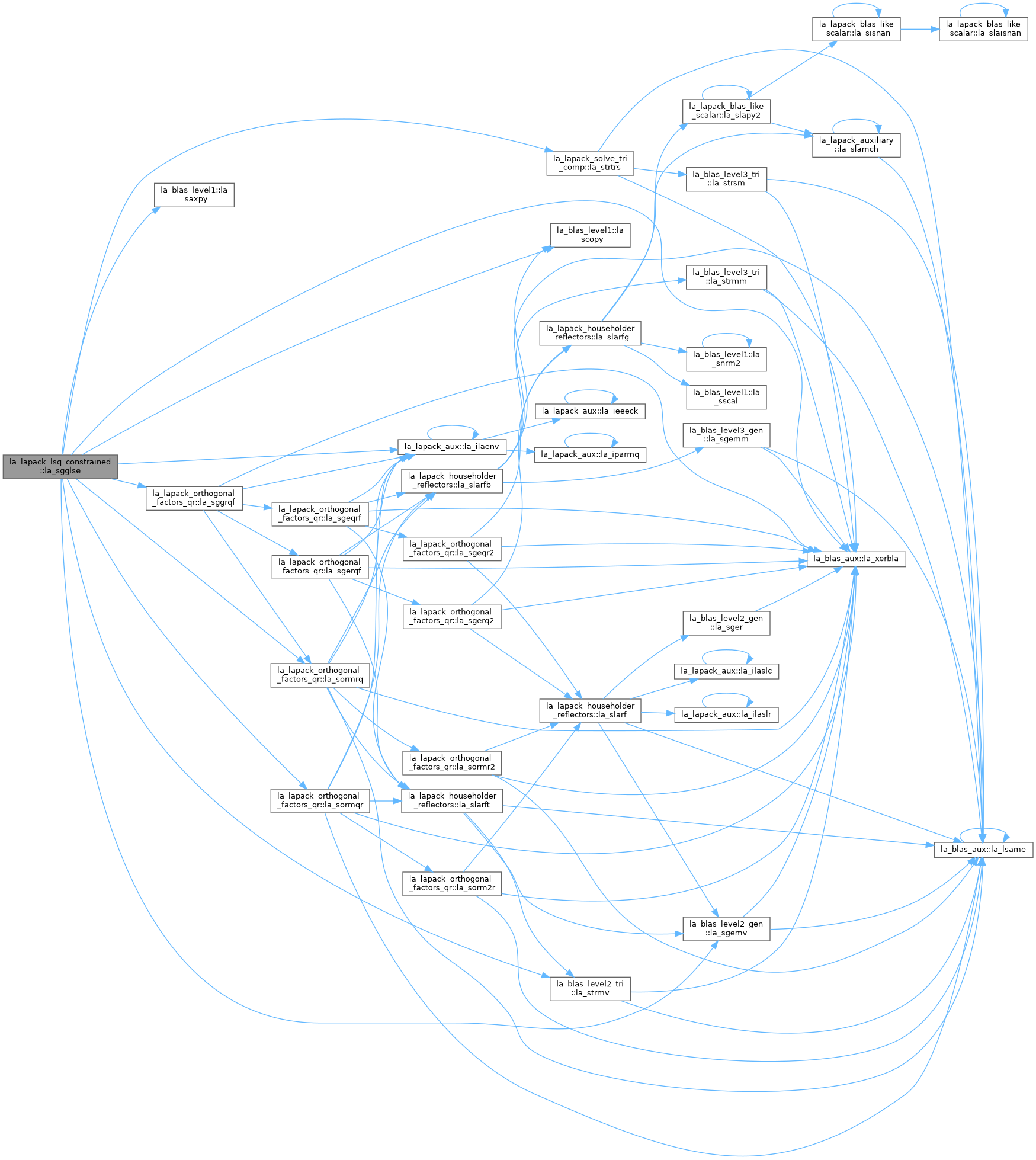
◆ la_wggglm()
| pure subroutine, public la_lapack_lsq_constrained::la_wggglm | ( | integer(ilp), intent(in) | n, |
| integer(ilp), intent(in) | m, | ||
| integer(ilp), intent(in) | p, | ||
| complex(qp), dimension(lda,*), intent(inout) | a, | ||
| integer(ilp), intent(in) | lda, | ||
| complex(qp), dimension(ldb,*), intent(inout) | b, | ||
| integer(ilp), intent(in) | ldb, | ||
| complex(qp), dimension(*), intent(inout) | d, | ||
| complex(qp), dimension(*), intent(out) | x, | ||
| complex(qp), dimension(*), intent(out) | y, | ||
| complex(qp), dimension(*), intent(out) | work, | ||
| integer(ilp), intent(in) | lwork, | ||
| integer(ilp), intent(out) | info ) |
WGGGLM: solves a general Gauss-Markov linear model (GLM) problem: minimize || y ||_2 subject to d = A*x + B*y x where A is an N-by-M matrix, B is an N-by-P matrix, and d is a given N-vector. It is assumed that M <= N <= M+P, and rank(A) = M and rank( A B ) = N. Under these assumptions, the constrained equation is always consistent, and there is a unique solution x and a minimal 2-norm solution y, which is obtained using a generalized QR factorization of the matrices (A, B) given by A = Q*(R), B = Q*T*Z. (0) In particular, if matrix B is square nonsingular, then the problem GLM is equivalent to the following weighted linear least squares problem minimize || inv(B)*(d-A*x) ||_2 x where inv(B) denotes the inverse of B.
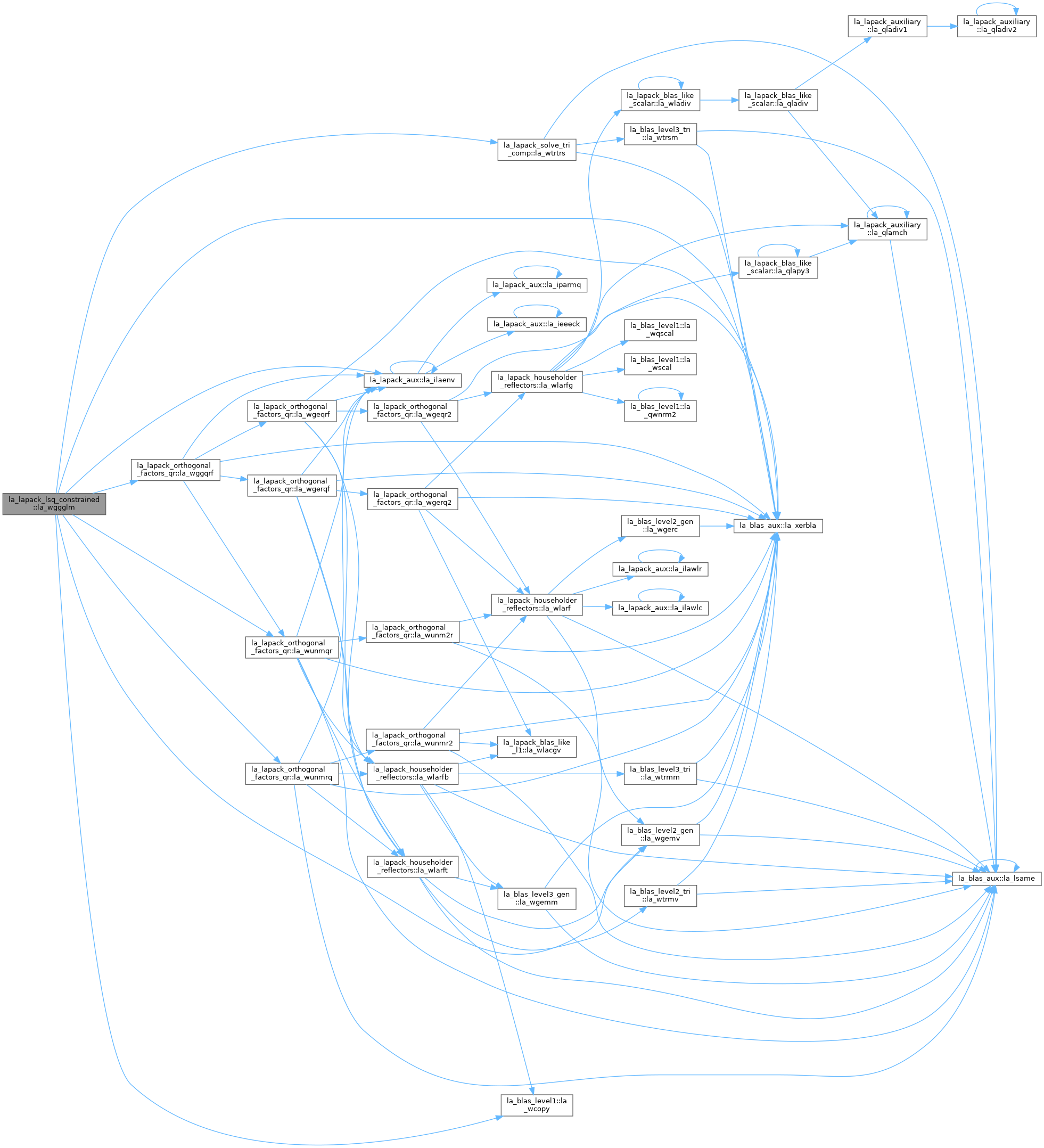
◆ la_wgglse()
| pure subroutine, public la_lapack_lsq_constrained::la_wgglse | ( | integer(ilp), intent(in) | m, |
| integer(ilp), intent(in) | n, | ||
| integer(ilp), intent(in) | p, | ||
| complex(qp), dimension(lda,*), intent(inout) | a, | ||
| integer(ilp), intent(in) | lda, | ||
| complex(qp), dimension(ldb,*), intent(inout) | b, | ||
| integer(ilp), intent(in) | ldb, | ||
| complex(qp), dimension(*), intent(inout) | c, | ||
| complex(qp), dimension(*), intent(inout) | d, | ||
| complex(qp), dimension(*), intent(out) | x, | ||
| complex(qp), dimension(*), intent(out) | work, | ||
| integer(ilp), intent(in) | lwork, | ||
| integer(ilp), intent(out) | info ) |
WGGLSE: solves the linear equality-constrained least squares (LSE) problem: minimize || c - A*x ||_2 subject to B*x = d where A is an M-by-N matrix, B is a P-by-N matrix, c is a given M-vector, and d is a given P-vector. It is assumed that P <= N <= M+P, and rank(B) = P and rank( (A) ) = N. ( (B) ) These conditions ensure that the LSE problem has a unique solution, which is obtained using a generalized RQ factorization of the matrices (B, A) given by B = (0 R)*Q, A = Z*T*Q.
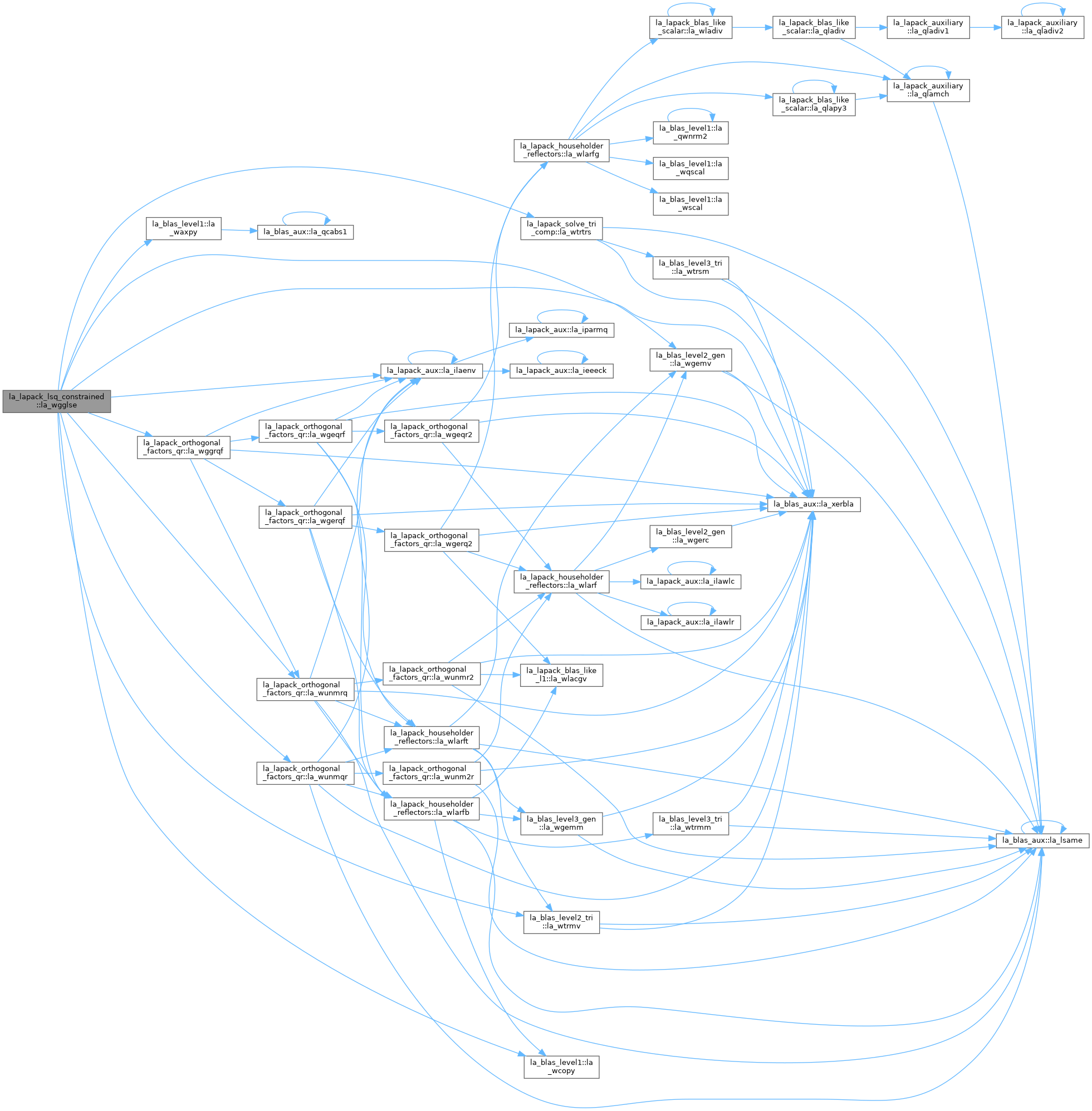
◆ la_zggglm()
| pure subroutine, public la_lapack_lsq_constrained::la_zggglm | ( | integer(ilp), intent(in) | n, |
| integer(ilp), intent(in) | m, | ||
| integer(ilp), intent(in) | p, | ||
| complex(dp), dimension(lda,*), intent(inout) | a, | ||
| integer(ilp), intent(in) | lda, | ||
| complex(dp), dimension(ldb,*), intent(inout) | b, | ||
| integer(ilp), intent(in) | ldb, | ||
| complex(dp), dimension(*), intent(inout) | d, | ||
| complex(dp), dimension(*), intent(out) | x, | ||
| complex(dp), dimension(*), intent(out) | y, | ||
| complex(dp), dimension(*), intent(out) | work, | ||
| integer(ilp), intent(in) | lwork, | ||
| integer(ilp), intent(out) | info ) |
ZGGGLM: solves a general Gauss-Markov linear model (GLM) problem: minimize || y ||_2 subject to d = A*x + B*y x where A is an N-by-M matrix, B is an N-by-P matrix, and d is a given N-vector. It is assumed that M <= N <= M+P, and rank(A) = M and rank( A B ) = N. Under these assumptions, the constrained equation is always consistent, and there is a unique solution x and a minimal 2-norm solution y, which is obtained using a generalized QR factorization of the matrices (A, B) given by A = Q*(R), B = Q*T*Z. (0) In particular, if matrix B is square nonsingular, then the problem GLM is equivalent to the following weighted linear least squares problem minimize || inv(B)*(d-A*x) ||_2 x where inv(B) denotes the inverse of B.
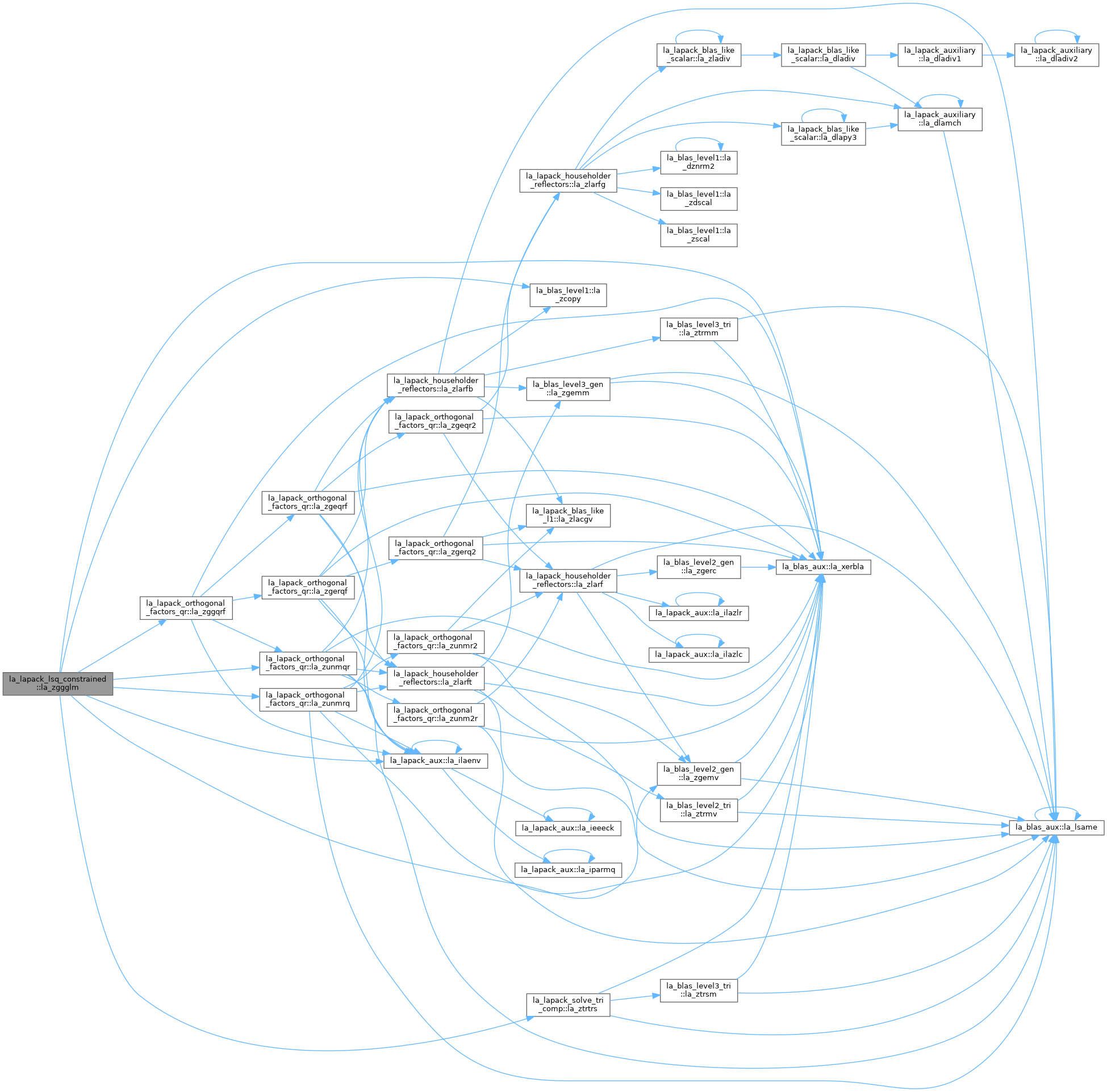
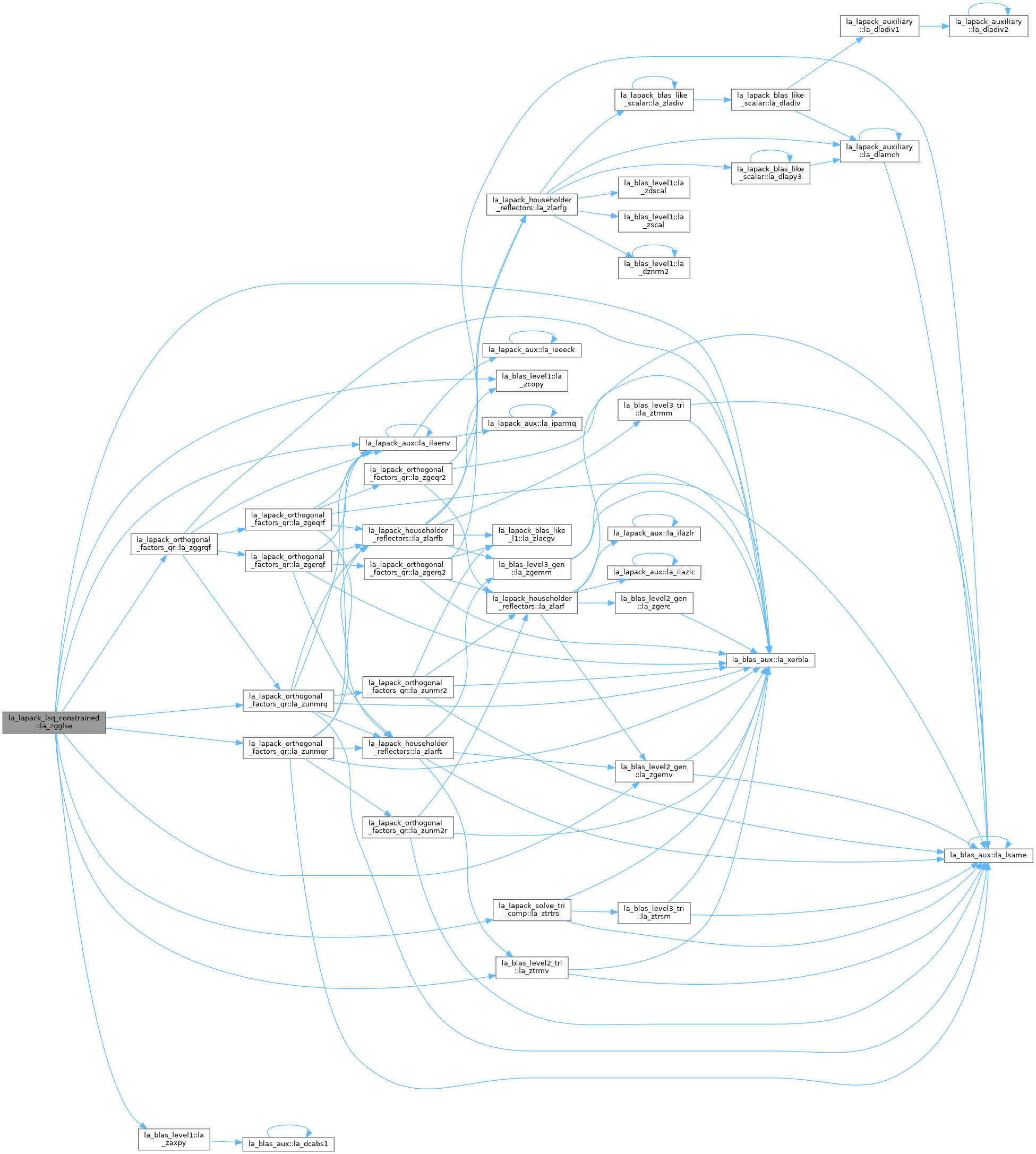
◆ la_zgglse()
| pure subroutine, public la_lapack_lsq_constrained::la_zgglse | ( | integer(ilp), intent(in) | m, |
| integer(ilp), intent(in) | n, | ||
| integer(ilp), intent(in) | p, | ||
| complex(dp), dimension(lda,*), intent(inout) | a, | ||
| integer(ilp), intent(in) | lda, | ||
| complex(dp), dimension(ldb,*), intent(inout) | b, | ||
| integer(ilp), intent(in) | ldb, | ||
| complex(dp), dimension(*), intent(inout) | c, | ||
| complex(dp), dimension(*), intent(inout) | d, | ||
| complex(dp), dimension(*), intent(out) | x, | ||
| complex(dp), dimension(*), intent(out) | work, | ||
| integer(ilp), intent(in) | lwork, | ||
| integer(ilp), intent(out) | info ) |
ZGGLSE: solves the linear equality-constrained least squares (LSE) problem: minimize || c - A*x ||_2 subject to B*x = d where A is an M-by-N matrix, B is a P-by-N matrix, c is a given M-vector, and d is a given P-vector. It is assumed that P <= N <= M+P, and rank(B) = P and rank( (A) ) = N. ( (B) ) These conditions ensure that the LSE problem has a unique solution, which is obtained using a generalized RQ factorization of the matrices (B, A) given by B = (0 R)*Q, A = Z*T*Q.