Extra-precise refinement helpers: condition numbers and pivot growth. More...
Functions/Subroutines | |
| pure real(sp) function, public | la_sla_gerpvgrw (n, ncols, a, lda, af, ldaf) |
| SLA_GERPVGRW: computes the reciprocal pivot growth factor norm(A)/norm(U). The "max absolute element" norm is used. If this is much less than 1, the stability of the LU factorization of the (equilibrated) matrix A could be poor. This also means that the solution X, estimated condition numbers, and error bounds could be unreliable. | |
| pure real(dp) function, public | la_dla_gerpvgrw (n, ncols, a, lda, af, ldaf) |
| DLA_GERPVGRW: computes the reciprocal pivot growth factor norm(A)/norm(U). The "max absolute element" norm is used. If this is much less than 1, the stability of the LU factorization of the (equilibrated) matrix A could be poor. This also means that the solution X, estimated condition numbers, and error bounds could be unreliable. | |
| pure real(qp) function, public | la_qla_gerpvgrw (n, ncols, a, lda, af, ldaf) |
| QLA_GERPVGRW: computes the reciprocal pivot growth factor norm(A)/norm(U). The "max absolute element" norm is used. If this is much less than 1, the stability of the LU factorization of the (equilibrated) matrix A could be poor. This also means that the solution X, estimated condition numbers, and error bounds could be unreliable. | |
| subroutine, public | la_sla_syamv (uplo, n, alpha, a, lda, x, incx, beta, y, incy) |
| SLA_SYAMV: performs the matrix-vector operation y := alpha*abs(A)*abs(x) + beta*abs(y), where alpha and beta are scalars, x and y are vectors and A is an n by n symmetric matrix. This function is primarily used in calculating error bounds. To protect against underflow during evaluation, components in the resulting vector are perturbed away from zero by (N+1) times the underflow threshold. To prevent unnecessarily large errors for block-structure embedded in general matrices, "symbolically" zero components are not perturbed. A zero entry is considered "symbolic" if all multiplications involved in computing that entry have at least one zero multiplicand. | |
| subroutine, public | la_dla_syamv (uplo, n, alpha, a, lda, x, incx, beta, y, incy) |
| DLA_SYAMV: performs the matrix-vector operation y := alpha*abs(A)*abs(x) + beta*abs(y), where alpha and beta are scalars, x and y are vectors and A is an n by n symmetric matrix. This function is primarily used in calculating error bounds. To protect against underflow during evaluation, components in the resulting vector are perturbed away from zero by (N+1) times the underflow threshold. To prevent unnecessarily large errors for block-structure embedded in general matrices, "symbolically" zero components are not perturbed. A zero entry is considered "symbolic" if all multiplications involved in computing that entry have at least one zero multiplicand. | |
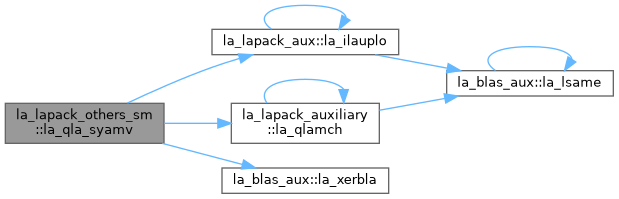
| subroutine, public | la_qla_syamv (uplo, n, alpha, a, lda, x, incx, beta, y, incy) |
| QLA_SYAMV: performs the matrix-vector operation y := alpha*abs(A)*abs(x) + beta*abs(y), where alpha and beta are scalars, x and y are vectors and A is an n by n symmetric matrix. This function is primarily used in calculating error bounds. To protect against underflow during evaluation, components in the resulting vector are perturbed away from zero by (N+1) times the underflow threshold. To prevent unnecessarily large errors for block-structure embedded in general matrices, "symbolically" zero components are not perturbed. A zero entry is considered "symbolic" if all multiplications involved in computing that entry have at least one zero multiplicand. | |
| real(sp) function, public | la_sla_syrcond (uplo, n, a, lda, af, ldaf, ipiv, cmode, c, info, work, iwork) |
| SLA_SYRCOND: estimates the Skeel condition number of op(A) * op2(C) where op2 is determined by CMODE as follows CMODE = 1 op2(C) = C CMODE = 0 op2(C) = I CMODE = -1 op2(C) = inv(C) The Skeel condition number cond(A) = norminf( |inv(A)||A| ) is computed by computing scaling factors R such that diag(R)*A*op2(C) is row equilibrated and computing the standard infinity-norm condition number. | |
| real(dp) function, public | la_dla_syrcond (uplo, n, a, lda, af, ldaf, ipiv, cmode, c, info, work, iwork) |
| DLA_SYRCOND: estimates the Skeel condition number of op(A) * op2(C) where op2 is determined by CMODE as follows CMODE = 1 op2(C) = C CMODE = 0 op2(C) = I CMODE = -1 op2(C) = inv(C) The Skeel condition number cond(A) = norminf( |inv(A)||A| ) is computed by computing scaling factors R such that diag(R)*A*op2(C) is row equilibrated and computing the standard infinity-norm condition number. | |
| real(qp) function, public | la_qla_syrcond (uplo, n, a, lda, af, ldaf, ipiv, cmode, c, info, work, iwork) |
| QLA_SYRCOND: estimates the Skeel condition number of op(A) * op2(C) where op2 is determined by CMODE as follows CMODE = 1 op2(C) = C CMODE = 0 op2(C) = I CMODE = -1 op2(C) = inv(C) The Skeel condition number cond(A) = norminf( |inv(A)||A| ) is computed by computing scaling factors R such that diag(R)*A*op2(C) is row equilibrated and computing the standard infinity-norm condition number. | |
| real(sp) function, public | la_sla_syrpvgrw (uplo, n, info, a, lda, af, ldaf, ipiv, work) |
| SLA_SYRPVGRW: computes the reciprocal pivot growth factor norm(A)/norm(U). The "max absolute element" norm is used. If this is much less than 1, the stability of the LU factorization of the (equilibrated) matrix A could be poor. This also means that the solution X, estimated condition numbers, and error bounds could be unreliable. | |
| real(dp) function, public | la_dla_syrpvgrw (uplo, n, info, a, lda, af, ldaf, ipiv, work) |
| DLA_SYRPVGRW: computes the reciprocal pivot growth factor norm(A)/norm(U). The "max absolute element" norm is used. If this is much less than 1, the stability of the LU factorization of the (equilibrated) matrix A could be poor. This also means that the solution X, estimated condition numbers, and error bounds could be unreliable. | |
| real(qp) function, public | la_qla_syrpvgrw (uplo, n, info, a, lda, af, ldaf, ipiv, work) |
| QLA_SYRPVGRW: computes the reciprocal pivot growth factor norm(A)/norm(U). The "max absolute element" norm is used. If this is much less than 1, the stability of the LU factorization of the (equilibrated) matrix A could be poor. This also means that the solution X, estimated condition numbers, and error bounds could be unreliable. | |
| pure real(sp) function, public | la_cla_gerpvgrw (n, ncols, a, lda, af, ldaf) |
| CLA_GERPVGRW: computes the reciprocal pivot growth factor norm(A)/norm(U). The "max absolute element" norm is used. If this is much less than 1, the stability of the LU factorization of the (equilibrated) matrix A could be poor. This also means that the solution X, estimated condition numbers, and error bounds could be unreliable. | |
| pure real(dp) function, public | la_zla_gerpvgrw (n, ncols, a, lda, af, ldaf) |
| ZLA_GERPVGRW: computes the reciprocal pivot growth factor norm(A)/norm(U). The "max absolute element" norm is used. If this is much less than 1, the stability of the LU factorization of the (equilibrated) matrix A could be poor. This also means that the solution X, estimated condition numbers, and error bounds could be unreliable. | |
| pure real(qp) function, public | la_wla_gerpvgrw (n, ncols, a, lda, af, ldaf) |
| WLA_GERPVGRW: computes the reciprocal pivot growth factor norm(A)/norm(U). The "max absolute element" norm is used. If this is much less than 1, the stability of the LU factorization of the (equilibrated) matrix A could be poor. This also means that the solution X, estimated condition numbers, and error bounds could be unreliable. | |
| subroutine, public | la_cla_syamv (uplo, n, alpha, a, lda, x, incx, beta, y, incy) |
| CLA_SYAMV: performs the matrix-vector operation y := alpha*abs(A)*abs(x) + beta*abs(y), where alpha and beta are scalars, x and y are vectors and A is an n by n symmetric matrix. This function is primarily used in calculating error bounds. To protect against underflow during evaluation, components in the resulting vector are perturbed away from zero by (N+1) times the underflow threshold. To prevent unnecessarily large errors for block-structure embedded in general matrices, "symbolically" zero components are not perturbed. A zero entry is considered "symbolic" if all multiplications involved in computing that entry have at least one zero multiplicand. | |
| subroutine, public | la_zla_syamv (uplo, n, alpha, a, lda, x, incx, beta, y, incy) |
| ZLA_SYAMV: performs the matrix-vector operation y := alpha*abs(A)*abs(x) + beta*abs(y), where alpha and beta are scalars, x and y are vectors and A is an n by n symmetric matrix. This function is primarily used in calculating error bounds. To protect against underflow during evaluation, components in the resulting vector are perturbed away from zero by (N+1) times the underflow threshold. To prevent unnecessarily large errors for block-structure embedded in general matrices, "symbolically" zero components are not perturbed. A zero entry is considered "symbolic" if all multiplications involved in computing that entry have at least one zero multiplicand. | |
| subroutine, public | la_wla_syamv (uplo, n, alpha, a, lda, x, incx, beta, y, incy) |
| WLA_SYAMV: performs the matrix-vector operation y := alpha*abs(A)*abs(x) + beta*abs(y), where alpha and beta are scalars, x and y are vectors and A is an n by n symmetric matrix. This function is primarily used in calculating error bounds. To protect against underflow during evaluation, components in the resulting vector are perturbed away from zero by (N+1) times the underflow threshold. To prevent unnecessarily large errors for block-structure embedded in general matrices, "symbolically" zero components are not perturbed. A zero entry is considered "symbolic" if all multiplications involved in computing that entry have at least one zero multiplicand. | |
| real(sp) function, public | la_cla_gbrcond_c (trans, n, kl, ku, ab, ldab, afb, ldafb, ipiv, c, capply, info, work, rwork) |
| CLA_GBRCOND_C: Computes the infinity norm condition number of op(A) * inv(diag(C)) where C is a REAL vector. | |
| real(dp) function, public | la_zla_gbrcond_c (trans, n, kl, ku, ab, ldab, afb, ldafb, ipiv, c, capply, info, work, rwork) |
| ZLA_GBRCOND_C: Computes the infinity norm condition number of op(A) * inv(diag(C)) where C is a DOUBLE PRECISION vector. | |
| real(qp) function, public | la_wla_gbrcond_c (trans, n, kl, ku, ab, ldab, afb, ldafb, ipiv, c, capply, info, work, rwork) |
| WLA_GBRCOND_C: Computes the infinity norm condition number of op(A) * inv(diag(C)) where C is a QUAD PRECISION vector. | |
| real(sp) function, public | la_cla_gercond_c (trans, n, a, lda, af, ldaf, ipiv, c, capply, info, work, rwork) |
| CLA_GERCOND_C: computes the infinity norm condition number of op(A) * inv(diag(C)) where C is a REAL vector. | |
| real(dp) function, public | la_zla_gercond_c (trans, n, a, lda, af, ldaf, ipiv, c, capply, info, work, rwork) |
| ZLA_GERCOND_C: computes the infinity norm condition number of op(A) * inv(diag(C)) where C is a DOUBLE PRECISION vector. | |
| real(qp) function, public | la_wla_gercond_c (trans, n, a, lda, af, ldaf, ipiv, c, capply, info, work, rwork) |
| WLA_GERCOND_C: computes the infinity norm condition number of op(A) * inv(diag(C)) where C is a QUAD PRECISION vector. | |
| real(sp) function, public | la_cla_hercond_c (uplo, n, a, lda, af, ldaf, ipiv, c, capply, info, work, rwork) |
| CLA_HERCOND_C: computes the infinity norm condition number of op(A) * inv(diag(C)) where C is a REAL vector. | |
| real(dp) function, public | la_zla_hercond_c (uplo, n, a, lda, af, ldaf, ipiv, c, capply, info, work, rwork) |
| ZLA_HERCOND_C: computes the infinity norm condition number of op(A) * inv(diag(C)) where C is a DOUBLE PRECISION vector. | |
| real(qp) function, public | la_wla_hercond_c (uplo, n, a, lda, af, ldaf, ipiv, c, capply, info, work, rwork) |
| WLA_HERCOND_C: computes the infinity norm condition number of op(A) * inv(diag(C)) where C is a QUAD PRECISION vector. | |
| real(sp) function, public | la_cla_porcond_c (uplo, n, a, lda, af, ldaf, c, capply, info, work, rwork) |
| CLA_PORCOND_C: Computes the infinity norm condition number of op(A) * inv(diag(C)) where C is a REAL vector. | |
| real(dp) function, public | la_zla_porcond_c (uplo, n, a, lda, af, ldaf, c, capply, info, work, rwork) |
| ZLA_PORCOND_C: Computes the infinity norm condition number of op(A) * inv(diag(C)) where C is a DOUBLE PRECISION vector. | |
| real(qp) function, public | la_wla_porcond_c (uplo, n, a, lda, af, ldaf, c, capply, info, work, rwork) |
| WLA_PORCOND_C: Computes the infinity norm condition number of op(A) * inv(diag(C)) where C is a QUAD PRECISION vector. | |
| real(sp) function, public | la_cla_syrcond_c (uplo, n, a, lda, af, ldaf, ipiv, c, capply, info, work, rwork) |
| CLA_SYRCOND_C: Computes the infinity norm condition number of op(A) * inv(diag(C)) where C is a REAL vector. | |
| real(dp) function, public | la_zla_syrcond_c (uplo, n, a, lda, af, ldaf, ipiv, c, capply, info, work, rwork) |
| ZLA_SYRCOND_C: Computes the infinity norm condition number of op(A) * inv(diag(C)) where C is a DOUBLE PRECISION vector. | |
| real(qp) function, public | la_wla_syrcond_c (uplo, n, a, lda, af, ldaf, ipiv, c, capply, info, work, rwork) |
| WLA_SYRCOND_C: Computes the infinity norm condition number of op(A) * inv(diag(C)) where C is a QUAD PRECISION vector. | |
| real(sp) function, public | la_cla_syrpvgrw (uplo, n, info, a, lda, af, ldaf, ipiv, work) |
| CLA_SYRPVGRW: computes the reciprocal pivot growth factor norm(A)/norm(U). The "max absolute element" norm is used. If this is much less than 1, the stability of the LU factorization of the (equilibrated) matrix A could be poor. This also means that the solution X, estimated condition numbers, and error bounds could be unreliable. | |
| real(dp) function, public | la_zla_syrpvgrw (uplo, n, info, a, lda, af, ldaf, ipiv, work) |
| ZLA_SYRPVGRW: computes the reciprocal pivot growth factor norm(A)/norm(U). The "max absolute element" norm is used. If this is much less than 1, the stability of the LU factorization of the (equilibrated) matrix A could be poor. This also means that the solution X, estimated condition numbers, and error bounds could be unreliable. | |
| real(qp) function, public | la_wla_syrpvgrw (uplo, n, info, a, lda, af, ldaf, ipiv, work) |
| WLA_SYRPVGRW: computes the reciprocal pivot growth factor norm(A)/norm(U). The "max absolute element" norm is used. If this is much less than 1, the stability of the LU factorization of the (equilibrated) matrix A could be poor. This also means that the solution X, estimated condition numbers, and error bounds could be unreliable. | |
Detailed Description
Extra-precise refinement helpers: condition numbers and pivot growth.
Function/Subroutine Documentation
◆ la_cla_gbrcond_c()
| real(sp) function, public la_lapack_others_sm::la_cla_gbrcond_c | ( | character, intent(in) | trans, |
| integer(ilp), intent(in) | n, | ||
| integer(ilp), intent(in) | kl, | ||
| integer(ilp), intent(in) | ku, | ||
| complex(sp), dimension(ldab,*), intent(in) | ab, | ||
| integer(ilp), intent(in) | ldab, | ||
| complex(sp), dimension(ldafb,*), intent(in) | afb, | ||
| integer(ilp), intent(in) | ldafb, | ||
| integer(ilp), dimension(*), intent(in) | ipiv, | ||
| real(sp), dimension(*), intent(in) | c, | ||
| logical(lk), intent(in) | capply, | ||
| integer(ilp), intent(out) | info, | ||
| complex(sp), dimension(*), intent(out) | work, | ||
| real(sp), dimension(*), intent(out) | rwork ) |
CLA_GBRCOND_C: Computes the infinity norm condition number of op(A) * inv(diag(C)) where C is a REAL vector.
◆ la_cla_gercond_c()
| real(sp) function, public la_lapack_others_sm::la_cla_gercond_c | ( | character, intent(in) | trans, |
| integer(ilp), intent(in) | n, | ||
| complex(sp), dimension(lda,*), intent(in) | a, | ||
| integer(ilp), intent(in) | lda, | ||
| complex(sp), dimension(ldaf,*), intent(in) | af, | ||
| integer(ilp), intent(in) | ldaf, | ||
| integer(ilp), dimension(*), intent(in) | ipiv, | ||
| real(sp), dimension(*), intent(in) | c, | ||
| logical(lk), intent(in) | capply, | ||
| integer(ilp), intent(out) | info, | ||
| complex(sp), dimension(*), intent(out) | work, | ||
| real(sp), dimension(*), intent(out) | rwork ) |
CLA_GERCOND_C: computes the infinity norm condition number of op(A) * inv(diag(C)) where C is a REAL vector.
◆ la_cla_gerpvgrw()
| pure real(sp) function, public la_lapack_others_sm::la_cla_gerpvgrw | ( | integer(ilp), intent(in) | n, |
| integer(ilp), intent(in) | ncols, | ||
| complex(sp), dimension(lda,*), intent(in) | a, | ||
| integer(ilp), intent(in) | lda, | ||
| complex(sp), dimension(ldaf,*), intent(in) | af, | ||
| integer(ilp), intent(in) | ldaf ) |
CLA_GERPVGRW: computes the reciprocal pivot growth factor norm(A)/norm(U). The "max absolute element" norm is used. If this is much less than 1, the stability of the LU factorization of the (equilibrated) matrix A could be poor. This also means that the solution X, estimated condition numbers, and error bounds could be unreliable.
◆ la_cla_hercond_c()
| real(sp) function, public la_lapack_others_sm::la_cla_hercond_c | ( | character, intent(in) | uplo, |
| integer(ilp), intent(in) | n, | ||
| complex(sp), dimension(lda,*), intent(in) | a, | ||
| integer(ilp), intent(in) | lda, | ||
| complex(sp), dimension(ldaf,*), intent(in) | af, | ||
| integer(ilp), intent(in) | ldaf, | ||
| integer(ilp), dimension(*), intent(in) | ipiv, | ||
| real(sp), dimension(*), intent(in) | c, | ||
| logical(lk), intent(in) | capply, | ||
| integer(ilp), intent(out) | info, | ||
| complex(sp), dimension(*), intent(out) | work, | ||
| real(sp), dimension(*), intent(out) | rwork ) |
CLA_HERCOND_C: computes the infinity norm condition number of op(A) * inv(diag(C)) where C is a REAL vector.
◆ la_cla_porcond_c()
| real(sp) function, public la_lapack_others_sm::la_cla_porcond_c | ( | character, intent(in) | uplo, |
| integer(ilp), intent(in) | n, | ||
| complex(sp), dimension(lda,*), intent(in) | a, | ||
| integer(ilp), intent(in) | lda, | ||
| complex(sp), dimension(ldaf,*), intent(in) | af, | ||
| integer(ilp), intent(in) | ldaf, | ||
| real(sp), dimension(*), intent(in) | c, | ||
| logical(lk), intent(in) | capply, | ||
| integer(ilp), intent(out) | info, | ||
| complex(sp), dimension(*), intent(out) | work, | ||
| real(sp), dimension(*), intent(out) | rwork ) |
CLA_PORCOND_C: Computes the infinity norm condition number of op(A) * inv(diag(C)) where C is a REAL vector.
◆ la_cla_syamv()
| subroutine, public la_lapack_others_sm::la_cla_syamv | ( | integer(ilp), intent(in) | uplo, |
| integer(ilp), intent(in) | n, | ||
| real(sp), intent(in) | alpha, | ||
| complex(sp), dimension(lda,*), intent(in) | a, | ||
| integer(ilp), intent(in) | lda, | ||
| complex(sp), dimension(*), intent(in) | x, | ||
| integer(ilp), intent(in) | incx, | ||
| real(sp), intent(in) | beta, | ||
| real(sp), dimension(*), intent(inout) | y, | ||
| integer(ilp), intent(in) | incy ) |
CLA_SYAMV: performs the matrix-vector operation y := alpha*abs(A)*abs(x) + beta*abs(y), where alpha and beta are scalars, x and y are vectors and A is an n by n symmetric matrix. This function is primarily used in calculating error bounds. To protect against underflow during evaluation, components in the resulting vector are perturbed away from zero by (N+1) times the underflow threshold. To prevent unnecessarily large errors for block-structure embedded in general matrices, "symbolically" zero components are not perturbed. A zero entry is considered "symbolic" if all multiplications involved in computing that entry have at least one zero multiplicand.
◆ la_cla_syrcond_c()
| real(sp) function, public la_lapack_others_sm::la_cla_syrcond_c | ( | character, intent(in) | uplo, |
| integer(ilp), intent(in) | n, | ||
| complex(sp), dimension(lda,*), intent(in) | a, | ||
| integer(ilp), intent(in) | lda, | ||
| complex(sp), dimension(ldaf,*), intent(in) | af, | ||
| integer(ilp), intent(in) | ldaf, | ||
| integer(ilp), dimension(*), intent(in) | ipiv, | ||
| real(sp), dimension(*), intent(in) | c, | ||
| logical(lk), intent(in) | capply, | ||
| integer(ilp), intent(out) | info, | ||
| complex(sp), dimension(*), intent(out) | work, | ||
| real(sp), dimension(*), intent(out) | rwork ) |
CLA_SYRCOND_C: Computes the infinity norm condition number of op(A) * inv(diag(C)) where C is a REAL vector.
◆ la_cla_syrpvgrw()
| real(sp) function, public la_lapack_others_sm::la_cla_syrpvgrw | ( | character, intent(in) | uplo, |
| integer(ilp), intent(in) | n, | ||
| integer(ilp), intent(in) | info, | ||
| complex(sp), dimension(lda,*), intent(in) | a, | ||
| integer(ilp), intent(in) | lda, | ||
| complex(sp), dimension(ldaf,*), intent(in) | af, | ||
| integer(ilp), intent(in) | ldaf, | ||
| integer(ilp), dimension(*), intent(in) | ipiv, | ||
| real(sp), dimension(*), intent(out) | work ) |
CLA_SYRPVGRW: computes the reciprocal pivot growth factor norm(A)/norm(U). The "max absolute element" norm is used. If this is much less than 1, the stability of the LU factorization of the (equilibrated) matrix A could be poor. This also means that the solution X, estimated condition numbers, and error bounds could be unreliable.
◆ la_dla_gerpvgrw()
| pure real(dp) function, public la_lapack_others_sm::la_dla_gerpvgrw | ( | integer(ilp), intent(in) | n, |
| integer(ilp), intent(in) | ncols, | ||
| real(dp), dimension(lda,*), intent(in) | a, | ||
| integer(ilp), intent(in) | lda, | ||
| real(dp), dimension(ldaf,*), intent(in) | af, | ||
| integer(ilp), intent(in) | ldaf ) |
DLA_GERPVGRW: computes the reciprocal pivot growth factor norm(A)/norm(U). The "max absolute element" norm is used. If this is much less than 1, the stability of the LU factorization of the (equilibrated) matrix A could be poor. This also means that the solution X, estimated condition numbers, and error bounds could be unreliable.
◆ la_dla_syamv()
| subroutine, public la_lapack_others_sm::la_dla_syamv | ( | integer(ilp), intent(in) | uplo, |
| integer(ilp), intent(in) | n, | ||
| real(dp), intent(in) | alpha, | ||
| real(dp), dimension(lda,*), intent(in) | a, | ||
| integer(ilp), intent(in) | lda, | ||
| real(dp), dimension(*), intent(in) | x, | ||
| integer(ilp), intent(in) | incx, | ||
| real(dp), intent(in) | beta, | ||
| real(dp), dimension(*), intent(inout) | y, | ||
| integer(ilp), intent(in) | incy ) |
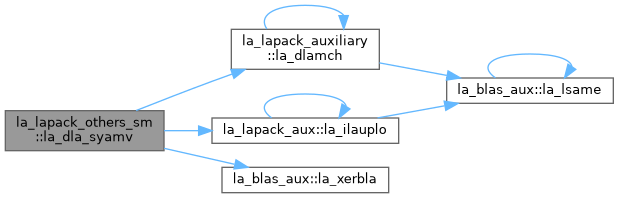
DLA_SYAMV: performs the matrix-vector operation y := alpha*abs(A)*abs(x) + beta*abs(y), where alpha and beta are scalars, x and y are vectors and A is an n by n symmetric matrix. This function is primarily used in calculating error bounds. To protect against underflow during evaluation, components in the resulting vector are perturbed away from zero by (N+1) times the underflow threshold. To prevent unnecessarily large errors for block-structure embedded in general matrices, "symbolically" zero components are not perturbed. A zero entry is considered "symbolic" if all multiplications involved in computing that entry have at least one zero multiplicand.
◆ la_dla_syrcond()
| real(dp) function, public la_lapack_others_sm::la_dla_syrcond | ( | character, intent(in) | uplo, |
| integer(ilp), intent(in) | n, | ||
| real(dp), dimension(lda,*), intent(in) | a, | ||
| integer(ilp), intent(in) | lda, | ||
| real(dp), dimension(ldaf,*), intent(in) | af, | ||
| integer(ilp), intent(in) | ldaf, | ||
| integer(ilp), dimension(*), intent(in) | ipiv, | ||
| integer(ilp), intent(in) | cmode, | ||
| real(dp), dimension(*), intent(in) | c, | ||
| integer(ilp), intent(out) | info, | ||
| real(dp), dimension(*), intent(out) | work, | ||
| integer(ilp), dimension(*), intent(out) | iwork ) |
DLA_SYRCOND: estimates the Skeel condition number of op(A) * op2(C) where op2 is determined by CMODE as follows CMODE = 1 op2(C) = C CMODE = 0 op2(C) = I CMODE = -1 op2(C) = inv(C) The Skeel condition number cond(A) = norminf( |inv(A)||A| ) is computed by computing scaling factors R such that diag(R)*A*op2(C) is row equilibrated and computing the standard infinity-norm condition number.
◆ la_dla_syrpvgrw()
| real(dp) function, public la_lapack_others_sm::la_dla_syrpvgrw | ( | character, intent(in) | uplo, |
| integer(ilp), intent(in) | n, | ||
| integer(ilp), intent(in) | info, | ||
| real(dp), dimension(lda,*), intent(in) | a, | ||
| integer(ilp), intent(in) | lda, | ||
| real(dp), dimension(ldaf,*), intent(in) | af, | ||
| integer(ilp), intent(in) | ldaf, | ||
| integer(ilp), dimension(*), intent(in) | ipiv, | ||
| real(dp), dimension(*), intent(out) | work ) |
DLA_SYRPVGRW: computes the reciprocal pivot growth factor norm(A)/norm(U). The "max absolute element" norm is used. If this is much less than 1, the stability of the LU factorization of the (equilibrated) matrix A could be poor. This also means that the solution X, estimated condition numbers, and error bounds could be unreliable.
◆ la_qla_gerpvgrw()
| pure real(qp) function, public la_lapack_others_sm::la_qla_gerpvgrw | ( | integer(ilp), intent(in) | n, |
| integer(ilp), intent(in) | ncols, | ||
| real(qp), dimension(lda,*), intent(in) | a, | ||
| integer(ilp), intent(in) | lda, | ||
| real(qp), dimension(ldaf,*), intent(in) | af, | ||
| integer(ilp), intent(in) | ldaf ) |
QLA_GERPVGRW: computes the reciprocal pivot growth factor norm(A)/norm(U). The "max absolute element" norm is used. If this is much less than 1, the stability of the LU factorization of the (equilibrated) matrix A could be poor. This also means that the solution X, estimated condition numbers, and error bounds could be unreliable.
◆ la_qla_syamv()
| subroutine, public la_lapack_others_sm::la_qla_syamv | ( | integer(ilp), intent(in) | uplo, |
| integer(ilp), intent(in) | n, | ||
| real(qp), intent(in) | alpha, | ||
| real(qp), dimension(lda,*), intent(in) | a, | ||
| integer(ilp), intent(in) | lda, | ||
| real(qp), dimension(*), intent(in) | x, | ||
| integer(ilp), intent(in) | incx, | ||
| real(qp), intent(in) | beta, | ||
| real(qp), dimension(*), intent(inout) | y, | ||
| integer(ilp), intent(in) | incy ) |
QLA_SYAMV: performs the matrix-vector operation y := alpha*abs(A)*abs(x) + beta*abs(y), where alpha and beta are scalars, x and y are vectors and A is an n by n symmetric matrix. This function is primarily used in calculating error bounds. To protect against underflow during evaluation, components in the resulting vector are perturbed away from zero by (N+1) times the underflow threshold. To prevent unnecessarily large errors for block-structure embedded in general matrices, "symbolically" zero components are not perturbed. A zero entry is considered "symbolic" if all multiplications involved in computing that entry have at least one zero multiplicand.
◆ la_qla_syrcond()
| real(qp) function, public la_lapack_others_sm::la_qla_syrcond | ( | character, intent(in) | uplo, |
| integer(ilp), intent(in) | n, | ||
| real(qp), dimension(lda,*), intent(in) | a, | ||
| integer(ilp), intent(in) | lda, | ||
| real(qp), dimension(ldaf,*), intent(in) | af, | ||
| integer(ilp), intent(in) | ldaf, | ||
| integer(ilp), dimension(*), intent(in) | ipiv, | ||
| integer(ilp), intent(in) | cmode, | ||
| real(qp), dimension(*), intent(in) | c, | ||
| integer(ilp), intent(out) | info, | ||
| real(qp), dimension(*), intent(out) | work, | ||
| integer(ilp), dimension(*), intent(out) | iwork ) |
QLA_SYRCOND: estimates the Skeel condition number of op(A) * op2(C) where op2 is determined by CMODE as follows CMODE = 1 op2(C) = C CMODE = 0 op2(C) = I CMODE = -1 op2(C) = inv(C) The Skeel condition number cond(A) = norminf( |inv(A)||A| ) is computed by computing scaling factors R such that diag(R)*A*op2(C) is row equilibrated and computing the standard infinity-norm condition number.
◆ la_qla_syrpvgrw()
| real(qp) function, public la_lapack_others_sm::la_qla_syrpvgrw | ( | character, intent(in) | uplo, |
| integer(ilp), intent(in) | n, | ||
| integer(ilp), intent(in) | info, | ||
| real(qp), dimension(lda,*), intent(in) | a, | ||
| integer(ilp), intent(in) | lda, | ||
| real(qp), dimension(ldaf,*), intent(in) | af, | ||
| integer(ilp), intent(in) | ldaf, | ||
| integer(ilp), dimension(*), intent(in) | ipiv, | ||
| real(qp), dimension(*), intent(out) | work ) |
QLA_SYRPVGRW: computes the reciprocal pivot growth factor norm(A)/norm(U). The "max absolute element" norm is used. If this is much less than 1, the stability of the LU factorization of the (equilibrated) matrix A could be poor. This also means that the solution X, estimated condition numbers, and error bounds could be unreliable.
◆ la_sla_gerpvgrw()
| pure real(sp) function, public la_lapack_others_sm::la_sla_gerpvgrw | ( | integer(ilp), intent(in) | n, |
| integer(ilp), intent(in) | ncols, | ||
| real(sp), dimension(lda,*), intent(in) | a, | ||
| integer(ilp), intent(in) | lda, | ||
| real(sp), dimension(ldaf,*), intent(in) | af, | ||
| integer(ilp), intent(in) | ldaf ) |
SLA_GERPVGRW: computes the reciprocal pivot growth factor norm(A)/norm(U). The "max absolute element" norm is used. If this is much less than 1, the stability of the LU factorization of the (equilibrated) matrix A could be poor. This also means that the solution X, estimated condition numbers, and error bounds could be unreliable.
◆ la_sla_syamv()
| subroutine, public la_lapack_others_sm::la_sla_syamv | ( | integer(ilp), intent(in) | uplo, |
| integer(ilp), intent(in) | n, | ||
| real(sp), intent(in) | alpha, | ||
| real(sp), dimension(lda,*), intent(in) | a, | ||
| integer(ilp), intent(in) | lda, | ||
| real(sp), dimension(*), intent(in) | x, | ||
| integer(ilp), intent(in) | incx, | ||
| real(sp), intent(in) | beta, | ||
| real(sp), dimension(*), intent(inout) | y, | ||
| integer(ilp), intent(in) | incy ) |
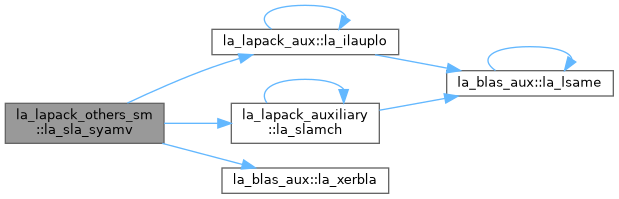
SLA_SYAMV: performs the matrix-vector operation y := alpha*abs(A)*abs(x) + beta*abs(y), where alpha and beta are scalars, x and y are vectors and A is an n by n symmetric matrix. This function is primarily used in calculating error bounds. To protect against underflow during evaluation, components in the resulting vector are perturbed away from zero by (N+1) times the underflow threshold. To prevent unnecessarily large errors for block-structure embedded in general matrices, "symbolically" zero components are not perturbed. A zero entry is considered "symbolic" if all multiplications involved in computing that entry have at least one zero multiplicand.
◆ la_sla_syrcond()
| real(sp) function, public la_lapack_others_sm::la_sla_syrcond | ( | character, intent(in) | uplo, |
| integer(ilp), intent(in) | n, | ||
| real(sp), dimension(lda,*), intent(in) | a, | ||
| integer(ilp), intent(in) | lda, | ||
| real(sp), dimension(ldaf,*), intent(in) | af, | ||
| integer(ilp), intent(in) | ldaf, | ||
| integer(ilp), dimension(*), intent(in) | ipiv, | ||
| integer(ilp), intent(in) | cmode, | ||
| real(sp), dimension(*), intent(in) | c, | ||
| integer(ilp), intent(out) | info, | ||
| real(sp), dimension(*), intent(out) | work, | ||
| integer(ilp), dimension(*), intent(out) | iwork ) |
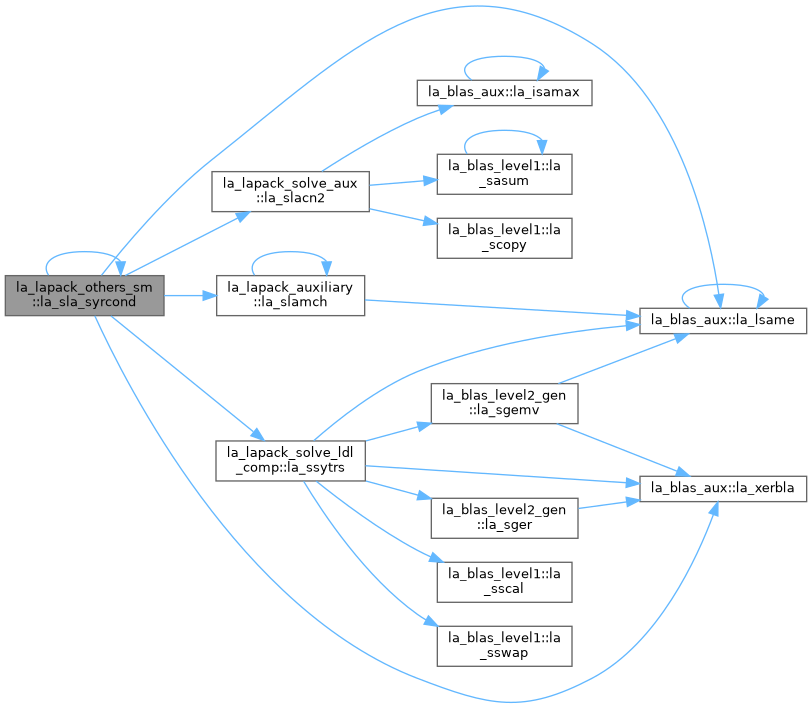
SLA_SYRCOND: estimates the Skeel condition number of op(A) * op2(C) where op2 is determined by CMODE as follows CMODE = 1 op2(C) = C CMODE = 0 op2(C) = I CMODE = -1 op2(C) = inv(C) The Skeel condition number cond(A) = norminf( |inv(A)||A| ) is computed by computing scaling factors R such that diag(R)*A*op2(C) is row equilibrated and computing the standard infinity-norm condition number.
◆ la_sla_syrpvgrw()
| real(sp) function, public la_lapack_others_sm::la_sla_syrpvgrw | ( | character, intent(in) | uplo, |
| integer(ilp), intent(in) | n, | ||
| integer(ilp), intent(in) | info, | ||
| real(sp), dimension(lda,*), intent(in) | a, | ||
| integer(ilp), intent(in) | lda, | ||
| real(sp), dimension(ldaf,*), intent(in) | af, | ||
| integer(ilp), intent(in) | ldaf, | ||
| integer(ilp), dimension(*), intent(in) | ipiv, | ||
| real(sp), dimension(*), intent(out) | work ) |
SLA_SYRPVGRW: computes the reciprocal pivot growth factor norm(A)/norm(U). The "max absolute element" norm is used. If this is much less than 1, the stability of the LU factorization of the (equilibrated) matrix A could be poor. This also means that the solution X, estimated condition numbers, and error bounds could be unreliable.
◆ la_wla_gbrcond_c()
| real(qp) function, public la_lapack_others_sm::la_wla_gbrcond_c | ( | character, intent(in) | trans, |
| integer(ilp), intent(in) | n, | ||
| integer(ilp), intent(in) | kl, | ||
| integer(ilp), intent(in) | ku, | ||
| complex(qp), dimension(ldab,*), intent(in) | ab, | ||
| integer(ilp), intent(in) | ldab, | ||
| complex(qp), dimension(ldafb,*), intent(in) | afb, | ||
| integer(ilp), intent(in) | ldafb, | ||
| integer(ilp), dimension(*), intent(in) | ipiv, | ||
| real(qp), dimension(*), intent(in) | c, | ||
| logical(lk), intent(in) | capply, | ||
| integer(ilp), intent(out) | info, | ||
| complex(qp), dimension(*), intent(out) | work, | ||
| real(qp), dimension(*), intent(out) | rwork ) |
WLA_GBRCOND_C: Computes the infinity norm condition number of op(A) * inv(diag(C)) where C is a QUAD PRECISION vector.
◆ la_wla_gercond_c()
| real(qp) function, public la_lapack_others_sm::la_wla_gercond_c | ( | character, intent(in) | trans, |
| integer(ilp), intent(in) | n, | ||
| complex(qp), dimension(lda,*), intent(in) | a, | ||
| integer(ilp), intent(in) | lda, | ||
| complex(qp), dimension(ldaf,*), intent(in) | af, | ||
| integer(ilp), intent(in) | ldaf, | ||
| integer(ilp), dimension(*), intent(in) | ipiv, | ||
| real(qp), dimension(*), intent(in) | c, | ||
| logical(lk), intent(in) | capply, | ||
| integer(ilp), intent(out) | info, | ||
| complex(qp), dimension(*), intent(out) | work, | ||
| real(qp), dimension(*), intent(out) | rwork ) |
WLA_GERCOND_C: computes the infinity norm condition number of op(A) * inv(diag(C)) where C is a QUAD PRECISION vector.
◆ la_wla_gerpvgrw()
| pure real(qp) function, public la_lapack_others_sm::la_wla_gerpvgrw | ( | integer(ilp), intent(in) | n, |
| integer(ilp), intent(in) | ncols, | ||
| complex(qp), dimension(lda,*), intent(in) | a, | ||
| integer(ilp), intent(in) | lda, | ||
| complex(qp), dimension(ldaf,*), intent(in) | af, | ||
| integer(ilp), intent(in) | ldaf ) |
WLA_GERPVGRW: computes the reciprocal pivot growth factor norm(A)/norm(U). The "max absolute element" norm is used. If this is much less than 1, the stability of the LU factorization of the (equilibrated) matrix A could be poor. This also means that the solution X, estimated condition numbers, and error bounds could be unreliable.
◆ la_wla_hercond_c()
| real(qp) function, public la_lapack_others_sm::la_wla_hercond_c | ( | character, intent(in) | uplo, |
| integer(ilp), intent(in) | n, | ||
| complex(qp), dimension(lda,*), intent(in) | a, | ||
| integer(ilp), intent(in) | lda, | ||
| complex(qp), dimension(ldaf,*), intent(in) | af, | ||
| integer(ilp), intent(in) | ldaf, | ||
| integer(ilp), dimension(*), intent(in) | ipiv, | ||
| real(qp), dimension(*), intent(in) | c, | ||
| logical(lk), intent(in) | capply, | ||
| integer(ilp), intent(out) | info, | ||
| complex(qp), dimension(*), intent(out) | work, | ||
| real(qp), dimension(*), intent(out) | rwork ) |
WLA_HERCOND_C: computes the infinity norm condition number of op(A) * inv(diag(C)) where C is a QUAD PRECISION vector.
◆ la_wla_porcond_c()
| real(qp) function, public la_lapack_others_sm::la_wla_porcond_c | ( | character, intent(in) | uplo, |
| integer(ilp), intent(in) | n, | ||
| complex(qp), dimension(lda,*), intent(in) | a, | ||
| integer(ilp), intent(in) | lda, | ||
| complex(qp), dimension(ldaf,*), intent(in) | af, | ||
| integer(ilp), intent(in) | ldaf, | ||
| real(qp), dimension(*), intent(in) | c, | ||
| logical(lk), intent(in) | capply, | ||
| integer(ilp), intent(out) | info, | ||
| complex(qp), dimension(*), intent(out) | work, | ||
| real(qp), dimension(*), intent(out) | rwork ) |
WLA_PORCOND_C: Computes the infinity norm condition number of op(A) * inv(diag(C)) where C is a QUAD PRECISION vector.
◆ la_wla_syamv()
| subroutine, public la_lapack_others_sm::la_wla_syamv | ( | integer(ilp), intent(in) | uplo, |
| integer(ilp), intent(in) | n, | ||
| real(qp), intent(in) | alpha, | ||
| complex(qp), dimension(lda,*), intent(in) | a, | ||
| integer(ilp), intent(in) | lda, | ||
| complex(qp), dimension(*), intent(in) | x, | ||
| integer(ilp), intent(in) | incx, | ||
| real(qp), intent(in) | beta, | ||
| real(qp), dimension(*), intent(inout) | y, | ||
| integer(ilp), intent(in) | incy ) |
WLA_SYAMV: performs the matrix-vector operation y := alpha*abs(A)*abs(x) + beta*abs(y), where alpha and beta are scalars, x and y are vectors and A is an n by n symmetric matrix. This function is primarily used in calculating error bounds. To protect against underflow during evaluation, components in the resulting vector are perturbed away from zero by (N+1) times the underflow threshold. To prevent unnecessarily large errors for block-structure embedded in general matrices, "symbolically" zero components are not perturbed. A zero entry is considered "symbolic" if all multiplications involved in computing that entry have at least one zero multiplicand.
◆ la_wla_syrcond_c()
| real(qp) function, public la_lapack_others_sm::la_wla_syrcond_c | ( | character, intent(in) | uplo, |
| integer(ilp), intent(in) | n, | ||
| complex(qp), dimension(lda,*), intent(in) | a, | ||
| integer(ilp), intent(in) | lda, | ||
| complex(qp), dimension(ldaf,*), intent(in) | af, | ||
| integer(ilp), intent(in) | ldaf, | ||
| integer(ilp), dimension(*), intent(in) | ipiv, | ||
| real(qp), dimension(*), intent(in) | c, | ||
| logical(lk), intent(in) | capply, | ||
| integer(ilp), intent(out) | info, | ||
| complex(qp), dimension(*), intent(out) | work, | ||
| real(qp), dimension(*), intent(out) | rwork ) |
WLA_SYRCOND_C: Computes the infinity norm condition number of op(A) * inv(diag(C)) where C is a QUAD PRECISION vector.
◆ la_wla_syrpvgrw()
| real(qp) function, public la_lapack_others_sm::la_wla_syrpvgrw | ( | character, intent(in) | uplo, |
| integer(ilp), intent(in) | n, | ||
| integer(ilp), intent(in) | info, | ||
| complex(qp), dimension(lda,*), intent(in) | a, | ||
| integer(ilp), intent(in) | lda, | ||
| complex(qp), dimension(ldaf,*), intent(in) | af, | ||
| integer(ilp), intent(in) | ldaf, | ||
| integer(ilp), dimension(*), intent(in) | ipiv, | ||
| real(qp), dimension(*), intent(out) | work ) |
WLA_SYRPVGRW: computes the reciprocal pivot growth factor norm(A)/norm(U). The "max absolute element" norm is used. If this is much less than 1, the stability of the LU factorization of the (equilibrated) matrix A could be poor. This also means that the solution X, estimated condition numbers, and error bounds could be unreliable.
◆ la_zla_gbrcond_c()
| real(dp) function, public la_lapack_others_sm::la_zla_gbrcond_c | ( | character, intent(in) | trans, |
| integer(ilp), intent(in) | n, | ||
| integer(ilp), intent(in) | kl, | ||
| integer(ilp), intent(in) | ku, | ||
| complex(dp), dimension(ldab,*), intent(in) | ab, | ||
| integer(ilp), intent(in) | ldab, | ||
| complex(dp), dimension(ldafb,*), intent(in) | afb, | ||
| integer(ilp), intent(in) | ldafb, | ||
| integer(ilp), dimension(*), intent(in) | ipiv, | ||
| real(dp), dimension(*), intent(in) | c, | ||
| logical(lk), intent(in) | capply, | ||
| integer(ilp), intent(out) | info, | ||
| complex(dp), dimension(*), intent(out) | work, | ||
| real(dp), dimension(*), intent(out) | rwork ) |
ZLA_GBRCOND_C: Computes the infinity norm condition number of op(A) * inv(diag(C)) where C is a DOUBLE PRECISION vector.
◆ la_zla_gercond_c()
| real(dp) function, public la_lapack_others_sm::la_zla_gercond_c | ( | character, intent(in) | trans, |
| integer(ilp), intent(in) | n, | ||
| complex(dp), dimension(lda,*), intent(in) | a, | ||
| integer(ilp), intent(in) | lda, | ||
| complex(dp), dimension(ldaf,*), intent(in) | af, | ||
| integer(ilp), intent(in) | ldaf, | ||
| integer(ilp), dimension(*), intent(in) | ipiv, | ||
| real(dp), dimension(*), intent(in) | c, | ||
| logical(lk), intent(in) | capply, | ||
| integer(ilp), intent(out) | info, | ||
| complex(dp), dimension(*), intent(out) | work, | ||
| real(dp), dimension(*), intent(out) | rwork ) |
ZLA_GERCOND_C: computes the infinity norm condition number of op(A) * inv(diag(C)) where C is a DOUBLE PRECISION vector.
◆ la_zla_gerpvgrw()
| pure real(dp) function, public la_lapack_others_sm::la_zla_gerpvgrw | ( | integer(ilp), intent(in) | n, |
| integer(ilp), intent(in) | ncols, | ||
| complex(dp), dimension(lda,*), intent(in) | a, | ||
| integer(ilp), intent(in) | lda, | ||
| complex(dp), dimension(ldaf,*), intent(in) | af, | ||
| integer(ilp), intent(in) | ldaf ) |
ZLA_GERPVGRW: computes the reciprocal pivot growth factor norm(A)/norm(U). The "max absolute element" norm is used. If this is much less than 1, the stability of the LU factorization of the (equilibrated) matrix A could be poor. This also means that the solution X, estimated condition numbers, and error bounds could be unreliable.
◆ la_zla_hercond_c()
| real(dp) function, public la_lapack_others_sm::la_zla_hercond_c | ( | character, intent(in) | uplo, |
| integer(ilp), intent(in) | n, | ||
| complex(dp), dimension(lda,*), intent(in) | a, | ||
| integer(ilp), intent(in) | lda, | ||
| complex(dp), dimension(ldaf,*), intent(in) | af, | ||
| integer(ilp), intent(in) | ldaf, | ||
| integer(ilp), dimension(*), intent(in) | ipiv, | ||
| real(dp), dimension(*), intent(in) | c, | ||
| logical(lk), intent(in) | capply, | ||
| integer(ilp), intent(out) | info, | ||
| complex(dp), dimension(*), intent(out) | work, | ||
| real(dp), dimension(*), intent(out) | rwork ) |
ZLA_HERCOND_C: computes the infinity norm condition number of op(A) * inv(diag(C)) where C is a DOUBLE PRECISION vector.
◆ la_zla_porcond_c()
| real(dp) function, public la_lapack_others_sm::la_zla_porcond_c | ( | character, intent(in) | uplo, |
| integer(ilp), intent(in) | n, | ||
| complex(dp), dimension(lda,*), intent(in) | a, | ||
| integer(ilp), intent(in) | lda, | ||
| complex(dp), dimension(ldaf,*), intent(in) | af, | ||
| integer(ilp), intent(in) | ldaf, | ||
| real(dp), dimension(*), intent(in) | c, | ||
| logical(lk), intent(in) | capply, | ||
| integer(ilp), intent(out) | info, | ||
| complex(dp), dimension(*), intent(out) | work, | ||
| real(dp), dimension(*), intent(out) | rwork ) |
ZLA_PORCOND_C: Computes the infinity norm condition number of op(A) * inv(diag(C)) where C is a DOUBLE PRECISION vector.
◆ la_zla_syamv()
| subroutine, public la_lapack_others_sm::la_zla_syamv | ( | integer(ilp), intent(in) | uplo, |
| integer(ilp), intent(in) | n, | ||
| real(dp), intent(in) | alpha, | ||
| complex(dp), dimension(lda,*), intent(in) | a, | ||
| integer(ilp), intent(in) | lda, | ||
| complex(dp), dimension(*), intent(in) | x, | ||
| integer(ilp), intent(in) | incx, | ||
| real(dp), intent(in) | beta, | ||
| real(dp), dimension(*), intent(inout) | y, | ||
| integer(ilp), intent(in) | incy ) |
ZLA_SYAMV: performs the matrix-vector operation y := alpha*abs(A)*abs(x) + beta*abs(y), where alpha and beta are scalars, x and y are vectors and A is an n by n symmetric matrix. This function is primarily used in calculating error bounds. To protect against underflow during evaluation, components in the resulting vector are perturbed away from zero by (N+1) times the underflow threshold. To prevent unnecessarily large errors for block-structure embedded in general matrices, "symbolically" zero components are not perturbed. A zero entry is considered "symbolic" if all multiplications involved in computing that entry have at least one zero multiplicand.
◆ la_zla_syrcond_c()
| real(dp) function, public la_lapack_others_sm::la_zla_syrcond_c | ( | character, intent(in) | uplo, |
| integer(ilp), intent(in) | n, | ||
| complex(dp), dimension(lda,*), intent(in) | a, | ||
| integer(ilp), intent(in) | lda, | ||
| complex(dp), dimension(ldaf,*), intent(in) | af, | ||
| integer(ilp), intent(in) | ldaf, | ||
| integer(ilp), dimension(*), intent(in) | ipiv, | ||
| real(dp), dimension(*), intent(in) | c, | ||
| logical(lk), intent(in) | capply, | ||
| integer(ilp), intent(out) | info, | ||
| complex(dp), dimension(*), intent(out) | work, | ||
| real(dp), dimension(*), intent(out) | rwork ) |
ZLA_SYRCOND_C: Computes the infinity norm condition number of op(A) * inv(diag(C)) where C is a DOUBLE PRECISION vector.
◆ la_zla_syrpvgrw()
| real(dp) function, public la_lapack_others_sm::la_zla_syrpvgrw | ( | character, intent(in) | uplo, |
| integer(ilp), intent(in) | n, | ||
| integer(ilp), intent(in) | info, | ||
| complex(dp), dimension(lda,*), intent(in) | a, | ||
| integer(ilp), intent(in) | lda, | ||
| complex(dp), dimension(ldaf,*), intent(in) | af, | ||
| integer(ilp), intent(in) | ldaf, | ||
| integer(ilp), dimension(*), intent(in) | ipiv, | ||
| real(dp), dimension(*), intent(out) | work ) |
ZLA_SYRPVGRW: computes the reciprocal pivot growth factor norm(A)/norm(U). The "max absolute element" norm is used. If this is much less than 1, the stability of the LU factorization of the (equilibrated) matrix A could be poor. This also means that the solution X, estimated condition numbers, and error bounds could be unreliable.