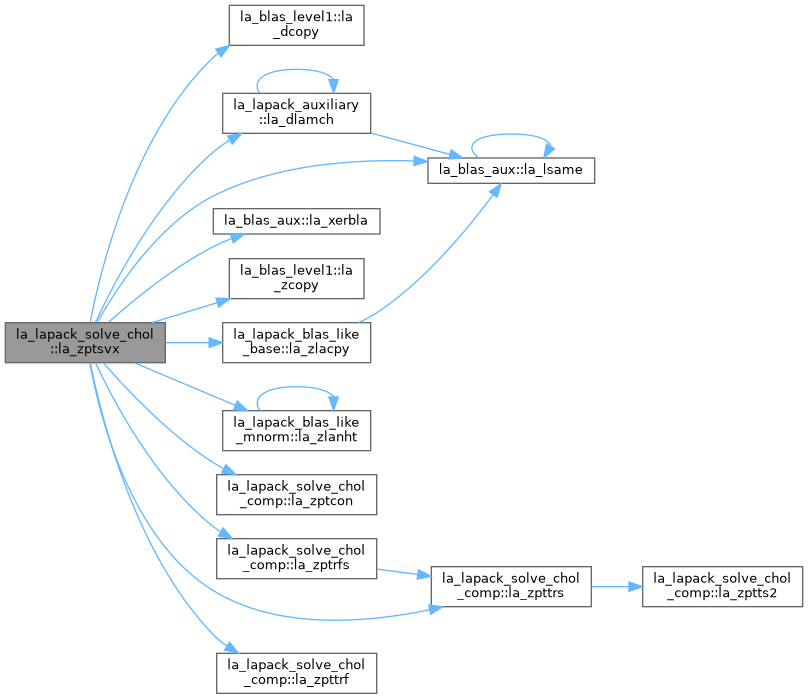
Cholesky drivers: positive definite, packed, banded and tridiagonal systems. More...
Functions/Subroutines | |
| pure subroutine, public | la_sppsv (uplo, n, nrhs, ap, b, ldb, info) |
| SPPSV: computes the solution to a real system of linear equations A * X = B, where A is an N-by-N symmetric positive definite matrix stored in packed format and X and B are N-by-NRHS matrices. The Cholesky decomposition is used to factor A as A = U**T* U, if UPLO = 'U', or A = L * L**T, if UPLO = 'L', where U is an upper triangular matrix and L is a lower triangular matrix. The factored form of A is then used to solve the system of equations A * X = B. | |
| pure subroutine, public | la_dppsv (uplo, n, nrhs, ap, b, ldb, info) |
| DPPSV: computes the solution to a real system of linear equations A * X = B, where A is an N-by-N symmetric positive definite matrix stored in packed format and X and B are N-by-NRHS matrices. The Cholesky decomposition is used to factor A as A = U**T* U, if UPLO = 'U', or A = L * L**T, if UPLO = 'L', where U is an upper triangular matrix and L is a lower triangular matrix. The factored form of A is then used to solve the system of equations A * X = B. | |
| pure subroutine, public | la_qppsv (uplo, n, nrhs, ap, b, ldb, info) |
| QPPSV: computes the solution to a real system of linear equations A * X = B, where A is an N-by-N symmetric positive definite matrix stored in packed format and X and B are N-by-NRHS matrices. The Cholesky decomposition is used to factor A as A = U**T* U, if UPLO = 'U', or A = L * L**T, if UPLO = 'L', where U is an upper triangular matrix and L is a lower triangular matrix. The factored form of A is then used to solve the system of equations A * X = B. | |
| subroutine, public | la_sppsvx (fact, uplo, n, nrhs, ap, afp, equed, s, b, ldb, x, ldx, rcond, ferr, berr, work, iwork, info) |
| SPPSVX: uses the Cholesky factorization A = U**T*U or A = L*L**T to compute the solution to a real system of linear equations A * X = B, where A is an N-by-N symmetric positive definite matrix stored in packed format and X and B are N-by-NRHS matrices. Error bounds on the solution and a condition estimate are also provided. | |
| subroutine, public | la_dppsvx (fact, uplo, n, nrhs, ap, afp, equed, s, b, ldb, x, ldx, rcond, ferr, berr, work, iwork, info) |
| DPPSVX: uses the Cholesky factorization A = U**T*U or A = L*L**T to compute the solution to a real system of linear equations A * X = B, where A is an N-by-N symmetric positive definite matrix stored in packed format and X and B are N-by-NRHS matrices. Error bounds on the solution and a condition estimate are also provided. | |
| subroutine, public | la_qppsvx (fact, uplo, n, nrhs, ap, afp, equed, s, b, ldb, x, ldx, rcond, ferr, berr, work, iwork, info) |
| QPPSVX: uses the Cholesky factorization A = U**T*U or A = L*L**T to compute the solution to a real system of linear equations A * X = B, where A is an N-by-N symmetric positive definite matrix stored in packed format and X and B are N-by-NRHS matrices. Error bounds on the solution and a condition estimate are also provided. | |
| pure subroutine, public | la_sptsv (n, nrhs, d, e, b, ldb, info) |
| SPTSV: computes the solution to a real system of linear equations A*X = B, where A is an N-by-N symmetric positive definite tridiagonal matrix, and X and B are N-by-NRHS matrices. A is factored as A = L*D*L**T, and the factored form of A is then used to solve the system of equations. | |
| pure subroutine, public | la_dptsv (n, nrhs, d, e, b, ldb, info) |
| DPTSV: computes the solution to a real system of linear equations A*X = B, where A is an N-by-N symmetric positive definite tridiagonal matrix, and X and B are N-by-NRHS matrices. A is factored as A = L*D*L**T, and the factored form of A is then used to solve the system of equations. | |
| pure subroutine, public | la_qptsv (n, nrhs, d, e, b, ldb, info) |
| QPTSV: computes the solution to a real system of linear equations A*X = B, where A is an N-by-N symmetric positive definite tridiagonal matrix, and X and B are N-by-NRHS matrices. A is factored as A = L*D*L**T, and the factored form of A is then used to solve the system of equations. | |
| pure subroutine, public | la_sptsvx (fact, n, nrhs, d, e, df, ef, b, ldb, x, ldx, rcond, ferr, berr, work, info) |
| SPTSVX: uses the factorization A = L*D*L**T to compute the solution to a real system of linear equations A*X = B, where A is an N-by-N symmetric positive definite tridiagonal matrix and X and B are N-by-NRHS matrices. Error bounds on the solution and a condition estimate are also provided. | |
| pure subroutine, public | la_dptsvx (fact, n, nrhs, d, e, df, ef, b, ldb, x, ldx, rcond, ferr, berr, work, info) |
| DPTSVX: uses the factorization A = L*D*L**T to compute the solution to a real system of linear equations A*X = B, where A is an N-by-N symmetric positive definite tridiagonal matrix and X and B are N-by-NRHS matrices. Error bounds on the solution and a condition estimate are also provided. | |
| pure subroutine, public | la_qptsvx (fact, n, nrhs, d, e, df, ef, b, ldb, x, ldx, rcond, ferr, berr, work, info) |
| QPTSVX: uses the factorization A = L*D*L**T to compute the solution to a real system of linear equations A*X = B, where A is an N-by-N symmetric positive definite tridiagonal matrix and X and B are N-by-NRHS matrices. Error bounds on the solution and a condition estimate are also provided. | |
| subroutine, public | la_dsposv (uplo, n, nrhs, a, lda, b, ldb, x, ldx, work, swork, iter, info) |
| DSPOSV: computes the solution to a real system of linear equations A * X = B, where A is an N-by-N symmetric positive definite matrix and X and B are N-by-NRHS matrices. DSPOSV first attempts to factorize the matrix in SINGLE PRECISION and use this factorization within an iterative refinement procedure to produce a solution with DOUBLE PRECISION normwise backward error quality (see below). If the approach fails the method switches to a DOUBLE PRECISION factorization and solve. The iterative refinement is not going to be a winning strategy if the ratio SINGLE PRECISION performance over DOUBLE PRECISION performance is too small. A reasonable strategy should take the number of right-hand sides and the size of the matrix into account. This might be done with a call to ILAENV in the future. Up to now, we always try iterative refinement. The iterative refinement process is stopped if ITER > ITERMAX or for all the RHS we have: RNRM < SQRT(N)*XNRM*ANRM*EPS*BWDMAX where o ITER is the number of the current iteration in the iterative refinement process o RNRM is the infinity-norm of the residual o XNRM is the infinity-norm of the solution o ANRM is the infinity-operator-norm of the matrix A o EPS is the machine epsilon returned by DLAMCH('Epsilon') The value ITERMAX and BWDMAX are fixed to 30 and 1.0D+00 respectively. | |
| subroutine, public | la_qdposv (uplo, n, nrhs, a, lda, b, ldb, x, ldx, work, swork, iter, info) |
| QDPOSV: computes the solution to a real system of linear equations A * X = B, where A is an N-by-N symmetric positive definite matrix and X and B are N-by-NRHS matrices. QDPOSV first attempts to factorize the matrix in SINGLE PRECISION and use this factorization within an iterative refinement procedure to produce a solution with QUAD PRECISION normwise backward error quality (see below). If the approach fails the method switches to a QUAD PRECISION factorization and solve. The iterative refinement is not going to be a winning strategy if the ratio SINGLE PRECISION performance over QUAD PRECISION performance is too small. A reasonable strategy should take the number of right-hand sides and the size of the matrix into account. This might be done with a call to ILAENV in the future. Up to now, we always try iterative refinement. The iterative refinement process is stopped if ITER > ITERMAX or for all the RHS we have: RNRM < SQRT(N)*XNRM*ANRM*EPS*BWDMAX where o ITER is the number of the current iteration in the iterative refinement process o RNRM is the infinity-norm of the residual o XNRM is the infinity-norm of the solution o ANRM is the infinity-operator-norm of the matrix A o EPS is the machine epsilon returned by QLAMCH('Epsilon') The value ITERMAX and BWDMAX are fixed to 30 and 1.0D+00 respectively. | |
| pure subroutine, public | la_spbsv (uplo, n, kd, nrhs, ab, ldab, b, ldb, info) |
| SPBSV: computes the solution to a real system of linear equations A * X = B, where A is an N-by-N symmetric positive definite band matrix and X and B are N-by-NRHS matrices. The Cholesky decomposition is used to factor A as A = U**T * U, if UPLO = 'U', or A = L * L**T, if UPLO = 'L', where U is an upper triangular band matrix, and L is a lower triangular band matrix, with the same number of superdiagonals or subdiagonals as A. The factored form of A is then used to solve the system of equations A * X = B. | |
| pure subroutine, public | la_dpbsv (uplo, n, kd, nrhs, ab, ldab, b, ldb, info) |
| DPBSV: computes the solution to a real system of linear equations A * X = B, where A is an N-by-N symmetric positive definite band matrix and X and B are N-by-NRHS matrices. The Cholesky decomposition is used to factor A as A = U**T * U, if UPLO = 'U', or A = L * L**T, if UPLO = 'L', where U is an upper triangular band matrix, and L is a lower triangular band matrix, with the same number of superdiagonals or subdiagonals as A. The factored form of A is then used to solve the system of equations A * X = B. | |
| pure subroutine, public | la_qpbsv (uplo, n, kd, nrhs, ab, ldab, b, ldb, info) |
| QPBSV: computes the solution to a real system of linear equations A * X = B, where A is an N-by-N symmetric positive definite band matrix and X and B are N-by-NRHS matrices. The Cholesky decomposition is used to factor A as A = U**T * U, if UPLO = 'U', or A = L * L**T, if UPLO = 'L', where U is an upper triangular band matrix, and L is a lower triangular band matrix, with the same number of superdiagonals or subdiagonals as A. The factored form of A is then used to solve the system of equations A * X = B. | |
| subroutine, public | la_spbsvx (fact, uplo, n, kd, nrhs, ab, ldab, afb, ldafb, equed, s, b, ldb, x, ldx, rcond, ferr, berr, work, iwork, info) |
| SPBSVX: uses the Cholesky factorization A = U**T*U or A = L*L**T to compute the solution to a real system of linear equations A * X = B, where A is an N-by-N symmetric positive definite band matrix and X and B are N-by-NRHS matrices. Error bounds on the solution and a condition estimate are also provided. | |
| subroutine, public | la_dpbsvx (fact, uplo, n, kd, nrhs, ab, ldab, afb, ldafb, equed, s, b, ldb, x, ldx, rcond, ferr, berr, work, iwork, info) |
| DPBSVX: uses the Cholesky factorization A = U**T*U or A = L*L**T to compute the solution to a real system of linear equations A * X = B, where A is an N-by-N symmetric positive definite band matrix and X and B are N-by-NRHS matrices. Error bounds on the solution and a condition estimate are also provided. | |
| subroutine, public | la_qpbsvx (fact, uplo, n, kd, nrhs, ab, ldab, afb, ldafb, equed, s, b, ldb, x, ldx, rcond, ferr, berr, work, iwork, info) |
| QPBSVX: uses the Cholesky factorization A = U**T*U or A = L*L**T to compute the solution to a real system of linear equations A * X = B, where A is an N-by-N symmetric positive definite band matrix and X and B are N-by-NRHS matrices. Error bounds on the solution and a condition estimate are also provided. | |
| pure subroutine, public | la_sposv (uplo, n, nrhs, a, lda, b, ldb, info) |
| SPOSV: computes the solution to a real system of linear equations A * X = B, where A is an N-by-N symmetric positive definite matrix and X and B are N-by-NRHS matrices. The Cholesky decomposition is used to factor A as A = U**T* U, if UPLO = 'U', or A = L * L**T, if UPLO = 'L', where U is an upper triangular matrix and L is a lower triangular matrix. The factored form of A is then used to solve the system of equations A * X = B. | |
| pure subroutine, public | la_dposv (uplo, n, nrhs, a, lda, b, ldb, info) |
| DPOSV: computes the solution to a real system of linear equations A * X = B, where A is an N-by-N symmetric positive definite matrix and X and B are N-by-NRHS matrices. The Cholesky decomposition is used to factor A as A = U**T* U, if UPLO = 'U', or A = L * L**T, if UPLO = 'L', where U is an upper triangular matrix and L is a lower triangular matrix. The factored form of A is then used to solve the system of equations A * X = B. | |
| pure subroutine, public | la_qposv (uplo, n, nrhs, a, lda, b, ldb, info) |
| QPOSV: computes the solution to a real system of linear equations A * X = B, where A is an N-by-N symmetric positive definite matrix and X and B are N-by-NRHS matrices. The Cholesky decomposition is used to factor A as A = U**T* U, if UPLO = 'U', or A = L * L**T, if UPLO = 'L', where U is an upper triangular matrix and L is a lower triangular matrix. The factored form of A is then used to solve the system of equations A * X = B. | |
| subroutine, public | la_sposvx (fact, uplo, n, nrhs, a, lda, af, ldaf, equed, s, b, ldb, x, ldx, rcond, ferr, berr, work, iwork, info) |
| SPOSVX: uses the Cholesky factorization A = U**T*U or A = L*L**T to compute the solution to a real system of linear equations A * X = B, where A is an N-by-N symmetric positive definite matrix and X and B are N-by-NRHS matrices. Error bounds on the solution and a condition estimate are also provided. | |
| subroutine, public | la_dposvx (fact, uplo, n, nrhs, a, lda, af, ldaf, equed, s, b, ldb, x, ldx, rcond, ferr, berr, work, iwork, info) |
| DPOSVX: uses the Cholesky factorization A = U**T*U or A = L*L**T to compute the solution to a real system of linear equations A * X = B, where A is an N-by-N symmetric positive definite matrix and X and B are N-by-NRHS matrices. Error bounds on the solution and a condition estimate are also provided. | |
| subroutine, public | la_qposvx (fact, uplo, n, nrhs, a, lda, af, ldaf, equed, s, b, ldb, x, ldx, rcond, ferr, berr, work, iwork, info) |
| QPOSVX: uses the Cholesky factorization A = U**T*U or A = L*L**T to compute the solution to a real system of linear equations A * X = B, where A is an N-by-N symmetric positive definite matrix and X and B are N-by-NRHS matrices. Error bounds on the solution and a condition estimate are also provided. | |
| pure subroutine, public | la_cppsv (uplo, n, nrhs, ap, b, ldb, info) |
| CPPSV: computes the solution to a complex system of linear equations A * X = B, where A is an N-by-N Hermitian positive definite matrix stored in packed format and X and B are N-by-NRHS matrices. The Cholesky decomposition is used to factor A as A = U**H * U, if UPLO = 'U', or A = L * L**H, if UPLO = 'L', where U is an upper triangular matrix and L is a lower triangular matrix. The factored form of A is then used to solve the system of equations A * X = B. | |
| pure subroutine, public | la_zppsv (uplo, n, nrhs, ap, b, ldb, info) |
| ZPPSV: computes the solution to a complex system of linear equations A * X = B, where A is an N-by-N Hermitian positive definite matrix stored in packed format and X and B are N-by-NRHS matrices. The Cholesky decomposition is used to factor A as A = U**H * U, if UPLO = 'U', or A = L * L**H, if UPLO = 'L', where U is an upper triangular matrix and L is a lower triangular matrix. The factored form of A is then used to solve the system of equations A * X = B. | |
| pure subroutine, public | la_wppsv (uplo, n, nrhs, ap, b, ldb, info) |
| WPPSV: computes the solution to a complex system of linear equations A * X = B, where A is an N-by-N Hermitian positive definite matrix stored in packed format and X and B are N-by-NRHS matrices. The Cholesky decomposition is used to factor A as A = U**H * U, if UPLO = 'U', or A = L * L**H, if UPLO = 'L', where U is an upper triangular matrix and L is a lower triangular matrix. The factored form of A is then used to solve the system of equations A * X = B. | |
| subroutine, public | la_cppsvx (fact, uplo, n, nrhs, ap, afp, equed, s, b, ldb, x, ldx, rcond, ferr, berr, work, rwork, info) |
| CPPSVX: uses the Cholesky factorization A = U**H*U or A = L*L**H to compute the solution to a complex system of linear equations A * X = B, where A is an N-by-N Hermitian positive definite matrix stored in packed format and X and B are N-by-NRHS matrices. Error bounds on the solution and a condition estimate are also provided. | |
| subroutine, public | la_zppsvx (fact, uplo, n, nrhs, ap, afp, equed, s, b, ldb, x, ldx, rcond, ferr, berr, work, rwork, info) |
| ZPPSVX: uses the Cholesky factorization A = U**H * U or A = L * L**H to compute the solution to a complex system of linear equations A * X = B, where A is an N-by-N Hermitian positive definite matrix stored in packed format and X and B are N-by-NRHS matrices. Error bounds on the solution and a condition estimate are also provided. | |
| subroutine, public | la_wppsvx (fact, uplo, n, nrhs, ap, afp, equed, s, b, ldb, x, ldx, rcond, ferr, berr, work, rwork, info) |
| WPPSVX: uses the Cholesky factorization A = U**H * U or A = L * L**H to compute the solution to a complex system of linear equations A * X = B, where A is an N-by-N Hermitian positive definite matrix stored in packed format and X and B are N-by-NRHS matrices. Error bounds on the solution and a condition estimate are also provided. | |
| subroutine, public | la_zcposv (uplo, n, nrhs, a, lda, b, ldb, x, ldx, work, swork, rwork, iter, info) |
| ZCPOSV: computes the solution to a complex system of linear equations A * X = B, where A is an N-by-N Hermitian positive definite matrix and X and B are N-by-NRHS matrices. ZCPOSV first attempts to factorize the matrix in COMPLEX and use this factorization within an iterative refinement procedure to produce a solution with COMPLEX*16 normwise backward error quality (see below). If the approach fails the method switches to a COMPLEX*16 factorization and solve. The iterative refinement is not going to be a winning strategy if the ratio COMPLEX performance over COMPLEX*16 performance is too small. A reasonable strategy should take the number of right-hand sides and the size of the matrix into account. This might be done with a call to ILAENV in the future. Up to now, we always try iterative refinement. The iterative refinement process is stopped if ITER > ITERMAX or for all the RHS we have: RNRM < SQRT(N)*XNRM*ANRM*EPS*BWDMAX where o ITER is the number of the current iteration in the iterative refinement process o RNRM is the infinity-norm of the residual o XNRM is the infinity-norm of the solution o ANRM is the infinity-operator-norm of the matrix A o EPS is the machine epsilon returned by DLAMCH('Epsilon') The value ITERMAX and BWDMAX are fixed to 30 and 1.0D+00 respectively. | |
| subroutine, public | la_wzposv (uplo, n, nrhs, a, lda, b, ldb, x, ldx, work, swork, rwork, iter, info) |
| WZPOSV: computes the solution to a complex system of linear equations A * X = B, where A is an N-by-N Hermitian positive definite matrix and X and B are N-by-NRHS matrices. WZPOSV first attempts to factorize the matrix in COMPLEX and use this factorization within an iterative refinement procedure to produce a solution with COMPLEX*16 normwise backward error quality (see below). If the approach fails the method switches to a COMPLEX*16 factorization and solve. The iterative refinement is not going to be a winning strategy if the ratio COMPLEX performance over COMPLEX*16 performance is too small. A reasonable strategy should take the number of right-hand sides and the size of the matrix into account. This might be done with a call to ILAENV in the future. Up to now, we always try iterative refinement. The iterative refinement process is stopped if ITER > ITERMAX or for all the RHS we have: RNRM < SQRT(N)*XNRM*ANRM*EPS*BWDMAX where o ITER is the number of the current iteration in the iterative refinement process o RNRM is the infinity-norm of the residual o XNRM is the infinity-norm of the solution o ANRM is the infinity-operator-norm of the matrix A o EPS is the machine epsilon returned by QLAMCH('Epsilon') The value ITERMAX and BWDMAX are fixed to 30 and 1.0D+00 respectively. | |
| pure subroutine, public | la_cpbsv (uplo, n, kd, nrhs, ab, ldab, b, ldb, info) |
| CPBSV: computes the solution to a complex system of linear equations A * X = B, where A is an N-by-N Hermitian positive definite band matrix and X and B are N-by-NRHS matrices. The Cholesky decomposition is used to factor A as A = U**H * U, if UPLO = 'U', or A = L * L**H, if UPLO = 'L', where U is an upper triangular band matrix, and L is a lower triangular band matrix, with the same number of superdiagonals or subdiagonals as A. The factored form of A is then used to solve the system of equations A * X = B. | |
| pure subroutine, public | la_zpbsv (uplo, n, kd, nrhs, ab, ldab, b, ldb, info) |
| ZPBSV: computes the solution to a complex system of linear equations A * X = B, where A is an N-by-N Hermitian positive definite band matrix and X and B are N-by-NRHS matrices. The Cholesky decomposition is used to factor A as A = U**H * U, if UPLO = 'U', or A = L * L**H, if UPLO = 'L', where U is an upper triangular band matrix, and L is a lower triangular band matrix, with the same number of superdiagonals or subdiagonals as A. The factored form of A is then used to solve the system of equations A * X = B. | |
| pure subroutine, public | la_wpbsv (uplo, n, kd, nrhs, ab, ldab, b, ldb, info) |
| WPBSV: computes the solution to a complex system of linear equations A * X = B, where A is an N-by-N Hermitian positive definite band matrix and X and B are N-by-NRHS matrices. The Cholesky decomposition is used to factor A as A = U**H * U, if UPLO = 'U', or A = L * L**H, if UPLO = 'L', where U is an upper triangular band matrix, and L is a lower triangular band matrix, with the same number of superdiagonals or subdiagonals as A. The factored form of A is then used to solve the system of equations A * X = B. | |
| subroutine, public | la_cpbsvx (fact, uplo, n, kd, nrhs, ab, ldab, afb, ldafb, equed, s, b, ldb, x, ldx, rcond, ferr, berr, work, rwork, info) |
| CPBSVX: uses the Cholesky factorization A = U**H*U or A = L*L**H to compute the solution to a complex system of linear equations A * X = B, where A is an N-by-N Hermitian positive definite band matrix and X and B are N-by-NRHS matrices. Error bounds on the solution and a condition estimate are also provided. | |
| subroutine, public | la_zpbsvx (fact, uplo, n, kd, nrhs, ab, ldab, afb, ldafb, equed, s, b, ldb, x, ldx, rcond, ferr, berr, work, rwork, info) |
| ZPBSVX: uses the Cholesky factorization A = U**H*U or A = L*L**H to compute the solution to a complex system of linear equations A * X = B, where A is an N-by-N Hermitian positive definite band matrix and X and B are N-by-NRHS matrices. Error bounds on the solution and a condition estimate are also provided. | |
| subroutine, public | la_wpbsvx (fact, uplo, n, kd, nrhs, ab, ldab, afb, ldafb, equed, s, b, ldb, x, ldx, rcond, ferr, berr, work, rwork, info) |
| WPBSVX: uses the Cholesky factorization A = U**H*U or A = L*L**H to compute the solution to a complex system of linear equations A * X = B, where A is an N-by-N Hermitian positive definite band matrix and X and B are N-by-NRHS matrices. Error bounds on the solution and a condition estimate are also provided. | |
| pure subroutine, public | la_cposv (uplo, n, nrhs, a, lda, b, ldb, info) |
| CPOSV: computes the solution to a complex system of linear equations A * X = B, where A is an N-by-N Hermitian positive definite matrix and X and B are N-by-NRHS matrices. The Cholesky decomposition is used to factor A as A = U**H* U, if UPLO = 'U', or A = L * L**H, if UPLO = 'L', where U is an upper triangular matrix and L is a lower triangular matrix. The factored form of A is then used to solve the system of equations A * X = B. | |
| pure subroutine, public | la_zposv (uplo, n, nrhs, a, lda, b, ldb, info) |
| ZPOSV: computes the solution to a complex system of linear equations A * X = B, where A is an N-by-N Hermitian positive definite matrix and X and B are N-by-NRHS matrices. The Cholesky decomposition is used to factor A as A = U**H* U, if UPLO = 'U', or A = L * L**H, if UPLO = 'L', where U is an upper triangular matrix and L is a lower triangular matrix. The factored form of A is then used to solve the system of equations A * X = B. | |
| pure subroutine, public | la_wposv (uplo, n, nrhs, a, lda, b, ldb, info) |
| WPOSV: computes the solution to a complex system of linear equations A * X = B, where A is an N-by-N Hermitian positive definite matrix and X and B are N-by-NRHS matrices. The Cholesky decomposition is used to factor A as A = U**H* U, if UPLO = 'U', or A = L * L**H, if UPLO = 'L', where U is an upper triangular matrix and L is a lower triangular matrix. The factored form of A is then used to solve the system of equations A * X = B. | |
| subroutine, public | la_cposvx (fact, uplo, n, nrhs, a, lda, af, ldaf, equed, s, b, ldb, x, ldx, rcond, ferr, berr, work, rwork, info) |
| CPOSVX: uses the Cholesky factorization A = U**H*U or A = L*L**H to compute the solution to a complex system of linear equations A * X = B, where A is an N-by-N Hermitian positive definite matrix and X and B are N-by-NRHS matrices. Error bounds on the solution and a condition estimate are also provided. | |
| subroutine, public | la_zposvx (fact, uplo, n, nrhs, a, lda, af, ldaf, equed, s, b, ldb, x, ldx, rcond, ferr, berr, work, rwork, info) |
| ZPOSVX: uses the Cholesky factorization A = U**H*U or A = L*L**H to compute the solution to a complex system of linear equations A * X = B, where A is an N-by-N Hermitian positive definite matrix and X and B are N-by-NRHS matrices. Error bounds on the solution and a condition estimate are also provided. | |
| subroutine, public | la_wposvx (fact, uplo, n, nrhs, a, lda, af, ldaf, equed, s, b, ldb, x, ldx, rcond, ferr, berr, work, rwork, info) |
| WPOSVX: uses the Cholesky factorization A = U**H*U or A = L*L**H to compute the solution to a complex system of linear equations A * X = B, where A is an N-by-N Hermitian positive definite matrix and X and B are N-by-NRHS matrices. Error bounds on the solution and a condition estimate are also provided. | |
| pure subroutine, public | la_cptsv (n, nrhs, d, e, b, ldb, info) |
| CPTSV: computes the solution to a complex system of linear equations A*X = B, where A is an N-by-N Hermitian positive definite tridiagonal matrix, and X and B are N-by-NRHS matrices. A is factored as A = L*D*L**H, and the factored form of A is then used to solve the system of equations. | |
| pure subroutine, public | la_zptsv (n, nrhs, d, e, b, ldb, info) |
| ZPTSV: computes the solution to a complex system of linear equations A*X = B, where A is an N-by-N Hermitian positive definite tridiagonal matrix, and X and B are N-by-NRHS matrices. A is factored as A = L*D*L**H, and the factored form of A is then used to solve the system of equations. | |
| pure subroutine, public | la_wptsv (n, nrhs, d, e, b, ldb, info) |
| WPTSV: computes the solution to a complex system of linear equations A*X = B, where A is an N-by-N Hermitian positive definite tridiagonal matrix, and X and B are N-by-NRHS matrices. A is factored as A = L*D*L**H, and the factored form of A is then used to solve the system of equations. | |
| pure subroutine, public | la_cptsvx (fact, n, nrhs, d, e, df, ef, b, ldb, x, ldx, rcond, ferr, berr, work, rwork, info) |
| CPTSVX: uses the factorization A = L*D*L**H to compute the solution to a complex system of linear equations A*X = B, where A is an N-by-N Hermitian positive definite tridiagonal matrix and X and B are N-by-NRHS matrices. Error bounds on the solution and a condition estimate are also provided. | |
| pure subroutine, public | la_zptsvx (fact, n, nrhs, d, e, df, ef, b, ldb, x, ldx, rcond, ferr, berr, work, rwork, info) |
| ZPTSVX: uses the factorization A = L*D*L**H to compute the solution to a complex system of linear equations A*X = B, where A is an N-by-N Hermitian positive definite tridiagonal matrix and X and B are N-by-NRHS matrices. Error bounds on the solution and a condition estimate are also provided. | |
| pure subroutine, public | la_wptsvx (fact, n, nrhs, d, e, df, ef, b, ldb, x, ldx, rcond, ferr, berr, work, rwork, info) |
| WPTSVX: uses the factorization A = L*D*L**H to compute the solution to a complex system of linear equations A*X = B, where A is an N-by-N Hermitian positive definite tridiagonal matrix and X and B are N-by-NRHS matrices. Error bounds on the solution and a condition estimate are also provided. | |
Detailed Description
Cholesky drivers: positive definite, packed, banded and tridiagonal systems.
Function/Subroutine Documentation
◆ la_cpbsv()
| pure subroutine, public la_lapack_solve_chol::la_cpbsv | ( | character, intent(in) | uplo, |
| integer(ilp), intent(in) | n, | ||
| integer(ilp), intent(in) | kd, | ||
| integer(ilp), intent(in) | nrhs, | ||
| complex(sp), dimension(ldab,*), intent(inout) | ab, | ||
| integer(ilp), intent(in) | ldab, | ||
| complex(sp), dimension(ldb,*), intent(inout) | b, | ||
| integer(ilp), intent(in) | ldb, | ||
| integer(ilp), intent(out) | info ) |
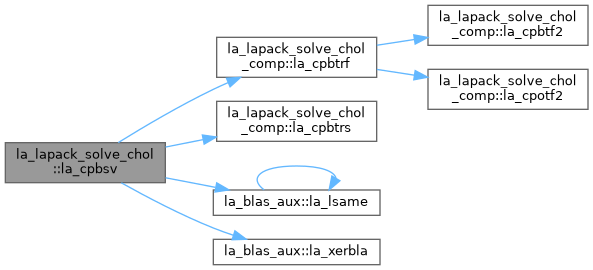
CPBSV: computes the solution to a complex system of linear equations A * X = B, where A is an N-by-N Hermitian positive definite band matrix and X and B are N-by-NRHS matrices. The Cholesky decomposition is used to factor A as A = U**H * U, if UPLO = 'U', or A = L * L**H, if UPLO = 'L', where U is an upper triangular band matrix, and L is a lower triangular band matrix, with the same number of superdiagonals or subdiagonals as A. The factored form of A is then used to solve the system of equations A * X = B.
◆ la_cpbsvx()
| subroutine, public la_lapack_solve_chol::la_cpbsvx | ( | character, intent(in) | fact, |
| character, intent(in) | uplo, | ||
| integer(ilp), intent(in) | n, | ||
| integer(ilp), intent(in) | kd, | ||
| integer(ilp), intent(in) | nrhs, | ||
| complex(sp), dimension(ldab,*), intent(inout) | ab, | ||
| integer(ilp), intent(in) | ldab, | ||
| complex(sp), dimension(ldafb,*), intent(inout) | afb, | ||
| integer(ilp), intent(in) | ldafb, | ||
| character, intent(inout) | equed, | ||
| real(sp), dimension(*), intent(inout) | s, | ||
| complex(sp), dimension(ldb,*), intent(inout) | b, | ||
| integer(ilp), intent(in) | ldb, | ||
| complex(sp), dimension(ldx,*), intent(out) | x, | ||
| integer(ilp), intent(in) | ldx, | ||
| real(sp), intent(out) | rcond, | ||
| real(sp), dimension(*), intent(out) | ferr, | ||
| real(sp), dimension(*), intent(out) | berr, | ||
| complex(sp), dimension(*), intent(out) | work, | ||
| real(sp), dimension(*), intent(out) | rwork, | ||
| integer(ilp), intent(out) | info ) |
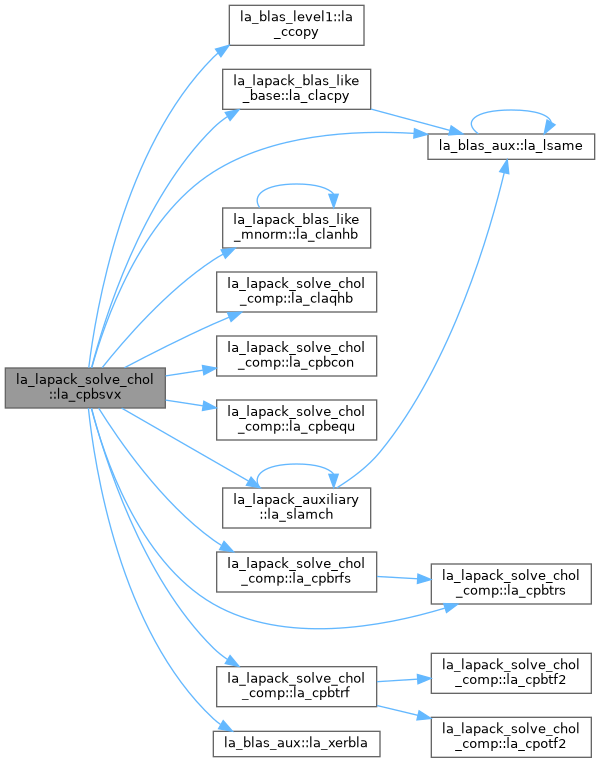
CPBSVX: uses the Cholesky factorization A = U**H*U or A = L*L**H to compute the solution to a complex system of linear equations A * X = B, where A is an N-by-N Hermitian positive definite band matrix and X and B are N-by-NRHS matrices. Error bounds on the solution and a condition estimate are also provided.
◆ la_cposv()
| pure subroutine, public la_lapack_solve_chol::la_cposv | ( | character, intent(in) | uplo, |
| integer(ilp), intent(in) | n, | ||
| integer(ilp), intent(in) | nrhs, | ||
| complex(sp), dimension(lda,*), intent(inout) | a, | ||
| integer(ilp), intent(in) | lda, | ||
| complex(sp), dimension(ldb,*), intent(inout) | b, | ||
| integer(ilp), intent(in) | ldb, | ||
| integer(ilp), intent(out) | info ) |
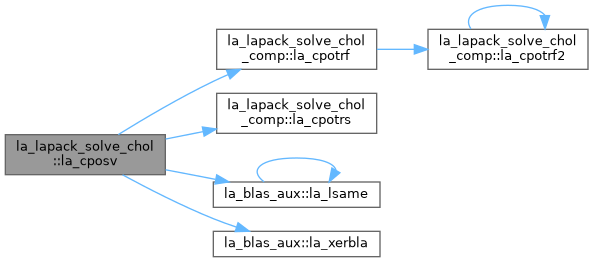
CPOSV: computes the solution to a complex system of linear equations A * X = B, where A is an N-by-N Hermitian positive definite matrix and X and B are N-by-NRHS matrices. The Cholesky decomposition is used to factor A as A = U**H* U, if UPLO = 'U', or A = L * L**H, if UPLO = 'L', where U is an upper triangular matrix and L is a lower triangular matrix. The factored form of A is then used to solve the system of equations A * X = B.
◆ la_cposvx()
| subroutine, public la_lapack_solve_chol::la_cposvx | ( | character, intent(in) | fact, |
| character, intent(in) | uplo, | ||
| integer(ilp), intent(in) | n, | ||
| integer(ilp), intent(in) | nrhs, | ||
| complex(sp), dimension(lda,*), intent(inout) | a, | ||
| integer(ilp), intent(in) | lda, | ||
| complex(sp), dimension(ldaf,*), intent(inout) | af, | ||
| integer(ilp), intent(in) | ldaf, | ||
| character, intent(inout) | equed, | ||
| real(sp), dimension(*), intent(inout) | s, | ||
| complex(sp), dimension(ldb,*), intent(inout) | b, | ||
| integer(ilp), intent(in) | ldb, | ||
| complex(sp), dimension(ldx,*), intent(out) | x, | ||
| integer(ilp), intent(in) | ldx, | ||
| real(sp), intent(out) | rcond, | ||
| real(sp), dimension(*), intent(out) | ferr, | ||
| real(sp), dimension(*), intent(out) | berr, | ||
| complex(sp), dimension(*), intent(out) | work, | ||
| real(sp), dimension(*), intent(out) | rwork, | ||
| integer(ilp), intent(out) | info ) |
CPOSVX: uses the Cholesky factorization A = U**H*U or A = L*L**H to compute the solution to a complex system of linear equations A * X = B, where A is an N-by-N Hermitian positive definite matrix and X and B are N-by-NRHS matrices. Error bounds on the solution and a condition estimate are also provided.
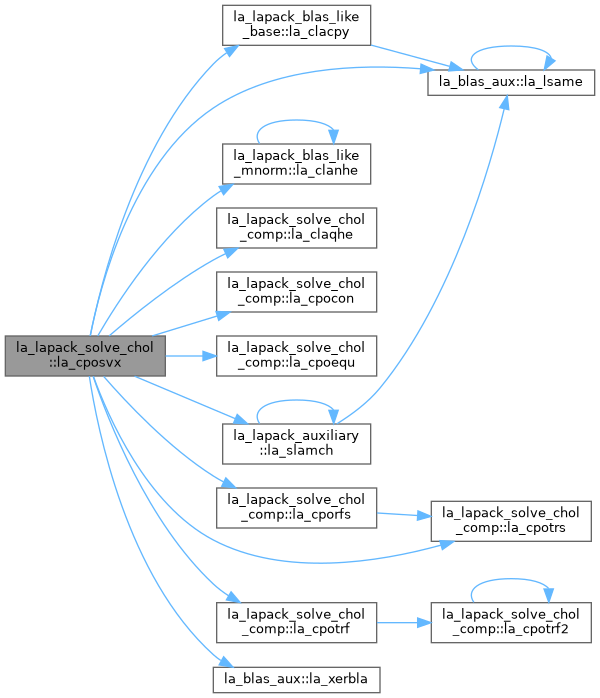
◆ la_cppsv()
| pure subroutine, public la_lapack_solve_chol::la_cppsv | ( | character, intent(in) | uplo, |
| integer(ilp), intent(in) | n, | ||
| integer(ilp), intent(in) | nrhs, | ||
| complex(sp), dimension(*), intent(inout) | ap, | ||
| complex(sp), dimension(ldb,*), intent(inout) | b, | ||
| integer(ilp), intent(in) | ldb, | ||
| integer(ilp), intent(out) | info ) |
CPPSV: computes the solution to a complex system of linear equations A * X = B, where A is an N-by-N Hermitian positive definite matrix stored in packed format and X and B are N-by-NRHS matrices. The Cholesky decomposition is used to factor A as A = U**H * U, if UPLO = 'U', or A = L * L**H, if UPLO = 'L', where U is an upper triangular matrix and L is a lower triangular matrix. The factored form of A is then used to solve the system of equations A * X = B.
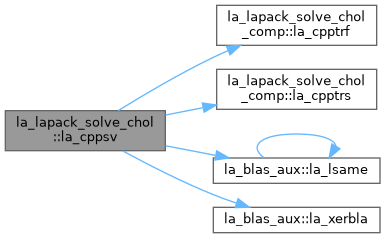
◆ la_cppsvx()
| subroutine, public la_lapack_solve_chol::la_cppsvx | ( | character, intent(in) | fact, |
| character, intent(in) | uplo, | ||
| integer(ilp), intent(in) | n, | ||
| integer(ilp), intent(in) | nrhs, | ||
| complex(sp), dimension(*), intent(inout) | ap, | ||
| complex(sp), dimension(*), intent(inout) | afp, | ||
| character, intent(inout) | equed, | ||
| real(sp), dimension(*), intent(inout) | s, | ||
| complex(sp), dimension(ldb,*), intent(inout) | b, | ||
| integer(ilp), intent(in) | ldb, | ||
| complex(sp), dimension(ldx,*), intent(out) | x, | ||
| integer(ilp), intent(in) | ldx, | ||
| real(sp), intent(out) | rcond, | ||
| real(sp), dimension(*), intent(out) | ferr, | ||
| real(sp), dimension(*), intent(out) | berr, | ||
| complex(sp), dimension(*), intent(out) | work, | ||
| real(sp), dimension(*), intent(out) | rwork, | ||
| integer(ilp), intent(out) | info ) |
CPPSVX: uses the Cholesky factorization A = U**H*U or A = L*L**H to compute the solution to a complex system of linear equations A * X = B, where A is an N-by-N Hermitian positive definite matrix stored in packed format and X and B are N-by-NRHS matrices. Error bounds on the solution and a condition estimate are also provided.
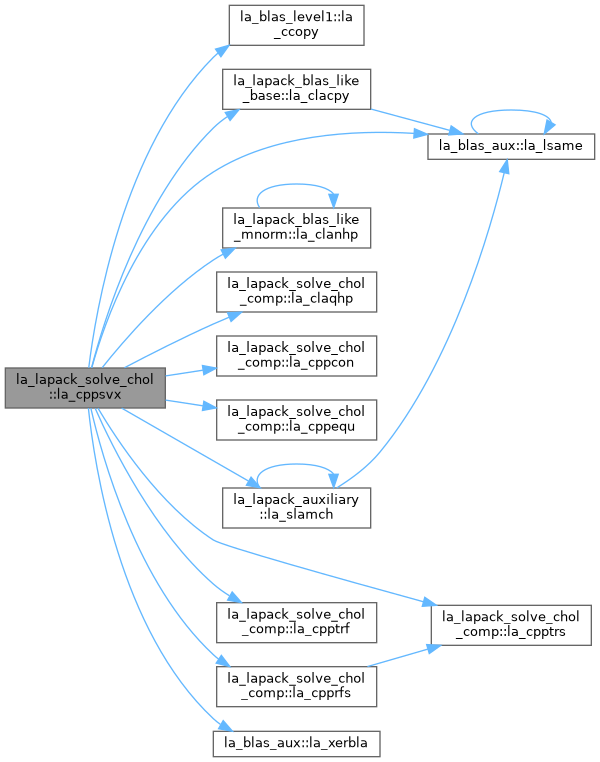
◆ la_cptsv()
| pure subroutine, public la_lapack_solve_chol::la_cptsv | ( | integer(ilp), intent(in) | n, |
| integer(ilp), intent(in) | nrhs, | ||
| real(sp), dimension(*), intent(inout) | d, | ||
| complex(sp), dimension(*), intent(inout) | e, | ||
| complex(sp), dimension(ldb,*), intent(inout) | b, | ||
| integer(ilp), intent(in) | ldb, | ||
| integer(ilp), intent(out) | info ) |
CPTSV: computes the solution to a complex system of linear equations A*X = B, where A is an N-by-N Hermitian positive definite tridiagonal matrix, and X and B are N-by-NRHS matrices. A is factored as A = L*D*L**H, and the factored form of A is then used to solve the system of equations.
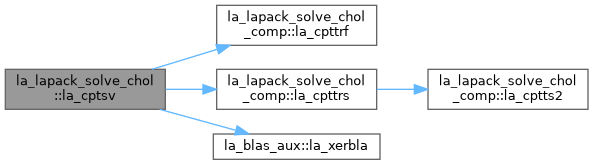
◆ la_cptsvx()
| pure subroutine, public la_lapack_solve_chol::la_cptsvx | ( | character, intent(in) | fact, |
| integer(ilp), intent(in) | n, | ||
| integer(ilp), intent(in) | nrhs, | ||
| real(sp), dimension(*), intent(in) | d, | ||
| complex(sp), dimension(*), intent(in) | e, | ||
| real(sp), dimension(*), intent(inout) | df, | ||
| complex(sp), dimension(*), intent(inout) | ef, | ||
| complex(sp), dimension(ldb,*), intent(in) | b, | ||
| integer(ilp), intent(in) | ldb, | ||
| complex(sp), dimension(ldx,*), intent(out) | x, | ||
| integer(ilp), intent(in) | ldx, | ||
| real(sp), intent(out) | rcond, | ||
| real(sp), dimension(*), intent(out) | ferr, | ||
| real(sp), dimension(*), intent(out) | berr, | ||
| complex(sp), dimension(*), intent(out) | work, | ||
| real(sp), dimension(*), intent(out) | rwork, | ||
| integer(ilp), intent(out) | info ) |
CPTSVX: uses the factorization A = L*D*L**H to compute the solution to a complex system of linear equations A*X = B, where A is an N-by-N Hermitian positive definite tridiagonal matrix and X and B are N-by-NRHS matrices. Error bounds on the solution and a condition estimate are also provided.
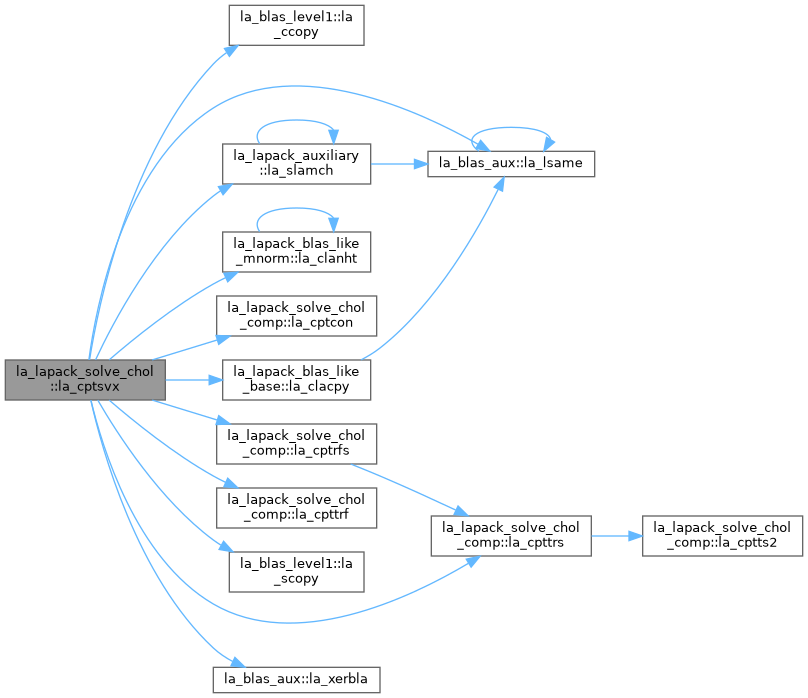
◆ la_dpbsv()
| pure subroutine, public la_lapack_solve_chol::la_dpbsv | ( | character, intent(in) | uplo, |
| integer(ilp), intent(in) | n, | ||
| integer(ilp), intent(in) | kd, | ||
| integer(ilp), intent(in) | nrhs, | ||
| real(dp), dimension(ldab,*), intent(inout) | ab, | ||
| integer(ilp), intent(in) | ldab, | ||
| real(dp), dimension(ldb,*), intent(inout) | b, | ||
| integer(ilp), intent(in) | ldb, | ||
| integer(ilp), intent(out) | info ) |
DPBSV: computes the solution to a real system of linear equations A * X = B, where A is an N-by-N symmetric positive definite band matrix and X and B are N-by-NRHS matrices. The Cholesky decomposition is used to factor A as A = U**T * U, if UPLO = 'U', or A = L * L**T, if UPLO = 'L', where U is an upper triangular band matrix, and L is a lower triangular band matrix, with the same number of superdiagonals or subdiagonals as A. The factored form of A is then used to solve the system of equations A * X = B.
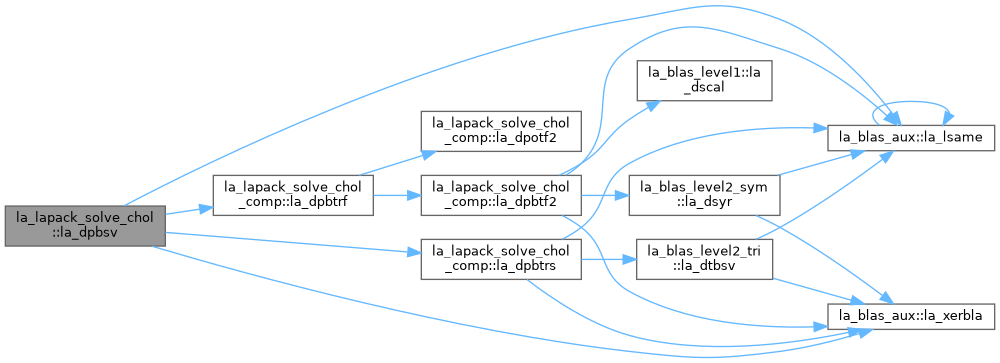
◆ la_dpbsvx()
| subroutine, public la_lapack_solve_chol::la_dpbsvx | ( | character, intent(in) | fact, |
| character, intent(in) | uplo, | ||
| integer(ilp), intent(in) | n, | ||
| integer(ilp), intent(in) | kd, | ||
| integer(ilp), intent(in) | nrhs, | ||
| real(dp), dimension(ldab,*), intent(inout) | ab, | ||
| integer(ilp), intent(in) | ldab, | ||
| real(dp), dimension(ldafb,*), intent(inout) | afb, | ||
| integer(ilp), intent(in) | ldafb, | ||
| character, intent(inout) | equed, | ||
| real(dp), dimension(*), intent(inout) | s, | ||
| real(dp), dimension(ldb,*), intent(inout) | b, | ||
| integer(ilp), intent(in) | ldb, | ||
| real(dp), dimension(ldx,*), intent(out) | x, | ||
| integer(ilp), intent(in) | ldx, | ||
| real(dp), intent(out) | rcond, | ||
| real(dp), dimension(*), intent(out) | ferr, | ||
| real(dp), dimension(*), intent(out) | berr, | ||
| real(dp), dimension(*), intent(out) | work, | ||
| integer(ilp), dimension(*), intent(out) | iwork, | ||
| integer(ilp), intent(out) | info ) |
DPBSVX: uses the Cholesky factorization A = U**T*U or A = L*L**T to compute the solution to a real system of linear equations A * X = B, where A is an N-by-N symmetric positive definite band matrix and X and B are N-by-NRHS matrices. Error bounds on the solution and a condition estimate are also provided.
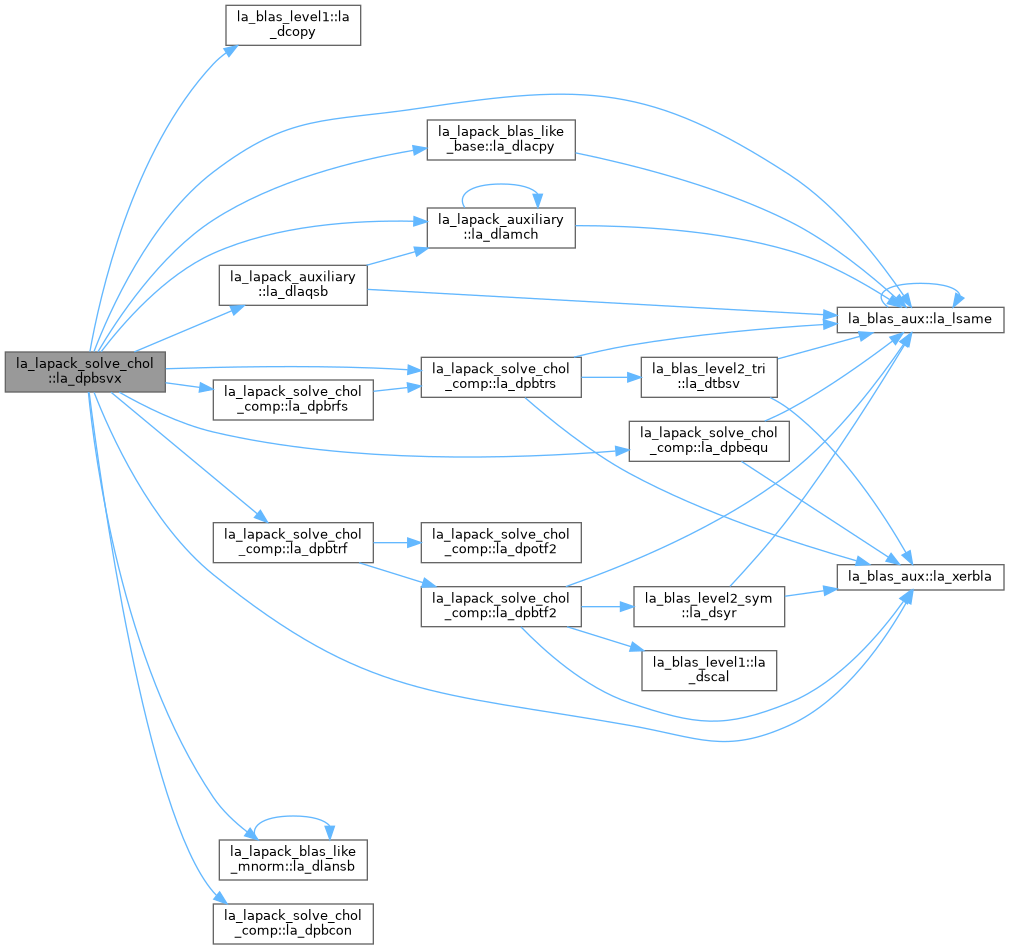
◆ la_dposv()
| pure subroutine, public la_lapack_solve_chol::la_dposv | ( | character, intent(in) | uplo, |
| integer(ilp), intent(in) | n, | ||
| integer(ilp), intent(in) | nrhs, | ||
| real(dp), dimension(lda,*), intent(inout) | a, | ||
| integer(ilp), intent(in) | lda, | ||
| real(dp), dimension(ldb,*), intent(inout) | b, | ||
| integer(ilp), intent(in) | ldb, | ||
| integer(ilp), intent(out) | info ) |
DPOSV: computes the solution to a real system of linear equations A * X = B, where A is an N-by-N symmetric positive definite matrix and X and B are N-by-NRHS matrices. The Cholesky decomposition is used to factor A as A = U**T* U, if UPLO = 'U', or A = L * L**T, if UPLO = 'L', where U is an upper triangular matrix and L is a lower triangular matrix. The factored form of A is then used to solve the system of equations A * X = B.
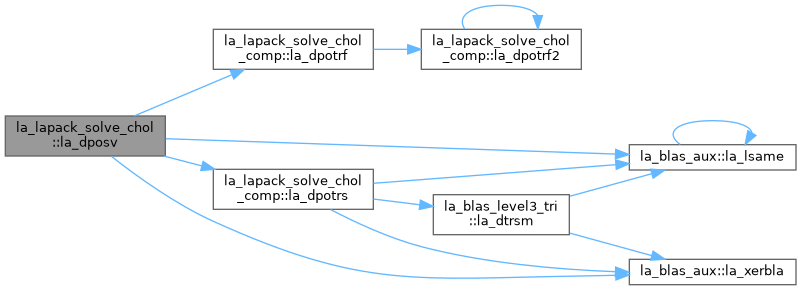
◆ la_dposvx()
| subroutine, public la_lapack_solve_chol::la_dposvx | ( | character, intent(in) | fact, |
| character, intent(in) | uplo, | ||
| integer(ilp), intent(in) | n, | ||
| integer(ilp), intent(in) | nrhs, | ||
| real(dp), dimension(lda,*), intent(inout) | a, | ||
| integer(ilp), intent(in) | lda, | ||
| real(dp), dimension(ldaf,*), intent(inout) | af, | ||
| integer(ilp), intent(in) | ldaf, | ||
| character, intent(inout) | equed, | ||
| real(dp), dimension(*), intent(inout) | s, | ||
| real(dp), dimension(ldb,*), intent(inout) | b, | ||
| integer(ilp), intent(in) | ldb, | ||
| real(dp), dimension(ldx,*), intent(out) | x, | ||
| integer(ilp), intent(in) | ldx, | ||
| real(dp), intent(out) | rcond, | ||
| real(dp), dimension(*), intent(out) | ferr, | ||
| real(dp), dimension(*), intent(out) | berr, | ||
| real(dp), dimension(*), intent(out) | work, | ||
| integer(ilp), dimension(*), intent(out) | iwork, | ||
| integer(ilp), intent(out) | info ) |
DPOSVX: uses the Cholesky factorization A = U**T*U or A = L*L**T to compute the solution to a real system of linear equations A * X = B, where A is an N-by-N symmetric positive definite matrix and X and B are N-by-NRHS matrices. Error bounds on the solution and a condition estimate are also provided.
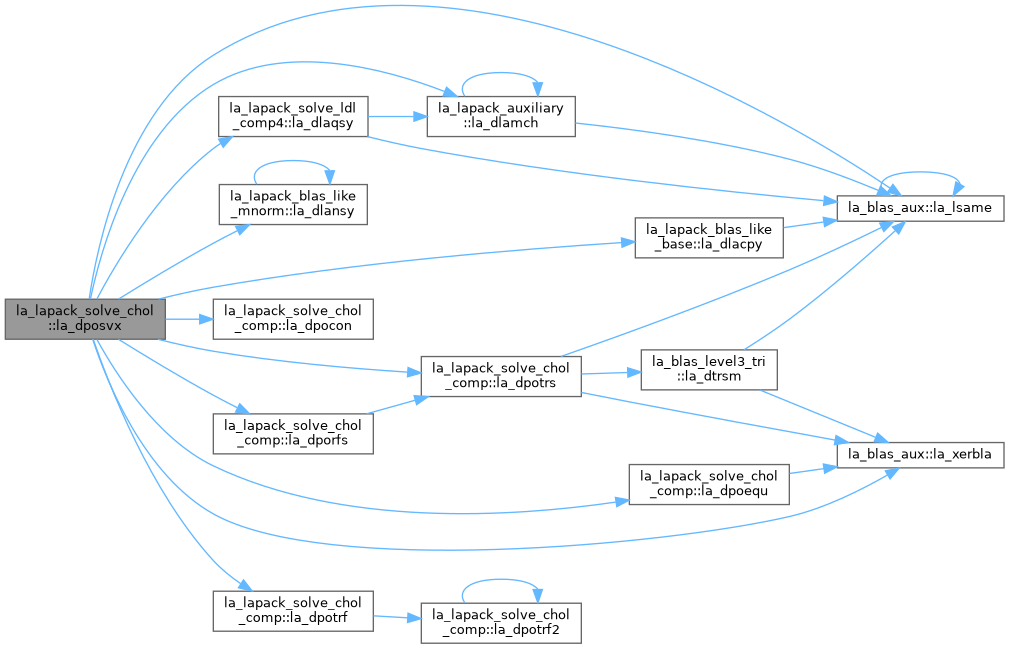
◆ la_dppsv()
| pure subroutine, public la_lapack_solve_chol::la_dppsv | ( | character, intent(in) | uplo, |
| integer(ilp), intent(in) | n, | ||
| integer(ilp), intent(in) | nrhs, | ||
| real(dp), dimension(*), intent(inout) | ap, | ||
| real(dp), dimension(ldb,*), intent(inout) | b, | ||
| integer(ilp), intent(in) | ldb, | ||
| integer(ilp), intent(out) | info ) |
DPPSV: computes the solution to a real system of linear equations A * X = B, where A is an N-by-N symmetric positive definite matrix stored in packed format and X and B are N-by-NRHS matrices. The Cholesky decomposition is used to factor A as A = U**T* U, if UPLO = 'U', or A = L * L**T, if UPLO = 'L', where U is an upper triangular matrix and L is a lower triangular matrix. The factored form of A is then used to solve the system of equations A * X = B.
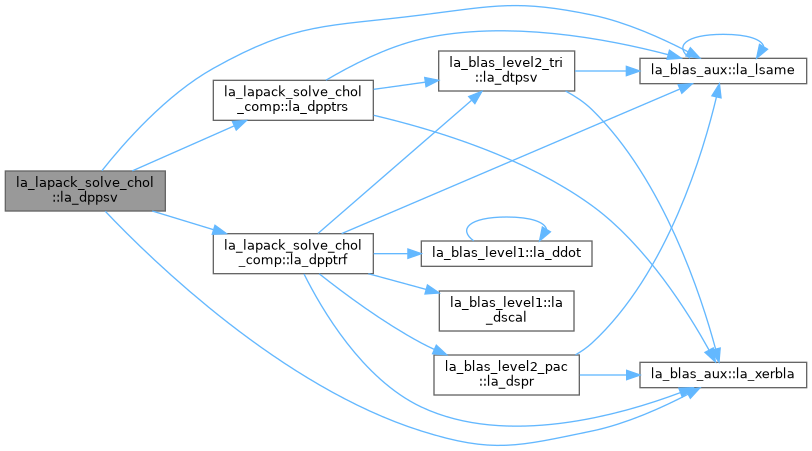
◆ la_dppsvx()
| subroutine, public la_lapack_solve_chol::la_dppsvx | ( | character, intent(in) | fact, |
| character, intent(in) | uplo, | ||
| integer(ilp), intent(in) | n, | ||
| integer(ilp), intent(in) | nrhs, | ||
| real(dp), dimension(*), intent(inout) | ap, | ||
| real(dp), dimension(*), intent(inout) | afp, | ||
| character, intent(inout) | equed, | ||
| real(dp), dimension(*), intent(inout) | s, | ||
| real(dp), dimension(ldb,*), intent(inout) | b, | ||
| integer(ilp), intent(in) | ldb, | ||
| real(dp), dimension(ldx,*), intent(out) | x, | ||
| integer(ilp), intent(in) | ldx, | ||
| real(dp), intent(out) | rcond, | ||
| real(dp), dimension(*), intent(out) | ferr, | ||
| real(dp), dimension(*), intent(out) | berr, | ||
| real(dp), dimension(*), intent(out) | work, | ||
| integer(ilp), dimension(*), intent(out) | iwork, | ||
| integer(ilp), intent(out) | info ) |
DPPSVX: uses the Cholesky factorization A = U**T*U or A = L*L**T to compute the solution to a real system of linear equations A * X = B, where A is an N-by-N symmetric positive definite matrix stored in packed format and X and B are N-by-NRHS matrices. Error bounds on the solution and a condition estimate are also provided.
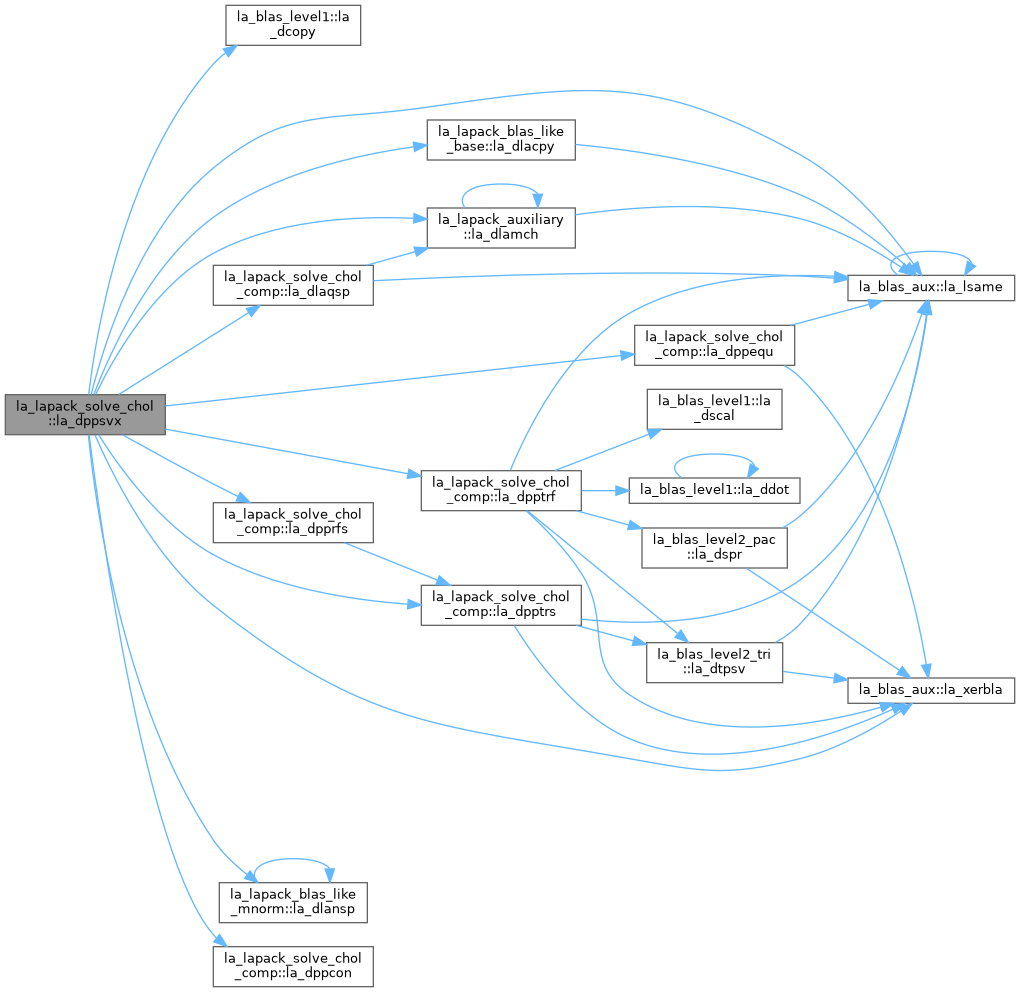
◆ la_dptsv()
| pure subroutine, public la_lapack_solve_chol::la_dptsv | ( | integer(ilp), intent(in) | n, |
| integer(ilp), intent(in) | nrhs, | ||
| real(dp), dimension(*), intent(inout) | d, | ||
| real(dp), dimension(*), intent(inout) | e, | ||
| real(dp), dimension(ldb,*), intent(inout) | b, | ||
| integer(ilp), intent(in) | ldb, | ||
| integer(ilp), intent(out) | info ) |
DPTSV: computes the solution to a real system of linear equations A*X = B, where A is an N-by-N symmetric positive definite tridiagonal matrix, and X and B are N-by-NRHS matrices. A is factored as A = L*D*L**T, and the factored form of A is then used to solve the system of equations.
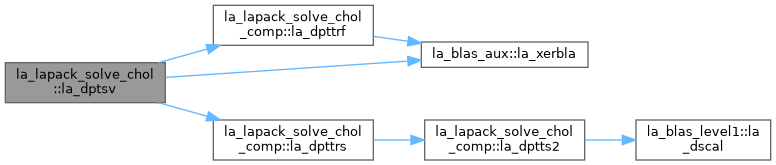
◆ la_dptsvx()
| pure subroutine, public la_lapack_solve_chol::la_dptsvx | ( | character, intent(in) | fact, |
| integer(ilp), intent(in) | n, | ||
| integer(ilp), intent(in) | nrhs, | ||
| real(dp), dimension(*), intent(in) | d, | ||
| real(dp), dimension(*), intent(in) | e, | ||
| real(dp), dimension(*), intent(inout) | df, | ||
| real(dp), dimension(*), intent(inout) | ef, | ||
| real(dp), dimension(ldb,*), intent(in) | b, | ||
| integer(ilp), intent(in) | ldb, | ||
| real(dp), dimension(ldx,*), intent(out) | x, | ||
| integer(ilp), intent(in) | ldx, | ||
| real(dp), intent(out) | rcond, | ||
| real(dp), dimension(*), intent(out) | ferr, | ||
| real(dp), dimension(*), intent(out) | berr, | ||
| real(dp), dimension(*), intent(out) | work, | ||
| integer(ilp), intent(out) | info ) |
DPTSVX: uses the factorization A = L*D*L**T to compute the solution to a real system of linear equations A*X = B, where A is an N-by-N symmetric positive definite tridiagonal matrix and X and B are N-by-NRHS matrices. Error bounds on the solution and a condition estimate are also provided.
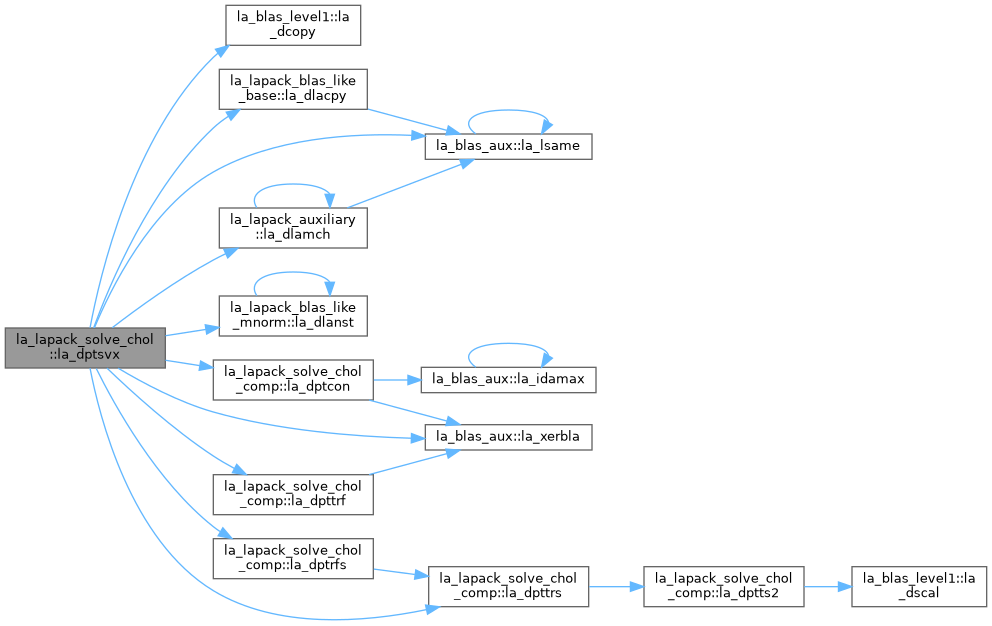
◆ la_dsposv()
| subroutine, public la_lapack_solve_chol::la_dsposv | ( | character, intent(in) | uplo, |
| integer(ilp), intent(in) | n, | ||
| integer(ilp), intent(in) | nrhs, | ||
| real(dp), dimension(lda,*), intent(inout) | a, | ||
| integer(ilp), intent(in) | lda, | ||
| real(dp), dimension(ldb,*), intent(in) | b, | ||
| integer(ilp), intent(in) | ldb, | ||
| real(dp), dimension(ldx,*), intent(out) | x, | ||
| integer(ilp), intent(in) | ldx, | ||
| real(dp), dimension(n,*), intent(out) | work, | ||
| real(sp), dimension(*), intent(out) | swork, | ||
| integer(ilp), intent(out) | iter, | ||
| integer(ilp), intent(out) | info ) |
DSPOSV: computes the solution to a real system of linear equations A * X = B, where A is an N-by-N symmetric positive definite matrix and X and B are N-by-NRHS matrices. DSPOSV first attempts to factorize the matrix in SINGLE PRECISION and use this factorization within an iterative refinement procedure to produce a solution with DOUBLE PRECISION normwise backward error quality (see below). If the approach fails the method switches to a DOUBLE PRECISION factorization and solve. The iterative refinement is not going to be a winning strategy if the ratio SINGLE PRECISION performance over DOUBLE PRECISION performance is too small. A reasonable strategy should take the number of right-hand sides and the size of the matrix into account. This might be done with a call to ILAENV in the future. Up to now, we always try iterative refinement. The iterative refinement process is stopped if ITER > ITERMAX or for all the RHS we have: RNRM < SQRT(N)*XNRM*ANRM*EPS*BWDMAX where o ITER is the number of the current iteration in the iterative refinement process o RNRM is the infinity-norm of the residual o XNRM is the infinity-norm of the solution o ANRM is the infinity-operator-norm of the matrix A o EPS is the machine epsilon returned by DLAMCH('Epsilon') The value ITERMAX and BWDMAX are fixed to 30 and 1.0D+00 respectively.
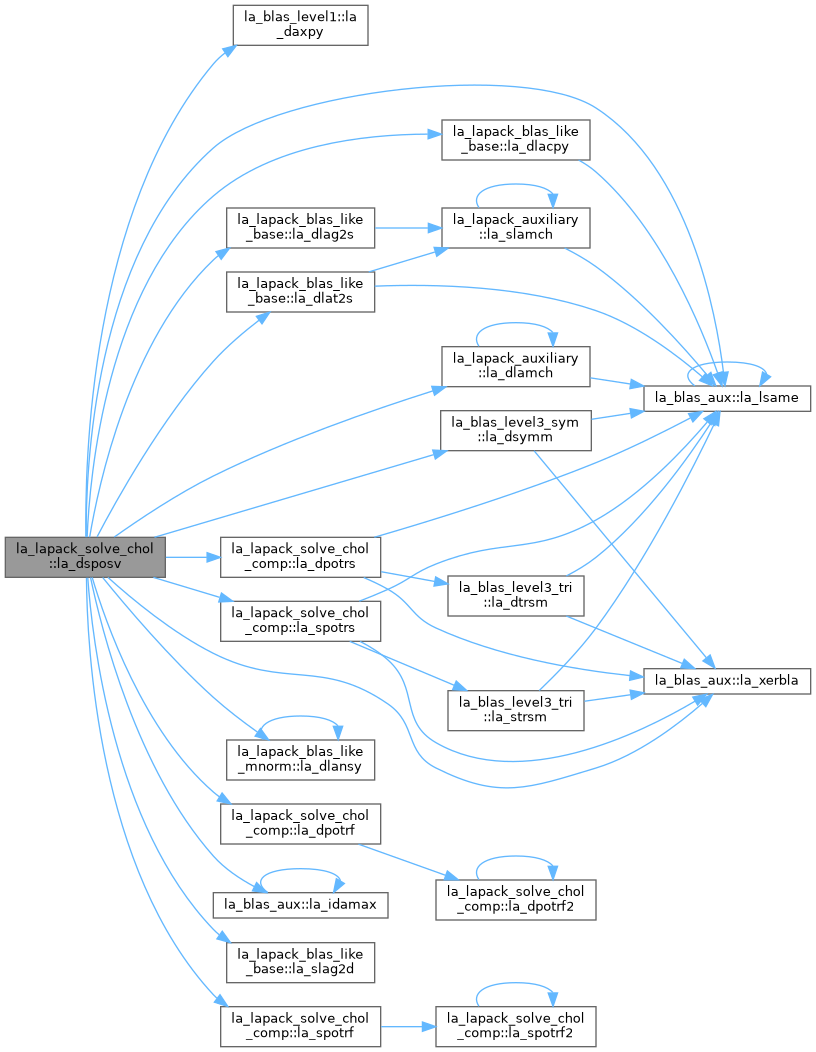
◆ la_qdposv()
| subroutine, public la_lapack_solve_chol::la_qdposv | ( | character, intent(in) | uplo, |
| integer(ilp), intent(in) | n, | ||
| integer(ilp), intent(in) | nrhs, | ||
| real(qp), dimension(lda,*), intent(inout) | a, | ||
| integer(ilp), intent(in) | lda, | ||
| real(qp), dimension(ldb,*), intent(in) | b, | ||
| integer(ilp), intent(in) | ldb, | ||
| real(qp), dimension(ldx,*), intent(out) | x, | ||
| integer(ilp), intent(in) | ldx, | ||
| real(qp), dimension(n,*), intent(out) | work, | ||
| real(dp), dimension(*), intent(out) | swork, | ||
| integer(ilp), intent(out) | iter, | ||
| integer(ilp), intent(out) | info ) |
QDPOSV: computes the solution to a real system of linear equations A * X = B, where A is an N-by-N symmetric positive definite matrix and X and B are N-by-NRHS matrices. QDPOSV first attempts to factorize the matrix in SINGLE PRECISION and use this factorization within an iterative refinement procedure to produce a solution with QUAD PRECISION normwise backward error quality (see below). If the approach fails the method switches to a QUAD PRECISION factorization and solve. The iterative refinement is not going to be a winning strategy if the ratio SINGLE PRECISION performance over QUAD PRECISION performance is too small. A reasonable strategy should take the number of right-hand sides and the size of the matrix into account. This might be done with a call to ILAENV in the future. Up to now, we always try iterative refinement. The iterative refinement process is stopped if ITER > ITERMAX or for all the RHS we have: RNRM < SQRT(N)*XNRM*ANRM*EPS*BWDMAX where o ITER is the number of the current iteration in the iterative refinement process o RNRM is the infinity-norm of the residual o XNRM is the infinity-norm of the solution o ANRM is the infinity-operator-norm of the matrix A o EPS is the machine epsilon returned by QLAMCH('Epsilon') The value ITERMAX and BWDMAX are fixed to 30 and 1.0D+00 respectively.
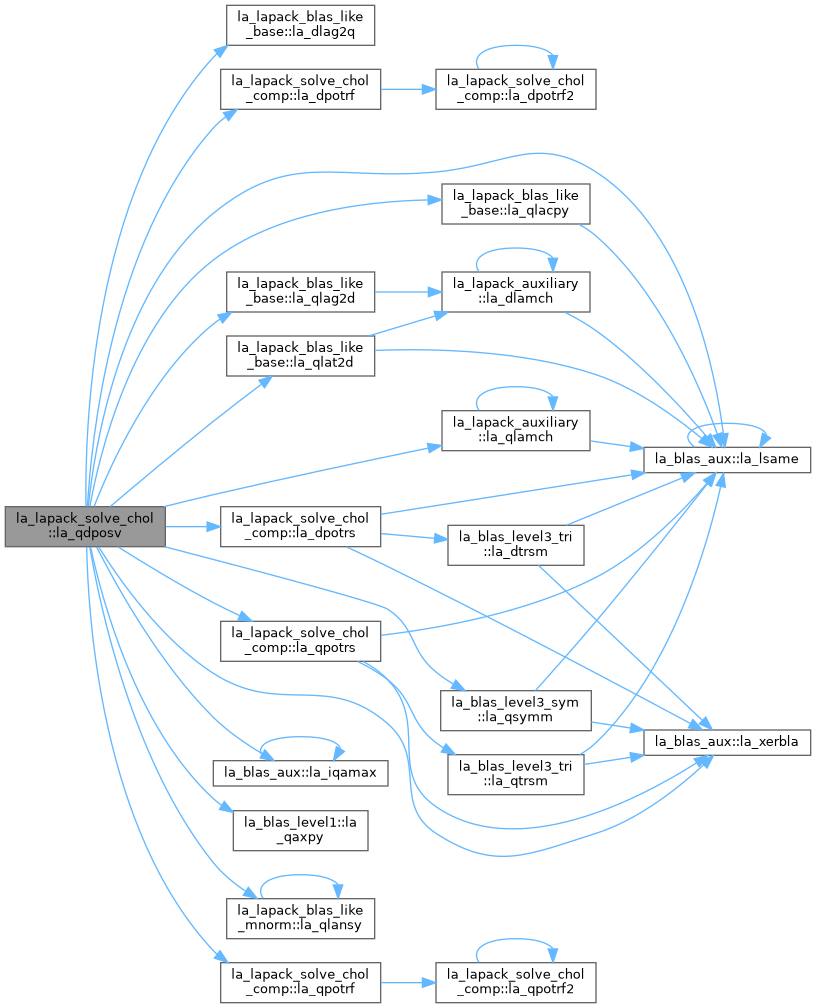
◆ la_qpbsv()
| pure subroutine, public la_lapack_solve_chol::la_qpbsv | ( | character, intent(in) | uplo, |
| integer(ilp), intent(in) | n, | ||
| integer(ilp), intent(in) | kd, | ||
| integer(ilp), intent(in) | nrhs, | ||
| real(qp), dimension(ldab,*), intent(inout) | ab, | ||
| integer(ilp), intent(in) | ldab, | ||
| real(qp), dimension(ldb,*), intent(inout) | b, | ||
| integer(ilp), intent(in) | ldb, | ||
| integer(ilp), intent(out) | info ) |
QPBSV: computes the solution to a real system of linear equations A * X = B, where A is an N-by-N symmetric positive definite band matrix and X and B are N-by-NRHS matrices. The Cholesky decomposition is used to factor A as A = U**T * U, if UPLO = 'U', or A = L * L**T, if UPLO = 'L', where U is an upper triangular band matrix, and L is a lower triangular band matrix, with the same number of superdiagonals or subdiagonals as A. The factored form of A is then used to solve the system of equations A * X = B.
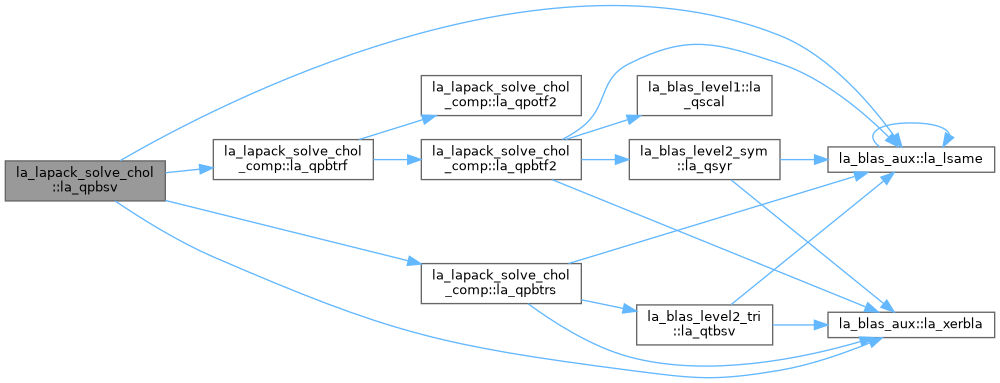
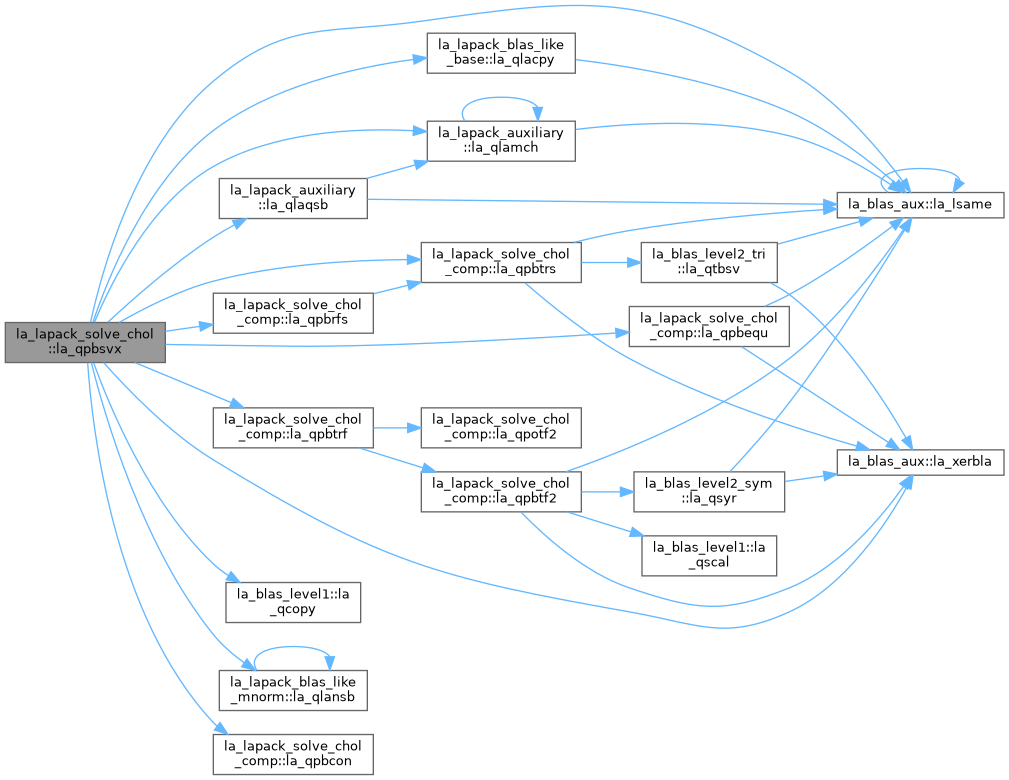
◆ la_qpbsvx()
| subroutine, public la_lapack_solve_chol::la_qpbsvx | ( | character, intent(in) | fact, |
| character, intent(in) | uplo, | ||
| integer(ilp), intent(in) | n, | ||
| integer(ilp), intent(in) | kd, | ||
| integer(ilp), intent(in) | nrhs, | ||
| real(qp), dimension(ldab,*), intent(inout) | ab, | ||
| integer(ilp), intent(in) | ldab, | ||
| real(qp), dimension(ldafb,*), intent(inout) | afb, | ||
| integer(ilp), intent(in) | ldafb, | ||
| character, intent(inout) | equed, | ||
| real(qp), dimension(*), intent(inout) | s, | ||
| real(qp), dimension(ldb,*), intent(inout) | b, | ||
| integer(ilp), intent(in) | ldb, | ||
| real(qp), dimension(ldx,*), intent(out) | x, | ||
| integer(ilp), intent(in) | ldx, | ||
| real(qp), intent(out) | rcond, | ||
| real(qp), dimension(*), intent(out) | ferr, | ||
| real(qp), dimension(*), intent(out) | berr, | ||
| real(qp), dimension(*), intent(out) | work, | ||
| integer(ilp), dimension(*), intent(out) | iwork, | ||
| integer(ilp), intent(out) | info ) |
QPBSVX: uses the Cholesky factorization A = U**T*U or A = L*L**T to compute the solution to a real system of linear equations A * X = B, where A is an N-by-N symmetric positive definite band matrix and X and B are N-by-NRHS matrices. Error bounds on the solution and a condition estimate are also provided.
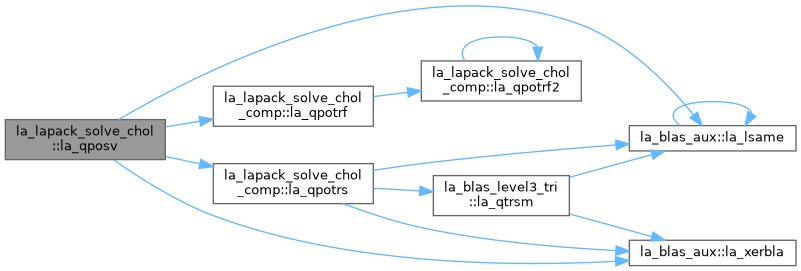
◆ la_qposv()
| pure subroutine, public la_lapack_solve_chol::la_qposv | ( | character, intent(in) | uplo, |
| integer(ilp), intent(in) | n, | ||
| integer(ilp), intent(in) | nrhs, | ||
| real(qp), dimension(lda,*), intent(inout) | a, | ||
| integer(ilp), intent(in) | lda, | ||
| real(qp), dimension(ldb,*), intent(inout) | b, | ||
| integer(ilp), intent(in) | ldb, | ||
| integer(ilp), intent(out) | info ) |
QPOSV: computes the solution to a real system of linear equations A * X = B, where A is an N-by-N symmetric positive definite matrix and X and B are N-by-NRHS matrices. The Cholesky decomposition is used to factor A as A = U**T* U, if UPLO = 'U', or A = L * L**T, if UPLO = 'L', where U is an upper triangular matrix and L is a lower triangular matrix. The factored form of A is then used to solve the system of equations A * X = B.
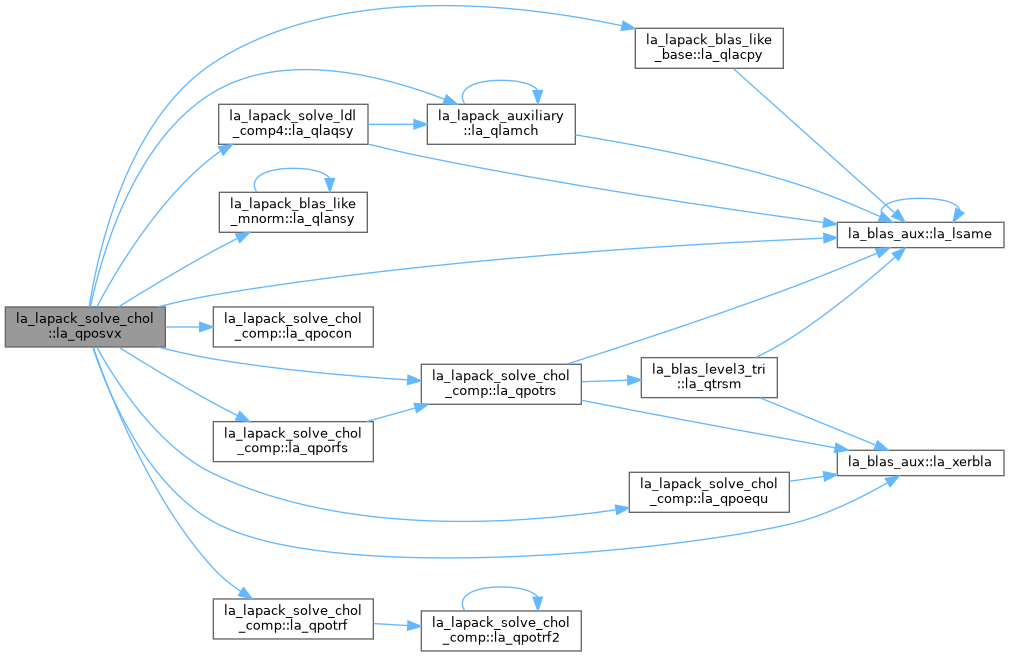
◆ la_qposvx()
| subroutine, public la_lapack_solve_chol::la_qposvx | ( | character, intent(in) | fact, |
| character, intent(in) | uplo, | ||
| integer(ilp), intent(in) | n, | ||
| integer(ilp), intent(in) | nrhs, | ||
| real(qp), dimension(lda,*), intent(inout) | a, | ||
| integer(ilp), intent(in) | lda, | ||
| real(qp), dimension(ldaf,*), intent(inout) | af, | ||
| integer(ilp), intent(in) | ldaf, | ||
| character, intent(inout) | equed, | ||
| real(qp), dimension(*), intent(inout) | s, | ||
| real(qp), dimension(ldb,*), intent(inout) | b, | ||
| integer(ilp), intent(in) | ldb, | ||
| real(qp), dimension(ldx,*), intent(out) | x, | ||
| integer(ilp), intent(in) | ldx, | ||
| real(qp), intent(out) | rcond, | ||
| real(qp), dimension(*), intent(out) | ferr, | ||
| real(qp), dimension(*), intent(out) | berr, | ||
| real(qp), dimension(*), intent(out) | work, | ||
| integer(ilp), dimension(*), intent(out) | iwork, | ||
| integer(ilp), intent(out) | info ) |
QPOSVX: uses the Cholesky factorization A = U**T*U or A = L*L**T to compute the solution to a real system of linear equations A * X = B, where A is an N-by-N symmetric positive definite matrix and X and B are N-by-NRHS matrices. Error bounds on the solution and a condition estimate are also provided.
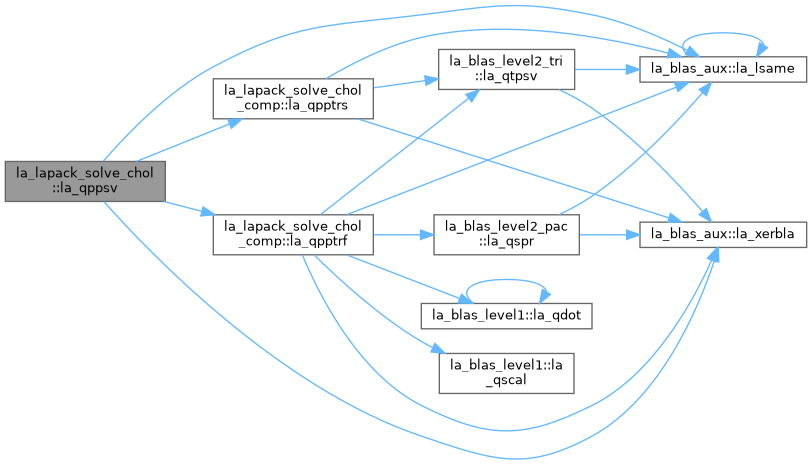
◆ la_qppsv()
| pure subroutine, public la_lapack_solve_chol::la_qppsv | ( | character, intent(in) | uplo, |
| integer(ilp), intent(in) | n, | ||
| integer(ilp), intent(in) | nrhs, | ||
| real(qp), dimension(*), intent(inout) | ap, | ||
| real(qp), dimension(ldb,*), intent(inout) | b, | ||
| integer(ilp), intent(in) | ldb, | ||
| integer(ilp), intent(out) | info ) |
QPPSV: computes the solution to a real system of linear equations A * X = B, where A is an N-by-N symmetric positive definite matrix stored in packed format and X and B are N-by-NRHS matrices. The Cholesky decomposition is used to factor A as A = U**T* U, if UPLO = 'U', or A = L * L**T, if UPLO = 'L', where U is an upper triangular matrix and L is a lower triangular matrix. The factored form of A is then used to solve the system of equations A * X = B.
◆ la_qppsvx()
| subroutine, public la_lapack_solve_chol::la_qppsvx | ( | character, intent(in) | fact, |
| character, intent(in) | uplo, | ||
| integer(ilp), intent(in) | n, | ||
| integer(ilp), intent(in) | nrhs, | ||
| real(qp), dimension(*), intent(inout) | ap, | ||
| real(qp), dimension(*), intent(inout) | afp, | ||
| character, intent(inout) | equed, | ||
| real(qp), dimension(*), intent(inout) | s, | ||
| real(qp), dimension(ldb,*), intent(inout) | b, | ||
| integer(ilp), intent(in) | ldb, | ||
| real(qp), dimension(ldx,*), intent(out) | x, | ||
| integer(ilp), intent(in) | ldx, | ||
| real(qp), intent(out) | rcond, | ||
| real(qp), dimension(*), intent(out) | ferr, | ||
| real(qp), dimension(*), intent(out) | berr, | ||
| real(qp), dimension(*), intent(out) | work, | ||
| integer(ilp), dimension(*), intent(out) | iwork, | ||
| integer(ilp), intent(out) | info ) |
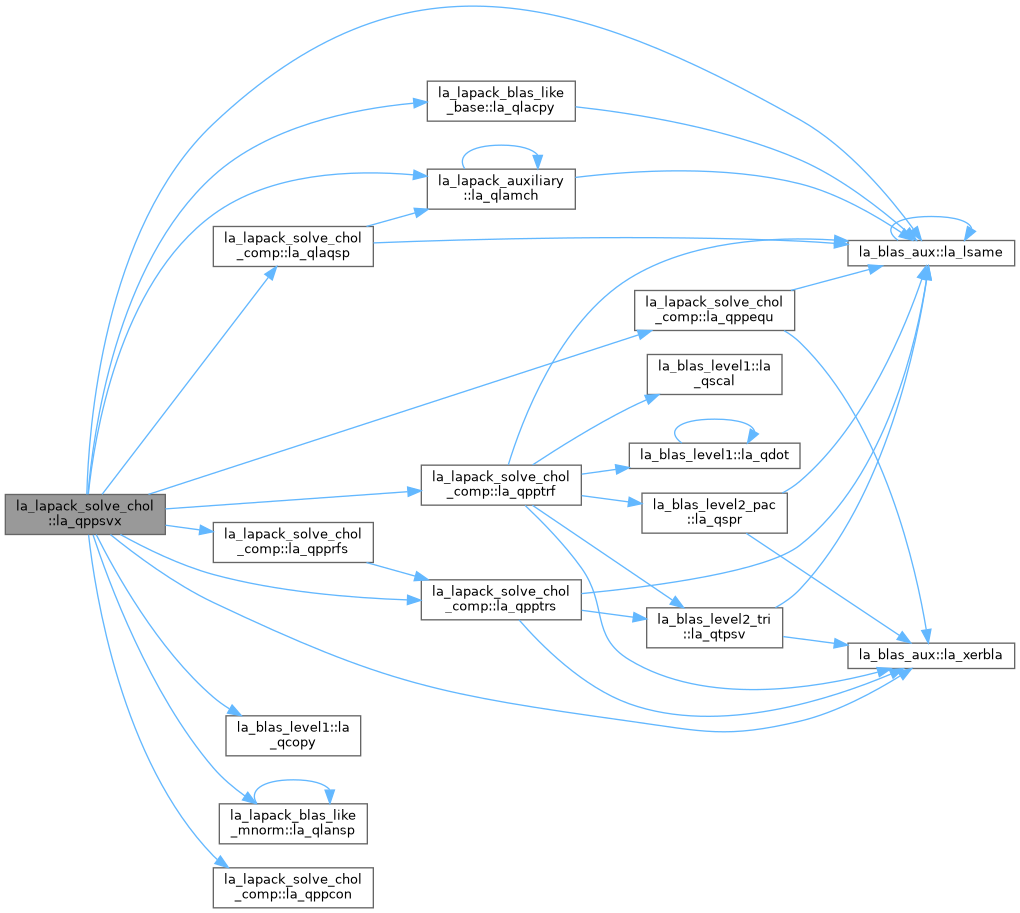
QPPSVX: uses the Cholesky factorization A = U**T*U or A = L*L**T to compute the solution to a real system of linear equations A * X = B, where A is an N-by-N symmetric positive definite matrix stored in packed format and X and B are N-by-NRHS matrices. Error bounds on the solution and a condition estimate are also provided.
◆ la_qptsv()
| pure subroutine, public la_lapack_solve_chol::la_qptsv | ( | integer(ilp), intent(in) | n, |
| integer(ilp), intent(in) | nrhs, | ||
| real(qp), dimension(*), intent(inout) | d, | ||
| real(qp), dimension(*), intent(inout) | e, | ||
| real(qp), dimension(ldb,*), intent(inout) | b, | ||
| integer(ilp), intent(in) | ldb, | ||
| integer(ilp), intent(out) | info ) |
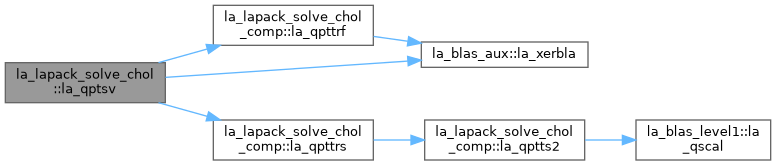
QPTSV: computes the solution to a real system of linear equations A*X = B, where A is an N-by-N symmetric positive definite tridiagonal matrix, and X and B are N-by-NRHS matrices. A is factored as A = L*D*L**T, and the factored form of A is then used to solve the system of equations.
◆ la_qptsvx()
| pure subroutine, public la_lapack_solve_chol::la_qptsvx | ( | character, intent(in) | fact, |
| integer(ilp), intent(in) | n, | ||
| integer(ilp), intent(in) | nrhs, | ||
| real(qp), dimension(*), intent(in) | d, | ||
| real(qp), dimension(*), intent(in) | e, | ||
| real(qp), dimension(*), intent(inout) | df, | ||
| real(qp), dimension(*), intent(inout) | ef, | ||
| real(qp), dimension(ldb,*), intent(in) | b, | ||
| integer(ilp), intent(in) | ldb, | ||
| real(qp), dimension(ldx,*), intent(out) | x, | ||
| integer(ilp), intent(in) | ldx, | ||
| real(qp), intent(out) | rcond, | ||
| real(qp), dimension(*), intent(out) | ferr, | ||
| real(qp), dimension(*), intent(out) | berr, | ||
| real(qp), dimension(*), intent(out) | work, | ||
| integer(ilp), intent(out) | info ) |
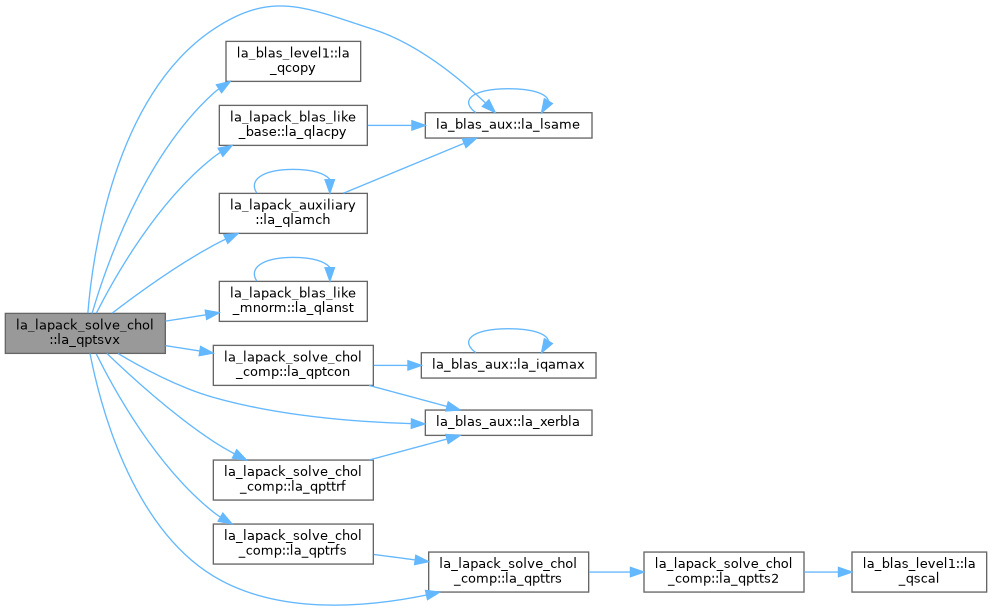
QPTSVX: uses the factorization A = L*D*L**T to compute the solution to a real system of linear equations A*X = B, where A is an N-by-N symmetric positive definite tridiagonal matrix and X and B are N-by-NRHS matrices. Error bounds on the solution and a condition estimate are also provided.
◆ la_spbsv()
| pure subroutine, public la_lapack_solve_chol::la_spbsv | ( | character, intent(in) | uplo, |
| integer(ilp), intent(in) | n, | ||
| integer(ilp), intent(in) | kd, | ||
| integer(ilp), intent(in) | nrhs, | ||
| real(sp), dimension(ldab,*), intent(inout) | ab, | ||
| integer(ilp), intent(in) | ldab, | ||
| real(sp), dimension(ldb,*), intent(inout) | b, | ||
| integer(ilp), intent(in) | ldb, | ||
| integer(ilp), intent(out) | info ) |
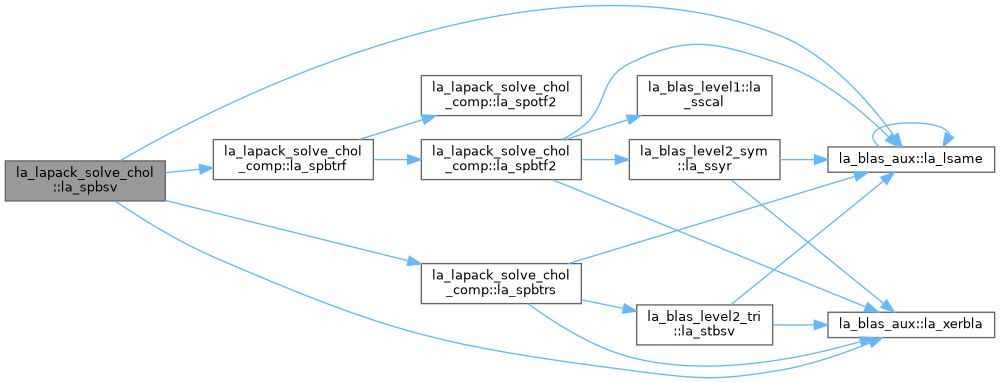
SPBSV: computes the solution to a real system of linear equations A * X = B, where A is an N-by-N symmetric positive definite band matrix and X and B are N-by-NRHS matrices. The Cholesky decomposition is used to factor A as A = U**T * U, if UPLO = 'U', or A = L * L**T, if UPLO = 'L', where U is an upper triangular band matrix, and L is a lower triangular band matrix, with the same number of superdiagonals or subdiagonals as A. The factored form of A is then used to solve the system of equations A * X = B.
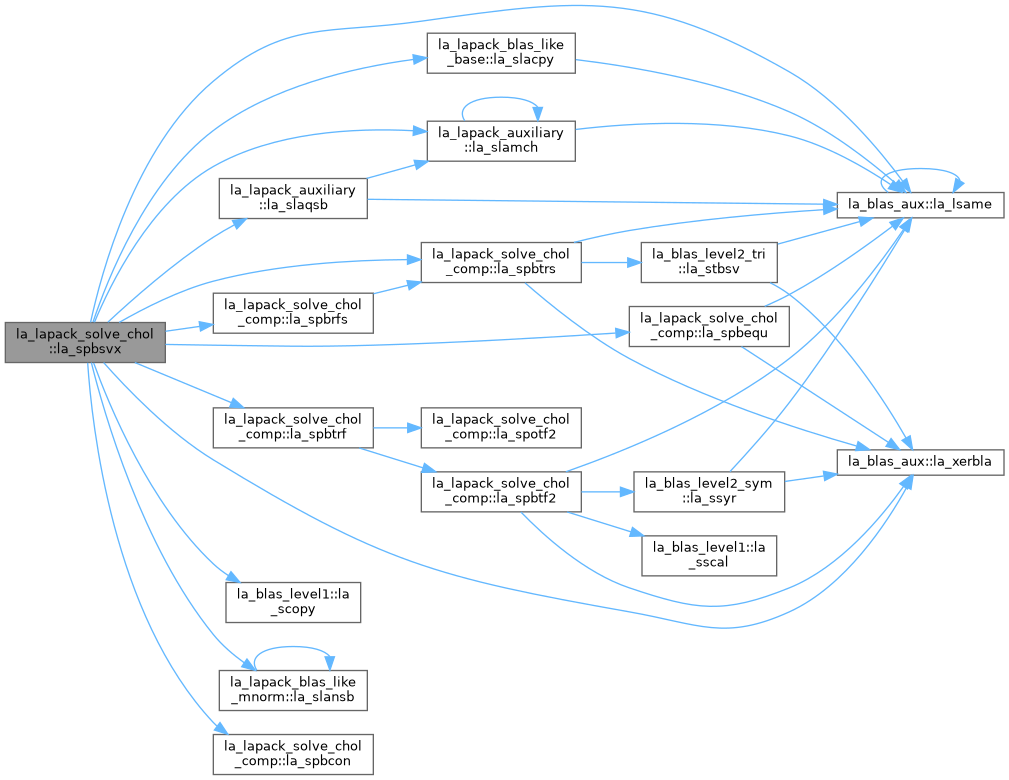
◆ la_spbsvx()
| subroutine, public la_lapack_solve_chol::la_spbsvx | ( | character, intent(in) | fact, |
| character, intent(in) | uplo, | ||
| integer(ilp), intent(in) | n, | ||
| integer(ilp), intent(in) | kd, | ||
| integer(ilp), intent(in) | nrhs, | ||
| real(sp), dimension(ldab,*), intent(inout) | ab, | ||
| integer(ilp), intent(in) | ldab, | ||
| real(sp), dimension(ldafb,*), intent(inout) | afb, | ||
| integer(ilp), intent(in) | ldafb, | ||
| character, intent(inout) | equed, | ||
| real(sp), dimension(*), intent(inout) | s, | ||
| real(sp), dimension(ldb,*), intent(inout) | b, | ||
| integer(ilp), intent(in) | ldb, | ||
| real(sp), dimension(ldx,*), intent(out) | x, | ||
| integer(ilp), intent(in) | ldx, | ||
| real(sp), intent(out) | rcond, | ||
| real(sp), dimension(*), intent(out) | ferr, | ||
| real(sp), dimension(*), intent(out) | berr, | ||
| real(sp), dimension(*), intent(out) | work, | ||
| integer(ilp), dimension(*), intent(out) | iwork, | ||
| integer(ilp), intent(out) | info ) |
SPBSVX: uses the Cholesky factorization A = U**T*U or A = L*L**T to compute the solution to a real system of linear equations A * X = B, where A is an N-by-N symmetric positive definite band matrix and X and B are N-by-NRHS matrices. Error bounds on the solution and a condition estimate are also provided.
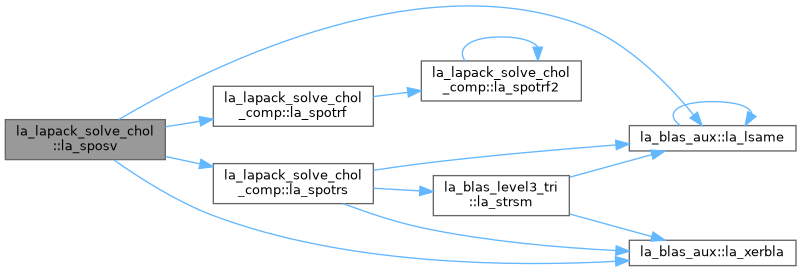
◆ la_sposv()
| pure subroutine, public la_lapack_solve_chol::la_sposv | ( | character, intent(in) | uplo, |
| integer(ilp), intent(in) | n, | ||
| integer(ilp), intent(in) | nrhs, | ||
| real(sp), dimension(lda,*), intent(inout) | a, | ||
| integer(ilp), intent(in) | lda, | ||
| real(sp), dimension(ldb,*), intent(inout) | b, | ||
| integer(ilp), intent(in) | ldb, | ||
| integer(ilp), intent(out) | info ) |
SPOSV: computes the solution to a real system of linear equations A * X = B, where A is an N-by-N symmetric positive definite matrix and X and B are N-by-NRHS matrices. The Cholesky decomposition is used to factor A as A = U**T* U, if UPLO = 'U', or A = L * L**T, if UPLO = 'L', where U is an upper triangular matrix and L is a lower triangular matrix. The factored form of A is then used to solve the system of equations A * X = B.
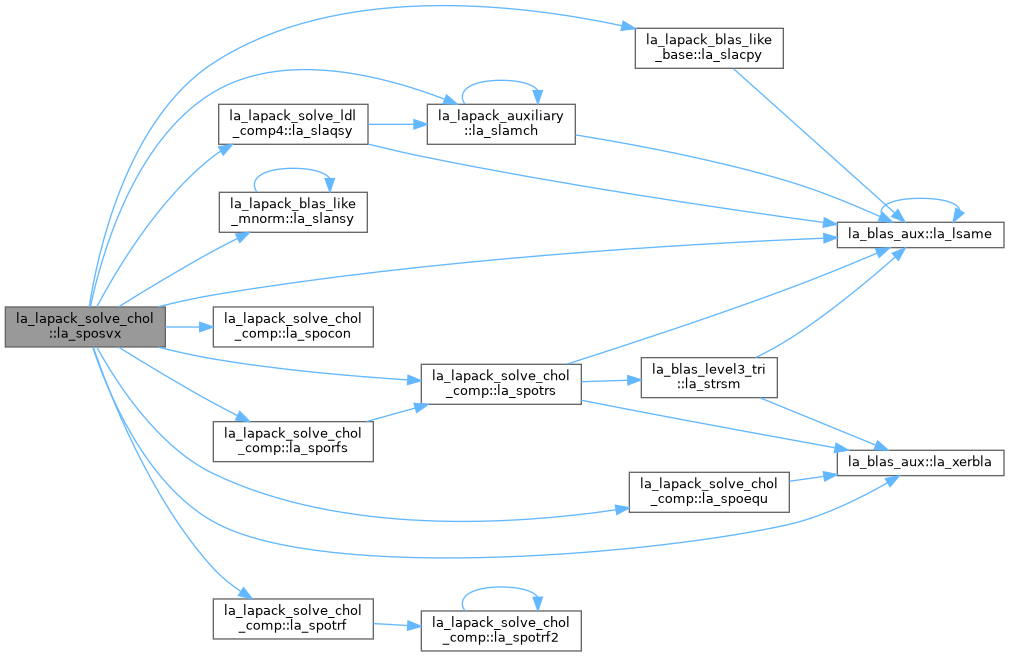
◆ la_sposvx()
| subroutine, public la_lapack_solve_chol::la_sposvx | ( | character, intent(in) | fact, |
| character, intent(in) | uplo, | ||
| integer(ilp), intent(in) | n, | ||
| integer(ilp), intent(in) | nrhs, | ||
| real(sp), dimension(lda,*), intent(inout) | a, | ||
| integer(ilp), intent(in) | lda, | ||
| real(sp), dimension(ldaf,*), intent(inout) | af, | ||
| integer(ilp), intent(in) | ldaf, | ||
| character, intent(inout) | equed, | ||
| real(sp), dimension(*), intent(inout) | s, | ||
| real(sp), dimension(ldb,*), intent(inout) | b, | ||
| integer(ilp), intent(in) | ldb, | ||
| real(sp), dimension(ldx,*), intent(out) | x, | ||
| integer(ilp), intent(in) | ldx, | ||
| real(sp), intent(out) | rcond, | ||
| real(sp), dimension(*), intent(out) | ferr, | ||
| real(sp), dimension(*), intent(out) | berr, | ||
| real(sp), dimension(*), intent(out) | work, | ||
| integer(ilp), dimension(*), intent(out) | iwork, | ||
| integer(ilp), intent(out) | info ) |
SPOSVX: uses the Cholesky factorization A = U**T*U or A = L*L**T to compute the solution to a real system of linear equations A * X = B, where A is an N-by-N symmetric positive definite matrix and X and B are N-by-NRHS matrices. Error bounds on the solution and a condition estimate are also provided.
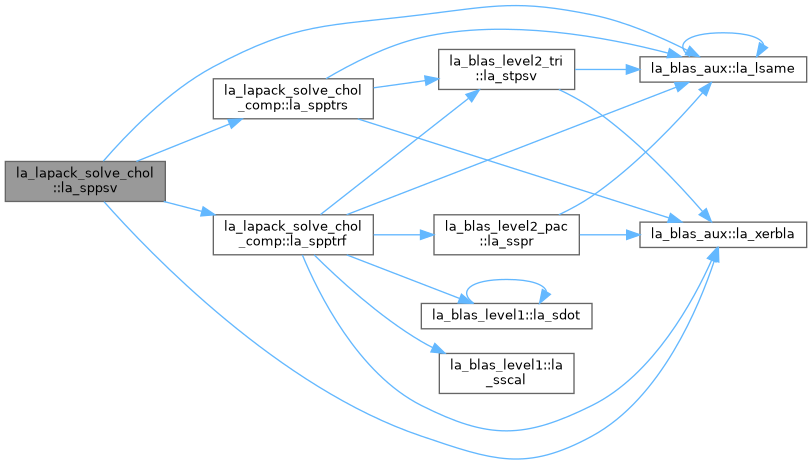
◆ la_sppsv()
| pure subroutine, public la_lapack_solve_chol::la_sppsv | ( | character, intent(in) | uplo, |
| integer(ilp), intent(in) | n, | ||
| integer(ilp), intent(in) | nrhs, | ||
| real(sp), dimension(*), intent(inout) | ap, | ||
| real(sp), dimension(ldb,*), intent(inout) | b, | ||
| integer(ilp), intent(in) | ldb, | ||
| integer(ilp), intent(out) | info ) |
SPPSV: computes the solution to a real system of linear equations A * X = B, where A is an N-by-N symmetric positive definite matrix stored in packed format and X and B are N-by-NRHS matrices. The Cholesky decomposition is used to factor A as A = U**T* U, if UPLO = 'U', or A = L * L**T, if UPLO = 'L', where U is an upper triangular matrix and L is a lower triangular matrix. The factored form of A is then used to solve the system of equations A * X = B.
◆ la_sppsvx()
| subroutine, public la_lapack_solve_chol::la_sppsvx | ( | character, intent(in) | fact, |
| character, intent(in) | uplo, | ||
| integer(ilp), intent(in) | n, | ||
| integer(ilp), intent(in) | nrhs, | ||
| real(sp), dimension(*), intent(inout) | ap, | ||
| real(sp), dimension(*), intent(inout) | afp, | ||
| character, intent(inout) | equed, | ||
| real(sp), dimension(*), intent(inout) | s, | ||
| real(sp), dimension(ldb,*), intent(inout) | b, | ||
| integer(ilp), intent(in) | ldb, | ||
| real(sp), dimension(ldx,*), intent(out) | x, | ||
| integer(ilp), intent(in) | ldx, | ||
| real(sp), intent(out) | rcond, | ||
| real(sp), dimension(*), intent(out) | ferr, | ||
| real(sp), dimension(*), intent(out) | berr, | ||
| real(sp), dimension(*), intent(out) | work, | ||
| integer(ilp), dimension(*), intent(out) | iwork, | ||
| integer(ilp), intent(out) | info ) |
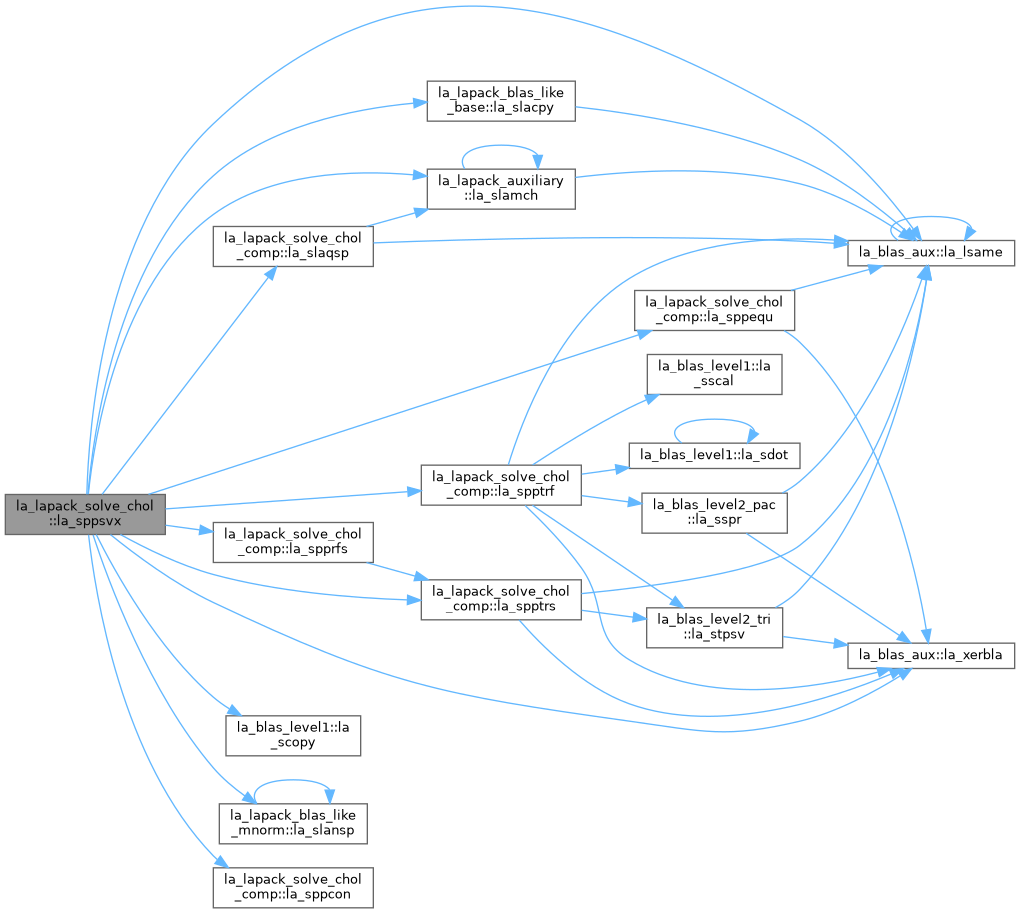
SPPSVX: uses the Cholesky factorization A = U**T*U or A = L*L**T to compute the solution to a real system of linear equations A * X = B, where A is an N-by-N symmetric positive definite matrix stored in packed format and X and B are N-by-NRHS matrices. Error bounds on the solution and a condition estimate are also provided.
◆ la_sptsv()
| pure subroutine, public la_lapack_solve_chol::la_sptsv | ( | integer(ilp), intent(in) | n, |
| integer(ilp), intent(in) | nrhs, | ||
| real(sp), dimension(*), intent(inout) | d, | ||
| real(sp), dimension(*), intent(inout) | e, | ||
| real(sp), dimension(ldb,*), intent(inout) | b, | ||
| integer(ilp), intent(in) | ldb, | ||
| integer(ilp), intent(out) | info ) |
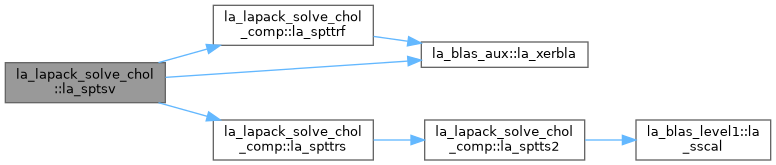
SPTSV: computes the solution to a real system of linear equations A*X = B, where A is an N-by-N symmetric positive definite tridiagonal matrix, and X and B are N-by-NRHS matrices. A is factored as A = L*D*L**T, and the factored form of A is then used to solve the system of equations.
◆ la_sptsvx()
| pure subroutine, public la_lapack_solve_chol::la_sptsvx | ( | character, intent(in) | fact, |
| integer(ilp), intent(in) | n, | ||
| integer(ilp), intent(in) | nrhs, | ||
| real(sp), dimension(*), intent(in) | d, | ||
| real(sp), dimension(*), intent(in) | e, | ||
| real(sp), dimension(*), intent(inout) | df, | ||
| real(sp), dimension(*), intent(inout) | ef, | ||
| real(sp), dimension(ldb,*), intent(in) | b, | ||
| integer(ilp), intent(in) | ldb, | ||
| real(sp), dimension(ldx,*), intent(out) | x, | ||
| integer(ilp), intent(in) | ldx, | ||
| real(sp), intent(out) | rcond, | ||
| real(sp), dimension(*), intent(out) | ferr, | ||
| real(sp), dimension(*), intent(out) | berr, | ||
| real(sp), dimension(*), intent(out) | work, | ||
| integer(ilp), intent(out) | info ) |
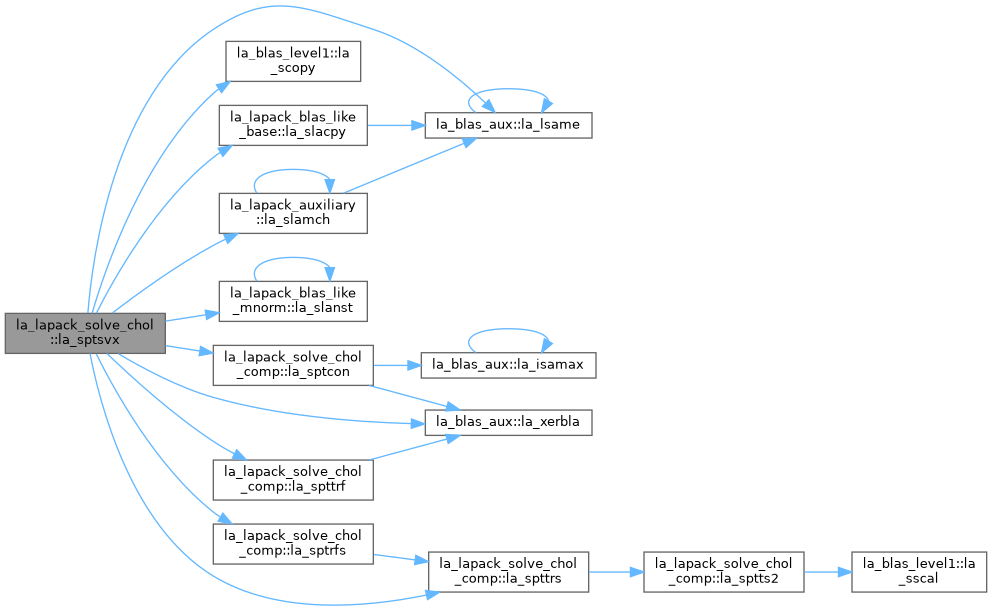
SPTSVX: uses the factorization A = L*D*L**T to compute the solution to a real system of linear equations A*X = B, where A is an N-by-N symmetric positive definite tridiagonal matrix and X and B are N-by-NRHS matrices. Error bounds on the solution and a condition estimate are also provided.
◆ la_wpbsv()
| pure subroutine, public la_lapack_solve_chol::la_wpbsv | ( | character, intent(in) | uplo, |
| integer(ilp), intent(in) | n, | ||
| integer(ilp), intent(in) | kd, | ||
| integer(ilp), intent(in) | nrhs, | ||
| complex(qp), dimension(ldab,*), intent(inout) | ab, | ||
| integer(ilp), intent(in) | ldab, | ||
| complex(qp), dimension(ldb,*), intent(inout) | b, | ||
| integer(ilp), intent(in) | ldb, | ||
| integer(ilp), intent(out) | info ) |
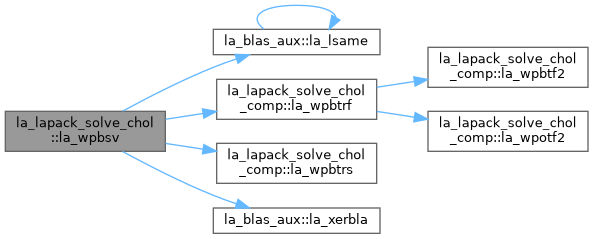
WPBSV: computes the solution to a complex system of linear equations A * X = B, where A is an N-by-N Hermitian positive definite band matrix and X and B are N-by-NRHS matrices. The Cholesky decomposition is used to factor A as A = U**H * U, if UPLO = 'U', or A = L * L**H, if UPLO = 'L', where U is an upper triangular band matrix, and L is a lower triangular band matrix, with the same number of superdiagonals or subdiagonals as A. The factored form of A is then used to solve the system of equations A * X = B.
◆ la_wpbsvx()
| subroutine, public la_lapack_solve_chol::la_wpbsvx | ( | character, intent(in) | fact, |
| character, intent(in) | uplo, | ||
| integer(ilp), intent(in) | n, | ||
| integer(ilp), intent(in) | kd, | ||
| integer(ilp), intent(in) | nrhs, | ||
| complex(qp), dimension(ldab,*), intent(inout) | ab, | ||
| integer(ilp), intent(in) | ldab, | ||
| complex(qp), dimension(ldafb,*), intent(inout) | afb, | ||
| integer(ilp), intent(in) | ldafb, | ||
| character, intent(inout) | equed, | ||
| real(qp), dimension(*), intent(inout) | s, | ||
| complex(qp), dimension(ldb,*), intent(inout) | b, | ||
| integer(ilp), intent(in) | ldb, | ||
| complex(qp), dimension(ldx,*), intent(out) | x, | ||
| integer(ilp), intent(in) | ldx, | ||
| real(qp), intent(out) | rcond, | ||
| real(qp), dimension(*), intent(out) | ferr, | ||
| real(qp), dimension(*), intent(out) | berr, | ||
| complex(qp), dimension(*), intent(out) | work, | ||
| real(qp), dimension(*), intent(out) | rwork, | ||
| integer(ilp), intent(out) | info ) |
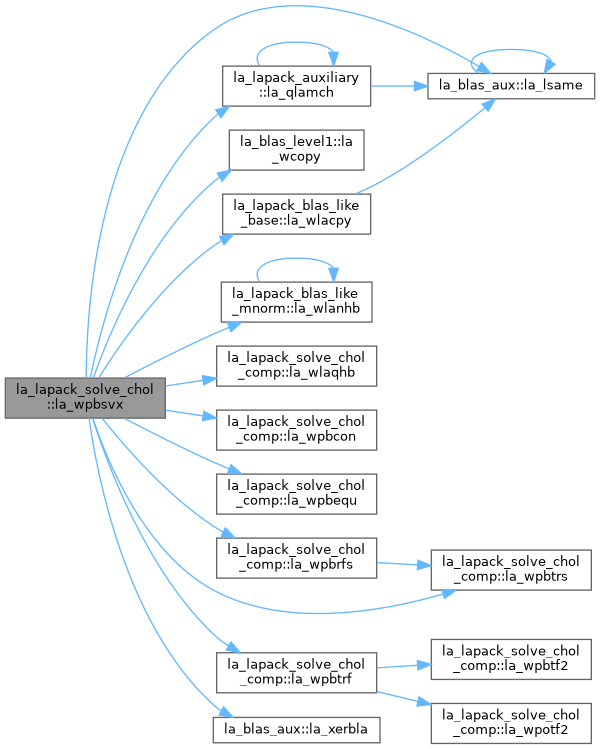
WPBSVX: uses the Cholesky factorization A = U**H*U or A = L*L**H to compute the solution to a complex system of linear equations A * X = B, where A is an N-by-N Hermitian positive definite band matrix and X and B are N-by-NRHS matrices. Error bounds on the solution and a condition estimate are also provided.
◆ la_wposv()
| pure subroutine, public la_lapack_solve_chol::la_wposv | ( | character, intent(in) | uplo, |
| integer(ilp), intent(in) | n, | ||
| integer(ilp), intent(in) | nrhs, | ||
| complex(qp), dimension(lda,*), intent(inout) | a, | ||
| integer(ilp), intent(in) | lda, | ||
| complex(qp), dimension(ldb,*), intent(inout) | b, | ||
| integer(ilp), intent(in) | ldb, | ||
| integer(ilp), intent(out) | info ) |
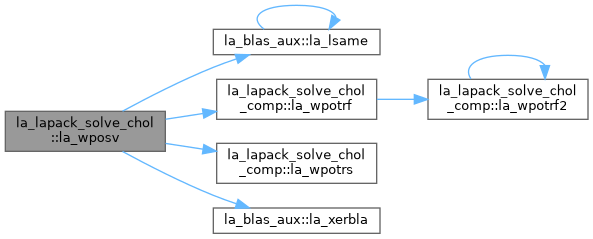
WPOSV: computes the solution to a complex system of linear equations A * X = B, where A is an N-by-N Hermitian positive definite matrix and X and B are N-by-NRHS matrices. The Cholesky decomposition is used to factor A as A = U**H* U, if UPLO = 'U', or A = L * L**H, if UPLO = 'L', where U is an upper triangular matrix and L is a lower triangular matrix. The factored form of A is then used to solve the system of equations A * X = B.
◆ la_wposvx()
| subroutine, public la_lapack_solve_chol::la_wposvx | ( | character, intent(in) | fact, |
| character, intent(in) | uplo, | ||
| integer(ilp), intent(in) | n, | ||
| integer(ilp), intent(in) | nrhs, | ||
| complex(qp), dimension(lda,*), intent(inout) | a, | ||
| integer(ilp), intent(in) | lda, | ||
| complex(qp), dimension(ldaf,*), intent(inout) | af, | ||
| integer(ilp), intent(in) | ldaf, | ||
| character, intent(inout) | equed, | ||
| real(qp), dimension(*), intent(inout) | s, | ||
| complex(qp), dimension(ldb,*), intent(inout) | b, | ||
| integer(ilp), intent(in) | ldb, | ||
| complex(qp), dimension(ldx,*), intent(out) | x, | ||
| integer(ilp), intent(in) | ldx, | ||
| real(qp), intent(out) | rcond, | ||
| real(qp), dimension(*), intent(out) | ferr, | ||
| real(qp), dimension(*), intent(out) | berr, | ||
| complex(qp), dimension(*), intent(out) | work, | ||
| real(qp), dimension(*), intent(out) | rwork, | ||
| integer(ilp), intent(out) | info ) |
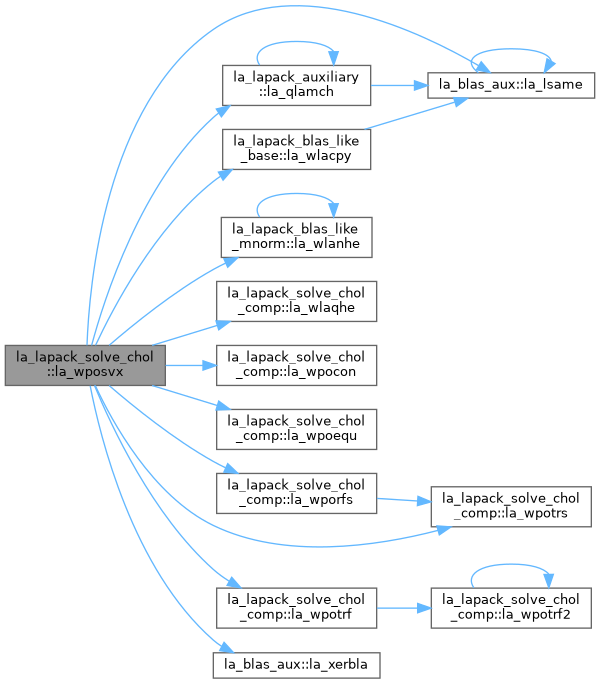
WPOSVX: uses the Cholesky factorization A = U**H*U or A = L*L**H to compute the solution to a complex system of linear equations A * X = B, where A is an N-by-N Hermitian positive definite matrix and X and B are N-by-NRHS matrices. Error bounds on the solution and a condition estimate are also provided.
◆ la_wppsv()
| pure subroutine, public la_lapack_solve_chol::la_wppsv | ( | character, intent(in) | uplo, |
| integer(ilp), intent(in) | n, | ||
| integer(ilp), intent(in) | nrhs, | ||
| complex(qp), dimension(*), intent(inout) | ap, | ||
| complex(qp), dimension(ldb,*), intent(inout) | b, | ||
| integer(ilp), intent(in) | ldb, | ||
| integer(ilp), intent(out) | info ) |
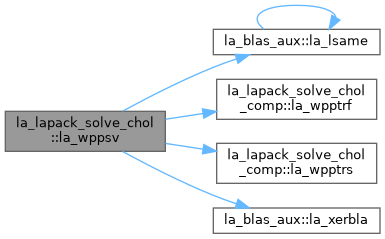
WPPSV: computes the solution to a complex system of linear equations A * X = B, where A is an N-by-N Hermitian positive definite matrix stored in packed format and X and B are N-by-NRHS matrices. The Cholesky decomposition is used to factor A as A = U**H * U, if UPLO = 'U', or A = L * L**H, if UPLO = 'L', where U is an upper triangular matrix and L is a lower triangular matrix. The factored form of A is then used to solve the system of equations A * X = B.
◆ la_wppsvx()
| subroutine, public la_lapack_solve_chol::la_wppsvx | ( | character, intent(in) | fact, |
| character, intent(in) | uplo, | ||
| integer(ilp), intent(in) | n, | ||
| integer(ilp), intent(in) | nrhs, | ||
| complex(qp), dimension(*), intent(inout) | ap, | ||
| complex(qp), dimension(*), intent(inout) | afp, | ||
| character, intent(inout) | equed, | ||
| real(qp), dimension(*), intent(inout) | s, | ||
| complex(qp), dimension(ldb,*), intent(inout) | b, | ||
| integer(ilp), intent(in) | ldb, | ||
| complex(qp), dimension(ldx,*), intent(out) | x, | ||
| integer(ilp), intent(in) | ldx, | ||
| real(qp), intent(out) | rcond, | ||
| real(qp), dimension(*), intent(out) | ferr, | ||
| real(qp), dimension(*), intent(out) | berr, | ||
| complex(qp), dimension(*), intent(out) | work, | ||
| real(qp), dimension(*), intent(out) | rwork, | ||
| integer(ilp), intent(out) | info ) |
WPPSVX: uses the Cholesky factorization A = U**H * U or A = L * L**H to compute the solution to a complex system of linear equations A * X = B, where A is an N-by-N Hermitian positive definite matrix stored in packed format and X and B are N-by-NRHS matrices. Error bounds on the solution and a condition estimate are also provided.
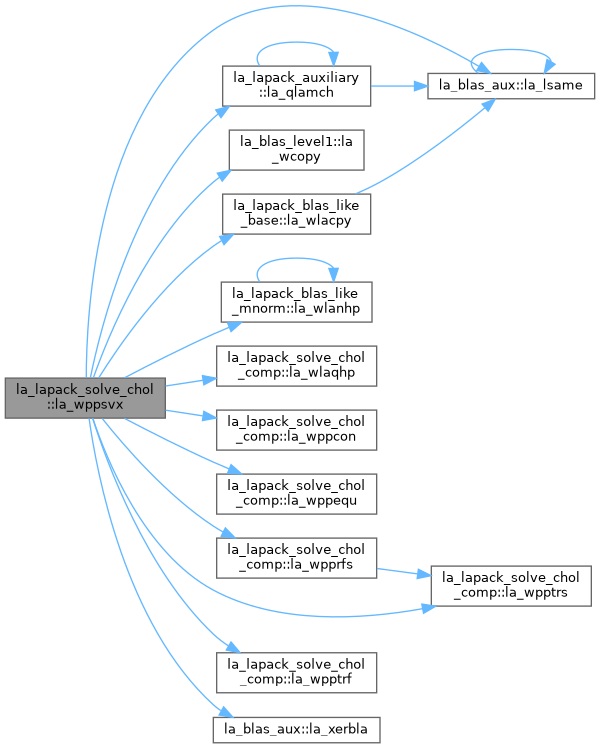
◆ la_wptsv()
| pure subroutine, public la_lapack_solve_chol::la_wptsv | ( | integer(ilp), intent(in) | n, |
| integer(ilp), intent(in) | nrhs, | ||
| real(qp), dimension(*), intent(inout) | d, | ||
| complex(qp), dimension(*), intent(inout) | e, | ||
| complex(qp), dimension(ldb,*), intent(inout) | b, | ||
| integer(ilp), intent(in) | ldb, | ||
| integer(ilp), intent(out) | info ) |
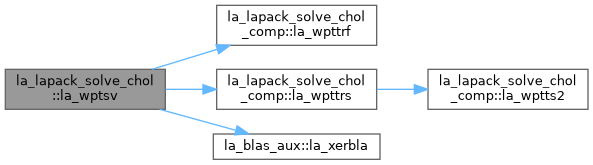
WPTSV: computes the solution to a complex system of linear equations A*X = B, where A is an N-by-N Hermitian positive definite tridiagonal matrix, and X and B are N-by-NRHS matrices. A is factored as A = L*D*L**H, and the factored form of A is then used to solve the system of equations.
◆ la_wptsvx()
| pure subroutine, public la_lapack_solve_chol::la_wptsvx | ( | character, intent(in) | fact, |
| integer(ilp), intent(in) | n, | ||
| integer(ilp), intent(in) | nrhs, | ||
| real(qp), dimension(*), intent(in) | d, | ||
| complex(qp), dimension(*), intent(in) | e, | ||
| real(qp), dimension(*), intent(inout) | df, | ||
| complex(qp), dimension(*), intent(inout) | ef, | ||
| complex(qp), dimension(ldb,*), intent(in) | b, | ||
| integer(ilp), intent(in) | ldb, | ||
| complex(qp), dimension(ldx,*), intent(out) | x, | ||
| integer(ilp), intent(in) | ldx, | ||
| real(qp), intent(out) | rcond, | ||
| real(qp), dimension(*), intent(out) | ferr, | ||
| real(qp), dimension(*), intent(out) | berr, | ||
| complex(qp), dimension(*), intent(out) | work, | ||
| real(qp), dimension(*), intent(out) | rwork, | ||
| integer(ilp), intent(out) | info ) |
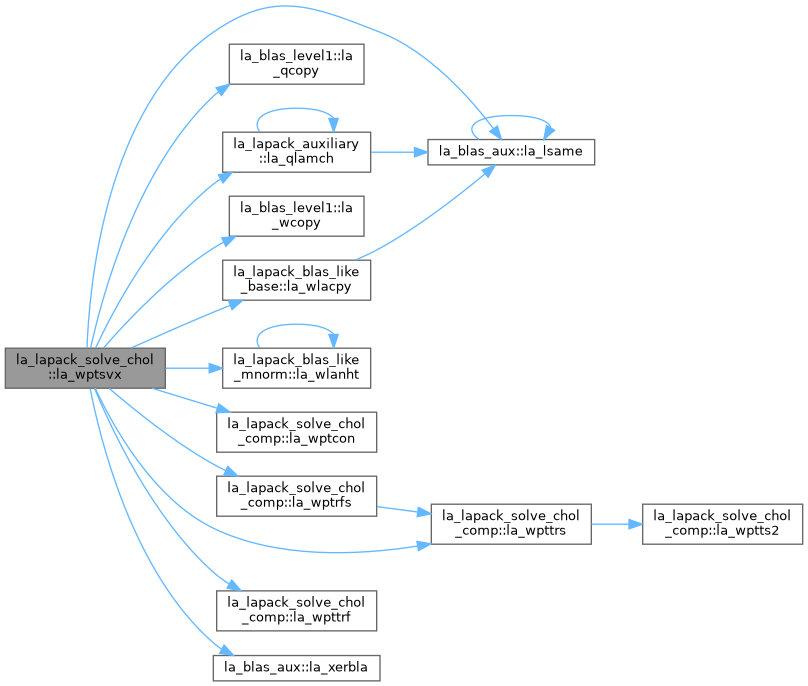
WPTSVX: uses the factorization A = L*D*L**H to compute the solution to a complex system of linear equations A*X = B, where A is an N-by-N Hermitian positive definite tridiagonal matrix and X and B are N-by-NRHS matrices. Error bounds on the solution and a condition estimate are also provided.
◆ la_wzposv()
| subroutine, public la_lapack_solve_chol::la_wzposv | ( | character, intent(in) | uplo, |
| integer(ilp), intent(in) | n, | ||
| integer(ilp), intent(in) | nrhs, | ||
| complex(qp), dimension(lda,*), intent(inout) | a, | ||
| integer(ilp), intent(in) | lda, | ||
| complex(qp), dimension(ldb,*), intent(in) | b, | ||
| integer(ilp), intent(in) | ldb, | ||
| complex(qp), dimension(ldx,*), intent(out) | x, | ||
| integer(ilp), intent(in) | ldx, | ||
| complex(qp), dimension(n,*), intent(out) | work, | ||
| complex(dp), dimension(*), intent(out) | swork, | ||
| real(qp), dimension(*), intent(out) | rwork, | ||
| integer(ilp), intent(out) | iter, | ||
| integer(ilp), intent(out) | info ) |
WZPOSV: computes the solution to a complex system of linear equations A * X = B, where A is an N-by-N Hermitian positive definite matrix and X and B are N-by-NRHS matrices. WZPOSV first attempts to factorize the matrix in COMPLEX and use this factorization within an iterative refinement procedure to produce a solution with COMPLEX*16 normwise backward error quality (see below). If the approach fails the method switches to a COMPLEX*16 factorization and solve. The iterative refinement is not going to be a winning strategy if the ratio COMPLEX performance over COMPLEX*16 performance is too small. A reasonable strategy should take the number of right-hand sides and the size of the matrix into account. This might be done with a call to ILAENV in the future. Up to now, we always try iterative refinement. The iterative refinement process is stopped if ITER > ITERMAX or for all the RHS we have: RNRM < SQRT(N)*XNRM*ANRM*EPS*BWDMAX where o ITER is the number of the current iteration in the iterative refinement process o RNRM is the infinity-norm of the residual o XNRM is the infinity-norm of the solution o ANRM is the infinity-operator-norm of the matrix A o EPS is the machine epsilon returned by QLAMCH('Epsilon') The value ITERMAX and BWDMAX are fixed to 30 and 1.0D+00 respectively.
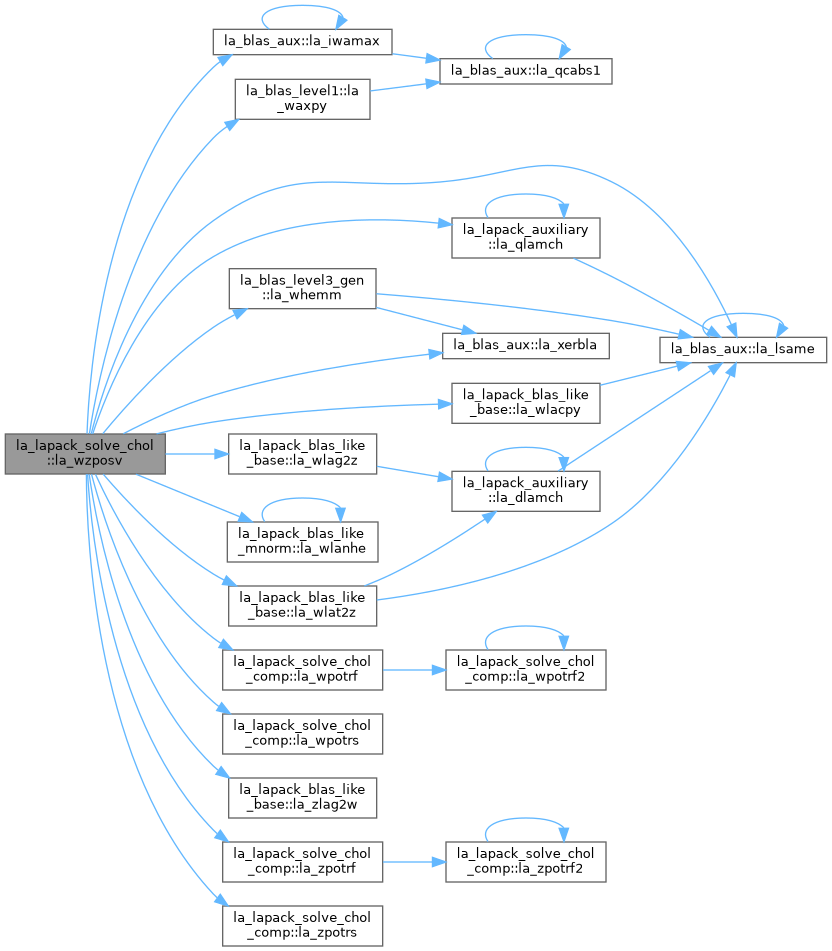
◆ la_zcposv()
| subroutine, public la_lapack_solve_chol::la_zcposv | ( | character, intent(in) | uplo, |
| integer(ilp), intent(in) | n, | ||
| integer(ilp), intent(in) | nrhs, | ||
| complex(dp), dimension(lda,*), intent(inout) | a, | ||
| integer(ilp), intent(in) | lda, | ||
| complex(dp), dimension(ldb,*), intent(in) | b, | ||
| integer(ilp), intent(in) | ldb, | ||
| complex(dp), dimension(ldx,*), intent(out) | x, | ||
| integer(ilp), intent(in) | ldx, | ||
| complex(dp), dimension(n,*), intent(out) | work, | ||
| complex(sp), dimension(*), intent(out) | swork, | ||
| real(dp), dimension(*), intent(out) | rwork, | ||
| integer(ilp), intent(out) | iter, | ||
| integer(ilp), intent(out) | info ) |
ZCPOSV: computes the solution to a complex system of linear equations A * X = B, where A is an N-by-N Hermitian positive definite matrix and X and B are N-by-NRHS matrices. ZCPOSV first attempts to factorize the matrix in COMPLEX and use this factorization within an iterative refinement procedure to produce a solution with COMPLEX*16 normwise backward error quality (see below). If the approach fails the method switches to a COMPLEX*16 factorization and solve. The iterative refinement is not going to be a winning strategy if the ratio COMPLEX performance over COMPLEX*16 performance is too small. A reasonable strategy should take the number of right-hand sides and the size of the matrix into account. This might be done with a call to ILAENV in the future. Up to now, we always try iterative refinement. The iterative refinement process is stopped if ITER > ITERMAX or for all the RHS we have: RNRM < SQRT(N)*XNRM*ANRM*EPS*BWDMAX where o ITER is the number of the current iteration in the iterative refinement process o RNRM is the infinity-norm of the residual o XNRM is the infinity-norm of the solution o ANRM is the infinity-operator-norm of the matrix A o EPS is the machine epsilon returned by DLAMCH('Epsilon') The value ITERMAX and BWDMAX are fixed to 30 and 1.0D+00 respectively.
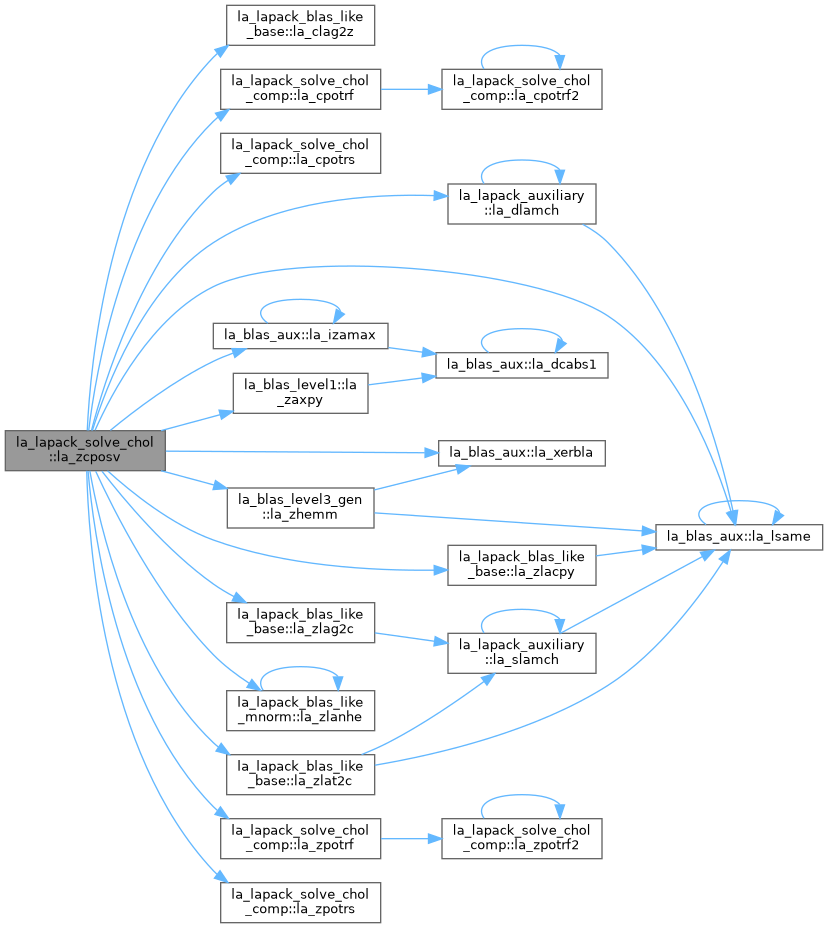
◆ la_zpbsv()
| pure subroutine, public la_lapack_solve_chol::la_zpbsv | ( | character, intent(in) | uplo, |
| integer(ilp), intent(in) | n, | ||
| integer(ilp), intent(in) | kd, | ||
| integer(ilp), intent(in) | nrhs, | ||
| complex(dp), dimension(ldab,*), intent(inout) | ab, | ||
| integer(ilp), intent(in) | ldab, | ||
| complex(dp), dimension(ldb,*), intent(inout) | b, | ||
| integer(ilp), intent(in) | ldb, | ||
| integer(ilp), intent(out) | info ) |
ZPBSV: computes the solution to a complex system of linear equations A * X = B, where A is an N-by-N Hermitian positive definite band matrix and X and B are N-by-NRHS matrices. The Cholesky decomposition is used to factor A as A = U**H * U, if UPLO = 'U', or A = L * L**H, if UPLO = 'L', where U is an upper triangular band matrix, and L is a lower triangular band matrix, with the same number of superdiagonals or subdiagonals as A. The factored form of A is then used to solve the system of equations A * X = B.
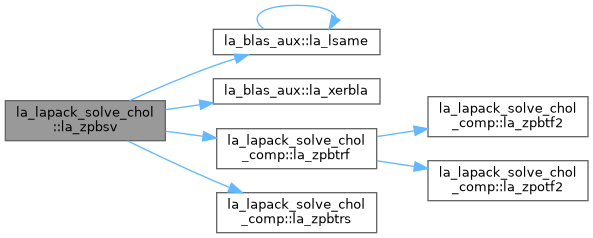
◆ la_zpbsvx()
| subroutine, public la_lapack_solve_chol::la_zpbsvx | ( | character, intent(in) | fact, |
| character, intent(in) | uplo, | ||
| integer(ilp), intent(in) | n, | ||
| integer(ilp), intent(in) | kd, | ||
| integer(ilp), intent(in) | nrhs, | ||
| complex(dp), dimension(ldab,*), intent(inout) | ab, | ||
| integer(ilp), intent(in) | ldab, | ||
| complex(dp), dimension(ldafb,*), intent(inout) | afb, | ||
| integer(ilp), intent(in) | ldafb, | ||
| character, intent(inout) | equed, | ||
| real(dp), dimension(*), intent(inout) | s, | ||
| complex(dp), dimension(ldb,*), intent(inout) | b, | ||
| integer(ilp), intent(in) | ldb, | ||
| complex(dp), dimension(ldx,*), intent(out) | x, | ||
| integer(ilp), intent(in) | ldx, | ||
| real(dp), intent(out) | rcond, | ||
| real(dp), dimension(*), intent(out) | ferr, | ||
| real(dp), dimension(*), intent(out) | berr, | ||
| complex(dp), dimension(*), intent(out) | work, | ||
| real(dp), dimension(*), intent(out) | rwork, | ||
| integer(ilp), intent(out) | info ) |
ZPBSVX: uses the Cholesky factorization A = U**H*U or A = L*L**H to compute the solution to a complex system of linear equations A * X = B, where A is an N-by-N Hermitian positive definite band matrix and X and B are N-by-NRHS matrices. Error bounds on the solution and a condition estimate are also provided.
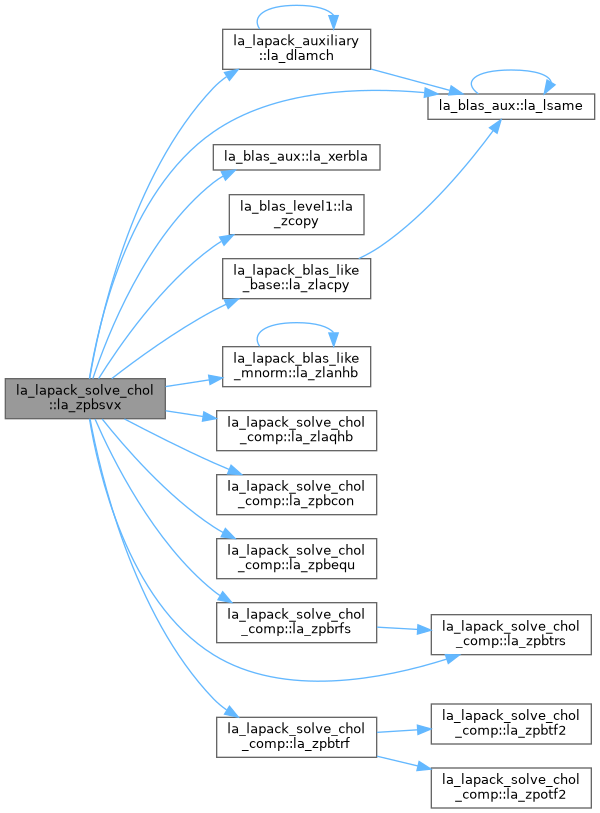
◆ la_zposv()
| pure subroutine, public la_lapack_solve_chol::la_zposv | ( | character, intent(in) | uplo, |
| integer(ilp), intent(in) | n, | ||
| integer(ilp), intent(in) | nrhs, | ||
| complex(dp), dimension(lda,*), intent(inout) | a, | ||
| integer(ilp), intent(in) | lda, | ||
| complex(dp), dimension(ldb,*), intent(inout) | b, | ||
| integer(ilp), intent(in) | ldb, | ||
| integer(ilp), intent(out) | info ) |
ZPOSV: computes the solution to a complex system of linear equations A * X = B, where A is an N-by-N Hermitian positive definite matrix and X and B are N-by-NRHS matrices. The Cholesky decomposition is used to factor A as A = U**H* U, if UPLO = 'U', or A = L * L**H, if UPLO = 'L', where U is an upper triangular matrix and L is a lower triangular matrix. The factored form of A is then used to solve the system of equations A * X = B.
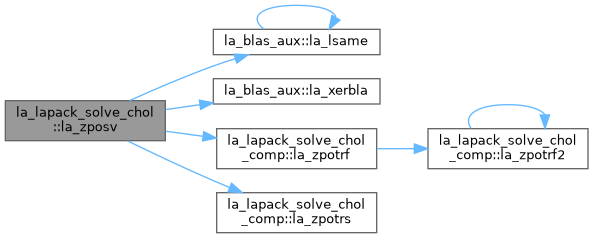
◆ la_zposvx()
| subroutine, public la_lapack_solve_chol::la_zposvx | ( | character, intent(in) | fact, |
| character, intent(in) | uplo, | ||
| integer(ilp), intent(in) | n, | ||
| integer(ilp), intent(in) | nrhs, | ||
| complex(dp), dimension(lda,*), intent(inout) | a, | ||
| integer(ilp), intent(in) | lda, | ||
| complex(dp), dimension(ldaf,*), intent(inout) | af, | ||
| integer(ilp), intent(in) | ldaf, | ||
| character, intent(inout) | equed, | ||
| real(dp), dimension(*), intent(inout) | s, | ||
| complex(dp), dimension(ldb,*), intent(inout) | b, | ||
| integer(ilp), intent(in) | ldb, | ||
| complex(dp), dimension(ldx,*), intent(out) | x, | ||
| integer(ilp), intent(in) | ldx, | ||
| real(dp), intent(out) | rcond, | ||
| real(dp), dimension(*), intent(out) | ferr, | ||
| real(dp), dimension(*), intent(out) | berr, | ||
| complex(dp), dimension(*), intent(out) | work, | ||
| real(dp), dimension(*), intent(out) | rwork, | ||
| integer(ilp), intent(out) | info ) |
ZPOSVX: uses the Cholesky factorization A = U**H*U or A = L*L**H to compute the solution to a complex system of linear equations A * X = B, where A is an N-by-N Hermitian positive definite matrix and X and B are N-by-NRHS matrices. Error bounds on the solution and a condition estimate are also provided.
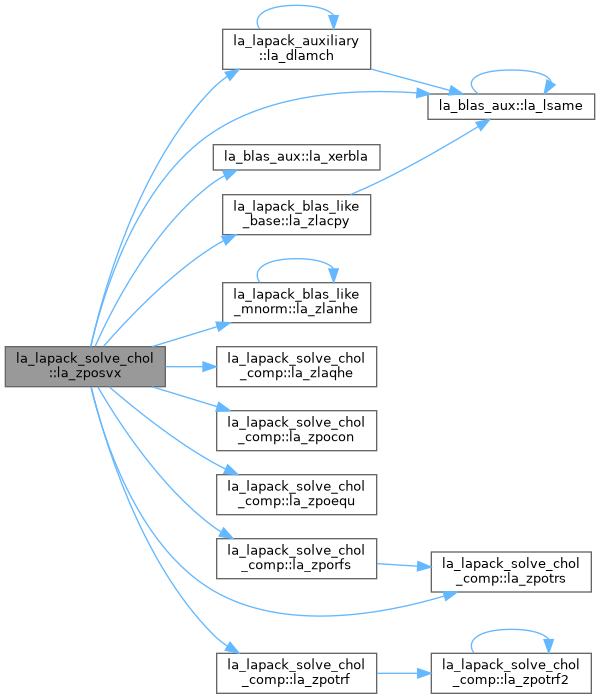
◆ la_zppsv()
| pure subroutine, public la_lapack_solve_chol::la_zppsv | ( | character, intent(in) | uplo, |
| integer(ilp), intent(in) | n, | ||
| integer(ilp), intent(in) | nrhs, | ||
| complex(dp), dimension(*), intent(inout) | ap, | ||
| complex(dp), dimension(ldb,*), intent(inout) | b, | ||
| integer(ilp), intent(in) | ldb, | ||
| integer(ilp), intent(out) | info ) |
ZPPSV: computes the solution to a complex system of linear equations A * X = B, where A is an N-by-N Hermitian positive definite matrix stored in packed format and X and B are N-by-NRHS matrices. The Cholesky decomposition is used to factor A as A = U**H * U, if UPLO = 'U', or A = L * L**H, if UPLO = 'L', where U is an upper triangular matrix and L is a lower triangular matrix. The factored form of A is then used to solve the system of equations A * X = B.
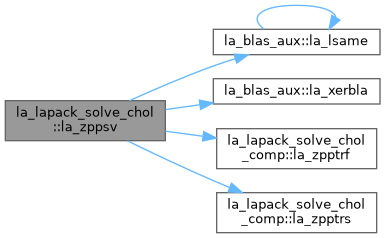
◆ la_zppsvx()
| subroutine, public la_lapack_solve_chol::la_zppsvx | ( | character, intent(in) | fact, |
| character, intent(in) | uplo, | ||
| integer(ilp), intent(in) | n, | ||
| integer(ilp), intent(in) | nrhs, | ||
| complex(dp), dimension(*), intent(inout) | ap, | ||
| complex(dp), dimension(*), intent(inout) | afp, | ||
| character, intent(inout) | equed, | ||
| real(dp), dimension(*), intent(inout) | s, | ||
| complex(dp), dimension(ldb,*), intent(inout) | b, | ||
| integer(ilp), intent(in) | ldb, | ||
| complex(dp), dimension(ldx,*), intent(out) | x, | ||
| integer(ilp), intent(in) | ldx, | ||
| real(dp), intent(out) | rcond, | ||
| real(dp), dimension(*), intent(out) | ferr, | ||
| real(dp), dimension(*), intent(out) | berr, | ||
| complex(dp), dimension(*), intent(out) | work, | ||
| real(dp), dimension(*), intent(out) | rwork, | ||
| integer(ilp), intent(out) | info ) |
ZPPSVX: uses the Cholesky factorization A = U**H * U or A = L * L**H to compute the solution to a complex system of linear equations A * X = B, where A is an N-by-N Hermitian positive definite matrix stored in packed format and X and B are N-by-NRHS matrices. Error bounds on the solution and a condition estimate are also provided.
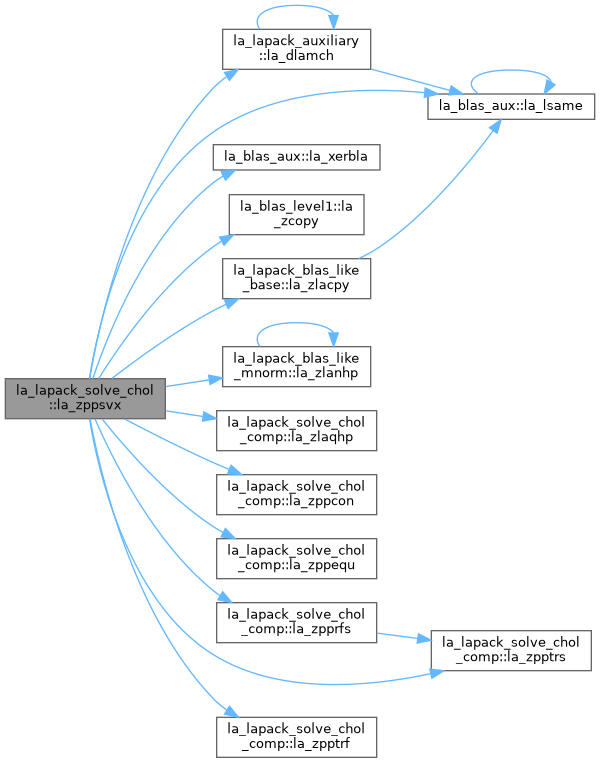
◆ la_zptsv()
| pure subroutine, public la_lapack_solve_chol::la_zptsv | ( | integer(ilp), intent(in) | n, |
| integer(ilp), intent(in) | nrhs, | ||
| real(dp), dimension(*), intent(inout) | d, | ||
| complex(dp), dimension(*), intent(inout) | e, | ||
| complex(dp), dimension(ldb,*), intent(inout) | b, | ||
| integer(ilp), intent(in) | ldb, | ||
| integer(ilp), intent(out) | info ) |
ZPTSV: computes the solution to a complex system of linear equations A*X = B, where A is an N-by-N Hermitian positive definite tridiagonal matrix, and X and B are N-by-NRHS matrices. A is factored as A = L*D*L**H, and the factored form of A is then used to solve the system of equations.
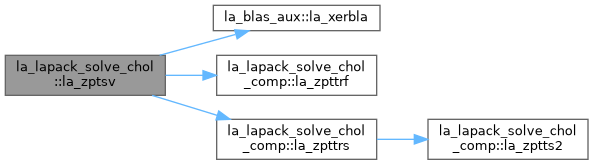
◆ la_zptsvx()
| pure subroutine, public la_lapack_solve_chol::la_zptsvx | ( | character, intent(in) | fact, |
| integer(ilp), intent(in) | n, | ||
| integer(ilp), intent(in) | nrhs, | ||
| real(dp), dimension(*), intent(in) | d, | ||
| complex(dp), dimension(*), intent(in) | e, | ||
| real(dp), dimension(*), intent(inout) | df, | ||
| complex(dp), dimension(*), intent(inout) | ef, | ||
| complex(dp), dimension(ldb,*), intent(in) | b, | ||
| integer(ilp), intent(in) | ldb, | ||
| complex(dp), dimension(ldx,*), intent(out) | x, | ||
| integer(ilp), intent(in) | ldx, | ||
| real(dp), intent(out) | rcond, | ||
| real(dp), dimension(*), intent(out) | ferr, | ||
| real(dp), dimension(*), intent(out) | berr, | ||
| complex(dp), dimension(*), intent(out) | work, | ||
| real(dp), dimension(*), intent(out) | rwork, | ||
| integer(ilp), intent(out) | info ) |
ZPTSVX: uses the factorization A = L*D*L**H to compute the solution to a complex system of linear equations A*X = B, where A is an N-by-N Hermitian positive definite tridiagonal matrix and X and B are N-by-NRHS matrices. Error bounds on the solution and a condition estimate are also provided.