Triangular systems: solve, inverse, condition estimation, refinement. More...
Functions/Subroutines | |
| pure subroutine, public | la_slatbs (uplo, trans, diag, normin, n, kd, ab, ldab, x, scale, cnorm, info) |
| SLATBS: solves one of the triangular systems A *x = s*b or A**T*x = s*b with scaling to prevent overflow, where A is an upper or lower triangular band matrix. Here A**T denotes the transpose of A, x and b are n-element vectors, and s is a scaling factor, usually less than or equal to 1, chosen so that the components of x will be less than the overflow threshold. If the unscaled problem will not cause overflow, the Level 2 BLAS routine STBSV is called. If the matrix A is singular (A(j,j) = 0 for some j), then s is set to 0 and a non-trivial solution to A*x = 0 is returned. | |
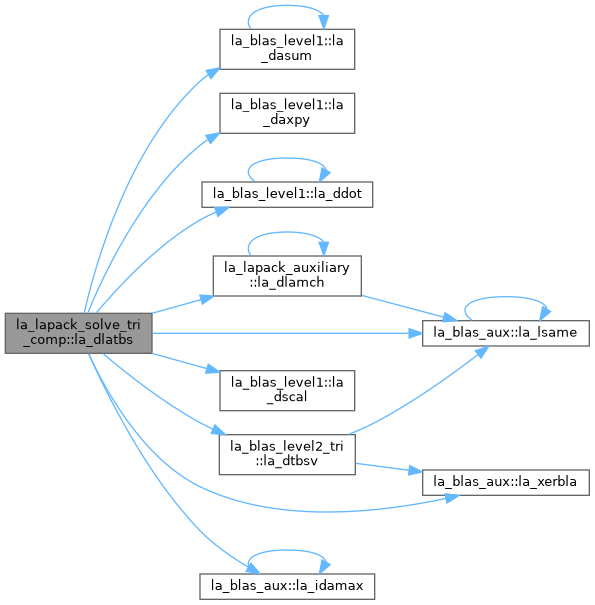
| pure subroutine, public | la_dlatbs (uplo, trans, diag, normin, n, kd, ab, ldab, x, scale, cnorm, info) |
| DLATBS: solves one of the triangular systems A *x = s*b or A**T*x = s*b with scaling to prevent overflow, where A is an upper or lower triangular band matrix. Here A**T denotes the transpose of A, x and b are n-element vectors, and s is a scaling factor, usually less than or equal to 1, chosen so that the components of x will be less than the overflow threshold. If the unscaled problem will not cause overflow, the Level 2 BLAS routine DTBSV is called. If the matrix A is singular (A(j,j) = 0 for some j), then s is set to 0 and a non-trivial solution to A*x = 0 is returned. | |
| pure subroutine, public | la_qlatbs (uplo, trans, diag, normin, n, kd, ab, ldab, x, scale, cnorm, info) |
| QLATBS: solves one of the triangular systems A *x = s*b or A**T*x = s*b with scaling to prevent overflow, where A is an upper or lower triangular band matrix. Here A**T denotes the transpose of A, x and b are n-element vectors, and s is a scaling factor, usually less than or equal to 1, chosen so that the components of x will be less than the overflow threshold. If the unscaled problem will not cause overflow, the Level 2 BLAS routine QTBSV is called. If the matrix A is singular (A(j,j) = 0 for some j), then s is set to 0 and a non-trivial solution to A*x = 0 is returned. | |
| pure subroutine, public | la_slatps (uplo, trans, diag, normin, n, ap, x, scale, cnorm, info) |
| SLATPS: solves one of the triangular systems A *x = s*b or A**T*x = s*b with scaling to prevent overflow, where A is an upper or lower triangular matrix stored in packed form. Here A**T denotes the transpose of A, x and b are n-element vectors, and s is a scaling factor, usually less than or equal to 1, chosen so that the components of x will be less than the overflow threshold. If the unscaled problem will not cause overflow, the Level 2 BLAS routine STPSV is called. If the matrix A is singular (A(j,j) = 0 for some j), then s is set to 0 and a non-trivial solution to A*x = 0 is returned. | |
| pure subroutine, public | la_dlatps (uplo, trans, diag, normin, n, ap, x, scale, cnorm, info) |
| DLATPS: solves one of the triangular systems A *x = s*b or A**T*x = s*b with scaling to prevent overflow, where A is an upper or lower triangular matrix stored in packed form. Here A**T denotes the transpose of A, x and b are n-element vectors, and s is a scaling factor, usually less than or equal to 1, chosen so that the components of x will be less than the overflow threshold. If the unscaled problem will not cause overflow, the Level 2 BLAS routine DTPSV is called. If the matrix A is singular (A(j,j) = 0 for some j), then s is set to 0 and a non-trivial solution to A*x = 0 is returned. | |
| pure subroutine, public | la_qlatps (uplo, trans, diag, normin, n, ap, x, scale, cnorm, info) |
| QLATPS: solves one of the triangular systems A *x = s*b or A**T*x = s*b with scaling to prevent overflow, where A is an upper or lower triangular matrix stored in packed form. Here A**T denotes the transpose of A, x and b are n-element vectors, and s is a scaling factor, usually less than or equal to 1, chosen so that the components of x will be less than the overflow threshold. If the unscaled problem will not cause overflow, the Level 2 BLAS routine QTPSV is called. If the matrix A is singular (A(j,j) = 0 for some j), then s is set to 0 and a non-trivial solution to A*x = 0 is returned. | |
| pure subroutine, public | la_slatrs (uplo, trans, diag, normin, n, a, lda, x, scale, cnorm, info) |
| SLATRS: solves one of the triangular systems A *x = s*b or A**T*x = s*b with scaling to prevent overflow. Here A is an upper or lower triangular matrix, A**T denotes the transpose of A, x and b are n-element vectors, and s is a scaling factor, usually less than or equal to 1, chosen so that the components of x will be less than the overflow threshold. If the unscaled problem will not cause overflow, the Level 2 BLAS routine STRSV is called. If the matrix A is singular (A(j,j) = 0 for some j), then s is set to 0 and a non-trivial solution to A*x = 0 is returned. | |
| pure subroutine, public | la_dlatrs (uplo, trans, diag, normin, n, a, lda, x, scale, cnorm, info) |
| DLATRS: solves one of the triangular systems A *x = s*b or A**T *x = s*b with scaling to prevent overflow. Here A is an upper or lower triangular matrix, A**T denotes the transpose of A, x and b are n-element vectors, and s is a scaling factor, usually less than or equal to 1, chosen so that the components of x will be less than the overflow threshold. If the unscaled problem will not cause overflow, the Level 2 BLAS routine DTRSV is called. If the matrix A is singular (A(j,j) = 0 for some j), then s is set to 0 and a non-trivial solution to A*x = 0 is returned. | |
| pure subroutine, public | la_qlatrs (uplo, trans, diag, normin, n, a, lda, x, scale, cnorm, info) |
| QLATRS: solves one of the triangular systems A *x = s*b or A**T *x = s*b with scaling to prevent overflow. Here A is an upper or lower triangular matrix, A**T denotes the transpose of A, x and b are n-element vectors, and s is a scaling factor, usually less than or equal to 1, chosen so that the components of x will be less than the overflow threshold. If the unscaled problem will not cause overflow, the Level 2 BLAS routine QTRSV is called. If the matrix A is singular (A(j,j) = 0 for some j), then s is set to 0 and a non-trivial solution to A*x = 0 is returned. | |
| pure subroutine, public | la_slauu2 (uplo, n, a, lda, info) |
| SLAUU2: computes the product U * U**T or L**T * L, where the triangular factor U or L is stored in the upper or lower triangular part of the array A. If UPLO = 'U' or 'u' then the upper triangle of the result is stored, overwriting the factor U in A. If UPLO = 'L' or 'l' then the lower triangle of the result is stored, overwriting the factor L in A. This is the unblocked form of the algorithm, calling Level 2 BLAS. | |
| pure subroutine, public | la_dlauu2 (uplo, n, a, lda, info) |
| DLAUU2: computes the product U * U**T or L**T * L, where the triangular factor U or L is stored in the upper or lower triangular part of the array A. If UPLO = 'U' or 'u' then the upper triangle of the result is stored, overwriting the factor U in A. If UPLO = 'L' or 'l' then the lower triangle of the result is stored, overwriting the factor L in A. This is the unblocked form of the algorithm, calling Level 2 BLAS. | |
| pure subroutine, public | la_qlauu2 (uplo, n, a, lda, info) |
| QLAUU2: computes the product U * U**T or L**T * L, where the triangular factor U or L is stored in the upper or lower triangular part of the array A. If UPLO = 'U' or 'u' then the upper triangle of the result is stored, overwriting the factor U in A. If UPLO = 'L' or 'l' then the lower triangle of the result is stored, overwriting the factor L in A. This is the unblocked form of the algorithm, calling Level 2 BLAS. | |
| pure subroutine, public | la_slauum (uplo, n, a, lda, info) |
| SLAUUM: computes the product U * U**T or L**T * L, where the triangular factor U or L is stored in the upper or lower triangular part of the array A. If UPLO = 'U' or 'u' then the upper triangle of the result is stored, overwriting the factor U in A. If UPLO = 'L' or 'l' then the lower triangle of the result is stored, overwriting the factor L in A. This is the blocked form of the algorithm, calling Level 3 BLAS. | |
| pure subroutine, public | la_dlauum (uplo, n, a, lda, info) |
| DLAUUM: computes the product U * U**T or L**T * L, where the triangular factor U or L is stored in the upper or lower triangular part of the array A. If UPLO = 'U' or 'u' then the upper triangle of the result is stored, overwriting the factor U in A. If UPLO = 'L' or 'l' then the lower triangle of the result is stored, overwriting the factor L in A. This is the blocked form of the algorithm, calling Level 3 BLAS. | |
| pure subroutine, public | la_qlauum (uplo, n, a, lda, info) |
| QLAUUM: computes the product U * U**T or L**T * L, where the triangular factor U or L is stored in the upper or lower triangular part of the array A. If UPLO = 'U' or 'u' then the upper triangle of the result is stored, overwriting the factor U in A. If UPLO = 'L' or 'l' then the lower triangle of the result is stored, overwriting the factor L in A. This is the blocked form of the algorithm, calling Level 3 BLAS. | |
| pure subroutine, public | la_stbrfs (uplo, trans, diag, n, kd, nrhs, ab, ldab, b, ldb, x, ldx, ferr, berr, work, iwork, info) |
| STBRFS: provides error bounds and backward error estimates for the solution to a system of linear equations with a triangular band coefficient matrix. The solution matrix X must be computed by STBTRS or some other means before entering this routine. STBRFS does not do iterative refinement because doing so cannot improve the backward error. | |
| pure subroutine, public | la_dtbrfs (uplo, trans, diag, n, kd, nrhs, ab, ldab, b, ldb, x, ldx, ferr, berr, work, iwork, info) |
| DTBRFS: provides error bounds and backward error estimates for the solution to a system of linear equations with a triangular band coefficient matrix. The solution matrix X must be computed by DTBTRS or some other means before entering this routine. DTBRFS does not do iterative refinement because doing so cannot improve the backward error. | |
| pure subroutine, public | la_qtbrfs (uplo, trans, diag, n, kd, nrhs, ab, ldab, b, ldb, x, ldx, ferr, berr, work, iwork, info) |
| QTBRFS: provides error bounds and backward error estimates for the solution to a system of linear equations with a triangular band coefficient matrix. The solution matrix X must be computed by QTBTRS or some other means before entering this routine. QTBRFS does not do iterative refinement because doing so cannot improve the backward error. | |
| pure subroutine, public | la_stbtrs (uplo, trans, diag, n, kd, nrhs, ab, ldab, b, ldb, info) |
| STBTRS: solves a triangular system of the form A * X = B or A**T * X = B, where A is a triangular band matrix of order N, and B is an N-by NRHS matrix. A check is made to verify that A is nonsingular. | |
| pure subroutine, public | la_dtbtrs (uplo, trans, diag, n, kd, nrhs, ab, ldab, b, ldb, info) |
| DTBTRS: solves a triangular system of the form A * X = B or A**T * X = B, where A is a triangular band matrix of order N, and B is an N-by NRHS matrix. A check is made to verify that A is nonsingular. | |
| pure subroutine, public | la_qtbtrs (uplo, trans, diag, n, kd, nrhs, ab, ldab, b, ldb, info) |
| QTBTRS: solves a triangular system of the form A * X = B or A**T * X = B, where A is a triangular band matrix of order N, and B is an N-by NRHS matrix. A check is made to verify that A is nonsingular. | |
| pure subroutine, public | la_stprfs (uplo, trans, diag, n, nrhs, ap, b, ldb, x, ldx, ferr, berr, work, iwork, info) |
| STPRFS: provides error bounds and backward error estimates for the solution to a system of linear equations with a triangular packed coefficient matrix. The solution matrix X must be computed by STPTRS or some other means before entering this routine. STPRFS does not do iterative refinement because doing so cannot improve the backward error. | |
| pure subroutine, public | la_dtprfs (uplo, trans, diag, n, nrhs, ap, b, ldb, x, ldx, ferr, berr, work, iwork, info) |
| DTPRFS: provides error bounds and backward error estimates for the solution to a system of linear equations with a triangular packed coefficient matrix. The solution matrix X must be computed by DTPTRS or some other means before entering this routine. DTPRFS does not do iterative refinement because doing so cannot improve the backward error. | |
| pure subroutine, public | la_qtprfs (uplo, trans, diag, n, nrhs, ap, b, ldb, x, ldx, ferr, berr, work, iwork, info) |
| QTPRFS: provides error bounds and backward error estimates for the solution to a system of linear equations with a triangular packed coefficient matrix. The solution matrix X must be computed by QTPTRS or some other means before entering this routine. QTPRFS does not do iterative refinement because doing so cannot improve the backward error. | |
| pure subroutine, public | la_stptri (uplo, diag, n, ap, info) |
| STPTRI: computes the inverse of a real upper or lower triangular matrix A stored in packed format. | |
| pure subroutine, public | la_dtptri (uplo, diag, n, ap, info) |
| DTPTRI: computes the inverse of a real upper or lower triangular matrix A stored in packed format. | |
| pure subroutine, public | la_qtptri (uplo, diag, n, ap, info) |
| QTPTRI: computes the inverse of a real upper or lower triangular matrix A stored in packed format. | |
| pure subroutine, public | la_stptrs (uplo, trans, diag, n, nrhs, ap, b, ldb, info) |
| STPTRS: solves a triangular system of the form A * X = B or A**T * X = B, where A is a triangular matrix of order N stored in packed format, and B is an N-by-NRHS matrix. A check is made to verify that A is nonsingular. | |
| pure subroutine, public | la_dtptrs (uplo, trans, diag, n, nrhs, ap, b, ldb, info) |
| DTPTRS: solves a triangular system of the form A * X = B or A**T * X = B, where A is a triangular matrix of order N stored in packed format, and B is an N-by-NRHS matrix. A check is made to verify that A is nonsingular. | |
| pure subroutine, public | la_qtptrs (uplo, trans, diag, n, nrhs, ap, b, ldb, info) |
| QTPTRS: solves a triangular system of the form A * X = B or A**T * X = B, where A is a triangular matrix of order N stored in packed format, and B is an N-by-NRHS matrix. A check is made to verify that A is nonsingular. | |
| pure subroutine, public | la_strrfs (uplo, trans, diag, n, nrhs, a, lda, b, ldb, x, ldx, ferr, berr, work, iwork, info) |
| STRRFS: provides error bounds and backward error estimates for the solution to a system of linear equations with a triangular coefficient matrix. The solution matrix X must be computed by STRTRS or some other means before entering this routine. STRRFS does not do iterative refinement because doing so cannot improve the backward error. | |
| pure subroutine, public | la_dtrrfs (uplo, trans, diag, n, nrhs, a, lda, b, ldb, x, ldx, ferr, berr, work, iwork, info) |
| DTRRFS: provides error bounds and backward error estimates for the solution to a system of linear equations with a triangular coefficient matrix. The solution matrix X must be computed by DTRTRS or some other means before entering this routine. DTRRFS does not do iterative refinement because doing so cannot improve the backward error. | |
| pure subroutine, public | la_qtrrfs (uplo, trans, diag, n, nrhs, a, lda, b, ldb, x, ldx, ferr, berr, work, iwork, info) |
| QTRRFS: provides error bounds and backward error estimates for the solution to a system of linear equations with a triangular coefficient matrix. The solution matrix X must be computed by QTRTRS or some other means before entering this routine. QTRRFS does not do iterative refinement because doing so cannot improve the backward error. | |
| pure subroutine, public | la_strti2 (uplo, diag, n, a, lda, info) |
| STRTI2: computes the inverse of a real upper or lower triangular matrix. This is the Level 2 BLAS version of the algorithm. | |
| pure subroutine, public | la_dtrti2 (uplo, diag, n, a, lda, info) |
| DTRTI2: computes the inverse of a real upper or lower triangular matrix. This is the Level 2 BLAS version of the algorithm. | |
| pure subroutine, public | la_qtrti2 (uplo, diag, n, a, lda, info) |
| QTRTI2: computes the inverse of a real upper or lower triangular matrix. This is the Level 2 BLAS version of the algorithm. | |
| pure subroutine, public | la_strtri (uplo, diag, n, a, lda, info) |
| STRTRI: computes the inverse of a real upper or lower triangular matrix A. This is the Level 3 BLAS version of the algorithm. | |
| pure subroutine, public | la_dtrtri (uplo, diag, n, a, lda, info) |
| DTRTRI: computes the inverse of a real upper or lower triangular matrix A. This is the Level 3 BLAS version of the algorithm. | |
| pure subroutine, public | la_qtrtri (uplo, diag, n, a, lda, info) |
| QTRTRI: computes the inverse of a real upper or lower triangular matrix A. This is the Level 3 BLAS version of the algorithm. | |
| pure subroutine, public | la_strtrs (uplo, trans, diag, n, nrhs, a, lda, b, ldb, info) |
| STRTRS: solves a triangular system of the form A * X = B or A**T * X = B, where A is a triangular matrix of order N, and B is an N-by-NRHS matrix. A check is made to verify that A is nonsingular. | |
| pure subroutine, public | la_dtrtrs (uplo, trans, diag, n, nrhs, a, lda, b, ldb, info) |
| DTRTRS: solves a triangular system of the form A * X = B or A**T * X = B, where A is a triangular matrix of order N, and B is an N-by-NRHS matrix. A check is made to verify that A is nonsingular. | |
| pure subroutine, public | la_qtrtrs (uplo, trans, diag, n, nrhs, a, lda, b, ldb, info) |
| QTRTRS: solves a triangular system of the form A * X = B or A**T * X = B, where A is a triangular matrix of order N, and B is an N-by-NRHS matrix. A check is made to verify that A is nonsingular. | |
| subroutine, public | la_stbcon (norm, uplo, diag, n, kd, ab, ldab, rcond, work, iwork, info) |
| STBCON: estimates the reciprocal of the condition number of a triangular band matrix A, in either the 1-norm or the infinity-norm. The norm of A is computed and an estimate is obtained for norm(inv(A)), then the reciprocal of the condition number is computed as RCOND = 1 / ( norm(A) * norm(inv(A)) ). | |
| subroutine, public | la_dtbcon (norm, uplo, diag, n, kd, ab, ldab, rcond, work, iwork, info) |
| DTBCON: estimates the reciprocal of the condition number of a triangular band matrix A, in either the 1-norm or the infinity-norm. The norm of A is computed and an estimate is obtained for norm(inv(A)), then the reciprocal of the condition number is computed as RCOND = 1 / ( norm(A) * norm(inv(A)) ). | |
| subroutine, public | la_qtbcon (norm, uplo, diag, n, kd, ab, ldab, rcond, work, iwork, info) |
| QTBCON: estimates the reciprocal of the condition number of a triangular band matrix A, in either the 1-norm or the infinity-norm. The norm of A is computed and an estimate is obtained for norm(inv(A)), then the reciprocal of the condition number is computed as RCOND = 1 / ( norm(A) * norm(inv(A)) ). | |
| pure subroutine, public | la_stftri (transr, uplo, diag, n, a, info) |
| STFTRI: computes the inverse of a triangular matrix A stored in RFP format. This is a Level 3 BLAS version of the algorithm. | |
| pure subroutine, public | la_dtftri (transr, uplo, diag, n, a, info) |
| DTFTRI: computes the inverse of a triangular matrix A stored in RFP format. This is a Level 3 BLAS version of the algorithm. | |
| pure subroutine, public | la_qtftri (transr, uplo, diag, n, a, info) |
| QTFTRI: computes the inverse of a triangular matrix A stored in RFP format. This is a Level 3 BLAS version of the algorithm. | |
| subroutine, public | la_stpcon (norm, uplo, diag, n, ap, rcond, work, iwork, info) |
| STPCON: estimates the reciprocal of the condition number of a packed triangular matrix A, in either the 1-norm or the infinity-norm. The norm of A is computed and an estimate is obtained for norm(inv(A)), then the reciprocal of the condition number is computed as RCOND = 1 / ( norm(A) * norm(inv(A)) ). | |
| subroutine, public | la_dtpcon (norm, uplo, diag, n, ap, rcond, work, iwork, info) |
| DTPCON: estimates the reciprocal of the condition number of a packed triangular matrix A, in either the 1-norm or the infinity-norm. The norm of A is computed and an estimate is obtained for norm(inv(A)), then the reciprocal of the condition number is computed as RCOND = 1 / ( norm(A) * norm(inv(A)) ). | |
| subroutine, public | la_qtpcon (norm, uplo, diag, n, ap, rcond, work, iwork, info) |
| QTPCON: estimates the reciprocal of the condition number of a packed triangular matrix A, in either the 1-norm or the infinity-norm. The norm of A is computed and an estimate is obtained for norm(inv(A)), then the reciprocal of the condition number is computed as RCOND = 1 / ( norm(A) * norm(inv(A)) ). | |
| subroutine, public | la_strcon (norm, uplo, diag, n, a, lda, rcond, work, iwork, info) |
| STRCON: estimates the reciprocal of the condition number of a triangular matrix A, in either the 1-norm or the infinity-norm. The norm of A is computed and an estimate is obtained for norm(inv(A)), then the reciprocal of the condition number is computed as RCOND = 1 / ( norm(A) * norm(inv(A)) ). | |
| subroutine, public | la_dtrcon (norm, uplo, diag, n, a, lda, rcond, work, iwork, info) |
| DTRCON: estimates the reciprocal of the condition number of a triangular matrix A, in either the 1-norm or the infinity-norm. The norm of A is computed and an estimate is obtained for norm(inv(A)), then the reciprocal of the condition number is computed as RCOND = 1 / ( norm(A) * norm(inv(A)) ). | |
| subroutine, public | la_qtrcon (norm, uplo, diag, n, a, lda, rcond, work, iwork, info) |
| QTRCON: estimates the reciprocal of the condition number of a triangular matrix A, in either the 1-norm or the infinity-norm. The norm of A is computed and an estimate is obtained for norm(inv(A)), then the reciprocal of the condition number is computed as RCOND = 1 / ( norm(A) * norm(inv(A)) ). | |
| pure subroutine, public | la_clatbs (uplo, trans, diag, normin, n, kd, ab, ldab, x, scale, cnorm, info) |
| CLATBS: solves one of the triangular systems A * x = s*b, A**T * x = s*b, or A**H * x = s*b, with scaling to prevent overflow, where A is an upper or lower triangular band matrix. Here A**T denotes the transpose of A, x and b are n-element vectors, and s is a scaling factor, usually less than or equal to 1, chosen so that the components of x will be less than the overflow threshold. If the unscaled problem will not cause overflow, the Level 2 BLAS routine CTBSV is called. If the matrix A is singular (A(j,j) = 0 for some j), then s is set to 0 and a non-trivial solution to A*x = 0 is returned. | |
| pure subroutine, public | la_zlatbs (uplo, trans, diag, normin, n, kd, ab, ldab, x, scale, cnorm, info) |
| ZLATBS: solves one of the triangular systems A * x = s*b, A**T * x = s*b, or A**H * x = s*b, with scaling to prevent overflow, where A is an upper or lower triangular band matrix. Here A**T denotes the transpose of A, x and b are n-element vectors, and s is a scaling factor, usually less than or equal to 1, chosen so that the components of x will be less than the overflow threshold. If the unscaled problem will not cause overflow, the Level 2 BLAS routine ZTBSV is called. If the matrix A is singular (A(j,j) = 0 for some j), then s is set to 0 and a non-trivial solution to A*x = 0 is returned. | |
| pure subroutine, public | la_wlatbs (uplo, trans, diag, normin, n, kd, ab, ldab, x, scale, cnorm, info) |
| WLATBS: solves one of the triangular systems A * x = s*b, A**T * x = s*b, or A**H * x = s*b, with scaling to prevent overflow, where A is an upper or lower triangular band matrix. Here A**T denotes the transpose of A, x and b are n-element vectors, and s is a scaling factor, usually less than or equal to 1, chosen so that the components of x will be less than the overflow threshold. If the unscaled problem will not cause overflow, the Level 2 BLAS routine WTBSV is called. If the matrix A is singular (A(j,j) = 0 for some j), then s is set to 0 and a non-trivial solution to A*x = 0 is returned. | |
| pure subroutine, public | la_clatps (uplo, trans, diag, normin, n, ap, x, scale, cnorm, info) |
| CLATPS: solves one of the triangular systems A * x = s*b, A**T * x = s*b, or A**H * x = s*b, with scaling to prevent overflow, where A is an upper or lower triangular matrix stored in packed form. Here A**T denotes the transpose of A, A**H denotes the conjugate transpose of A, x and b are n-element vectors, and s is a scaling factor, usually less than or equal to 1, chosen so that the components of x will be less than the overflow threshold. If the unscaled problem will not cause overflow, the Level 2 BLAS routine CTPSV is called. If the matrix A is singular (A(j,j) = 0 for some j), then s is set to 0 and a non-trivial solution to A*x = 0 is returned. | |
| pure subroutine, public | la_zlatps (uplo, trans, diag, normin, n, ap, x, scale, cnorm, info) |
| ZLATPS: solves one of the triangular systems A * x = s*b, A**T * x = s*b, or A**H * x = s*b, with scaling to prevent overflow, where A is an upper or lower triangular matrix stored in packed form. Here A**T denotes the transpose of A, A**H denotes the conjugate transpose of A, x and b are n-element vectors, and s is a scaling factor, usually less than or equal to 1, chosen so that the components of x will be less than the overflow threshold. If the unscaled problem will not cause overflow, the Level 2 BLAS routine ZTPSV is called. If the matrix A is singular (A(j,j) = 0 for some j), then s is set to 0 and a non-trivial solution to A*x = 0 is returned. | |
| pure subroutine, public | la_wlatps (uplo, trans, diag, normin, n, ap, x, scale, cnorm, info) |
| WLATPS: solves one of the triangular systems A * x = s*b, A**T * x = s*b, or A**H * x = s*b, with scaling to prevent overflow, where A is an upper or lower triangular matrix stored in packed form. Here A**T denotes the transpose of A, A**H denotes the conjugate transpose of A, x and b are n-element vectors, and s is a scaling factor, usually less than or equal to 1, chosen so that the components of x will be less than the overflow threshold. If the unscaled problem will not cause overflow, the Level 2 BLAS routine WTPSV is called. If the matrix A is singular (A(j,j) = 0 for some j), then s is set to 0 and a non-trivial solution to A*x = 0 is returned. | |
| pure subroutine, public | la_clatrs (uplo, trans, diag, normin, n, a, lda, x, scale, cnorm, info) |
| CLATRS: solves one of the triangular systems A * x = s*b, A**T * x = s*b, or A**H * x = s*b, with scaling to prevent overflow. Here A is an upper or lower triangular matrix, A**T denotes the transpose of A, A**H denotes the conjugate transpose of A, x and b are n-element vectors, and s is a scaling factor, usually less than or equal to 1, chosen so that the components of x will be less than the overflow threshold. If the unscaled problem will not cause overflow, the Level 2 BLAS routine CTRSV is called. If the matrix A is singular (A(j,j) = 0 for some j), then s is set to 0 and a non-trivial solution to A*x = 0 is returned. | |
| pure subroutine, public | la_zlatrs (uplo, trans, diag, normin, n, a, lda, x, scale, cnorm, info) |
| ZLATRS: solves one of the triangular systems A * x = s*b, A**T * x = s*b, or A**H * x = s*b, with scaling to prevent overflow. Here A is an upper or lower triangular matrix, A**T denotes the transpose of A, A**H denotes the conjugate transpose of A, x and b are n-element vectors, and s is a scaling factor, usually less than or equal to 1, chosen so that the components of x will be less than the overflow threshold. If the unscaled problem will not cause overflow, the Level 2 BLAS routine ZTRSV is called. If the matrix A is singular (A(j,j) = 0 for some j), then s is set to 0 and a non-trivial solution to A*x = 0 is returned. | |
| pure subroutine, public | la_wlatrs (uplo, trans, diag, normin, n, a, lda, x, scale, cnorm, info) |
| WLATRS: solves one of the triangular systems A * x = s*b, A**T * x = s*b, or A**H * x = s*b, with scaling to prevent overflow. Here A is an upper or lower triangular matrix, A**T denotes the transpose of A, A**H denotes the conjugate transpose of A, x and b are n-element vectors, and s is a scaling factor, usually less than or equal to 1, chosen so that the components of x will be less than the overflow threshold. If the unscaled problem will not cause overflow, the Level 2 BLAS routine WTRSV is called. If the matrix A is singular (A(j,j) = 0 for some j), then s is set to 0 and a non-trivial solution to A*x = 0 is returned. | |
| pure subroutine, public | la_clauu2 (uplo, n, a, lda, info) |
| CLAUU2: computes the product U * U**H or L**H * L, where the triangular factor U or L is stored in the upper or lower triangular part of the array A. If UPLO = 'U' or 'u' then the upper triangle of the result is stored, overwriting the factor U in A. If UPLO = 'L' or 'l' then the lower triangle of the result is stored, overwriting the factor L in A. This is the unblocked form of the algorithm, calling Level 2 BLAS. | |
| pure subroutine, public | la_zlauu2 (uplo, n, a, lda, info) |
| ZLAUU2: computes the product U * U**H or L**H * L, where the triangular factor U or L is stored in the upper or lower triangular part of the array A. If UPLO = 'U' or 'u' then the upper triangle of the result is stored, overwriting the factor U in A. If UPLO = 'L' or 'l' then the lower triangle of the result is stored, overwriting the factor L in A. This is the unblocked form of the algorithm, calling Level 2 BLAS. | |
| pure subroutine, public | la_wlauu2 (uplo, n, a, lda, info) |
| WLAUU2: computes the product U * U**H or L**H * L, where the triangular factor U or L is stored in the upper or lower triangular part of the array A. If UPLO = 'U' or 'u' then the upper triangle of the result is stored, overwriting the factor U in A. If UPLO = 'L' or 'l' then the lower triangle of the result is stored, overwriting the factor L in A. This is the unblocked form of the algorithm, calling Level 2 BLAS. | |
| pure subroutine, public | la_clauum (uplo, n, a, lda, info) |
| CLAUUM: computes the product U * U**H or L**H * L, where the triangular factor U or L is stored in the upper or lower triangular part of the array A. If UPLO = 'U' or 'u' then the upper triangle of the result is stored, overwriting the factor U in A. If UPLO = 'L' or 'l' then the lower triangle of the result is stored, overwriting the factor L in A. This is the blocked form of the algorithm, calling Level 3 BLAS. | |
| pure subroutine, public | la_zlauum (uplo, n, a, lda, info) |
| ZLAUUM: computes the product U * U**H or L**H * L, where the triangular factor U or L is stored in the upper or lower triangular part of the array A. If UPLO = 'U' or 'u' then the upper triangle of the result is stored, overwriting the factor U in A. If UPLO = 'L' or 'l' then the lower triangle of the result is stored, overwriting the factor L in A. This is the blocked form of the algorithm, calling Level 3 BLAS. | |
| pure subroutine, public | la_wlauum (uplo, n, a, lda, info) |
| WLAUUM: computes the product U * U**H or L**H * L, where the triangular factor U or L is stored in the upper or lower triangular part of the array A. If UPLO = 'U' or 'u' then the upper triangle of the result is stored, overwriting the factor U in A. If UPLO = 'L' or 'l' then the lower triangle of the result is stored, overwriting the factor L in A. This is the blocked form of the algorithm, calling Level 3 BLAS. | |
| pure subroutine, public | la_ctbrfs (uplo, trans, diag, n, kd, nrhs, ab, ldab, b, ldb, x, ldx, ferr, berr, work, rwork, info) |
| CTBRFS: provides error bounds and backward error estimates for the solution to a system of linear equations with a triangular band coefficient matrix. The solution matrix X must be computed by CTBTRS or some other means before entering this routine. CTBRFS does not do iterative refinement because doing so cannot improve the backward error. | |
| pure subroutine, public | la_ztbrfs (uplo, trans, diag, n, kd, nrhs, ab, ldab, b, ldb, x, ldx, ferr, berr, work, rwork, info) |
| ZTBRFS: provides error bounds and backward error estimates for the solution to a system of linear equations with a triangular band coefficient matrix. The solution matrix X must be computed by ZTBTRS or some other means before entering this routine. ZTBRFS does not do iterative refinement because doing so cannot improve the backward error. | |
| pure subroutine, public | la_wtbrfs (uplo, trans, diag, n, kd, nrhs, ab, ldab, b, ldb, x, ldx, ferr, berr, work, rwork, info) |
| WTBRFS: provides error bounds and backward error estimates for the solution to a system of linear equations with a triangular band coefficient matrix. The solution matrix X must be computed by WTBTRS or some other means before entering this routine. WTBRFS does not do iterative refinement because doing so cannot improve the backward error. | |
| pure subroutine, public | la_ctbtrs (uplo, trans, diag, n, kd, nrhs, ab, ldab, b, ldb, info) |
| CTBTRS: solves a triangular system of the form A * X = B, A**T * X = B, or A**H * X = B, where A is a triangular band matrix of order N, and B is an N-by-NRHS matrix. A check is made to verify that A is nonsingular. | |
| pure subroutine, public | la_ztbtrs (uplo, trans, diag, n, kd, nrhs, ab, ldab, b, ldb, info) |
| ZTBTRS: solves a triangular system of the form A * X = B, A**T * X = B, or A**H * X = B, where A is a triangular band matrix of order N, and B is an N-by-NRHS matrix. A check is made to verify that A is nonsingular. | |
| pure subroutine, public | la_wtbtrs (uplo, trans, diag, n, kd, nrhs, ab, ldab, b, ldb, info) |
| WTBTRS: solves a triangular system of the form A * X = B, A**T * X = B, or A**H * X = B, where A is a triangular band matrix of order N, and B is an N-by-NRHS matrix. A check is made to verify that A is nonsingular. | |
| pure subroutine, public | la_ctprfs (uplo, trans, diag, n, nrhs, ap, b, ldb, x, ldx, ferr, berr, work, rwork, info) |
| CTPRFS: provides error bounds and backward error estimates for the solution to a system of linear equations with a triangular packed coefficient matrix. The solution matrix X must be computed by CTPTRS or some other means before entering this routine. CTPRFS does not do iterative refinement because doing so cannot improve the backward error. | |
| pure subroutine, public | la_ztprfs (uplo, trans, diag, n, nrhs, ap, b, ldb, x, ldx, ferr, berr, work, rwork, info) |
| ZTPRFS: provides error bounds and backward error estimates for the solution to a system of linear equations with a triangular packed coefficient matrix. The solution matrix X must be computed by ZTPTRS or some other means before entering this routine. ZTPRFS does not do iterative refinement because doing so cannot improve the backward error. | |
| pure subroutine, public | la_wtprfs (uplo, trans, diag, n, nrhs, ap, b, ldb, x, ldx, ferr, berr, work, rwork, info) |
| WTPRFS: provides error bounds and backward error estimates for the solution to a system of linear equations with a triangular packed coefficient matrix. The solution matrix X must be computed by WTPTRS or some other means before entering this routine. WTPRFS does not do iterative refinement because doing so cannot improve the backward error. | |
| pure subroutine, public | la_ctptri (uplo, diag, n, ap, info) |
| CTPTRI: computes the inverse of a complex upper or lower triangular matrix A stored in packed format. | |
| pure subroutine, public | la_ztptri (uplo, diag, n, ap, info) |
| ZTPTRI: computes the inverse of a complex upper or lower triangular matrix A stored in packed format. | |
| pure subroutine, public | la_wtptri (uplo, diag, n, ap, info) |
| WTPTRI: computes the inverse of a complex upper or lower triangular matrix A stored in packed format. | |
| pure subroutine, public | la_ctptrs (uplo, trans, diag, n, nrhs, ap, b, ldb, info) |
| CTPTRS: solves a triangular system of the form A * X = B, A**T * X = B, or A**H * X = B, where A is a triangular matrix of order N stored in packed format, and B is an N-by-NRHS matrix. A check is made to verify that A is nonsingular. | |
| pure subroutine, public | la_ztptrs (uplo, trans, diag, n, nrhs, ap, b, ldb, info) |
| ZTPTRS: solves a triangular system of the form A * X = B, A**T * X = B, or A**H * X = B, where A is a triangular matrix of order N stored in packed format, and B is an N-by-NRHS matrix. A check is made to verify that A is nonsingular. | |
| pure subroutine, public | la_wtptrs (uplo, trans, diag, n, nrhs, ap, b, ldb, info) |
| WTPTRS: solves a triangular system of the form A * X = B, A**T * X = B, or A**H * X = B, where A is a triangular matrix of order N stored in packed format, and B is an N-by-NRHS matrix. A check is made to verify that A is nonsingular. | |
| pure subroutine, public | la_ctrrfs (uplo, trans, diag, n, nrhs, a, lda, b, ldb, x, ldx, ferr, berr, work, rwork, info) |
| CTRRFS: provides error bounds and backward error estimates for the solution to a system of linear equations with a triangular coefficient matrix. The solution matrix X must be computed by CTRTRS or some other means before entering this routine. CTRRFS does not do iterative refinement because doing so cannot improve the backward error. | |
| pure subroutine, public | la_ztrrfs (uplo, trans, diag, n, nrhs, a, lda, b, ldb, x, ldx, ferr, berr, work, rwork, info) |
| ZTRRFS: provides error bounds and backward error estimates for the solution to a system of linear equations with a triangular coefficient matrix. The solution matrix X must be computed by ZTRTRS or some other means before entering this routine. ZTRRFS does not do iterative refinement because doing so cannot improve the backward error. | |
| pure subroutine, public | la_wtrrfs (uplo, trans, diag, n, nrhs, a, lda, b, ldb, x, ldx, ferr, berr, work, rwork, info) |
| WTRRFS: provides error bounds and backward error estimates for the solution to a system of linear equations with a triangular coefficient matrix. The solution matrix X must be computed by WTRTRS or some other means before entering this routine. WTRRFS does not do iterative refinement because doing so cannot improve the backward error. | |
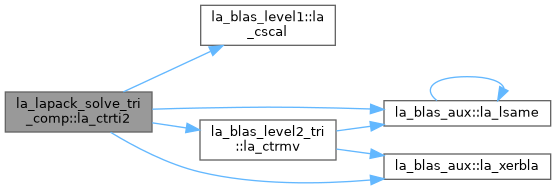
| pure subroutine, public | la_ctrti2 (uplo, diag, n, a, lda, info) |
| CTRTI2: computes the inverse of a complex upper or lower triangular matrix. This is the Level 2 BLAS version of the algorithm. | |
| pure subroutine, public | la_ztrti2 (uplo, diag, n, a, lda, info) |
| ZTRTI2: computes the inverse of a complex upper or lower triangular matrix. This is the Level 2 BLAS version of the algorithm. | |
| pure subroutine, public | la_wtrti2 (uplo, diag, n, a, lda, info) |
| WTRTI2: computes the inverse of a complex upper or lower triangular matrix. This is the Level 2 BLAS version of the algorithm. | |
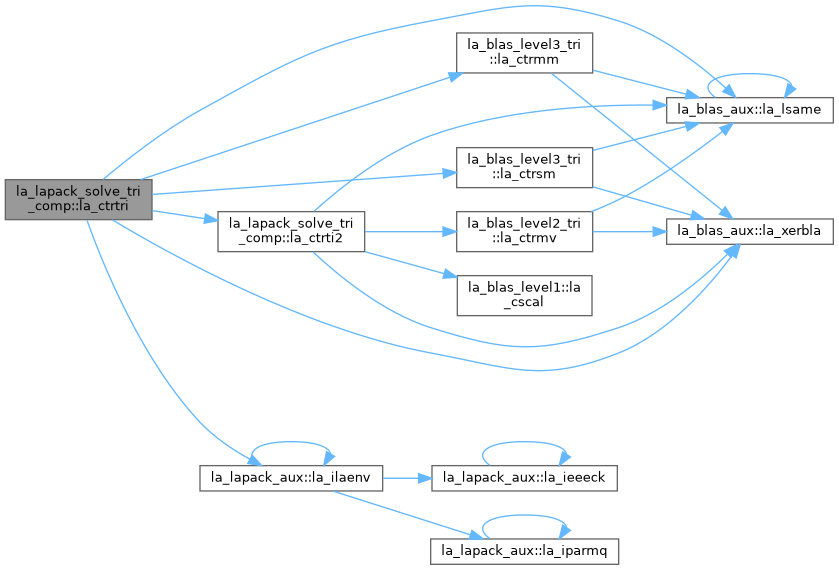
| pure subroutine, public | la_ctrtri (uplo, diag, n, a, lda, info) |
| CTRTRI: computes the inverse of a complex upper or lower triangular matrix A. This is the Level 3 BLAS version of the algorithm. | |
| pure subroutine, public | la_ztrtri (uplo, diag, n, a, lda, info) |
| ZTRTRI: computes the inverse of a complex upper or lower triangular matrix A. This is the Level 3 BLAS version of the algorithm. | |
| pure subroutine, public | la_wtrtri (uplo, diag, n, a, lda, info) |
| WTRTRI: computes the inverse of a complex upper or lower triangular matrix A. This is the Level 3 BLAS version of the algorithm. | |
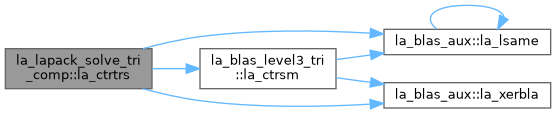
| pure subroutine, public | la_ctrtrs (uplo, trans, diag, n, nrhs, a, lda, b, ldb, info) |
| CTRTRS: solves a triangular system of the form A * X = B, A**T * X = B, or A**H * X = B, where A is a triangular matrix of order N, and B is an N-by-NRHS matrix. A check is made to verify that A is nonsingular. | |
| pure subroutine, public | la_ztrtrs (uplo, trans, diag, n, nrhs, a, lda, b, ldb, info) |
| ZTRTRS: solves a triangular system of the form A * X = B, A**T * X = B, or A**H * X = B, where A is a triangular matrix of order N, and B is an N-by-NRHS matrix. A check is made to verify that A is nonsingular. | |
| pure subroutine, public | la_wtrtrs (uplo, trans, diag, n, nrhs, a, lda, b, ldb, info) |
| WTRTRS: solves a triangular system of the form A * X = B, A**T * X = B, or A**H * X = B, where A is a triangular matrix of order N, and B is an N-by-NRHS matrix. A check is made to verify that A is nonsingular. | |
| subroutine, public | la_ctbcon (norm, uplo, diag, n, kd, ab, ldab, rcond, work, rwork, info) |
| CTBCON: estimates the reciprocal of the condition number of a triangular band matrix A, in either the 1-norm or the infinity-norm. The norm of A is computed and an estimate is obtained for norm(inv(A)), then the reciprocal of the condition number is computed as RCOND = 1 / ( norm(A) * norm(inv(A)) ). | |
| subroutine, public | la_ztbcon (norm, uplo, diag, n, kd, ab, ldab, rcond, work, rwork, info) |
| ZTBCON: estimates the reciprocal of the condition number of a triangular band matrix A, in either the 1-norm or the infinity-norm. The norm of A is computed and an estimate is obtained for norm(inv(A)), then the reciprocal of the condition number is computed as RCOND = 1 / ( norm(A) * norm(inv(A)) ). | |
| subroutine, public | la_wtbcon (norm, uplo, diag, n, kd, ab, ldab, rcond, work, rwork, info) |
| WTBCON: estimates the reciprocal of the condition number of a triangular band matrix A, in either the 1-norm or the infinity-norm. The norm of A is computed and an estimate is obtained for norm(inv(A)), then the reciprocal of the condition number is computed as RCOND = 1 / ( norm(A) * norm(inv(A)) ). | |
| pure subroutine, public | la_ctftri (transr, uplo, diag, n, a, info) |
| CTFTRI: computes the inverse of a triangular matrix A stored in RFP format. This is a Level 3 BLAS version of the algorithm. | |
| pure subroutine, public | la_ztftri (transr, uplo, diag, n, a, info) |
| ZTFTRI: computes the inverse of a triangular matrix A stored in RFP format. This is a Level 3 BLAS version of the algorithm. | |
| pure subroutine, public | la_wtftri (transr, uplo, diag, n, a, info) |
| WTFTRI: computes the inverse of a triangular matrix A stored in RFP format. This is a Level 3 BLAS version of the algorithm. | |
| subroutine, public | la_ctpcon (norm, uplo, diag, n, ap, rcond, work, rwork, info) |
| CTPCON: estimates the reciprocal of the condition number of a packed triangular matrix A, in either the 1-norm or the infinity-norm. The norm of A is computed and an estimate is obtained for norm(inv(A)), then the reciprocal of the condition number is computed as RCOND = 1 / ( norm(A) * norm(inv(A)) ). | |
| subroutine, public | la_ztpcon (norm, uplo, diag, n, ap, rcond, work, rwork, info) |
| ZTPCON: estimates the reciprocal of the condition number of a packed triangular matrix A, in either the 1-norm or the infinity-norm. The norm of A is computed and an estimate is obtained for norm(inv(A)), then the reciprocal of the condition number is computed as RCOND = 1 / ( norm(A) * norm(inv(A)) ). | |
| subroutine, public | la_wtpcon (norm, uplo, diag, n, ap, rcond, work, rwork, info) |
| WTPCON: estimates the reciprocal of the condition number of a packed triangular matrix A, in either the 1-norm or the infinity-norm. The norm of A is computed and an estimate is obtained for norm(inv(A)), then the reciprocal of the condition number is computed as RCOND = 1 / ( norm(A) * norm(inv(A)) ). | |
| subroutine, public | la_ctrcon (norm, uplo, diag, n, a, lda, rcond, work, rwork, info) |
| CTRCON: estimates the reciprocal of the condition number of a triangular matrix A, in either the 1-norm or the infinity-norm. The norm of A is computed and an estimate is obtained for norm(inv(A)), then the reciprocal of the condition number is computed as RCOND = 1 / ( norm(A) * norm(inv(A)) ). | |
| subroutine, public | la_ztrcon (norm, uplo, diag, n, a, lda, rcond, work, rwork, info) |
| ZTRCON: estimates the reciprocal of the condition number of a triangular matrix A, in either the 1-norm or the infinity-norm. The norm of A is computed and an estimate is obtained for norm(inv(A)), then the reciprocal of the condition number is computed as RCOND = 1 / ( norm(A) * norm(inv(A)) ). | |
| subroutine, public | la_wtrcon (norm, uplo, diag, n, a, lda, rcond, work, rwork, info) |
| WTRCON: estimates the reciprocal of the condition number of a triangular matrix A, in either the 1-norm or the infinity-norm. The norm of A is computed and an estimate is obtained for norm(inv(A)), then the reciprocal of the condition number is computed as RCOND = 1 / ( norm(A) * norm(inv(A)) ). | |
Detailed Description
Triangular systems: solve, inverse, condition estimation, refinement.
Function/Subroutine Documentation
◆ la_clatbs()
| pure subroutine, public la_lapack_solve_tri_comp::la_clatbs | ( | character, intent(in) | uplo, |
| character, intent(in) | trans, | ||
| character, intent(in) | diag, | ||
| character, intent(in) | normin, | ||
| integer(ilp), intent(in) | n, | ||
| integer(ilp), intent(in) | kd, | ||
| complex(sp), dimension(ldab,*), intent(in) | ab, | ||
| integer(ilp), intent(in) | ldab, | ||
| complex(sp), dimension(*), intent(inout) | x, | ||
| real(sp), intent(out) | scale, | ||
| real(sp), dimension(*), intent(inout) | cnorm, | ||
| integer(ilp), intent(out) | info ) |
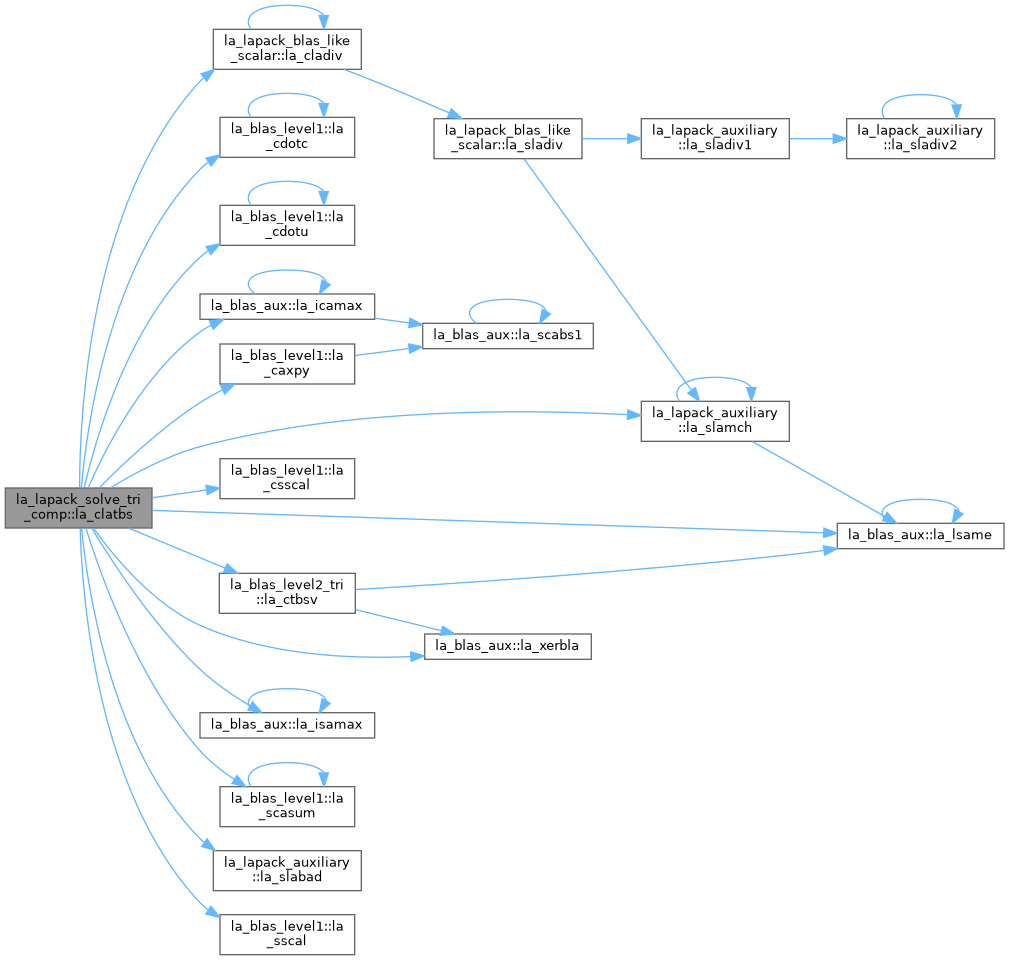
CLATBS: solves one of the triangular systems A * x = s*b, A**T * x = s*b, or A**H * x = s*b, with scaling to prevent overflow, where A is an upper or lower triangular band matrix. Here A**T denotes the transpose of A, x and b are n-element vectors, and s is a scaling factor, usually less than or equal to 1, chosen so that the components of x will be less than the overflow threshold. If the unscaled problem will not cause overflow, the Level 2 BLAS routine CTBSV is called. If the matrix A is singular (A(j,j) = 0 for some j), then s is set to 0 and a non-trivial solution to A*x = 0 is returned.
◆ la_clatps()
| pure subroutine, public la_lapack_solve_tri_comp::la_clatps | ( | character, intent(in) | uplo, |
| character, intent(in) | trans, | ||
| character, intent(in) | diag, | ||
| character, intent(in) | normin, | ||
| integer(ilp), intent(in) | n, | ||
| complex(sp), dimension(*), intent(in) | ap, | ||
| complex(sp), dimension(*), intent(inout) | x, | ||
| real(sp), intent(out) | scale, | ||
| real(sp), dimension(*), intent(inout) | cnorm, | ||
| integer(ilp), intent(out) | info ) |
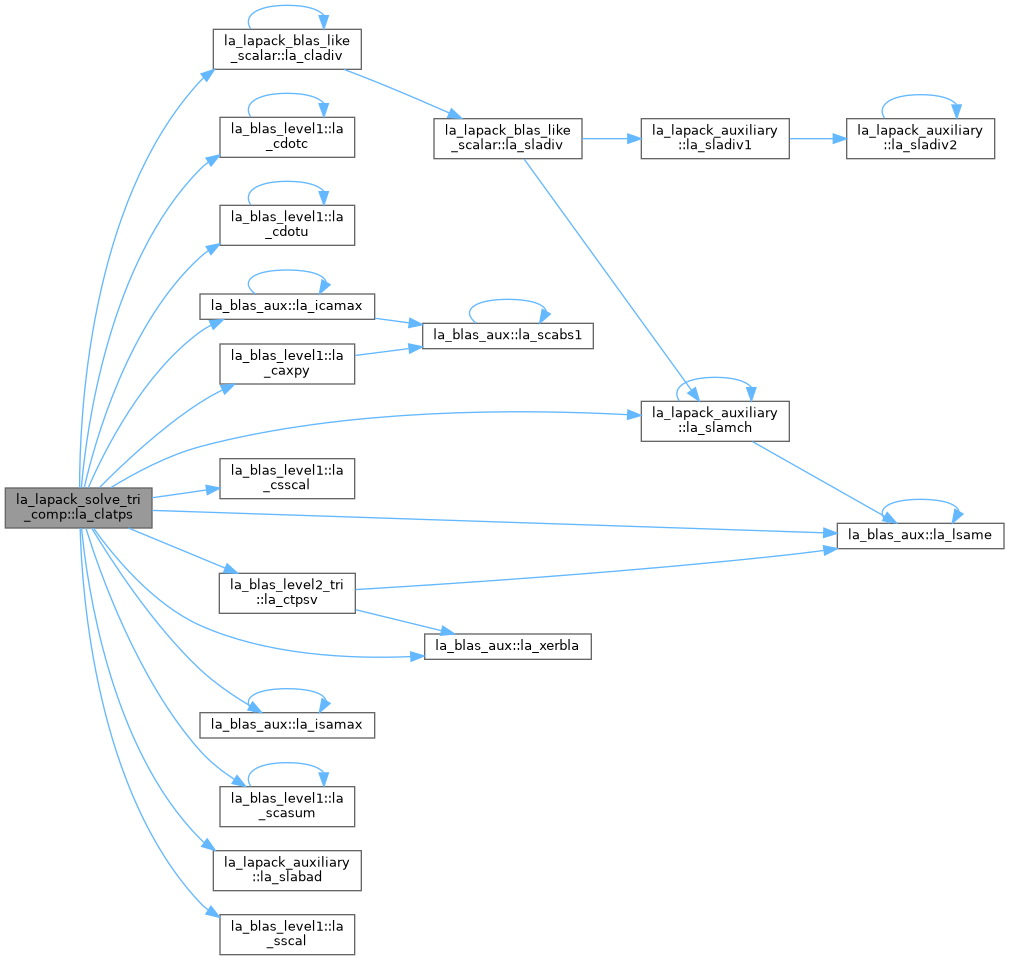
CLATPS: solves one of the triangular systems A * x = s*b, A**T * x = s*b, or A**H * x = s*b, with scaling to prevent overflow, where A is an upper or lower triangular matrix stored in packed form. Here A**T denotes the transpose of A, A**H denotes the conjugate transpose of A, x and b are n-element vectors, and s is a scaling factor, usually less than or equal to 1, chosen so that the components of x will be less than the overflow threshold. If the unscaled problem will not cause overflow, the Level 2 BLAS routine CTPSV is called. If the matrix A is singular (A(j,j) = 0 for some j), then s is set to 0 and a non-trivial solution to A*x = 0 is returned.
◆ la_clatrs()
| pure subroutine, public la_lapack_solve_tri_comp::la_clatrs | ( | character, intent(in) | uplo, |
| character, intent(in) | trans, | ||
| character, intent(in) | diag, | ||
| character, intent(in) | normin, | ||
| integer(ilp), intent(in) | n, | ||
| complex(sp), dimension(lda,*), intent(in) | a, | ||
| integer(ilp), intent(in) | lda, | ||
| complex(sp), dimension(*), intent(inout) | x, | ||
| real(sp), intent(out) | scale, | ||
| real(sp), dimension(*), intent(inout) | cnorm, | ||
| integer(ilp), intent(out) | info ) |
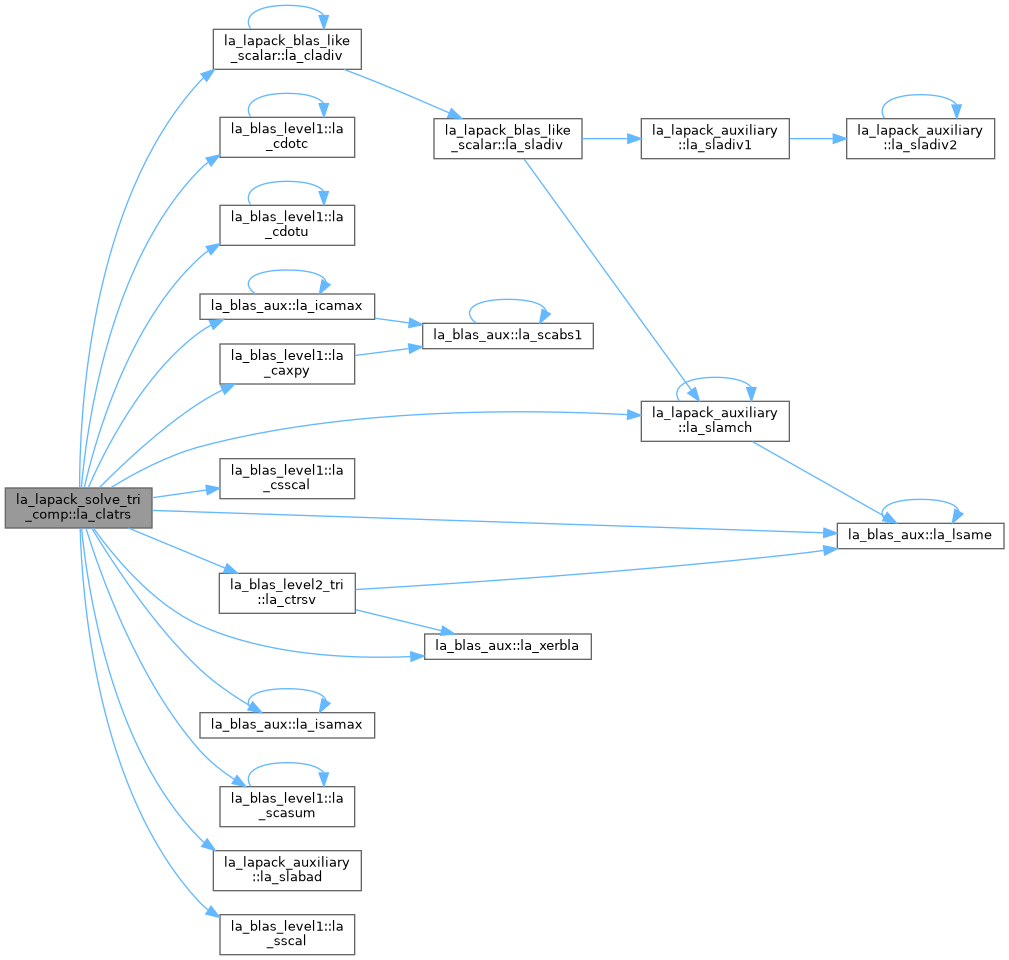
CLATRS: solves one of the triangular systems A * x = s*b, A**T * x = s*b, or A**H * x = s*b, with scaling to prevent overflow. Here A is an upper or lower triangular matrix, A**T denotes the transpose of A, A**H denotes the conjugate transpose of A, x and b are n-element vectors, and s is a scaling factor, usually less than or equal to 1, chosen so that the components of x will be less than the overflow threshold. If the unscaled problem will not cause overflow, the Level 2 BLAS routine CTRSV is called. If the matrix A is singular (A(j,j) = 0 for some j), then s is set to 0 and a non-trivial solution to A*x = 0 is returned.
◆ la_clauu2()
| pure subroutine, public la_lapack_solve_tri_comp::la_clauu2 | ( | character, intent(in) | uplo, |
| integer(ilp), intent(in) | n, | ||
| complex(sp), dimension(lda,*), intent(inout) | a, | ||
| integer(ilp), intent(in) | lda, | ||
| integer(ilp), intent(out) | info ) |
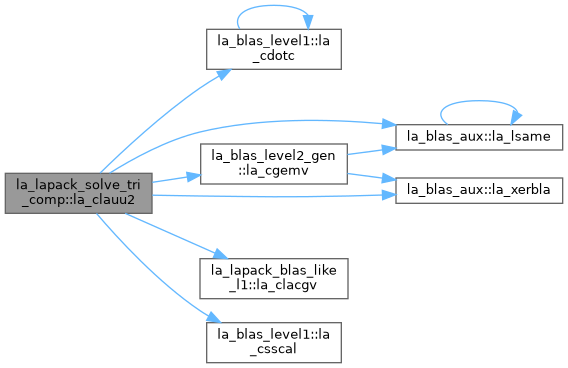
CLAUU2: computes the product U * U**H or L**H * L, where the triangular factor U or L is stored in the upper or lower triangular part of the array A. If UPLO = 'U' or 'u' then the upper triangle of the result is stored, overwriting the factor U in A. If UPLO = 'L' or 'l' then the lower triangle of the result is stored, overwriting the factor L in A. This is the unblocked form of the algorithm, calling Level 2 BLAS.
◆ la_clauum()
| pure subroutine, public la_lapack_solve_tri_comp::la_clauum | ( | character, intent(in) | uplo, |
| integer(ilp), intent(in) | n, | ||
| complex(sp), dimension(lda,*), intent(inout) | a, | ||
| integer(ilp), intent(in) | lda, | ||
| integer(ilp), intent(out) | info ) |
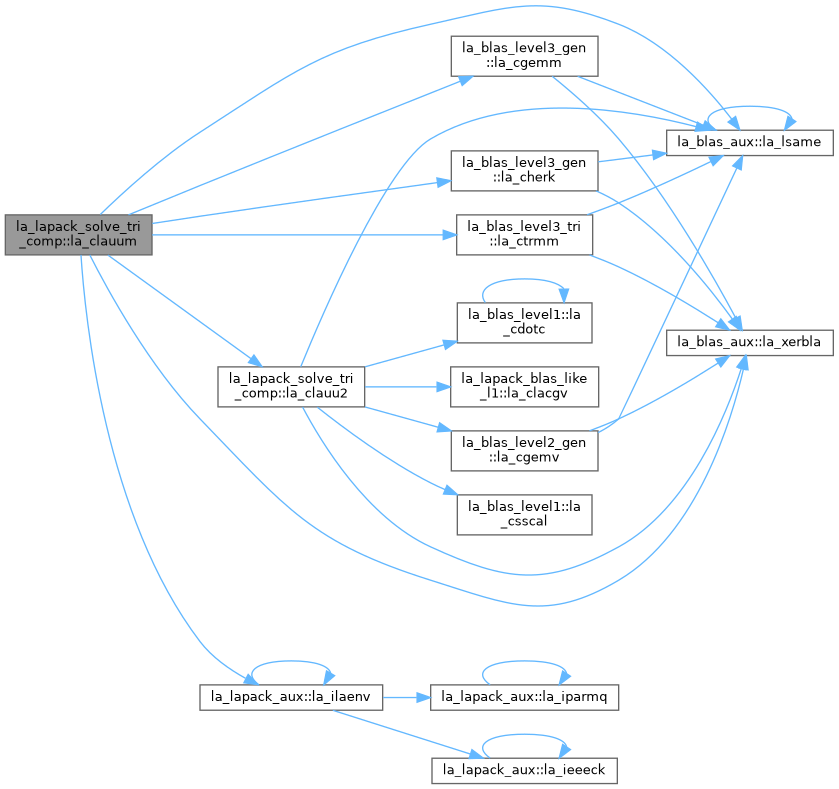
CLAUUM: computes the product U * U**H or L**H * L, where the triangular factor U or L is stored in the upper or lower triangular part of the array A. If UPLO = 'U' or 'u' then the upper triangle of the result is stored, overwriting the factor U in A. If UPLO = 'L' or 'l' then the lower triangle of the result is stored, overwriting the factor L in A. This is the blocked form of the algorithm, calling Level 3 BLAS.
◆ la_ctbcon()
| subroutine, public la_lapack_solve_tri_comp::la_ctbcon | ( | character, intent(in) | norm, |
| character, intent(in) | uplo, | ||
| character, intent(in) | diag, | ||
| integer(ilp), intent(in) | n, | ||
| integer(ilp), intent(in) | kd, | ||
| complex(sp), dimension(ldab,*), intent(in) | ab, | ||
| integer(ilp), intent(in) | ldab, | ||
| real(sp), intent(out) | rcond, | ||
| complex(sp), dimension(*), intent(out) | work, | ||
| real(sp), dimension(*), intent(out) | rwork, | ||
| integer(ilp), intent(out) | info ) |
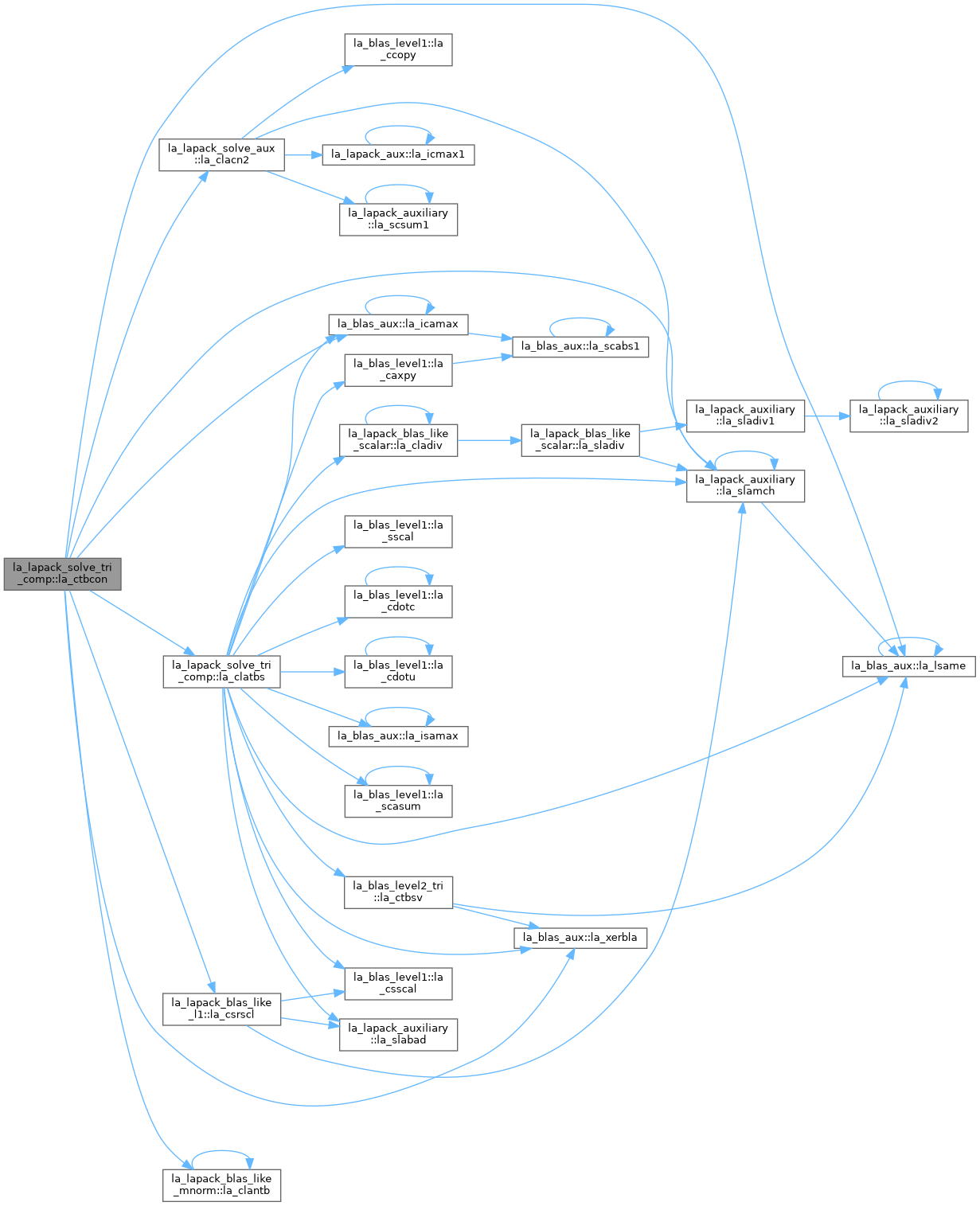
CTBCON: estimates the reciprocal of the condition number of a triangular band matrix A, in either the 1-norm or the infinity-norm. The norm of A is computed and an estimate is obtained for norm(inv(A)), then the reciprocal of the condition number is computed as RCOND = 1 / ( norm(A) * norm(inv(A)) ).
◆ la_ctbrfs()
| pure subroutine, public la_lapack_solve_tri_comp::la_ctbrfs | ( | character, intent(in) | uplo, |
| character, intent(in) | trans, | ||
| character, intent(in) | diag, | ||
| integer(ilp), intent(in) | n, | ||
| integer(ilp), intent(in) | kd, | ||
| integer(ilp), intent(in) | nrhs, | ||
| complex(sp), dimension(ldab,*), intent(in) | ab, | ||
| integer(ilp), intent(in) | ldab, | ||
| complex(sp), dimension(ldb,*), intent(in) | b, | ||
| integer(ilp), intent(in) | ldb, | ||
| complex(sp), dimension(ldx,*), intent(in) | x, | ||
| integer(ilp), intent(in) | ldx, | ||
| real(sp), dimension(*), intent(out) | ferr, | ||
| real(sp), dimension(*), intent(out) | berr, | ||
| complex(sp), dimension(*), intent(out) | work, | ||
| real(sp), dimension(*), intent(out) | rwork, | ||
| integer(ilp), intent(out) | info ) |
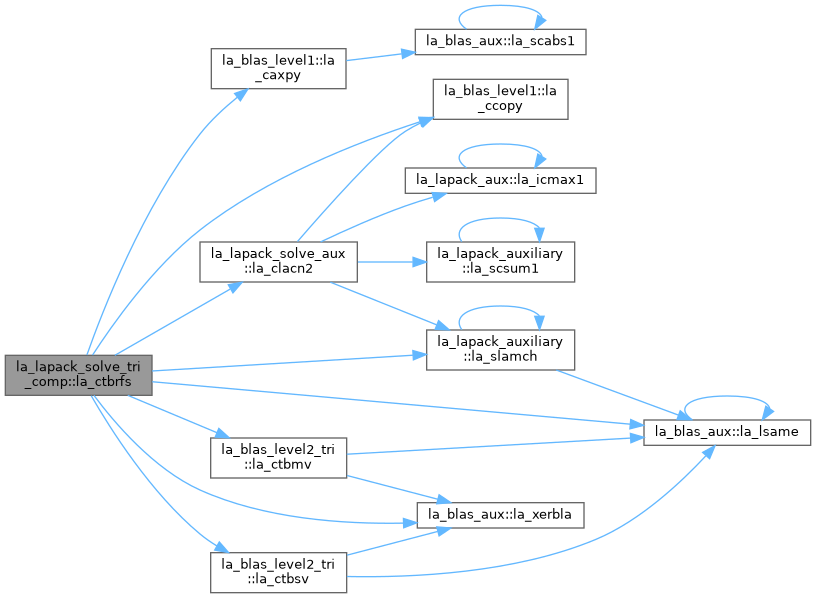
CTBRFS: provides error bounds and backward error estimates for the solution to a system of linear equations with a triangular band coefficient matrix. The solution matrix X must be computed by CTBTRS or some other means before entering this routine. CTBRFS does not do iterative refinement because doing so cannot improve the backward error.
◆ la_ctbtrs()
| pure subroutine, public la_lapack_solve_tri_comp::la_ctbtrs | ( | character, intent(in) | uplo, |
| character, intent(in) | trans, | ||
| character, intent(in) | diag, | ||
| integer(ilp), intent(in) | n, | ||
| integer(ilp), intent(in) | kd, | ||
| integer(ilp), intent(in) | nrhs, | ||
| complex(sp), dimension(ldab,*), intent(in) | ab, | ||
| integer(ilp), intent(in) | ldab, | ||
| complex(sp), dimension(ldb,*), intent(inout) | b, | ||
| integer(ilp), intent(in) | ldb, | ||
| integer(ilp), intent(out) | info ) |
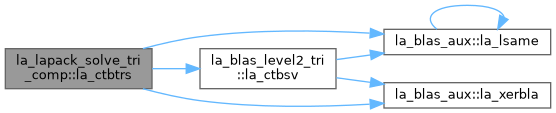
CTBTRS: solves a triangular system of the form A * X = B, A**T * X = B, or A**H * X = B, where A is a triangular band matrix of order N, and B is an N-by-NRHS matrix. A check is made to verify that A is nonsingular.
◆ la_ctftri()
| pure subroutine, public la_lapack_solve_tri_comp::la_ctftri | ( | character, intent(in) | transr, |
| character, intent(in) | uplo, | ||
| character, intent(in) | diag, | ||
| integer(ilp), intent(in) | n, | ||
| complex(sp), dimension(0:*), intent(inout) | a, | ||
| integer(ilp), intent(out) | info ) |
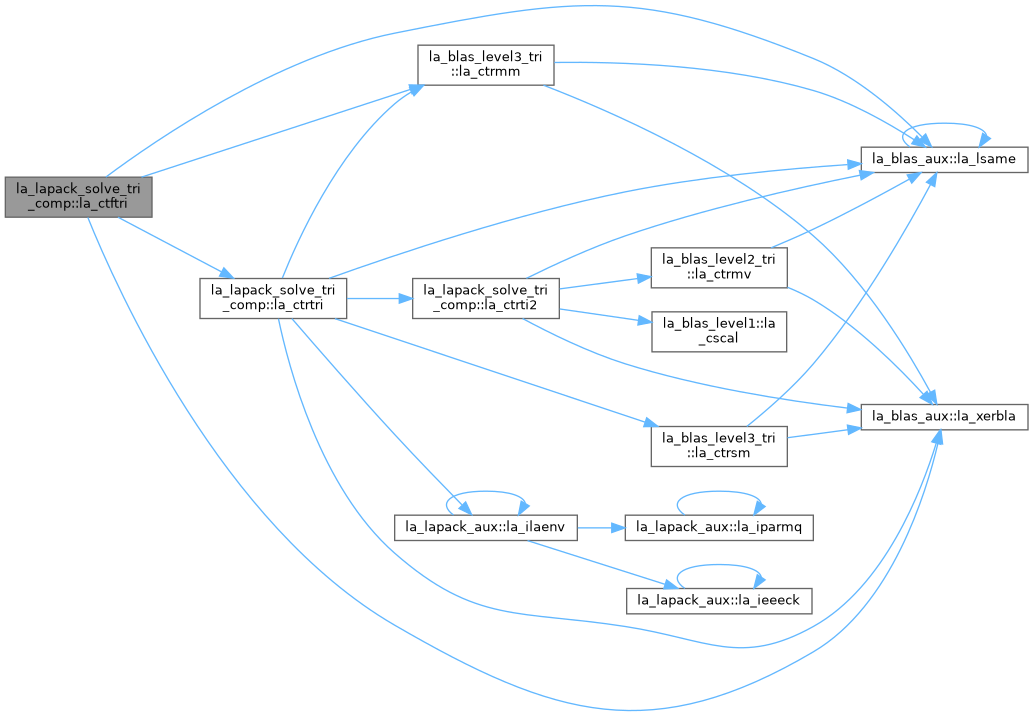
CTFTRI: computes the inverse of a triangular matrix A stored in RFP format. This is a Level 3 BLAS version of the algorithm.
◆ la_ctpcon()
| subroutine, public la_lapack_solve_tri_comp::la_ctpcon | ( | character, intent(in) | norm, |
| character, intent(in) | uplo, | ||
| character, intent(in) | diag, | ||
| integer(ilp), intent(in) | n, | ||
| complex(sp), dimension(*), intent(in) | ap, | ||
| real(sp), intent(out) | rcond, | ||
| complex(sp), dimension(*), intent(out) | work, | ||
| real(sp), dimension(*), intent(out) | rwork, | ||
| integer(ilp), intent(out) | info ) |
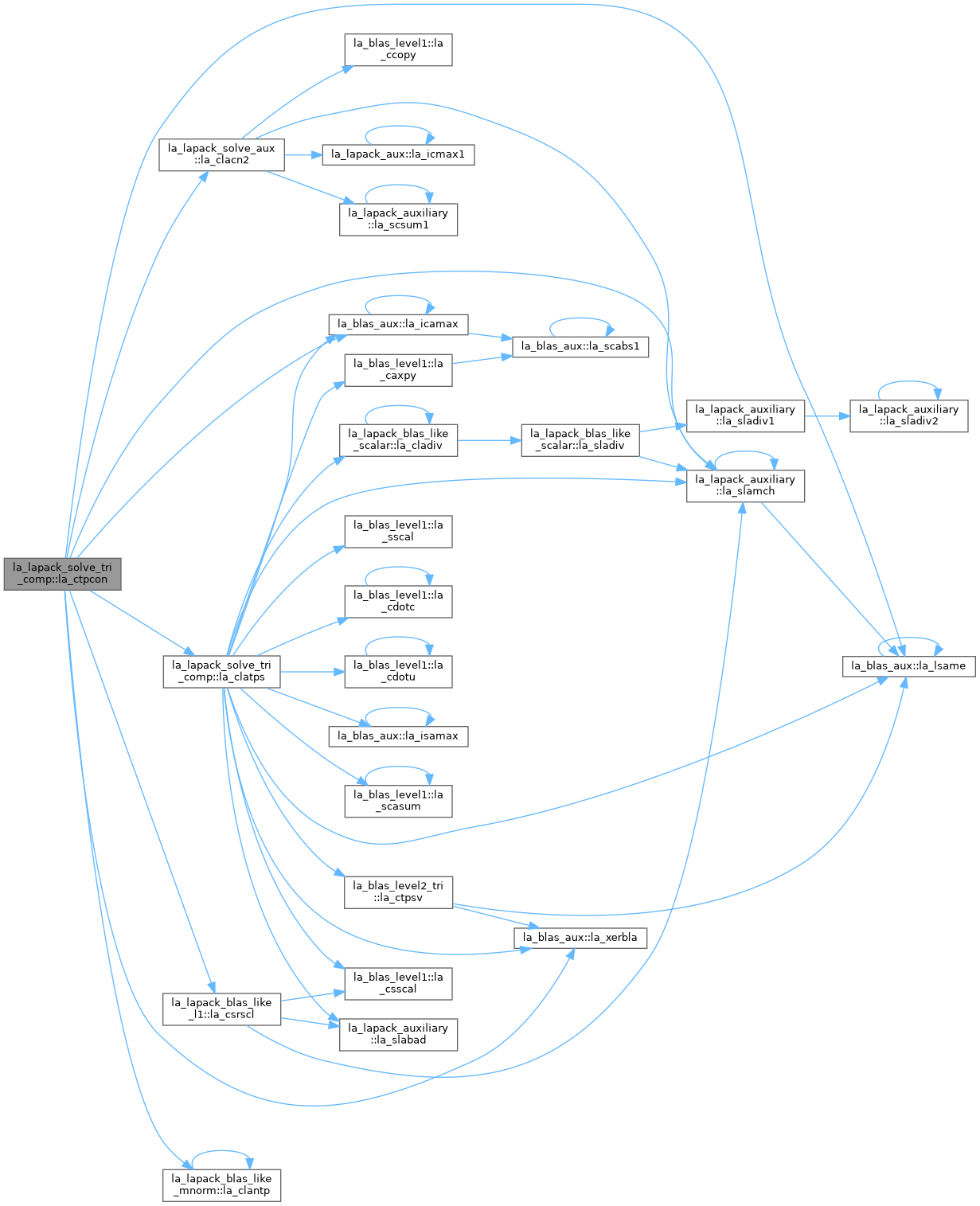
CTPCON: estimates the reciprocal of the condition number of a packed triangular matrix A, in either the 1-norm or the infinity-norm. The norm of A is computed and an estimate is obtained for norm(inv(A)), then the reciprocal of the condition number is computed as RCOND = 1 / ( norm(A) * norm(inv(A)) ).
◆ la_ctprfs()
| pure subroutine, public la_lapack_solve_tri_comp::la_ctprfs | ( | character, intent(in) | uplo, |
| character, intent(in) | trans, | ||
| character, intent(in) | diag, | ||
| integer(ilp), intent(in) | n, | ||
| integer(ilp), intent(in) | nrhs, | ||
| complex(sp), dimension(*), intent(in) | ap, | ||
| complex(sp), dimension(ldb,*), intent(in) | b, | ||
| integer(ilp), intent(in) | ldb, | ||
| complex(sp), dimension(ldx,*), intent(in) | x, | ||
| integer(ilp), intent(in) | ldx, | ||
| real(sp), dimension(*), intent(out) | ferr, | ||
| real(sp), dimension(*), intent(out) | berr, | ||
| complex(sp), dimension(*), intent(out) | work, | ||
| real(sp), dimension(*), intent(out) | rwork, | ||
| integer(ilp), intent(out) | info ) |
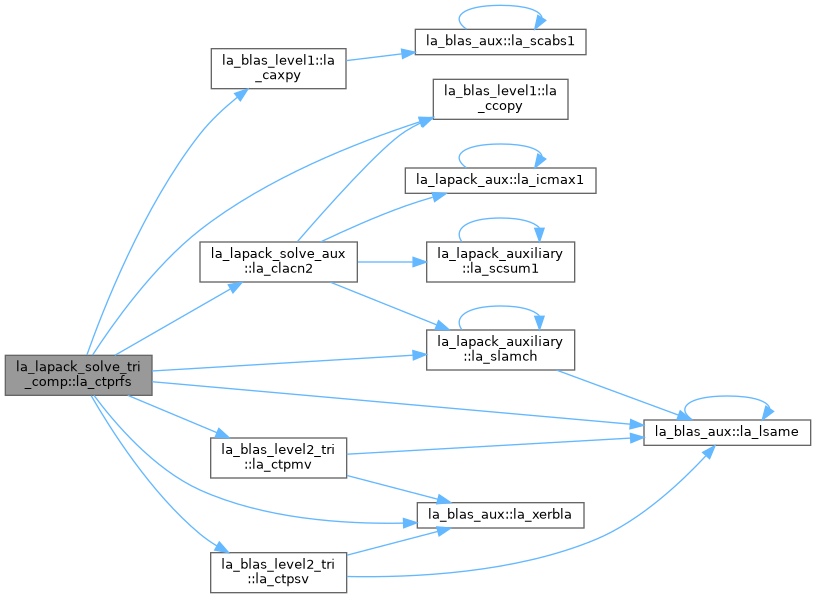
CTPRFS: provides error bounds and backward error estimates for the solution to a system of linear equations with a triangular packed coefficient matrix. The solution matrix X must be computed by CTPTRS or some other means before entering this routine. CTPRFS does not do iterative refinement because doing so cannot improve the backward error.
◆ la_ctptri()
| pure subroutine, public la_lapack_solve_tri_comp::la_ctptri | ( | character, intent(in) | uplo, |
| character, intent(in) | diag, | ||
| integer(ilp), intent(in) | n, | ||
| complex(sp), dimension(*), intent(inout) | ap, | ||
| integer(ilp), intent(out) | info ) |
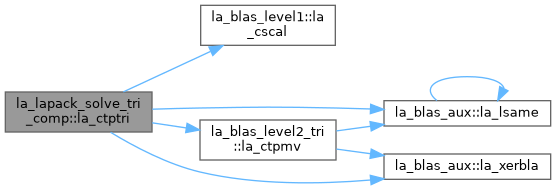
CTPTRI: computes the inverse of a complex upper or lower triangular matrix A stored in packed format.
◆ la_ctptrs()
| pure subroutine, public la_lapack_solve_tri_comp::la_ctptrs | ( | character, intent(in) | uplo, |
| character, intent(in) | trans, | ||
| character, intent(in) | diag, | ||
| integer(ilp), intent(in) | n, | ||
| integer(ilp), intent(in) | nrhs, | ||
| complex(sp), dimension(*), intent(in) | ap, | ||
| complex(sp), dimension(ldb,*), intent(inout) | b, | ||
| integer(ilp), intent(in) | ldb, | ||
| integer(ilp), intent(out) | info ) |
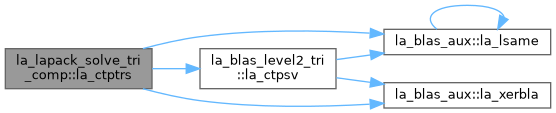
CTPTRS: solves a triangular system of the form A * X = B, A**T * X = B, or A**H * X = B, where A is a triangular matrix of order N stored in packed format, and B is an N-by-NRHS matrix. A check is made to verify that A is nonsingular.
◆ la_ctrcon()
| subroutine, public la_lapack_solve_tri_comp::la_ctrcon | ( | character, intent(in) | norm, |
| character, intent(in) | uplo, | ||
| character, intent(in) | diag, | ||
| integer(ilp), intent(in) | n, | ||
| complex(sp), dimension(lda,*), intent(in) | a, | ||
| integer(ilp), intent(in) | lda, | ||
| real(sp), intent(out) | rcond, | ||
| complex(sp), dimension(*), intent(out) | work, | ||
| real(sp), dimension(*), intent(out) | rwork, | ||
| integer(ilp), intent(out) | info ) |
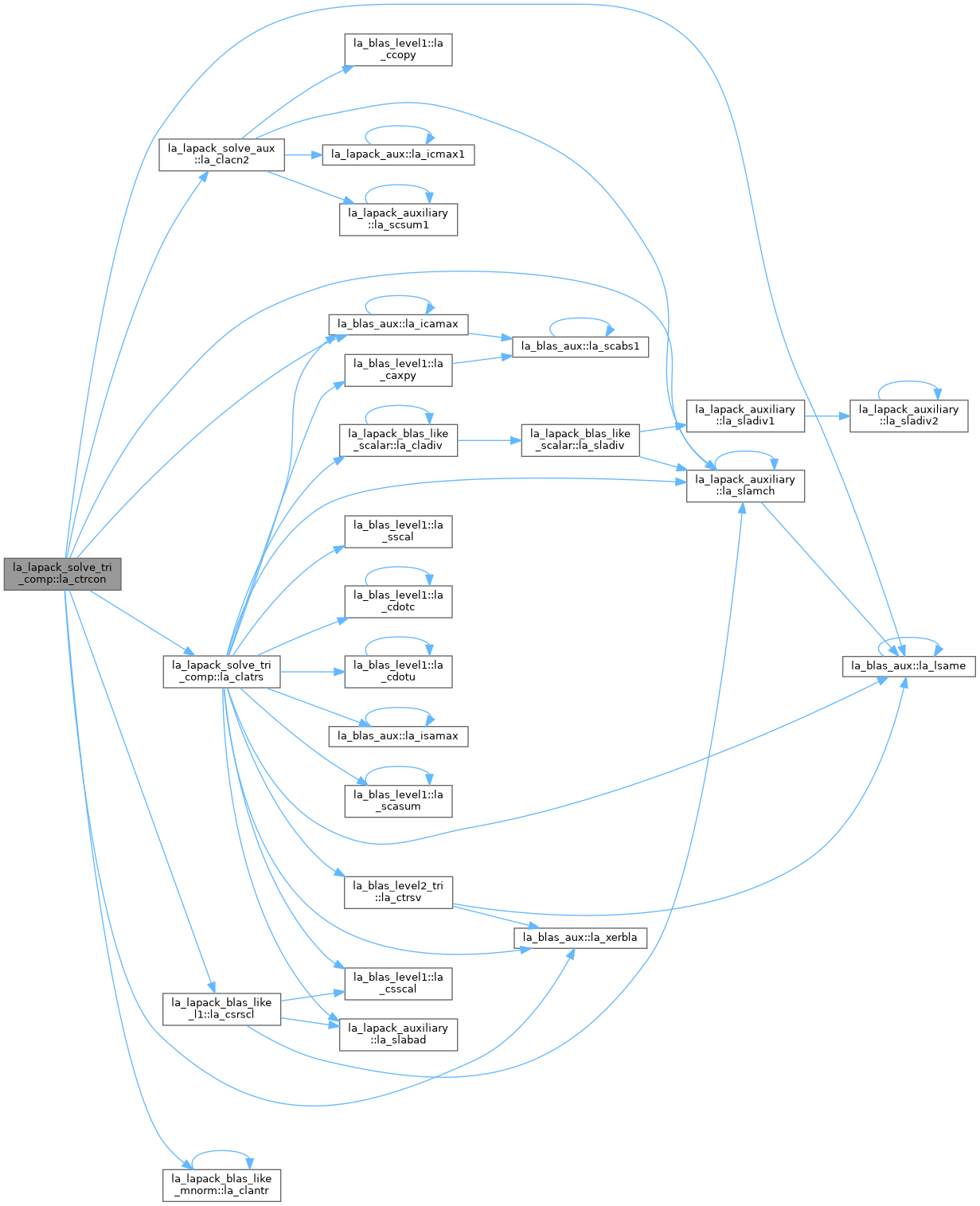
CTRCON: estimates the reciprocal of the condition number of a triangular matrix A, in either the 1-norm or the infinity-norm. The norm of A is computed and an estimate is obtained for norm(inv(A)), then the reciprocal of the condition number is computed as RCOND = 1 / ( norm(A) * norm(inv(A)) ).
◆ la_ctrrfs()
| pure subroutine, public la_lapack_solve_tri_comp::la_ctrrfs | ( | character, intent(in) | uplo, |
| character, intent(in) | trans, | ||
| character, intent(in) | diag, | ||
| integer(ilp), intent(in) | n, | ||
| integer(ilp), intent(in) | nrhs, | ||
| complex(sp), dimension(lda,*), intent(in) | a, | ||
| integer(ilp), intent(in) | lda, | ||
| complex(sp), dimension(ldb,*), intent(in) | b, | ||
| integer(ilp), intent(in) | ldb, | ||
| complex(sp), dimension(ldx,*), intent(in) | x, | ||
| integer(ilp), intent(in) | ldx, | ||
| real(sp), dimension(*), intent(out) | ferr, | ||
| real(sp), dimension(*), intent(out) | berr, | ||
| complex(sp), dimension(*), intent(out) | work, | ||
| real(sp), dimension(*), intent(out) | rwork, | ||
| integer(ilp), intent(out) | info ) |
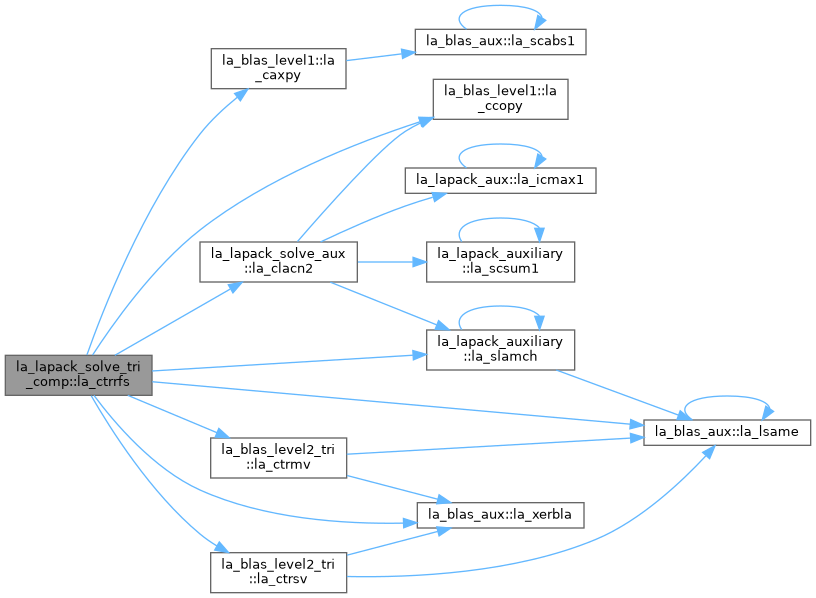
CTRRFS: provides error bounds and backward error estimates for the solution to a system of linear equations with a triangular coefficient matrix. The solution matrix X must be computed by CTRTRS or some other means before entering this routine. CTRRFS does not do iterative refinement because doing so cannot improve the backward error.
◆ la_ctrti2()
| pure subroutine, public la_lapack_solve_tri_comp::la_ctrti2 | ( | character, intent(in) | uplo, |
| character, intent(in) | diag, | ||
| integer(ilp), intent(in) | n, | ||
| complex(sp), dimension(lda,*), intent(inout) | a, | ||
| integer(ilp), intent(in) | lda, | ||
| integer(ilp), intent(out) | info ) |
CTRTI2: computes the inverse of a complex upper or lower triangular matrix. This is the Level 2 BLAS version of the algorithm.
◆ la_ctrtri()
| pure subroutine, public la_lapack_solve_tri_comp::la_ctrtri | ( | character, intent(in) | uplo, |
| character, intent(in) | diag, | ||
| integer(ilp), intent(in) | n, | ||
| complex(sp), dimension(lda,*), intent(inout) | a, | ||
| integer(ilp), intent(in) | lda, | ||
| integer(ilp), intent(out) | info ) |
CTRTRI: computes the inverse of a complex upper or lower triangular matrix A. This is the Level 3 BLAS version of the algorithm.
◆ la_ctrtrs()
| pure subroutine, public la_lapack_solve_tri_comp::la_ctrtrs | ( | character, intent(in) | uplo, |
| character, intent(in) | trans, | ||
| character, intent(in) | diag, | ||
| integer(ilp), intent(in) | n, | ||
| integer(ilp), intent(in) | nrhs, | ||
| complex(sp), dimension(lda,*), intent(in) | a, | ||
| integer(ilp), intent(in) | lda, | ||
| complex(sp), dimension(ldb,*), intent(inout) | b, | ||
| integer(ilp), intent(in) | ldb, | ||
| integer(ilp), intent(out) | info ) |
CTRTRS: solves a triangular system of the form A * X = B, A**T * X = B, or A**H * X = B, where A is a triangular matrix of order N, and B is an N-by-NRHS matrix. A check is made to verify that A is nonsingular.
◆ la_dlatbs()
| pure subroutine, public la_lapack_solve_tri_comp::la_dlatbs | ( | character, intent(in) | uplo, |
| character, intent(in) | trans, | ||
| character, intent(in) | diag, | ||
| character, intent(in) | normin, | ||
| integer(ilp), intent(in) | n, | ||
| integer(ilp), intent(in) | kd, | ||
| real(dp), dimension(ldab,*), intent(in) | ab, | ||
| integer(ilp), intent(in) | ldab, | ||
| real(dp), dimension(*), intent(inout) | x, | ||
| real(dp), intent(out) | scale, | ||
| real(dp), dimension(*), intent(inout) | cnorm, | ||
| integer(ilp), intent(out) | info ) |
DLATBS: solves one of the triangular systems A *x = s*b or A**T*x = s*b with scaling to prevent overflow, where A is an upper or lower triangular band matrix. Here A**T denotes the transpose of A, x and b are n-element vectors, and s is a scaling factor, usually less than or equal to 1, chosen so that the components of x will be less than the overflow threshold. If the unscaled problem will not cause overflow, the Level 2 BLAS routine DTBSV is called. If the matrix A is singular (A(j,j) = 0 for some j), then s is set to 0 and a non-trivial solution to A*x = 0 is returned.
◆ la_dlatps()
| pure subroutine, public la_lapack_solve_tri_comp::la_dlatps | ( | character, intent(in) | uplo, |
| character, intent(in) | trans, | ||
| character, intent(in) | diag, | ||
| character, intent(in) | normin, | ||
| integer(ilp), intent(in) | n, | ||
| real(dp), dimension(*), intent(in) | ap, | ||
| real(dp), dimension(*), intent(inout) | x, | ||
| real(dp), intent(out) | scale, | ||
| real(dp), dimension(*), intent(inout) | cnorm, | ||
| integer(ilp), intent(out) | info ) |
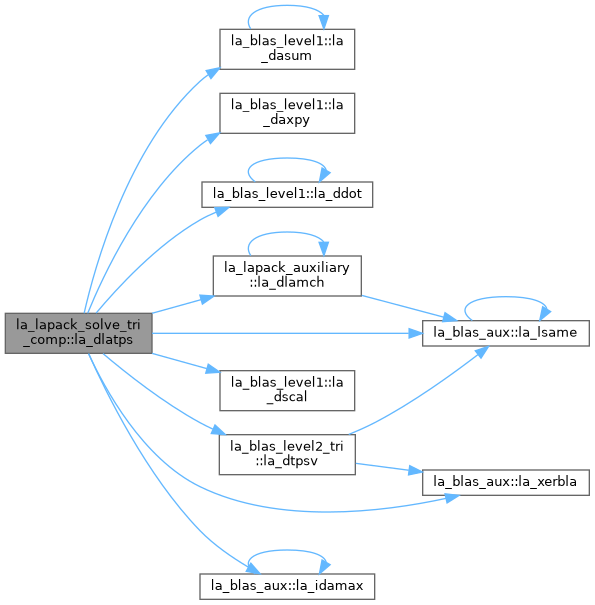
DLATPS: solves one of the triangular systems A *x = s*b or A**T*x = s*b with scaling to prevent overflow, where A is an upper or lower triangular matrix stored in packed form. Here A**T denotes the transpose of A, x and b are n-element vectors, and s is a scaling factor, usually less than or equal to 1, chosen so that the components of x will be less than the overflow threshold. If the unscaled problem will not cause overflow, the Level 2 BLAS routine DTPSV is called. If the matrix A is singular (A(j,j) = 0 for some j), then s is set to 0 and a non-trivial solution to A*x = 0 is returned.
◆ la_dlatrs()
| pure subroutine, public la_lapack_solve_tri_comp::la_dlatrs | ( | character, intent(in) | uplo, |
| character, intent(in) | trans, | ||
| character, intent(in) | diag, | ||
| character, intent(in) | normin, | ||
| integer(ilp), intent(in) | n, | ||
| real(dp), dimension(lda,*), intent(in) | a, | ||
| integer(ilp), intent(in) | lda, | ||
| real(dp), dimension(*), intent(inout) | x, | ||
| real(dp), intent(out) | scale, | ||
| real(dp), dimension(*), intent(inout) | cnorm, | ||
| integer(ilp), intent(out) | info ) |
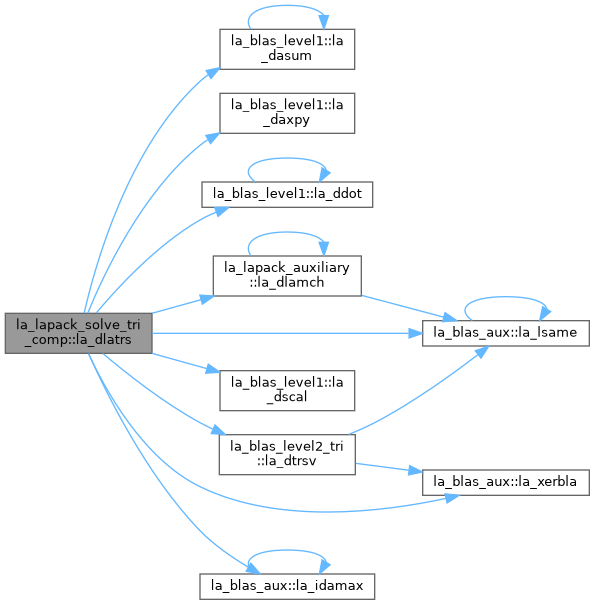
DLATRS: solves one of the triangular systems A *x = s*b or A**T *x = s*b with scaling to prevent overflow. Here A is an upper or lower triangular matrix, A**T denotes the transpose of A, x and b are n-element vectors, and s is a scaling factor, usually less than or equal to 1, chosen so that the components of x will be less than the overflow threshold. If the unscaled problem will not cause overflow, the Level 2 BLAS routine DTRSV is called. If the matrix A is singular (A(j,j) = 0 for some j), then s is set to 0 and a non-trivial solution to A*x = 0 is returned.
◆ la_dlauu2()
| pure subroutine, public la_lapack_solve_tri_comp::la_dlauu2 | ( | character, intent(in) | uplo, |
| integer(ilp), intent(in) | n, | ||
| real(dp), dimension(lda,*), intent(inout) | a, | ||
| integer(ilp), intent(in) | lda, | ||
| integer(ilp), intent(out) | info ) |
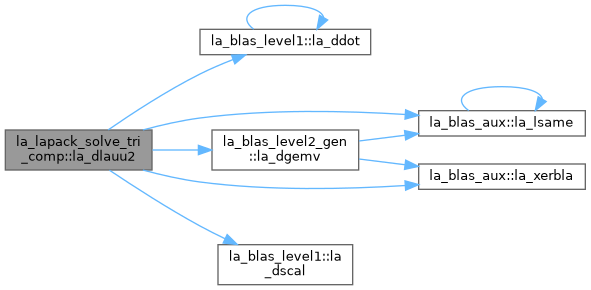
DLAUU2: computes the product U * U**T or L**T * L, where the triangular factor U or L is stored in the upper or lower triangular part of the array A. If UPLO = 'U' or 'u' then the upper triangle of the result is stored, overwriting the factor U in A. If UPLO = 'L' or 'l' then the lower triangle of the result is stored, overwriting the factor L in A. This is the unblocked form of the algorithm, calling Level 2 BLAS.
◆ la_dlauum()
| pure subroutine, public la_lapack_solve_tri_comp::la_dlauum | ( | character, intent(in) | uplo, |
| integer(ilp), intent(in) | n, | ||
| real(dp), dimension(lda,*), intent(inout) | a, | ||
| integer(ilp), intent(in) | lda, | ||
| integer(ilp), intent(out) | info ) |
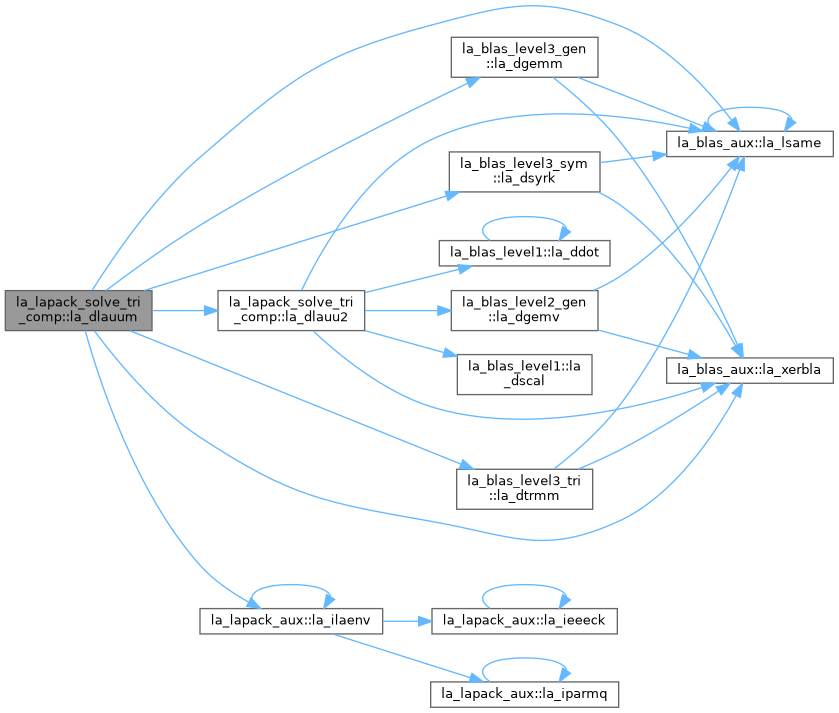
DLAUUM: computes the product U * U**T or L**T * L, where the triangular factor U or L is stored in the upper or lower triangular part of the array A. If UPLO = 'U' or 'u' then the upper triangle of the result is stored, overwriting the factor U in A. If UPLO = 'L' or 'l' then the lower triangle of the result is stored, overwriting the factor L in A. This is the blocked form of the algorithm, calling Level 3 BLAS.
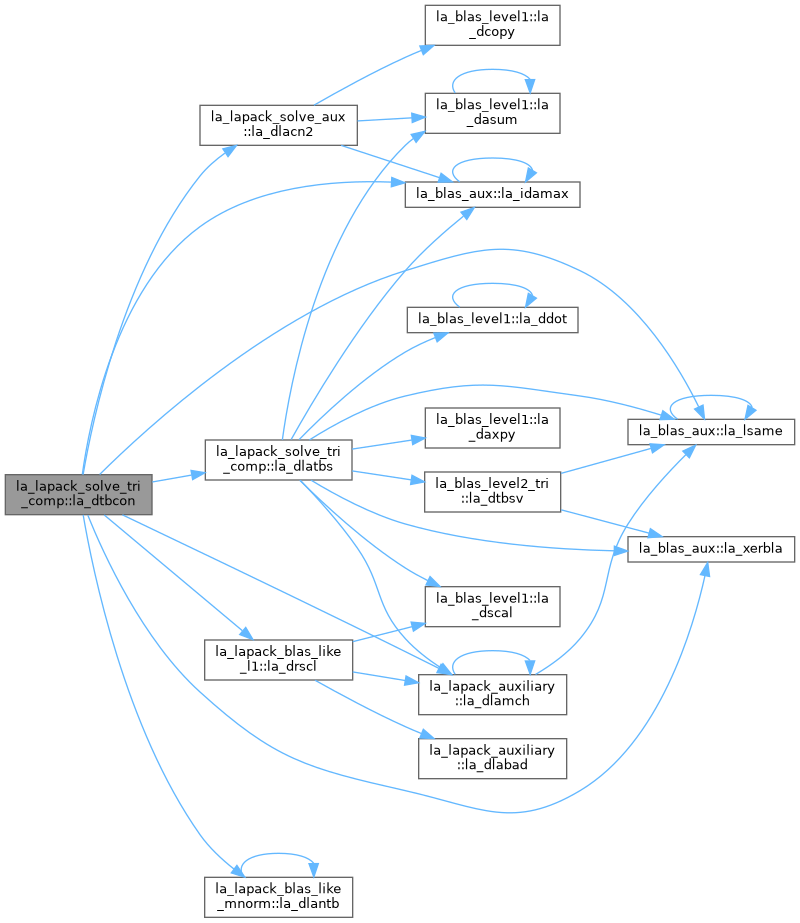
◆ la_dtbcon()
| subroutine, public la_lapack_solve_tri_comp::la_dtbcon | ( | character, intent(in) | norm, |
| character, intent(in) | uplo, | ||
| character, intent(in) | diag, | ||
| integer(ilp), intent(in) | n, | ||
| integer(ilp), intent(in) | kd, | ||
| real(dp), dimension(ldab,*), intent(in) | ab, | ||
| integer(ilp), intent(in) | ldab, | ||
| real(dp), intent(out) | rcond, | ||
| real(dp), dimension(*), intent(out) | work, | ||
| integer(ilp), dimension(*), intent(out) | iwork, | ||
| integer(ilp), intent(out) | info ) |
DTBCON: estimates the reciprocal of the condition number of a triangular band matrix A, in either the 1-norm or the infinity-norm. The norm of A is computed and an estimate is obtained for norm(inv(A)), then the reciprocal of the condition number is computed as RCOND = 1 / ( norm(A) * norm(inv(A)) ).
◆ la_dtbrfs()
| pure subroutine, public la_lapack_solve_tri_comp::la_dtbrfs | ( | character, intent(in) | uplo, |
| character, intent(in) | trans, | ||
| character, intent(in) | diag, | ||
| integer(ilp), intent(in) | n, | ||
| integer(ilp), intent(in) | kd, | ||
| integer(ilp), intent(in) | nrhs, | ||
| real(dp), dimension(ldab,*), intent(in) | ab, | ||
| integer(ilp), intent(in) | ldab, | ||
| real(dp), dimension(ldb,*), intent(in) | b, | ||
| integer(ilp), intent(in) | ldb, | ||
| real(dp), dimension(ldx,*), intent(in) | x, | ||
| integer(ilp), intent(in) | ldx, | ||
| real(dp), dimension(*), intent(out) | ferr, | ||
| real(dp), dimension(*), intent(out) | berr, | ||
| real(dp), dimension(*), intent(out) | work, | ||
| integer(ilp), dimension(*), intent(out) | iwork, | ||
| integer(ilp), intent(out) | info ) |
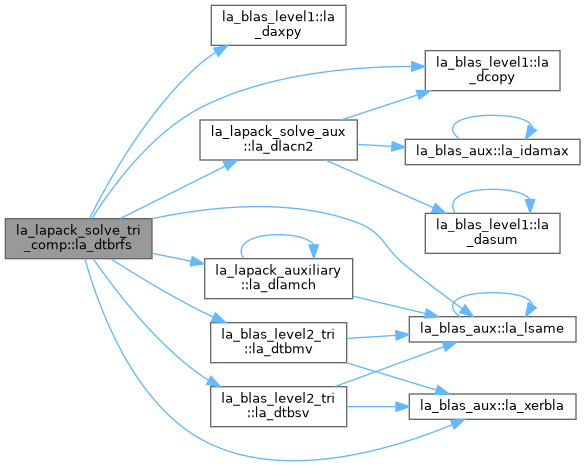
DTBRFS: provides error bounds and backward error estimates for the solution to a system of linear equations with a triangular band coefficient matrix. The solution matrix X must be computed by DTBTRS or some other means before entering this routine. DTBRFS does not do iterative refinement because doing so cannot improve the backward error.
◆ la_dtbtrs()
| pure subroutine, public la_lapack_solve_tri_comp::la_dtbtrs | ( | character, intent(in) | uplo, |
| character, intent(in) | trans, | ||
| character, intent(in) | diag, | ||
| integer(ilp), intent(in) | n, | ||
| integer(ilp), intent(in) | kd, | ||
| integer(ilp), intent(in) | nrhs, | ||
| real(dp), dimension(ldab,*), intent(in) | ab, | ||
| integer(ilp), intent(in) | ldab, | ||
| real(dp), dimension(ldb,*), intent(inout) | b, | ||
| integer(ilp), intent(in) | ldb, | ||
| integer(ilp), intent(out) | info ) |
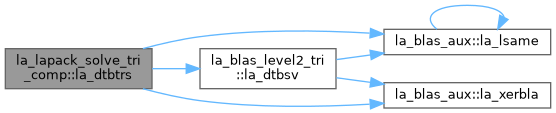
DTBTRS: solves a triangular system of the form A * X = B or A**T * X = B, where A is a triangular band matrix of order N, and B is an N-by NRHS matrix. A check is made to verify that A is nonsingular.
◆ la_dtftri()
| pure subroutine, public la_lapack_solve_tri_comp::la_dtftri | ( | character, intent(in) | transr, |
| character, intent(in) | uplo, | ||
| character, intent(in) | diag, | ||
| integer(ilp), intent(in) | n, | ||
| real(dp), dimension(0:*), intent(inout) | a, | ||
| integer(ilp), intent(out) | info ) |
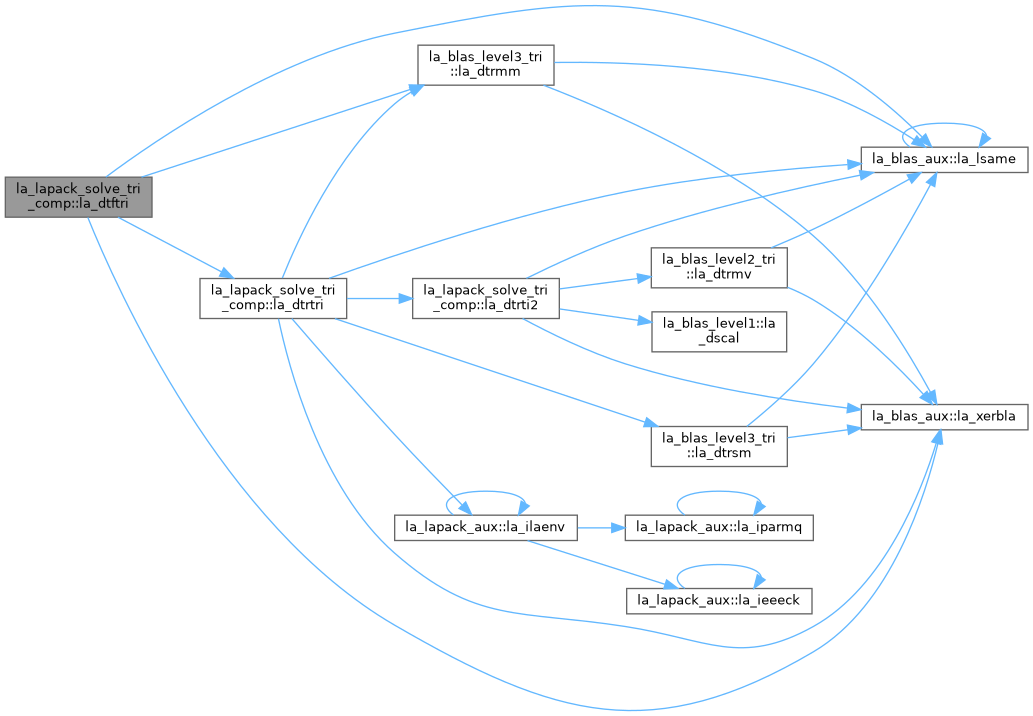
DTFTRI: computes the inverse of a triangular matrix A stored in RFP format. This is a Level 3 BLAS version of the algorithm.
◆ la_dtpcon()
| subroutine, public la_lapack_solve_tri_comp::la_dtpcon | ( | character, intent(in) | norm, |
| character, intent(in) | uplo, | ||
| character, intent(in) | diag, | ||
| integer(ilp), intent(in) | n, | ||
| real(dp), dimension(*), intent(in) | ap, | ||
| real(dp), intent(out) | rcond, | ||
| real(dp), dimension(*), intent(out) | work, | ||
| integer(ilp), dimension(*), intent(out) | iwork, | ||
| integer(ilp), intent(out) | info ) |
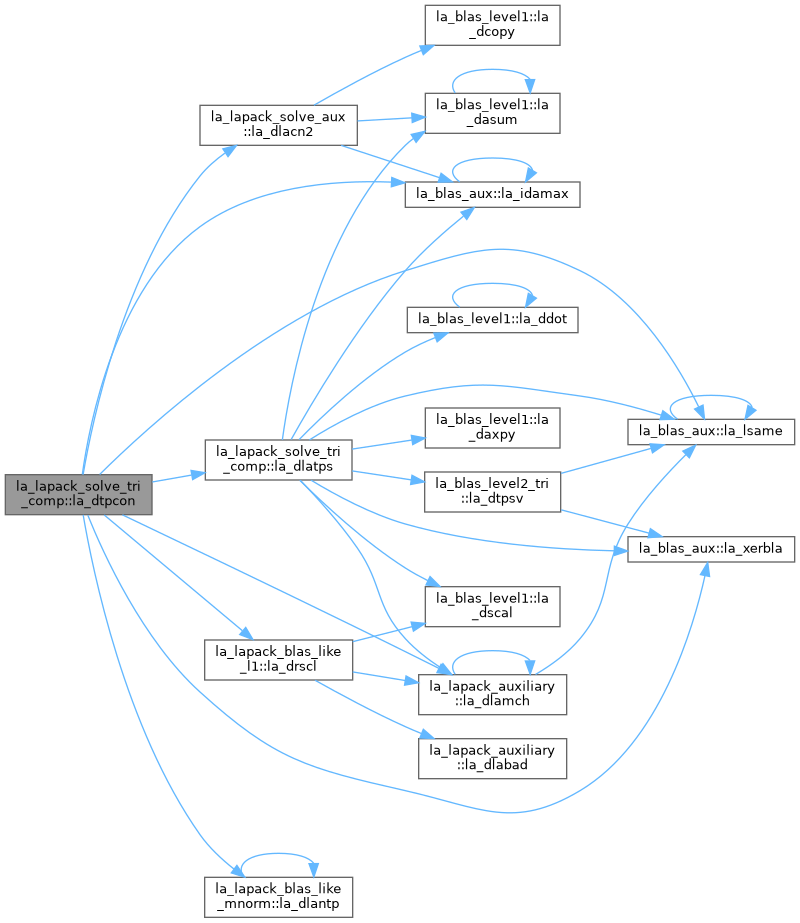
DTPCON: estimates the reciprocal of the condition number of a packed triangular matrix A, in either the 1-norm or the infinity-norm. The norm of A is computed and an estimate is obtained for norm(inv(A)), then the reciprocal of the condition number is computed as RCOND = 1 / ( norm(A) * norm(inv(A)) ).
◆ la_dtprfs()
| pure subroutine, public la_lapack_solve_tri_comp::la_dtprfs | ( | character, intent(in) | uplo, |
| character, intent(in) | trans, | ||
| character, intent(in) | diag, | ||
| integer(ilp), intent(in) | n, | ||
| integer(ilp), intent(in) | nrhs, | ||
| real(dp), dimension(*), intent(in) | ap, | ||
| real(dp), dimension(ldb,*), intent(in) | b, | ||
| integer(ilp), intent(in) | ldb, | ||
| real(dp), dimension(ldx,*), intent(in) | x, | ||
| integer(ilp), intent(in) | ldx, | ||
| real(dp), dimension(*), intent(out) | ferr, | ||
| real(dp), dimension(*), intent(out) | berr, | ||
| real(dp), dimension(*), intent(out) | work, | ||
| integer(ilp), dimension(*), intent(out) | iwork, | ||
| integer(ilp), intent(out) | info ) |
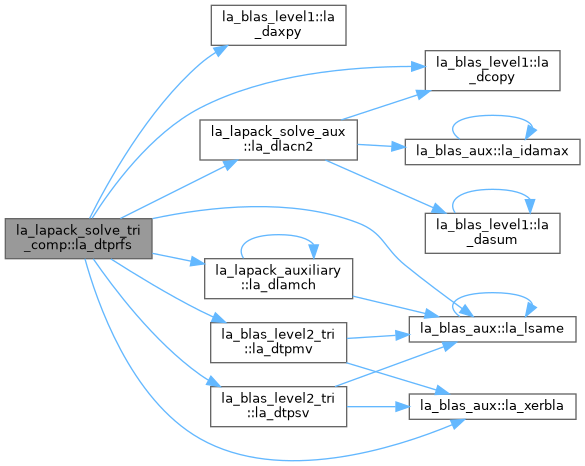
DTPRFS: provides error bounds and backward error estimates for the solution to a system of linear equations with a triangular packed coefficient matrix. The solution matrix X must be computed by DTPTRS or some other means before entering this routine. DTPRFS does not do iterative refinement because doing so cannot improve the backward error.
◆ la_dtptri()
| pure subroutine, public la_lapack_solve_tri_comp::la_dtptri | ( | character, intent(in) | uplo, |
| character, intent(in) | diag, | ||
| integer(ilp), intent(in) | n, | ||
| real(dp), dimension(*), intent(inout) | ap, | ||
| integer(ilp), intent(out) | info ) |
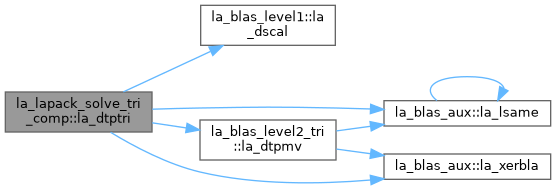
DTPTRI: computes the inverse of a real upper or lower triangular matrix A stored in packed format.
◆ la_dtptrs()
| pure subroutine, public la_lapack_solve_tri_comp::la_dtptrs | ( | character, intent(in) | uplo, |
| character, intent(in) | trans, | ||
| character, intent(in) | diag, | ||
| integer(ilp), intent(in) | n, | ||
| integer(ilp), intent(in) | nrhs, | ||
| real(dp), dimension(*), intent(in) | ap, | ||
| real(dp), dimension(ldb,*), intent(inout) | b, | ||
| integer(ilp), intent(in) | ldb, | ||
| integer(ilp), intent(out) | info ) |
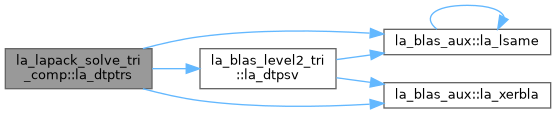
DTPTRS: solves a triangular system of the form A * X = B or A**T * X = B, where A is a triangular matrix of order N stored in packed format, and B is an N-by-NRHS matrix. A check is made to verify that A is nonsingular.
◆ la_dtrcon()
| subroutine, public la_lapack_solve_tri_comp::la_dtrcon | ( | character, intent(in) | norm, |
| character, intent(in) | uplo, | ||
| character, intent(in) | diag, | ||
| integer(ilp), intent(in) | n, | ||
| real(dp), dimension(lda,*), intent(in) | a, | ||
| integer(ilp), intent(in) | lda, | ||
| real(dp), intent(out) | rcond, | ||
| real(dp), dimension(*), intent(out) | work, | ||
| integer(ilp), dimension(*), intent(out) | iwork, | ||
| integer(ilp), intent(out) | info ) |
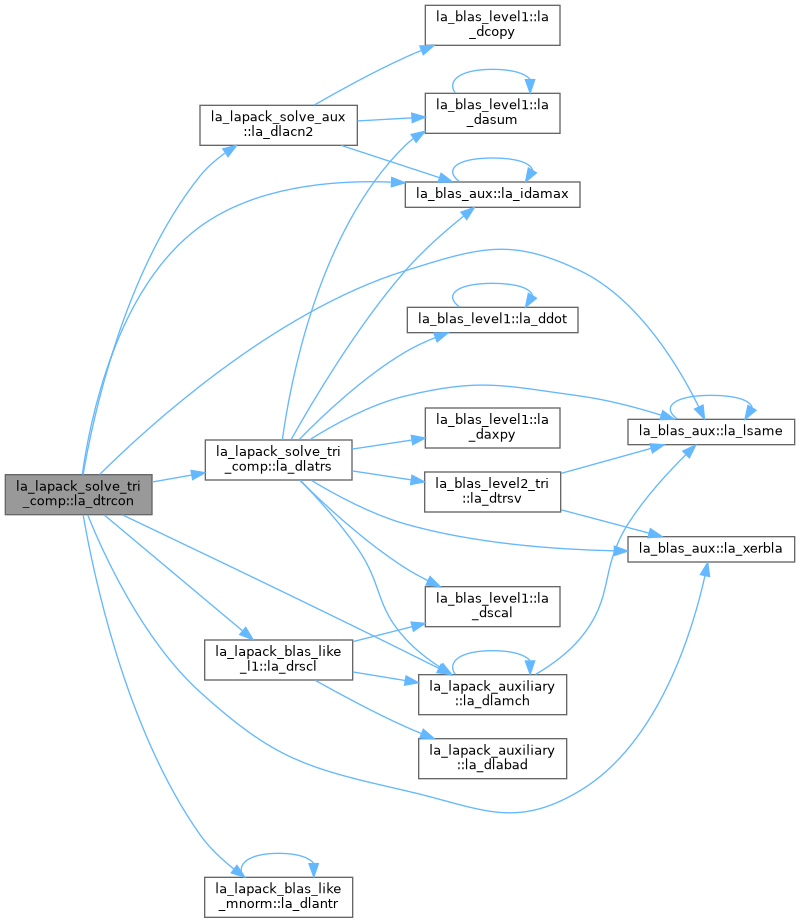
DTRCON: estimates the reciprocal of the condition number of a triangular matrix A, in either the 1-norm or the infinity-norm. The norm of A is computed and an estimate is obtained for norm(inv(A)), then the reciprocal of the condition number is computed as RCOND = 1 / ( norm(A) * norm(inv(A)) ).
◆ la_dtrrfs()
| pure subroutine, public la_lapack_solve_tri_comp::la_dtrrfs | ( | character, intent(in) | uplo, |
| character, intent(in) | trans, | ||
| character, intent(in) | diag, | ||
| integer(ilp), intent(in) | n, | ||
| integer(ilp), intent(in) | nrhs, | ||
| real(dp), dimension(lda,*), intent(in) | a, | ||
| integer(ilp), intent(in) | lda, | ||
| real(dp), dimension(ldb,*), intent(in) | b, | ||
| integer(ilp), intent(in) | ldb, | ||
| real(dp), dimension(ldx,*), intent(in) | x, | ||
| integer(ilp), intent(in) | ldx, | ||
| real(dp), dimension(*), intent(out) | ferr, | ||
| real(dp), dimension(*), intent(out) | berr, | ||
| real(dp), dimension(*), intent(out) | work, | ||
| integer(ilp), dimension(*), intent(out) | iwork, | ||
| integer(ilp), intent(out) | info ) |
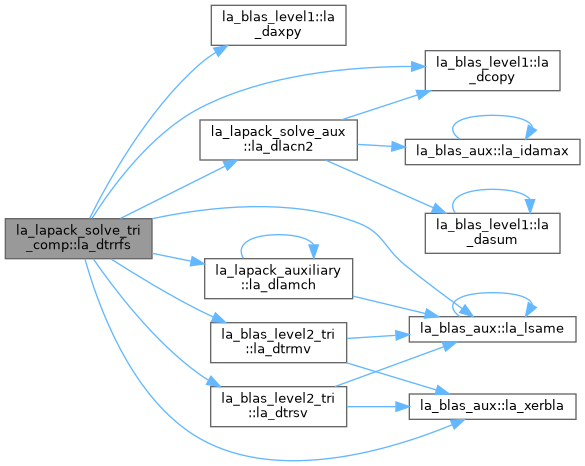
DTRRFS: provides error bounds and backward error estimates for the solution to a system of linear equations with a triangular coefficient matrix. The solution matrix X must be computed by DTRTRS or some other means before entering this routine. DTRRFS does not do iterative refinement because doing so cannot improve the backward error.
◆ la_dtrti2()
| pure subroutine, public la_lapack_solve_tri_comp::la_dtrti2 | ( | character, intent(in) | uplo, |
| character, intent(in) | diag, | ||
| integer(ilp), intent(in) | n, | ||
| real(dp), dimension(lda,*), intent(inout) | a, | ||
| integer(ilp), intent(in) | lda, | ||
| integer(ilp), intent(out) | info ) |
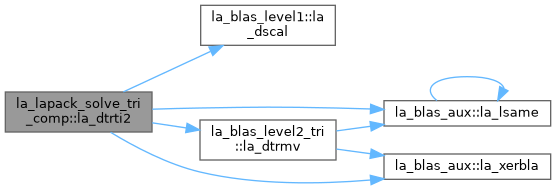
DTRTI2: computes the inverse of a real upper or lower triangular matrix. This is the Level 2 BLAS version of the algorithm.
◆ la_dtrtri()
| pure subroutine, public la_lapack_solve_tri_comp::la_dtrtri | ( | character, intent(in) | uplo, |
| character, intent(in) | diag, | ||
| integer(ilp), intent(in) | n, | ||
| real(dp), dimension(lda,*), intent(inout) | a, | ||
| integer(ilp), intent(in) | lda, | ||
| integer(ilp), intent(out) | info ) |
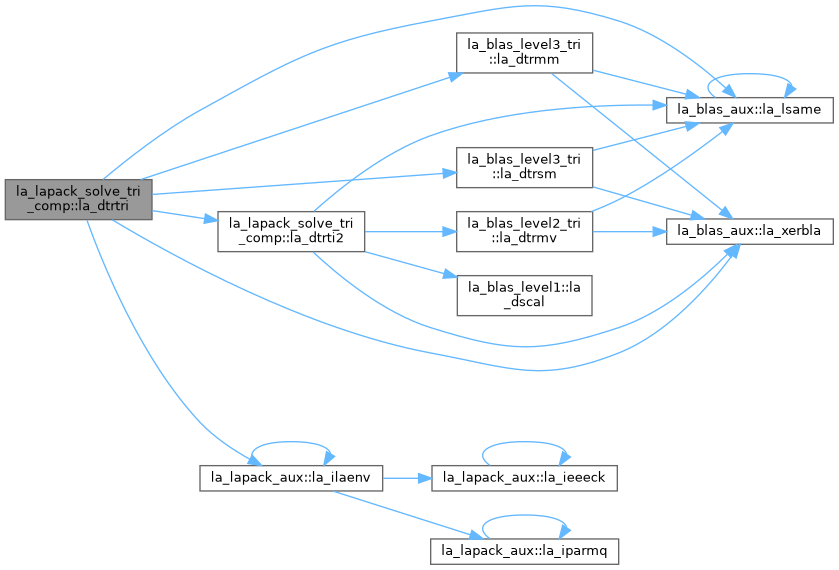
DTRTRI: computes the inverse of a real upper or lower triangular matrix A. This is the Level 3 BLAS version of the algorithm.
◆ la_dtrtrs()
| pure subroutine, public la_lapack_solve_tri_comp::la_dtrtrs | ( | character, intent(in) | uplo, |
| character, intent(in) | trans, | ||
| character, intent(in) | diag, | ||
| integer(ilp), intent(in) | n, | ||
| integer(ilp), intent(in) | nrhs, | ||
| real(dp), dimension(lda,*), intent(in) | a, | ||
| integer(ilp), intent(in) | lda, | ||
| real(dp), dimension(ldb,*), intent(inout) | b, | ||
| integer(ilp), intent(in) | ldb, | ||
| integer(ilp), intent(out) | info ) |
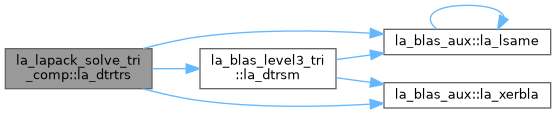
DTRTRS: solves a triangular system of the form A * X = B or A**T * X = B, where A is a triangular matrix of order N, and B is an N-by-NRHS matrix. A check is made to verify that A is nonsingular.
◆ la_qlatbs()
| pure subroutine, public la_lapack_solve_tri_comp::la_qlatbs | ( | character, intent(in) | uplo, |
| character, intent(in) | trans, | ||
| character, intent(in) | diag, | ||
| character, intent(in) | normin, | ||
| integer(ilp), intent(in) | n, | ||
| integer(ilp), intent(in) | kd, | ||
| real(qp), dimension(ldab,*), intent(in) | ab, | ||
| integer(ilp), intent(in) | ldab, | ||
| real(qp), dimension(*), intent(inout) | x, | ||
| real(qp), intent(out) | scale, | ||
| real(qp), dimension(*), intent(inout) | cnorm, | ||
| integer(ilp), intent(out) | info ) |
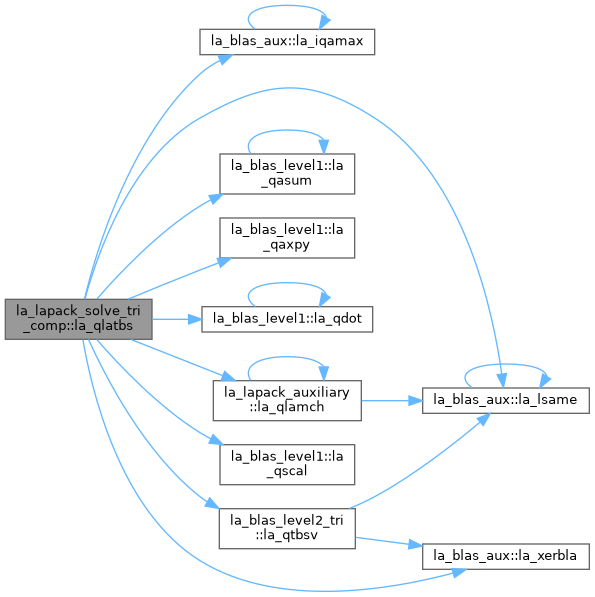
QLATBS: solves one of the triangular systems A *x = s*b or A**T*x = s*b with scaling to prevent overflow, where A is an upper or lower triangular band matrix. Here A**T denotes the transpose of A, x and b are n-element vectors, and s is a scaling factor, usually less than or equal to 1, chosen so that the components of x will be less than the overflow threshold. If the unscaled problem will not cause overflow, the Level 2 BLAS routine QTBSV is called. If the matrix A is singular (A(j,j) = 0 for some j), then s is set to 0 and a non-trivial solution to A*x = 0 is returned.
◆ la_qlatps()
| pure subroutine, public la_lapack_solve_tri_comp::la_qlatps | ( | character, intent(in) | uplo, |
| character, intent(in) | trans, | ||
| character, intent(in) | diag, | ||
| character, intent(in) | normin, | ||
| integer(ilp), intent(in) | n, | ||
| real(qp), dimension(*), intent(in) | ap, | ||
| real(qp), dimension(*), intent(inout) | x, | ||
| real(qp), intent(out) | scale, | ||
| real(qp), dimension(*), intent(inout) | cnorm, | ||
| integer(ilp), intent(out) | info ) |
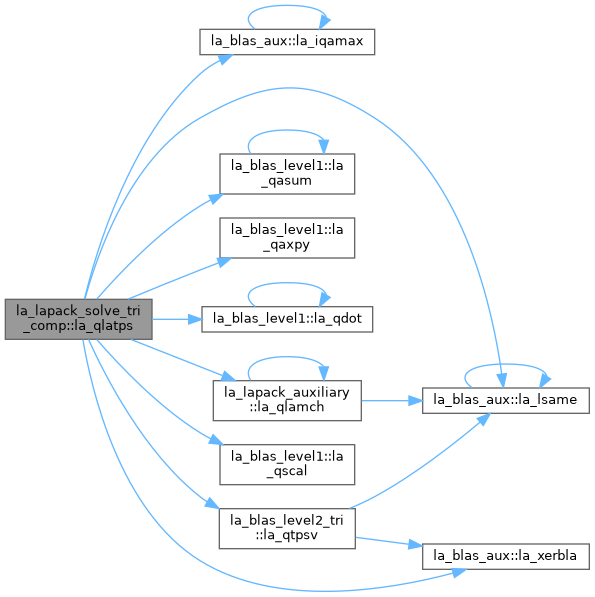
QLATPS: solves one of the triangular systems A *x = s*b or A**T*x = s*b with scaling to prevent overflow, where A is an upper or lower triangular matrix stored in packed form. Here A**T denotes the transpose of A, x and b are n-element vectors, and s is a scaling factor, usually less than or equal to 1, chosen so that the components of x will be less than the overflow threshold. If the unscaled problem will not cause overflow, the Level 2 BLAS routine QTPSV is called. If the matrix A is singular (A(j,j) = 0 for some j), then s is set to 0 and a non-trivial solution to A*x = 0 is returned.
◆ la_qlatrs()
| pure subroutine, public la_lapack_solve_tri_comp::la_qlatrs | ( | character, intent(in) | uplo, |
| character, intent(in) | trans, | ||
| character, intent(in) | diag, | ||
| character, intent(in) | normin, | ||
| integer(ilp), intent(in) | n, | ||
| real(qp), dimension(lda,*), intent(in) | a, | ||
| integer(ilp), intent(in) | lda, | ||
| real(qp), dimension(*), intent(inout) | x, | ||
| real(qp), intent(out) | scale, | ||
| real(qp), dimension(*), intent(inout) | cnorm, | ||
| integer(ilp), intent(out) | info ) |
QLATRS: solves one of the triangular systems A *x = s*b or A**T *x = s*b with scaling to prevent overflow. Here A is an upper or lower triangular matrix, A**T denotes the transpose of A, x and b are n-element vectors, and s is a scaling factor, usually less than or equal to 1, chosen so that the components of x will be less than the overflow threshold. If the unscaled problem will not cause overflow, the Level 2 BLAS routine QTRSV is called. If the matrix A is singular (A(j,j) = 0 for some j), then s is set to 0 and a non-trivial solution to A*x = 0 is returned.
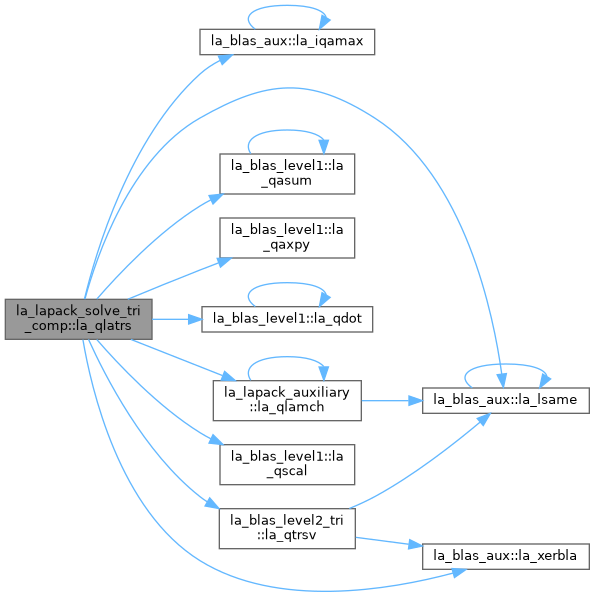
◆ la_qlauu2()
| pure subroutine, public la_lapack_solve_tri_comp::la_qlauu2 | ( | character, intent(in) | uplo, |
| integer(ilp), intent(in) | n, | ||
| real(qp), dimension(lda,*), intent(inout) | a, | ||
| integer(ilp), intent(in) | lda, | ||
| integer(ilp), intent(out) | info ) |
QLAUU2: computes the product U * U**T or L**T * L, where the triangular factor U or L is stored in the upper or lower triangular part of the array A. If UPLO = 'U' or 'u' then the upper triangle of the result is stored, overwriting the factor U in A. If UPLO = 'L' or 'l' then the lower triangle of the result is stored, overwriting the factor L in A. This is the unblocked form of the algorithm, calling Level 2 BLAS.
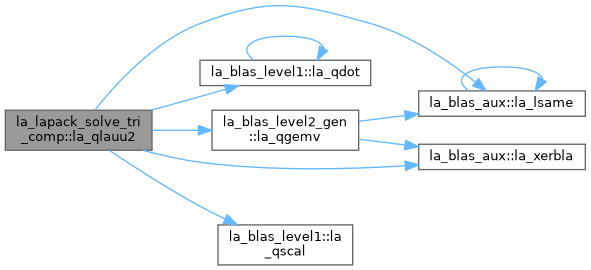
◆ la_qlauum()
| pure subroutine, public la_lapack_solve_tri_comp::la_qlauum | ( | character, intent(in) | uplo, |
| integer(ilp), intent(in) | n, | ||
| real(qp), dimension(lda,*), intent(inout) | a, | ||
| integer(ilp), intent(in) | lda, | ||
| integer(ilp), intent(out) | info ) |
QLAUUM: computes the product U * U**T or L**T * L, where the triangular factor U or L is stored in the upper or lower triangular part of the array A. If UPLO = 'U' or 'u' then the upper triangle of the result is stored, overwriting the factor U in A. If UPLO = 'L' or 'l' then the lower triangle of the result is stored, overwriting the factor L in A. This is the blocked form of the algorithm, calling Level 3 BLAS.
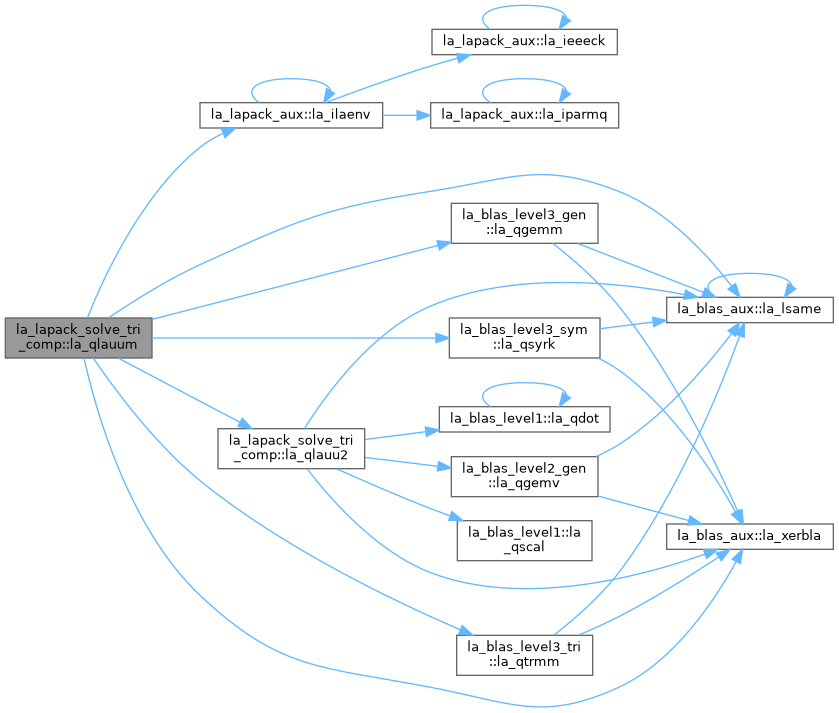
◆ la_qtbcon()
| subroutine, public la_lapack_solve_tri_comp::la_qtbcon | ( | character, intent(in) | norm, |
| character, intent(in) | uplo, | ||
| character, intent(in) | diag, | ||
| integer(ilp), intent(in) | n, | ||
| integer(ilp), intent(in) | kd, | ||
| real(qp), dimension(ldab,*), intent(in) | ab, | ||
| integer(ilp), intent(in) | ldab, | ||
| real(qp), intent(out) | rcond, | ||
| real(qp), dimension(*), intent(out) | work, | ||
| integer(ilp), dimension(*), intent(out) | iwork, | ||
| integer(ilp), intent(out) | info ) |
QTBCON: estimates the reciprocal of the condition number of a triangular band matrix A, in either the 1-norm or the infinity-norm. The norm of A is computed and an estimate is obtained for norm(inv(A)), then the reciprocal of the condition number is computed as RCOND = 1 / ( norm(A) * norm(inv(A)) ).
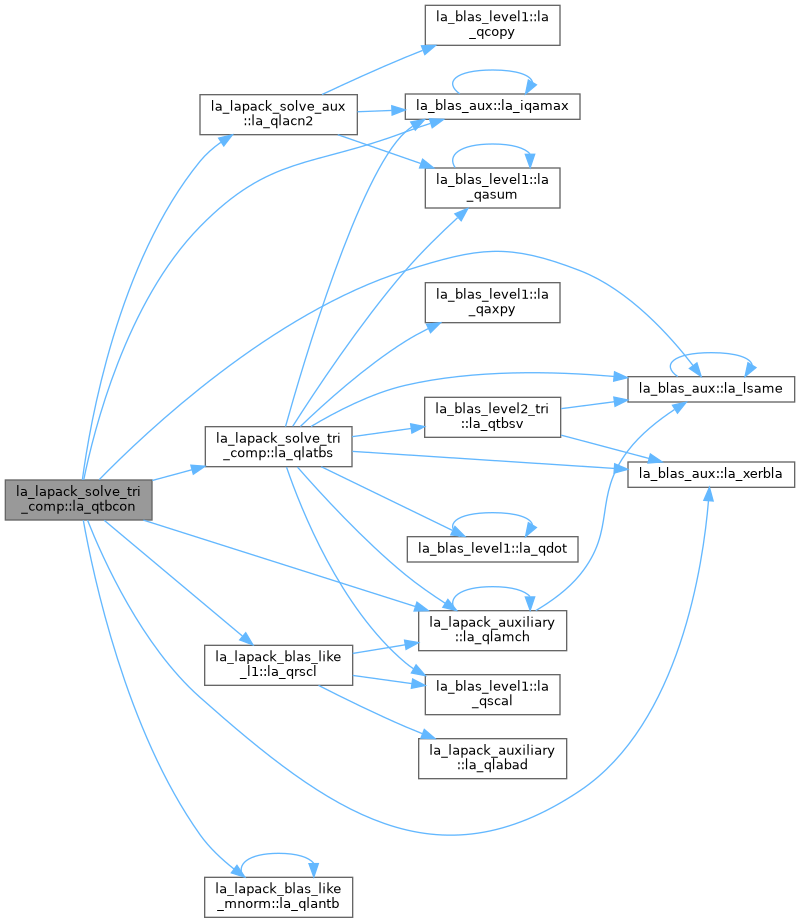
◆ la_qtbrfs()
| pure subroutine, public la_lapack_solve_tri_comp::la_qtbrfs | ( | character, intent(in) | uplo, |
| character, intent(in) | trans, | ||
| character, intent(in) | diag, | ||
| integer(ilp), intent(in) | n, | ||
| integer(ilp), intent(in) | kd, | ||
| integer(ilp), intent(in) | nrhs, | ||
| real(qp), dimension(ldab,*), intent(in) | ab, | ||
| integer(ilp), intent(in) | ldab, | ||
| real(qp), dimension(ldb,*), intent(in) | b, | ||
| integer(ilp), intent(in) | ldb, | ||
| real(qp), dimension(ldx,*), intent(in) | x, | ||
| integer(ilp), intent(in) | ldx, | ||
| real(qp), dimension(*), intent(out) | ferr, | ||
| real(qp), dimension(*), intent(out) | berr, | ||
| real(qp), dimension(*), intent(out) | work, | ||
| integer(ilp), dimension(*), intent(out) | iwork, | ||
| integer(ilp), intent(out) | info ) |
QTBRFS: provides error bounds and backward error estimates for the solution to a system of linear equations with a triangular band coefficient matrix. The solution matrix X must be computed by QTBTRS or some other means before entering this routine. QTBRFS does not do iterative refinement because doing so cannot improve the backward error.
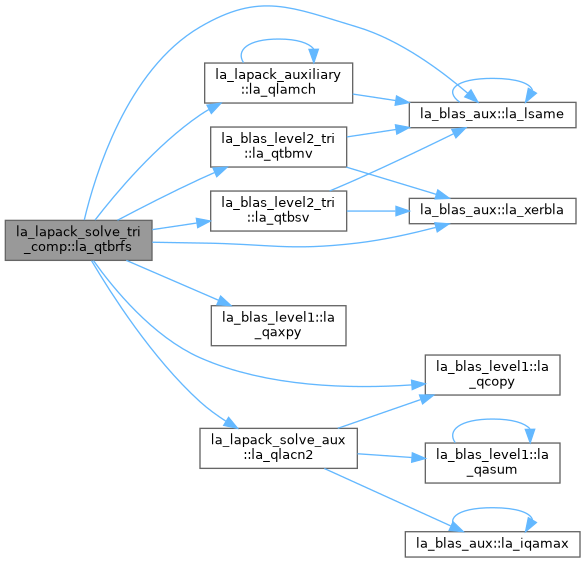
◆ la_qtbtrs()
| pure subroutine, public la_lapack_solve_tri_comp::la_qtbtrs | ( | character, intent(in) | uplo, |
| character, intent(in) | trans, | ||
| character, intent(in) | diag, | ||
| integer(ilp), intent(in) | n, | ||
| integer(ilp), intent(in) | kd, | ||
| integer(ilp), intent(in) | nrhs, | ||
| real(qp), dimension(ldab,*), intent(in) | ab, | ||
| integer(ilp), intent(in) | ldab, | ||
| real(qp), dimension(ldb,*), intent(inout) | b, | ||
| integer(ilp), intent(in) | ldb, | ||
| integer(ilp), intent(out) | info ) |
QTBTRS: solves a triangular system of the form A * X = B or A**T * X = B, where A is a triangular band matrix of order N, and B is an N-by NRHS matrix. A check is made to verify that A is nonsingular.
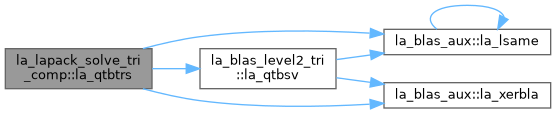
◆ la_qtftri()
| pure subroutine, public la_lapack_solve_tri_comp::la_qtftri | ( | character, intent(in) | transr, |
| character, intent(in) | uplo, | ||
| character, intent(in) | diag, | ||
| integer(ilp), intent(in) | n, | ||
| real(qp), dimension(0:*), intent(inout) | a, | ||
| integer(ilp), intent(out) | info ) |
QTFTRI: computes the inverse of a triangular matrix A stored in RFP format. This is a Level 3 BLAS version of the algorithm.
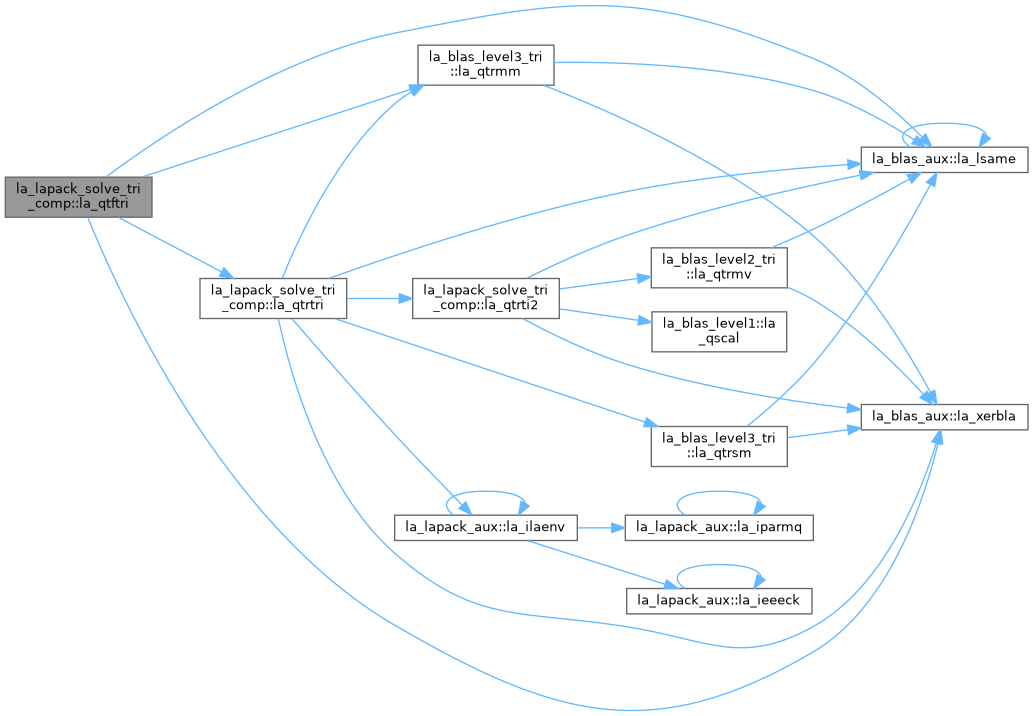
◆ la_qtpcon()
| subroutine, public la_lapack_solve_tri_comp::la_qtpcon | ( | character, intent(in) | norm, |
| character, intent(in) | uplo, | ||
| character, intent(in) | diag, | ||
| integer(ilp), intent(in) | n, | ||
| real(qp), dimension(*), intent(in) | ap, | ||
| real(qp), intent(out) | rcond, | ||
| real(qp), dimension(*), intent(out) | work, | ||
| integer(ilp), dimension(*), intent(out) | iwork, | ||
| integer(ilp), intent(out) | info ) |
QTPCON: estimates the reciprocal of the condition number of a packed triangular matrix A, in either the 1-norm or the infinity-norm. The norm of A is computed and an estimate is obtained for norm(inv(A)), then the reciprocal of the condition number is computed as RCOND = 1 / ( norm(A) * norm(inv(A)) ).
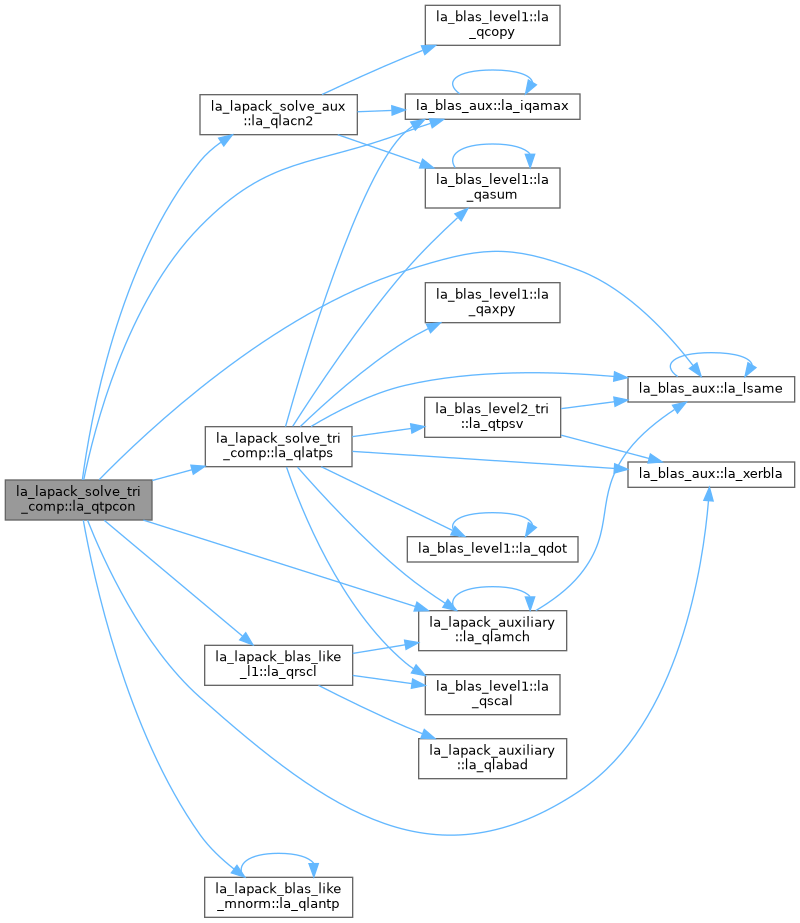
◆ la_qtprfs()
| pure subroutine, public la_lapack_solve_tri_comp::la_qtprfs | ( | character, intent(in) | uplo, |
| character, intent(in) | trans, | ||
| character, intent(in) | diag, | ||
| integer(ilp), intent(in) | n, | ||
| integer(ilp), intent(in) | nrhs, | ||
| real(qp), dimension(*), intent(in) | ap, | ||
| real(qp), dimension(ldb,*), intent(in) | b, | ||
| integer(ilp), intent(in) | ldb, | ||
| real(qp), dimension(ldx,*), intent(in) | x, | ||
| integer(ilp), intent(in) | ldx, | ||
| real(qp), dimension(*), intent(out) | ferr, | ||
| real(qp), dimension(*), intent(out) | berr, | ||
| real(qp), dimension(*), intent(out) | work, | ||
| integer(ilp), dimension(*), intent(out) | iwork, | ||
| integer(ilp), intent(out) | info ) |
QTPRFS: provides error bounds and backward error estimates for the solution to a system of linear equations with a triangular packed coefficient matrix. The solution matrix X must be computed by QTPTRS or some other means before entering this routine. QTPRFS does not do iterative refinement because doing so cannot improve the backward error.
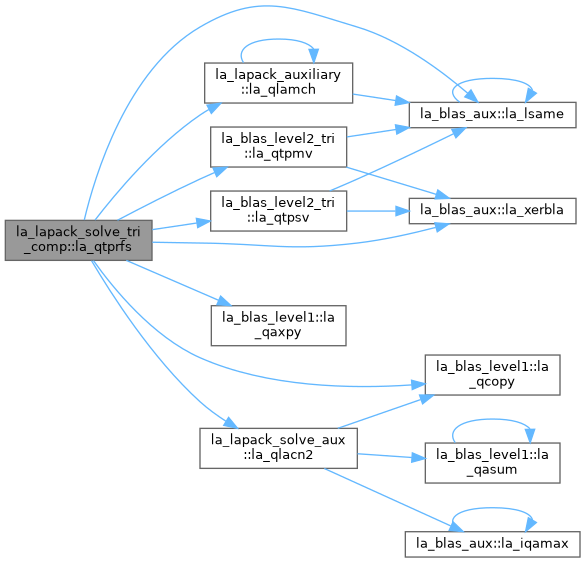
◆ la_qtptri()
| pure subroutine, public la_lapack_solve_tri_comp::la_qtptri | ( | character, intent(in) | uplo, |
| character, intent(in) | diag, | ||
| integer(ilp), intent(in) | n, | ||
| real(qp), dimension(*), intent(inout) | ap, | ||
| integer(ilp), intent(out) | info ) |
QTPTRI: computes the inverse of a real upper or lower triangular matrix A stored in packed format.
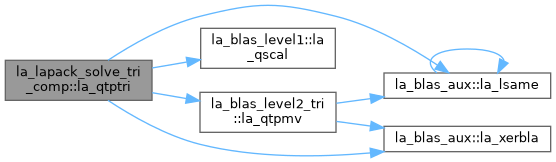
◆ la_qtptrs()
| pure subroutine, public la_lapack_solve_tri_comp::la_qtptrs | ( | character, intent(in) | uplo, |
| character, intent(in) | trans, | ||
| character, intent(in) | diag, | ||
| integer(ilp), intent(in) | n, | ||
| integer(ilp), intent(in) | nrhs, | ||
| real(qp), dimension(*), intent(in) | ap, | ||
| real(qp), dimension(ldb,*), intent(inout) | b, | ||
| integer(ilp), intent(in) | ldb, | ||
| integer(ilp), intent(out) | info ) |
QTPTRS: solves a triangular system of the form A * X = B or A**T * X = B, where A is a triangular matrix of order N stored in packed format, and B is an N-by-NRHS matrix. A check is made to verify that A is nonsingular.
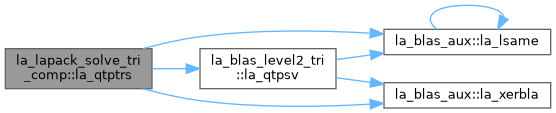
◆ la_qtrcon()
| subroutine, public la_lapack_solve_tri_comp::la_qtrcon | ( | character, intent(in) | norm, |
| character, intent(in) | uplo, | ||
| character, intent(in) | diag, | ||
| integer(ilp), intent(in) | n, | ||
| real(qp), dimension(lda,*), intent(in) | a, | ||
| integer(ilp), intent(in) | lda, | ||
| real(qp), intent(out) | rcond, | ||
| real(qp), dimension(*), intent(out) | work, | ||
| integer(ilp), dimension(*), intent(out) | iwork, | ||
| integer(ilp), intent(out) | info ) |
QTRCON: estimates the reciprocal of the condition number of a triangular matrix A, in either the 1-norm or the infinity-norm. The norm of A is computed and an estimate is obtained for norm(inv(A)), then the reciprocal of the condition number is computed as RCOND = 1 / ( norm(A) * norm(inv(A)) ).
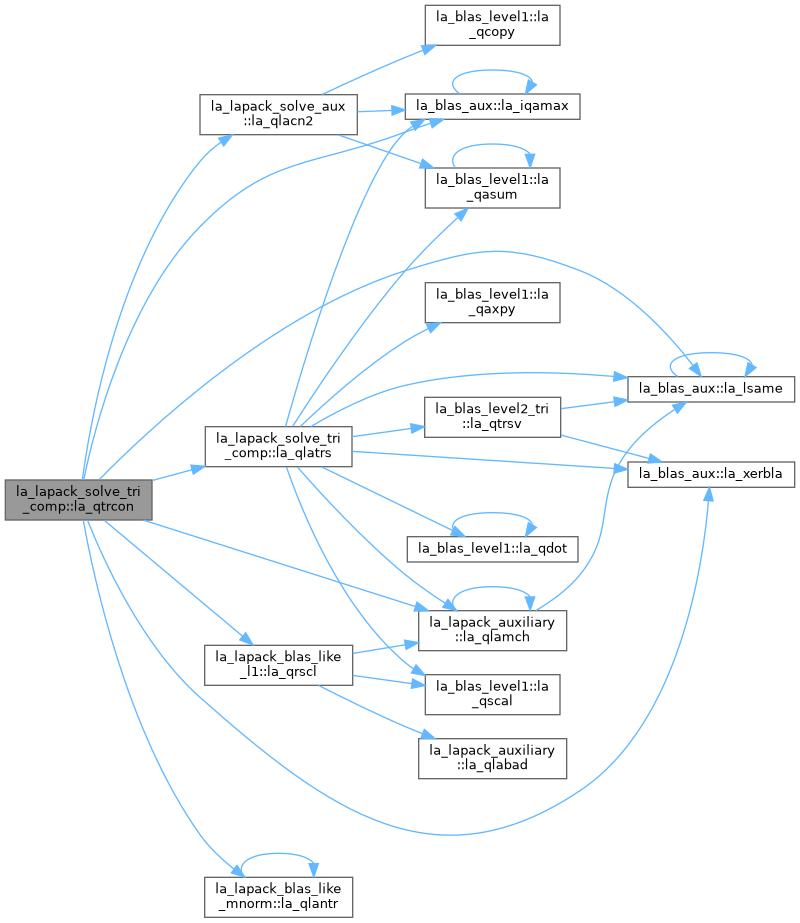
◆ la_qtrrfs()
| pure subroutine, public la_lapack_solve_tri_comp::la_qtrrfs | ( | character, intent(in) | uplo, |
| character, intent(in) | trans, | ||
| character, intent(in) | diag, | ||
| integer(ilp), intent(in) | n, | ||
| integer(ilp), intent(in) | nrhs, | ||
| real(qp), dimension(lda,*), intent(in) | a, | ||
| integer(ilp), intent(in) | lda, | ||
| real(qp), dimension(ldb,*), intent(in) | b, | ||
| integer(ilp), intent(in) | ldb, | ||
| real(qp), dimension(ldx,*), intent(in) | x, | ||
| integer(ilp), intent(in) | ldx, | ||
| real(qp), dimension(*), intent(out) | ferr, | ||
| real(qp), dimension(*), intent(out) | berr, | ||
| real(qp), dimension(*), intent(out) | work, | ||
| integer(ilp), dimension(*), intent(out) | iwork, | ||
| integer(ilp), intent(out) | info ) |
QTRRFS: provides error bounds and backward error estimates for the solution to a system of linear equations with a triangular coefficient matrix. The solution matrix X must be computed by QTRTRS or some other means before entering this routine. QTRRFS does not do iterative refinement because doing so cannot improve the backward error.
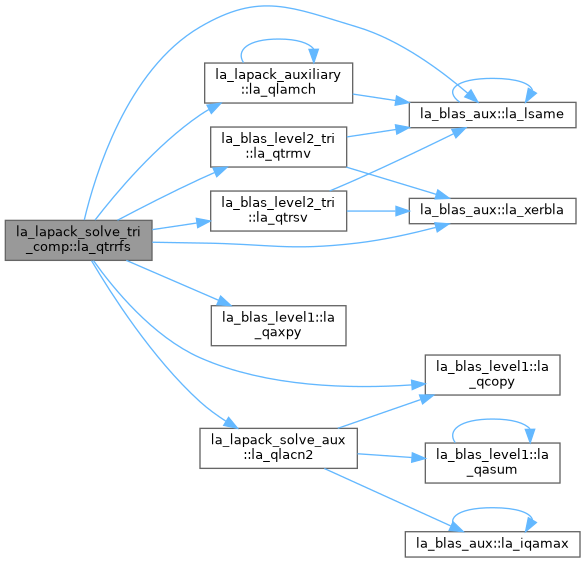
◆ la_qtrti2()
| pure subroutine, public la_lapack_solve_tri_comp::la_qtrti2 | ( | character, intent(in) | uplo, |
| character, intent(in) | diag, | ||
| integer(ilp), intent(in) | n, | ||
| real(qp), dimension(lda,*), intent(inout) | a, | ||
| integer(ilp), intent(in) | lda, | ||
| integer(ilp), intent(out) | info ) |
QTRTI2: computes the inverse of a real upper or lower triangular matrix. This is the Level 2 BLAS version of the algorithm.
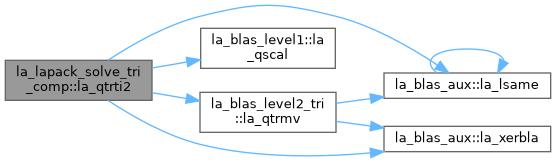
◆ la_qtrtri()
| pure subroutine, public la_lapack_solve_tri_comp::la_qtrtri | ( | character, intent(in) | uplo, |
| character, intent(in) | diag, | ||
| integer(ilp), intent(in) | n, | ||
| real(qp), dimension(lda,*), intent(inout) | a, | ||
| integer(ilp), intent(in) | lda, | ||
| integer(ilp), intent(out) | info ) |
QTRTRI: computes the inverse of a real upper or lower triangular matrix A. This is the Level 3 BLAS version of the algorithm.
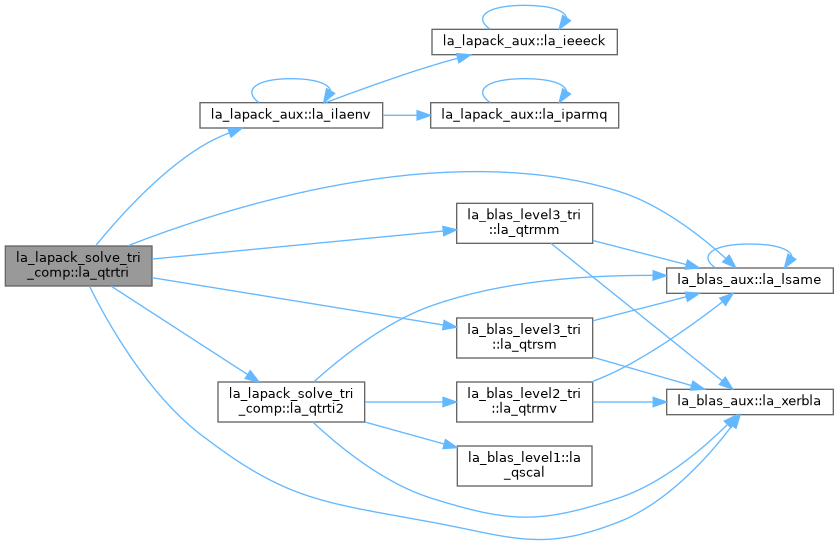
◆ la_qtrtrs()
| pure subroutine, public la_lapack_solve_tri_comp::la_qtrtrs | ( | character, intent(in) | uplo, |
| character, intent(in) | trans, | ||
| character, intent(in) | diag, | ||
| integer(ilp), intent(in) | n, | ||
| integer(ilp), intent(in) | nrhs, | ||
| real(qp), dimension(lda,*), intent(in) | a, | ||
| integer(ilp), intent(in) | lda, | ||
| real(qp), dimension(ldb,*), intent(inout) | b, | ||
| integer(ilp), intent(in) | ldb, | ||
| integer(ilp), intent(out) | info ) |
QTRTRS: solves a triangular system of the form A * X = B or A**T * X = B, where A is a triangular matrix of order N, and B is an N-by-NRHS matrix. A check is made to verify that A is nonsingular.
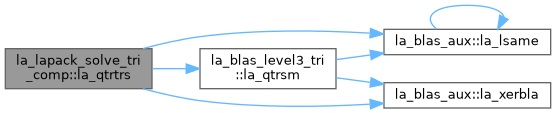
◆ la_slatbs()
| pure subroutine, public la_lapack_solve_tri_comp::la_slatbs | ( | character, intent(in) | uplo, |
| character, intent(in) | trans, | ||
| character, intent(in) | diag, | ||
| character, intent(in) | normin, | ||
| integer(ilp), intent(in) | n, | ||
| integer(ilp), intent(in) | kd, | ||
| real(sp), dimension(ldab,*), intent(in) | ab, | ||
| integer(ilp), intent(in) | ldab, | ||
| real(sp), dimension(*), intent(inout) | x, | ||
| real(sp), intent(out) | scale, | ||
| real(sp), dimension(*), intent(inout) | cnorm, | ||
| integer(ilp), intent(out) | info ) |
SLATBS: solves one of the triangular systems A *x = s*b or A**T*x = s*b with scaling to prevent overflow, where A is an upper or lower triangular band matrix. Here A**T denotes the transpose of A, x and b are n-element vectors, and s is a scaling factor, usually less than or equal to 1, chosen so that the components of x will be less than the overflow threshold. If the unscaled problem will not cause overflow, the Level 2 BLAS routine STBSV is called. If the matrix A is singular (A(j,j) = 0 for some j), then s is set to 0 and a non-trivial solution to A*x = 0 is returned.
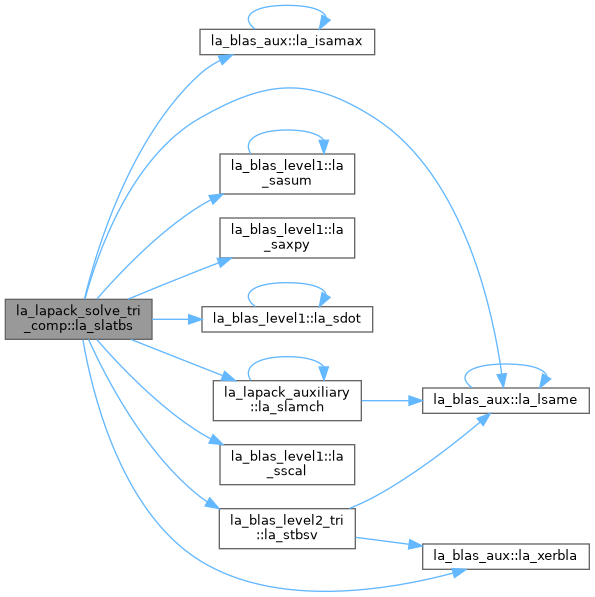
◆ la_slatps()
| pure subroutine, public la_lapack_solve_tri_comp::la_slatps | ( | character, intent(in) | uplo, |
| character, intent(in) | trans, | ||
| character, intent(in) | diag, | ||
| character, intent(in) | normin, | ||
| integer(ilp), intent(in) | n, | ||
| real(sp), dimension(*), intent(in) | ap, | ||
| real(sp), dimension(*), intent(inout) | x, | ||
| real(sp), intent(out) | scale, | ||
| real(sp), dimension(*), intent(inout) | cnorm, | ||
| integer(ilp), intent(out) | info ) |
SLATPS: solves one of the triangular systems A *x = s*b or A**T*x = s*b with scaling to prevent overflow, where A is an upper or lower triangular matrix stored in packed form. Here A**T denotes the transpose of A, x and b are n-element vectors, and s is a scaling factor, usually less than or equal to 1, chosen so that the components of x will be less than the overflow threshold. If the unscaled problem will not cause overflow, the Level 2 BLAS routine STPSV is called. If the matrix A is singular (A(j,j) = 0 for some j), then s is set to 0 and a non-trivial solution to A*x = 0 is returned.
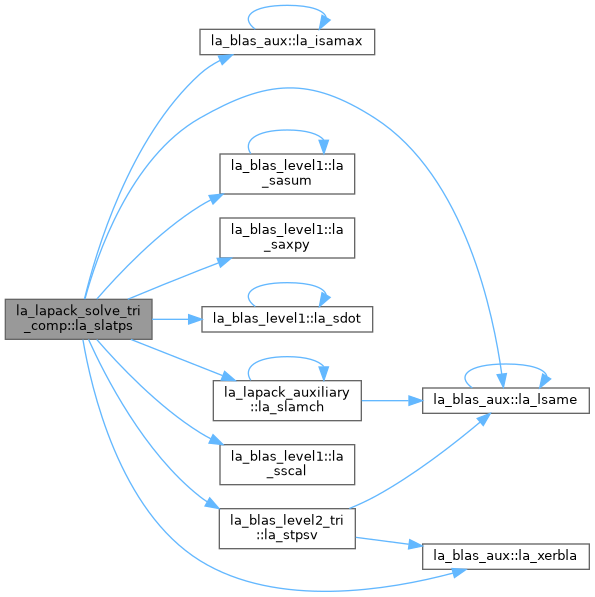
◆ la_slatrs()
| pure subroutine, public la_lapack_solve_tri_comp::la_slatrs | ( | character, intent(in) | uplo, |
| character, intent(in) | trans, | ||
| character, intent(in) | diag, | ||
| character, intent(in) | normin, | ||
| integer(ilp), intent(in) | n, | ||
| real(sp), dimension(lda,*), intent(in) | a, | ||
| integer(ilp), intent(in) | lda, | ||
| real(sp), dimension(*), intent(inout) | x, | ||
| real(sp), intent(out) | scale, | ||
| real(sp), dimension(*), intent(inout) | cnorm, | ||
| integer(ilp), intent(out) | info ) |
SLATRS: solves one of the triangular systems A *x = s*b or A**T*x = s*b with scaling to prevent overflow. Here A is an upper or lower triangular matrix, A**T denotes the transpose of A, x and b are n-element vectors, and s is a scaling factor, usually less than or equal to 1, chosen so that the components of x will be less than the overflow threshold. If the unscaled problem will not cause overflow, the Level 2 BLAS routine STRSV is called. If the matrix A is singular (A(j,j) = 0 for some j), then s is set to 0 and a non-trivial solution to A*x = 0 is returned.
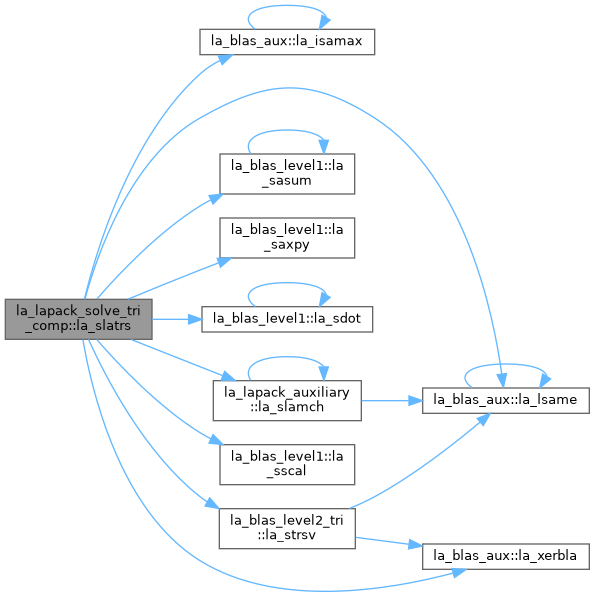
◆ la_slauu2()
| pure subroutine, public la_lapack_solve_tri_comp::la_slauu2 | ( | character, intent(in) | uplo, |
| integer(ilp), intent(in) | n, | ||
| real(sp), dimension(lda,*), intent(inout) | a, | ||
| integer(ilp), intent(in) | lda, | ||
| integer(ilp), intent(out) | info ) |
SLAUU2: computes the product U * U**T or L**T * L, where the triangular factor U or L is stored in the upper or lower triangular part of the array A. If UPLO = 'U' or 'u' then the upper triangle of the result is stored, overwriting the factor U in A. If UPLO = 'L' or 'l' then the lower triangle of the result is stored, overwriting the factor L in A. This is the unblocked form of the algorithm, calling Level 2 BLAS.
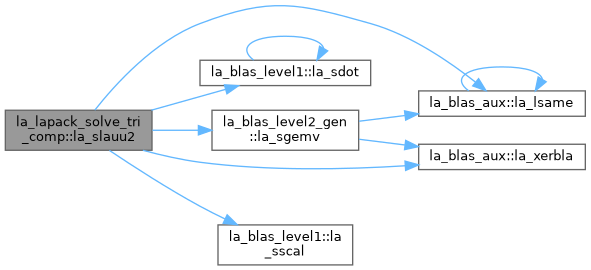
◆ la_slauum()
| pure subroutine, public la_lapack_solve_tri_comp::la_slauum | ( | character, intent(in) | uplo, |
| integer(ilp), intent(in) | n, | ||
| real(sp), dimension(lda,*), intent(inout) | a, | ||
| integer(ilp), intent(in) | lda, | ||
| integer(ilp), intent(out) | info ) |
SLAUUM: computes the product U * U**T or L**T * L, where the triangular factor U or L is stored in the upper or lower triangular part of the array A. If UPLO = 'U' or 'u' then the upper triangle of the result is stored, overwriting the factor U in A. If UPLO = 'L' or 'l' then the lower triangle of the result is stored, overwriting the factor L in A. This is the blocked form of the algorithm, calling Level 3 BLAS.
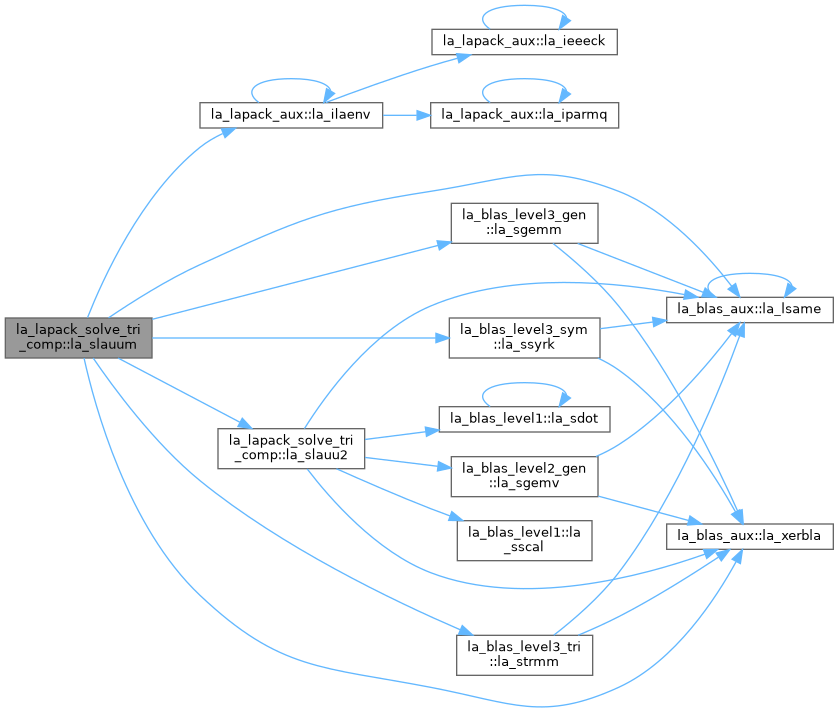
◆ la_stbcon()
| subroutine, public la_lapack_solve_tri_comp::la_stbcon | ( | character, intent(in) | norm, |
| character, intent(in) | uplo, | ||
| character, intent(in) | diag, | ||
| integer(ilp), intent(in) | n, | ||
| integer(ilp), intent(in) | kd, | ||
| real(sp), dimension(ldab,*), intent(in) | ab, | ||
| integer(ilp), intent(in) | ldab, | ||
| real(sp), intent(out) | rcond, | ||
| real(sp), dimension(*), intent(out) | work, | ||
| integer(ilp), dimension(*), intent(out) | iwork, | ||
| integer(ilp), intent(out) | info ) |
STBCON: estimates the reciprocal of the condition number of a triangular band matrix A, in either the 1-norm or the infinity-norm. The norm of A is computed and an estimate is obtained for norm(inv(A)), then the reciprocal of the condition number is computed as RCOND = 1 / ( norm(A) * norm(inv(A)) ).
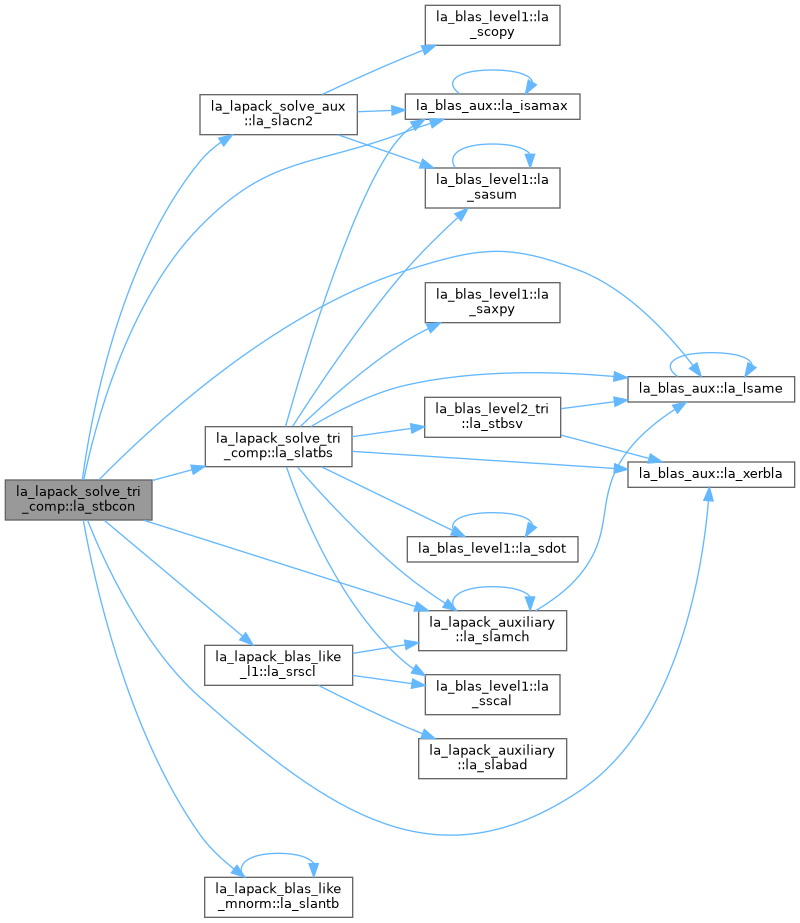
◆ la_stbrfs()
| pure subroutine, public la_lapack_solve_tri_comp::la_stbrfs | ( | character, intent(in) | uplo, |
| character, intent(in) | trans, | ||
| character, intent(in) | diag, | ||
| integer(ilp), intent(in) | n, | ||
| integer(ilp), intent(in) | kd, | ||
| integer(ilp), intent(in) | nrhs, | ||
| real(sp), dimension(ldab,*), intent(in) | ab, | ||
| integer(ilp), intent(in) | ldab, | ||
| real(sp), dimension(ldb,*), intent(in) | b, | ||
| integer(ilp), intent(in) | ldb, | ||
| real(sp), dimension(ldx,*), intent(in) | x, | ||
| integer(ilp), intent(in) | ldx, | ||
| real(sp), dimension(*), intent(out) | ferr, | ||
| real(sp), dimension(*), intent(out) | berr, | ||
| real(sp), dimension(*), intent(out) | work, | ||
| integer(ilp), dimension(*), intent(out) | iwork, | ||
| integer(ilp), intent(out) | info ) |
STBRFS: provides error bounds and backward error estimates for the solution to a system of linear equations with a triangular band coefficient matrix. The solution matrix X must be computed by STBTRS or some other means before entering this routine. STBRFS does not do iterative refinement because doing so cannot improve the backward error.
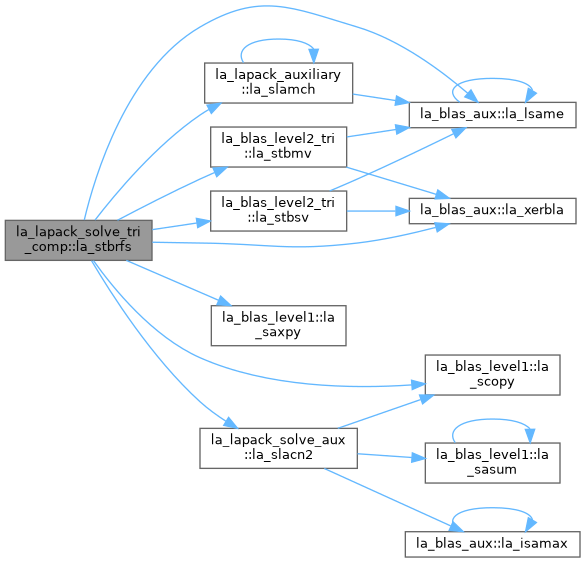
◆ la_stbtrs()
| pure subroutine, public la_lapack_solve_tri_comp::la_stbtrs | ( | character, intent(in) | uplo, |
| character, intent(in) | trans, | ||
| character, intent(in) | diag, | ||
| integer(ilp), intent(in) | n, | ||
| integer(ilp), intent(in) | kd, | ||
| integer(ilp), intent(in) | nrhs, | ||
| real(sp), dimension(ldab,*), intent(in) | ab, | ||
| integer(ilp), intent(in) | ldab, | ||
| real(sp), dimension(ldb,*), intent(inout) | b, | ||
| integer(ilp), intent(in) | ldb, | ||
| integer(ilp), intent(out) | info ) |
STBTRS: solves a triangular system of the form A * X = B or A**T * X = B, where A is a triangular band matrix of order N, and B is an N-by NRHS matrix. A check is made to verify that A is nonsingular.
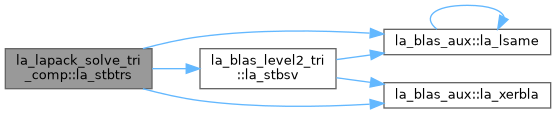
◆ la_stftri()
| pure subroutine, public la_lapack_solve_tri_comp::la_stftri | ( | character, intent(in) | transr, |
| character, intent(in) | uplo, | ||
| character, intent(in) | diag, | ||
| integer(ilp), intent(in) | n, | ||
| real(sp), dimension(0:*), intent(inout) | a, | ||
| integer(ilp), intent(out) | info ) |
STFTRI: computes the inverse of a triangular matrix A stored in RFP format. This is a Level 3 BLAS version of the algorithm.
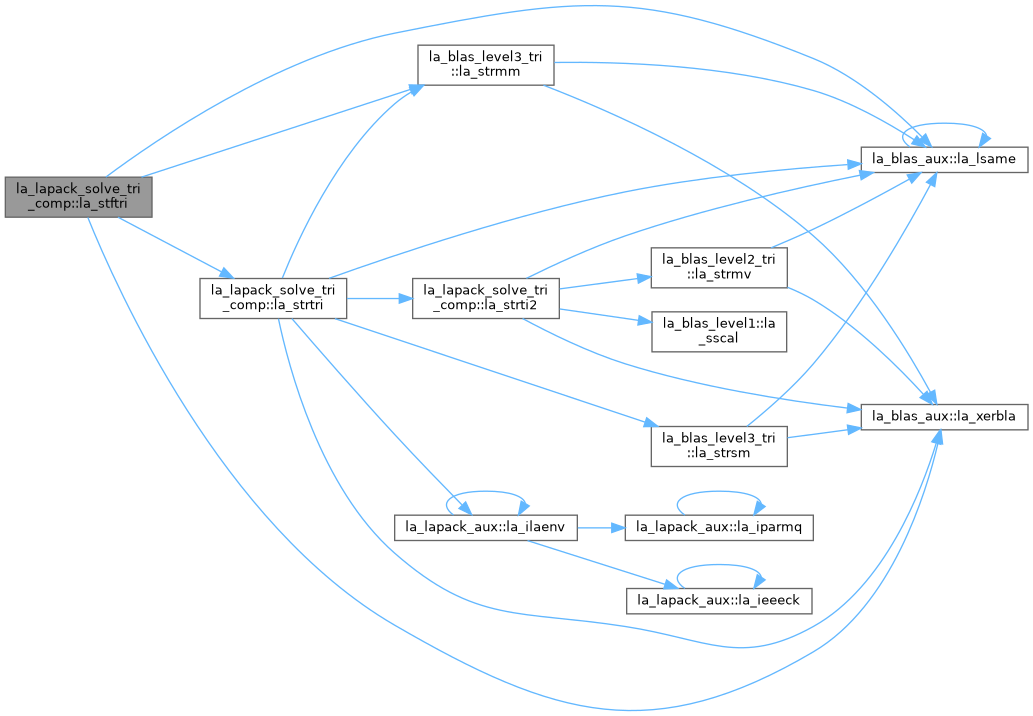
◆ la_stpcon()
| subroutine, public la_lapack_solve_tri_comp::la_stpcon | ( | character, intent(in) | norm, |
| character, intent(in) | uplo, | ||
| character, intent(in) | diag, | ||
| integer(ilp), intent(in) | n, | ||
| real(sp), dimension(*), intent(in) | ap, | ||
| real(sp), intent(out) | rcond, | ||
| real(sp), dimension(*), intent(out) | work, | ||
| integer(ilp), dimension(*), intent(out) | iwork, | ||
| integer(ilp), intent(out) | info ) |
STPCON: estimates the reciprocal of the condition number of a packed triangular matrix A, in either the 1-norm or the infinity-norm. The norm of A is computed and an estimate is obtained for norm(inv(A)), then the reciprocal of the condition number is computed as RCOND = 1 / ( norm(A) * norm(inv(A)) ).
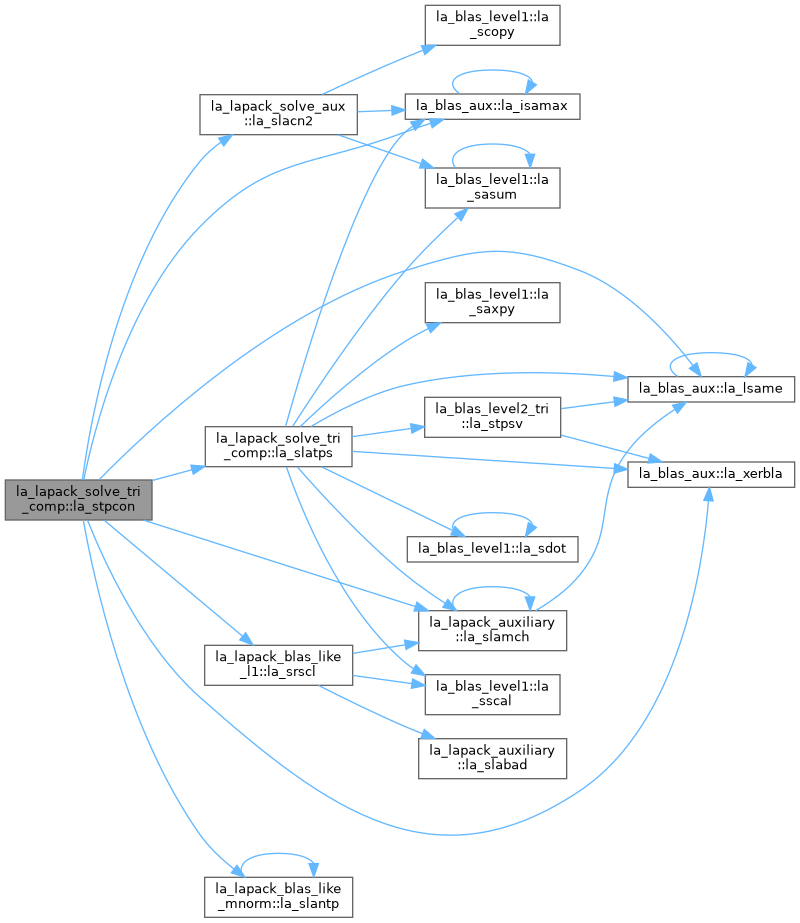
◆ la_stprfs()
| pure subroutine, public la_lapack_solve_tri_comp::la_stprfs | ( | character, intent(in) | uplo, |
| character, intent(in) | trans, | ||
| character, intent(in) | diag, | ||
| integer(ilp), intent(in) | n, | ||
| integer(ilp), intent(in) | nrhs, | ||
| real(sp), dimension(*), intent(in) | ap, | ||
| real(sp), dimension(ldb,*), intent(in) | b, | ||
| integer(ilp), intent(in) | ldb, | ||
| real(sp), dimension(ldx,*), intent(in) | x, | ||
| integer(ilp), intent(in) | ldx, | ||
| real(sp), dimension(*), intent(out) | ferr, | ||
| real(sp), dimension(*), intent(out) | berr, | ||
| real(sp), dimension(*), intent(out) | work, | ||
| integer(ilp), dimension(*), intent(out) | iwork, | ||
| integer(ilp), intent(out) | info ) |
STPRFS: provides error bounds and backward error estimates for the solution to a system of linear equations with a triangular packed coefficient matrix. The solution matrix X must be computed by STPTRS or some other means before entering this routine. STPRFS does not do iterative refinement because doing so cannot improve the backward error.
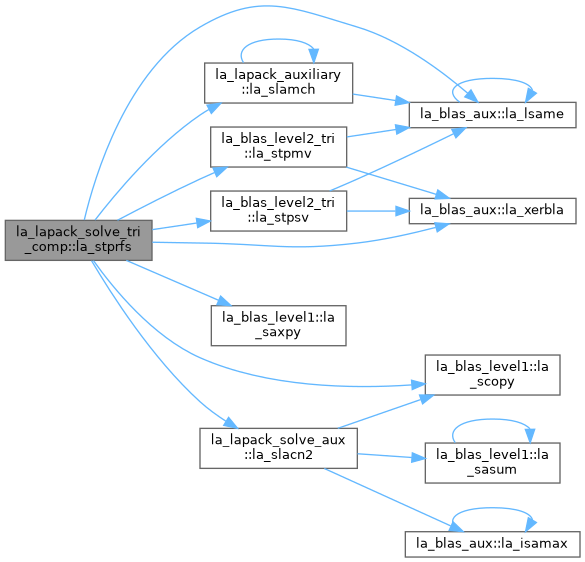
◆ la_stptri()
| pure subroutine, public la_lapack_solve_tri_comp::la_stptri | ( | character, intent(in) | uplo, |
| character, intent(in) | diag, | ||
| integer(ilp), intent(in) | n, | ||
| real(sp), dimension(*), intent(inout) | ap, | ||
| integer(ilp), intent(out) | info ) |
STPTRI: computes the inverse of a real upper or lower triangular matrix A stored in packed format.
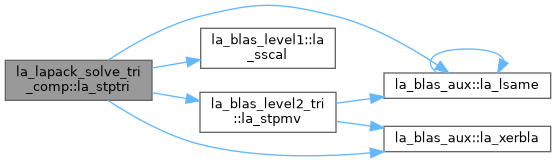
◆ la_stptrs()
| pure subroutine, public la_lapack_solve_tri_comp::la_stptrs | ( | character, intent(in) | uplo, |
| character, intent(in) | trans, | ||
| character, intent(in) | diag, | ||
| integer(ilp), intent(in) | n, | ||
| integer(ilp), intent(in) | nrhs, | ||
| real(sp), dimension(*), intent(in) | ap, | ||
| real(sp), dimension(ldb,*), intent(inout) | b, | ||
| integer(ilp), intent(in) | ldb, | ||
| integer(ilp), intent(out) | info ) |
STPTRS: solves a triangular system of the form A * X = B or A**T * X = B, where A is a triangular matrix of order N stored in packed format, and B is an N-by-NRHS matrix. A check is made to verify that A is nonsingular.
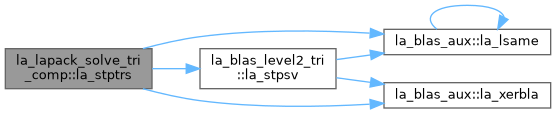
◆ la_strcon()
| subroutine, public la_lapack_solve_tri_comp::la_strcon | ( | character, intent(in) | norm, |
| character, intent(in) | uplo, | ||
| character, intent(in) | diag, | ||
| integer(ilp), intent(in) | n, | ||
| real(sp), dimension(lda,*), intent(in) | a, | ||
| integer(ilp), intent(in) | lda, | ||
| real(sp), intent(out) | rcond, | ||
| real(sp), dimension(*), intent(out) | work, | ||
| integer(ilp), dimension(*), intent(out) | iwork, | ||
| integer(ilp), intent(out) | info ) |
STRCON: estimates the reciprocal of the condition number of a triangular matrix A, in either the 1-norm or the infinity-norm. The norm of A is computed and an estimate is obtained for norm(inv(A)), then the reciprocal of the condition number is computed as RCOND = 1 / ( norm(A) * norm(inv(A)) ).
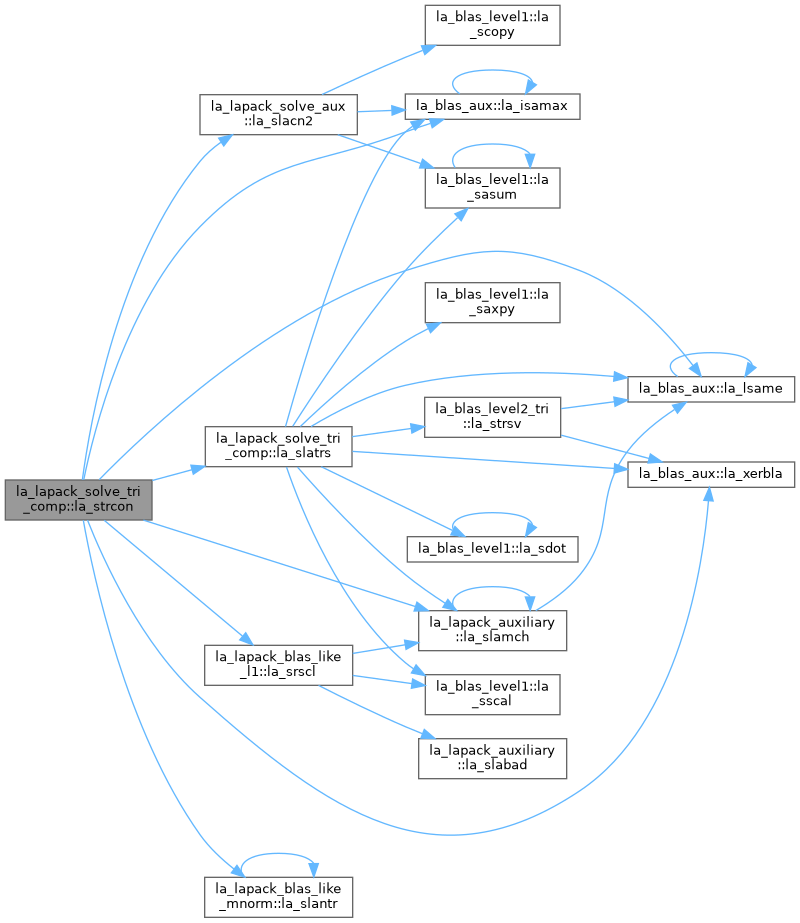
◆ la_strrfs()
| pure subroutine, public la_lapack_solve_tri_comp::la_strrfs | ( | character, intent(in) | uplo, |
| character, intent(in) | trans, | ||
| character, intent(in) | diag, | ||
| integer(ilp), intent(in) | n, | ||
| integer(ilp), intent(in) | nrhs, | ||
| real(sp), dimension(lda,*), intent(in) | a, | ||
| integer(ilp), intent(in) | lda, | ||
| real(sp), dimension(ldb,*), intent(in) | b, | ||
| integer(ilp), intent(in) | ldb, | ||
| real(sp), dimension(ldx,*), intent(in) | x, | ||
| integer(ilp), intent(in) | ldx, | ||
| real(sp), dimension(*), intent(out) | ferr, | ||
| real(sp), dimension(*), intent(out) | berr, | ||
| real(sp), dimension(*), intent(out) | work, | ||
| integer(ilp), dimension(*), intent(out) | iwork, | ||
| integer(ilp), intent(out) | info ) |
STRRFS: provides error bounds and backward error estimates for the solution to a system of linear equations with a triangular coefficient matrix. The solution matrix X must be computed by STRTRS or some other means before entering this routine. STRRFS does not do iterative refinement because doing so cannot improve the backward error.
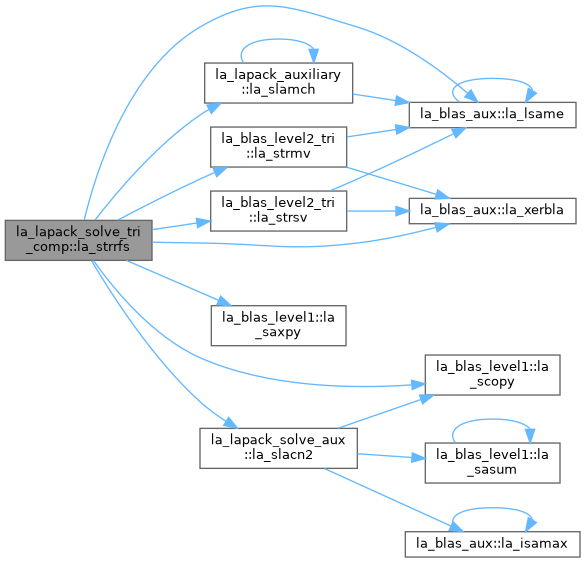
◆ la_strti2()
| pure subroutine, public la_lapack_solve_tri_comp::la_strti2 | ( | character, intent(in) | uplo, |
| character, intent(in) | diag, | ||
| integer(ilp), intent(in) | n, | ||
| real(sp), dimension(lda,*), intent(inout) | a, | ||
| integer(ilp), intent(in) | lda, | ||
| integer(ilp), intent(out) | info ) |
STRTI2: computes the inverse of a real upper or lower triangular matrix. This is the Level 2 BLAS version of the algorithm.
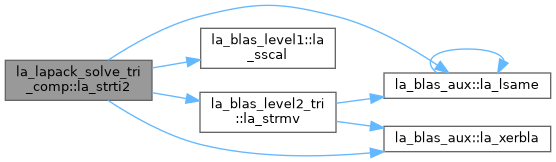
◆ la_strtri()
| pure subroutine, public la_lapack_solve_tri_comp::la_strtri | ( | character, intent(in) | uplo, |
| character, intent(in) | diag, | ||
| integer(ilp), intent(in) | n, | ||
| real(sp), dimension(lda,*), intent(inout) | a, | ||
| integer(ilp), intent(in) | lda, | ||
| integer(ilp), intent(out) | info ) |
STRTRI: computes the inverse of a real upper or lower triangular matrix A. This is the Level 3 BLAS version of the algorithm.
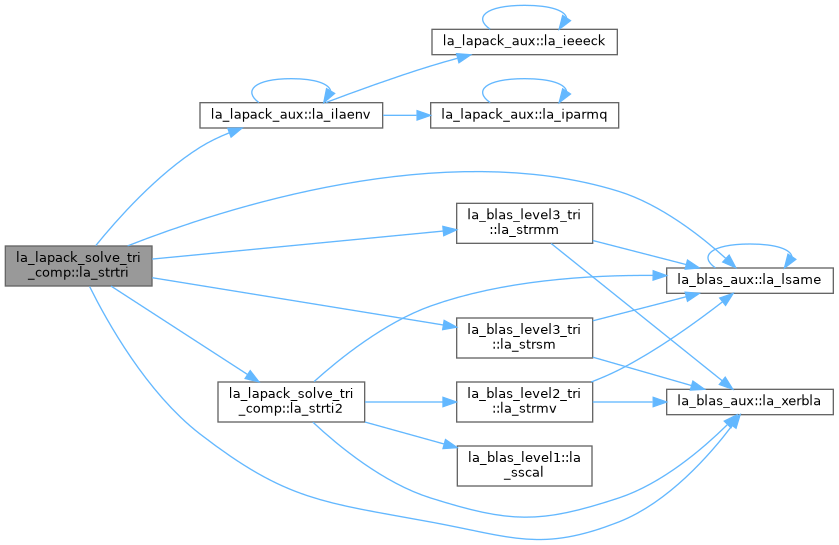
◆ la_strtrs()
| pure subroutine, public la_lapack_solve_tri_comp::la_strtrs | ( | character, intent(in) | uplo, |
| character, intent(in) | trans, | ||
| character, intent(in) | diag, | ||
| integer(ilp), intent(in) | n, | ||
| integer(ilp), intent(in) | nrhs, | ||
| real(sp), dimension(lda,*), intent(in) | a, | ||
| integer(ilp), intent(in) | lda, | ||
| real(sp), dimension(ldb,*), intent(inout) | b, | ||
| integer(ilp), intent(in) | ldb, | ||
| integer(ilp), intent(out) | info ) |
STRTRS: solves a triangular system of the form A * X = B or A**T * X = B, where A is a triangular matrix of order N, and B is an N-by-NRHS matrix. A check is made to verify that A is nonsingular.
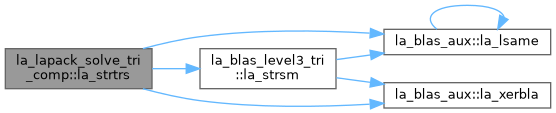
◆ la_wlatbs()
| pure subroutine, public la_lapack_solve_tri_comp::la_wlatbs | ( | character, intent(in) | uplo, |
| character, intent(in) | trans, | ||
| character, intent(in) | diag, | ||
| character, intent(in) | normin, | ||
| integer(ilp), intent(in) | n, | ||
| integer(ilp), intent(in) | kd, | ||
| complex(qp), dimension(ldab,*), intent(in) | ab, | ||
| integer(ilp), intent(in) | ldab, | ||
| complex(qp), dimension(*), intent(inout) | x, | ||
| real(qp), intent(out) | scale, | ||
| real(qp), dimension(*), intent(inout) | cnorm, | ||
| integer(ilp), intent(out) | info ) |
WLATBS: solves one of the triangular systems A * x = s*b, A**T * x = s*b, or A**H * x = s*b, with scaling to prevent overflow, where A is an upper or lower triangular band matrix. Here A**T denotes the transpose of A, x and b are n-element vectors, and s is a scaling factor, usually less than or equal to 1, chosen so that the components of x will be less than the overflow threshold. If the unscaled problem will not cause overflow, the Level 2 BLAS routine WTBSV is called. If the matrix A is singular (A(j,j) = 0 for some j), then s is set to 0 and a non-trivial solution to A*x = 0 is returned.
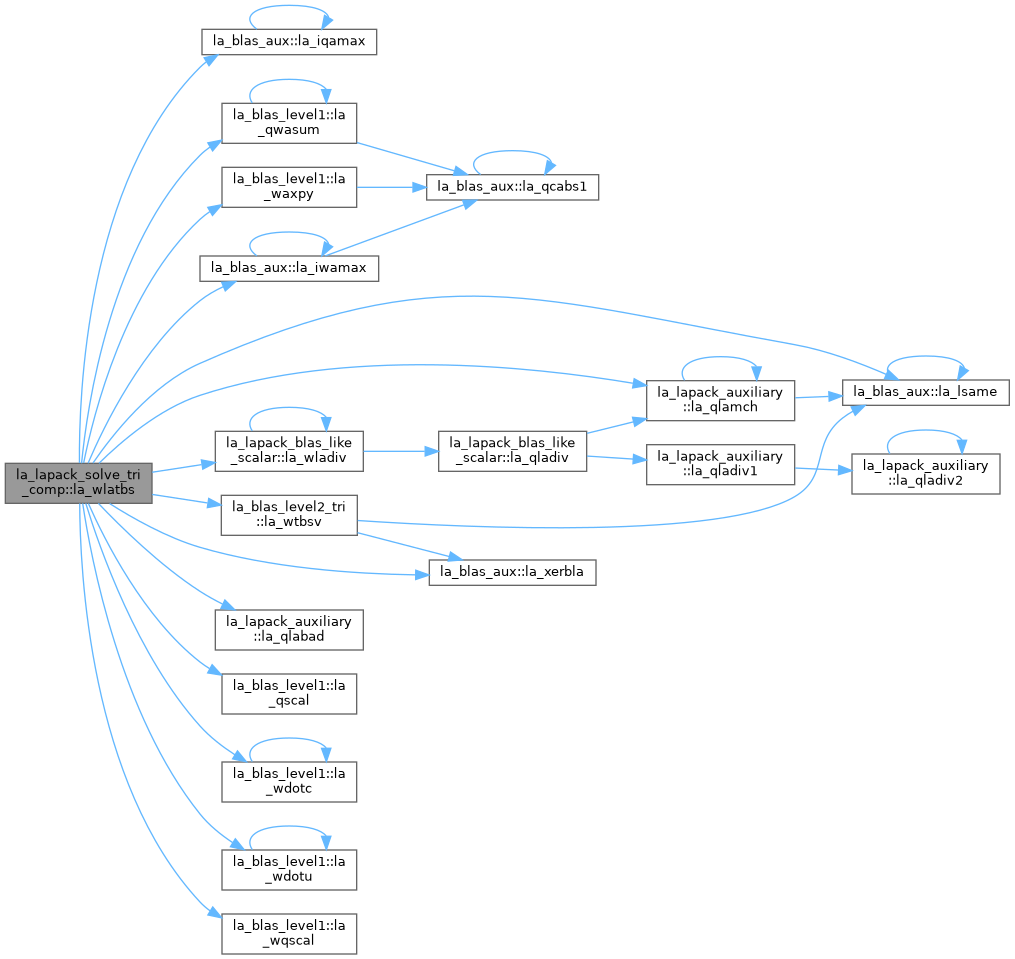
◆ la_wlatps()
| pure subroutine, public la_lapack_solve_tri_comp::la_wlatps | ( | character, intent(in) | uplo, |
| character, intent(in) | trans, | ||
| character, intent(in) | diag, | ||
| character, intent(in) | normin, | ||
| integer(ilp), intent(in) | n, | ||
| complex(qp), dimension(*), intent(in) | ap, | ||
| complex(qp), dimension(*), intent(inout) | x, | ||
| real(qp), intent(out) | scale, | ||
| real(qp), dimension(*), intent(inout) | cnorm, | ||
| integer(ilp), intent(out) | info ) |
WLATPS: solves one of the triangular systems A * x = s*b, A**T * x = s*b, or A**H * x = s*b, with scaling to prevent overflow, where A is an upper or lower triangular matrix stored in packed form. Here A**T denotes the transpose of A, A**H denotes the conjugate transpose of A, x and b are n-element vectors, and s is a scaling factor, usually less than or equal to 1, chosen so that the components of x will be less than the overflow threshold. If the unscaled problem will not cause overflow, the Level 2 BLAS routine WTPSV is called. If the matrix A is singular (A(j,j) = 0 for some j), then s is set to 0 and a non-trivial solution to A*x = 0 is returned.
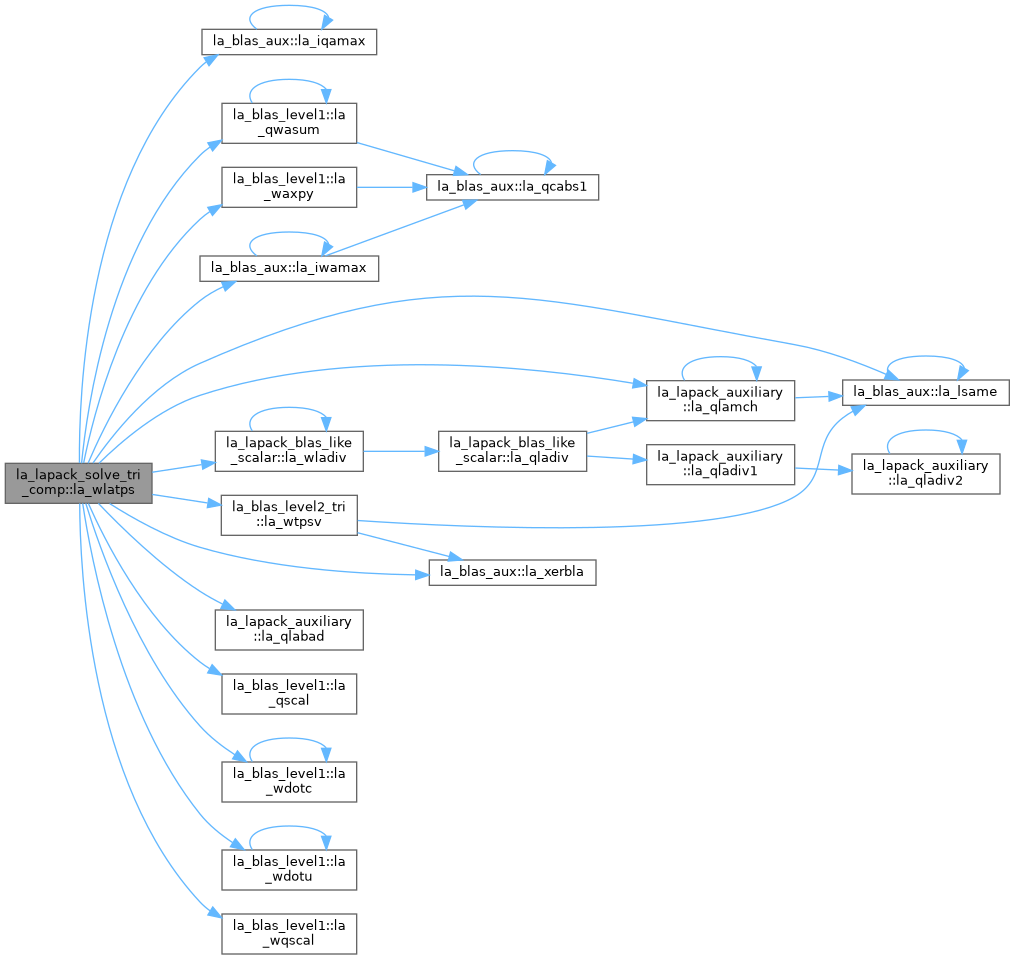
◆ la_wlatrs()
| pure subroutine, public la_lapack_solve_tri_comp::la_wlatrs | ( | character, intent(in) | uplo, |
| character, intent(in) | trans, | ||
| character, intent(in) | diag, | ||
| character, intent(in) | normin, | ||
| integer(ilp), intent(in) | n, | ||
| complex(qp), dimension(lda,*), intent(in) | a, | ||
| integer(ilp), intent(in) | lda, | ||
| complex(qp), dimension(*), intent(inout) | x, | ||
| real(qp), intent(out) | scale, | ||
| real(qp), dimension(*), intent(inout) | cnorm, | ||
| integer(ilp), intent(out) | info ) |
WLATRS: solves one of the triangular systems A * x = s*b, A**T * x = s*b, or A**H * x = s*b, with scaling to prevent overflow. Here A is an upper or lower triangular matrix, A**T denotes the transpose of A, A**H denotes the conjugate transpose of A, x and b are n-element vectors, and s is a scaling factor, usually less than or equal to 1, chosen so that the components of x will be less than the overflow threshold. If the unscaled problem will not cause overflow, the Level 2 BLAS routine WTRSV is called. If the matrix A is singular (A(j,j) = 0 for some j), then s is set to 0 and a non-trivial solution to A*x = 0 is returned.
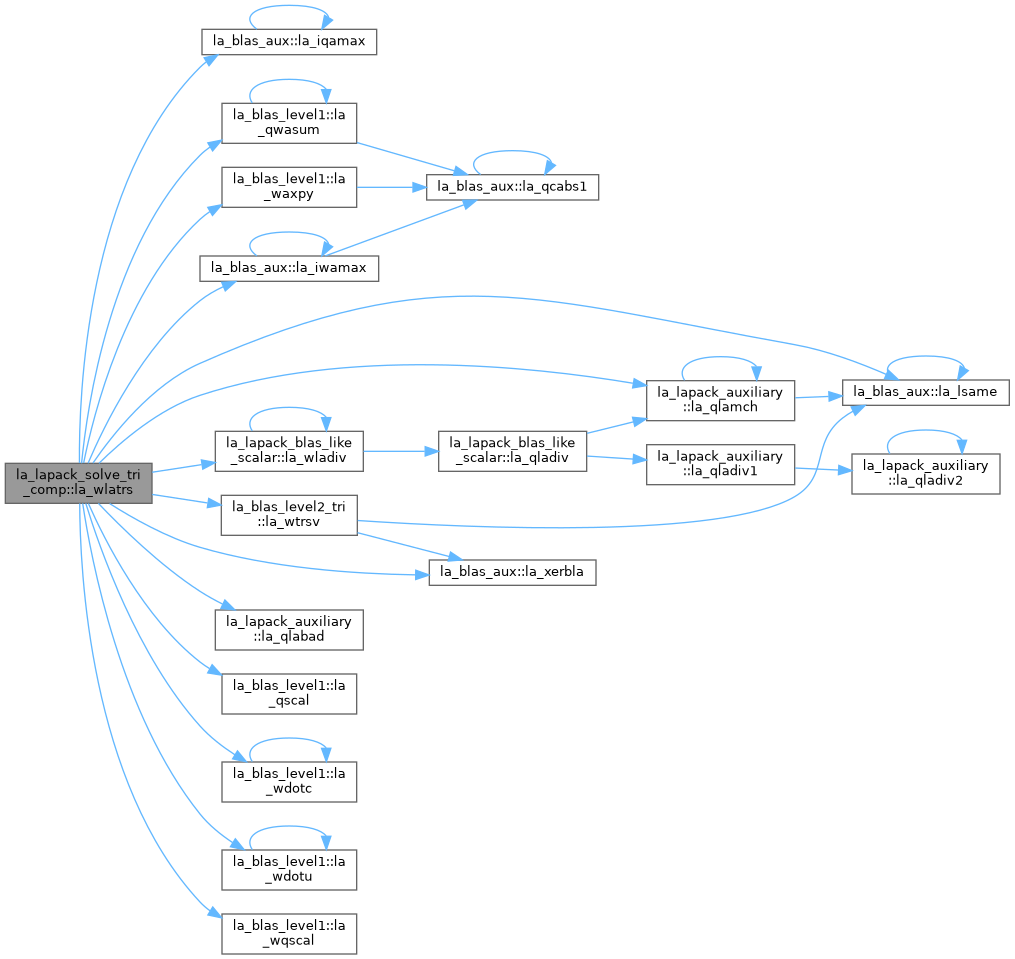
◆ la_wlauu2()
| pure subroutine, public la_lapack_solve_tri_comp::la_wlauu2 | ( | character, intent(in) | uplo, |
| integer(ilp), intent(in) | n, | ||
| complex(qp), dimension(lda,*), intent(inout) | a, | ||
| integer(ilp), intent(in) | lda, | ||
| integer(ilp), intent(out) | info ) |
WLAUU2: computes the product U * U**H or L**H * L, where the triangular factor U or L is stored in the upper or lower triangular part of the array A. If UPLO = 'U' or 'u' then the upper triangle of the result is stored, overwriting the factor U in A. If UPLO = 'L' or 'l' then the lower triangle of the result is stored, overwriting the factor L in A. This is the unblocked form of the algorithm, calling Level 2 BLAS.
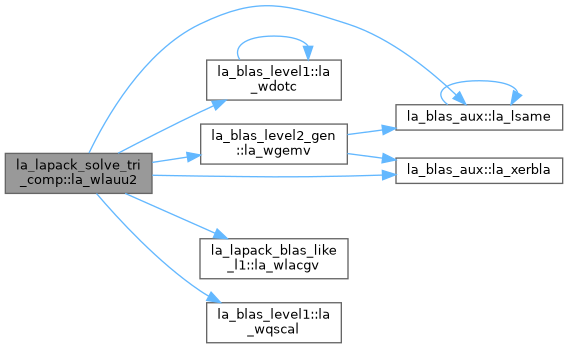
◆ la_wlauum()
| pure subroutine, public la_lapack_solve_tri_comp::la_wlauum | ( | character, intent(in) | uplo, |
| integer(ilp), intent(in) | n, | ||
| complex(qp), dimension(lda,*), intent(inout) | a, | ||
| integer(ilp), intent(in) | lda, | ||
| integer(ilp), intent(out) | info ) |
WLAUUM: computes the product U * U**H or L**H * L, where the triangular factor U or L is stored in the upper or lower triangular part of the array A. If UPLO = 'U' or 'u' then the upper triangle of the result is stored, overwriting the factor U in A. If UPLO = 'L' or 'l' then the lower triangle of the result is stored, overwriting the factor L in A. This is the blocked form of the algorithm, calling Level 3 BLAS.
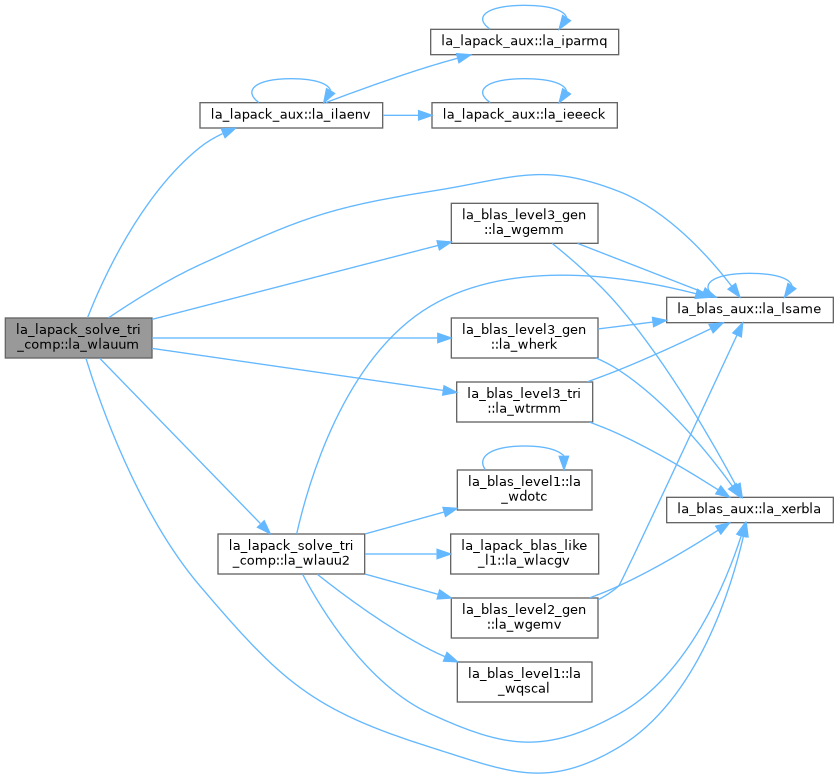
◆ la_wtbcon()
| subroutine, public la_lapack_solve_tri_comp::la_wtbcon | ( | character, intent(in) | norm, |
| character, intent(in) | uplo, | ||
| character, intent(in) | diag, | ||
| integer(ilp), intent(in) | n, | ||
| integer(ilp), intent(in) | kd, | ||
| complex(qp), dimension(ldab,*), intent(in) | ab, | ||
| integer(ilp), intent(in) | ldab, | ||
| real(qp), intent(out) | rcond, | ||
| complex(qp), dimension(*), intent(out) | work, | ||
| real(qp), dimension(*), intent(out) | rwork, | ||
| integer(ilp), intent(out) | info ) |
WTBCON: estimates the reciprocal of the condition number of a triangular band matrix A, in either the 1-norm or the infinity-norm. The norm of A is computed and an estimate is obtained for norm(inv(A)), then the reciprocal of the condition number is computed as RCOND = 1 / ( norm(A) * norm(inv(A)) ).
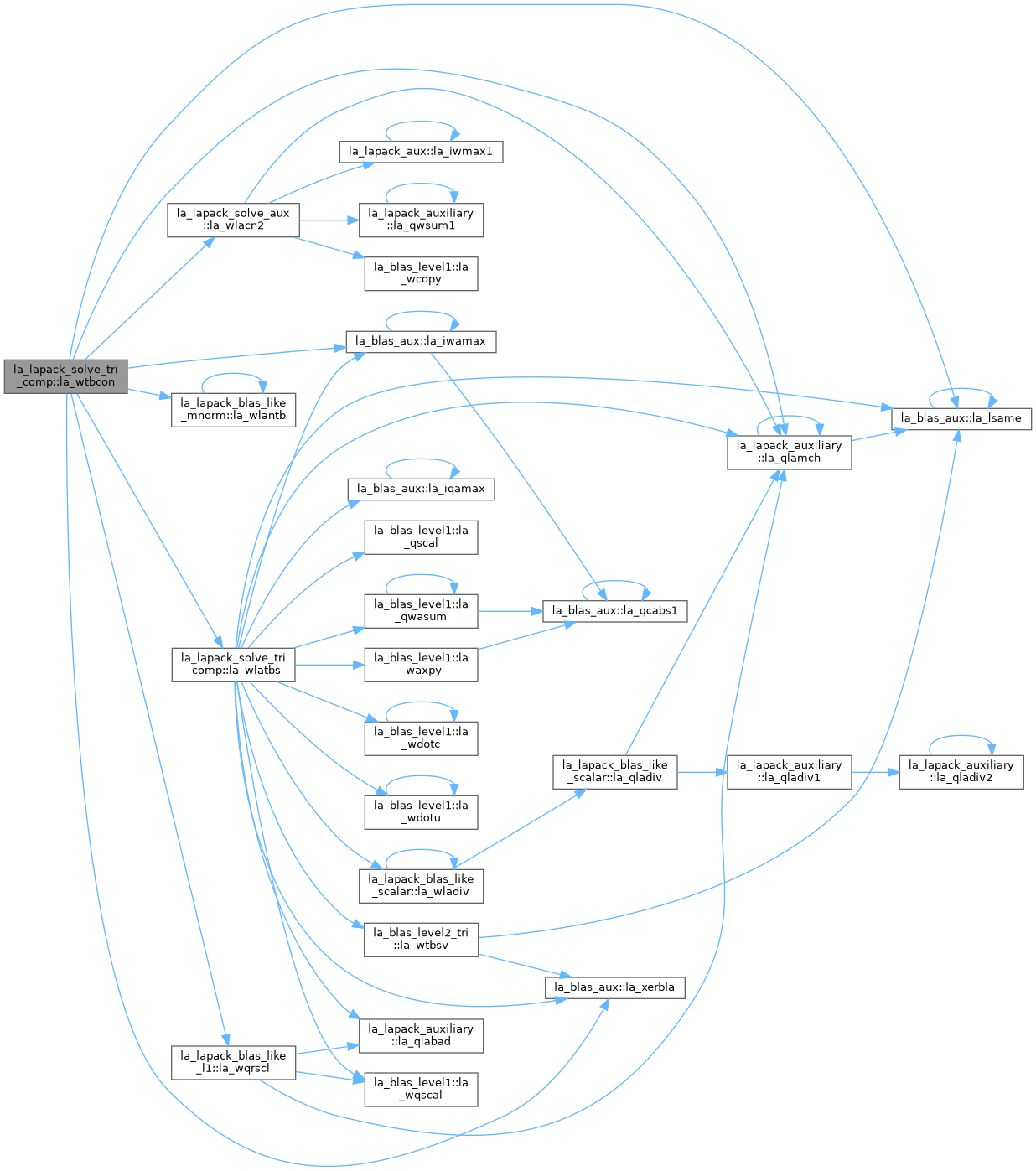
◆ la_wtbrfs()
| pure subroutine, public la_lapack_solve_tri_comp::la_wtbrfs | ( | character, intent(in) | uplo, |
| character, intent(in) | trans, | ||
| character, intent(in) | diag, | ||
| integer(ilp), intent(in) | n, | ||
| integer(ilp), intent(in) | kd, | ||
| integer(ilp), intent(in) | nrhs, | ||
| complex(qp), dimension(ldab,*), intent(in) | ab, | ||
| integer(ilp), intent(in) | ldab, | ||
| complex(qp), dimension(ldb,*), intent(in) | b, | ||
| integer(ilp), intent(in) | ldb, | ||
| complex(qp), dimension(ldx,*), intent(in) | x, | ||
| integer(ilp), intent(in) | ldx, | ||
| real(qp), dimension(*), intent(out) | ferr, | ||
| real(qp), dimension(*), intent(out) | berr, | ||
| complex(qp), dimension(*), intent(out) | work, | ||
| real(qp), dimension(*), intent(out) | rwork, | ||
| integer(ilp), intent(out) | info ) |
WTBRFS: provides error bounds and backward error estimates for the solution to a system of linear equations with a triangular band coefficient matrix. The solution matrix X must be computed by WTBTRS or some other means before entering this routine. WTBRFS does not do iterative refinement because doing so cannot improve the backward error.
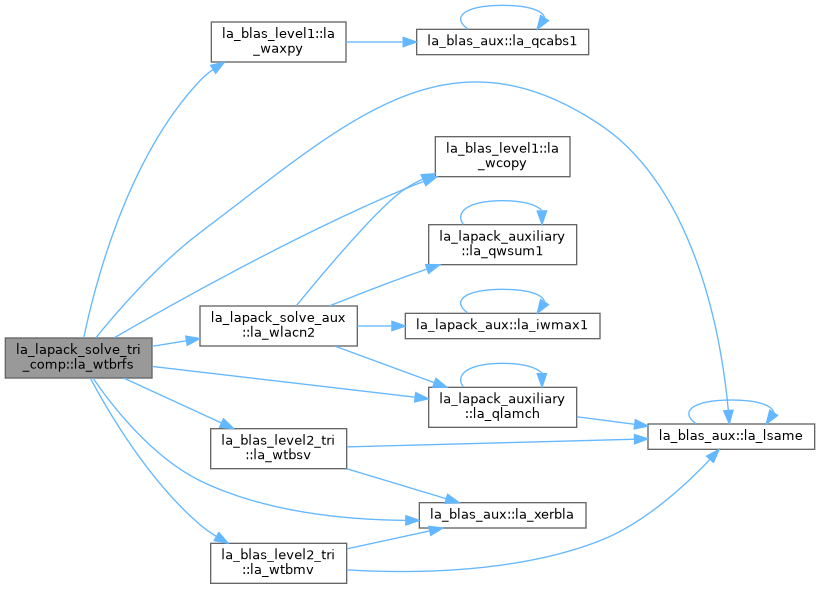
◆ la_wtbtrs()
| pure subroutine, public la_lapack_solve_tri_comp::la_wtbtrs | ( | character, intent(in) | uplo, |
| character, intent(in) | trans, | ||
| character, intent(in) | diag, | ||
| integer(ilp), intent(in) | n, | ||
| integer(ilp), intent(in) | kd, | ||
| integer(ilp), intent(in) | nrhs, | ||
| complex(qp), dimension(ldab,*), intent(in) | ab, | ||
| integer(ilp), intent(in) | ldab, | ||
| complex(qp), dimension(ldb,*), intent(inout) | b, | ||
| integer(ilp), intent(in) | ldb, | ||
| integer(ilp), intent(out) | info ) |
WTBTRS: solves a triangular system of the form A * X = B, A**T * X = B, or A**H * X = B, where A is a triangular band matrix of order N, and B is an N-by-NRHS matrix. A check is made to verify that A is nonsingular.
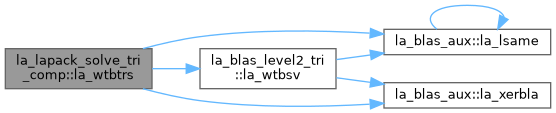
◆ la_wtftri()
| pure subroutine, public la_lapack_solve_tri_comp::la_wtftri | ( | character, intent(in) | transr, |
| character, intent(in) | uplo, | ||
| character, intent(in) | diag, | ||
| integer(ilp), intent(in) | n, | ||
| complex(qp), dimension(0:*), intent(inout) | a, | ||
| integer(ilp), intent(out) | info ) |
WTFTRI: computes the inverse of a triangular matrix A stored in RFP format. This is a Level 3 BLAS version of the algorithm.
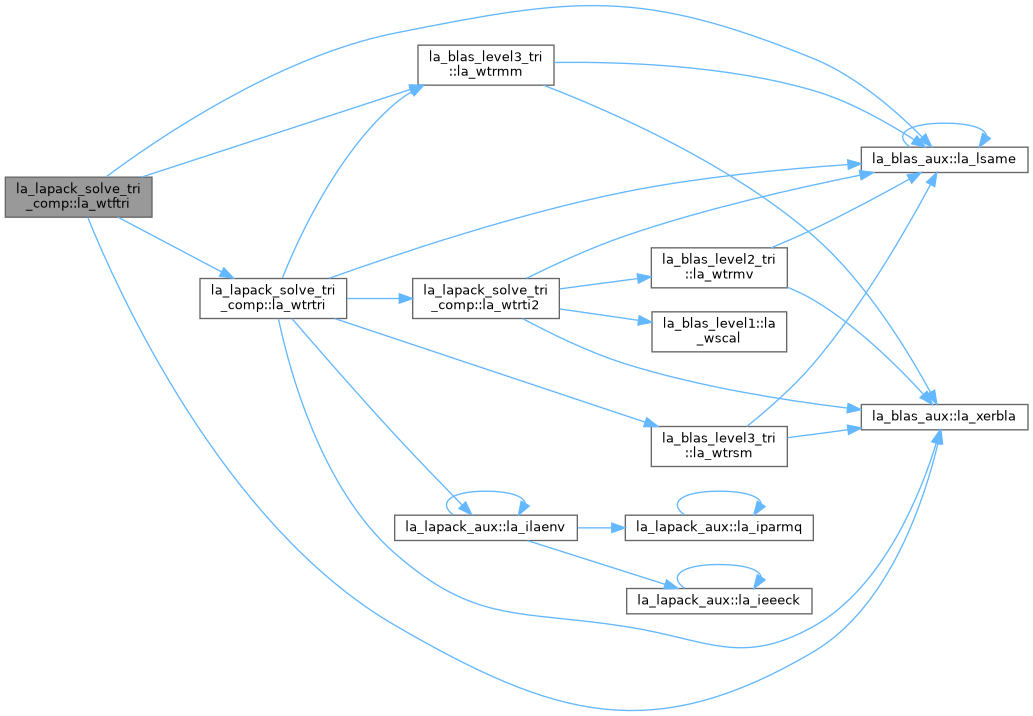
◆ la_wtpcon()
| subroutine, public la_lapack_solve_tri_comp::la_wtpcon | ( | character, intent(in) | norm, |
| character, intent(in) | uplo, | ||
| character, intent(in) | diag, | ||
| integer(ilp), intent(in) | n, | ||
| complex(qp), dimension(*), intent(in) | ap, | ||
| real(qp), intent(out) | rcond, | ||
| complex(qp), dimension(*), intent(out) | work, | ||
| real(qp), dimension(*), intent(out) | rwork, | ||
| integer(ilp), intent(out) | info ) |
WTPCON: estimates the reciprocal of the condition number of a packed triangular matrix A, in either the 1-norm or the infinity-norm. The norm of A is computed and an estimate is obtained for norm(inv(A)), then the reciprocal of the condition number is computed as RCOND = 1 / ( norm(A) * norm(inv(A)) ).
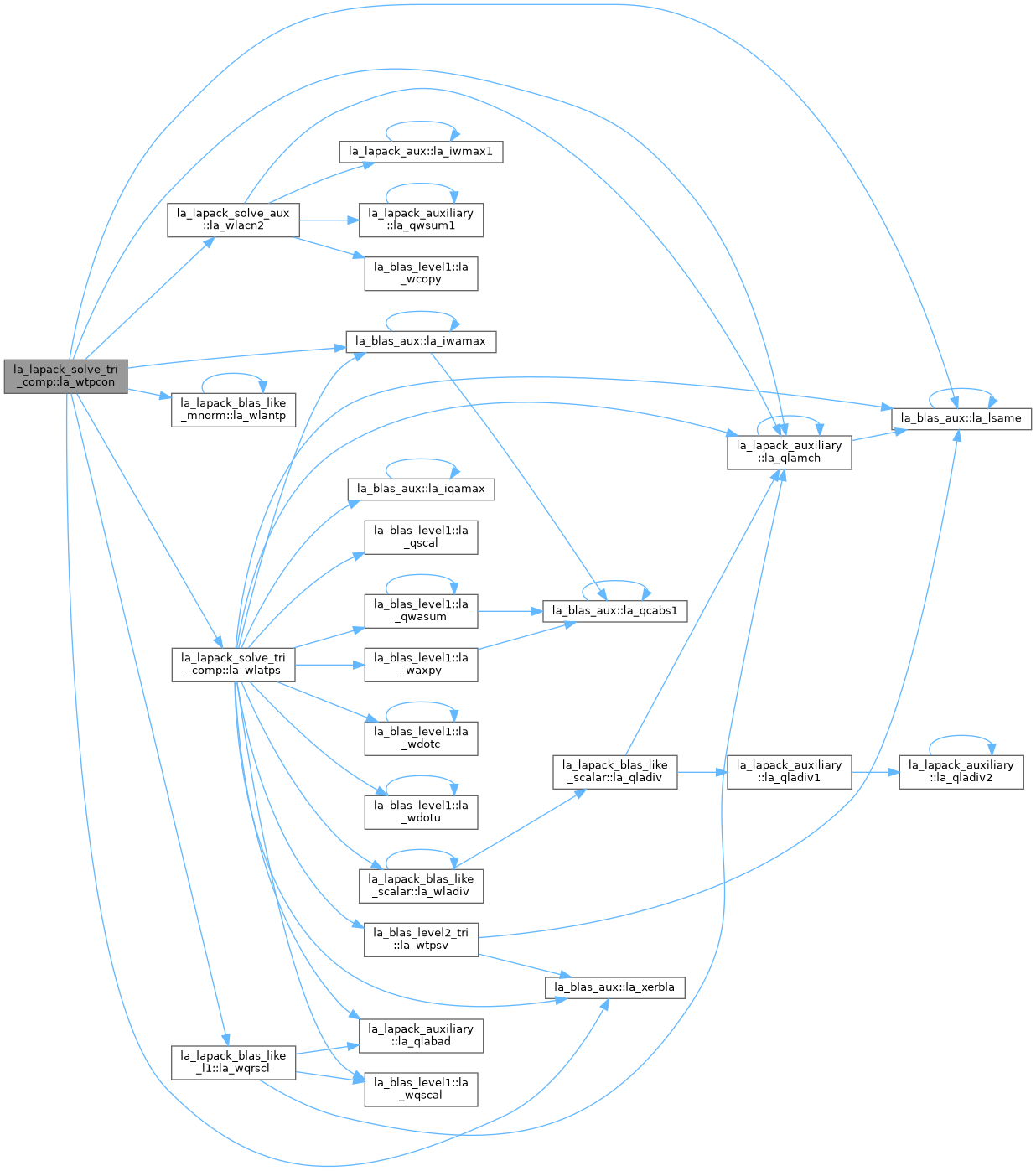
◆ la_wtprfs()
| pure subroutine, public la_lapack_solve_tri_comp::la_wtprfs | ( | character, intent(in) | uplo, |
| character, intent(in) | trans, | ||
| character, intent(in) | diag, | ||
| integer(ilp), intent(in) | n, | ||
| integer(ilp), intent(in) | nrhs, | ||
| complex(qp), dimension(*), intent(in) | ap, | ||
| complex(qp), dimension(ldb,*), intent(in) | b, | ||
| integer(ilp), intent(in) | ldb, | ||
| complex(qp), dimension(ldx,*), intent(in) | x, | ||
| integer(ilp), intent(in) | ldx, | ||
| real(qp), dimension(*), intent(out) | ferr, | ||
| real(qp), dimension(*), intent(out) | berr, | ||
| complex(qp), dimension(*), intent(out) | work, | ||
| real(qp), dimension(*), intent(out) | rwork, | ||
| integer(ilp), intent(out) | info ) |
WTPRFS: provides error bounds and backward error estimates for the solution to a system of linear equations with a triangular packed coefficient matrix. The solution matrix X must be computed by WTPTRS or some other means before entering this routine. WTPRFS does not do iterative refinement because doing so cannot improve the backward error.
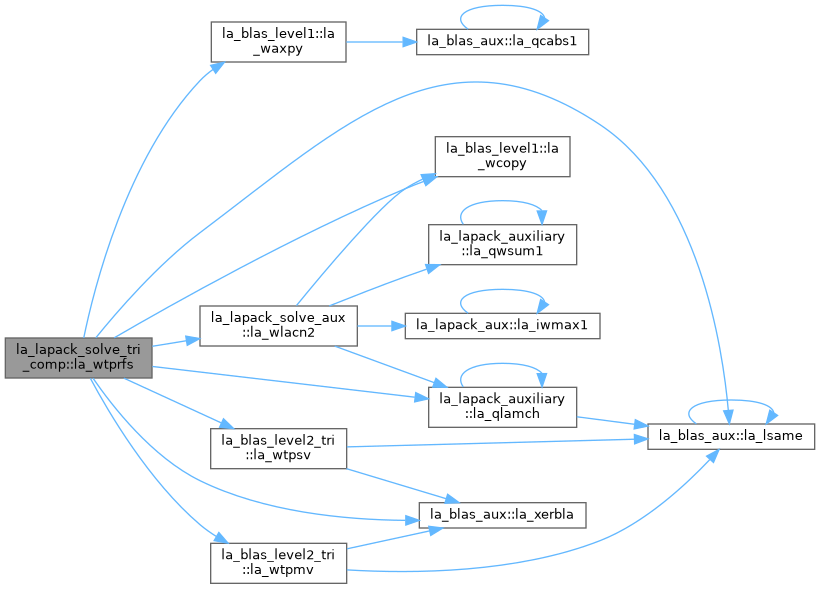
◆ la_wtptri()
| pure subroutine, public la_lapack_solve_tri_comp::la_wtptri | ( | character, intent(in) | uplo, |
| character, intent(in) | diag, | ||
| integer(ilp), intent(in) | n, | ||
| complex(qp), dimension(*), intent(inout) | ap, | ||
| integer(ilp), intent(out) | info ) |
WTPTRI: computes the inverse of a complex upper or lower triangular matrix A stored in packed format.
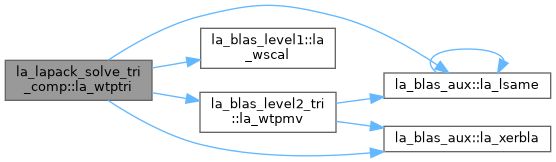
◆ la_wtptrs()
| pure subroutine, public la_lapack_solve_tri_comp::la_wtptrs | ( | character, intent(in) | uplo, |
| character, intent(in) | trans, | ||
| character, intent(in) | diag, | ||
| integer(ilp), intent(in) | n, | ||
| integer(ilp), intent(in) | nrhs, | ||
| complex(qp), dimension(*), intent(in) | ap, | ||
| complex(qp), dimension(ldb,*), intent(inout) | b, | ||
| integer(ilp), intent(in) | ldb, | ||
| integer(ilp), intent(out) | info ) |
WTPTRS: solves a triangular system of the form A * X = B, A**T * X = B, or A**H * X = B, where A is a triangular matrix of order N stored in packed format, and B is an N-by-NRHS matrix. A check is made to verify that A is nonsingular.
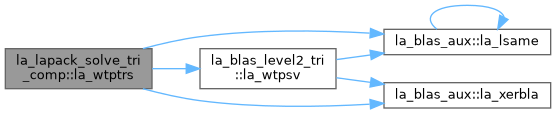
◆ la_wtrcon()
| subroutine, public la_lapack_solve_tri_comp::la_wtrcon | ( | character, intent(in) | norm, |
| character, intent(in) | uplo, | ||
| character, intent(in) | diag, | ||
| integer(ilp), intent(in) | n, | ||
| complex(qp), dimension(lda,*), intent(in) | a, | ||
| integer(ilp), intent(in) | lda, | ||
| real(qp), intent(out) | rcond, | ||
| complex(qp), dimension(*), intent(out) | work, | ||
| real(qp), dimension(*), intent(out) | rwork, | ||
| integer(ilp), intent(out) | info ) |
WTRCON: estimates the reciprocal of the condition number of a triangular matrix A, in either the 1-norm or the infinity-norm. The norm of A is computed and an estimate is obtained for norm(inv(A)), then the reciprocal of the condition number is computed as RCOND = 1 / ( norm(A) * norm(inv(A)) ).
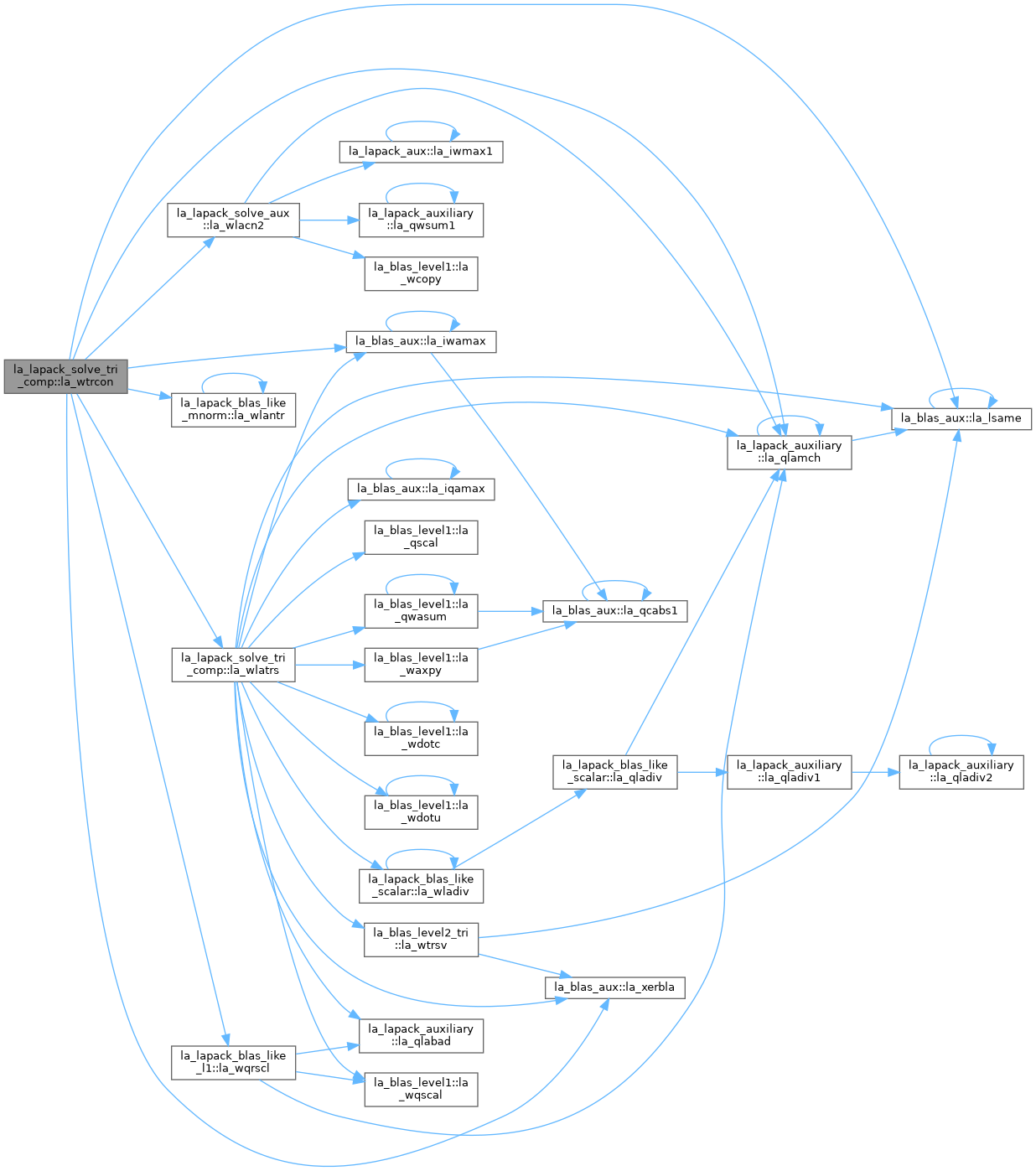
◆ la_wtrrfs()
| pure subroutine, public la_lapack_solve_tri_comp::la_wtrrfs | ( | character, intent(in) | uplo, |
| character, intent(in) | trans, | ||
| character, intent(in) | diag, | ||
| integer(ilp), intent(in) | n, | ||
| integer(ilp), intent(in) | nrhs, | ||
| complex(qp), dimension(lda,*), intent(in) | a, | ||
| integer(ilp), intent(in) | lda, | ||
| complex(qp), dimension(ldb,*), intent(in) | b, | ||
| integer(ilp), intent(in) | ldb, | ||
| complex(qp), dimension(ldx,*), intent(in) | x, | ||
| integer(ilp), intent(in) | ldx, | ||
| real(qp), dimension(*), intent(out) | ferr, | ||
| real(qp), dimension(*), intent(out) | berr, | ||
| complex(qp), dimension(*), intent(out) | work, | ||
| real(qp), dimension(*), intent(out) | rwork, | ||
| integer(ilp), intent(out) | info ) |
WTRRFS: provides error bounds and backward error estimates for the solution to a system of linear equations with a triangular coefficient matrix. The solution matrix X must be computed by WTRTRS or some other means before entering this routine. WTRRFS does not do iterative refinement because doing so cannot improve the backward error.
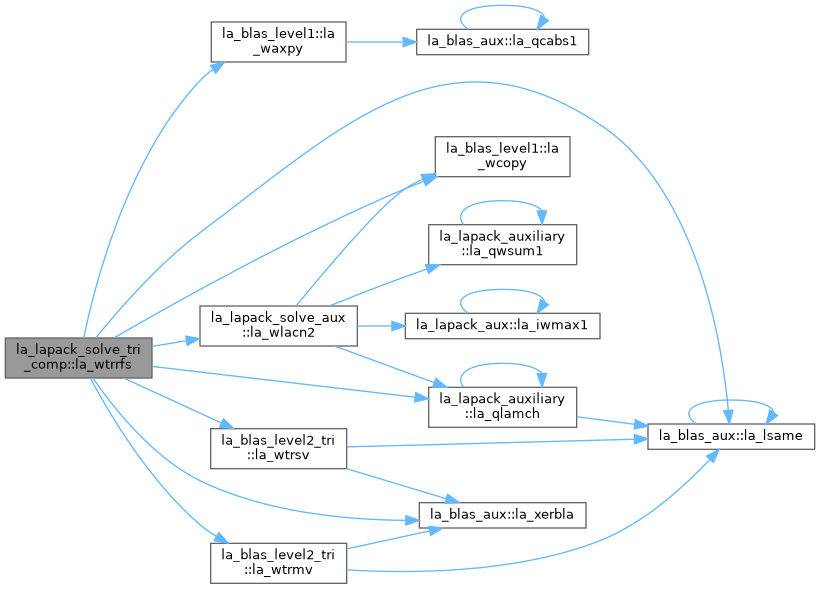
◆ la_wtrti2()
| pure subroutine, public la_lapack_solve_tri_comp::la_wtrti2 | ( | character, intent(in) | uplo, |
| character, intent(in) | diag, | ||
| integer(ilp), intent(in) | n, | ||
| complex(qp), dimension(lda,*), intent(inout) | a, | ||
| integer(ilp), intent(in) | lda, | ||
| integer(ilp), intent(out) | info ) |
WTRTI2: computes the inverse of a complex upper or lower triangular matrix. This is the Level 2 BLAS version of the algorithm.
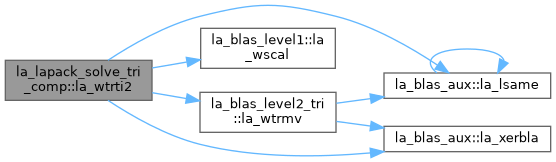
◆ la_wtrtri()
| pure subroutine, public la_lapack_solve_tri_comp::la_wtrtri | ( | character, intent(in) | uplo, |
| character, intent(in) | diag, | ||
| integer(ilp), intent(in) | n, | ||
| complex(qp), dimension(lda,*), intent(inout) | a, | ||
| integer(ilp), intent(in) | lda, | ||
| integer(ilp), intent(out) | info ) |
WTRTRI: computes the inverse of a complex upper or lower triangular matrix A. This is the Level 3 BLAS version of the algorithm.
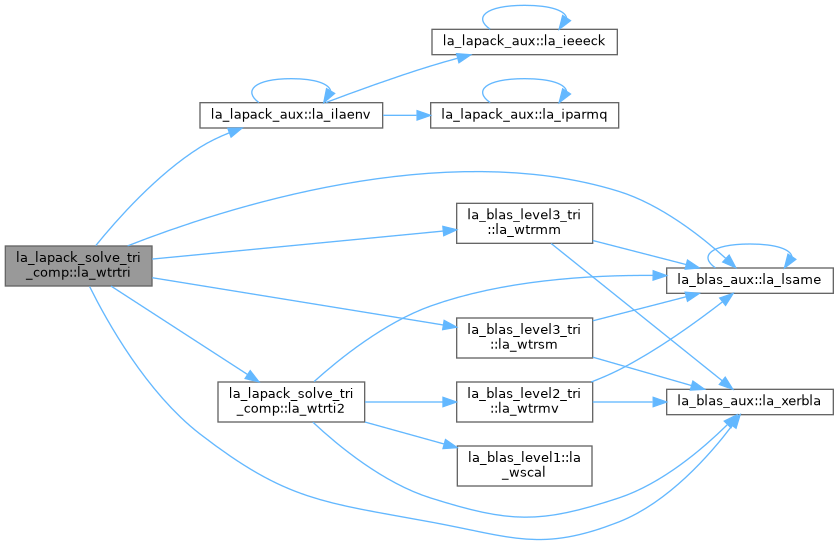
◆ la_wtrtrs()
| pure subroutine, public la_lapack_solve_tri_comp::la_wtrtrs | ( | character, intent(in) | uplo, |
| character, intent(in) | trans, | ||
| character, intent(in) | diag, | ||
| integer(ilp), intent(in) | n, | ||
| integer(ilp), intent(in) | nrhs, | ||
| complex(qp), dimension(lda,*), intent(in) | a, | ||
| integer(ilp), intent(in) | lda, | ||
| complex(qp), dimension(ldb,*), intent(inout) | b, | ||
| integer(ilp), intent(in) | ldb, | ||
| integer(ilp), intent(out) | info ) |
WTRTRS: solves a triangular system of the form A * X = B, A**T * X = B, or A**H * X = B, where A is a triangular matrix of order N, and B is an N-by-NRHS matrix. A check is made to verify that A is nonsingular.
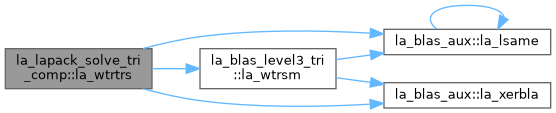
◆ la_zlatbs()
| pure subroutine, public la_lapack_solve_tri_comp::la_zlatbs | ( | character, intent(in) | uplo, |
| character, intent(in) | trans, | ||
| character, intent(in) | diag, | ||
| character, intent(in) | normin, | ||
| integer(ilp), intent(in) | n, | ||
| integer(ilp), intent(in) | kd, | ||
| complex(dp), dimension(ldab,*), intent(in) | ab, | ||
| integer(ilp), intent(in) | ldab, | ||
| complex(dp), dimension(*), intent(inout) | x, | ||
| real(dp), intent(out) | scale, | ||
| real(dp), dimension(*), intent(inout) | cnorm, | ||
| integer(ilp), intent(out) | info ) |
ZLATBS: solves one of the triangular systems A * x = s*b, A**T * x = s*b, or A**H * x = s*b, with scaling to prevent overflow, where A is an upper or lower triangular band matrix. Here A**T denotes the transpose of A, x and b are n-element vectors, and s is a scaling factor, usually less than or equal to 1, chosen so that the components of x will be less than the overflow threshold. If the unscaled problem will not cause overflow, the Level 2 BLAS routine ZTBSV is called. If the matrix A is singular (A(j,j) = 0 for some j), then s is set to 0 and a non-trivial solution to A*x = 0 is returned.
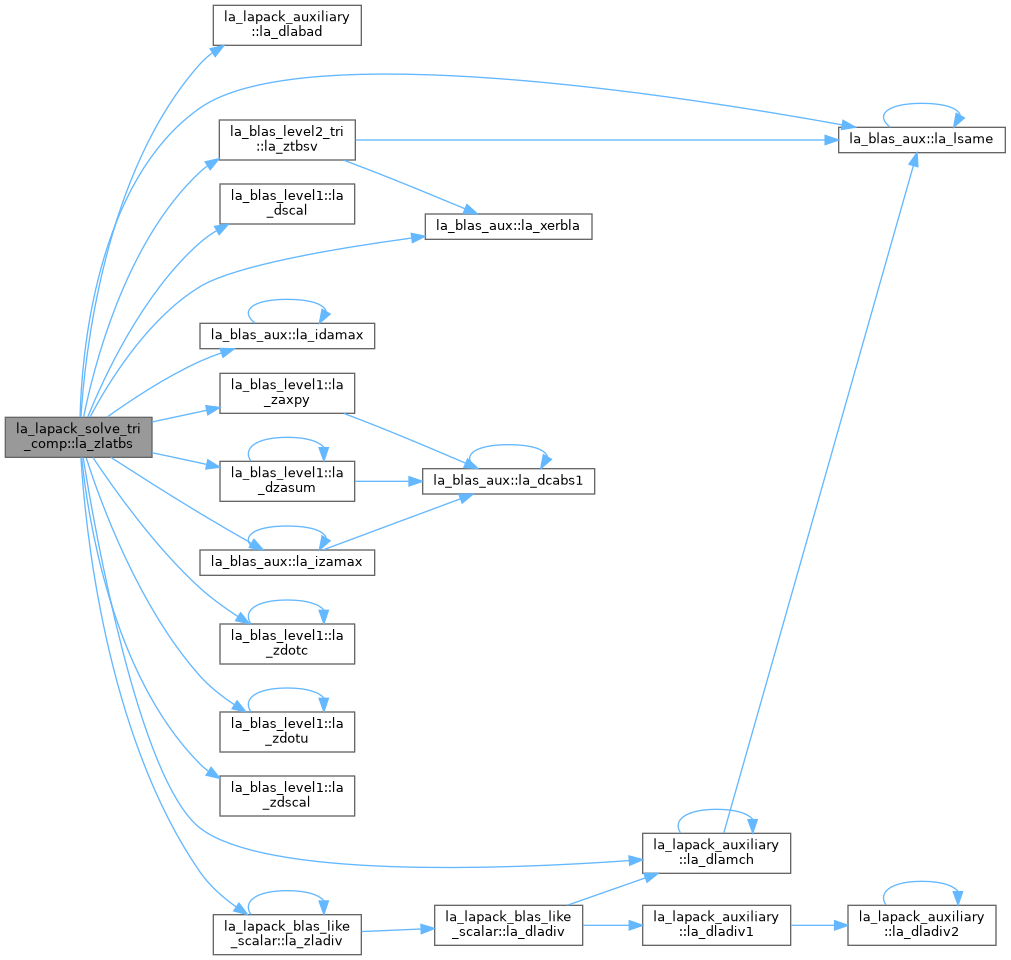
◆ la_zlatps()
| pure subroutine, public la_lapack_solve_tri_comp::la_zlatps | ( | character, intent(in) | uplo, |
| character, intent(in) | trans, | ||
| character, intent(in) | diag, | ||
| character, intent(in) | normin, | ||
| integer(ilp), intent(in) | n, | ||
| complex(dp), dimension(*), intent(in) | ap, | ||
| complex(dp), dimension(*), intent(inout) | x, | ||
| real(dp), intent(out) | scale, | ||
| real(dp), dimension(*), intent(inout) | cnorm, | ||
| integer(ilp), intent(out) | info ) |
ZLATPS: solves one of the triangular systems A * x = s*b, A**T * x = s*b, or A**H * x = s*b, with scaling to prevent overflow, where A is an upper or lower triangular matrix stored in packed form. Here A**T denotes the transpose of A, A**H denotes the conjugate transpose of A, x and b are n-element vectors, and s is a scaling factor, usually less than or equal to 1, chosen so that the components of x will be less than the overflow threshold. If the unscaled problem will not cause overflow, the Level 2 BLAS routine ZTPSV is called. If the matrix A is singular (A(j,j) = 0 for some j), then s is set to 0 and a non-trivial solution to A*x = 0 is returned.
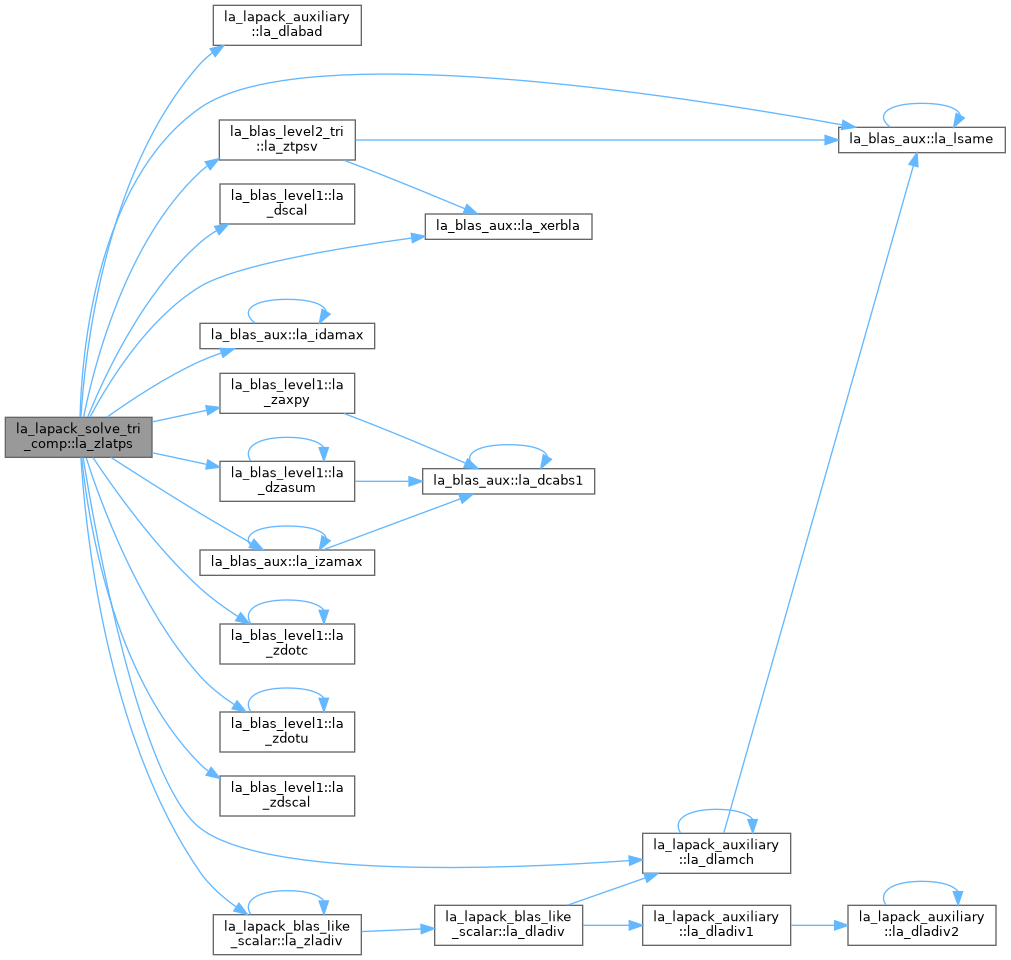
◆ la_zlatrs()
| pure subroutine, public la_lapack_solve_tri_comp::la_zlatrs | ( | character, intent(in) | uplo, |
| character, intent(in) | trans, | ||
| character, intent(in) | diag, | ||
| character, intent(in) | normin, | ||
| integer(ilp), intent(in) | n, | ||
| complex(dp), dimension(lda,*), intent(in) | a, | ||
| integer(ilp), intent(in) | lda, | ||
| complex(dp), dimension(*), intent(inout) | x, | ||
| real(dp), intent(out) | scale, | ||
| real(dp), dimension(*), intent(inout) | cnorm, | ||
| integer(ilp), intent(out) | info ) |
ZLATRS: solves one of the triangular systems A * x = s*b, A**T * x = s*b, or A**H * x = s*b, with scaling to prevent overflow. Here A is an upper or lower triangular matrix, A**T denotes the transpose of A, A**H denotes the conjugate transpose of A, x and b are n-element vectors, and s is a scaling factor, usually less than or equal to 1, chosen so that the components of x will be less than the overflow threshold. If the unscaled problem will not cause overflow, the Level 2 BLAS routine ZTRSV is called. If the matrix A is singular (A(j,j) = 0 for some j), then s is set to 0 and a non-trivial solution to A*x = 0 is returned.
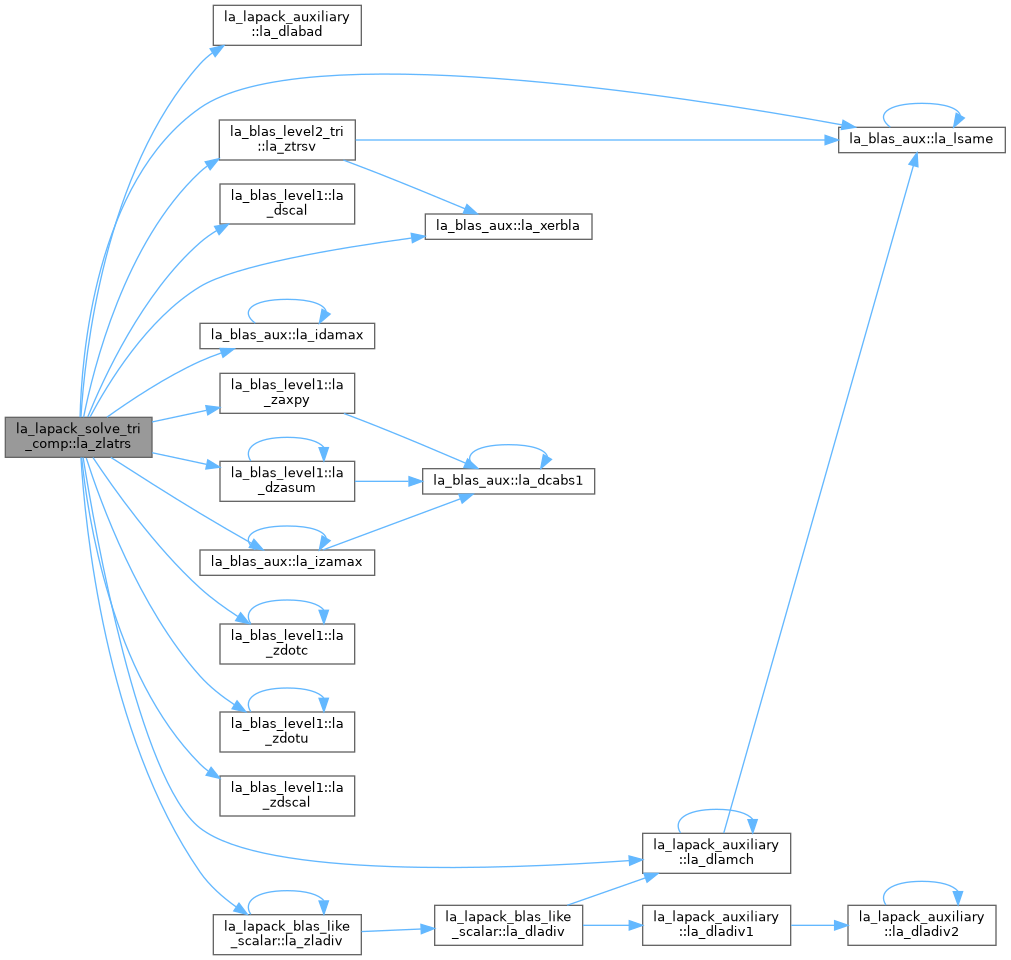
◆ la_zlauu2()
| pure subroutine, public la_lapack_solve_tri_comp::la_zlauu2 | ( | character, intent(in) | uplo, |
| integer(ilp), intent(in) | n, | ||
| complex(dp), dimension(lda,*), intent(inout) | a, | ||
| integer(ilp), intent(in) | lda, | ||
| integer(ilp), intent(out) | info ) |
ZLAUU2: computes the product U * U**H or L**H * L, where the triangular factor U or L is stored in the upper or lower triangular part of the array A. If UPLO = 'U' or 'u' then the upper triangle of the result is stored, overwriting the factor U in A. If UPLO = 'L' or 'l' then the lower triangle of the result is stored, overwriting the factor L in A. This is the unblocked form of the algorithm, calling Level 2 BLAS.
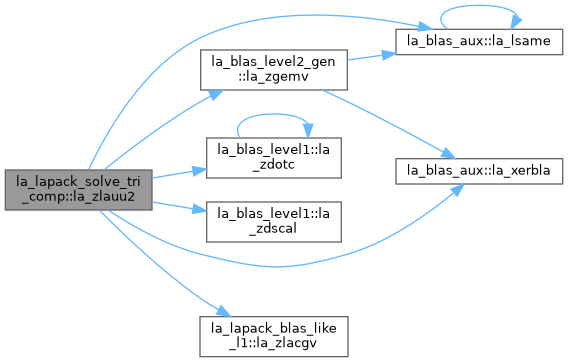
◆ la_zlauum()
| pure subroutine, public la_lapack_solve_tri_comp::la_zlauum | ( | character, intent(in) | uplo, |
| integer(ilp), intent(in) | n, | ||
| complex(dp), dimension(lda,*), intent(inout) | a, | ||
| integer(ilp), intent(in) | lda, | ||
| integer(ilp), intent(out) | info ) |
ZLAUUM: computes the product U * U**H or L**H * L, where the triangular factor U or L is stored in the upper or lower triangular part of the array A. If UPLO = 'U' or 'u' then the upper triangle of the result is stored, overwriting the factor U in A. If UPLO = 'L' or 'l' then the lower triangle of the result is stored, overwriting the factor L in A. This is the blocked form of the algorithm, calling Level 3 BLAS.
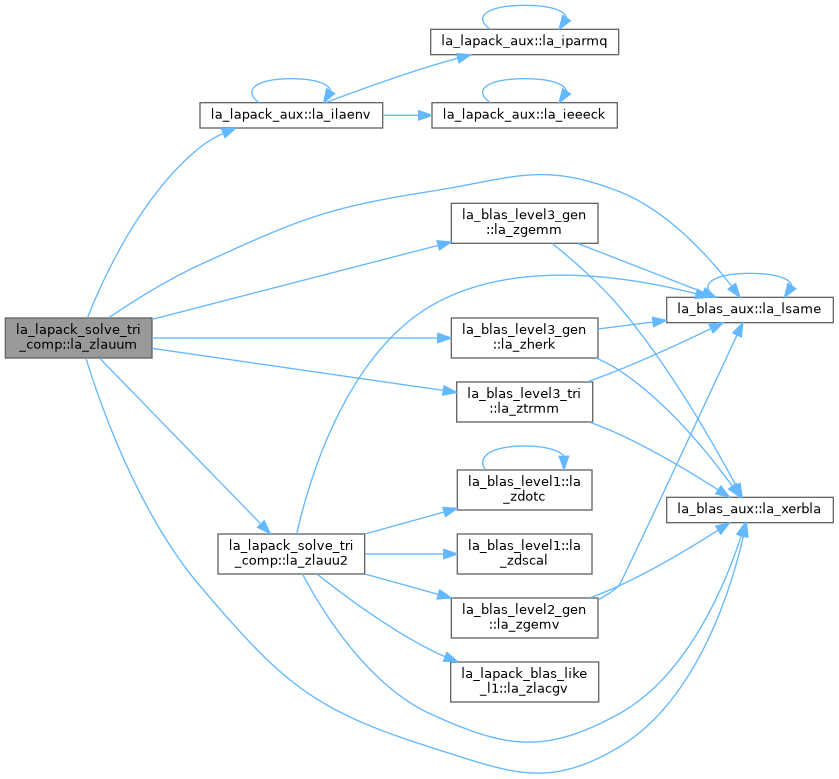
◆ la_ztbcon()
| subroutine, public la_lapack_solve_tri_comp::la_ztbcon | ( | character, intent(in) | norm, |
| character, intent(in) | uplo, | ||
| character, intent(in) | diag, | ||
| integer(ilp), intent(in) | n, | ||
| integer(ilp), intent(in) | kd, | ||
| complex(dp), dimension(ldab,*), intent(in) | ab, | ||
| integer(ilp), intent(in) | ldab, | ||
| real(dp), intent(out) | rcond, | ||
| complex(dp), dimension(*), intent(out) | work, | ||
| real(dp), dimension(*), intent(out) | rwork, | ||
| integer(ilp), intent(out) | info ) |
ZTBCON: estimates the reciprocal of the condition number of a triangular band matrix A, in either the 1-norm or the infinity-norm. The norm of A is computed and an estimate is obtained for norm(inv(A)), then the reciprocal of the condition number is computed as RCOND = 1 / ( norm(A) * norm(inv(A)) ).
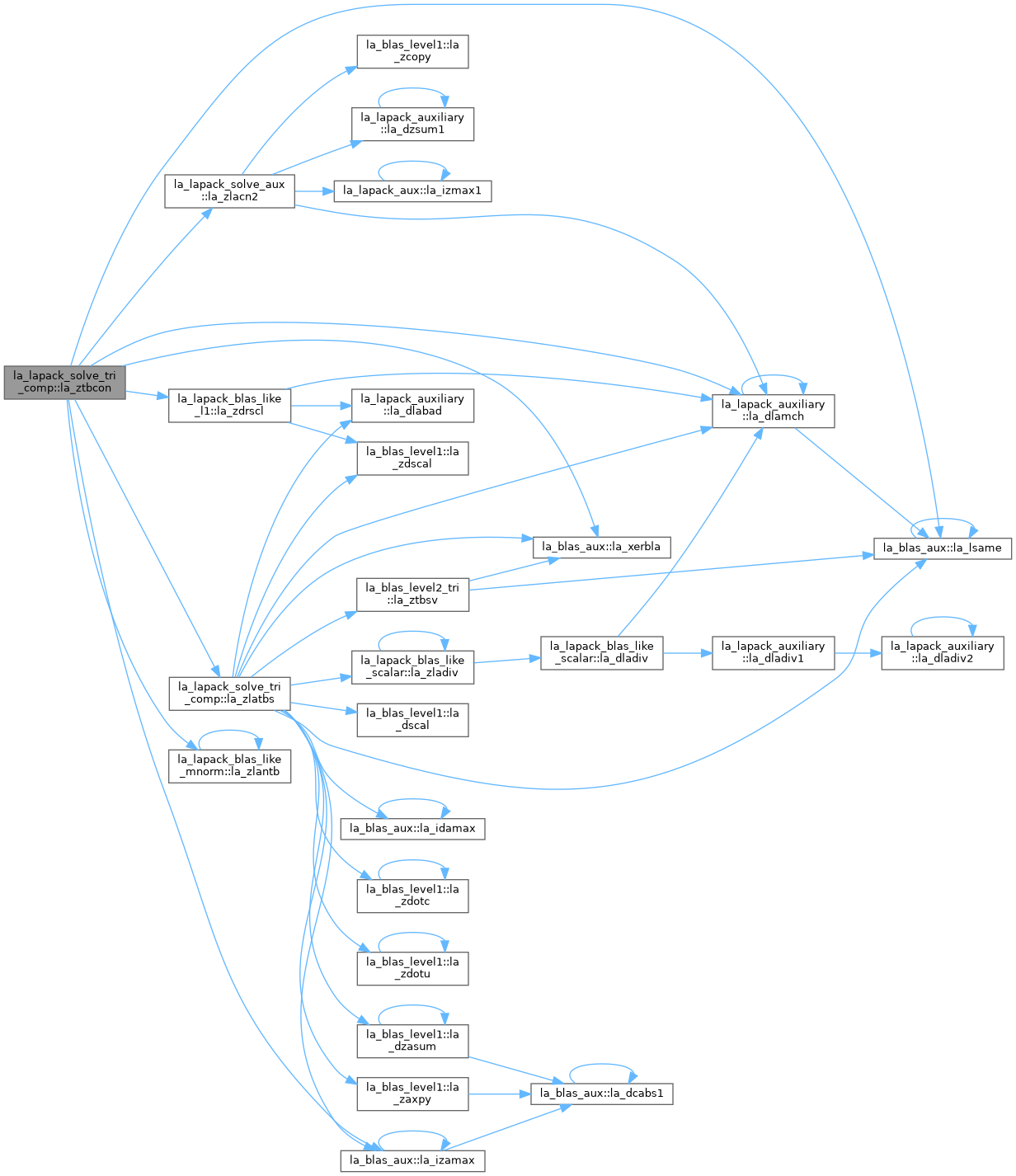
◆ la_ztbrfs()
| pure subroutine, public la_lapack_solve_tri_comp::la_ztbrfs | ( | character, intent(in) | uplo, |
| character, intent(in) | trans, | ||
| character, intent(in) | diag, | ||
| integer(ilp), intent(in) | n, | ||
| integer(ilp), intent(in) | kd, | ||
| integer(ilp), intent(in) | nrhs, | ||
| complex(dp), dimension(ldab,*), intent(in) | ab, | ||
| integer(ilp), intent(in) | ldab, | ||
| complex(dp), dimension(ldb,*), intent(in) | b, | ||
| integer(ilp), intent(in) | ldb, | ||
| complex(dp), dimension(ldx,*), intent(in) | x, | ||
| integer(ilp), intent(in) | ldx, | ||
| real(dp), dimension(*), intent(out) | ferr, | ||
| real(dp), dimension(*), intent(out) | berr, | ||
| complex(dp), dimension(*), intent(out) | work, | ||
| real(dp), dimension(*), intent(out) | rwork, | ||
| integer(ilp), intent(out) | info ) |
ZTBRFS: provides error bounds and backward error estimates for the solution to a system of linear equations with a triangular band coefficient matrix. The solution matrix X must be computed by ZTBTRS or some other means before entering this routine. ZTBRFS does not do iterative refinement because doing so cannot improve the backward error.
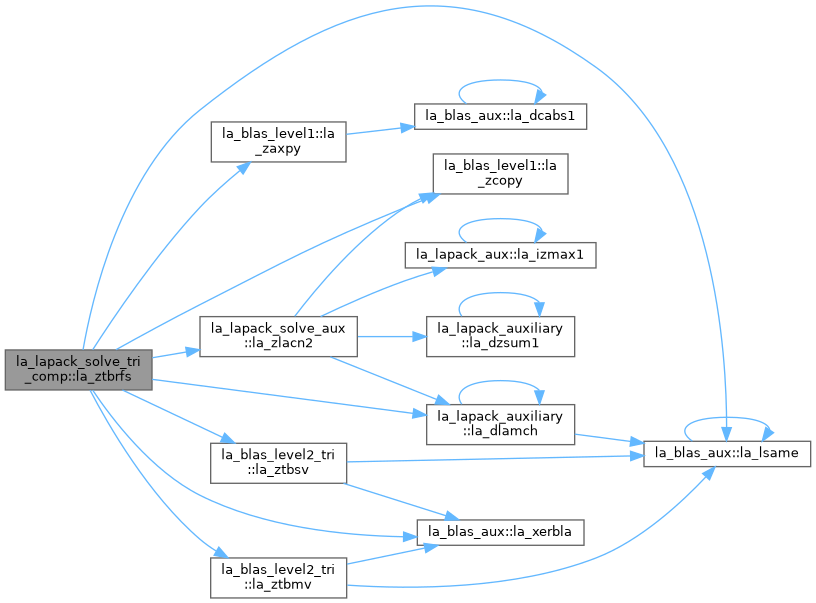
◆ la_ztbtrs()
| pure subroutine, public la_lapack_solve_tri_comp::la_ztbtrs | ( | character, intent(in) | uplo, |
| character, intent(in) | trans, | ||
| character, intent(in) | diag, | ||
| integer(ilp), intent(in) | n, | ||
| integer(ilp), intent(in) | kd, | ||
| integer(ilp), intent(in) | nrhs, | ||
| complex(dp), dimension(ldab,*), intent(in) | ab, | ||
| integer(ilp), intent(in) | ldab, | ||
| complex(dp), dimension(ldb,*), intent(inout) | b, | ||
| integer(ilp), intent(in) | ldb, | ||
| integer(ilp), intent(out) | info ) |
ZTBTRS: solves a triangular system of the form A * X = B, A**T * X = B, or A**H * X = B, where A is a triangular band matrix of order N, and B is an N-by-NRHS matrix. A check is made to verify that A is nonsingular.
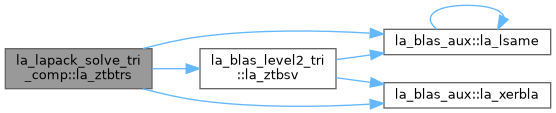
◆ la_ztftri()
| pure subroutine, public la_lapack_solve_tri_comp::la_ztftri | ( | character, intent(in) | transr, |
| character, intent(in) | uplo, | ||
| character, intent(in) | diag, | ||
| integer(ilp), intent(in) | n, | ||
| complex(dp), dimension(0:*), intent(inout) | a, | ||
| integer(ilp), intent(out) | info ) |
ZTFTRI: computes the inverse of a triangular matrix A stored in RFP format. This is a Level 3 BLAS version of the algorithm.
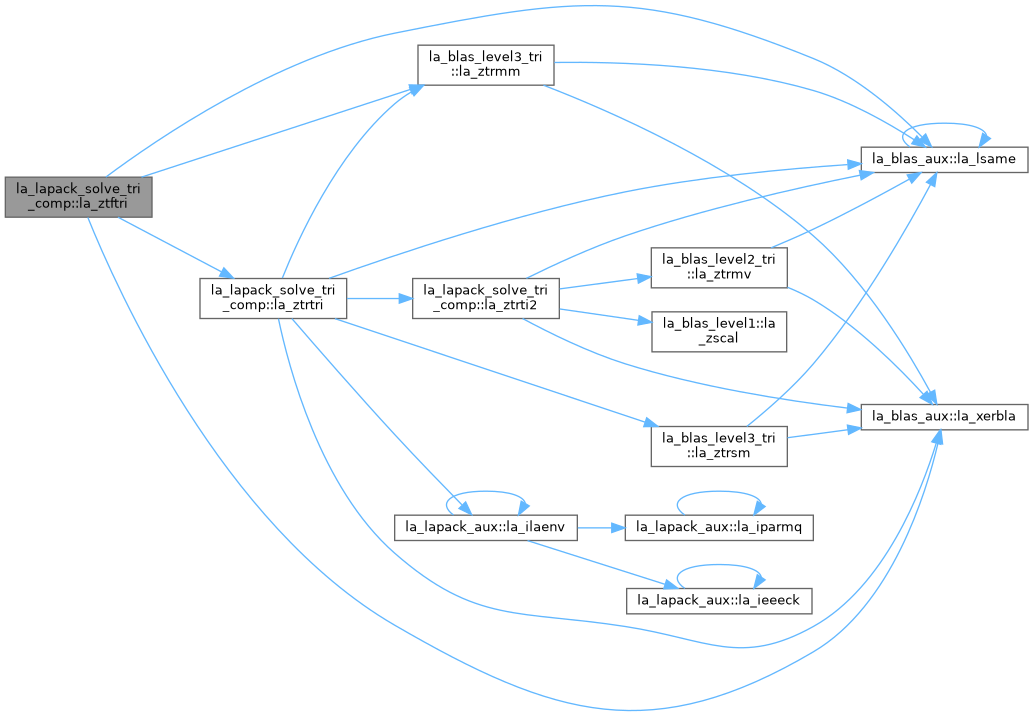
◆ la_ztpcon()
| subroutine, public la_lapack_solve_tri_comp::la_ztpcon | ( | character, intent(in) | norm, |
| character, intent(in) | uplo, | ||
| character, intent(in) | diag, | ||
| integer(ilp), intent(in) | n, | ||
| complex(dp), dimension(*), intent(in) | ap, | ||
| real(dp), intent(out) | rcond, | ||
| complex(dp), dimension(*), intent(out) | work, | ||
| real(dp), dimension(*), intent(out) | rwork, | ||
| integer(ilp), intent(out) | info ) |
ZTPCON: estimates the reciprocal of the condition number of a packed triangular matrix A, in either the 1-norm or the infinity-norm. The norm of A is computed and an estimate is obtained for norm(inv(A)), then the reciprocal of the condition number is computed as RCOND = 1 / ( norm(A) * norm(inv(A)) ).
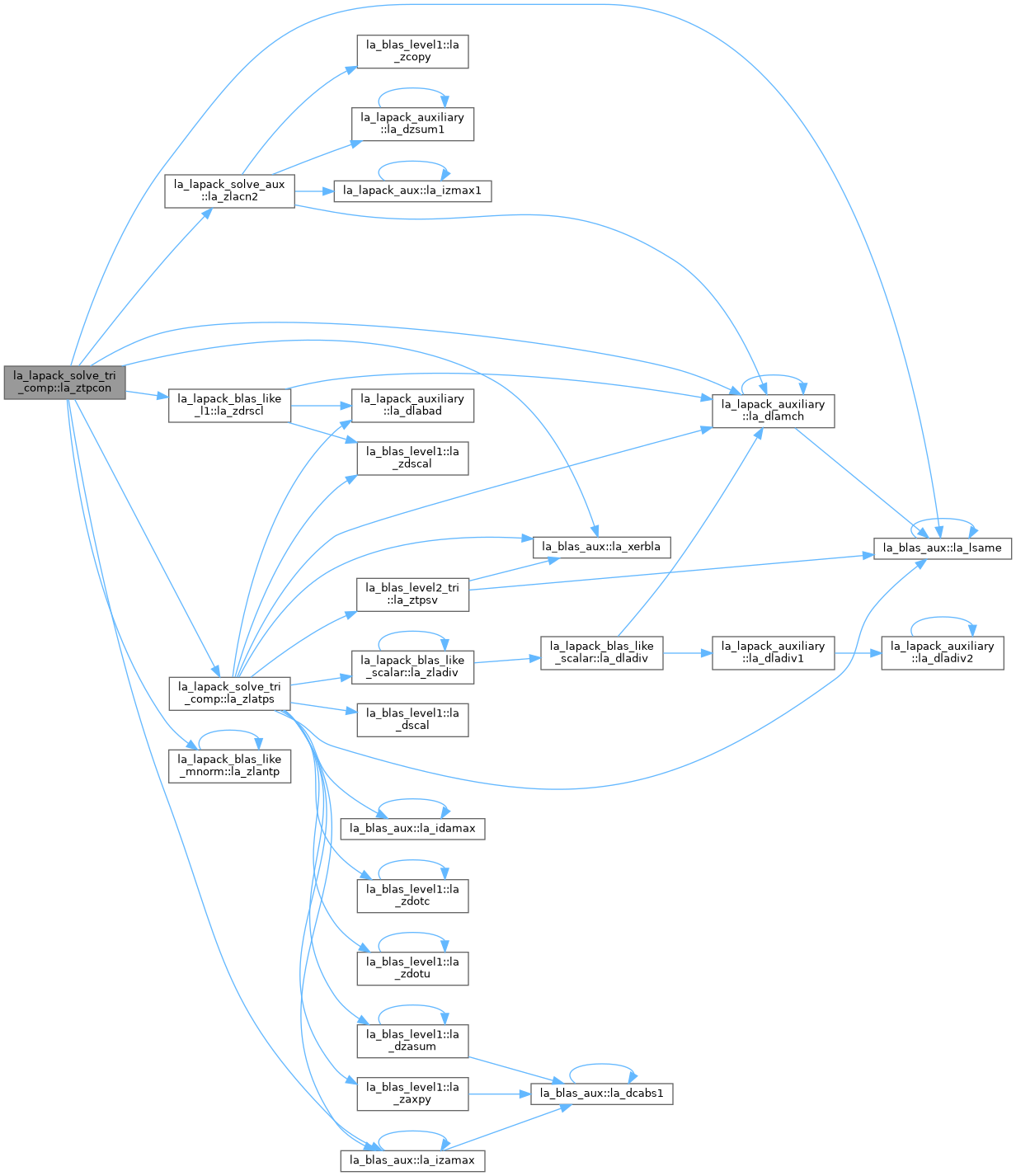
◆ la_ztprfs()
| pure subroutine, public la_lapack_solve_tri_comp::la_ztprfs | ( | character, intent(in) | uplo, |
| character, intent(in) | trans, | ||
| character, intent(in) | diag, | ||
| integer(ilp), intent(in) | n, | ||
| integer(ilp), intent(in) | nrhs, | ||
| complex(dp), dimension(*), intent(in) | ap, | ||
| complex(dp), dimension(ldb,*), intent(in) | b, | ||
| integer(ilp), intent(in) | ldb, | ||
| complex(dp), dimension(ldx,*), intent(in) | x, | ||
| integer(ilp), intent(in) | ldx, | ||
| real(dp), dimension(*), intent(out) | ferr, | ||
| real(dp), dimension(*), intent(out) | berr, | ||
| complex(dp), dimension(*), intent(out) | work, | ||
| real(dp), dimension(*), intent(out) | rwork, | ||
| integer(ilp), intent(out) | info ) |
ZTPRFS: provides error bounds and backward error estimates for the solution to a system of linear equations with a triangular packed coefficient matrix. The solution matrix X must be computed by ZTPTRS or some other means before entering this routine. ZTPRFS does not do iterative refinement because doing so cannot improve the backward error.
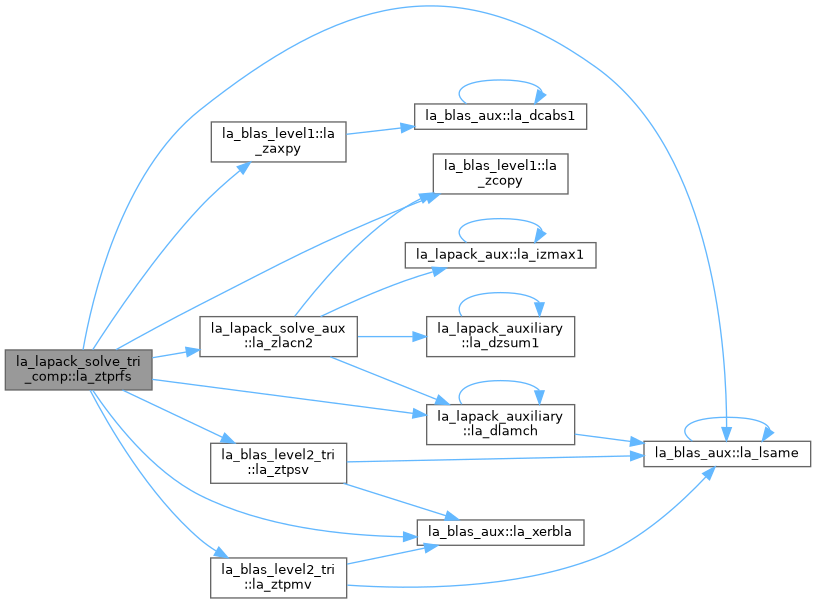
◆ la_ztptri()
| pure subroutine, public la_lapack_solve_tri_comp::la_ztptri | ( | character, intent(in) | uplo, |
| character, intent(in) | diag, | ||
| integer(ilp), intent(in) | n, | ||
| complex(dp), dimension(*), intent(inout) | ap, | ||
| integer(ilp), intent(out) | info ) |
ZTPTRI: computes the inverse of a complex upper or lower triangular matrix A stored in packed format.
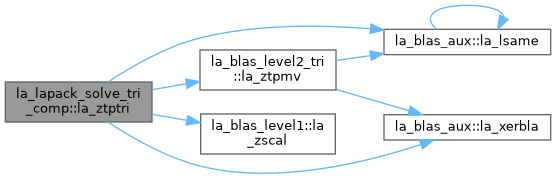
◆ la_ztptrs()
| pure subroutine, public la_lapack_solve_tri_comp::la_ztptrs | ( | character, intent(in) | uplo, |
| character, intent(in) | trans, | ||
| character, intent(in) | diag, | ||
| integer(ilp), intent(in) | n, | ||
| integer(ilp), intent(in) | nrhs, | ||
| complex(dp), dimension(*), intent(in) | ap, | ||
| complex(dp), dimension(ldb,*), intent(inout) | b, | ||
| integer(ilp), intent(in) | ldb, | ||
| integer(ilp), intent(out) | info ) |
ZTPTRS: solves a triangular system of the form A * X = B, A**T * X = B, or A**H * X = B, where A is a triangular matrix of order N stored in packed format, and B is an N-by-NRHS matrix. A check is made to verify that A is nonsingular.
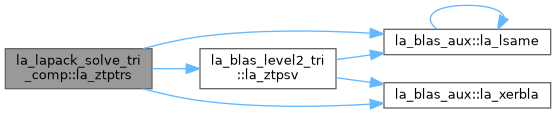
◆ la_ztrcon()
| subroutine, public la_lapack_solve_tri_comp::la_ztrcon | ( | character, intent(in) | norm, |
| character, intent(in) | uplo, | ||
| character, intent(in) | diag, | ||
| integer(ilp), intent(in) | n, | ||
| complex(dp), dimension(lda,*), intent(in) | a, | ||
| integer(ilp), intent(in) | lda, | ||
| real(dp), intent(out) | rcond, | ||
| complex(dp), dimension(*), intent(out) | work, | ||
| real(dp), dimension(*), intent(out) | rwork, | ||
| integer(ilp), intent(out) | info ) |
ZTRCON: estimates the reciprocal of the condition number of a triangular matrix A, in either the 1-norm or the infinity-norm. The norm of A is computed and an estimate is obtained for norm(inv(A)), then the reciprocal of the condition number is computed as RCOND = 1 / ( norm(A) * norm(inv(A)) ).
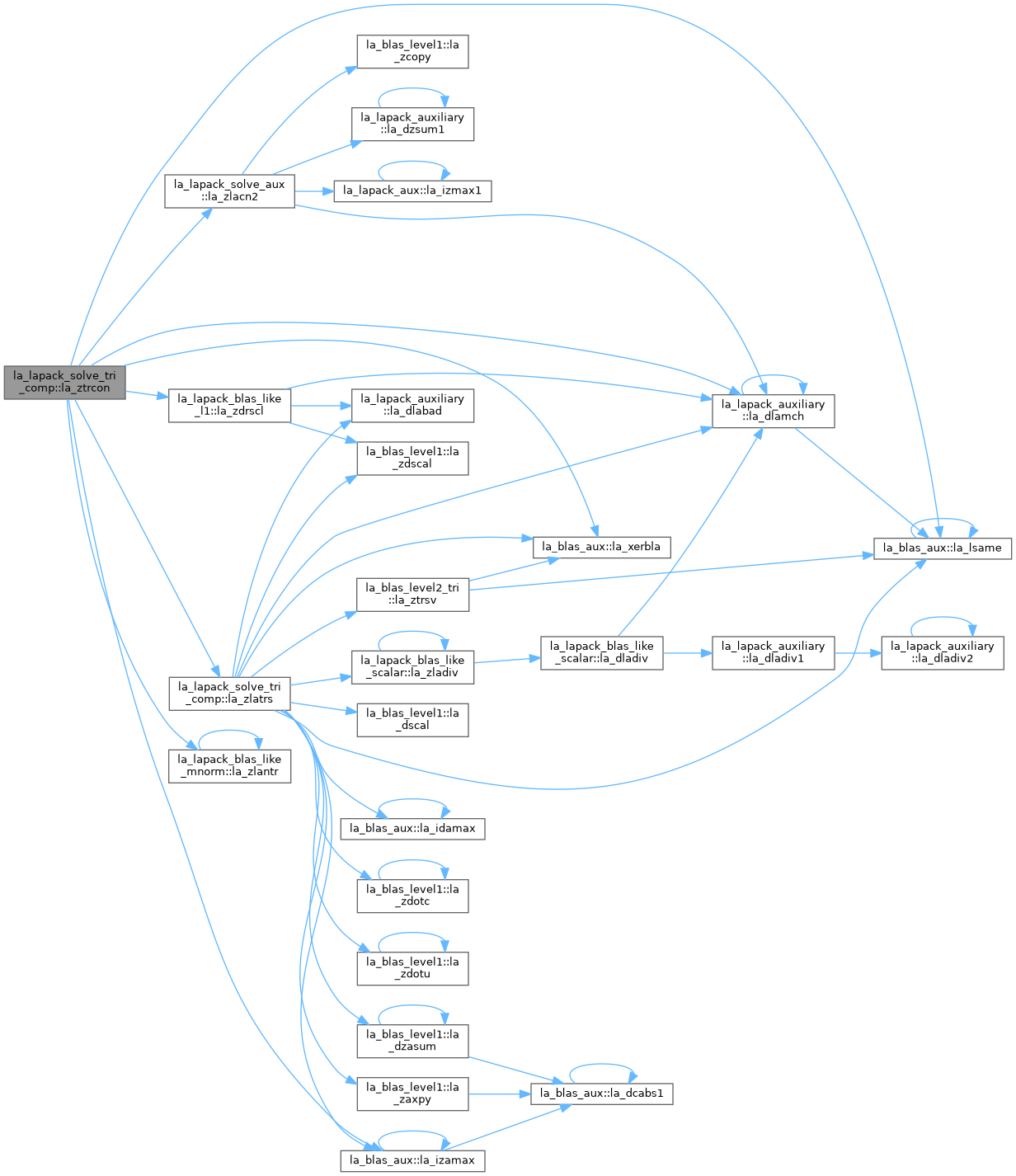
◆ la_ztrrfs()
| pure subroutine, public la_lapack_solve_tri_comp::la_ztrrfs | ( | character, intent(in) | uplo, |
| character, intent(in) | trans, | ||
| character, intent(in) | diag, | ||
| integer(ilp), intent(in) | n, | ||
| integer(ilp), intent(in) | nrhs, | ||
| complex(dp), dimension(lda,*), intent(in) | a, | ||
| integer(ilp), intent(in) | lda, | ||
| complex(dp), dimension(ldb,*), intent(in) | b, | ||
| integer(ilp), intent(in) | ldb, | ||
| complex(dp), dimension(ldx,*), intent(in) | x, | ||
| integer(ilp), intent(in) | ldx, | ||
| real(dp), dimension(*), intent(out) | ferr, | ||
| real(dp), dimension(*), intent(out) | berr, | ||
| complex(dp), dimension(*), intent(out) | work, | ||
| real(dp), dimension(*), intent(out) | rwork, | ||
| integer(ilp), intent(out) | info ) |
ZTRRFS: provides error bounds and backward error estimates for the solution to a system of linear equations with a triangular coefficient matrix. The solution matrix X must be computed by ZTRTRS or some other means before entering this routine. ZTRRFS does not do iterative refinement because doing so cannot improve the backward error.
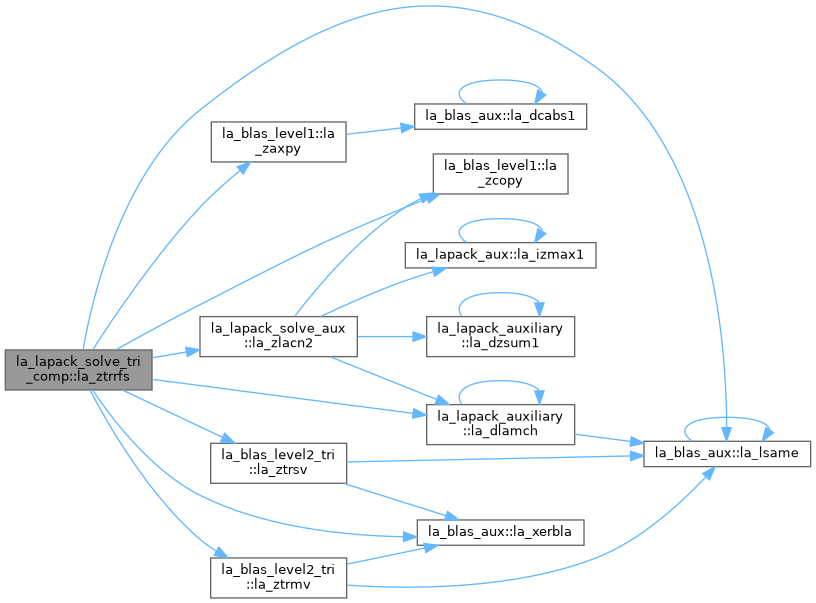
◆ la_ztrti2()
| pure subroutine, public la_lapack_solve_tri_comp::la_ztrti2 | ( | character, intent(in) | uplo, |
| character, intent(in) | diag, | ||
| integer(ilp), intent(in) | n, | ||
| complex(dp), dimension(lda,*), intent(inout) | a, | ||
| integer(ilp), intent(in) | lda, | ||
| integer(ilp), intent(out) | info ) |
ZTRTI2: computes the inverse of a complex upper or lower triangular matrix. This is the Level 2 BLAS version of the algorithm.
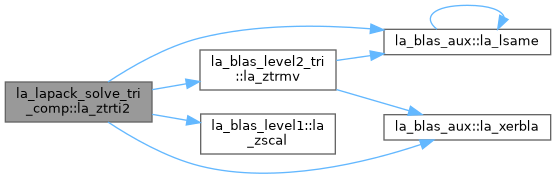
◆ la_ztrtri()
| pure subroutine, public la_lapack_solve_tri_comp::la_ztrtri | ( | character, intent(in) | uplo, |
| character, intent(in) | diag, | ||
| integer(ilp), intent(in) | n, | ||
| complex(dp), dimension(lda,*), intent(inout) | a, | ||
| integer(ilp), intent(in) | lda, | ||
| integer(ilp), intent(out) | info ) |
ZTRTRI: computes the inverse of a complex upper or lower triangular matrix A. This is the Level 3 BLAS version of the algorithm.
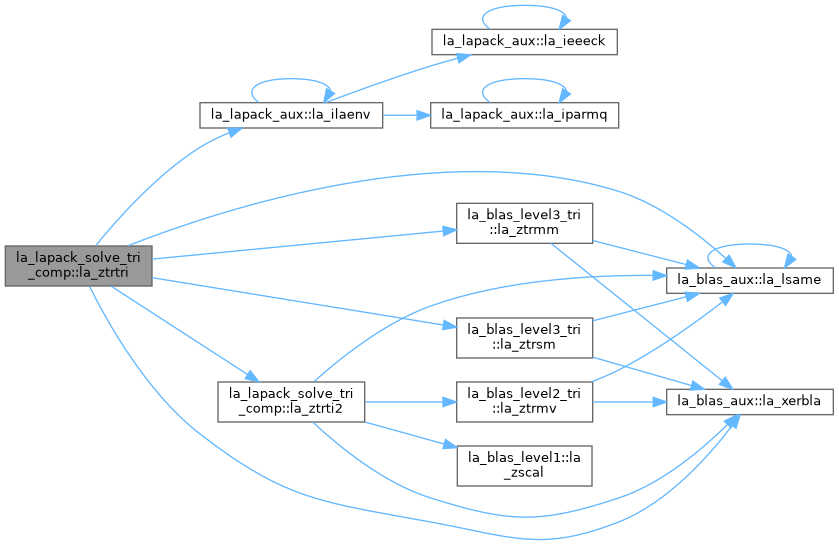
◆ la_ztrtrs()
| pure subroutine, public la_lapack_solve_tri_comp::la_ztrtrs | ( | character, intent(in) | uplo, |
| character, intent(in) | trans, | ||
| character, intent(in) | diag, | ||
| integer(ilp), intent(in) | n, | ||
| integer(ilp), intent(in) | nrhs, | ||
| complex(dp), dimension(lda,*), intent(in) | a, | ||
| integer(ilp), intent(in) | lda, | ||
| complex(dp), dimension(ldb,*), intent(inout) | b, | ||
| integer(ilp), intent(in) | ldb, | ||
| integer(ilp), intent(out) | info ) |
ZTRTRS: solves a triangular system of the form A * X = B, A**T * X = B, or A**H * X = B, where A is a triangular matrix of order N, and B is an N-by-NRHS matrix. A check is made to verify that A is nonsingular.