Generic N-dimensional gridded smoothing-spline fitter. More...
Data Types | |
| type | fitpack_gridded_spline |
| Tensor-product gridded smoothing-spline fitter for any domain dimension. More... | |
Functions/Subroutines | |
| elemental subroutine | grid_destroy (this) |
| Release all allocated storage and reset the fit state. | |
| subroutine | grid_new_points (this, xg, z, m, row_major, order) |
Load new gridded data. z is assumed-rank: a rank-d array (2 <= d <= MAX_IDIM) whose shape gives the per-axis point counts, or a flat rank-1 array with explicit m. | |
| integer(fp_flag) function | grid_new_fit (this, xg, z, m, row_major, order, smoothing) |
| Load new gridded data and perform a fit in one call. | |
| integer(fp_flag) function | grid_fit_automatic_knots (this, smoothing, order) |
| Fit a smoothing spline with automatic knot placement (delegates to regrid). | |
| integer(fp_flag) function | grid_fit_least_squares (this, smoothing, reset_knots) |
| Least-squares fit on the current knots (optionally recomputing them first). | |
| integer(fp_flag) function | grid_fit_interpolating (this) |
| Interpolating fit (s = 0). | |
| real(fp_real) function, dimension(product(m)) | grid_eval_ongrid (this, xg, m, ierr) |
| Evaluate the fitted spline on a rectangular grid (delegates to ndspev). | |
| real(fp_real) function, dimension(size(xp, 2)) | grid_eval_many (this, xp, ierr) |
| Evaluate the fitted spline at scattered points (delegates to ndspeu). | |
| real(fp_real) function | grid_eval_one (this, x, ierr) |
Evaluate the fitted spline at a single point x(1:dims). | |
| real(fp_real) function, dimension(product(m)) | grid_derivatives_gridded (this, xg, m, nu, ierr) |
Evaluate partial derivatives of order nu(:) on a rectangular grid (delegates to parder). | |
| real(fp_real) function, dimension(size(xp, 2)) | grid_derivatives_many (this, xp, nu, ierr) |
Evaluate partial derivatives of order nu(:) at scattered points (delegates to pardeu). | |
| real(fp_real) function | grid_derivatives_one (this, x, nu, ierr) |
Evaluate a partial derivative of order nu(:) at a single point x(1:dims). | |
| real(fp_real) function | grid_integral (this, lower, upper) |
Integral of the fitted spline over the box [lower(d),upper(d)] (delegates to dblint). | |
| type(fitpack_gridded_spline) function | grid_cross_section (this, ax, u, ierr) |
Cross-section: fix axis ax at value u, returning the (dims-1)-D spline \( s|_{x_{ax}=u} \). | |
| type(fitpack_gridded_spline) function | grid_derivative_spline (this, nu, ierr) |
Partial-derivative spline of order nu(:): a new gridded spline of per-axis degrees order-nu on trimmed knots (delegates to pardtc). Eval-only, like cross_section. | |
| subroutine | grid_prepare_workspace (this) |
| (Re)size the persistent workspace, maximally, so it is allocated only once, at spline construction. Covers both regrid's fit requirement (mirroring its internal lwest/kwest) and the peripheral evaluations (ndspev/parder/pardeu on grids up to the data-grid size), which carve their scratch past regrid's persistent iopt=1 state in wrk(1:2+dims)/ iwrk(1:1+dims). Grows the arrays only when needed so a continuation keeps that state. | |
| subroutine | grid_ensure_eval_workspace (this, maxm) |
Ensure the persistent workspace covers a peripheral evaluation with per-axis grids of up to maxm points. grid_prepare_workspace already sized it for grids up to the data grid, so this only grows the arrays for finer evaluation grids; contents are preserved so regrid's iopt=1 state in wrk(1:2+dims)/iwrk(1:1+dims) survives the growth. | |
| pure subroutine | ranked_sizes (shp, row_major, dims, m) |
Map a rank-d array shape to per-axis domain sizes, honouring the row_major flag. row_major=.true.: axes are reversed (z(m_d,...,m_1)); .false.: natural (z(m_1,...,m_d)). | |
| pure real(fp_real) function, dimension(size(zc)) | flat_row_major (zc, shp, row_major) |
| Return the flat row-major (axis-1-slowest) value buffer from a column-major flatten. row_major=.true.: the input already IS row-major, copy as-is. row_major=.false.: the input is a natural Fortran grid z(m_1,...,m_d); permute (reverse axes) into row-major. | |
| elemental integer(fp_size) function | grid_comm_size (this) |
| Communication buffer size: base fields + fixed metadata (1 + 6*MAX_IDIM) + bulk arrays. | |
| pure subroutine | grid_comm_pack (this, buffer) |
| Pack the fitter into a communication buffer. | |
| pure subroutine | grid_comm_expand (this, buffer) |
| Expand the fitter from a communication buffer. | |
Detailed Description
Generic N-dimensional gridded smoothing-spline fitter.
fitpack_gridded_spline fits a tensor-product B-spline \( s(x_1,\ldots,x_d) \) to data on a rectangular grid of arbitrary domain dimension dims (the 3D+ analogue of the concrete 2-D fitpack_grid_surface). One runtime-dims type holds a fit of any dimensionality up to MAX_IDIM; the guts marshal onto the dimension-generic core routines regrid (fit) and ndspev (grid evaluation).
CANONICAL DATA LAYOUT. Internally the function values live in a flat, row-major buffer with domain axis 1 the slowest-varying and axis dims the fastest — exactly the contract of regrid. The rank-natural entry points accept an assumed-rank array and an optional row_major flag:
row_major = .true.(default): the array's Fortran (column-major) storage already equals the internal buffer, so it is copied as-is. For a rank-darray that means passing the axes in reverse,z(m_d, ..., m_1)— the direct generalization of the 2-Dz(iy,ix)convention.row_major = .false.: the array is a natural Fortran gridz(m_1, ..., m_d)(dimensionkis domain axisk); it is permuted into the row-major buffer on ingest (a one-time copy). A flat rank-1z(:)plus explicitm(:)is always accepted (row-major, unambiguous).
Function/Subroutine Documentation
◆ flat_row_major()
|
private |
Return the flat row-major (axis-1-slowest) value buffer from a column-major flatten. row_major=.true.: the input already IS row-major, copy as-is. row_major=.false.: the input is a natural Fortran grid z(m_1,...,m_d); permute (reverse axes) into row-major.
◆ grid_comm_expand()
|
private |
Expand the fitter from a communication buffer.
◆ grid_comm_pack()
|
private |
Pack the fitter into a communication buffer.
◆ grid_comm_size()
|
private |
Communication buffer size: base fields + fixed metadata (1 + 6*MAX_IDIM) + bulk arrays.
◆ grid_cross_section()
|
private |
Cross-section: fix axis ax at value u, returning the (dims-1)-D spline \( s|_{x_{ax}=u} \).
The result is a fully-formed, evaluable fitpack_gridded_spline over the surviving axes (in their original relative order). Like the 2-D cross_section it carries only the spline (knots/degrees/ coefficients/bounds), not a data grid, so it is eval-only.
- Parameters
-
[in] ax Axis to fix, 1 <= ax <= dims(requiresdims >= 2).[in] u Value at which axis axis fixed.[out] ierr Optional error flag.

◆ grid_derivative_spline()
|
private |
Partial-derivative spline of order nu(:): a new gridded spline of per-axis degrees order-nu on trimmed knots (delegates to pardtc). Eval-only, like cross_section.

◆ grid_derivatives_gridded()
|
private |
Evaluate partial derivatives of order nu(:) on a rectangular grid (delegates to parder).
- Parameters
-
[in] xg Per-axis evaluation grids, xg(1:m(d),d)strictly increasing.[in] m Per-axis grid sizes. [in] nu Per-axis derivative orders, 0 <= nu(d) < order(d).[out] ierr Optional error flag.
- Returns
- f Flat row-major derivative values, length
product(m).

◆ grid_derivatives_many()
|
private |
Evaluate partial derivatives of order nu(:) at scattered points (delegates to pardeu).
- Parameters
-
[in] xp Point coordinates, xp(d,i)= axis-dcoordinate of pointi(shape(dims,m), pointi= contiguous columnxp(:,i)).

◆ grid_derivatives_one()
|
private |
Evaluate a partial derivative of order nu(:) at a single point x(1:dims).

◆ grid_destroy()
| elemental subroutine fitpack_gridded_splines::grid_destroy | ( | class(fitpack_gridded_spline), intent(inout) | this | ) |
Release all allocated storage and reset the fit state.
◆ grid_ensure_eval_workspace()
|
private |
Ensure the persistent workspace covers a peripheral evaluation with per-axis grids of up to maxm points. grid_prepare_workspace already sized it for grids up to the data grid, so this only grows the arrays for finer evaluation grids; contents are preserved so regrid's iopt=1 state in wrk(1:2+dims)/iwrk(1:1+dims) survives the growth.
◆ grid_eval_many()
|
private |
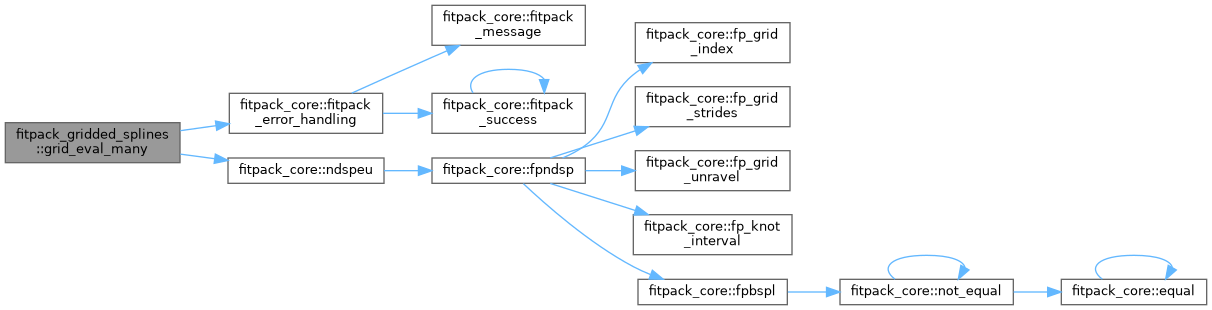
Evaluate the fitted spline at scattered points (delegates to ndspeu).
- Parameters
-
[in] xp Point coordinates, xp(d,i)= axis-dcoordinate of pointi(shape(dims,m), pointi= contiguous columnxp(:,i); matches curev/parcur layout).[out] ierr Optional error flag.
- Returns
- f Spline values at the
mpoints.
◆ grid_eval_one()
|
private |
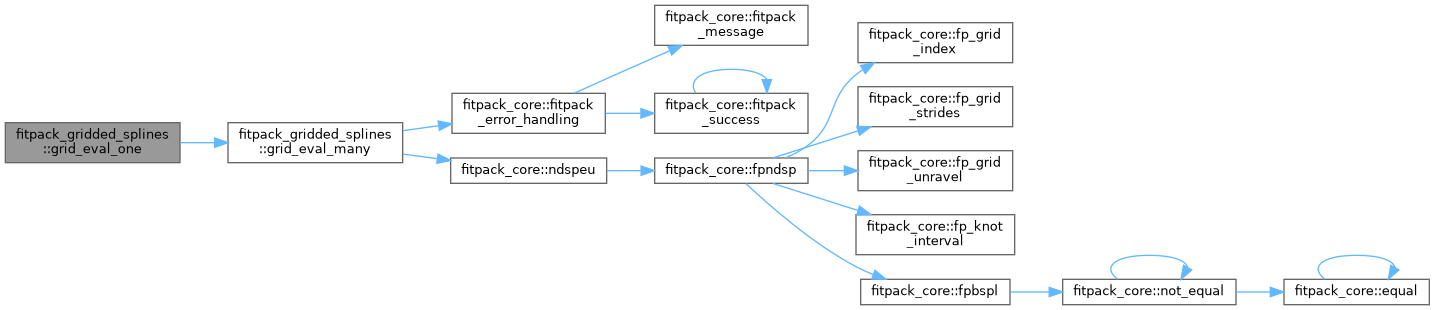
Evaluate the fitted spline at a single point x(1:dims).
◆ grid_eval_ongrid()
|
private |
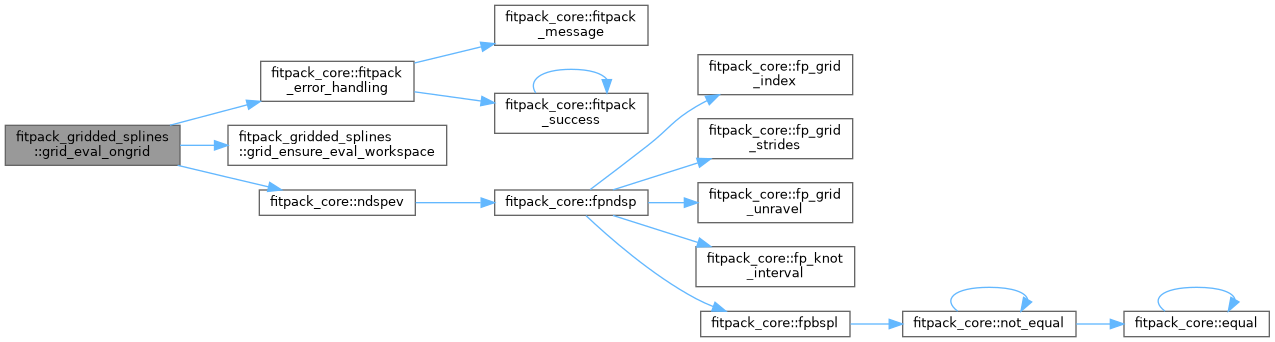
Evaluate the fitted spline on a rectangular grid (delegates to ndspev).
- Parameters
-
[in] xg Evaluation coordinates, xg(1:m(d),d)strictly increasing on axisd.[in] m Per-axis evaluation-grid sizes. [out] ierr Optional error flag.
- Returns
- zeval Flat, row-major (axis 1 slowest) evaluated values, length
product(m).
◆ grid_fit_automatic_knots()
|
private |
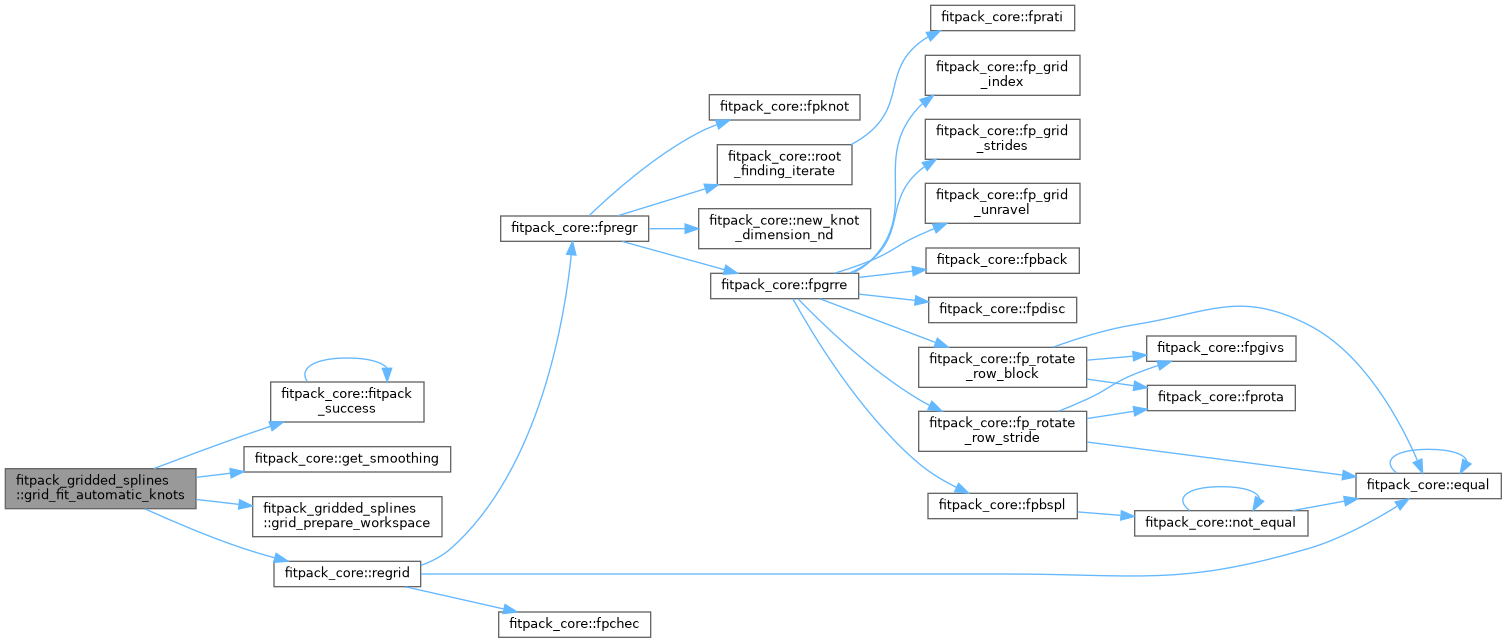
Fit a smoothing spline with automatic knot placement (delegates to regrid).
◆ grid_fit_interpolating()
|
private |
Interpolating fit (s = 0).
◆ grid_fit_least_squares()
|
private |
Least-squares fit on the current knots (optionally recomputing them first).

◆ grid_integral()
|
private |
Integral of the fitted spline over the box [lower(d),upper(d)] (delegates to dblint).
◆ grid_new_fit()
|
private |
Load new gridded data and perform a fit in one call.
◆ grid_new_points()
|
private |
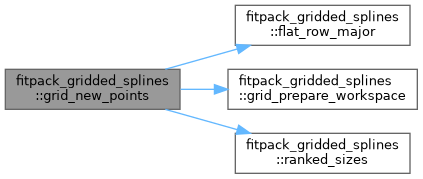
Load new gridded data. z is assumed-rank: a rank-d array (2 <= d <= MAX_IDIM) whose shape gives the per-axis point counts, or a flat rank-1 array with explicit m.
- Parameters
-
[in] xg Grid coordinates, xg(1:m(d),d)strictly increasing on axisd.[in] z Function values (see the module header for the layout conventions). [in] m Per-axis point counts; REQUIRED when zis rank-1, ignored otherwise.[in] row_major Layout of a rank- dz(default .true.); see the module header.[in] order Optional per-axis spline degree (scalar, applied to all axes).
◆ grid_prepare_workspace()
|
private |
(Re)size the persistent workspace, maximally, so it is allocated only once, at spline construction. Covers both regrid's fit requirement (mirroring its internal lwest/kwest) and the peripheral evaluations (ndspev/parder/pardeu on grids up to the data-grid size), which carve their scratch past regrid's persistent iopt=1 state in wrk(1:2+dims)/ iwrk(1:1+dims). Grows the arrays only when needed so a continuation keeps that state.
◆ ranked_sizes()
|
private |
Map a rank-d array shape to per-axis domain sizes, honouring the row_major flag. row_major=.true.: axes are reversed (z(m_d,...,m_1)); .false.: natural (z(m_1,...,m_d)).