OOP wrapper for bivariate spline fitting on scattered polar domains. More...
Data Types | |
| interface | fitpack_polar |
| Bicubic spline fitter for data scattered over a general polar domain. More... | |
Functions/Subroutines | |
| integer function | surface_fit_least_squares (this, smoothing, reset_knots) |
| Fit a least-squares polar surface with fixed knots. | |
| integer function | surface_fit_interpolating (this, reset_knots) |
| Fit an interpolating polar surface ( \( s = 0 \)). | |
| integer function | surface_fit_automatic_knots (this, smoothing, keep_knots) |
| Fit a smoothing polar surface with automatic knot placement. | |
| elemental subroutine | polar_destroy (this) |
| Destroy a polar surface object and release all allocated memory. | |
| subroutine | polar_new_points (this, x, y, z, boundary, w, boundary_bc) |
| Load new scattered data and a boundary function for polar fitting. | |
| type(fitpack_polar) function | polr_new_from_points (x, y, z, boundary, w, boundary_bc, ierr) |
| Construct a polar surface from scattered data and perform a default fit. | |
| real(fp_real) function | polr_eval_one (this, x, y, ierr) |
| Evaluate the polar surface at a single Cartesian \( (x, y) \) point. | |
| real(fp_real) function, dimension(size(x)) | polr_eval_many (this, x, y, ierr) |
| Evaluate the polar surface at multiple Cartesian points. | |
| integer function | polr_new_fit (this, x, y, z, boundary, w, boundary_bc, smoothing) |
| Load new data and perform a fresh polar surface fit. | |
| elemental integer(fp_size) function | polar_comm_size (this) |
| Return the communication buffer size for the polar surface. | |
| pure subroutine | polar_comm_pack (this, buffer) |
| Pack polar surface data into a communication buffer. | |
| pure subroutine | polar_comm_expand (this, buffer) |
| Expand polar surface data from a communication buffer. | |
Detailed Description
OOP wrapper for bivariate spline fitting on scattered polar domains.
Provides fitpack_polar, a derived type for fitting bicubic splines to data scattered over a general polar domain \( x^2 + y^2 \leq r(\theta)^2 \), where \( r(\theta) \) is a user-supplied boundary function. The Cartesian coordinates are transformed to normalized polar coordinates:
\[ x = u \, r(v) \cos v, \quad y = u \, r(v) \sin v, \quad 0 \leq u \leq 1, \ -\pi \leq v \leq \pi \]
and a bicubic spline \( s(u, v) \) is fitted with appropriate continuity constraints at the origin.
- See also
- Dierckx, Ch. 11, §11.1 (pp. 255–263); polar
Function/Subroutine Documentation
◆ polar_comm_expand()
|
private |
Expand polar surface data from a communication buffer.
◆ polar_comm_pack()
|
private |
Pack polar surface data into a communication buffer.
◆ polar_comm_size()
|
private |
Return the communication buffer size for the polar surface.
◆ polar_destroy()
|
private |
Destroy a polar surface object and release all allocated memory.
◆ polar_new_points()
|
private |
Load new scattered data and a boundary function for polar fitting.
- Parameters
-
[in,out] this The polar surface (destroyed and reinitialized). [in] x Cartesian x coordinates. [in] y Cartesian y coordinates, same size as x.[in] z Function values, same size as x.[in] boundary Boundary function \( r(\theta) \) defining the polar domain. [in] w Optional positive weights. [in] boundary_bc Optional boundary extrapolation flag.
- See also
- polar
◆ polr_eval_many()
|
private |
Evaluate the polar surface at multiple Cartesian points.
- See also
- evapol

◆ polr_eval_one()
|
private |
Evaluate the polar surface at a single Cartesian \( (x, y) \) point.
Internally transforms to normalized polar coordinates before evaluation.
- See also
- evapol
◆ polr_new_fit()
|
private |
Load new data and perform a fresh polar surface fit.
- See also
- polar
◆ polr_new_from_points()
|
private |
Construct a polar surface from scattered data and perform a default fit.
- See also
- polar
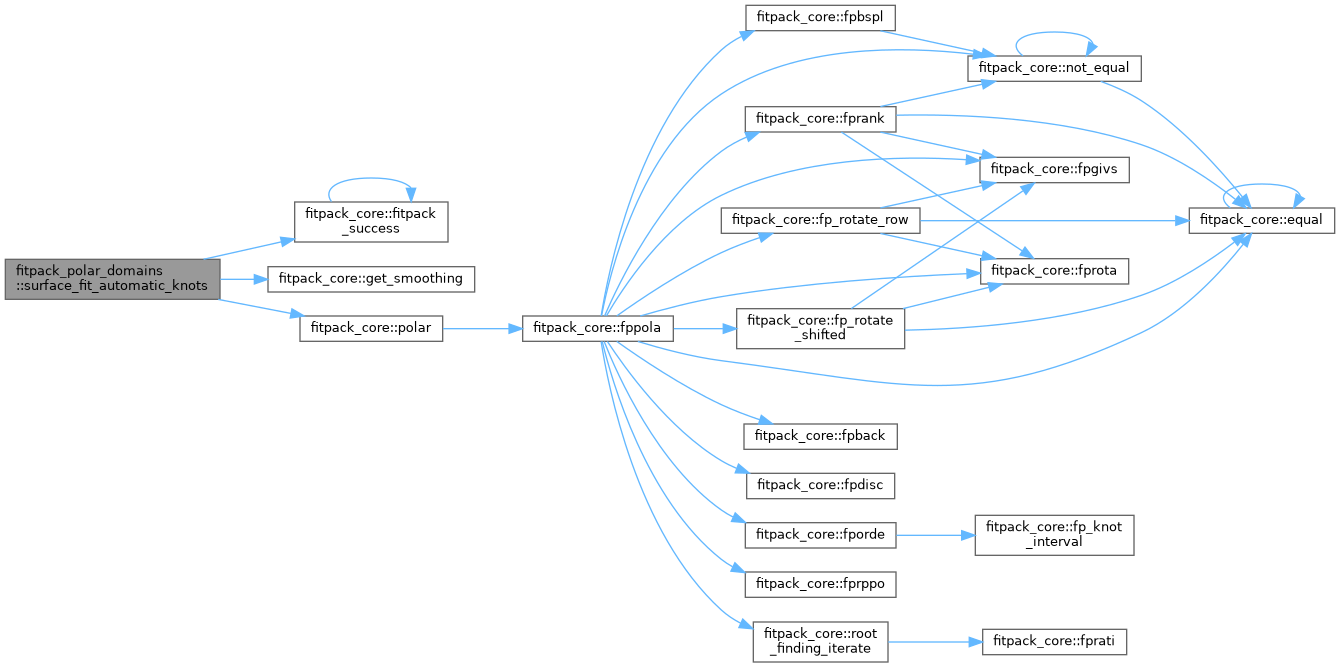
◆ surface_fit_automatic_knots()
|
private |
Fit a smoothing polar surface with automatic knot placement.
The fitting uses normalized polar coordinates \( (u, v) \) with a user-supplied boundary function \( r(\theta) \). Continuity at the origin is controlled by bc_continuity_origin.
- See also
- polar
Ensure we start with new knots (unless caller wants to keep them)
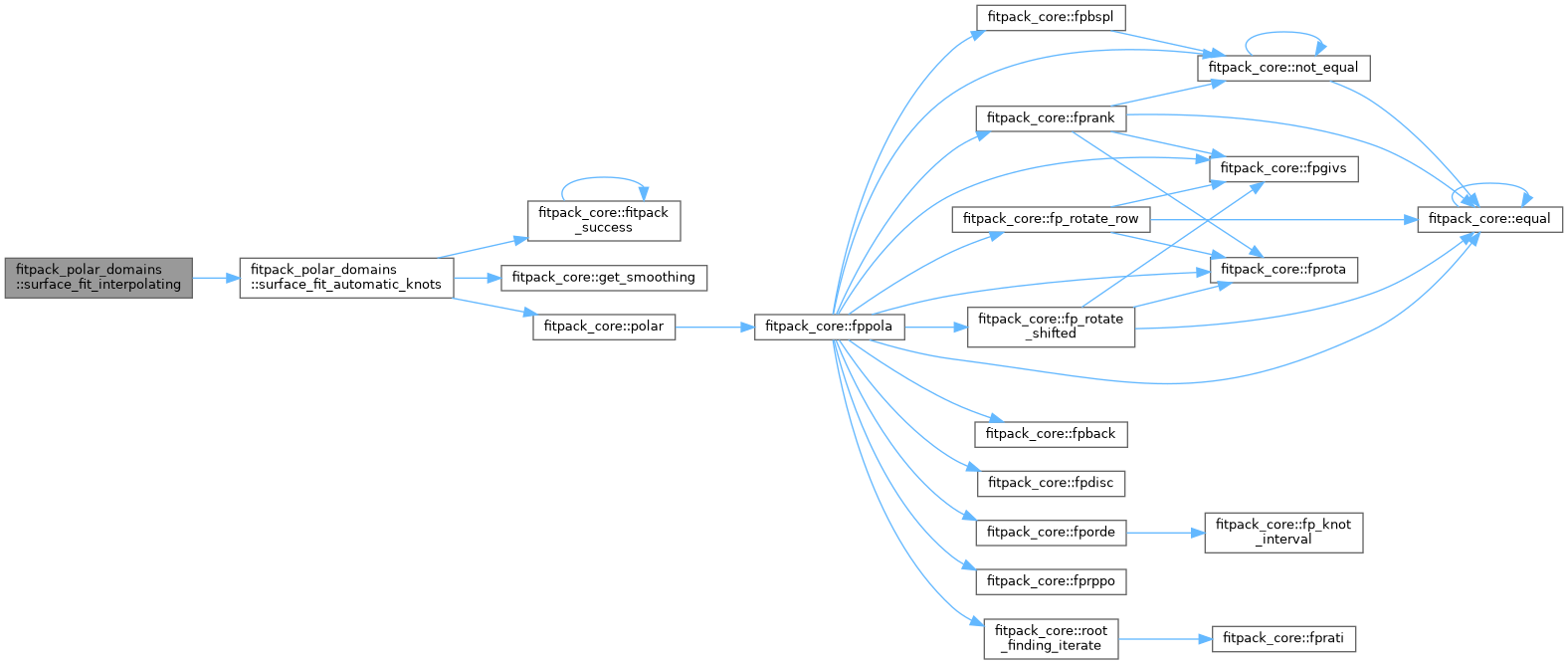
◆ surface_fit_interpolating()
|
private |
Fit an interpolating polar surface ( \( s = 0 \)).
- See also
- polar
◆ surface_fit_least_squares()
|
private |
Fit a least-squares polar surface with fixed knots.
- See also
- polar